Commercial Crew
                  Insight/Oversight Model
                     Recommendations


                      Frank H. Bauer


               Project Management Challenge
                    February 9-10, 2011

www.nasa.gov
Overview

Objective
 Develop an insight/oversight model that will contribute to the
 safe flight and safe return of NASA crew members on
 commercial space vehicles


Co-Leads
 Wayne Hale/DAA SOMD-Strategic Partnerships
 Frank Bauer/ESMD Chief Engineer


                                                                  2
Approach

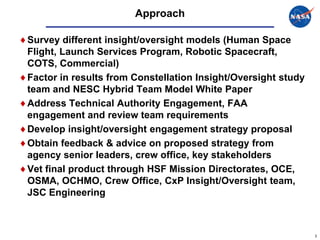
Survey different insight/oversight models (Human Space
Flight, Launch Services Program, Robotic Spacecraft,
COTS, Commercial)
Factor in results from Constellation Insight/Oversight study
team and NESC Hybrid Team Model White Paper
Address Technical Authority Engagement, FAA
engagement and review team requirements
Develop insight/oversight engagement strategy proposal
Obtain feedback & advice on proposed strategy from
agency senior leaders, crew office, key stakeholders
Vet final product through HSF Mission Directorates, OCE,
OSMA, OCHMO, Crew Office, CxP Insight/Oversight team,
JSC Engineering


                                                               3
Insight and Oversight Definitions

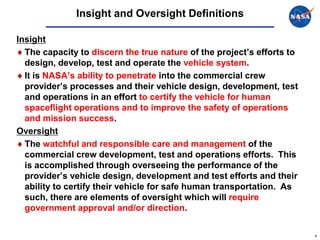
Insight
  The capacity to discern the true nature of the project’s efforts to
  design, develop, test and operate the vehicle system.
  It is NASA’s ability to penetrate into the commercial crew
  provider’s processes and their vehicle design, development, test
  and operations in an effort to certify the vehicle for human
  spaceflight operations and to improve the safety of operations
  and mission success.
Oversight
  The watchful and responsible care and management of the
  commercial crew development, test and operations efforts. This
  is accomplished through overseeing the performance of the
  provider’s vehicle design, development and test efforts and their
  ability to certify their vehicle for safe human transportation. As
  such, there are elements of oversight which will require
  government approval and/or direction.

                                                                        4
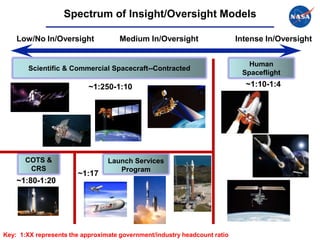
Spectrum of Insight/Oversight Models

    Low/No In/Oversight              Medium In/Oversight                   Intense In/Oversight


                                                                              Human
        Scientific & Commercial Spacecraft--Contracted
                                                                            Spaceflight

                           ~1:250-1:10                                       ~1:10-1:4


       COTS &                    Launch Services
        CRS                         Program
                       ~1:17
    ~1:80-1:20


Key: 1:XX represents the approximate government/industry headcount ratio
Insight and Technical Engagement
                               Overview
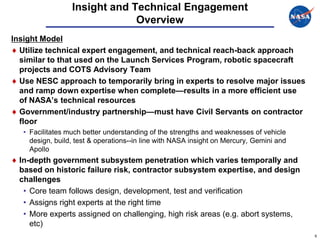
Insight Model
  Utilize technical expert engagement, and technical reach-back approach
  similar to that used on the Launch Services Program, robotic spacecraft
  projects and COTS Advisory Team
  Use NESC approach to temporarily bring in experts to resolve major issues
  and ramp down expertise when complete—results in a more efficient use
  of NASA’s technical resources
  Government/industry partnership—must have Civil Servants on contractor
  floor
   • Facilitates much better understanding of the strengths and weaknesses of vehicle
     design, build, test & operations--in line with NASA insight on Mercury, Gemini and
     Apollo
  In-depth government subsystem penetration which varies temporally and
  based on historic failure risk, contractor subsystem expertise, and design
  challenges
   • Core team follows design, development, test and verification
   • Assigns right experts at the right time
   • More experts assigned on challenging, high risk areas (e.g. abort systems,
     etc)
                                                                                          6
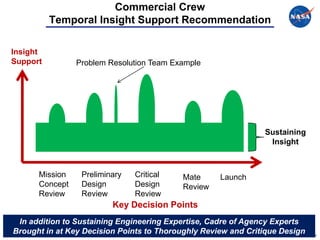
Commercial Crew
          Temporal Insight Support Recommendation

Insight
Support         Problem Resolution Team Example


                                                               Sustaining
                                                                Insight


      Mission    Preliminary   Critical    Mate     Launch
      Concept    Design        Design      Review
      Review     Review        Review
                         Key Decision Points
 In addition to Sustaining Engineering Expertise, Cadre of Agency Experts
Brought in at Key Decision Points to Thoroughly Review and Critique Design   7
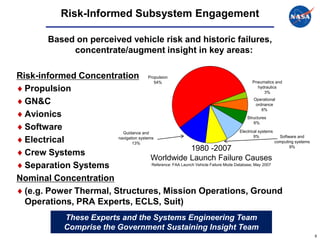
Risk-Informed Subsystem Engagement

             Based on perceived vehicle risk and historic failures,
                  concentrate/augment insight in key areas:

Risk-informed Concentration Propulsion
                                           54%                                                 Pneumatics and
  Propulsion                                                                                      hydraulics
                                                                                                     3%

  GN&C                                                                            
                                                                                               Operational
                                                                                                ordnance
                                                                                                    6%
  Avionics                                                                                 Structures
                                                                                               6%
  Software                                                                             Electrical systems
                          Guidance and
                                                                                               9%            Software and
  Electrical            navigation systems
                               13%                                                                         computing systems
                                                             1980 -2007                                           9%
  Crew Systems
                                         Worldwide Launch Failure Causes
  Separation Systems                     Reference: FAA Launch Vehicle Failure Mode Database, May 2007


Nominal Concentration
  (e.g. Power Thermal, Structures, Mission Operations, Ground
  Operations, PRA Experts, ECLS, Suit)
                    These Experts and the Systems Engineering Team
                    Comprise the Government Sustaining Insight Team
                                                                                                                               8
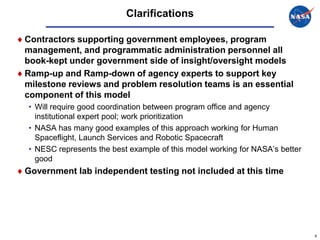
Clarifications

Contractors supporting government employees, program
management, and programmatic administration personnel all
book-kept under government side of insight/oversight models
Ramp-up and Ramp-down of agency experts to support key
milestone reviews and problem resolution teams is an essential
component of this model
• Will require good coordination between program office and agency
  institutional expert pool; work prioritization
• NASA has many good examples of this approach working for Human
  Spaceflight, Launch Services and Robotic Spacecraft
• NESC represents the best example of this model working for NASA’s better
  good
Government lab independent testing not included at this time


                                                                             9
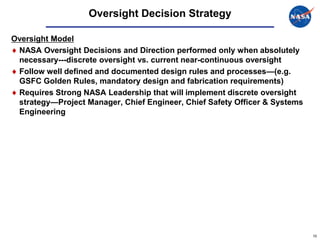
Oversight Decision Strategy

Oversight Model
 NASA Oversight Decisions and Direction performed only when absolutely
 necessary---discrete oversight vs. current near-continuous oversight
 Follow well defined and documented design rules and processes—(e.g.
 GSFC Golden Rules, mandatory design and fabrication requirements)
 Requires Strong NASA Leadership that will implement discrete oversight
 strategy—Project Manager, Chief Engineer, Chief Safety Officer & Systems
 Engineering


                                                                            10
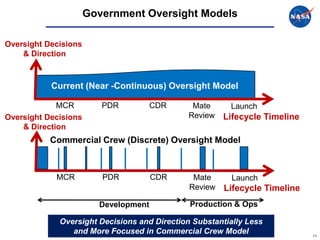
Government Oversight Models

Oversight Decisions
    & Direction


           Current (Near -Continuous) Oversight Model

             MCR         PDR          CDR      Mate     Launch
Oversight Decisions                           Review   Lifecycle Timeline
    & Direction
           Commercial Crew (Discrete) Oversight Model


            MCR          PDR          CDR      Mate      Launch
                                              Review   Lifecycle Timeline
                        Development           Production & Ops

             Oversight Decisions and Direction Substantially Less
                and More Focused in Commercial Crew Model                   11
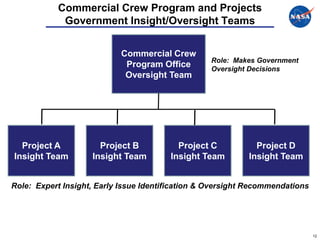
Commercial Crew Program and Projects
            Government Insight/Oversight Teams


                            Commercial Crew
                                                   Role: Makes Government
                             Program Office        Oversight Decisions
                             Oversight Team


  Project A           Project B           Project C           Project D
Insight Team        Insight Team        Insight Team        Insight Team


Role: Expert Insight, Early Issue Identification & Oversight Recommendations


                                                                               12
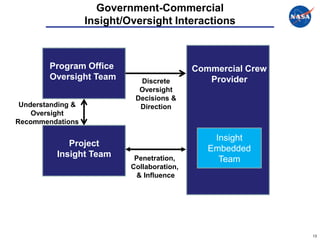
Government-Commercial
                   Insight/Oversight Interactions


        Program Office                       Commercial Crew
        Oversight Team        Discrete          Provider
                              Oversight
                             Decisions &
 Understanding &              Direction
    Oversight
Recommendations

                                                 Insight
             Project
                                                Embedded
          Insight Team       Penetration,         Team
                            Collaboration,
                             & Influence


                                                               13
Technical Authority Engagement

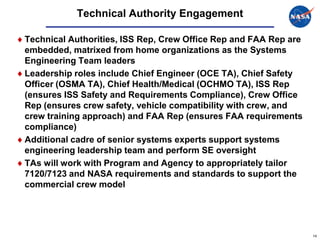
Technical Authorities, ISS Rep, Crew Office Rep and FAA Rep are
embedded, matrixed from home organizations as the Systems
Engineering Team leaders
Leadership roles include Chief Engineer (OCE TA), Chief Safety
Officer (OSMA TA), Chief Health/Medical (OCHMO TA), ISS Rep
(ensures ISS Safety and Requirements Compliance), Crew Office
Rep (ensures crew safety, vehicle compatibility with crew, and
crew training approach) and FAA Rep (ensures FAA requirements
compliance)
Additional cadre of senior systems experts support systems
engineering leadership team and perform SE oversight
TAs will work with Program and Agency to appropriately tailor
7120/7123 and NASA requirements and standards to support the
commercial crew model


                                                                  14
NASA Participation in Major Reviews

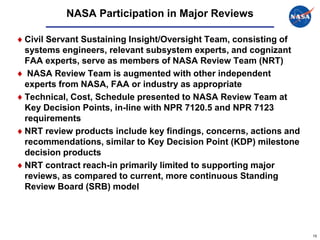
Civil Servant Sustaining Insight/Oversight Team, consisting of
systems engineers, relevant subsystem experts, and cognizant
FAA experts, serve as members of NASA Review Team (NRT)
 NASA Review Team is augmented with other independent
experts from NASA, FAA or industry as appropriate
Technical, Cost, Schedule presented to NASA Review Team at
Key Decision Points, in-line with NPR 7120.5 and NPR 7123
requirements
NRT review products include key findings, concerns, actions and
recommendations, similar to Key Decision Point (KDP) milestone
decision products
NRT contract reach-in primarily limited to supporting major
reviews, as compared to current, more continuous Standing
Review Board (SRB) model


                                                                  15
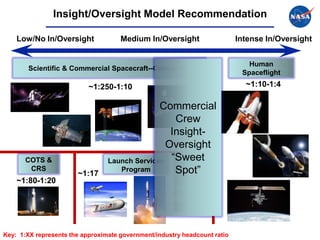
Insight/Oversight Model Recommendation

    Low/No In/Oversight              Medium In/Oversight                   Intense In/Oversight


                                                                              Human
        Scientific & Commercial Spacecraft--Contracted
                                                                            Spaceflight

                           ~1:250-1:10                                       ~1:10-1:4

                                               Commercial
                                                  Crew
                                                 Insight-
                                                Oversight
       COTS &                    Launch Services “Sweet
        CRS
                       ~1:17
                                    Program       Spot”
    ~1:80-1:20


Key: 1:XX represents the approximate government/industry headcount ratio
Summary

Overall Summary
  Examined NASA’s safety and mission reliability role in the commercial
  spaceflight market and explored and recommended an insight/oversight
  model for commercial crew systems
  Provides recommendations for the right balance of civil servant workforce
  insight/oversight that will contribute to the safe flight & return of NASA crew
  members on commercial vehicles
Key Message
  Recommendations represent a Huge Culture Shift in NASA’s development of
  Human Spaceflight Vehicles
  Culture changes require outstanding, effective culture change leadership
  within the commercial crew leadership team to move the agency on the right
  course
  To be successful, team must simultaneously embrace criticality of safe,
  reliable flight and adopt insight/oversight changes necessary to accomplish
  in a commercial crew environment
  Crucial for agency senior leadership to invest time---early and often—to
  guide and mentor the NASA commercial crew teams to be successful in this
  culture change endeavor. Culture change inertia can only be overcome
  through actively engaged senior leadership setting the proper course              17
Backup
Acknowledgements

Ralph Roe/NESC
Alan Lindenmoyer/C3PO
Geoff Yoder/ESMD
Marc Timm/ESMD
Mike Ryschkewitsch/OCE
Bryan O’Connor/OSMA
Engineering Management Board (EMB) and Safety and Mission
Assurance team members
Mark Geyer and Mark Kirasich/Orion Project
Kathy Leuders and Amy Stencil/ISS CRS Project
CxP Insight/Oversight Assessment Subteam


                                                            19
Forward Work

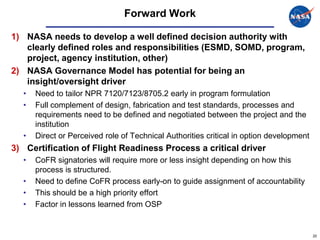
1) NASA needs to develop a well defined decision authority with
   clearly defined roles and responsibilities (ESMD, SOMD, program,
   project, agency institution, other)
2) NASA Governance Model has potential for being an
   insight/oversight driver
  •   Need to tailor NPR 7120/7123/8705.2 early in program formulation
  •   Full complement of design, fabrication and test standards, processes and
      requirements need to be defined and negotiated between the project and the
      institution
  •   Direct or Perceived role of Technical Authorities critical in option development
3) Certification of Flight Readiness Process a critical driver
  •   CoFR signatories will require more or less insight depending on how this
      process is structured.
  •   Need to define CoFR process early-on to guide assignment of accountability
  •   This should be a high priority effort
  •   Factor in lessons learned from OSP


                                                                                         20
Forward Work (Continued)

4) Procurement must be structured to enable badge-less government
   “in-reach” by the insight team and strong financial incentives
   which shift mission success to the provider and their suppliers as
   an accountable deliverable
5) Crucial to identify clear goals, objectives, requirements, and
   vehicle operability (ground and flight operations) constraints early
6) Once the vendor is selected, the early identification of risks (cost,
   schedule, technical, safety) will drive oversight model FTE
   requirements
7) Development, prior to provider selection, of a compiled list of pre-
   declared independent analyses to be performed by the insight
   team and test verifications that will be reviewed by the insight
   team.


                                                                           21

Bauer.frank

  • 1.
    Commercial Crew Insight/Oversight Model Recommendations Frank H. Bauer Project Management Challenge February 9-10, 2011 www.nasa.gov
  • 2.
    Overview Objective Develop aninsight/oversight model that will contribute to the safe flight and safe return of NASA crew members on commercial space vehicles Co-Leads Wayne Hale/DAA SOMD-Strategic Partnerships Frank Bauer/ESMD Chief Engineer 2
  • 3.
    Approach Survey different insight/oversightmodels (Human Space Flight, Launch Services Program, Robotic Spacecraft, COTS, Commercial) Factor in results from Constellation Insight/Oversight study team and NESC Hybrid Team Model White Paper Address Technical Authority Engagement, FAA engagement and review team requirements Develop insight/oversight engagement strategy proposal Obtain feedback & advice on proposed strategy from agency senior leaders, crew office, key stakeholders Vet final product through HSF Mission Directorates, OCE, OSMA, OCHMO, Crew Office, CxP Insight/Oversight team, JSC Engineering 3
  • 4.
    Insight and OversightDefinitions Insight The capacity to discern the true nature of the project’s efforts to design, develop, test and operate the vehicle system. It is NASA’s ability to penetrate into the commercial crew provider’s processes and their vehicle design, development, test and operations in an effort to certify the vehicle for human spaceflight operations and to improve the safety of operations and mission success. Oversight The watchful and responsible care and management of the commercial crew development, test and operations efforts. This is accomplished through overseeing the performance of the provider’s vehicle design, development and test efforts and their ability to certify their vehicle for safe human transportation. As such, there are elements of oversight which will require government approval and/or direction. 4
  • 5.
    Spectrum of Insight/OversightModels Low/No In/Oversight Medium In/Oversight Intense In/Oversight Human Scientific & Commercial Spacecraft--Contracted Spaceflight ~1:250-1:10 ~1:10-1:4 COTS & Launch Services CRS Program ~1:17 ~1:80-1:20 Key: 1:XX represents the approximate government/industry headcount ratio
  • 6.
    Insight and TechnicalEngagement Overview Insight Model Utilize technical expert engagement, and technical reach-back approach similar to that used on the Launch Services Program, robotic spacecraft projects and COTS Advisory Team Use NESC approach to temporarily bring in experts to resolve major issues and ramp down expertise when complete—results in a more efficient use of NASA’s technical resources Government/industry partnership—must have Civil Servants on contractor floor • Facilitates much better understanding of the strengths and weaknesses of vehicle design, build, test & operations--in line with NASA insight on Mercury, Gemini and Apollo In-depth government subsystem penetration which varies temporally and based on historic failure risk, contractor subsystem expertise, and design challenges • Core team follows design, development, test and verification • Assigns right experts at the right time • More experts assigned on challenging, high risk areas (e.g. abort systems, etc) 6
  • 7.
    Commercial Crew Temporal Insight Support Recommendation Insight Support Problem Resolution Team Example Sustaining Insight Mission Preliminary Critical Mate Launch Concept Design Design Review Review Review Review Key Decision Points In addition to Sustaining Engineering Expertise, Cadre of Agency Experts Brought in at Key Decision Points to Thoroughly Review and Critique Design 7
  • 8.
    Risk-Informed Subsystem Engagement Based on perceived vehicle risk and historic failures, concentrate/augment insight in key areas: Risk-informed Concentration Propulsion 54% Pneumatics and Propulsion hydraulics 3% GN&C Operational ordnance 6% Avionics Structures 6% Software Electrical systems Guidance and 9% Software and Electrical navigation systems 13% computing systems 1980 -2007 9% Crew Systems Worldwide Launch Failure Causes Separation Systems Reference: FAA Launch Vehicle Failure Mode Database, May 2007 Nominal Concentration (e.g. Power Thermal, Structures, Mission Operations, Ground Operations, PRA Experts, ECLS, Suit) These Experts and the Systems Engineering Team Comprise the Government Sustaining Insight Team 8
  • 9.
    Clarifications Contractors supporting governmentemployees, program management, and programmatic administration personnel all book-kept under government side of insight/oversight models Ramp-up and Ramp-down of agency experts to support key milestone reviews and problem resolution teams is an essential component of this model • Will require good coordination between program office and agency institutional expert pool; work prioritization • NASA has many good examples of this approach working for Human Spaceflight, Launch Services and Robotic Spacecraft • NESC represents the best example of this model working for NASA’s better good Government lab independent testing not included at this time 9
  • 10.
    Oversight Decision Strategy OversightModel NASA Oversight Decisions and Direction performed only when absolutely necessary---discrete oversight vs. current near-continuous oversight Follow well defined and documented design rules and processes—(e.g. GSFC Golden Rules, mandatory design and fabrication requirements) Requires Strong NASA Leadership that will implement discrete oversight strategy—Project Manager, Chief Engineer, Chief Safety Officer & Systems Engineering 10
  • 11.
    Government Oversight Models OversightDecisions & Direction Current (Near -Continuous) Oversight Model MCR PDR CDR Mate Launch Oversight Decisions Review Lifecycle Timeline & Direction Commercial Crew (Discrete) Oversight Model MCR PDR CDR Mate Launch Review Lifecycle Timeline Development Production & Ops Oversight Decisions and Direction Substantially Less and More Focused in Commercial Crew Model 11
  • 12.
    Commercial Crew Programand Projects Government Insight/Oversight Teams Commercial Crew Role: Makes Government Program Office Oversight Decisions Oversight Team Project A Project B Project C Project D Insight Team Insight Team Insight Team Insight Team Role: Expert Insight, Early Issue Identification & Oversight Recommendations 12
  • 13.
    Government-Commercial Insight/Oversight Interactions Program Office Commercial Crew Oversight Team Discrete Provider Oversight Decisions & Understanding & Direction Oversight Recommendations Insight Project Embedded Insight Team Penetration, Team Collaboration, & Influence 13
  • 14.
    Technical Authority Engagement TechnicalAuthorities, ISS Rep, Crew Office Rep and FAA Rep are embedded, matrixed from home organizations as the Systems Engineering Team leaders Leadership roles include Chief Engineer (OCE TA), Chief Safety Officer (OSMA TA), Chief Health/Medical (OCHMO TA), ISS Rep (ensures ISS Safety and Requirements Compliance), Crew Office Rep (ensures crew safety, vehicle compatibility with crew, and crew training approach) and FAA Rep (ensures FAA requirements compliance) Additional cadre of senior systems experts support systems engineering leadership team and perform SE oversight TAs will work with Program and Agency to appropriately tailor 7120/7123 and NASA requirements and standards to support the commercial crew model 14
  • 15.
    NASA Participation inMajor Reviews Civil Servant Sustaining Insight/Oversight Team, consisting of systems engineers, relevant subsystem experts, and cognizant FAA experts, serve as members of NASA Review Team (NRT) NASA Review Team is augmented with other independent experts from NASA, FAA or industry as appropriate Technical, Cost, Schedule presented to NASA Review Team at Key Decision Points, in-line with NPR 7120.5 and NPR 7123 requirements NRT review products include key findings, concerns, actions and recommendations, similar to Key Decision Point (KDP) milestone decision products NRT contract reach-in primarily limited to supporting major reviews, as compared to current, more continuous Standing Review Board (SRB) model 15
  • 16.
    Insight/Oversight Model Recommendation Low/No In/Oversight Medium In/Oversight Intense In/Oversight Human Scientific & Commercial Spacecraft--Contracted Spaceflight ~1:250-1:10 ~1:10-1:4 Commercial Crew Insight- Oversight COTS & Launch Services “Sweet CRS ~1:17 Program Spot” ~1:80-1:20 Key: 1:XX represents the approximate government/industry headcount ratio
  • 17.
    Summary Overall Summary Examined NASA’s safety and mission reliability role in the commercial spaceflight market and explored and recommended an insight/oversight model for commercial crew systems Provides recommendations for the right balance of civil servant workforce insight/oversight that will contribute to the safe flight & return of NASA crew members on commercial vehicles Key Message Recommendations represent a Huge Culture Shift in NASA’s development of Human Spaceflight Vehicles Culture changes require outstanding, effective culture change leadership within the commercial crew leadership team to move the agency on the right course To be successful, team must simultaneously embrace criticality of safe, reliable flight and adopt insight/oversight changes necessary to accomplish in a commercial crew environment Crucial for agency senior leadership to invest time---early and often—to guide and mentor the NASA commercial crew teams to be successful in this culture change endeavor. Culture change inertia can only be overcome through actively engaged senior leadership setting the proper course 17
  • 18.
  • 19.
    Acknowledgements Ralph Roe/NESC Alan Lindenmoyer/C3PO GeoffYoder/ESMD Marc Timm/ESMD Mike Ryschkewitsch/OCE Bryan O’Connor/OSMA Engineering Management Board (EMB) and Safety and Mission Assurance team members Mark Geyer and Mark Kirasich/Orion Project Kathy Leuders and Amy Stencil/ISS CRS Project CxP Insight/Oversight Assessment Subteam 19
  • 20.
    Forward Work 1) NASAneeds to develop a well defined decision authority with clearly defined roles and responsibilities (ESMD, SOMD, program, project, agency institution, other) 2) NASA Governance Model has potential for being an insight/oversight driver • Need to tailor NPR 7120/7123/8705.2 early in program formulation • Full complement of design, fabrication and test standards, processes and requirements need to be defined and negotiated between the project and the institution • Direct or Perceived role of Technical Authorities critical in option development 3) Certification of Flight Readiness Process a critical driver • CoFR signatories will require more or less insight depending on how this process is structured. • Need to define CoFR process early-on to guide assignment of accountability • This should be a high priority effort • Factor in lessons learned from OSP 20
  • 21.
    Forward Work (Continued) 4)Procurement must be structured to enable badge-less government “in-reach” by the insight team and strong financial incentives which shift mission success to the provider and their suppliers as an accountable deliverable 5) Crucial to identify clear goals, objectives, requirements, and vehicle operability (ground and flight operations) constraints early 6) Once the vendor is selected, the early identification of risks (cost, schedule, technical, safety) will drive oversight model FTE requirements 7) Development, prior to provider selection, of a compiled list of pre- declared independent analyses to be performed by the insight team and test verifications that will be reviewed by the insight team. 21