LECTURE 4 2.2 Crosses that deviate from the  Mendelian  inheritance. 2.2.1  Codominant  allele 2.2.2  Incomplete dominant allele 2.2.3  Multiple alleles   2.2.4  Polygenes/polygenic inheritance
OBJECTIVES At the end of the lesson, students should be able to : Explain codominant alleles. Calculate the genotypic and phenotypic ratio (1:2:1). Explain incomplete dominant alleles. Calculate the genotypic and phenotypic ratio (1:2:1). Explain multiple alleles Explain polygenes/polygenic inheritance
Codominant  allele both alleles of a pair are fully expressed in a heterozygous form Eg : The existence of three different human blood groups called the M,N and MN blood groups. Another example is ABO human blood group. Genotypic ratio 1:2:1
ABO Blood Group I O I O  /  ii O I A I B AB I B I B  ,  I B I O B I A I A  ,   I A I O A Genotype Phenotype (Blood   group )
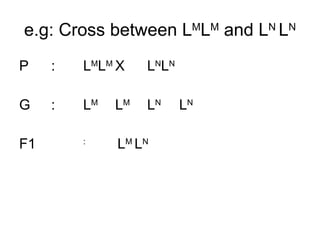
e.g: Cross between L M L M  and L N  L N P : L M L M X L N L N G : L M L M L N L N F1 :   L M  L N
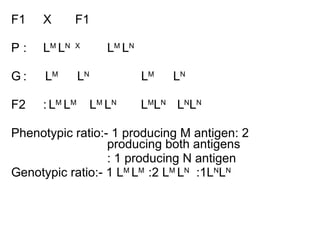
F1 X F1 P : L M  L N X L M  L N G :   L M   L N   L M    L N F2 :   L M  L M  L M  L N   L M L N   L N L N Phenotypic ratio:- 1 producing M antigen: 2  producing both antigens : 1 producing N antigen Genotypic ratio:- 1 L M  L M  :2 L M  L N   :1L N L N
Different from Mendel’s law because the phenotypic ratio is 1:2:1 in F 2  generation instead of 3:1.
Incomplete Dominant Allele One allele is  not fully dominant  over its partner, so in the heterozygous condition, the total product is  intermediate  between that of the dominant and  recessive alleles. Eg :color of snapdragon flower  Antirrhinum . Heterozygotes for color alleles have  pink  colors in contrast to  red  ( dominant  homozygotes) and  white (recessive heterozygotes).  The phenotypic ratio for the monohybrid cross then becomes 1:2:1 instead  of 3:1. (for F2)
 
Incomplete dominance in snapdragons
Summary of dominance relationships
Multiple Alleles When  more than two  different forms of alleles, they are referred to as  multiple  alleles . Eg :  ABO blood type alleles in  humans. There are 4 blood types :  A, B, AB and O.   The ABO locus has three common  alleles :  I A  , I B  , I O .
Multiple alleles control the ABO blood groups.
Poligenes In many characters such as human skin color and height, an either-or classification is impossible, because the characters vary in the population gradually.  These are called quantitative characters .  Quantitative variation usually indicates polygenic inheritance,  an   additive   effect   of   two   or   more   genes   on   a   single   phenotypic   character . For example, skin pigmentation in humans is controlled by at least three (probably more) separately inherited genes.
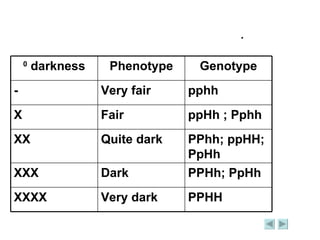
Let us consider three genes, with a dark-skin allele for each gene (A,B,C) contributing one ‘unit’ of darkness to the phenotype and being incompletely dominant to the other  alleles (a,b,c). An  AABBCC  person would be  very   dark , while an  aabbcc  individual would be  very   light .  An  AaBbCc  person would have skin of an  intermediate   shade .  Because the alleles have a cumulative effect, the genotypes AaBbCc and AABbcc would make the same genetic contribution (three units) to skin darkness.
This polygenic inheritance could result in a bell-shaped curve, called a  normal   distribution , for skin darkness among the members of a hypothetical population.  Environmental   factors , such as exposure to the sun, also affect the skin-color phenotype.
 
Individuals based on  degrees of skin darkness . PPHH Very dark XXXX PPHh; PpHh Dark XXX PPhh; ppHH; PpHh Quite dark XX ppHh ; Pphh Fair X pphh Very fair - Genotype Phenotype 0  darkness
Differences between multiple alleles and polygenes - Phenotypes that controlled by polygenes can be influence by environmental factors while multiple alleles is not influence by environmental factors For multiple alleles, phenotypes control involved genes that have multiple alleles (exist more than two allelic forms) while in polygenes the phenotype is controlled by more than one gene
Polygenic traits involved continuous variation/ quantitative variation while multiple alleles traits are expressed as discontinuous variation.

Hour 4

  • 1.
    LECTURE 4 2.2Crosses that deviate from the Mendelian inheritance. 2.2.1 Codominant allele 2.2.2 Incomplete dominant allele 2.2.3 Multiple alleles 2.2.4 Polygenes/polygenic inheritance
  • 2.
    OBJECTIVES At theend of the lesson, students should be able to : Explain codominant alleles. Calculate the genotypic and phenotypic ratio (1:2:1). Explain incomplete dominant alleles. Calculate the genotypic and phenotypic ratio (1:2:1). Explain multiple alleles Explain polygenes/polygenic inheritance
  • 3.
    Codominant alleleboth alleles of a pair are fully expressed in a heterozygous form Eg : The existence of three different human blood groups called the M,N and MN blood groups. Another example is ABO human blood group. Genotypic ratio 1:2:1
  • 4.
    ABO Blood GroupI O I O / ii O I A I B AB I B I B , I B I O B I A I A , I A I O A Genotype Phenotype (Blood group )
  • 5.
    e.g: Cross betweenL M L M and L N L N P : L M L M X L N L N G : L M L M L N L N F1 : L M L N
  • 6.
    F1 X F1P : L M L N X L M L N G : L M L N L M L N F2 : L M L M L M L N L M L N L N L N Phenotypic ratio:- 1 producing M antigen: 2 producing both antigens : 1 producing N antigen Genotypic ratio:- 1 L M L M :2 L M L N :1L N L N
  • 7.
    Different from Mendel’slaw because the phenotypic ratio is 1:2:1 in F 2 generation instead of 3:1.
  • 8.
    Incomplete Dominant AlleleOne allele is not fully dominant over its partner, so in the heterozygous condition, the total product is intermediate between that of the dominant and recessive alleles. Eg :color of snapdragon flower Antirrhinum . Heterozygotes for color alleles have pink colors in contrast to red ( dominant homozygotes) and white (recessive heterozygotes). The phenotypic ratio for the monohybrid cross then becomes 1:2:1 instead of 3:1. (for F2)
  • 9.
  • 10.
  • 11.
    Summary of dominancerelationships
  • 12.
    Multiple Alleles When more than two different forms of alleles, they are referred to as multiple alleles . Eg : ABO blood type alleles in humans. There are 4 blood types : A, B, AB and O. The ABO locus has three common alleles : I A , I B , I O .
  • 13.
    Multiple alleles controlthe ABO blood groups.
  • 14.
    Poligenes In manycharacters such as human skin color and height, an either-or classification is impossible, because the characters vary in the population gradually. These are called quantitative characters . Quantitative variation usually indicates polygenic inheritance, an additive effect of two or more genes on a single phenotypic character . For example, skin pigmentation in humans is controlled by at least three (probably more) separately inherited genes.
  • 15.
    Let us considerthree genes, with a dark-skin allele for each gene (A,B,C) contributing one ‘unit’ of darkness to the phenotype and being incompletely dominant to the other alleles (a,b,c). An AABBCC person would be very dark , while an aabbcc individual would be very light . An AaBbCc person would have skin of an intermediate shade . Because the alleles have a cumulative effect, the genotypes AaBbCc and AABbcc would make the same genetic contribution (three units) to skin darkness.
  • 16.
    This polygenic inheritancecould result in a bell-shaped curve, called a normal distribution , for skin darkness among the members of a hypothetical population. Environmental factors , such as exposure to the sun, also affect the skin-color phenotype.
  • 17.
  • 18.
    Individuals based on degrees of skin darkness . PPHH Very dark XXXX PPHh; PpHh Dark XXX PPhh; ppHH; PpHh Quite dark XX ppHh ; Pphh Fair X pphh Very fair - Genotype Phenotype 0 darkness
  • 19.
    Differences between multiplealleles and polygenes - Phenotypes that controlled by polygenes can be influence by environmental factors while multiple alleles is not influence by environmental factors For multiple alleles, phenotypes control involved genes that have multiple alleles (exist more than two allelic forms) while in polygenes the phenotype is controlled by more than one gene
  • 20.
    Polygenic traits involvedcontinuous variation/ quantitative variation while multiple alleles traits are expressed as discontinuous variation.