CHAPTER 2: GENETIC INHERITANCE
Concept review… Genetic inheritance Terms & concepts Mendel’s experiment Pisum sativum  – garden pea Monohybrid crosses Dihybrid crosses Law of segregation Law of independent assortment Deviation from Mendel’s Law Codominance Incomplete  dominance Multiple allele Polygene Lethal allele Linked gene Genetic mapping Pedigree analysis
Important terms… allele genes locus genotype phenotype dominant recessive homozygous heterozygous true-breed
OBJECTIVE Define terminologies used in genetic inheritance. Describe  the characteristics of Mendel’s pea plants.
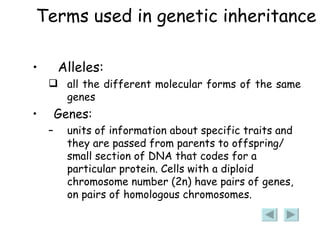
Terms used in genetic inheritance Alleles: all the different molecular forms of the same genes Genes: units of information about specific traits and they are passed from parents to offspring/ small section of DNA that codes for a particular protein. Cells with a diploid chromosome number (2n) have pairs of genes, on pairs of homologous chromosomes.
Locus Each gene has a specific location locus on a chromosome . P Q p q
There are two  loci , one is for flower color and the other is for stem length
Two terms help keep the distinction clear between genes and the traits they specify. Genotype Particular genes and individual carries /  the genes that an organism inherits from its mother and father.  Phenotype An individual’s observable traits/ the protein  used by these genes that determine the organism’s  physical characteristic. Eg: Phenotype : tall   Genotype  : TT @ Tt
An allele is said to be  dominant  when its effect on a trait masks that of any  recessive allele  paired with it. We used capital letters for dominant alleles and lowercase letters for the recessive one. Example, A and a. So, the homozygous dominant has a pair of dominant alleles (AA), homozygous recessive has a pair of recessive alleles (aa) and heterozygous has a pair of non-identical allele (Aa).
True-breed @ pure-breed Organisms that are homozygous for any given genotype and therefore pass it on to all their progeny in a cross with a similar homozygote
P  : parental generation F1 : first-generation offspring F2 : second-generation offspring
TYPES OF CROSSES Test cross A  cross between a recessive homozygous  and an  organism of  dominant phenotype , but unknown  genotype. If an organism displays a dominant characteristic, it may possess 2 dominant alleles (homologous) or a dominant and recessive allele for that characteristic (heterozygous) To find out which in the case, the organism is crossed with one displaying the recessive characteristic. If all the offspring show the dominant characteristic then the organism is homozygous, but if half show the recessive characteristic, then the organism is heterozygous.
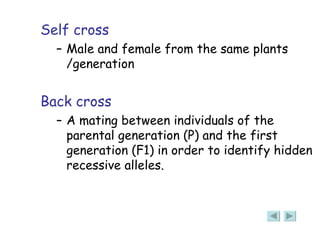
Self cross Male and female from the same plants /generation Back cross A mating between individuals of the parental generation (P) and the first generation (F1) in order to identify hidden recessive alleles.
Reciprocal cross A cross reversing the roles of males and females to confirm the results obtained from an earlier cross. For example, if a pollen (male) from tall plants in transferred to the stigma (female) of dwarf plants in one cross, the reciprocal cross would use the pollen of dwarf plants to pollinate the stigmas of tall plants.
P :  X b X b   x  X B Y   color blind  normal G :  X b   X b   X B   Y F1 : X B X b   X B X b   X b Y  X b Y EARLIER CROSS B – normal b – color blind normal female  Color blind male Phenotype ratio : 1 normal : 1 color blind
P :  X B X B   x  X b Y   normal  color blind G : X B   X B   X b   Y F1 : X B X b   X B X b   X B Y  X B Y RECIPROCAL CROSS Female carrier  Normal male Phenotypic ratio : All normal
Mendel’s Experiment Gregor Mendel studied  the inheritance of characteristics in garden peas ( Pisum sativum ). He chose peas because : they were  easy to grow they had a  short life cycle their  pollination could be controlled   they have  easily observable characteristics .
He studied 7 characteristics, each of which has two contrasting alternatives. seed   shape   : round / wrinkled seed   color  : yellow / green pod   shape  : inflated / constricted pod   color  : yellow / green flower   color  : purple / white flower   position  : axial / terminal plant height  : tall / dwarf
Page 250
Mendel’s Experimental Result Character   Dominant vs  F 2  Ratio recessive  Seed shape    R x r   5474 : 1850   2.96 :1 Seed color   Y x y  6022 : 2001   3.01 :1 Flower color   P x p  705:224   3.15 : 1 Pod shape   I x i  882:299   2.95 : 1 Pod color   G x g  428:152  2.82 : 1 Flower position  A x a  651:207   3.14 : 1 Plant height  T x t  787:277   2.84 : 1
It shows 7 characters studied in garden pea crosses and the data obtained. F 2  generation showed close to 3:1 ratio of characteristics.

Hour 1

  • 1.
    CHAPTER 2: GENETICINHERITANCE
  • 2.
    Concept review… Geneticinheritance Terms & concepts Mendel’s experiment Pisum sativum – garden pea Monohybrid crosses Dihybrid crosses Law of segregation Law of independent assortment Deviation from Mendel’s Law Codominance Incomplete dominance Multiple allele Polygene Lethal allele Linked gene Genetic mapping Pedigree analysis
  • 3.
    Important terms… allelegenes locus genotype phenotype dominant recessive homozygous heterozygous true-breed
  • 4.
    OBJECTIVE Define terminologiesused in genetic inheritance. Describe the characteristics of Mendel’s pea plants.
  • 5.
    Terms used ingenetic inheritance Alleles: all the different molecular forms of the same genes Genes: units of information about specific traits and they are passed from parents to offspring/ small section of DNA that codes for a particular protein. Cells with a diploid chromosome number (2n) have pairs of genes, on pairs of homologous chromosomes.
  • 6.
    Locus Each genehas a specific location locus on a chromosome . P Q p q
  • 7.
    There are two loci , one is for flower color and the other is for stem length
  • 8.
    Two terms helpkeep the distinction clear between genes and the traits they specify. Genotype Particular genes and individual carries / the genes that an organism inherits from its mother and father. Phenotype An individual’s observable traits/ the protein used by these genes that determine the organism’s physical characteristic. Eg: Phenotype : tall Genotype : TT @ Tt
  • 9.
    An allele issaid to be dominant when its effect on a trait masks that of any recessive allele paired with it. We used capital letters for dominant alleles and lowercase letters for the recessive one. Example, A and a. So, the homozygous dominant has a pair of dominant alleles (AA), homozygous recessive has a pair of recessive alleles (aa) and heterozygous has a pair of non-identical allele (Aa).
  • 10.
    True-breed @ pure-breedOrganisms that are homozygous for any given genotype and therefore pass it on to all their progeny in a cross with a similar homozygote
  • 11.
    P :parental generation F1 : first-generation offspring F2 : second-generation offspring
  • 12.
    TYPES OF CROSSESTest cross A cross between a recessive homozygous and an organism of dominant phenotype , but unknown genotype. If an organism displays a dominant characteristic, it may possess 2 dominant alleles (homologous) or a dominant and recessive allele for that characteristic (heterozygous) To find out which in the case, the organism is crossed with one displaying the recessive characteristic. If all the offspring show the dominant characteristic then the organism is homozygous, but if half show the recessive characteristic, then the organism is heterozygous.
  • 13.
    Self cross Maleand female from the same plants /generation Back cross A mating between individuals of the parental generation (P) and the first generation (F1) in order to identify hidden recessive alleles.
  • 14.
    Reciprocal cross Across reversing the roles of males and females to confirm the results obtained from an earlier cross. For example, if a pollen (male) from tall plants in transferred to the stigma (female) of dwarf plants in one cross, the reciprocal cross would use the pollen of dwarf plants to pollinate the stigmas of tall plants.
  • 15.
    P : X b X b x X B Y color blind normal G : X b X b X B Y F1 : X B X b X B X b X b Y X b Y EARLIER CROSS B – normal b – color blind normal female Color blind male Phenotype ratio : 1 normal : 1 color blind
  • 16.
    P : X B X B x X b Y normal color blind G : X B X B X b Y F1 : X B X b X B X b X B Y X B Y RECIPROCAL CROSS Female carrier Normal male Phenotypic ratio : All normal
  • 17.
    Mendel’s Experiment GregorMendel studied the inheritance of characteristics in garden peas ( Pisum sativum ). He chose peas because : they were easy to grow they had a short life cycle their pollination could be controlled they have easily observable characteristics .
  • 18.
    He studied 7characteristics, each of which has two contrasting alternatives. seed shape : round / wrinkled seed color : yellow / green pod shape : inflated / constricted pod color : yellow / green flower color : purple / white flower position : axial / terminal plant height : tall / dwarf
  • 19.
  • 20.
    Mendel’s Experimental ResultCharacter Dominant vs F 2 Ratio recessive Seed shape R x r 5474 : 1850 2.96 :1 Seed color Y x y 6022 : 2001 3.01 :1 Flower color P x p 705:224 3.15 : 1 Pod shape I x i 882:299 2.95 : 1 Pod color G x g 428:152 2.82 : 1 Flower position A x a 651:207 3.14 : 1 Plant height T x t 787:277 2.84 : 1
  • 21.
    It shows 7characters studied in garden pea crosses and the data obtained. F 2 generation showed close to 3:1 ratio of characteristics.