HORMONES AND CANCER           HORMONES   AND CANCER           Richin john  koshy
OVERVIEW:HORMONES   HORMONE DEPENDENT CANCER   RISK FACTORS CAUSING CANCER  PATHOPHYSIOLOGY THERAPEUTIC MEDICATIONS CONCLUSION
   Hormones are peptide or a steroid which is produced by a tissue and conveyed to the bloodstream to the target organs for maturation Hormones are involved in growth and development  of an individual
HORMONE DEPENDENT CANCERS: Hormones  share a strong bond in cancer and its progression  and the role in which hormones play in cancer are seen in breast ,prostate and ovaries
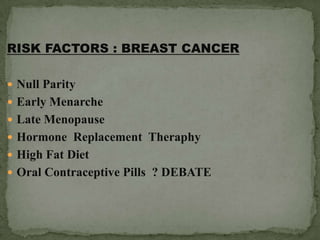
RISK FACTORS : BREAST CANCER Null ParityEarly Menarche Late MenopauseHormone  Replacement  TheraphyHigh Fat Diet Oral Contraceptive Pills  ? DEBATE
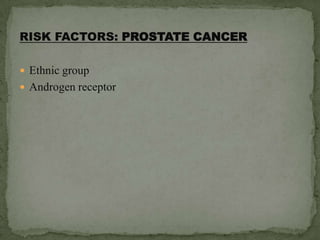
RISK FACTORS:PROSTATE CANCEREthnic groupAndrogen receptor
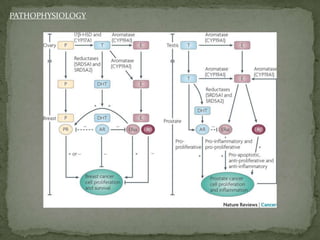
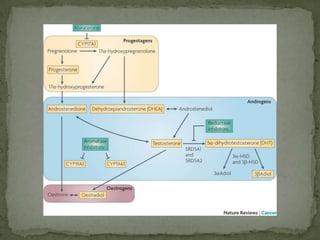
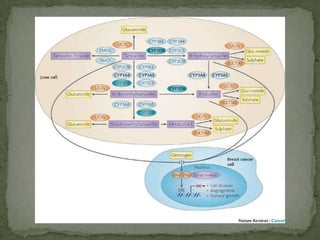
PATHOPHYSIOLOGY
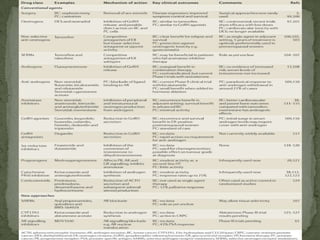
ANTI ANDROGENS :Bicalutamide and Nilutamide which block the binding of androgen to receptors are commonly used as a hormonal therapy GNRH AGONIST :Leuprolide acetate or Goserelin acetate can be given which  eventually leads to chemical castration
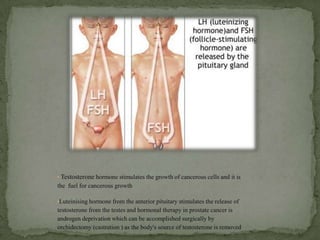
Testosterone hormone stimulates the growth of cancerous cells and it is the  fuel for cancerous growth
Luteinising hormone from the anterior pituitary stimulates the release of testosterone from the testes and hormonal therapy in prostate cancer is androgen deprivation which can be accomplished surgically by orchidectomy (castration ) as the body's source of testosterone is removed
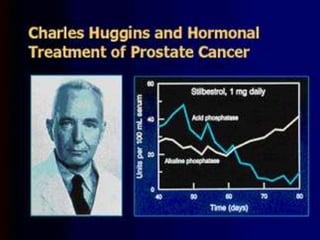
Conclusion     Breast and Prostate tumours have a common feature in that at some stage in their evolution they were hormone dependent cancers, and therefore hormone therapy is an intuitively obvious therapeutic   approach
RefrencesRisbridger ,G.P et al.Breast and prostate cancer more similiar than diffrent .Nature (2010) Ricke, W. A. et al. Prostatic hormonal carcinogenesis ismediated by in situ estrogen production and estrogen trial. J. Urol. 176, 965–970 (2006)Ma, X. J., Dahiya, S., Richardson, E., Erlander, M. &Sgroi, D. C. Gene expression profiling of the tumor microenvironment during breast cancer progression.BreastCancer Res. 11, 7 (2009).

Hormones and cancer final ppt

  • 1.
    HORMONES AND CANCER HORMONES AND CANCER Richin john koshy
  • 2.
    OVERVIEW:HORMONES HORMONE DEPENDENT CANCER RISK FACTORS CAUSING CANCER PATHOPHYSIOLOGY THERAPEUTIC MEDICATIONS CONCLUSION
  • 3.
    Hormones are peptide or a steroid which is produced by a tissue and conveyed to the bloodstream to the target organs for maturation Hormones are involved in growth and development of an individual
  • 4.
    HORMONE DEPENDENT CANCERS:Hormones share a strong bond in cancer and its progression and the role in which hormones play in cancer are seen in breast ,prostate and ovaries
  • 5.
    RISK FACTORS :BREAST CANCER Null ParityEarly Menarche Late MenopauseHormone Replacement TheraphyHigh Fat Diet Oral Contraceptive Pills ? DEBATE
  • 6.
    RISK FACTORS:PROSTATE CANCEREthnicgroupAndrogen receptor
  • 7.
  • 10.
    ANTI ANDROGENS :Bicalutamideand Nilutamide which block the binding of androgen to receptors are commonly used as a hormonal therapy GNRH AGONIST :Leuprolide acetate or Goserelin acetate can be given which eventually leads to chemical castration
  • 12.
    Testosterone hormone stimulatesthe growth of cancerous cells and it is the fuel for cancerous growth
  • 13.
    Luteinising hormone fromthe anterior pituitary stimulates the release of testosterone from the testes and hormonal therapy in prostate cancer is androgen deprivation which can be accomplished surgically by orchidectomy (castration ) as the body's source of testosterone is removed
  • 14.
    Conclusion Breast and Prostate tumours have a common feature in that at some stage in their evolution they were hormone dependent cancers, and therefore hormone therapy is an intuitively obvious therapeutic approach
  • 15.
    RefrencesRisbridger ,G.P etal.Breast and prostate cancer more similiar than diffrent .Nature (2010) Ricke, W. A. et al. Prostatic hormonal carcinogenesis ismediated by in situ estrogen production and estrogen trial. J. Urol. 176, 965–970 (2006)Ma, X. J., Dahiya, S., Richardson, E., Erlander, M. &Sgroi, D. C. Gene expression profiling of the tumor microenvironment during breast cancer progression.BreastCancer Res. 11, 7 (2009).