Targeted Anticancer
Therapy
Presenter : Dr. Amarjeet
Targeted anticancer therapies are drugs that
interfere with specific molecular structures
implicated in tumor growth and progression
Targeted cancer therapies
Nuclear factors
Cell survival
Angiogenesis
Cellular proliferation
Primary tools for targeted therapy
Monoclonal antibodies
Small synthetic molecules
Protein Kinase
• Group of enzymes that possess a catalytic subunit that
transfers the gamma phosphate from nucleotide triphosphates
(often ATP) to one or more amino acid residues in a protein
substrate side chain
• Resulting in a conformational change affecting protein
function
• Play role in signal transduction pathway – regulate cell growth
& adaption to extracellular environment
CATEGORIES
Classified into three different categories
1. Kinases that specifically phosphorylate tyrosine residues
2. Kinases that phosphorylate serine and threonine residues
3. Kinases with activity toward all three residues
Tyrosine kinases can be further subdivided into
Receptor tyrosine kinases
EGFR, PDGFR, FGFR
Non-receptor tyrosine kinases
SRC, ABL, FAK and Janus kinase
BCR-ABL Tyrosine Kinase Inhibitors
(Imatinib mesylate)
 First molecularly targeted protein kinase inhibitor to receive
FDA approval in 2003
 Targets the BCR-ABL tyrosine kinase in a closed or inactive
configuration
IJPSDR April-June, 2010, Vol 2, Issue 2 (80-90)
Resistance to Imatinib
To overcome the resistance to Imatinib
 Binds to multiple states of
kinase including active
conformation
 Targets both ABL & SRC
kinases
 Active against almost all of
the clinically relevant
mutants, the exception being
the T315I mutant
 More potent and less toxic
than Imatinib
Target the active kinase conformation
PonatinibNilotinib, Dasatinib, Bosutinib
 Effective against all
mutants including T315I
Indications
Chronic myelogenous leukemia (CML)
Additional therapeutic use
 GIST ( kit mutation positive)
 Chronic myelomonocytic leukemia
 Hypereosinophilia syndrome
 Dermatofibrosarcoma protuberans
Epidermal Growth Factor Receptor
• EGFR - ErbB family of transmembrane receptor tyrosine
kinases
• Also known as ErbB1 or HER1
MOA - EGFR/ ErbB1 inhibitors
Gefitinib
Erlotinib
Indications
• Second-line treatment of patients with locally advanced
or metastatic NSCLC
• First-line treatment of patients with locally advanced,
unresectable, or metastatic pancreatic cancer in
combination with gemcitabine
Resistance
To overcome resistance
Afatinib
• Irreversible inhibitor of the ErbB family of tyrosine kinases
• Covalently binding to the kinase domains of EGFR, HER 2,
HER3 & HER 4
• Approved as monotherapy for treatment of locally advanced or
metastatic NSCLC
Osimertinib
• Binds irreversibly to mutant forms of EGFR (T790M, L858R,
and exon 19 deletion)
• Also inhibit the activity of HER2, HER3, HER4
Brigatinib (AP26113)
For the treatment of anaplastic lymphoma kinase positive
(ALK+) NSCLC whose disease is resistant to crizotinib
Not yet approved
Cetuximab & Panitumumab
Bind to extracellular domain of
EGFR, blocking cell growth and
survival signals
Cetuximab :
Locally or regionally advanced
HNSCC
EGFR-positive metastatic colorectal
cancer
Panitumumab : First-line therapy in
combination with cytotoxic drugs in
patients with wild-type KRAS mCRC
Cetuximab
PanitumumabNecitumumab
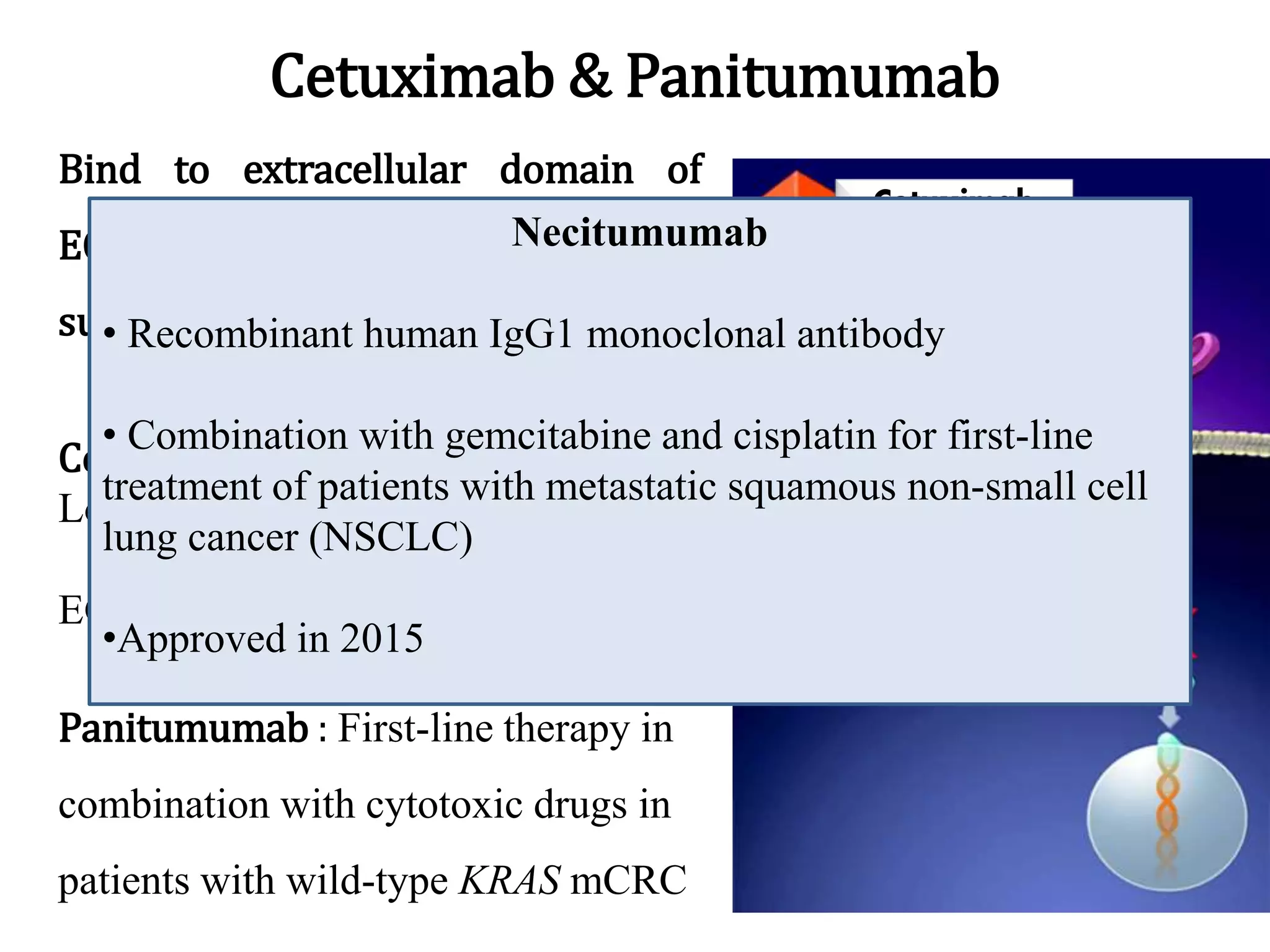
• Recombinant human IgG1 monoclonal antibody
• Combination with gemcitabine and cisplatin for first-line
treatment of patients with metastatic squamous non-small cell
lung cancer (NSCLC)
•Approved in 2015
HER2 / NEU (Erb B2)
ErbB2 or HER 2/neu inhibitors
 First mab approved for solid
tumor
 Approved for HER2/neu-
overexpressing metastatic
breast cancer, in combination
with paclitaxel as initial
treatment or as monotherapy
following chemotherapy
relapse
 Toxicity - cardiac failure
Trastuzumab
Lapatinib
 Blocks both ErbB1 and ErbB2
 Inhibits the truncated form of
HER2 that lacks the trastuzumab
binding domain
 FDA-approved for HER2-
amplified, trastuzumab-
refractory breast cancer, with
capecitabine
 Crosses the BBB
 ADR: Diarrhoea, Acneform rash
Targeting angiogenesis
Judah Folkman: opened the field of anti-angiogenesis therapy
Jain: proposed an additional mechanism
Capillary permeability and tumor interstitial pressure
Inhibition of blood flow and drug delivery within the tumor
Targeting primary angiogenic factor would normalize interstitial
pressure & improve blood flow
Enhance the ability of chemotherapeutic agents to reach the tumor
VEGF
Approved in 2014
•NSCLC – Bivacizumab + carboplatin + paclitaxel
•Metastatic RCC – Bivacizumab + interferon- alpha
•Metastatic colorectal cancer – Aflibercept + 5-flourouracil +
leucovorin + irinotecan
•Sunitinib - Advanced renal-cell carcinoma and GIST
•Sorafenib – hepatocellular carcinoma
Indications
Other uses
•Wet macular degeneration
•Neurofibromatosis type – 2 related tumor - To restore hearing in patient
with progressive disease
Lenvatinib
 Acts as a multiple kinase inhibitor against the VEGFR1, VEGFR2
and VEGFR3 kinases
 Also inhibit FGFR, PDGFR - alpha, c-Kit, and the RET proto-
oncogene
 Approved (2015) for the treatment of differentiated thyroid cancer
 In 2016 approved in combination with everolimus for the treatment of
advanced RCC following one prior anti-angiogenic therapy
Rapamycin
Temsirolimus
Everolimus
Buparlisib
Idelalisib
Dactolisib
Indications
•Relapsed CLL
•Relapsed follicular B cell NHL
•Relapsed small lymphatic lymphoma
Ipatasertib
Perifosine
Resistance
• May arise through the action of a mTOR C2 - Unaffected by
rapamycin
Inhibition of mTORC1
mTORC2 activation of AKT kinase & MAP kinase
pathways
Responsible for incomplete responses
Resistance of rapamycin
Indications
1. Renal cell carcinoma
2. Mantle cell lymphoma
3. Hepatocellular cancer
Proteasome inhibitor
Proteasome
• Multienzyme complex that degrades regulating cell cycle
• Enhance proteolysis of Ikb, allowing NF-kB to promote
survival & inhibit apoptosis
Bortezomib
Bind to 26S proteasome
Irreversibly inhibit its chymotrypsin like activity
Inhibit NF-kB & disrupt intracellular signalling cascade
Apoptosis
Indication
1. Multiple myeloma – combination with cytotoxic
drugs as first line and also for relapsed disease
2. Mantle cell lymphoma
Recently approved
1. Ixazomib
• Orally administration
• Reversible proteasome inhibitors
• Toxicity : Nausea, vomiting, thrombocytopenia, peripheral
neuropathy
2. Carfilzomib
• IV administration
• Irreversible proteasome inhibitors
• Toxicity : Infusion related, thrombocytopenia
Mitogen-activated protein kinase (MAPK)
pathway
Cobimetinib
• Kinase inhibitor – approved in 2015
• Reversible inhibitor of mitogen activated protein kinase
(MAPK) / extracellular signal regulated kinase 1 ( MEK 1 &
MEK 2)
Indication –unresectible or metastatic melanoma with BRAF-
V600F & K mutation in combination with vemurafenib
Toxicity
Diarrhea
Sensitivity to UV light
Pyrexia
MONOCLONALANTIBODIES
 Monoclonal antibodies - monospecific antibodies produced by
single Ab forming cell or clone & directed against single
antigenic determinant
 Targeted therapeutic approach
 Well tolerated & effective for treatment of clinical disorders
Mechanism of action
Potential mechanisms include
 Blocking or steric hindrance of the function of target
antigen which are capable of transducing intracellular
signals
 Cytotoxicity to the cell expressing target antigen by CDC
or ADCC
 Inhibition of growth factors like EGFR, involved in
regulation of cell proliferation and survival
Recently FDA approved
AGENT TARGET INDICATION
Alemtuzumab CD52 B-cell chronic lymphocytic leukemia
Atezolizumab PD-L1 Urothelial carcinoma
Non-small cell lung cancer
Avelumab PD-L1 Merkel cell carcinoma
Brentuximab CD30 Hodgkin lymphoma
Anaplastic large cell lymphoma
Daratumumab CD38 Multiple myeloma
Ofatumumab CD20 Chronic lymphocytic leukemia
Pembrolizumab PD-1 Classical Hodgkin lymphoma
Melanoma, HNSCC
Pertuzumab HER2 (ERBB2/neu) Breast cancer (HER2+)
Ramucirumab VEGFR2 Colorectal cancer
Gastric cancer
Ligand Targeted Therapeutics (LTT)
• Delivery of antineoplastic drug to cancer cell or cancer
associated tissue such as tumor vasculature
• Increased by associating the drug molecules that binds to
antigen or receptor that are expressed or overexpressed on the
target cell
• LTT approach can be applied to drug carriers (microreservoir
system)
Ligand used in LTT
Antibody ligands Non – antibody ligands
Monoclonal antibodies or antibody
fragments can be selected
Often readily available (diet),
inexpensive, easy to handle
High degree of specificity for the
target tissue
Can bind to non target tissue
Trastuzumab - ERBB2 receptor Folate - Folate receptor
Denileukin diftitox - Interleukin-2
receptor
Transferrin - Transferrin receptor
Radio-immunotherapy (RAIT)
• Monoclonal antibodies linked to radionuclides with high linear
energy transfer (LET)
• Radioisotopes
– 131Iodine , 90Yttrium ( β emitters)
– 213 Bismuth, 211 Astatine ( α emitters)
• Cause DNA strand breaks & result in cell death
• RAIT – successful in treating haematopoietic malignancies
RAIT Target Indication Status
• 90Yttrium – ibritumomab
tiuxetin
• 131Iodine – tositumomab
Anti – CD20 NHL Approved
• 90Yttrium – epratuzumab Anti – CD22 NHL
B - cell
lymphoma
Phase II
• 213Bismuth – HuM195 Anti – CD33 AML Phase II
• 90 Yttrium – daclizumab Anti-Tac /
CD25
T - cell
leukemia
Phase II
Immunotoxins
Internalizing mAbs or ligand + potent toxins
Inactivate protein synthesis & signal
transduction
Cell death
Denileukin diftitox – An IL – 2 diptheria toxin fusion protein
rather than an antibody based drug
Indication : Cutaneous T – cell lymphoma
Toxicity
• Flu like syndrome
• Infusion related events – shortness of breath, chest & back
pain
• Vascular leak syndrome – hypotension, oedema,
hypoalbuminemia
• Deranged LFT
Immunoconjugates
• Molecules of standard chemotherapy drugs linked to the
targeting molecules rather than potent toxins
Gemtuzumab ozogamicin – mAb + calcichemicin
Antibody portion of molecule targets CD33 (a cell surface
molecule) (acute myeloid leukemia cells)
Calcichemicin is a potent anti-cancer drug
Intercalates into DNA
dsDNA breakage
Apoptosis
Antibody directed enzyme prodrug thearpy
(ADEPT)
• Designed to overcome the problems - poor penetration, antigen
heterogeneity, poor drug potency and inefficient drug release
• Monoclonal antibodies linked to a drug-activating enzyme
Two step approach
1. mAbs used to localize enzymes to tumor cell surface antigens
2. Prodrug administration – converted to active drug & released
outside at cell surface
Cytosine deaminase - converts 5-fluorocytosine to the
active drug 5-fluorouracil
Passive targeting
Microreservoir system / drug carrier (Liposomes & polymers)
Carriers are small in size – extravasate & localized to area of
increased vascular permeability
Significantly increase in the amount of drug delivered to solid
tumor
Distribution of drug to normal tissue is decreased – fewer side
effects
Immunoliposomes
• Chemotherapeutic molecules or gene therapeutics loaded into
liposomes and targeting ligand are attached at liposome
surface
Following binding of liposomes to target cell
Drug delivered – internalizing or non-
internalizing ligand
Liposomal chemotherapeutics that target via anti-ERBB2
and anti-CD19 or other B-cell or T-cell epitopes
Immunopolymers
• Bioconjugates of drugs to biodegradable water soluble
polymers (copolymer HPMA)
• Release of drug from polymer is necessary for its biological
activity
• E.g. HPMA copolymer – gly – phe – leu – gly – doxorubicin :
targeting to melanoma tumor
Polymer directed enzyme prodrug therapy
(PDEPT)
• Combines ADEPT with polymer–drug conjugates
• HPMA copolymer-Gly-Phe-Leu-Gly–doxorubicin (prodrug)
linked to the enzyme cathespin B
• Which led to a rapid increase in the rate of doxorubicin
release within the tumour
Thalidomide & linalidomide
Antisense strategies
• Antisense are small pieces of synthetic oligonucleotides
• Designed to interact with the mRNA to block the transcription
and translation to target proteins
• Targeting IGF-1R – induce apoptosis
• Effective in malignant melanoma & breast cancer
Conclusion
• Cancer treatment needs multidisciplinary approach
• Molecular targeted therapy is a new way of approaching cancer
treatment
• Targeted therapies are used increasingly in combination with
other targeted therapies or with other treatment modalities
• Targeted therapy is well tolerated and lesser side effect than
conventional chemotherapy
• New approaches and new technologies will further improve new
class of anticancer therapeutics
THANK YOU

Targeted cancer therapy

  • 1.
  • 2.
    Targeted anticancer therapiesare drugs that interfere with specific molecular structures implicated in tumor growth and progression
  • 3.
    Targeted cancer therapies Nuclearfactors Cell survival Angiogenesis Cellular proliferation
  • 4.
    Primary tools fortargeted therapy Monoclonal antibodies Small synthetic molecules
  • 5.
    Protein Kinase • Groupof enzymes that possess a catalytic subunit that transfers the gamma phosphate from nucleotide triphosphates (often ATP) to one or more amino acid residues in a protein substrate side chain • Resulting in a conformational change affecting protein function • Play role in signal transduction pathway – regulate cell growth & adaption to extracellular environment
  • 6.
    CATEGORIES Classified into threedifferent categories 1. Kinases that specifically phosphorylate tyrosine residues 2. Kinases that phosphorylate serine and threonine residues 3. Kinases with activity toward all three residues Tyrosine kinases can be further subdivided into Receptor tyrosine kinases EGFR, PDGFR, FGFR Non-receptor tyrosine kinases SRC, ABL, FAK and Janus kinase
  • 8.
    BCR-ABL Tyrosine KinaseInhibitors (Imatinib mesylate)  First molecularly targeted protein kinase inhibitor to receive FDA approval in 2003  Targets the BCR-ABL tyrosine kinase in a closed or inactive configuration IJPSDR April-June, 2010, Vol 2, Issue 2 (80-90)
  • 9.
  • 10.
    To overcome theresistance to Imatinib  Binds to multiple states of kinase including active conformation  Targets both ABL & SRC kinases  Active against almost all of the clinically relevant mutants, the exception being the T315I mutant  More potent and less toxic than Imatinib Target the active kinase conformation PonatinibNilotinib, Dasatinib, Bosutinib  Effective against all mutants including T315I Indications Chronic myelogenous leukemia (CML) Additional therapeutic use  GIST ( kit mutation positive)  Chronic myelomonocytic leukemia  Hypereosinophilia syndrome  Dermatofibrosarcoma protuberans
  • 11.
    Epidermal Growth FactorReceptor • EGFR - ErbB family of transmembrane receptor tyrosine kinases • Also known as ErbB1 or HER1
  • 12.
    MOA - EGFR/ErbB1 inhibitors Gefitinib Erlotinib Indications • Second-line treatment of patients with locally advanced or metastatic NSCLC • First-line treatment of patients with locally advanced, unresectable, or metastatic pancreatic cancer in combination with gemcitabine
  • 13.
  • 14.
    To overcome resistance Afatinib •Irreversible inhibitor of the ErbB family of tyrosine kinases • Covalently binding to the kinase domains of EGFR, HER 2, HER3 & HER 4 • Approved as monotherapy for treatment of locally advanced or metastatic NSCLC Osimertinib • Binds irreversibly to mutant forms of EGFR (T790M, L858R, and exon 19 deletion) • Also inhibit the activity of HER2, HER3, HER4 Brigatinib (AP26113) For the treatment of anaplastic lymphoma kinase positive (ALK+) NSCLC whose disease is resistant to crizotinib Not yet approved
  • 15.
    Cetuximab & Panitumumab Bindto extracellular domain of EGFR, blocking cell growth and survival signals Cetuximab : Locally or regionally advanced HNSCC EGFR-positive metastatic colorectal cancer Panitumumab : First-line therapy in combination with cytotoxic drugs in patients with wild-type KRAS mCRC Cetuximab PanitumumabNecitumumab • Recombinant human IgG1 monoclonal antibody • Combination with gemcitabine and cisplatin for first-line treatment of patients with metastatic squamous non-small cell lung cancer (NSCLC) •Approved in 2015
  • 16.
    HER2 / NEU(Erb B2)
  • 17.
    ErbB2 or HER2/neu inhibitors  First mab approved for solid tumor  Approved for HER2/neu- overexpressing metastatic breast cancer, in combination with paclitaxel as initial treatment or as monotherapy following chemotherapy relapse  Toxicity - cardiac failure Trastuzumab Lapatinib  Blocks both ErbB1 and ErbB2  Inhibits the truncated form of HER2 that lacks the trastuzumab binding domain  FDA-approved for HER2- amplified, trastuzumab- refractory breast cancer, with capecitabine  Crosses the BBB  ADR: Diarrhoea, Acneform rash
  • 18.
    Targeting angiogenesis Judah Folkman:opened the field of anti-angiogenesis therapy Jain: proposed an additional mechanism Capillary permeability and tumor interstitial pressure Inhibition of blood flow and drug delivery within the tumor Targeting primary angiogenic factor would normalize interstitial pressure & improve blood flow Enhance the ability of chemotherapeutic agents to reach the tumor
  • 19.
  • 20.
  • 21.
    •NSCLC – Bivacizumab+ carboplatin + paclitaxel •Metastatic RCC – Bivacizumab + interferon- alpha •Metastatic colorectal cancer – Aflibercept + 5-flourouracil + leucovorin + irinotecan •Sunitinib - Advanced renal-cell carcinoma and GIST •Sorafenib – hepatocellular carcinoma Indications Other uses •Wet macular degeneration •Neurofibromatosis type – 2 related tumor - To restore hearing in patient with progressive disease Lenvatinib  Acts as a multiple kinase inhibitor against the VEGFR1, VEGFR2 and VEGFR3 kinases  Also inhibit FGFR, PDGFR - alpha, c-Kit, and the RET proto- oncogene  Approved (2015) for the treatment of differentiated thyroid cancer  In 2016 approved in combination with everolimus for the treatment of advanced RCC following one prior anti-angiogenic therapy
  • 22.
  • 23.
    Resistance • May arisethrough the action of a mTOR C2 - Unaffected by rapamycin Inhibition of mTORC1 mTORC2 activation of AKT kinase & MAP kinase pathways Responsible for incomplete responses Resistance of rapamycin Indications 1. Renal cell carcinoma 2. Mantle cell lymphoma 3. Hepatocellular cancer
  • 24.
    Proteasome inhibitor Proteasome • Multienzymecomplex that degrades regulating cell cycle • Enhance proteolysis of Ikb, allowing NF-kB to promote survival & inhibit apoptosis Bortezomib Bind to 26S proteasome Irreversibly inhibit its chymotrypsin like activity Inhibit NF-kB & disrupt intracellular signalling cascade Apoptosis Indication 1. Multiple myeloma – combination with cytotoxic drugs as first line and also for relapsed disease 2. Mantle cell lymphoma Recently approved 1. Ixazomib • Orally administration • Reversible proteasome inhibitors • Toxicity : Nausea, vomiting, thrombocytopenia, peripheral neuropathy 2. Carfilzomib • IV administration • Irreversible proteasome inhibitors • Toxicity : Infusion related, thrombocytopenia
  • 25.
  • 26.
    Cobimetinib • Kinase inhibitor– approved in 2015 • Reversible inhibitor of mitogen activated protein kinase (MAPK) / extracellular signal regulated kinase 1 ( MEK 1 & MEK 2) Indication –unresectible or metastatic melanoma with BRAF- V600F & K mutation in combination with vemurafenib Toxicity Diarrhea Sensitivity to UV light Pyrexia
  • 27.
    MONOCLONALANTIBODIES  Monoclonal antibodies- monospecific antibodies produced by single Ab forming cell or clone & directed against single antigenic determinant  Targeted therapeutic approach  Well tolerated & effective for treatment of clinical disorders
  • 28.
    Mechanism of action Potentialmechanisms include  Blocking or steric hindrance of the function of target antigen which are capable of transducing intracellular signals  Cytotoxicity to the cell expressing target antigen by CDC or ADCC  Inhibition of growth factors like EGFR, involved in regulation of cell proliferation and survival
  • 30.
    Recently FDA approved AGENTTARGET INDICATION Alemtuzumab CD52 B-cell chronic lymphocytic leukemia Atezolizumab PD-L1 Urothelial carcinoma Non-small cell lung cancer Avelumab PD-L1 Merkel cell carcinoma Brentuximab CD30 Hodgkin lymphoma Anaplastic large cell lymphoma Daratumumab CD38 Multiple myeloma Ofatumumab CD20 Chronic lymphocytic leukemia Pembrolizumab PD-1 Classical Hodgkin lymphoma Melanoma, HNSCC Pertuzumab HER2 (ERBB2/neu) Breast cancer (HER2+) Ramucirumab VEGFR2 Colorectal cancer Gastric cancer
  • 31.
    Ligand Targeted Therapeutics(LTT) • Delivery of antineoplastic drug to cancer cell or cancer associated tissue such as tumor vasculature • Increased by associating the drug molecules that binds to antigen or receptor that are expressed or overexpressed on the target cell • LTT approach can be applied to drug carriers (microreservoir system)
  • 32.
    Ligand used inLTT Antibody ligands Non – antibody ligands Monoclonal antibodies or antibody fragments can be selected Often readily available (diet), inexpensive, easy to handle High degree of specificity for the target tissue Can bind to non target tissue Trastuzumab - ERBB2 receptor Folate - Folate receptor Denileukin diftitox - Interleukin-2 receptor Transferrin - Transferrin receptor
  • 33.
    Radio-immunotherapy (RAIT) • Monoclonalantibodies linked to radionuclides with high linear energy transfer (LET) • Radioisotopes – 131Iodine , 90Yttrium ( β emitters) – 213 Bismuth, 211 Astatine ( α emitters) • Cause DNA strand breaks & result in cell death • RAIT – successful in treating haematopoietic malignancies RAIT Target Indication Status • 90Yttrium – ibritumomab tiuxetin • 131Iodine – tositumomab Anti – CD20 NHL Approved • 90Yttrium – epratuzumab Anti – CD22 NHL B - cell lymphoma Phase II • 213Bismuth – HuM195 Anti – CD33 AML Phase II • 90 Yttrium – daclizumab Anti-Tac / CD25 T - cell leukemia Phase II
  • 34.
    Immunotoxins Internalizing mAbs orligand + potent toxins Inactivate protein synthesis & signal transduction Cell death Denileukin diftitox – An IL – 2 diptheria toxin fusion protein rather than an antibody based drug Indication : Cutaneous T – cell lymphoma
  • 35.
    Toxicity • Flu likesyndrome • Infusion related events – shortness of breath, chest & back pain • Vascular leak syndrome – hypotension, oedema, hypoalbuminemia • Deranged LFT
  • 36.
    Immunoconjugates • Molecules ofstandard chemotherapy drugs linked to the targeting molecules rather than potent toxins Gemtuzumab ozogamicin – mAb + calcichemicin Antibody portion of molecule targets CD33 (a cell surface molecule) (acute myeloid leukemia cells) Calcichemicin is a potent anti-cancer drug Intercalates into DNA dsDNA breakage Apoptosis
  • 37.
    Antibody directed enzymeprodrug thearpy (ADEPT) • Designed to overcome the problems - poor penetration, antigen heterogeneity, poor drug potency and inefficient drug release • Monoclonal antibodies linked to a drug-activating enzyme Two step approach 1. mAbs used to localize enzymes to tumor cell surface antigens 2. Prodrug administration – converted to active drug & released outside at cell surface Cytosine deaminase - converts 5-fluorocytosine to the active drug 5-fluorouracil
  • 38.
    Passive targeting Microreservoir system/ drug carrier (Liposomes & polymers) Carriers are small in size – extravasate & localized to area of increased vascular permeability Significantly increase in the amount of drug delivered to solid tumor Distribution of drug to normal tissue is decreased – fewer side effects
  • 39.
    Immunoliposomes • Chemotherapeutic moleculesor gene therapeutics loaded into liposomes and targeting ligand are attached at liposome surface Following binding of liposomes to target cell Drug delivered – internalizing or non- internalizing ligand Liposomal chemotherapeutics that target via anti-ERBB2 and anti-CD19 or other B-cell or T-cell epitopes
  • 40.
    Immunopolymers • Bioconjugates ofdrugs to biodegradable water soluble polymers (copolymer HPMA) • Release of drug from polymer is necessary for its biological activity • E.g. HPMA copolymer – gly – phe – leu – gly – doxorubicin : targeting to melanoma tumor Polymer directed enzyme prodrug therapy (PDEPT) • Combines ADEPT with polymer–drug conjugates • HPMA copolymer-Gly-Phe-Leu-Gly–doxorubicin (prodrug) linked to the enzyme cathespin B • Which led to a rapid increase in the rate of doxorubicin release within the tumour
  • 41.
  • 42.
    Antisense strategies • Antisenseare small pieces of synthetic oligonucleotides • Designed to interact with the mRNA to block the transcription and translation to target proteins • Targeting IGF-1R – induce apoptosis • Effective in malignant melanoma & breast cancer
  • 43.
    Conclusion • Cancer treatmentneeds multidisciplinary approach • Molecular targeted therapy is a new way of approaching cancer treatment • Targeted therapies are used increasingly in combination with other targeted therapies or with other treatment modalities • Targeted therapy is well tolerated and lesser side effect than conventional chemotherapy • New approaches and new technologies will further improve new class of anticancer therapeutics
  • 44.

Editor's Notes

  • #4 The main strategies to achieve this ..is by targeting cellular proliferation, …..
  • #5 The primary tools for inhibiting these targets are either monoclonal antibodies that attack cell surface receptors and antigens, or synthetic small molecules that enter cells and engage critical enzymes.. But, now, the point to be noted is that.. The two classes of drug, when targeted against the same pathway, may have significantly different spectra of antitumor activity. As shown in the figure here, monoclonal antibodies to the epidermal growth factor receptor (EGFR) are effective in the treatment of head and neck and colon cancers, while small molecules against the intracellular tyrosine kinase function of the same receptor have a different spectrum of antitumor activity in non–small cell lung cancer..
  • #9 Imatinib received fast-track approval by the FDA as an ATP-competitive selective inhibitor of bcr-abl Imatinib bind to a segment of the bcr-abl kinase domain that fixes the enzyme in a closed or non functional state, in which protein is unable to bind ATP, thereby inhibiting the signalling pathway. One important point to be noted is that Imatinib is an inhibitor of the closed, or inactive, configuration of the kinase. Also, later it was realized that BCR‐ABL kinase is the major survival element in the leukemic cells in early phase CML. This is not the case for more advanced disease. So, Only a temporary effect was seen with Imatinib in acute CML, with disease recurrence in a matter of months Imatinib does not eradicate CML, relapse occurs if treatment is stopped Therefore, patients are now kept on Imatinib indefinitely, unless resistance emerges
  • #10  A number of mechanisms of resistance to Imatinib have been characterized, the most common being mutations in the ABL kinase domain. The mutations lock the enzyme in its open configuration, in which it has access to substrate Other mechanisms of resistance include amplification of the BCR‐ABL gene, activation of BCR‐ABL independent alternative oncogenic pathways like the SRC signalling pathway.. And other minor mechanisms like presence of multidrug resistant (MDR ) gene which codes for a drug efflux protein. The realization of resistance lead to development of new targets …
  • #11 To overcome resistance, new drugs were tested that can bind both active and inactive forms of the kinase and Dasatinib & Nilotinib were developed. less toxic.. because the active state of enzyme is present only transiently in healthy cells, whereas it is the predominant form of the enzyme in the targeted cancer cells. Also, being a dual Src‐Abl inhibitor such as Dasatinib provides “combination” therapy in a single formulation. Now, most current PTK inhibitors, including Imatinib, are ATP competitive inhibitors. But they tend to be poorly selective and target several related kinases. Another way to overcome resistance is targeting the substrate binding site. Recently, a substrate‐competitive inhibitor of BCR‐ABL, ON012380 has been developed. T315I mutant wherein Threonine is replaced by isoleucine at 315 position
  • #13 Two separate classes of drugs that target the EGFR pathway have become important agents in the therapy of solid tumors. Small molecules ie. The EGFR tyrosine kinase inhibitors erlotinib and gefitinib bind to the kinase domain and block the enzymatic function of EGFR. The monoclonal antibodies cetuximab and panitumumab bind specifically to the extracellular domain of EGFR.
  • #14 But, Resistance to Gefitinib and Erlotinib arises through several different mechanisms A secondary mutation in the EGFR gatekeeper residue, T790M, prevents binding of drug to the kinase domain and confers resistance. Irreversible EGFR inhibitors currently are in clinical development to overcome this mechanism. Amplification of the met oncogene provides an alternative pathway to clinical resistance by activating cell growth signals downstream of EGFR. Such MET -amplified tumors respond in vitro to the simultaneous inhibition of EGFR and MET in combination therapies
  • #16 Both bind to extracellular domain of EGFR & prevents ligand dependent signalling and receptor dimerization, thereby blocking cell growth and survival signals. Cetuximab is fda approved for metastatic colorectal cancer, but, numerous trials now have shown that the 40-50% of colorectal tumors carrying mutations in the k-ras oncogene are resistant to the effects of cetuximab. The antibody yields a response rate of 1% in patients with mutant tumors, compared to 12% in k-ras wild-type tumors mCRC: metastatic colorectal cancer
  • #18 In this case, both monoclonal antibody trastuzumab and small molecules lapatinib have striking antitumor effects in patients with HER2-positive breast cancer, and have become essential therapeutic agents. Trastuzumab was the first monoclonal antibody to be approved for the treatment of a solid tumor. This humanized Mab binds to the external domain of HER2/neu, thereby preventing receptor kinase activation and downstream signaling and blocks of the angiogenic effects of HER2 signaling. Currently, it is approved for HER2/neu-overexpressing metastatic breast cancer, in combination with paclitaxel as initial treatment or as monotherapy following chemotherapy relapse. The most serious toxicity of trastuzumab is cardiac failure; reasons for cardio toxicity are poorly understood. Lapatinib: block both ErbB1 and ErbB2. 2 main advntages of Lapatinib are, It inhibits the truncated form of HER2 that lacks the trastuzumab binding domain, responsible for activity in trastuzumab resistant patients. FDA-approved for HER2-amplified, trastuzumab-refractory breast cancer, in combination with capecitabine. Being a small molecule, lapatinib crosses the blood-brain barrier more readily than inhibitor antibodies and has produced anecdotal responses in patients with brain metastases ADR: Diarrhoea, rash, no cardio toxicity noted with its use.
  • #19 he hypothesized that angiogenesis-is an essential property of cancer. Cancer cells secrete angiogenic factors like VEGF , FGF , TGF- β , PDGF that induce the formation of new blood vessels and guarantee the flow of nutrients to the tumor cells. Multiple tumor types overexpress these angiogenic factors. Jain has proposed an additional mechanism for the efficacy of angiogenesis inhibitors. Increased capillary permeability within tumors cause an increase in tumor interstitial pressure. Increased pressure inhibits blood flow, decreases oxygenation, and prevents drug delivery within the tumor. Antibodies directed at the primary angiogenic factor normalize interstitial pressure, improve blood flow. Enhance the ability of chemotherapeutic agents to reach the tumor
  • #23 The phosphatidyl inositol (PI-3) kinase pathway is central to intracellular signalling. PI3-kinase,a type of receptor tyrosine kinase, is activated by many growth factor receptors and leads to the formation of the intracellular messenger PIP3. And the downstream effectors, the mechanistic target of rapamycin (mTOR) modulates cell growth, metabolism, and apoptosis. The tumor suppressor PTEN dephosphorylates PI3K. Activating mutations and amplification of genes in the receptor-PI3K pathway, and loss of function alterations in PTEN, occur frequently in cancer cells, with the result that PI3K signaling is exaggerated and cells lose growth control and exhibit enhanced survival (decreased apoptosis). Rapamycins & its congeners exert anti-tumour action from their binding to FKBP12 and inhibition of mTOR and thus inhibit cell-cycle progression, angiogenesis, and promote apoptosis.
  • #26 This pathway is activated in human tumours by several mechanisms.. including binding of ligand to receptor tyrosine kinases or mutations in RAS, BRAF and MEK---This leads to activation of ERK which regulates gene transcription thereby promoting cell cycle progression and tumour survival. Also, this pathway has a classical negative feedback loop and in case of tumours with a mutant BRAF, the pathway output is enhanced due to impaired upstream feedback regulation. So, drugs against these new targets are currently in clinical development… PD325901 and AZD6244 target MEK. The clinical development of PD325901 was discontinued due to safety concerns of ocular & neurological toxicities. AZD6244 is currently in phase 2 trials in patients with BRAF mutant melanoma. Also, Phase 1 trial with a third MEK inhibitor ,GSK1 120212, have reported a high response rate of 40% in BRAF-mutant melanoma patients. In 2009 -2010, dramatic clinical response was observed with novel selective BRAF inhibitor PLX4032. Currently it is in phase 3 clinical trial. Also, impressive responses were observed in Phase 1 trial with BRAF mutant melanoma patients with more potent BRAF inhibitor GSK2118436
  • #29 Target Ag= T-lymphocytes, B-lymphocytes,TNF- alpha CDC=complement dependent cytotoxicity, ADCC= Ab dependent cell mediated cytotoxicity
  • #44 We definitely will be hearing much more about targeted therapies for cancer in the future
  • #46 Second-line treatment of patients with locally advanced or metastatic NSCLC (based on improvement in overall survival in a large multi-national trial comparing oral Erlotinib, 150 mg daily, to placebo) First-line treatment of patients with locally advanced, unresectable, or metastatic pancreatic cancer in combination with gemcitabine (based on a double-blinded study of 569 patients which demonstrated a modest 2-week improvement in overall survival in patients who received 100 mg of erlotinib plus gemcitabine, as compared with patients who received gemcitabine alone)
  • #49 These Tyrosine kinase inhibitors have efficacy in diseases in which the ABL, kit , or PDGFR have dominant roles in driving the proliferation of the tumor. Remarkable therapeutic benefits also seen in patients GIST ( kit mutation positive), chronic myelomonocytic leukemia (EVT6-PDGFR translocation), hypereosinophilia syndrome (FIP1L1-PDGFR), and dermatofibrosarcoma protuberans (constitutive production of the ligand for PDGFR) Food does not change the pharmacokinetic profile of Imatinib & Dasatinib... but.. All three drugs promote fluid retention, which may lead to dependent edema, and peri-orbital swelling
  • #50 HNSCC: squamous cell carcinoma of head & neck region