SUBJECTIVE ASSIGNMENT - 2
Course Name : UGC - ACADEMIC WRITING
Name : K. VINOTH
Email : vinobiochem2345@gmail.com
Student ID : 1ec62c9cf35511e9ac22856977b3bf24
Mr. K. VINOTH., M.Sc., M.Phil.,
Assistant Professor
Department of Biochemistry
Islamiah College (Autonomous)
HORMONAL CASCADE SYSTEM
INVOLVING
HYPOTHALAMUS
 INTRODUCTION
 CLASSIFICATION OF CHEMICAL MESSENGERS
 STUDY OF HORMONES
 HORMONAL CASCADE SYSTEM
 ENDOCRINE GLANDS
 Hypothalamus
 Anterior pituitary gland
 Posterior pituitary gland
 Thyroid gland
 Parathyroid gland
 Pancreas
 Adrenal cortex
 Testes
 Ovaries
 HORMONES SECRETED BY OTHER ORGANS
 LOCAL HORMONES
INTRODUCTION
All the physiological activities of the body are regulated by two major systems:
1. Nervous system
2. Endocrine system.
These two systems interact with one another and regulate the body functions. This section deals with
endocrine system and Section 10 deals with nervous system. Endocrine system functions by secreting
some chemical substances called hormones.
CELL-TO-CELL SIGNALING
Cell-to-cell signaling refers to the transfer of information from one cell to another. It is also called cell
signalling or intercellular communication. The cells of the body communicate with each other through
some chemical substances called chemical messengers.
CHEMICAL MESSENGERS
Chemical messengers are the substances involved in cell signaling. These messengers are mainly secreted
from endocrine glands. Some chemical messengers are secreted by nerve endings and the cells of several
other tissues also.
All these chemical messengers carry the message (signal) from the signaling cells (controlling cells) to
the target cells. The messenger substances may be the hormones or hormonelike substances.
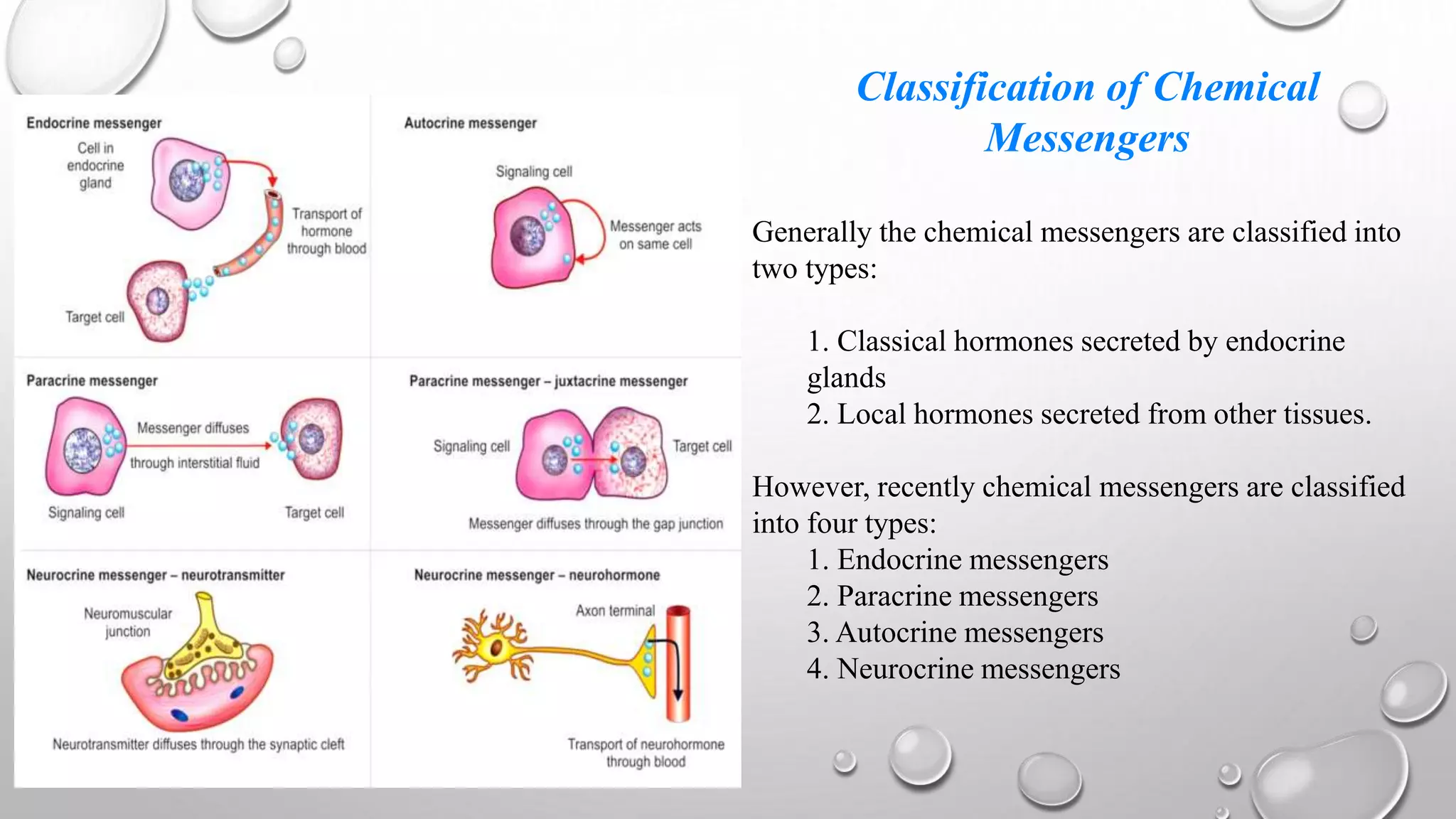
Classification of Chemical
Messengers
Generally the chemical messengers are classified into
two types:
1. Classical hormones secreted by endocrine
glands
2. Local hormones secreted from other tissues.
However, recently chemical messengers are classified
into four types:
1. Endocrine messengers
2. Paracrine messengers
3. Autocrine messengers
4. Neurocrine messengers
STUDY OF HORMONES
A hormone is usually studied as follows:
1. Source of secretion (gland as well as the cell that secretes the hormone)
2. Chemistry
3. Halflife
4. Synthesis and metabolism
5. Actions
6. Mode of action
7. Regulation of secretion
8. Applied physiology
i. Disorders due to hypersecretion of the hormone
ii. Disorders due to hyposecretion of the hormone.
Hormonal cascade system:
Hypothalamus to anterior pituitary to ultimate glands
 Signaling steps
 For many hormonal systems, pathway originates in brain using components that
innervate hypothalamus
 Hypothalamus responds by secreting specific releasing hormones (polypeptide
hormones)
 Releasing hormones transported through closed portal system to anterior pituitary; bind
to membrane receptors and cause secretion of specific anterior pituitary hormones
(polypeptide hormones)
 Anterior pituitary hormones enter bloodstream and bind receptors in ultimate glands
(such as thyroid gland, adrenal cortex, ovary, testes)
 Ultimate glands secrete hormones into bloodstream; hormones bind to receptors on
target tissues to generate systemic response
 Amplification of signal-
Amount and stability of
hormones increased at each step in
pathway
 Negative feedback-
Hormones inhibit previous
steps in pathway when sufficient
amounts are present
ENDOCRINE GLANDS
Endocrine
Gland
Hormone Primary Hormone Function
Hypothalamus Corticotropin- releasing
hormone (CRH)
Gonadotropin-releasing
hormone (GnRH)
Thyrotropin-releasing
hormone (TRH)
Growth hormone-releasing
hormone(GHRH)
Somatostatin
Dopamine
Stimulates the pituitary to release
adrenocorticotropic hormone (ACTH)
Stimulates the pituitary to release
luteinizing hormone (LH) and follicle-
stimulating hormone (FSH)
Stimulates the pituitary to release thyroid-
stimulating hormone (TSH)
Stimulates the release of growth hormone
(GH) from the pituitary
Inhibits the release of GH from the
pituitary
Inhibits the release of prolactin from the
pituitary
Endocrine Gland Hormone Primary Hormone Function
Anterior pituitary gland Adrenocorticotropic
hormone (ACTH)
Luteinizing hormone
(LH)
Follicle stimulating
hormone (FSH)
Thyroid stimulating
hormone (TSH)
Growth hormone
(GH)
Prolactin
Stimulates the release of hormones from
the adrenal cortex
In women, stimulates the production of sex
hormones (i.e.,estrogens) in the ovaries as
well as during ovulation; in men, stimulates
testosterone production in the testes
In women, stimulates follicle development;
in men, stimulates sperm production
Stimulates the release of thyroid hormone
Promotes the body’s growth and
development
Controls milk production (i.e., lactation)
Endocrine Gland Hormone Primary Hormone
Function
Posterior pituitary gland # Vasopressin
Oxytocin
Helps control the body’s water
and electrolyte levels
Promotes uterine contraction
during labor and activates
milk ejection in nursing
women
#These hormones are produced in the hypothalamus but stored in and released from the posterior pituitary
gland.
Endocrine Gland Hormone Primary Hormone Function
Thyroid gland Thyroid hormone (i.e., thyroxine
[T4] and triiodothyronine [T3])
Calcitonin
Controls metabolic processes in
all cells
Helps control calcium metabolism
(i.e., lowers calcium
levels in the blood)
Parathyroid gland Parathyroid hormone (PTH) Helps control calcium metabolism
(i.e., increases calcium levels in
the blood)
Endocrine Gland Hormone Primary Hormone Function
Pancreas Insulin
Glucagon
Helps control carbohydrate metabolism
(i.e., lowers blood sugar levels)
Helps control carbohydrate metabolism
(i.e., increases blood sugar levels)
Adrenal cortex Cortisol
Aldosterone
Helps control carbohydrate, protein,
and lipid metabolism; protects against
stress
Helps control the body’s water and
electrolyte regulation
Endocrine Gland Hormone Primary Hormone Function
Testes Testosterone Stimulates development of the
male reproductive organs, sperm
production, and protein anabolism
Ovaries Estrogen (produced by the
follicle)
Progesterone (produced by
the corpus luteum)
Stimulates development of the
female reproductive organs
Prepares uterus for pregnancy and
mammary glands for lactation
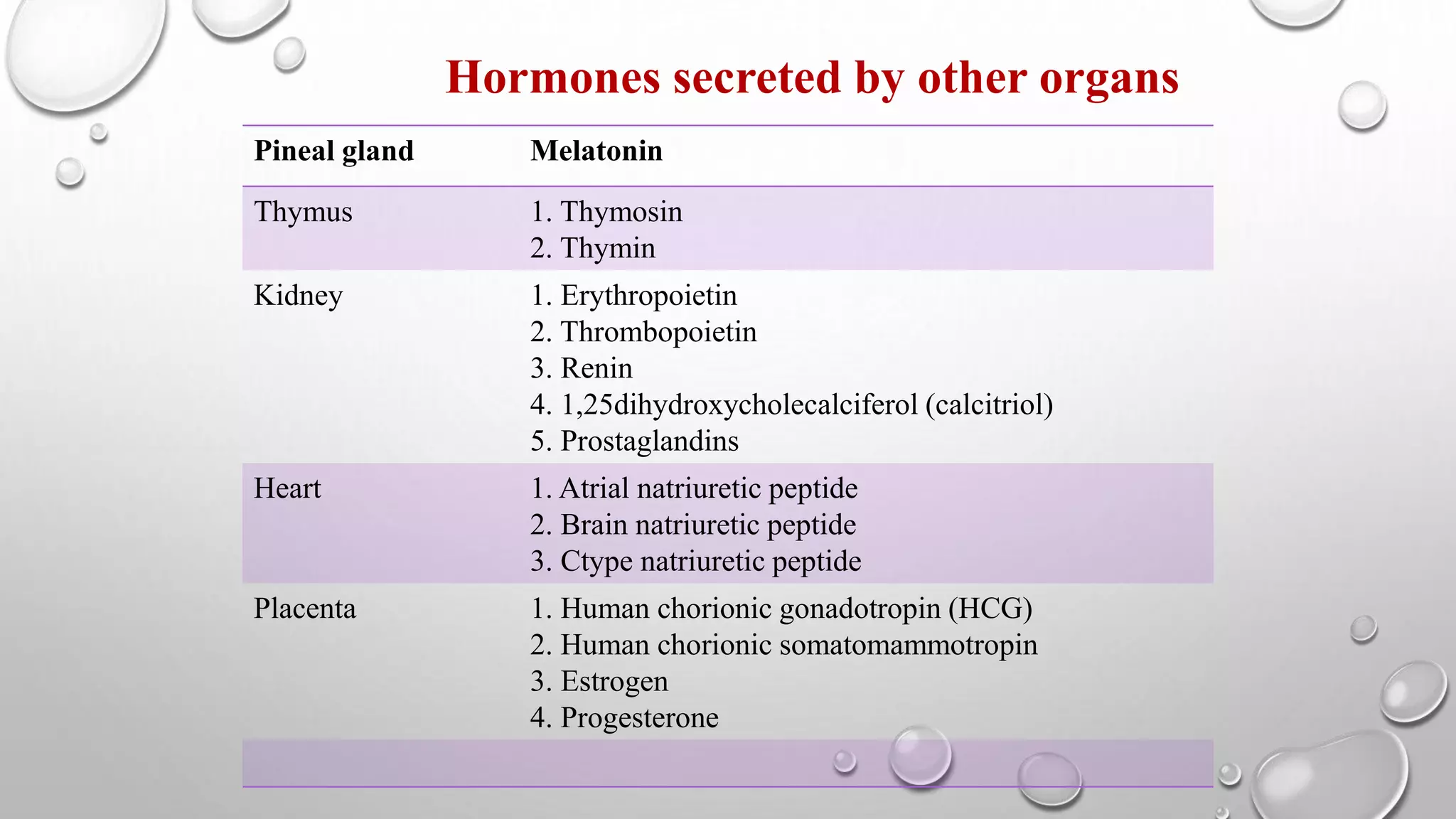
Hormones secreted by other organs
Pineal gland Melatonin
Thymus 1. Thymosin
2. Thymin
Kidney 1. Erythropoietin
2. Thrombopoietin
3. Renin
4. 1,25dihydroxycholecalciferol (calcitriol)
5. Prostaglandins
Heart 1. Atrial natriuretic peptide
2. Brain natriuretic peptide
3. Ctype natriuretic peptide
Placenta 1. Human chorionic gonadotropin (HCG)
2. Human chorionic somatomammotropin
3. Estrogen
4. Progesterone
Local hormones
Local hormones are the substances which act on the same area of their secretion or in
immediate neighborhood. The endocrine hormones are secreted in one place but execute their
actions on some other remote place.
Local hormones are usually released in an inactive form and are activated by some conditions
or substances.
Classification of Local Hormones
Local hormones are classified into two types:
I Hormones synthesized in tissues
II Hormones synthesized in blood
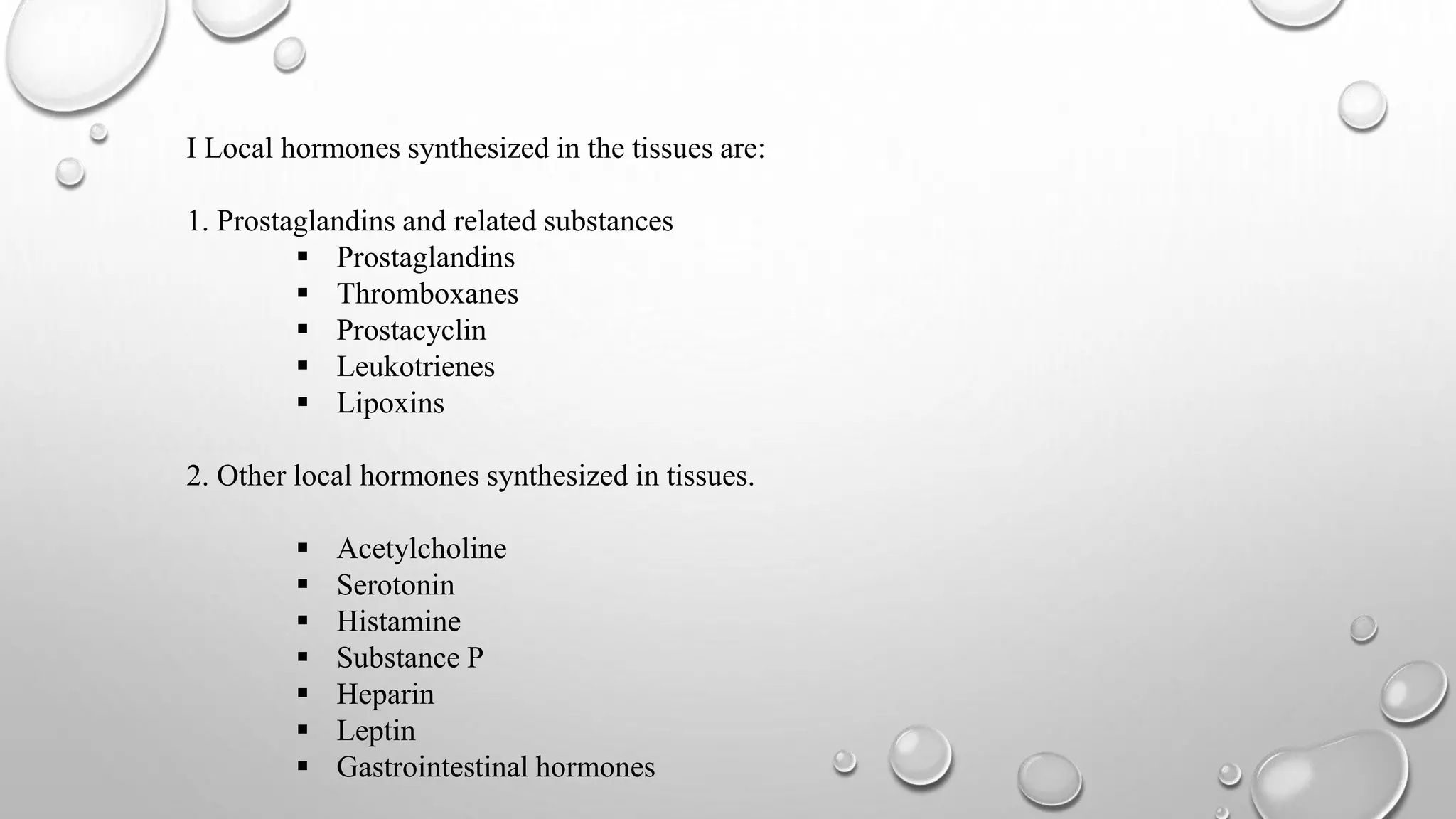
I Local hormones synthesized in the tissues are:
1. Prostaglandins and related substances
 Prostaglandins
 Thromboxanes
 Prostacyclin
 Leukotrienes
 Lipoxins
2. Other local hormones synthesized in tissues.
 Acetylcholine
 Serotonin
 Histamine
 Substance P
 Heparin
 Leptin
 Gastrointestinal hormones
II LOCAL HORMONES PRODUCED IN BLOOD
Local hormones produced in the blood are:
 Serotonin
 Angiotensinogen
 Kinins.
Hormonal cascade system involving hypothalamus

Hormonal cascade system involving hypothalamus

  • 1.
    SUBJECTIVE ASSIGNMENT -2 Course Name : UGC - ACADEMIC WRITING Name : K. VINOTH Email : vinobiochem2345@gmail.com Student ID : 1ec62c9cf35511e9ac22856977b3bf24
  • 2.
    Mr. K. VINOTH.,M.Sc., M.Phil., Assistant Professor Department of Biochemistry Islamiah College (Autonomous) HORMONAL CASCADE SYSTEM INVOLVING HYPOTHALAMUS
  • 3.
     INTRODUCTION  CLASSIFICATIONOF CHEMICAL MESSENGERS  STUDY OF HORMONES  HORMONAL CASCADE SYSTEM  ENDOCRINE GLANDS  Hypothalamus  Anterior pituitary gland  Posterior pituitary gland  Thyroid gland  Parathyroid gland  Pancreas  Adrenal cortex  Testes  Ovaries  HORMONES SECRETED BY OTHER ORGANS  LOCAL HORMONES
  • 4.
    INTRODUCTION All the physiologicalactivities of the body are regulated by two major systems: 1. Nervous system 2. Endocrine system. These two systems interact with one another and regulate the body functions. This section deals with endocrine system and Section 10 deals with nervous system. Endocrine system functions by secreting some chemical substances called hormones. CELL-TO-CELL SIGNALING Cell-to-cell signaling refers to the transfer of information from one cell to another. It is also called cell signalling or intercellular communication. The cells of the body communicate with each other through some chemical substances called chemical messengers. CHEMICAL MESSENGERS Chemical messengers are the substances involved in cell signaling. These messengers are mainly secreted from endocrine glands. Some chemical messengers are secreted by nerve endings and the cells of several other tissues also. All these chemical messengers carry the message (signal) from the signaling cells (controlling cells) to the target cells. The messenger substances may be the hormones or hormonelike substances.
  • 5.
    Classification of Chemical Messengers Generallythe chemical messengers are classified into two types: 1. Classical hormones secreted by endocrine glands 2. Local hormones secreted from other tissues. However, recently chemical messengers are classified into four types: 1. Endocrine messengers 2. Paracrine messengers 3. Autocrine messengers 4. Neurocrine messengers
  • 6.
    STUDY OF HORMONES Ahormone is usually studied as follows: 1. Source of secretion (gland as well as the cell that secretes the hormone) 2. Chemistry 3. Halflife 4. Synthesis and metabolism 5. Actions 6. Mode of action 7. Regulation of secretion 8. Applied physiology i. Disorders due to hypersecretion of the hormone ii. Disorders due to hyposecretion of the hormone.
  • 7.
    Hormonal cascade system: Hypothalamusto anterior pituitary to ultimate glands  Signaling steps  For many hormonal systems, pathway originates in brain using components that innervate hypothalamus  Hypothalamus responds by secreting specific releasing hormones (polypeptide hormones)  Releasing hormones transported through closed portal system to anterior pituitary; bind to membrane receptors and cause secretion of specific anterior pituitary hormones (polypeptide hormones)  Anterior pituitary hormones enter bloodstream and bind receptors in ultimate glands (such as thyroid gland, adrenal cortex, ovary, testes)  Ultimate glands secrete hormones into bloodstream; hormones bind to receptors on target tissues to generate systemic response
  • 8.
     Amplification ofsignal- Amount and stability of hormones increased at each step in pathway  Negative feedback- Hormones inhibit previous steps in pathway when sufficient amounts are present ENDOCRINE GLANDS
  • 10.
    Endocrine Gland Hormone Primary HormoneFunction Hypothalamus Corticotropin- releasing hormone (CRH) Gonadotropin-releasing hormone (GnRH) Thyrotropin-releasing hormone (TRH) Growth hormone-releasing hormone(GHRH) Somatostatin Dopamine Stimulates the pituitary to release adrenocorticotropic hormone (ACTH) Stimulates the pituitary to release luteinizing hormone (LH) and follicle- stimulating hormone (FSH) Stimulates the pituitary to release thyroid- stimulating hormone (TSH) Stimulates the release of growth hormone (GH) from the pituitary Inhibits the release of GH from the pituitary Inhibits the release of prolactin from the pituitary
  • 11.
    Endocrine Gland HormonePrimary Hormone Function Anterior pituitary gland Adrenocorticotropic hormone (ACTH) Luteinizing hormone (LH) Follicle stimulating hormone (FSH) Thyroid stimulating hormone (TSH) Growth hormone (GH) Prolactin Stimulates the release of hormones from the adrenal cortex In women, stimulates the production of sex hormones (i.e.,estrogens) in the ovaries as well as during ovulation; in men, stimulates testosterone production in the testes In women, stimulates follicle development; in men, stimulates sperm production Stimulates the release of thyroid hormone Promotes the body’s growth and development Controls milk production (i.e., lactation)
  • 12.
    Endocrine Gland HormonePrimary Hormone Function Posterior pituitary gland # Vasopressin Oxytocin Helps control the body’s water and electrolyte levels Promotes uterine contraction during labor and activates milk ejection in nursing women #These hormones are produced in the hypothalamus but stored in and released from the posterior pituitary gland.
  • 13.
    Endocrine Gland HormonePrimary Hormone Function Thyroid gland Thyroid hormone (i.e., thyroxine [T4] and triiodothyronine [T3]) Calcitonin Controls metabolic processes in all cells Helps control calcium metabolism (i.e., lowers calcium levels in the blood) Parathyroid gland Parathyroid hormone (PTH) Helps control calcium metabolism (i.e., increases calcium levels in the blood)
  • 14.
    Endocrine Gland HormonePrimary Hormone Function Pancreas Insulin Glucagon Helps control carbohydrate metabolism (i.e., lowers blood sugar levels) Helps control carbohydrate metabolism (i.e., increases blood sugar levels) Adrenal cortex Cortisol Aldosterone Helps control carbohydrate, protein, and lipid metabolism; protects against stress Helps control the body’s water and electrolyte regulation
  • 15.
    Endocrine Gland HormonePrimary Hormone Function Testes Testosterone Stimulates development of the male reproductive organs, sperm production, and protein anabolism Ovaries Estrogen (produced by the follicle) Progesterone (produced by the corpus luteum) Stimulates development of the female reproductive organs Prepares uterus for pregnancy and mammary glands for lactation
  • 16.
    Hormones secreted byother organs Pineal gland Melatonin Thymus 1. Thymosin 2. Thymin Kidney 1. Erythropoietin 2. Thrombopoietin 3. Renin 4. 1,25dihydroxycholecalciferol (calcitriol) 5. Prostaglandins Heart 1. Atrial natriuretic peptide 2. Brain natriuretic peptide 3. Ctype natriuretic peptide Placenta 1. Human chorionic gonadotropin (HCG) 2. Human chorionic somatomammotropin 3. Estrogen 4. Progesterone
  • 17.
    Local hormones Local hormonesare the substances which act on the same area of their secretion or in immediate neighborhood. The endocrine hormones are secreted in one place but execute their actions on some other remote place. Local hormones are usually released in an inactive form and are activated by some conditions or substances. Classification of Local Hormones Local hormones are classified into two types: I Hormones synthesized in tissues II Hormones synthesized in blood
  • 18.
    I Local hormonessynthesized in the tissues are: 1. Prostaglandins and related substances  Prostaglandins  Thromboxanes  Prostacyclin  Leukotrienes  Lipoxins 2. Other local hormones synthesized in tissues.  Acetylcholine  Serotonin  Histamine  Substance P  Heparin  Leptin  Gastrointestinal hormones
  • 19.
    II LOCAL HORMONESPRODUCED IN BLOOD Local hormones produced in the blood are:  Serotonin  Angiotensinogen  Kinins.