Chapter 1: Motion
Chapter 1: Motion
Section 1:
Section 1: Describing and Measuring Motion
Describing and Measuring Motion
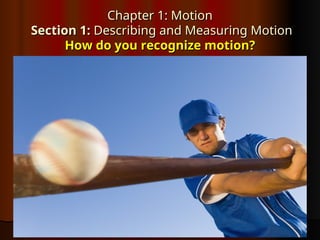
How do you recognize motion?
Chapter 1: Motion
Chapter 1: Motion
Section 1: Describing and Measuring Motion
How do you recognize motion?
An object is in
An object is in
motion
motion when its
when its
distance
distance from
from
another object is
another object is
changing
changing
Chapter 1: Motion
Chapter 1: Motion
Section 1: Describing and Measuring Motion
How do you recognize motion?
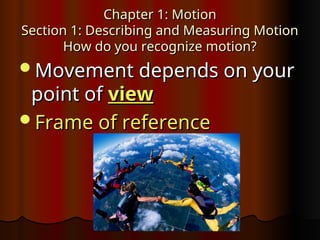
Movement depends on your
Movement depends on your
point of
point of view
view
Frame of reference
Frame of reference
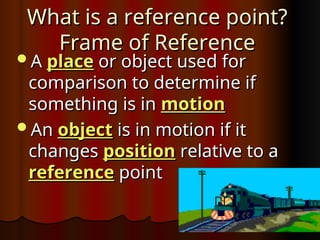
What is a reference point?
Frame of Reference
Frame of Reference
A
A place
place or object used for
or object used for
comparison to determine if
something is in
something is in motion
motion
An
An object
object is in motion if it
is in motion if it
changes
changes position
position relative to a
relative to a
reference
reference point
point
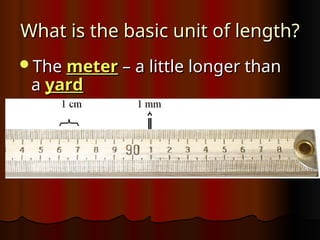
What is the basic unit of length?
The
The meter
meter – a little longer than
– a little longer than
a
a yard
yard
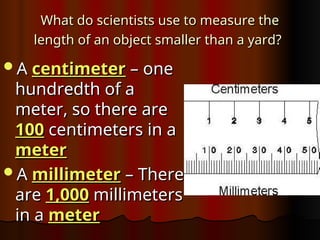
What do scientists use to measure the
length of an object smaller than a yard?
A
A centimeter
centimeter – one
– one
hundredth of a
hundredth of a
meter, so there are
meter, so there are
100
100 centimeters in a
centimeters in a
meter
meter
A
A millimeter
millimeter – There
– There
are
are 1,000
1,000 millimeters
millimeters
in a
in a meter
meter
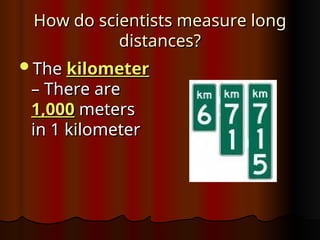
How do scientists measure long
distances?
distances?
The
The kilometer
kilometer
– There are
– There are
1,000
1,000 meters
meters
in 1 kilometer
in 1 kilometer
How do scientists calculate speed?
Speed – the
Speed – the distance
distance the object
the object
travels in one unit of
travels in one unit of time
time
Rate – tells you the amount of
Rate – tells you the amount of
something
something that occurs or
that occurs or
changes in one unit of
changes in one unit of time
time
Speed =
Speed = distance
distance
time
time
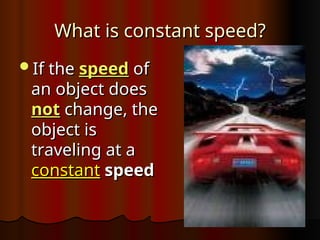
What is constant speed?
If the
If the speed
speed of
of
an object does
an object does
not
not change, the
change, the
object is
object is
traveling at a
traveling at a
constant
constant speed
speed
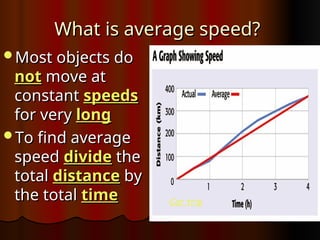
What is average speed?
Most objects do
Most objects do
not
not move at
move at
constant
constant speeds
speeds
for very
for very long
long
To find average
To find average
speed
speed divide
divide the
the
total
total distance
distance by
by
the total
the total time
time •Car trip
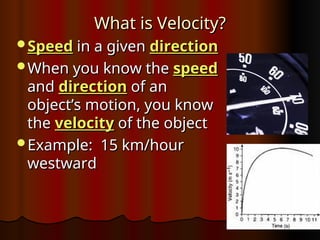
What is Velocity?
What is Velocity?
Speed
Speed in a given
in a given direction
direction
When you know the
When you know the speed
speed
and
and direction
direction of an
of an
object’s motion, you know
the
the velocity
velocity of the object
of the object
Example: 15 km/hour
Example: 15 km/hour
westward
westward
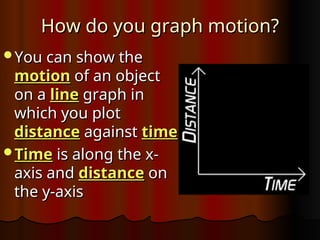
How do you graph motion?
You can show the
You can show the
motion
motion of an object
of an object
on a
on a line
line graph in
graph in
which you plot
which you plot
distance
distance against
against time
time
Time
Time is along the x-
is along the x-
axis and
axis and distance
distance on
on
the y-axis
the y-axis
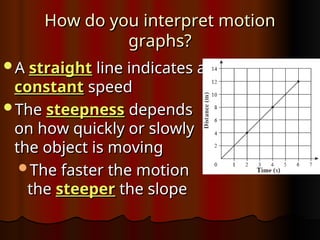
How do you interpret motion
graphs?
graphs?
A
A straight
straight line indicates a
line indicates a
constant
constant speed
speed
The
The steepness
steepness depends
depends
on how quickly or slowly
the object is moving
The faster the motion
The faster the motion
the
the steeper
steeper the slope
the slope
Section 2:
Section 2: Slow motion on Planet
Slow motion on Planet
Earth
Earth
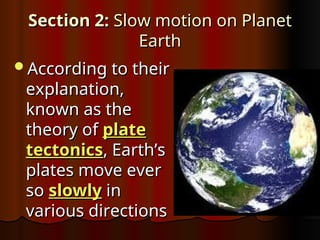
According to their
According to their
explanation,
explanation,
known as the
known as the
theory of
theory of plate
plate
tectonics
tectonics, Earth’s
, Earth’s
plates move ever
plates move ever
so
so slowly
slowly in
in
various directions
various directions
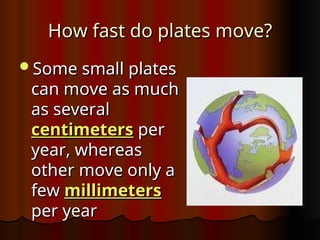
How fast do plates move?
Some small plates
Some small plates
can move as much
can move as much
as several
as several
centimeters
centimeters per
per
year, whereas
year, whereas
other move only a
other move only a
few
few millimeters
millimeters
per year
per year
How can you calculate the distance
an object has moved?
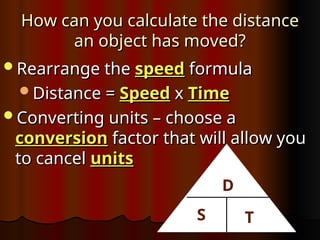
Rearrange the
Rearrange the speed
speed formula
formula
Distance =
Distance = Speed
Speed x
x Time
Time
Converting units – choose a
Converting units – choose a
conversion
conversion factor that will allow you
factor that will allow you
to cancel
to cancel units
units
D
S T
Section 3: Acceleration
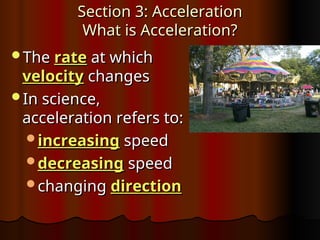
What is Acceleration?
The
The rate
rate at which
at which
velocity
velocity changes
changes
In science,
In science,
acceleration refers to:
increasing
increasing speed
speed
decreasing
decreasing speed
speed
changing
changing direction
direction
Acceleration
Acceleration
Whenever an objects speed
Whenever an objects speed
increases,
increases, the object
the object
accelerates.
accelerates.
Pitcher throwing a softball
Pitcher throwing a softball
Car moving from a stopped
Car moving from a stopped
position
position
Acceleration
Acceleration
Whenever an objects speed
Whenever an objects speed
SLOWS DOWN, the object
decelerates
decelerates or has negative
or has negative
acceleration.
acceleration.
Softball landing in the
Softball landing in the
catcher’s glove.
catcher’s glove.
Car stopping at a red light.
Car stopping at a red light.
Acceleration
Acceleration
Acceleration can be a
Acceleration can be a change in
change in
direction
direction as well as a change in
as well as a change in
speed.
speed.
Runners accelerate as the round a
Runners accelerate as the round a
curve
curve
car accelerates as it follows a curve in
car accelerates as it follows a curve in
the road
the road
a softball accelerates as it is hit by a
a softball accelerates as it is hit by a
bat.
bat.
Acceleration
Acceleration
Many objects continuously change
Many objects continuously change
direction without changing speed.
Circular motion
Circular motion – a motion
– a motion
along a circular path.
Ex. Seats on a Ferris wheel
Ex. Seats on a Ferris wheel
Stop and Think
Stop and Think
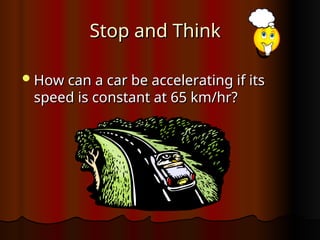
How can a car be accelerating if its
How can a car be accelerating if its
speed is constant at 65 km/hr?
How do you calculate acceleration?
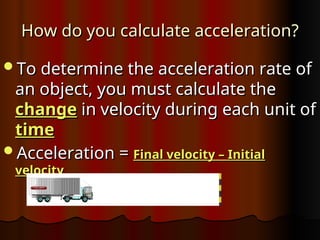
To determine the acceleration rate of
To determine the acceleration rate of
an object, you must calculate the
change
change in velocity during each unit of
in velocity during each unit of
time
time
Acceleration =
Acceleration = Final velocity – Initial
Final velocity – Initial
velocity
velocity
Time
Time
How do you interpret graphs to
determine acceleration?
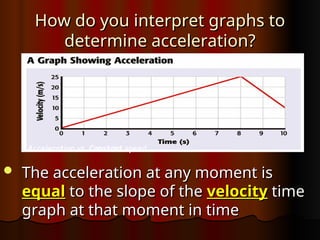
 The acceleration at any moment is
The acceleration at any moment is
equal
equal to the slope of the
to the slope of the velocity
velocity time
time
graph at that moment in time
Acceleration vs. Constant speed

Chapter 1 Motion Powerpoint and Notes.ppt

  • 1.
    Chapter 1: Motion Chapter1: Motion Section 1: Section 1: Describing and Measuring Motion Describing and Measuring Motion How do you recognize motion? How do you recognize motion?
  • 2.
    Chapter 1: Motion Chapter1: Motion Section 1: Describing and Measuring Motion Section 1: Describing and Measuring Motion How do you recognize motion? How do you recognize motion? An object is in An object is in motion motion when its when its distance distance from from another object is another object is changing changing
  • 3.
    Chapter 1: Motion Chapter1: Motion Section 1: Describing and Measuring Motion Section 1: Describing and Measuring Motion How do you recognize motion? How do you recognize motion? Movement depends on your Movement depends on your point of point of view view Frame of reference Frame of reference
  • 4.
    What is areference point? What is a reference point? Frame of Reference Frame of Reference A A place place or object used for or object used for comparison to determine if comparison to determine if something is in something is in motion motion An An object object is in motion if it is in motion if it changes changes position position relative to a relative to a reference reference point point
  • 5.
    What is thebasic unit of length? What is the basic unit of length? The The meter meter – a little longer than – a little longer than a a yard yard
  • 6.
    What do scientistsuse to measure the What do scientists use to measure the length of an object smaller than a yard? length of an object smaller than a yard? A A centimeter centimeter – one – one hundredth of a hundredth of a meter, so there are meter, so there are 100 100 centimeters in a centimeters in a meter meter A A millimeter millimeter – There – There are are 1,000 1,000 millimeters millimeters in a in a meter meter
  • 7.
    How do scientistsmeasure long How do scientists measure long distances? distances? The The kilometer kilometer – There are – There are 1,000 1,000 meters meters in 1 kilometer in 1 kilometer
  • 8.
    How do scientistscalculate speed? How do scientists calculate speed? Speed – the Speed – the distance distance the object the object travels in one unit of travels in one unit of time time Rate – tells you the amount of Rate – tells you the amount of something something that occurs or that occurs or changes in one unit of changes in one unit of time time Speed = Speed = distance distance time time
  • 9.
    What is constantspeed? What is constant speed? If the If the speed speed of of an object does an object does not not change, the change, the object is object is traveling at a traveling at a constant constant speed speed
  • 10.
    What is averagespeed? What is average speed? Most objects do Most objects do not not move at move at constant constant speeds speeds for very for very long long To find average To find average speed speed divide divide the the total total distance distance by by the total the total time time •Car trip
  • 11.
    What is Velocity? Whatis Velocity? Speed Speed in a given in a given direction direction When you know the When you know the speed speed and and direction direction of an of an object’s motion, you know object’s motion, you know the the velocity velocity of the object of the object Example: 15 km/hour Example: 15 km/hour westward westward
  • 12.
    How do yougraph motion? How do you graph motion? You can show the You can show the motion motion of an object of an object on a on a line line graph in graph in which you plot which you plot distance distance against against time time Time Time is along the x- is along the x- axis and axis and distance distance on on the y-axis the y-axis
  • 13.
    How do youinterpret motion How do you interpret motion graphs? graphs? A A straight straight line indicates a line indicates a constant constant speed speed The The steepness steepness depends depends on how quickly or slowly on how quickly or slowly the object is moving the object is moving The faster the motion The faster the motion the the steeper steeper the slope the slope
  • 14.
    Section 2: Section 2:Slow motion on Planet Slow motion on Planet Earth Earth According to their According to their explanation, explanation, known as the known as the theory of theory of plate plate tectonics tectonics, Earth’s , Earth’s plates move ever plates move ever so so slowly slowly in in various directions various directions
  • 15.
    How fast doplates move? How fast do plates move? Some small plates Some small plates can move as much can move as much as several as several centimeters centimeters per per year, whereas year, whereas other move only a other move only a few few millimeters millimeters per year per year
  • 16.
    How can youcalculate the distance How can you calculate the distance an object has moved? an object has moved? Rearrange the Rearrange the speed speed formula formula Distance = Distance = Speed Speed x x Time Time Converting units – choose a Converting units – choose a conversion conversion factor that will allow you factor that will allow you to cancel to cancel units units D S T
  • 17.
    Section 3: Acceleration Section3: Acceleration What is Acceleration? What is Acceleration? The The rate rate at which at which velocity velocity changes changes In science, In science, acceleration refers to: acceleration refers to: increasing increasing speed speed decreasing decreasing speed speed changing changing direction direction
  • 18.
    Acceleration Acceleration Whenever an objectsspeed Whenever an objects speed increases, increases, the object the object accelerates. accelerates. Pitcher throwing a softball Pitcher throwing a softball Car moving from a stopped Car moving from a stopped position position
  • 19.
    Acceleration Acceleration Whenever an objectsspeed Whenever an objects speed SLOWS DOWN, the object SLOWS DOWN, the object decelerates decelerates or has negative or has negative acceleration. acceleration. Softball landing in the Softball landing in the catcher’s glove. catcher’s glove. Car stopping at a red light. Car stopping at a red light.
  • 20.
    Acceleration Acceleration Acceleration can bea Acceleration can be a change in change in direction direction as well as a change in as well as a change in speed. speed. Runners accelerate as the round a Runners accelerate as the round a curve curve car accelerates as it follows a curve in car accelerates as it follows a curve in the road the road a softball accelerates as it is hit by a a softball accelerates as it is hit by a bat. bat.
  • 21.
    Acceleration Acceleration Many objects continuouslychange Many objects continuously change direction without changing speed. direction without changing speed. Circular motion Circular motion – a motion – a motion along a circular path. along a circular path. Ex. Seats on a Ferris wheel Ex. Seats on a Ferris wheel
  • 22.
    Stop and Think Stopand Think How can a car be accelerating if its How can a car be accelerating if its speed is constant at 65 km/hr? speed is constant at 65 km/hr?
  • 23.
    How do youcalculate acceleration? How do you calculate acceleration? To determine the acceleration rate of To determine the acceleration rate of an object, you must calculate the an object, you must calculate the change change in velocity during each unit of in velocity during each unit of time time Acceleration = Acceleration = Final velocity – Initial Final velocity – Initial velocity velocity Time Time
  • 24.
    How do youinterpret graphs to How do you interpret graphs to determine acceleration? determine acceleration?  The acceleration at any moment is The acceleration at any moment is equal equal to the slope of the to the slope of the velocity velocity time time graph at that moment in time graph at that moment in time Acceleration vs. Constant speed