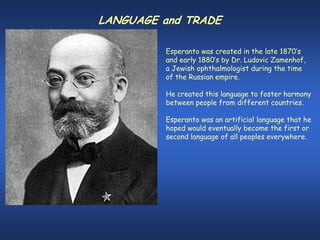
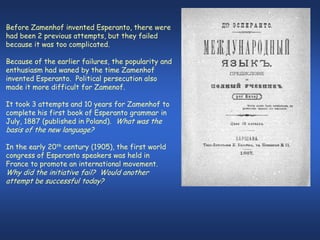
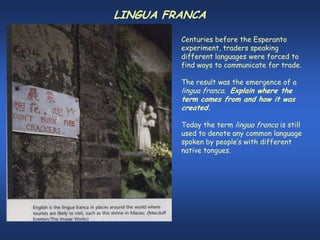
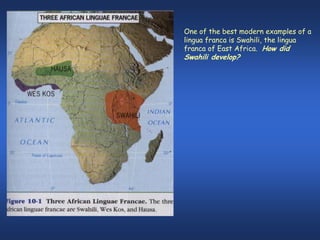
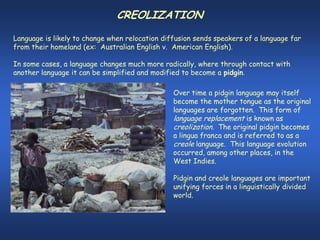
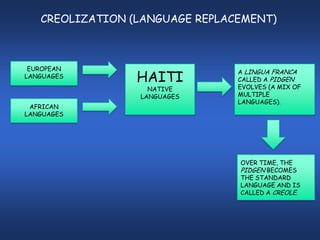
The document discusses the history and development of Esperanto, an artificial language created in the late 19th century to foster international harmony. It was invented by Dr. Ludovic Zamenhof, a Polish ophthalmologist, who hoped it would become the first or second language of all people. Esperanto incorporated elements from major European languages and had simpler grammar rules than natural languages. The first World Congress of Esperanto speakers was held in 1905 in France but the language initiative ultimately failed to gain widespread adoption. The document also examines the emergence of lingua francas throughout history to enable trade between groups speaking different languages, using Swahili in East Africa as a modern example.