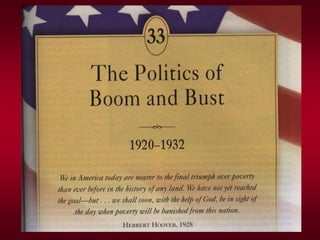
THE GREAT CRASH ENDS the GOLDEN TWENTIES
When Hoover became president there were not any obvious indications that the booming
economy was in trouble. Few people sensed that overproduction and over extension of
credit would bring the “economic house of cards” crashing down. Only a few brave souls
were bold enough to sound warnings and these were drowned out by the mad clatter of
the ticker-tape machine.
The catastrophic crash came in October 1929.


                                         The floor of the NYSE following the collapse
The crash was partially triggered by the British and other foreign investors. Tension
built up to the panicky “Black Tuesday” of October 29, 1929. Losses, even in blue-chip
securities, were unbelievable – by the end of 1929, stockholders had lost $40 billion in
paper values, more than the total cost of WWI to the U.S.
The stock market collapse heralded a business depression, at home and abroad, that was
the most prolonged and prostrating in American world experience.


                 The chaotic scene outside the NYSE following the crash
By the end of 1930, more than 4 million workers in the U.S. were jobless; two years later the figure
had about triples. Hungry and despairing workers searched for nonexistent jobs. Where employees
were not discharged, wages & salaries were often slashed. No socioeconomic group was immune from
the disaster.
The misery and gloom were incalculable, as factories closed, banks collapsed, and farmers
lost their farms. Life savings were lost, homes were lost, bread lines formed and soup
kitchens dispensed food.
Families felt the stress, as jobless fathers nursed their guilt and shame at not being able
to provide for their households.


               Unemployed workers desperate for jobs at a city job bureau
Breadless breadwinners often blamed themselves for their plight, despite evidence that
the economic system, not individual initiative, had broken down. The economic crisis
dramatically reduced the fertility rate in the country.
HOOKED on the HORN of PLENTY


               What caused the Great Depression?
               Consider both domestic and international
               factors.
By 1930 the depression had become a national calamity. Through no fault of their own, a
host of industrious citizens had lost everything. Initiative and and self-respect were
stifled, as panhandler begged. In extreme cases individuals slept under “Hoover blankets”
and lived in tin-and-paper shantytowns cynically named “Hoovervilles.”
The very foundations of America’s social and political structure trembled.

A.p. ch 33 pt. 3

  • 2.
    THE GREAT CRASHENDS the GOLDEN TWENTIES When Hoover became president there were not any obvious indications that the booming economy was in trouble. Few people sensed that overproduction and over extension of credit would bring the “economic house of cards” crashing down. Only a few brave souls were bold enough to sound warnings and these were drowned out by the mad clatter of the ticker-tape machine.
  • 3.
    The catastrophic crashcame in October 1929. The floor of the NYSE following the collapse
  • 4.
    The crash waspartially triggered by the British and other foreign investors. Tension built up to the panicky “Black Tuesday” of October 29, 1929. Losses, even in blue-chip securities, were unbelievable – by the end of 1929, stockholders had lost $40 billion in paper values, more than the total cost of WWI to the U.S.
  • 5.
    The stock marketcollapse heralded a business depression, at home and abroad, that was the most prolonged and prostrating in American world experience. The chaotic scene outside the NYSE following the crash
  • 6.
    By the endof 1930, more than 4 million workers in the U.S. were jobless; two years later the figure had about triples. Hungry and despairing workers searched for nonexistent jobs. Where employees were not discharged, wages & salaries were often slashed. No socioeconomic group was immune from the disaster.
  • 7.
    The misery andgloom were incalculable, as factories closed, banks collapsed, and farmers lost their farms. Life savings were lost, homes were lost, bread lines formed and soup kitchens dispensed food.
  • 8.
    Families felt thestress, as jobless fathers nursed their guilt and shame at not being able to provide for their households. Unemployed workers desperate for jobs at a city job bureau
  • 9.
    Breadless breadwinners oftenblamed themselves for their plight, despite evidence that the economic system, not individual initiative, had broken down. The economic crisis dramatically reduced the fertility rate in the country.
  • 10.
    HOOKED on theHORN of PLENTY What caused the Great Depression? Consider both domestic and international factors.
  • 11.
    By 1930 thedepression had become a national calamity. Through no fault of their own, a host of industrious citizens had lost everything. Initiative and and self-respect were stifled, as panhandler begged. In extreme cases individuals slept under “Hoover blankets” and lived in tin-and-paper shantytowns cynically named “Hoovervilles.”
  • 12.
    The very foundationsof America’s social and political structure trembled.