RUGGED TIMES for RUGGED INDIVIDUALISTS
Hoover’s exalted reputation as a wonder-worker and efficiency engineer crashed about as
dismally as the stock market. The perplexed president was impaled on the horns of a
cruel dilemma – explain this personal/political dilemma confronting Hoover in this
crisis.
The president at last worked out a compromise between the old hands-off philosophy and
the “soul-destroying” direct dole then being used in England. He would assist businesses in
the hope that its financial health would trickle-down to the masses.
Partisan critics sneered at the “Great Humanitarian,” who used federal funds to feed
faraway Belgians but would not use federal funds to feed needy Americans. Hostile
commentators criticized Hoover’s support for business who allegedly had plunged the
economy into the mess.


                                                            Much of this criticism was
                                                            unfair – why?

                                                            Put yourself in Hoover’s place
                                                            in October, 1929. Do you see
                                                            him as the “villain” or a
                                                            “political casualty” of the
                                                            event? Explain.
HERBERT HOOVER:
                     PIONEER for the NEW DEAL
President Hoover, in line with his “trickle-down” philosophy, at last recommended that
Congress vote immense sums for useful public works. Though at heart an anti-spender, he
secured from Congress appropriations totaling $2.25 billion for such projects. What was
most imposing of the public enterprises?

But Hoover sternly fought all schemes that he regarded as “socialistic.” Early in 1932
Congress established the Reconstruction Finance Corporation (RFC). Describe how this
federal agency would work.

Hoover’s administration also provided some indirect benefits for labor – the Norris-La
Guardia Anti-Injunction Act (1932).

The truth is that Hoover, despite criticism of his “heartlessness,” did inaugurate a
significant new policy. Slow though Hoover was to abandon this 19th century bias, by the
end of his term he had started down the road toward govt. assistance for needy citizens –
a road that FDR would travel much farther.

Describe Hoover’s woes with Congress during this critical time.
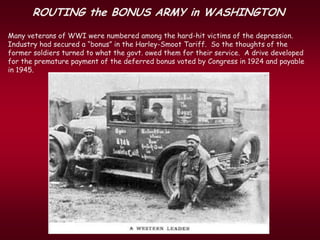
ROUTING the BONUS ARMY in WASHINGTON
Many veterans of WWI were numbered among the hard-hit victims of the depression.
Industry had secured a “bonus” in the Harley-Smoot Tariff. So the thoughts of the
former soldiers turned to what the govt. owed them for their service. A drive developed
for the premature payment of the deferred bonus voted by Congress in 1924 and payable
in 1945.
Thousands of impoverished veterans, both of war & unemployment, were now prepared to
move onto Washington, there to demand of Congress their immediate payment of their
entire bonus.
The “Bonus Expeditionary Force” (BEF), numbering 20,000, converged on the capital in the
summer of 1932. They promptly set up unsanitary camps. Describe the sequence of
events and their impact.
JAPANESE MILITARISTS ATTACK CHINA
The Great Depression added immensely to difficulties abroad. Militaristic Japanese
imperialists, taking advantage of the West’s economic woes, lunged into Manchuria, bolting
shut the Open Door in the conquered area.
Peaceful peoples were stunned by this act of naked aggression, which was a flagrant
violation of the League of Nations covenant. But the League was handicapped in taking
two-fisted action by the non-membership of the U.S. Numerous Americans, though by no
means a majority, urged strong measures.
Washington flatly rebuffed initial attempts in 1931 to secure American cooperation in
applying economic pressure on Japan. The only American response was the so-called
Stimson doctrine – what did it proclaim?


This verbal slap on the wrist from America did not deter the Japanese militarists.
Despite further Japanese aggression, there was no real American sentiment for armed
intervention. In a broad sense, collective security died and WWII was born in 1931 in
Manchuria.
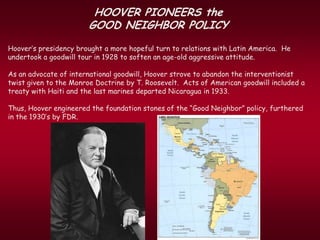
HOOVER PIONEERS the
                       GOOD NEIGHBOR POLICY
Hoover’s presidency brought a more hopeful turn to relations with Latin America. He
undertook a goodwill tour in 1928 to soften an age-old aggressive attitude.

As an advocate of international goodwill, Hoover strove to abandon the interventionist
twist given to the Monroe Doctrine by T. Roosevelt. Acts of American goodwill included a
treaty with Haiti and the last marines departed Nicaragua in 1933.

Thus, Hoover engineered the foundation stones of the “Good Neighbor” policy, furthered
in the 1930’s by FDR.

A.p. ch 33 pt. 4

  • 2.
    RUGGED TIMES forRUGGED INDIVIDUALISTS Hoover’s exalted reputation as a wonder-worker and efficiency engineer crashed about as dismally as the stock market. The perplexed president was impaled on the horns of a cruel dilemma – explain this personal/political dilemma confronting Hoover in this crisis.
  • 3.
    The president atlast worked out a compromise between the old hands-off philosophy and the “soul-destroying” direct dole then being used in England. He would assist businesses in the hope that its financial health would trickle-down to the masses.
  • 4.
    Partisan critics sneeredat the “Great Humanitarian,” who used federal funds to feed faraway Belgians but would not use federal funds to feed needy Americans. Hostile commentators criticized Hoover’s support for business who allegedly had plunged the economy into the mess. Much of this criticism was unfair – why? Put yourself in Hoover’s place in October, 1929. Do you see him as the “villain” or a “political casualty” of the event? Explain.
  • 5.
    HERBERT HOOVER: PIONEER for the NEW DEAL President Hoover, in line with his “trickle-down” philosophy, at last recommended that Congress vote immense sums for useful public works. Though at heart an anti-spender, he secured from Congress appropriations totaling $2.25 billion for such projects. What was most imposing of the public enterprises? But Hoover sternly fought all schemes that he regarded as “socialistic.” Early in 1932 Congress established the Reconstruction Finance Corporation (RFC). Describe how this federal agency would work. Hoover’s administration also provided some indirect benefits for labor – the Norris-La Guardia Anti-Injunction Act (1932). The truth is that Hoover, despite criticism of his “heartlessness,” did inaugurate a significant new policy. Slow though Hoover was to abandon this 19th century bias, by the end of his term he had started down the road toward govt. assistance for needy citizens – a road that FDR would travel much farther. Describe Hoover’s woes with Congress during this critical time.
  • 6.
    ROUTING the BONUSARMY in WASHINGTON Many veterans of WWI were numbered among the hard-hit victims of the depression. Industry had secured a “bonus” in the Harley-Smoot Tariff. So the thoughts of the former soldiers turned to what the govt. owed them for their service. A drive developed for the premature payment of the deferred bonus voted by Congress in 1924 and payable in 1945.
  • 7.
    Thousands of impoverishedveterans, both of war & unemployment, were now prepared to move onto Washington, there to demand of Congress their immediate payment of their entire bonus.
  • 8.
    The “Bonus ExpeditionaryForce” (BEF), numbering 20,000, converged on the capital in the summer of 1932. They promptly set up unsanitary camps. Describe the sequence of events and their impact.
  • 9.
    JAPANESE MILITARISTS ATTACKCHINA The Great Depression added immensely to difficulties abroad. Militaristic Japanese imperialists, taking advantage of the West’s economic woes, lunged into Manchuria, bolting shut the Open Door in the conquered area.
  • 10.
    Peaceful peoples werestunned by this act of naked aggression, which was a flagrant violation of the League of Nations covenant. But the League was handicapped in taking two-fisted action by the non-membership of the U.S. Numerous Americans, though by no means a majority, urged strong measures.
  • 11.
    Washington flatly rebuffedinitial attempts in 1931 to secure American cooperation in applying economic pressure on Japan. The only American response was the so-called Stimson doctrine – what did it proclaim? This verbal slap on the wrist from America did not deter the Japanese militarists. Despite further Japanese aggression, there was no real American sentiment for armed intervention. In a broad sense, collective security died and WWII was born in 1931 in Manchuria.
  • 12.
    HOOVER PIONEERS the GOOD NEIGHBOR POLICY Hoover’s presidency brought a more hopeful turn to relations with Latin America. He undertook a goodwill tour in 1928 to soften an age-old aggressive attitude. As an advocate of international goodwill, Hoover strove to abandon the interventionist twist given to the Monroe Doctrine by T. Roosevelt. Acts of American goodwill included a treaty with Haiti and the last marines departed Nicaragua in 1933. Thus, Hoover engineered the foundation stones of the “Good Neighbor” policy, furthered in the 1930’s by FDR.