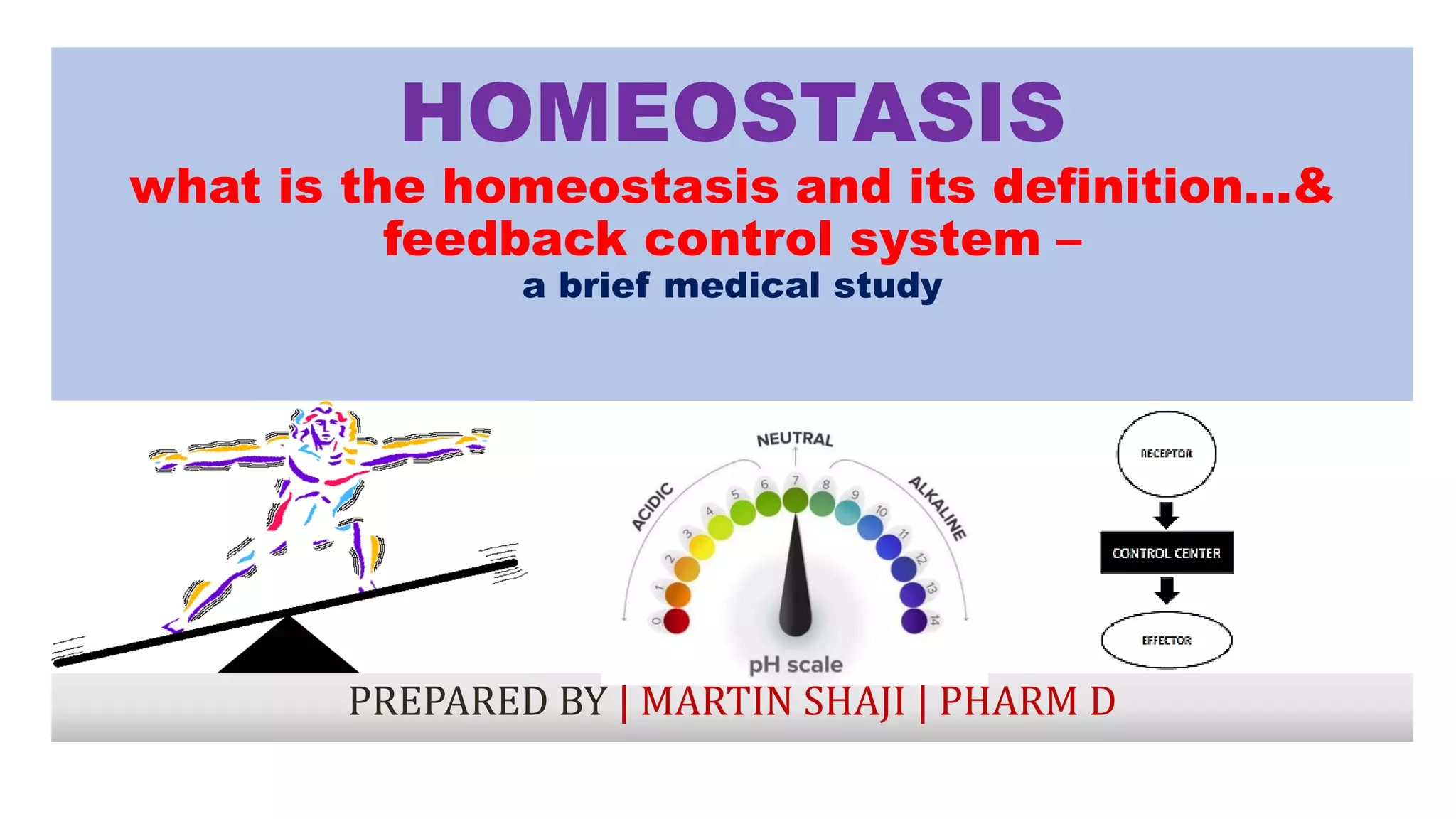
HOMEOSTASIS
what is the homeostasis and its definition…&
feedback control system –
a brief medical study
PREPARED BY | MARTIN SHAJI | PHARM D
HOMEOSTASIS:(homo>same)staisis>condition)
• Homeostasis, any self-regulating process by which biological
systems tend to maintain stability while adjusting to
conditions that are optimal for survival. If homeostasis is
successful, life continues; if unsuccessful, disaster or death
ensues. The stability attained is actually a dynamic
equilibrium, in which continuous change occurs yet relatively
uniform conditions prevail.
• Any system in dynamic equilibrium tends to reach a steady
state, a balance that resists outside forces of change. When
such a system is disturbed, built-in regulatory devices
respond to the departures to establish a new balance; such a
process is one of feedback control. All processes of
integration and coordination of function, whether mediated
by electrical circuits or by nervous and hormonal systems,
are examples of homeostatic regulation.
• A familiar example of homeostatic regulation in a mechanical
system is the action of a room-temperature regulator, or
thermostat. The heart of the thermostat is a bimetallic strip
that responds to temperature changes by completing or
disrupting an electric circuit. When the room cools, the circuit
is completed, the furnace operates, and the temperature rises.
At a preset level the circuit breaks, the furnace stops, and the
temperature drops. Biological systems, of greater complexity,
however, have regulators only very roughly comparable to
such mechanical devices. The two types of systems are alike,
however, in their goals—to sustain activity within prescribed
ranges, whether to control the thickness of rolled steel or the
pressure within the circulatory system.
THERMOSTAT:
• Adjusting a residential thermostat. A bimetallic strip inside the device
responds to temperature changes by completing or disrupting an
electric circuit. In a cold room the circuit is completed, the furnace
switches on, and the room's air temperature rises. At a preset level
the circuit breaks, causing the furnace to switch off and thereby
allowing the temperature to fall.
The concept of homeostasis
• The concept of homeostasis has also been applied to ecological settings. First
proposed by Canadian-born American ecologist Robert MacArthur in 1955,
homeostasis in ecosystems is a product of the combination of biodiversity and
large numbers of ecological interactions that occur between species. It was
thought of as a concept that could help to explain an ecosystem’s stability—that
is, its persistence as a particular ecosystem type over time (see ecological
resilience). Since then, the concept has changed slightly to incorporate the
ecosystem’s abiotic (nonliving) parts; the term has been used by many ecologists
to describe the reciprocation that occurs between an ecosystem’s living and
nonliving parts to maintain the status quo. The Gaia hypothesis—the model of
Earth posited by English scientist James Lovelock that considers its various living
and nonliving parts as components of a larger system or single organism—makes
the assumption that the collective effort of individual organisms contributes to
homeostasis at the planetary level. The single-organism aspect of the Gaia
hypothesis is considered controversial because it posits that living things, at
some level, are driven to work on behalf of the biosphere rather than toward the
goal of their own survival.
FEEDBACK CONTROL SYSTEM:
Feedback control system has two types
1:POSITIVE FEEDBACK
2:NEGATIVE FEEDBACK
First of all we need to understand feedback control system.
FEEDBACK CONTROL SYSTEM:
• Control system, means by which a variable quantity or set of
variable quantities is made to conform to a prescribed norm.
It either holds the values of the controlled quantities
constant or causes them to vary in a prescribed way. A
control system may be operated by electricity, by mechanical
means, by fluid pressure (liquid or gas), or by a combination
of means. When a computer is involved in the control circuit,
it is usually more convenient to operate all of the control
systems electrically, although intermixtures are fairly
common.
1:POSITIVE FEEDBACK:
• Homeostatic circuits usually involve negative feedback loops. The hallmark of a
negative feedback loop is that it counteracts a change, bringing the value of a
parameter—such as temperature or blood sugar—back towards it set point.
• Some biological systems, however, use positive feedback loops. Unlike negative
feedback loops, positive feedback loops amplify the starting signal. Positive
feedback loops are usually found in processes that need to be pushed to
completion, not when the status quo needs to be maintained.
• A positive feedback loop comes into play during childbirth. In childbirth, the
baby's head presses on the cervix—the bottom of the uterus, through which the
baby must emerge—and activates neurons to the brain. The neurons send a
signal that leads to release of the hormone oxytocin from the pituitary gland.
• Oxytocin increases uterine contractions, and thus pressure on the cervix. This
causes the release of even more oxytocin and produces even stronger
contractions. This positive feedback loop continues until the baby is born.
2:NEGATIVE FEEDBACK:
• Definition(1)
• A feedback in which the system responds to the
perturbation in the opposite direction as the perturbation
• (2) A feedback mechanism resulting in the inhibition or the
slowing down of a process
Supplement
• A feedback mechanism is a loop system wherein the system responds to a
perturbation. The response may be in the same direction (as in positive
feedback) or in the opposite direction (as in negative feedback).A negative
feedback is one that which responds to the perturbation in the opposite
direction as the perturbation, as opposed to a positive feedback that responds
in the same direction. While the mechanism involved in positive feedback
tends to initiate or accelerate a process, the mechanism involved in negative
feedback tends to inhibit it or slow down.
• A negative feedback is a self-regulatory system in which it feeds back to the
input a part of a system’s output so as to reverse the direction of change of
the output. The process reduces the output of a system in order to stabilize or
re-establish internal equilibrium.
• There are several negative feedback in biological system to regulate and
maintain homeostasis. Some of them are the regulation of hormone synthesis,
blood glucose levels, body temperature, and baroflex in blood pressure.
For a detailed study on acid base homeostasis
• https://www.slideshare.net/martinshaji/acid-base-homeostasis-a-
brief-study
Homeostasis| feedback control system - a brief medical study

Homeostasis| feedback control system - a brief medical study

  • 1.
    HOMEOSTASIS what is thehomeostasis and its definition…& feedback control system – a brief medical study PREPARED BY | MARTIN SHAJI | PHARM D
  • 2.
    HOMEOSTASIS:(homo>same)staisis>condition) • Homeostasis, anyself-regulating process by which biological systems tend to maintain stability while adjusting to conditions that are optimal for survival. If homeostasis is successful, life continues; if unsuccessful, disaster or death ensues. The stability attained is actually a dynamic equilibrium, in which continuous change occurs yet relatively uniform conditions prevail.
  • 3.
    • Any systemin dynamic equilibrium tends to reach a steady state, a balance that resists outside forces of change. When such a system is disturbed, built-in regulatory devices respond to the departures to establish a new balance; such a process is one of feedback control. All processes of integration and coordination of function, whether mediated by electrical circuits or by nervous and hormonal systems, are examples of homeostatic regulation.
  • 4.
    • A familiarexample of homeostatic regulation in a mechanical system is the action of a room-temperature regulator, or thermostat. The heart of the thermostat is a bimetallic strip that responds to temperature changes by completing or disrupting an electric circuit. When the room cools, the circuit is completed, the furnace operates, and the temperature rises. At a preset level the circuit breaks, the furnace stops, and the temperature drops. Biological systems, of greater complexity, however, have regulators only very roughly comparable to such mechanical devices. The two types of systems are alike, however, in their goals—to sustain activity within prescribed ranges, whether to control the thickness of rolled steel or the pressure within the circulatory system.
  • 5.
    THERMOSTAT: • Adjusting aresidential thermostat. A bimetallic strip inside the device responds to temperature changes by completing or disrupting an electric circuit. In a cold room the circuit is completed, the furnace switches on, and the room's air temperature rises. At a preset level the circuit breaks, causing the furnace to switch off and thereby allowing the temperature to fall.
  • 6.
    The concept ofhomeostasis • The concept of homeostasis has also been applied to ecological settings. First proposed by Canadian-born American ecologist Robert MacArthur in 1955, homeostasis in ecosystems is a product of the combination of biodiversity and large numbers of ecological interactions that occur between species. It was thought of as a concept that could help to explain an ecosystem’s stability—that is, its persistence as a particular ecosystem type over time (see ecological resilience). Since then, the concept has changed slightly to incorporate the ecosystem’s abiotic (nonliving) parts; the term has been used by many ecologists to describe the reciprocation that occurs between an ecosystem’s living and nonliving parts to maintain the status quo. The Gaia hypothesis—the model of Earth posited by English scientist James Lovelock that considers its various living and nonliving parts as components of a larger system or single organism—makes the assumption that the collective effort of individual organisms contributes to homeostasis at the planetary level. The single-organism aspect of the Gaia hypothesis is considered controversial because it posits that living things, at some level, are driven to work on behalf of the biosphere rather than toward the goal of their own survival.
  • 7.
    FEEDBACK CONTROL SYSTEM: Feedbackcontrol system has two types 1:POSITIVE FEEDBACK 2:NEGATIVE FEEDBACK First of all we need to understand feedback control system.
  • 8.
    FEEDBACK CONTROL SYSTEM: •Control system, means by which a variable quantity or set of variable quantities is made to conform to a prescribed norm. It either holds the values of the controlled quantities constant or causes them to vary in a prescribed way. A control system may be operated by electricity, by mechanical means, by fluid pressure (liquid or gas), or by a combination of means. When a computer is involved in the control circuit, it is usually more convenient to operate all of the control systems electrically, although intermixtures are fairly common.
  • 9.
    1:POSITIVE FEEDBACK: • Homeostaticcircuits usually involve negative feedback loops. The hallmark of a negative feedback loop is that it counteracts a change, bringing the value of a parameter—such as temperature or blood sugar—back towards it set point. • Some biological systems, however, use positive feedback loops. Unlike negative feedback loops, positive feedback loops amplify the starting signal. Positive feedback loops are usually found in processes that need to be pushed to completion, not when the status quo needs to be maintained. • A positive feedback loop comes into play during childbirth. In childbirth, the baby's head presses on the cervix—the bottom of the uterus, through which the baby must emerge—and activates neurons to the brain. The neurons send a signal that leads to release of the hormone oxytocin from the pituitary gland. • Oxytocin increases uterine contractions, and thus pressure on the cervix. This causes the release of even more oxytocin and produces even stronger contractions. This positive feedback loop continues until the baby is born.
  • 10.
    2:NEGATIVE FEEDBACK: • Definition(1) •A feedback in which the system responds to the perturbation in the opposite direction as the perturbation • (2) A feedback mechanism resulting in the inhibition or the slowing down of a process
  • 11.
    Supplement • A feedbackmechanism is a loop system wherein the system responds to a perturbation. The response may be in the same direction (as in positive feedback) or in the opposite direction (as in negative feedback).A negative feedback is one that which responds to the perturbation in the opposite direction as the perturbation, as opposed to a positive feedback that responds in the same direction. While the mechanism involved in positive feedback tends to initiate or accelerate a process, the mechanism involved in negative feedback tends to inhibit it or slow down. • A negative feedback is a self-regulatory system in which it feeds back to the input a part of a system’s output so as to reverse the direction of change of the output. The process reduces the output of a system in order to stabilize or re-establish internal equilibrium. • There are several negative feedback in biological system to regulate and maintain homeostasis. Some of them are the regulation of hormone synthesis, blood glucose levels, body temperature, and baroflex in blood pressure.
  • 12.
    For a detailedstudy on acid base homeostasis • https://www.slideshare.net/martinshaji/acid-base-homeostasis-a- brief-study