CASE STUDY BASED ON
{ Maxillofacial Trauma }
PREPARED BY
MARTIN SHAJI
Pharm D 4 th year
17G91T0023
• Patient name –Ms. v IP no. –12038
• Admission date- 19 - 10- 2020
• Discharge date – 22- 10 - 2020
• Age-50
• Sex-f
• Department- General Medicine
PATIENT DEMOGRAPHY
1. Physical examination: Patient was conscious and oriented.
C/O : Lt orbital edema after accident.
Pain in nose and head.
fall from 2 wheeler on 19/10, @ 12;00 pm and sustained injury to
face.
H/O : LOC 2 mins, nose bleed+ , No vomiting/seizures/ear bleed.
No other ENT complaints.
No other significant history
General Examinations
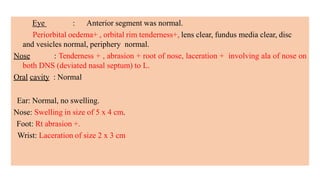
Eye : Anterior segment was normal.
Periorbital oedema+ , orbital rim tenderness+, lens clear, fundus media clear, disc
and vesicles normal, periphery normal.
Nose : Tenderness + , abrasion + root of nose, laceration + involving ala of nose on
both DNS (deviated nasal septum) to L.
Oral cavity : Normal
Ear: Normal, no swelling.
Nose: Swelling in size of 5 x 4 cm.
Foot: Rt abrasion +.
Wrist: Laceration of size 2 x 3 cm
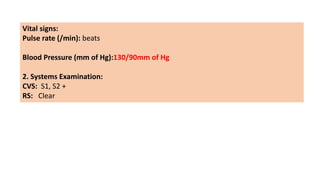
Vital signs:
Pulse rate (/min): beats
Blood Pressure (mm of Hg):130/90mm of Hg
2. Systems Examination:
CVS: S1, S2 +
RS: Clear
PLANNING
• Lab investigations [ CBC ]
• For Rhinoplastic surgery
• Cold Compress. Use cold compresses on eyes, cheeks, and forehead (not nose).
Without getting your nose cast too wet
• Bandage the foot abrasion
• Suturing / wrist laceration
• USG abdomen
• CT brain
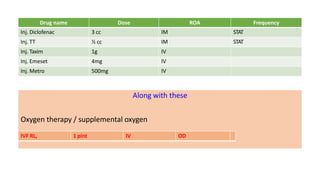
• Medications
Drug name Dose ROA Frequency
Inj. Diclofenac 3 cc IM STAT
Inj. TT ½ cc IM STAT
Inj. Taxim 1g IV
Inj. Emeset 4mg IV
Inj. Metro 500mg IV
Along with these
Oxygen therapy / supplemental oxygen
IVF RL, 1 pint IV OD
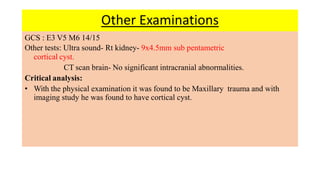
Other Examinations
GCS : E3 V5 M6 14/15
Other tests: Ultra sound- Rt kidney- 9x4.5mm sub pentametric
cortical cyst.
CT scan brain- No significant intracranial abnormalities.
Critical analysis:
• With the physical examination it was found to be Maxillary trauma and with
imaging study he was found to have cortical cyst.
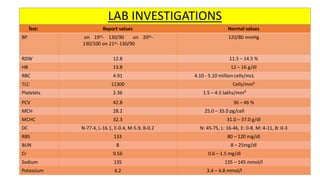
Test: Report values Normal values
BP on 19th- 130/90 on 20th-
130/100 on 21st- 130/90
120/80 mmHg
RDW 12.8 11.5 – 14.5 %
HB 13.8 12 – 16 g/dl
RBC 4.91 4.10 - 5.10 million cells/mcL
TLC 11300 Cells/mm³
Platelets 2.36 1.5 – 4.5 lakhs/mm³
PCV 42.8 36 – 46 %
MCH 28.2 25.0 – 35.0 pg/cell
MCHC 32.3 31.0 – 37.0 g/dl
DC N-77.4, L-16.1, E-0.4, M-5.9, B-0.2 N: 45-75, L: 16-46, E: 0-8, M: 4-11, B: 0-3
RBS 133 80 – 120 mg/dl
BUN 8 8 – 25mg/dl
Cr 0.56 0.6 – 1.5 mg/dl
Sodium 135 135 – 145 mmol/l
Potassium 4.2 3.4 – 4.8 mmol/l
LAB INVESTIGATIONS
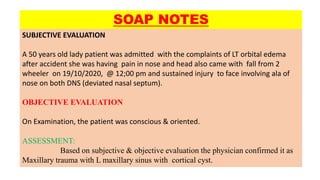
SUBJECTIVE EVALUATION
A 50 years old lady patient was admitted with the complaints of LT orbital edema
after accident she was having pain in nose and head also came with fall from 2
wheeler on 19/10/2020, @ 12;00 pm and sustained injury to face involving ala of
nose on both DNS (deviated nasal septum).
OBJECTIVE EVALUATION
On Examination, the patient was conscious & oriented.
ASSESSMENT:
Based on subjective & objective evaluation the physician confirmed it as
Maxillary trauma with L maxillary sinus with cortical cyst.
SOAP NOTES
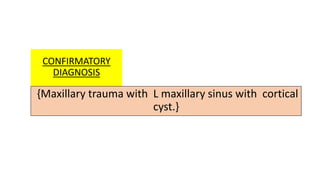
CONFIRMATORY
DIAGNOSIS
{Maxillary trauma with L maxillary sinus with cortical
cyst.}
}
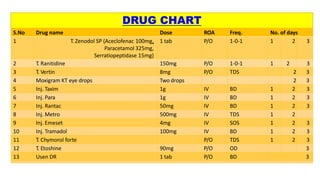
DRUG CHART
S.No Drug name Dose ROA Freq. No. of days
1 T. Zenodol SP (Aceclofenac 100mg,
Paracetamol 325mg,
Serratiopeptidase 15mg)
1 tab P/O 1-0-1 1 2 3
2 T
. Ranitidine 150mg P/O 1-0-1 1 2 3
3 T
. Vertin 8mg P/O TDS 2 3
4 Moxigram KT eye drops Two drops 2 3
5 Inj. Taxim 1g IV BD 1 2 3
6 Inj. Para 1g IV BD 1 2 3
7 Inj. Rantac 50mg IV BD 1 2 3
8 Inj. Metro 500mg IV TDS 1 2
9 Inj. Emeset 4mg IV SOS 1 2 3
10 Inj. Tramadol 100mg IV BD 1 2 3
11 T
. Chymorol forte P/O TDS 1 2 3
12 T
. Etoshine 90mg P/O OD 3
13 Usen DR 1 tab P/O BD 3
T . Bact ointment and Inj. Levetiracetam are given if required according to patient
condition.
REGARDING MEDICATION
RANTAC ( Ranitidine)
It is an anti ulcerative agent and should be taken twice a day before food.
FLAGYL(Metronidazole)
It is an antibiotic used against certain bacteria and protozoa , used to treat a wide
variety of infections induced by microbes but it wont stand against viruses.
ONDAN(Ondansetron)
It is an antiemetic agent used to treat nausea and vomiting caused due to
certain medical conditions. It works by blocking the action of a chemical substance
that causes nausea and vomiting.
T . Vertin
This tablet contains Betahistine and is used to treat Meniere's syndrome. Meniere's
syndrome is an ear disorder that may cause vertigo, ringing in the ears, spinning,
Serratiopeptidase
Serratiopeptidase helps relieve pain and swelling associated with post-operative
wounds and inflammatory diseases
T . Usen DR
Bromelain + Trypsin + Rutoside (90mg/48mg/100mg Tablet )is a combination of two enzymes
and an antioxidant .The enzymes work by increasing the blood supply to the affected area and
help the body produce substances that fight pain and swelling. and further reduces swelling.
T . Etoshine (Etoricoxib (90mg)
It is used for relieving moderate pain and swelling. It effectively alleviates pain, redness, and
swelling. Etoshine 90 Tablet may be taken with or without food, but it is better to take it at a
fixed time.
Inj . Taxim
Injection is an antibiotic medicine used to treat bacterial infections in your body. It is also used
to prevent infections during surgery. This helps to improve your symptoms and cure the
underlying infection.
T . Chymoral Forte
It is an anti-inflammatory medicine that is used in reducing pain and swelling. It is also helpful
in the quick healing of post-operative wounds, traumas, injuries or sprains. Chymo. They help to
improve the digestion and absorption of protein and essential nutrients in the body
PHARMACIST INTERVENTIONS
Findings:
• Possible drug-drug interaction with
1. Aceclofenac and Diclofenac
2. Metronidazole and Ondansetron
3. Ranitidine multiple form one should be eliminated .
Assesment:
• Aceclofenac and Diclofenac :
• Concurrent use of DICLOFENAC and NSAIDS AND SALICYLATES may
result in increased risk of bleeding
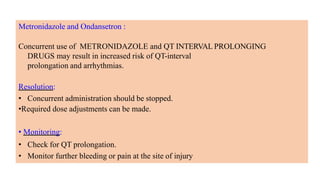
Metronidazole and Ondansetron :
Concurrent use of METRONIDAZOLE and QT INTERVAL PROLONGING
DRUGS may result in increased risk of QT-interval
prolongation and arrhythmias.
Resolution:
• Concurrent administration should be stopped.
•Required dose adjustments can be made.
• Monitoring:
• Check for QT prolongation.
• Monitor further bleeding or pain at the site of injury
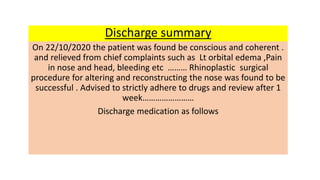
Discharge summary
On 22/10/2020 the patient was found be conscious and coherent .
and relieved from chief complaints such as Lt orbital edema ,Pain
in nose and head, bleeding etc ……… Rhinoplastic surgical
procedure for altering and reconstructing the nose was found to be
successful . Advised to strictly adhere to drugs and review after 1
week……………………
Discharge medication as follows
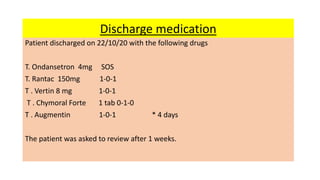
Discharge medication
Patient discharged on 22/10/20 with the following drugs
T. Ondansetron 4mg SOS
T. Rantac 150mg 1-0-1
T . Vertin 8 mg 1-0-1
T . Chymoral Forte 1 tab 0-1-0
T . Augmentin 1-0-1 * 4 days
The patient was asked to review after 1 weeks.
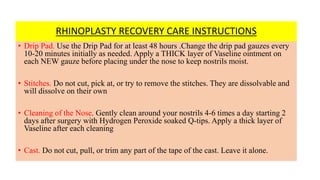
RHINOPLASTY RECOVERY CARE INSTRUCTIONS
• Drip Pad. Use the Drip Pad for at least 48 hours .Change the drip pad gauzes every
10-20 minutes initially as needed. Apply a THICK layer of Vaseline ointment on
each NEW gauze before placing under the nose to keep nostrils moist.
• Stitches. Do not cut, pick at, or try to remove the stitches. They are dissolvable and
will dissolve on their own
• Cleaning of the Nose. Gently clean around your nostrils 4-6 times a day starting 2
days after surgery with Hydrogen Peroxide soaked Q-tips. Apply a thick layer of
Vaseline after each cleaning
• Cast. Do not cut, pull, or trim any part of the tape of the cast. Leave it alone.
PATIENT COUNSELING- Instructions for patient
If Feel Dizziness Or Drowsiness For 4-6 Episodes ,Then Meet The ENT Specialist .
Stay Away From Unhygienic Conditions And Food .
Try To Avoid Infections .
Take a light food diet for one week .
Avoid stress full activities and driving .
Strictly adhere to drugs
Avoid alcohol, nicotine, and caffeine, these will dramatically slow the healing
process
DISCUSSION
Facial trauma, also called maxillofacial trauma, is any physical trauma to
the face. Facial trauma can involve soft tissue injuries such as burns,
lacerations and bruises, or fractures of the facial bones such as nasal
fractures and fractures of the jaw, as well as trauma such as eye injuries.
Symptoms are specific to the type of injury; for example, fractures may
involve pain, swelling, loss of function, or changes in the shape of facial
structures
• Facialinjuries have the potential to cause disfigurement and loss of function; for example,
blindness or difficulty moving the jaw can result. Although it is seldom life-threatening, facial
trauma can also be deadly, because it can cause severe bleeding or interference with the airway;
thus a primary concern in treatment is ensuring that the airway is open and not threatened so
that the patient can breathe. Depending on the type of facial injury, treatment may include
bandaging and suturing of open wounds, administration of ice, antibiotics and pain killers,
moving bones back into place, and surgery.When fractures are suspected, radiography is used
for diagnosis. Treatment may also be necessary for other injuries such as traumatic brain injury,
which commonly accompany severe facial trauma.
a case study on maxillofacial trauma

a case study on maxillofacial trauma

  • 1.
    CASE STUDY BASEDON { Maxillofacial Trauma } PREPARED BY MARTIN SHAJI Pharm D 4 th year 17G91T0023
  • 2.
    • Patient name–Ms. v IP no. –12038 • Admission date- 19 - 10- 2020 • Discharge date – 22- 10 - 2020 • Age-50 • Sex-f • Department- General Medicine PATIENT DEMOGRAPHY
  • 3.
    1. Physical examination:Patient was conscious and oriented. C/O : Lt orbital edema after accident. Pain in nose and head. fall from 2 wheeler on 19/10, @ 12;00 pm and sustained injury to face. H/O : LOC 2 mins, nose bleed+ , No vomiting/seizures/ear bleed. No other ENT complaints. No other significant history General Examinations
  • 4.
    Eye : Anteriorsegment was normal. Periorbital oedema+ , orbital rim tenderness+, lens clear, fundus media clear, disc and vesicles normal, periphery normal. Nose : Tenderness + , abrasion + root of nose, laceration + involving ala of nose on both DNS (deviated nasal septum) to L. Oral cavity : Normal Ear: Normal, no swelling. Nose: Swelling in size of 5 x 4 cm. Foot: Rt abrasion +. Wrist: Laceration of size 2 x 3 cm
  • 5.
    Vital signs: Pulse rate(/min): beats Blood Pressure (mm of Hg):130/90mm of Hg 2. Systems Examination: CVS: S1, S2 + RS: Clear
  • 6.
    PLANNING • Lab investigations[ CBC ] • For Rhinoplastic surgery • Cold Compress. Use cold compresses on eyes, cheeks, and forehead (not nose). Without getting your nose cast too wet • Bandage the foot abrasion • Suturing / wrist laceration • USG abdomen • CT brain • Medications
  • 7.
    Drug name DoseROA Frequency Inj. Diclofenac 3 cc IM STAT Inj. TT ½ cc IM STAT Inj. Taxim 1g IV Inj. Emeset 4mg IV Inj. Metro 500mg IV Along with these Oxygen therapy / supplemental oxygen IVF RL, 1 pint IV OD
  • 8.
    Other Examinations GCS :E3 V5 M6 14/15 Other tests: Ultra sound- Rt kidney- 9x4.5mm sub pentametric cortical cyst. CT scan brain- No significant intracranial abnormalities. Critical analysis: • With the physical examination it was found to be Maxillary trauma and with imaging study he was found to have cortical cyst.
  • 9.
    Test: Report valuesNormal values BP on 19th- 130/90 on 20th- 130/100 on 21st- 130/90 120/80 mmHg RDW 12.8 11.5 – 14.5 % HB 13.8 12 – 16 g/dl RBC 4.91 4.10 - 5.10 million cells/mcL TLC 11300 Cells/mm³ Platelets 2.36 1.5 – 4.5 lakhs/mm³ PCV 42.8 36 – 46 % MCH 28.2 25.0 – 35.0 pg/cell MCHC 32.3 31.0 – 37.0 g/dl DC N-77.4, L-16.1, E-0.4, M-5.9, B-0.2 N: 45-75, L: 16-46, E: 0-8, M: 4-11, B: 0-3 RBS 133 80 – 120 mg/dl BUN 8 8 – 25mg/dl Cr 0.56 0.6 – 1.5 mg/dl Sodium 135 135 – 145 mmol/l Potassium 4.2 3.4 – 4.8 mmol/l LAB INVESTIGATIONS
  • 10.
    SUBJECTIVE EVALUATION A 50years old lady patient was admitted with the complaints of LT orbital edema after accident she was having pain in nose and head also came with fall from 2 wheeler on 19/10/2020, @ 12;00 pm and sustained injury to face involving ala of nose on both DNS (deviated nasal septum). OBJECTIVE EVALUATION On Examination, the patient was conscious & oriented. ASSESSMENT: Based on subjective & objective evaluation the physician confirmed it as Maxillary trauma with L maxillary sinus with cortical cyst. SOAP NOTES
  • 11.
    CONFIRMATORY DIAGNOSIS {Maxillary trauma withL maxillary sinus with cortical cyst.} }
  • 12.
    DRUG CHART S.No Drugname Dose ROA Freq. No. of days 1 T. Zenodol SP (Aceclofenac 100mg, Paracetamol 325mg, Serratiopeptidase 15mg) 1 tab P/O 1-0-1 1 2 3 2 T . Ranitidine 150mg P/O 1-0-1 1 2 3 3 T . Vertin 8mg P/O TDS 2 3 4 Moxigram KT eye drops Two drops 2 3 5 Inj. Taxim 1g IV BD 1 2 3 6 Inj. Para 1g IV BD 1 2 3 7 Inj. Rantac 50mg IV BD 1 2 3 8 Inj. Metro 500mg IV TDS 1 2 9 Inj. Emeset 4mg IV SOS 1 2 3 10 Inj. Tramadol 100mg IV BD 1 2 3 11 T . Chymorol forte P/O TDS 1 2 3 12 T . Etoshine 90mg P/O OD 3 13 Usen DR 1 tab P/O BD 3
  • 13.
    T . Bactointment and Inj. Levetiracetam are given if required according to patient condition.
  • 14.
    REGARDING MEDICATION RANTAC (Ranitidine) It is an anti ulcerative agent and should be taken twice a day before food. FLAGYL(Metronidazole) It is an antibiotic used against certain bacteria and protozoa , used to treat a wide variety of infections induced by microbes but it wont stand against viruses. ONDAN(Ondansetron) It is an antiemetic agent used to treat nausea and vomiting caused due to certain medical conditions. It works by blocking the action of a chemical substance that causes nausea and vomiting. T . Vertin This tablet contains Betahistine and is used to treat Meniere's syndrome. Meniere's syndrome is an ear disorder that may cause vertigo, ringing in the ears, spinning, Serratiopeptidase Serratiopeptidase helps relieve pain and swelling associated with post-operative wounds and inflammatory diseases
  • 15.
    T . UsenDR Bromelain + Trypsin + Rutoside (90mg/48mg/100mg Tablet )is a combination of two enzymes and an antioxidant .The enzymes work by increasing the blood supply to the affected area and help the body produce substances that fight pain and swelling. and further reduces swelling. T . Etoshine (Etoricoxib (90mg) It is used for relieving moderate pain and swelling. It effectively alleviates pain, redness, and swelling. Etoshine 90 Tablet may be taken with or without food, but it is better to take it at a fixed time. Inj . Taxim Injection is an antibiotic medicine used to treat bacterial infections in your body. It is also used to prevent infections during surgery. This helps to improve your symptoms and cure the underlying infection. T . Chymoral Forte It is an anti-inflammatory medicine that is used in reducing pain and swelling. It is also helpful in the quick healing of post-operative wounds, traumas, injuries or sprains. Chymo. They help to improve the digestion and absorption of protein and essential nutrients in the body
  • 16.
    PHARMACIST INTERVENTIONS Findings: • Possibledrug-drug interaction with 1. Aceclofenac and Diclofenac 2. Metronidazole and Ondansetron 3. Ranitidine multiple form one should be eliminated . Assesment: • Aceclofenac and Diclofenac : • Concurrent use of DICLOFENAC and NSAIDS AND SALICYLATES may result in increased risk of bleeding
  • 17.
    Metronidazole and Ondansetron: Concurrent use of METRONIDAZOLE and QT INTERVAL PROLONGING DRUGS may result in increased risk of QT-interval prolongation and arrhythmias. Resolution: • Concurrent administration should be stopped. •Required dose adjustments can be made. • Monitoring: • Check for QT prolongation. • Monitor further bleeding or pain at the site of injury
  • 18.
    Discharge summary On 22/10/2020the patient was found be conscious and coherent . and relieved from chief complaints such as Lt orbital edema ,Pain in nose and head, bleeding etc ……… Rhinoplastic surgical procedure for altering and reconstructing the nose was found to be successful . Advised to strictly adhere to drugs and review after 1 week…………………… Discharge medication as follows
  • 19.
    Discharge medication Patient dischargedon 22/10/20 with the following drugs T. Ondansetron 4mg SOS T. Rantac 150mg 1-0-1 T . Vertin 8 mg 1-0-1 T . Chymoral Forte 1 tab 0-1-0 T . Augmentin 1-0-1 * 4 days The patient was asked to review after 1 weeks.
  • 20.
    RHINOPLASTY RECOVERY CAREINSTRUCTIONS • Drip Pad. Use the Drip Pad for at least 48 hours .Change the drip pad gauzes every 10-20 minutes initially as needed. Apply a THICK layer of Vaseline ointment on each NEW gauze before placing under the nose to keep nostrils moist. • Stitches. Do not cut, pick at, or try to remove the stitches. They are dissolvable and will dissolve on their own • Cleaning of the Nose. Gently clean around your nostrils 4-6 times a day starting 2 days after surgery with Hydrogen Peroxide soaked Q-tips. Apply a thick layer of Vaseline after each cleaning • Cast. Do not cut, pull, or trim any part of the tape of the cast. Leave it alone.
  • 21.
    PATIENT COUNSELING- Instructionsfor patient If Feel Dizziness Or Drowsiness For 4-6 Episodes ,Then Meet The ENT Specialist . Stay Away From Unhygienic Conditions And Food . Try To Avoid Infections . Take a light food diet for one week . Avoid stress full activities and driving . Strictly adhere to drugs Avoid alcohol, nicotine, and caffeine, these will dramatically slow the healing process
  • 22.
    DISCUSSION Facial trauma, alsocalled maxillofacial trauma, is any physical trauma to the face. Facial trauma can involve soft tissue injuries such as burns, lacerations and bruises, or fractures of the facial bones such as nasal fractures and fractures of the jaw, as well as trauma such as eye injuries. Symptoms are specific to the type of injury; for example, fractures may involve pain, swelling, loss of function, or changes in the shape of facial structures
  • 23.
    • Facialinjuries havethe potential to cause disfigurement and loss of function; for example, blindness or difficulty moving the jaw can result. Although it is seldom life-threatening, facial trauma can also be deadly, because it can cause severe bleeding or interference with the airway; thus a primary concern in treatment is ensuring that the airway is open and not threatened so that the patient can breathe. Depending on the type of facial injury, treatment may include bandaging and suturing of open wounds, administration of ice, antibiotics and pain killers, moving bones back into place, and surgery.When fractures are suspected, radiography is used for diagnosis. Treatment may also be necessary for other injuries such as traumatic brain injury, which commonly accompany severe facial trauma.