holistic perspectives on a blended learning environment an inter-disciplinary bachelor report
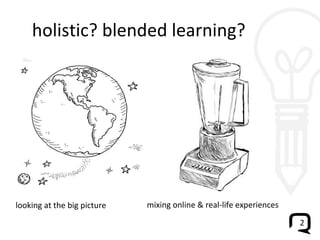
holistic? blended learning? mixing online & real-life experiences looking at the big picture
central question how can  we make  it * better? *it = learning, teaching and IT systems in this specific context
the challenge who? what? where? when? how? why? learning is  not limited  to a single teacher knowing everything  a set body of standards  the classroom a certain period in life one strategy or approach the same motivation for everybody
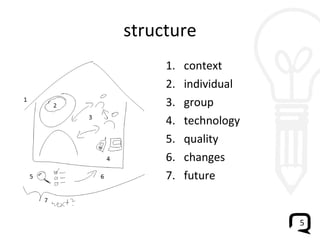
structure context individual group technology quality changes future
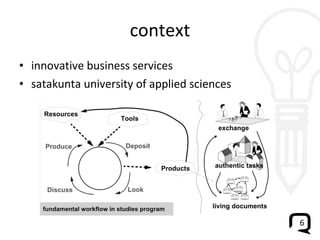
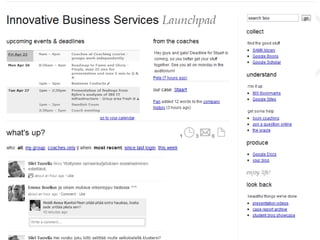
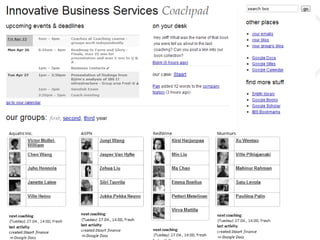
context innovative business services satakunta university of applied sciences
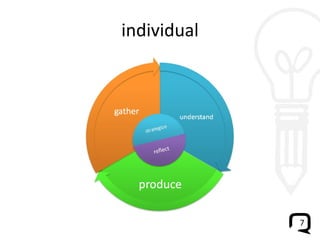
individual
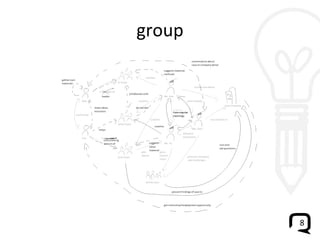
group
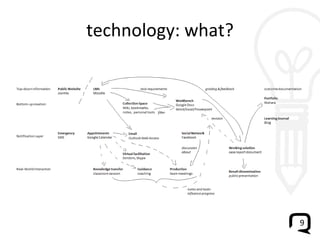
technology: what?
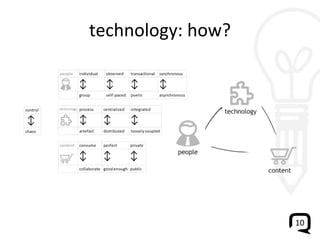
technology: how?
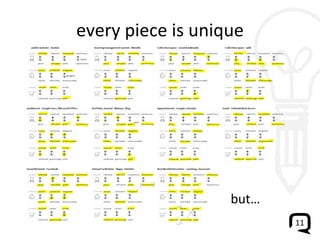
every piece is unique but…
common challenges people grouping, peeking, usability, fragmentation technology process integration, too many places content sharing, quality definition, publishing
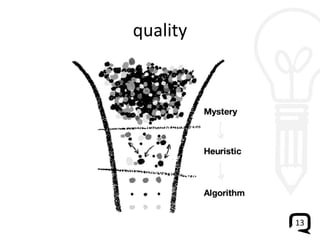
quality
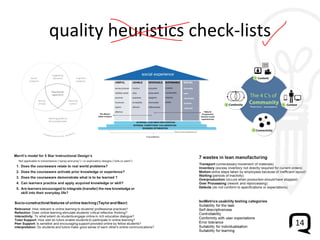
quality heuristics check-lists
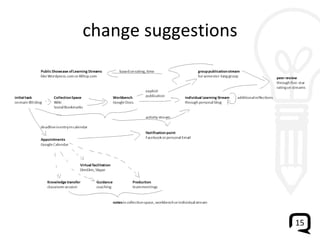
change suggestions
 
 
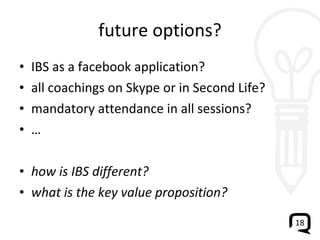
future options? IBS as a facebook application? all coachings on Skype or in Second Life? mandatory attendance in all sessions? … how is IBS different?  what is the key value proposition?
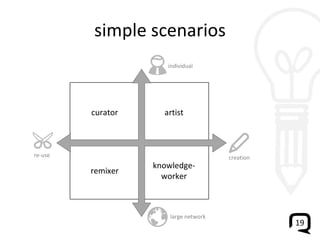
simple scenarios individual large network re-use creation curator artist remixer knowledge-worker
a curator knows sources/people takes time to select material displays it in a closed environment and gets money for letting people in example : exhibition, newspaper, library core principle : keeping a  cultural heritage
an artist pursues original ideas expressed in selected, varying doses takes inspiration from history & observation example : journalist, painter, musician core principle : truth, beauty, emotion
a remixer re-purposes & combines (unrelated) material piggybacks on recognition of original sources more inputs, more outputs, less control example : Grey Album, Girl Talk, GoMix.com core principle : stretching imagination
a knowledge-worker has to balance all the previous roles is constantly exposed to a large network of collaborators (colleagues, partners) has to find a way to  add value  to others’ work example : securities analyst, consultant, coach core principle : tangible, effective results
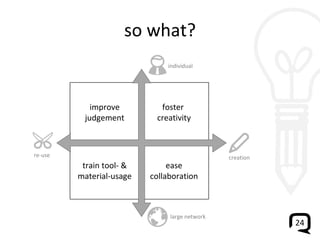
so what? individual large network re-use creation improve judgement foster  creativity train tool- & material-usage ease collaboration
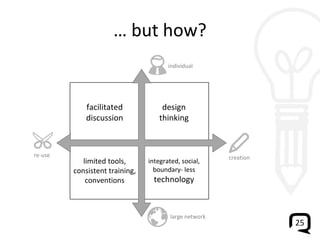
…  but how? individual large network re-use creation facilitated discussion design thinking limited tools, consistent training, conventions integrated, social, boundary- less technology
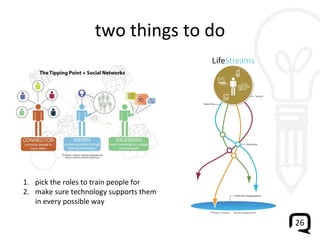
two things to do pick the roles to train people for make sure technology supports them in every possible way
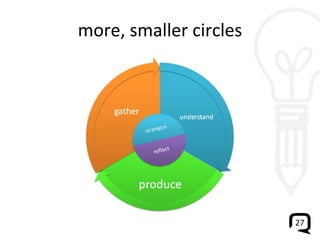
more, smaller circles
serendipity & innovation “ In the fields of observation chance favors only the prepared mind.” Louis Pasteur to create  innovative  business services, students need to find the  unexpected technology can foster and ease discovery, regular exchange and production
21 st  century learning? there’s an app for that
thank you! questions, critique, tomatoes?
sources slide 2 blender image:  http://blubberybastard.tripod.com/scrimshaw/blendr.jpg earth sketch:  static.howstuffworks.com/gif/earth-day-activities-57.jpg slide 10: The knowledge funnel, Roger Martin slide 11: Anderson et. al. 2004, David Armano (2x) Merill's instructional design guidelines (from Schneider 2005) 7 wastes in lean manufacturing (compare eg. Womack 1996) Taylor and Maor's socio-constructivist features of online teaching (from Schneider 2005) IsoMetrics Usability Categories, operationalized from ISO 9241, Part 10 (Gediga, Hamborg 1999) slide 22: David Armano,  darmano.typepad.com/logic_emotion/visualizations/ slide 23: Louis Pasteur, Lecture, University of Lille (7 December 1854)

Holistic perspectives on a blended learning environment

  • 1.
    holistic perspectives ona blended learning environment an inter-disciplinary bachelor report
  • 2.
    holistic? blended learning?mixing online & real-life experiences looking at the big picture
  • 3.
    central question howcan we make it * better? *it = learning, teaching and IT systems in this specific context
  • 4.
    the challenge who?what? where? when? how? why? learning is not limited to a single teacher knowing everything a set body of standards the classroom a certain period in life one strategy or approach the same motivation for everybody
  • 5.
    structure context individualgroup technology quality changes future
  • 6.
    context innovative businessservices satakunta university of applied sciences
  • 7.
  • 8.
  • 9.
  • 10.
  • 11.
    every piece isunique but…
  • 12.
    common challenges peoplegrouping, peeking, usability, fragmentation technology process integration, too many places content sharing, quality definition, publishing
  • 13.
  • 14.
  • 15.
  • 16.
  • 17.
  • 18.
    future options? IBSas a facebook application? all coachings on Skype or in Second Life? mandatory attendance in all sessions? … how is IBS different? what is the key value proposition?
  • 19.
    simple scenarios individuallarge network re-use creation curator artist remixer knowledge-worker
  • 20.
    a curator knowssources/people takes time to select material displays it in a closed environment and gets money for letting people in example : exhibition, newspaper, library core principle : keeping a cultural heritage
  • 21.
    an artist pursuesoriginal ideas expressed in selected, varying doses takes inspiration from history & observation example : journalist, painter, musician core principle : truth, beauty, emotion
  • 22.
    a remixer re-purposes& combines (unrelated) material piggybacks on recognition of original sources more inputs, more outputs, less control example : Grey Album, Girl Talk, GoMix.com core principle : stretching imagination
  • 23.
    a knowledge-worker hasto balance all the previous roles is constantly exposed to a large network of collaborators (colleagues, partners) has to find a way to add value to others’ work example : securities analyst, consultant, coach core principle : tangible, effective results
  • 24.
    so what? individuallarge network re-use creation improve judgement foster creativity train tool- & material-usage ease collaboration
  • 25.
    … buthow? individual large network re-use creation facilitated discussion design thinking limited tools, consistent training, conventions integrated, social, boundary- less technology
  • 26.
    two things todo pick the roles to train people for make sure technology supports them in every possible way
  • 27.
  • 28.
    serendipity & innovation“ In the fields of observation chance favors only the prepared mind.” Louis Pasteur to create innovative business services, students need to find the unexpected technology can foster and ease discovery, regular exchange and production
  • 29.
    21 st century learning? there’s an app for that
  • 30.
    thank you! questions,critique, tomatoes?
  • 31.
    sources slide 2blender image: http://blubberybastard.tripod.com/scrimshaw/blendr.jpg earth sketch: static.howstuffworks.com/gif/earth-day-activities-57.jpg slide 10: The knowledge funnel, Roger Martin slide 11: Anderson et. al. 2004, David Armano (2x) Merill's instructional design guidelines (from Schneider 2005) 7 wastes in lean manufacturing (compare eg. Womack 1996) Taylor and Maor's socio-constructivist features of online teaching (from Schneider 2005) IsoMetrics Usability Categories, operationalized from ISO 9241, Part 10 (Gediga, Hamborg 1999) slide 22: David Armano, darmano.typepad.com/logic_emotion/visualizations/ slide 23: Louis Pasteur, Lecture, University of Lille (7 December 1854)

Editor's Notes

  • #13 issues wih people group issue: not consistent across tools observation gap: only Facebook facilitates "peeking", in Mahara only after the fact poetic limits: usability of tools hinders creative process asynchronous communication: too many channels => fragmentation   issues with technology too artefact-centric, no best practice for holistic process too many centralized points, distributed parts not well integrated   issues with content consume oriented material not shared, collaboration places to distributed no shared definition of quality (reference, re-use vs. re-creation, contextualisation) no clear policy for publishing in private, group, collective, world