Developing a Framework for Understanding and Evaluating the Impact of Open Educational Resources Li Yuan JISC CETIS, Institute Educational Cybernetics, University of Bolton
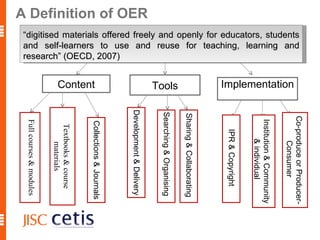
A Definition of OER   “ digitised materials offered freely and openly for educators, students and self-learners to use and reuse for teaching, learning and research” (OECD, 2007) Content Tools Implementation  Development & Delivery  Searching & Organising  Sharing & Collaborating  IPR & Copyright  Co-produce or Producer- Consumer  Institution & Community & individual  Full courses & modules Collections & Journals Textbooks & course materials
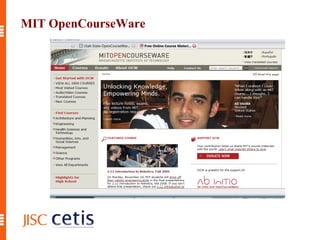
MIT OpenCourseWare
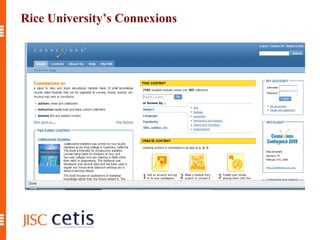
Rice University’s Connexions
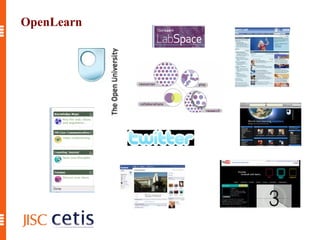
OpenLearn
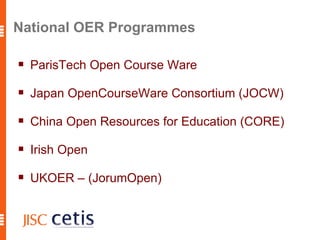
National OER Programmes  ParisTech Open Course Ware Japan OpenCourseWare Consortium (JOCW) China Open Resources for Education (CORE) Irish Open  UKOER – (JorumOpen)
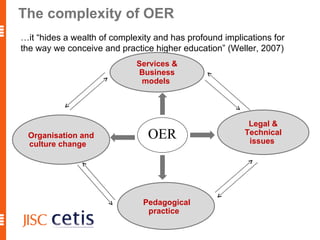
The complexity of OER … it “hides a wealth of complexity and has profound implications for the way we conceive and practice higher education” (Weller, 2007) OER Legal & Technical issues  Services & Business models  Pedagogical practice  Organisation and culture change
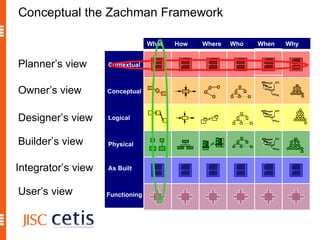
Conceptual the Zachman Framework Planner’s view Owner’s view Designer’s view Builder’s view Integrator’s view User’s view Contextual Conceptual Logical Physical As Built Functioning Why Who When Where What How
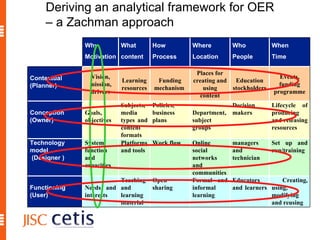
Deriving an analytical framework for OER – a Zachman approach Why Motivation What content How Process  Where Location  Who  People  When Time  Contextual (Planner) Vision, mission, drivers Learning resources Funding mechanism  Places for creating and using content Education stockholders Events, funding programme Conception (Owner) Goals, objectives Subjects, media types and content formats Policies, business plans Department, subject groups Decision makers Lifecycle of producing and releasing resources Technology  model (Designer ) System function and capacities Platforms and tools Work flow Online  social networks and  communities  managers and technician  Set up and run/training Functioning  (User) Needs and interests  Teaching and learning material Open sharing  Formal and informal learning  Educators and learners  Creating, using, modifying  and reusing
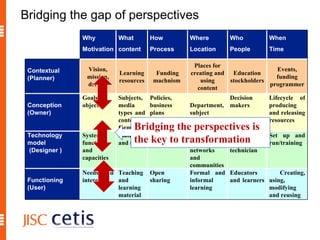
Bridging the gap of perspectives  Bridging the perspectives is the key to transformation Why Motivation What content How Process Where Location  Who  People  When Time  Contextual (Planner) Vision, mission, drivers Learning resources Funding machnism  Places for creating and using content Education stockholders Events, funding programmer Conception (Owner) Goals, objective  Subjects, media types and content formats Policies, business plans Department, subject groups Decision makers Lifecycle of producing and releasing resources Technology  model (Designer ) System function and capacities Platforms and tools Work flow Online  social networks and  communities  managers and technician  Set up and run/training Functioning  (User) Needs and interests  Teaching and learning material Open sharing  Formal and informal learning  Educators and learners  Creating, using, modifying  and reusing
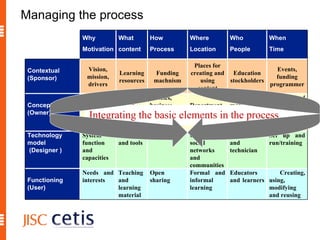
Managing the process  Integrating the basic elements in the process  Why Motivation What content How Process  Where Location  Who  People  When Time  Contextual (Sponsor) Vision, mission, drivers Learning resources Funding machnism Places for creating and using content Education stockholders Events, funding programmer Conception (Owner) Goals, strategies  Subjects, media types and content formats Policies, business plans Department, subject groups Decision makers Lifecycle of producing and releasing resources Technology  model (Designer ) System function and capacities Platforms and tools Work flow Online  social networks and  communities  managers and technician  Set up and run/training Functioning  (User) Needs and interests  Teaching and learning material Open sharing  Formal and informal learning  Educators and learners  Creating, using, modifying  and reusing
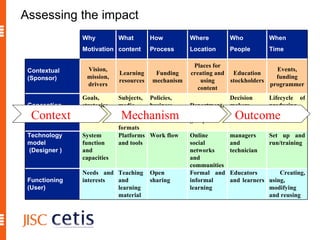
Assessing the impact  Context Mechanism  Outcome Why Motivation What content How Process  Where Location  Who  People  When Time  Contextual (Sponsor) Vision, mission, drivers Learning resources Funding mechanism Places for creating and using content Education stockholders Events, funding programmer Conception (Owner) Goals, strategies  Subjects, media types and content formats Policies, business plans Department, subject groups Decision makers Lifecycle of producing and releasing resources Technology  model (Designer ) System function and capacities Platforms and tools Work flow Online  social networks and  communities  managers and technician  Set up and run/training Functioning  (User) Needs and interests  Teaching and learning material Open sharing  Formal and informal learning  Educators and learners  Creating, using, modifying  and reusing
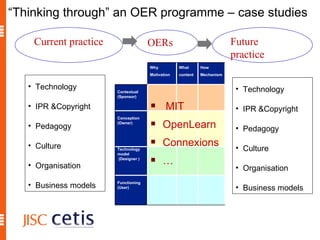
MIT OpenLearn Connexions … Current practice  Future practice  OERs Technology  IPR &Copyright Pedagogy  Culture  Organisation Business models  Technology  IPR &Copyright Pedagogy  Culture  Organisation Business models  “ Thinking through” an OER programme – case studies Why Motivation What content How Mechanism  Contextual (Sponsor) Conception (Owner) Technology  model (Designer ) Functioning  (User)
References: CETIS Briefing Paper (2008),  Open Educational Resources – Opportunities and Challenges for Higher Education ,  http://wiki.cetis.ac.uk/images/0/0b/OER_Briefing_Paper.pdf   OECD (2007),  Giving Knowledge for Free: the Emergence of Open Educational Resources,  http://tinyurl.com/62hjx6 Pawson, Ray and Tilley, N (1997), Realistic evaluation Zachman, J. A. (1987), A Framework for Information Systems Architecture.  IBM Systems Journal 26,(3).
Thanks for your attention!!! For more information about OER working group and future events at CETIS, please visit  Cetis website at  http://jisc.cetis.ac.uk/  or email Li Yuan at l.yuan@bolton.ac.uk

Cal09 Presentation

  • 1.
    Developing a Frameworkfor Understanding and Evaluating the Impact of Open Educational Resources Li Yuan JISC CETIS, Institute Educational Cybernetics, University of Bolton
  • 2.
    A Definition ofOER “ digitised materials offered freely and openly for educators, students and self-learners to use and reuse for teaching, learning and research” (OECD, 2007) Content Tools Implementation Development & Delivery Searching & Organising Sharing & Collaborating IPR & Copyright Co-produce or Producer- Consumer Institution & Community & individual Full courses & modules Collections & Journals Textbooks & course materials
  • 3.
  • 4.
  • 5.
  • 6.
    National OER Programmes ParisTech Open Course Ware Japan OpenCourseWare Consortium (JOCW) China Open Resources for Education (CORE) Irish Open UKOER – (JorumOpen)
  • 7.
    The complexity ofOER … it “hides a wealth of complexity and has profound implications for the way we conceive and practice higher education” (Weller, 2007) OER Legal & Technical issues Services & Business models Pedagogical practice Organisation and culture change
  • 8.
    Conceptual the ZachmanFramework Planner’s view Owner’s view Designer’s view Builder’s view Integrator’s view User’s view Contextual Conceptual Logical Physical As Built Functioning Why Who When Where What How
  • 9.
    Deriving an analyticalframework for OER – a Zachman approach Why Motivation What content How Process Where Location Who People When Time Contextual (Planner) Vision, mission, drivers Learning resources Funding mechanism Places for creating and using content Education stockholders Events, funding programme Conception (Owner) Goals, objectives Subjects, media types and content formats Policies, business plans Department, subject groups Decision makers Lifecycle of producing and releasing resources Technology model (Designer ) System function and capacities Platforms and tools Work flow Online social networks and communities managers and technician Set up and run/training Functioning (User) Needs and interests Teaching and learning material Open sharing Formal and informal learning Educators and learners Creating, using, modifying and reusing
  • 10.
    Bridging the gapof perspectives Bridging the perspectives is the key to transformation Why Motivation What content How Process Where Location Who People When Time Contextual (Planner) Vision, mission, drivers Learning resources Funding machnism Places for creating and using content Education stockholders Events, funding programmer Conception (Owner) Goals, objective Subjects, media types and content formats Policies, business plans Department, subject groups Decision makers Lifecycle of producing and releasing resources Technology model (Designer ) System function and capacities Platforms and tools Work flow Online social networks and communities managers and technician Set up and run/training Functioning (User) Needs and interests Teaching and learning material Open sharing Formal and informal learning Educators and learners Creating, using, modifying and reusing
  • 11.
    Managing the process Integrating the basic elements in the process Why Motivation What content How Process Where Location Who People When Time Contextual (Sponsor) Vision, mission, drivers Learning resources Funding machnism Places for creating and using content Education stockholders Events, funding programmer Conception (Owner) Goals, strategies Subjects, media types and content formats Policies, business plans Department, subject groups Decision makers Lifecycle of producing and releasing resources Technology model (Designer ) System function and capacities Platforms and tools Work flow Online social networks and communities managers and technician Set up and run/training Functioning (User) Needs and interests Teaching and learning material Open sharing Formal and informal learning Educators and learners Creating, using, modifying and reusing
  • 12.
    Assessing the impact Context Mechanism Outcome Why Motivation What content How Process Where Location Who People When Time Contextual (Sponsor) Vision, mission, drivers Learning resources Funding mechanism Places for creating and using content Education stockholders Events, funding programmer Conception (Owner) Goals, strategies Subjects, media types and content formats Policies, business plans Department, subject groups Decision makers Lifecycle of producing and releasing resources Technology model (Designer ) System function and capacities Platforms and tools Work flow Online social networks and communities managers and technician Set up and run/training Functioning (User) Needs and interests Teaching and learning material Open sharing Formal and informal learning Educators and learners Creating, using, modifying and reusing
  • 13.
    MIT OpenLearn Connexions… Current practice Future practice OERs Technology IPR &Copyright Pedagogy Culture Organisation Business models Technology IPR &Copyright Pedagogy Culture Organisation Business models “ Thinking through” an OER programme – case studies Why Motivation What content How Mechanism Contextual (Sponsor) Conception (Owner) Technology model (Designer ) Functioning (User)
  • 14.
    References: CETIS BriefingPaper (2008), Open Educational Resources – Opportunities and Challenges for Higher Education , http://wiki.cetis.ac.uk/images/0/0b/OER_Briefing_Paper.pdf OECD (2007), Giving Knowledge for Free: the Emergence of Open Educational Resources, http://tinyurl.com/62hjx6 Pawson, Ray and Tilley, N (1997), Realistic evaluation Zachman, J. A. (1987), A Framework for Information Systems Architecture. IBM Systems Journal 26,(3).
  • 15.
    Thanks for yourattention!!! For more information about OER working group and future events at CETIS, please visit Cetis website at http://jisc.cetis.ac.uk/ or email Li Yuan at l.yuan@bolton.ac.uk