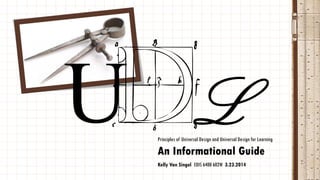
LPrinciples of Universal Design and Universal Design for Learning
An Informational Guide
Kelly Van Singel EDIS 6400 602W 3.23.2014
DU L
HISTORY
Universal Design and the Principles for Universal Design are a thought
outgrowth of a center at North Carolina State University. Originally opening in
1989, the center officially became known as The Center for Universal Design in
1996. Federal grant funding from the National Institute on Disability and
Rehabilitation Research or NIDRR helped in the formation of an advocating
committee composed of Bettye Rose Connell, Mike Jones, Ron Mace, Jim
Mueller, Abir Mullick, Elaine Ostroff, Jon Sanford, Ed Steinfeld, Molly Story, and
Gregg Vanderheiden who developed an important document known as The
Principles of Universal Design. The next slide contains the seven major principles
contained therein.
DU L
“The Principles of Universal Design were conceived and developed by The Center for Universal Design at North Carolina State University. Use or application of the Principles in any form by an
individual or organization is separate and distinct from the Principles and does not constitute or imply acceptance or endorsement by The Center for Universal Design of the use or application.”
1
2
3
4
5
6
7
PRINCIPLE ONE: Equitable Use
The design is useful and marketable to peoplewith diverseabilities.
PRINCIPLE TWO: Flexibility in Use
The design accommodatesa wide range of individual preferencesand abilities
PRINCIPLE THREE: Simple and Intuitive Use
Use of the design is easy to understand, regardlessof the user's experience,knowledge, languageskills, or current concentrationlevel.
PRINCIPLE FOUR: Perceptible Information
The design communicatesnecessaryinformationeffectivelyto the user, regardlessof ambient conditionsor the user'ssensory abilities.
PRINCIPLE FIVE: Tolerance for Error
The design minimizes hazards and the adverseconsequencesof accidentalor unintended actions.
PRINCIPLE SIX: Low Physical Effort
The design can be used efficiently and comfortably and with a minimum of fatigue.
PRINCIPLE SEVEN: Size and Space for Approach and Use
Appropriate size and space is providedfor approach, reach, manipulation,and use regardlessof user's body size, posture, or mobility.
http://www.ncsu.edu/ncsu/design/cud/pubs_p/docs/poster.pdf
DU L
IMPACT and EXTENSION
The concepts of the Universal Design architectural movement and its seven
principles extend into the accessible educational thought process called University
Design for Learning or UDL.
“Universal Design for Learning extends universal design in two key ways. First, it
applies the idea of built-in flexibility to the educational curriculum. Second, it pushes
universal design one step further by supporting not only improved access to
information within classrooms, but also improved access to learning.”
http://www.cast.org/teachingeverystudent/ideas/tes/chapter4_2.cfm
DU L
CONNECTION of UD, UDL and Early AT
In 1984 a group educational advocates and researchers founded CAST, the
Center for Applied Special Technology. By 1995, the concept of Universal Design
for Learning was now being featured and explained in CAST presentations.
After the introduction of UDL principles to the Council of Exception Children via
the topical brief entitled Design Principles for Student Access, several accessibility
software technologies such as Bobby, Thinking Reader, and CAST eREADER 3.0
emerged. CAST also continually strived to monitor the overall accessibility and
application of UDL principals on their website. The National UDL Support Center
was then founded in 2009 as an outgrowth program of CAST.
http://www.cast.org/about/timeline/index.html
http://www.udlcenter.org/aboutudlcenter
DU L
http://www.udlcenter.org/aboutudl/whatisudl
UDL
is necessary
“Individuals bring a
huge variety of skills,
needs, and interests to
learning. Neuroscience
reveals that these
differences are as
varied and unique as
our DNA or
fingerprints. Three
primary brain
networks come into
play:”
DU L
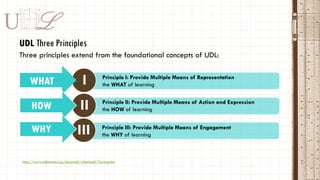
Principle I: Provide Multiple Means of Representation
the WHAT of learning
Principle II: Provide Multiple Means of Action and Expression
the HOW of learning
Principle III: Provide Multiple Means of Engagement
the WHY of learning
I
II
III
WHAT
HOW
WHY
http://www.udlcenter.org/aboutudl/whatisudl/3principles
UDL Three Principles
Three principles extend from the foundational concepts of UDL:
DU L
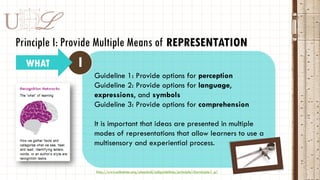
Principle I: Provide Multiple Means of REPRESENTATION
IWHAT
http://www.udlcenter.org/aboutudl/udlguidelines/principle1#principle1_g1
Guideline 1: Provide options for perception
Guideline 2: Provide options for language,
expressions, and symbols
Guideline 3: Provide options for comprehension
It is important that ideas are presented in multiple
modes of representations that allow learners to use a
multisensory and experiential process.
DU L
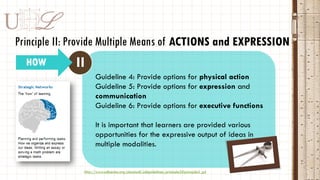
Principle II: Provide Multiple Means of ACTIONS and EXPRESSION
IIHOW
Guideline 4: Provide options for physical action
Guideline 5: Provide options for expression and
communication
Guideline 6: Provide options for executive functions
It is important that learners are provided various
opportunities for the expressive output of ideas in
multiple modalities.
http://www.udlcenter.org/aboutudl/udlguidelines/principle2#principle2_g4
DU L
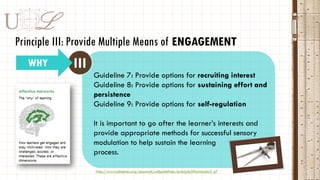
IIIWHY
Principle III: Provide Multiple Means of ENGAGEMENT
http://www.udlcenter.org/aboutudl/udlguidelines/principle3#principle3_g7
Guideline 7: Provide options for recruiting interest
Guideline 8: Provide options for sustaining effort and
persistence
Guideline 9: Provide options for self-regulation
It is important to go after the learner’s interests and
provide appropriate methods for successful sensory
modulation to help sustain the learning
process.
DU L
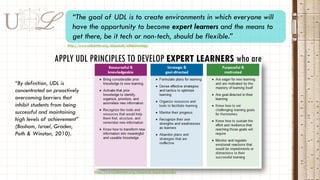
APPLY UDL PRINCIPLES TO DEVELOP EXPERT LEARNERS who are
“The goal of UDL is to create environments in which everyone will
have the opportunity to become expert learners and the means to
get there, be it tech or non-tech, should be flexible.”
http://www.udlcenter.org/aboutudl/expertlearners
http://www.udlcenter.org/aboutudl/udltechnology
“By definition, UDL is
concentrated on proactively
overcoming barriers that
inhibit students from being
successful and maintaining
high levels of achievement”
(Basham, Israel, Graden,
Poth & Winston, 2010).
DU L
CONNECTION of UDL to ASSISTIVE TECHNOLOGY
“In short, technology is
not synonymous with
UDL, but it does play a
valuable role in its
implementation and
conceptualization.”
http://www.udlcenter.org/aboutudl/udltechnology
http://community.udlcenter.org/
Assistive Technology is not automatically UDL. Assistive Technology can help
create opportunities for students to perform at their best while it implements
principles of UDL to improve the overall learning process. “The use of
technology provides clear advantages to those who wish to provide flexible,
supportive, and adjustable learning and productivity experiences to all learners”
(Hitchcock & Stahl, 2003).
DU L
APPLICATION of UDL
UDL can be applied in the development of curriculum materials in the
classroom. Materials that are accessible and flexible to meet the needs of any
learner of any age, ability, gender, linguistic or cultural background.
Curriculum materials created with UDL principles should help instructors
differentiate instruction and modify curriculum for any learner.
DU L
APPLICATION STRATEGIES of UDL
• Use multiple strategies to present content
• Offer a choice of learning
• Use a variety of materials
• Provide cognitive supports
• Teach to a variety of learning styles
• Provide flexible opportunities for assessment
(Rose & Meyer, 2002)
https://teal.ed.gov/tealGuide/udl
DU L
RESOURCES ON UDL IN CURRICULUM
http://mits.cenmi.org/Resources/UDLCriticalElements.aspx
http://www.ocali.org/center/udl
http://e3t.org/
http://udlexchange.cast.org/home
REFERENCES
Basham, J., Israel, M., Graden, J., Poth, R., and Winston, M. (2010) A comprehensive approach to rti: embedding universal design for learning and
technology. Learning Disability Quarterly , 33(4), 243-255. http://0-www.jstor.org.maurice.bgsu.edu/stable/23053228
Cortiella, C. (2008). A Parent’s Guide to Universal Design for Learning (UDL).
http://www.ncld.org/images/stories/Publications/AdvocacyBriefs/ParentGuide-UDL/ParentsGuidetoUDL.pdf
Hitchcock, C., & Stahl, S. (2003). Assistive technology, universal design, universal design for learning: improved learning
opportunities. Journal Of Special Education Technology, 18(4), 45-52.
http://0-search.ebscohost.com.maurice.bgsu.edu/login.aspx?direct=true&db=eft&AN=507858001&site=ehost-live&scope=site
Rose, D.H., & Meyer, A. (2002). Teaching every student in the digital age: Universal Design for Learning. Alexandria, VA: Association for
Supervision and Curriculum Development.

Principles of Universal Design and Universal Design for Learning: An Informational Guide

  • 1.
    LPrinciples of UniversalDesign and Universal Design for Learning An Informational Guide Kelly Van Singel EDIS 6400 602W 3.23.2014
  • 2.
    DU L HISTORY Universal Designand the Principles for Universal Design are a thought outgrowth of a center at North Carolina State University. Originally opening in 1989, the center officially became known as The Center for Universal Design in 1996. Federal grant funding from the National Institute on Disability and Rehabilitation Research or NIDRR helped in the formation of an advocating committee composed of Bettye Rose Connell, Mike Jones, Ron Mace, Jim Mueller, Abir Mullick, Elaine Ostroff, Jon Sanford, Ed Steinfeld, Molly Story, and Gregg Vanderheiden who developed an important document known as The Principles of Universal Design. The next slide contains the seven major principles contained therein.
  • 3.
    DU L “The Principlesof Universal Design were conceived and developed by The Center for Universal Design at North Carolina State University. Use or application of the Principles in any form by an individual or organization is separate and distinct from the Principles and does not constitute or imply acceptance or endorsement by The Center for Universal Design of the use or application.” 1 2 3 4 5 6 7 PRINCIPLE ONE: Equitable Use The design is useful and marketable to peoplewith diverseabilities. PRINCIPLE TWO: Flexibility in Use The design accommodatesa wide range of individual preferencesand abilities PRINCIPLE THREE: Simple and Intuitive Use Use of the design is easy to understand, regardlessof the user's experience,knowledge, languageskills, or current concentrationlevel. PRINCIPLE FOUR: Perceptible Information The design communicatesnecessaryinformationeffectivelyto the user, regardlessof ambient conditionsor the user'ssensory abilities. PRINCIPLE FIVE: Tolerance for Error The design minimizes hazards and the adverseconsequencesof accidentalor unintended actions. PRINCIPLE SIX: Low Physical Effort The design can be used efficiently and comfortably and with a minimum of fatigue. PRINCIPLE SEVEN: Size and Space for Approach and Use Appropriate size and space is providedfor approach, reach, manipulation,and use regardlessof user's body size, posture, or mobility. http://www.ncsu.edu/ncsu/design/cud/pubs_p/docs/poster.pdf
  • 4.
    DU L IMPACT andEXTENSION The concepts of the Universal Design architectural movement and its seven principles extend into the accessible educational thought process called University Design for Learning or UDL. “Universal Design for Learning extends universal design in two key ways. First, it applies the idea of built-in flexibility to the educational curriculum. Second, it pushes universal design one step further by supporting not only improved access to information within classrooms, but also improved access to learning.” http://www.cast.org/teachingeverystudent/ideas/tes/chapter4_2.cfm
  • 5.
    DU L CONNECTION ofUD, UDL and Early AT In 1984 a group educational advocates and researchers founded CAST, the Center for Applied Special Technology. By 1995, the concept of Universal Design for Learning was now being featured and explained in CAST presentations. After the introduction of UDL principles to the Council of Exception Children via the topical brief entitled Design Principles for Student Access, several accessibility software technologies such as Bobby, Thinking Reader, and CAST eREADER 3.0 emerged. CAST also continually strived to monitor the overall accessibility and application of UDL principals on their website. The National UDL Support Center was then founded in 2009 as an outgrowth program of CAST. http://www.cast.org/about/timeline/index.html http://www.udlcenter.org/aboutudlcenter
  • 6.
    DU L http://www.udlcenter.org/aboutudl/whatisudl UDL is necessary “Individualsbring a huge variety of skills, needs, and interests to learning. Neuroscience reveals that these differences are as varied and unique as our DNA or fingerprints. Three primary brain networks come into play:”
  • 7.
    DU L Principle I:Provide Multiple Means of Representation the WHAT of learning Principle II: Provide Multiple Means of Action and Expression the HOW of learning Principle III: Provide Multiple Means of Engagement the WHY of learning I II III WHAT HOW WHY http://www.udlcenter.org/aboutudl/whatisudl/3principles UDL Three Principles Three principles extend from the foundational concepts of UDL:
  • 8.
    DU L Principle I:Provide Multiple Means of REPRESENTATION IWHAT http://www.udlcenter.org/aboutudl/udlguidelines/principle1#principle1_g1 Guideline 1: Provide options for perception Guideline 2: Provide options for language, expressions, and symbols Guideline 3: Provide options for comprehension It is important that ideas are presented in multiple modes of representations that allow learners to use a multisensory and experiential process.
  • 9.
    DU L Principle II:Provide Multiple Means of ACTIONS and EXPRESSION IIHOW Guideline 4: Provide options for physical action Guideline 5: Provide options for expression and communication Guideline 6: Provide options for executive functions It is important that learners are provided various opportunities for the expressive output of ideas in multiple modalities. http://www.udlcenter.org/aboutudl/udlguidelines/principle2#principle2_g4
  • 10.
    DU L IIIWHY Principle III:Provide Multiple Means of ENGAGEMENT http://www.udlcenter.org/aboutudl/udlguidelines/principle3#principle3_g7 Guideline 7: Provide options for recruiting interest Guideline 8: Provide options for sustaining effort and persistence Guideline 9: Provide options for self-regulation It is important to go after the learner’s interests and provide appropriate methods for successful sensory modulation to help sustain the learning process.
  • 11.
    DU L APPLY UDLPRINCIPLES TO DEVELOP EXPERT LEARNERS who are “The goal of UDL is to create environments in which everyone will have the opportunity to become expert learners and the means to get there, be it tech or non-tech, should be flexible.” http://www.udlcenter.org/aboutudl/expertlearners http://www.udlcenter.org/aboutudl/udltechnology “By definition, UDL is concentrated on proactively overcoming barriers that inhibit students from being successful and maintaining high levels of achievement” (Basham, Israel, Graden, Poth & Winston, 2010).
  • 12.
    DU L CONNECTION ofUDL to ASSISTIVE TECHNOLOGY “In short, technology is not synonymous with UDL, but it does play a valuable role in its implementation and conceptualization.” http://www.udlcenter.org/aboutudl/udltechnology http://community.udlcenter.org/ Assistive Technology is not automatically UDL. Assistive Technology can help create opportunities for students to perform at their best while it implements principles of UDL to improve the overall learning process. “The use of technology provides clear advantages to those who wish to provide flexible, supportive, and adjustable learning and productivity experiences to all learners” (Hitchcock & Stahl, 2003).
  • 13.
    DU L APPLICATION ofUDL UDL can be applied in the development of curriculum materials in the classroom. Materials that are accessible and flexible to meet the needs of any learner of any age, ability, gender, linguistic or cultural background. Curriculum materials created with UDL principles should help instructors differentiate instruction and modify curriculum for any learner.
  • 14.
    DU L APPLICATION STRATEGIESof UDL • Use multiple strategies to present content • Offer a choice of learning • Use a variety of materials • Provide cognitive supports • Teach to a variety of learning styles • Provide flexible opportunities for assessment (Rose & Meyer, 2002) https://teal.ed.gov/tealGuide/udl
  • 15.
    DU L RESOURCES ONUDL IN CURRICULUM http://mits.cenmi.org/Resources/UDLCriticalElements.aspx http://www.ocali.org/center/udl http://e3t.org/ http://udlexchange.cast.org/home
  • 16.
    REFERENCES Basham, J., Israel,M., Graden, J., Poth, R., and Winston, M. (2010) A comprehensive approach to rti: embedding universal design for learning and technology. Learning Disability Quarterly , 33(4), 243-255. http://0-www.jstor.org.maurice.bgsu.edu/stable/23053228 Cortiella, C. (2008). A Parent’s Guide to Universal Design for Learning (UDL). http://www.ncld.org/images/stories/Publications/AdvocacyBriefs/ParentGuide-UDL/ParentsGuidetoUDL.pdf Hitchcock, C., & Stahl, S. (2003). Assistive technology, universal design, universal design for learning: improved learning opportunities. Journal Of Special Education Technology, 18(4), 45-52. http://0-search.ebscohost.com.maurice.bgsu.edu/login.aspx?direct=true&db=eft&AN=507858001&site=ehost-live&scope=site Rose, D.H., & Meyer, A. (2002). Teaching every student in the digital age: Universal Design for Learning. Alexandria, VA: Association for Supervision and Curriculum Development.