Prepared by
Prof. Ashish Makwana
Civil Engineering Dept. - MEFGI
1Prof. Ashish Makwana
PRESENTATION
OUTLINE…
• Mobile crane
• Tower crane
• Winch
• Hoist
• Jack
• Shear leg
2Prof. Ashish Makwana
1. Mobile crane:
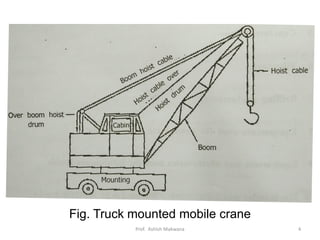
• Mobile crane is used in big construction projects
for lifting heavy loads.
• It is used for loading and unloading of materials
in coal mines.
• Loading and unloading of ships.
• To take the load from ground level and place it
into the truck. (i.e. skimmer)
Prof. Ashish Makwana 3
Fig. Truck mounted mobile crane
Prof. Ashish Makwana 4
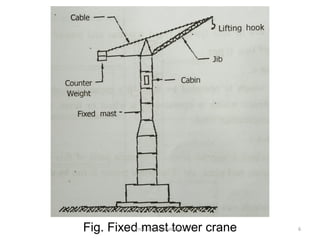
2. Tower crane:
• These are the cranes of swing jib type and are
mounted on high steel towers.
• The height of tower may be 25 to 30 m and
these cranes are found to be suitable in the
construction of tall buildings in congested area.
• The ground area required for such cranes is
very small.
• Main components: Tower, Support, Boom,
Revolving cabin, Control cabin, Lifting hook,
Counter weight, etc.
Prof. Ashish Makwana 5
Fig. Fixed mast tower craneProf. Ashish Makwana 6
Purposes:
• For hoisting concrete and other building
materials,
• For loading and unloading operation.
• To install separate elements.
Types of tower cranes:
• Fixed mast tower crane
• Movable mast tower crane
• Telescopic stationary crane
• Non-telescopic rotating crane
• Telescopic travelling crane
Prof. Ashish Makwana 7
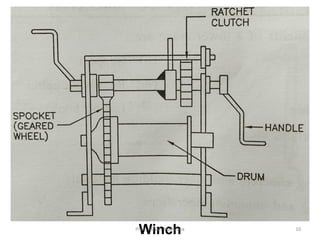
3. Winch:
• A winch is a mechanism in the shape of a
cylinder, over which rope or chain is wound.
• If a winch is used only for raising and lowering, it
is sometimes referred to as hoist.
• The winches are of two types: Hand winches
and power winches
Prof. Ashish Makwana 8
Hand winches:
• This type of winch is operated by hand.
• It’s capacity is about 1 to 5 tonne.
• Each winch has a brake which is operated by a
wheel or lever.
• Hand winches are more suitable on construction
sites.
Power winches:
• This type of winch is run by power.
• The main parts of this winch are prime mover,
drive, rope barrel, bed plate, etc.
• The prime mover is run by diesel, petrol,
electricity, vapour, etc.
Prof. Ashish Makwana 9
WinchProf. Ashish Makwana 10
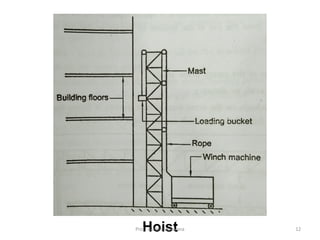
4. Hoist:
• It is also called an elevator.
• It is useful for lifting concrete from ground level
to the higher floor in the construction of
multistoried buildings.
• It is suitable for buildings up to 50 stories.
Prof. Ashish Makwana 11
HoistProf. Ashish Makwana 12
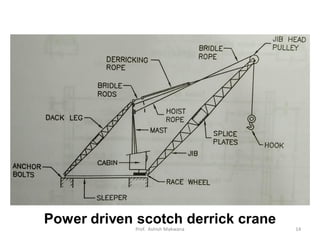
5. Power driven scotch derrick crane:
• Standard models have capacity from 3 to 50
tonnes with jib lengths from 20m to 36m.
• These cranes are driven either by a steam
engine or electric motor.
• The maximum load that can be lifted by this
crane is normally handled at a radius equal to 75
% of the jib length.
• The jib length is the distance from the pin at the
bottom of the jib to the pin carrying the hoist
rope sheave at the jib-head.
Prof. Ashish Makwana 13
Power driven scotch derrick crane
Prof. Ashish Makwana 14
6. Gantry crane:
Main components:
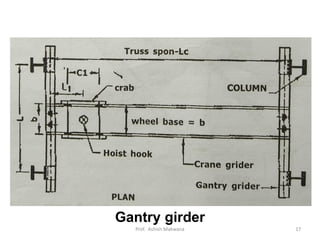
(i) Trolley or crab or Jenny
• Crab moves on wheels on the cross truss
(Crane girder).
• It forms the hoisting mechanism.
• A hook is suspended from the crab which can be
raised or lowered.
(ii) Bridge:
• It consists of two girders (trusses) provided with
wheels at ends which can move on the rails on
the gantry girders.
Prof. Ashish Makwana 15
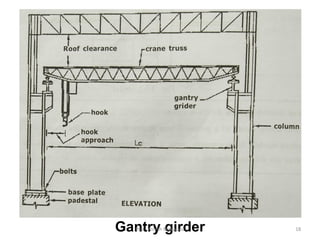
(iii) Gantry girder
• It is an I-section supported on the brackets
projected from columns.
• A rail section is placed on the gantry girder.
• This type of crane is mainly used in big machine
shops, foundry power houses, ice factories, steel
plants, storage yards, etc.
The main advantages of this crane are:
• Large service area
• Freedom from obstruction on floor
• Independent motion in all directions
Prof. Ashish Makwana 16
Gantry girder
Prof. Ashish Makwana 17
Gantry girderProf. Ashish Makwana 18
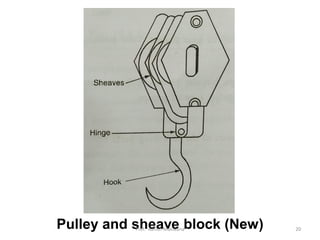
(iii) Pulley and sheave block
• It is suitable for lifting rough surfaced and heavy
loads.
• Alloy chains and wire ropes are used.
• The load hook is the weakest component of this
system.
• The hook fails by straightening or elongation.
• The hook should be replaced if it gets elongated.
Prof. Ashish Makwana 19
Pulley and sheave block (New)Prof. Ashish Makwana 20
Prof. Ashish Makwana 21

Hoisting equipments_Advanced Construction Technology (Semester-6), Civil Engineering

  • 1.
    Prepared by Prof. AshishMakwana Civil Engineering Dept. - MEFGI 1Prof. Ashish Makwana
  • 2.
    PRESENTATION OUTLINE… • Mobile crane •Tower crane • Winch • Hoist • Jack • Shear leg 2Prof. Ashish Makwana
  • 3.
    1. Mobile crane: •Mobile crane is used in big construction projects for lifting heavy loads. • It is used for loading and unloading of materials in coal mines. • Loading and unloading of ships. • To take the load from ground level and place it into the truck. (i.e. skimmer) Prof. Ashish Makwana 3
  • 4.
    Fig. Truck mountedmobile crane Prof. Ashish Makwana 4
  • 5.
    2. Tower crane: •These are the cranes of swing jib type and are mounted on high steel towers. • The height of tower may be 25 to 30 m and these cranes are found to be suitable in the construction of tall buildings in congested area. • The ground area required for such cranes is very small. • Main components: Tower, Support, Boom, Revolving cabin, Control cabin, Lifting hook, Counter weight, etc. Prof. Ashish Makwana 5
  • 6.
    Fig. Fixed masttower craneProf. Ashish Makwana 6
  • 7.
    Purposes: • For hoistingconcrete and other building materials, • For loading and unloading operation. • To install separate elements. Types of tower cranes: • Fixed mast tower crane • Movable mast tower crane • Telescopic stationary crane • Non-telescopic rotating crane • Telescopic travelling crane Prof. Ashish Makwana 7
  • 8.
    3. Winch: • Awinch is a mechanism in the shape of a cylinder, over which rope or chain is wound. • If a winch is used only for raising and lowering, it is sometimes referred to as hoist. • The winches are of two types: Hand winches and power winches Prof. Ashish Makwana 8
  • 9.
    Hand winches: • Thistype of winch is operated by hand. • It’s capacity is about 1 to 5 tonne. • Each winch has a brake which is operated by a wheel or lever. • Hand winches are more suitable on construction sites. Power winches: • This type of winch is run by power. • The main parts of this winch are prime mover, drive, rope barrel, bed plate, etc. • The prime mover is run by diesel, petrol, electricity, vapour, etc. Prof. Ashish Makwana 9
  • 10.
  • 11.
    4. Hoist: • Itis also called an elevator. • It is useful for lifting concrete from ground level to the higher floor in the construction of multistoried buildings. • It is suitable for buildings up to 50 stories. Prof. Ashish Makwana 11
  • 12.
  • 13.
    5. Power drivenscotch derrick crane: • Standard models have capacity from 3 to 50 tonnes with jib lengths from 20m to 36m. • These cranes are driven either by a steam engine or electric motor. • The maximum load that can be lifted by this crane is normally handled at a radius equal to 75 % of the jib length. • The jib length is the distance from the pin at the bottom of the jib to the pin carrying the hoist rope sheave at the jib-head. Prof. Ashish Makwana 13
  • 14.
    Power driven scotchderrick crane Prof. Ashish Makwana 14
  • 15.
    6. Gantry crane: Maincomponents: (i) Trolley or crab or Jenny • Crab moves on wheels on the cross truss (Crane girder). • It forms the hoisting mechanism. • A hook is suspended from the crab which can be raised or lowered. (ii) Bridge: • It consists of two girders (trusses) provided with wheels at ends which can move on the rails on the gantry girders. Prof. Ashish Makwana 15
  • 16.
    (iii) Gantry girder •It is an I-section supported on the brackets projected from columns. • A rail section is placed on the gantry girder. • This type of crane is mainly used in big machine shops, foundry power houses, ice factories, steel plants, storage yards, etc. The main advantages of this crane are: • Large service area • Freedom from obstruction on floor • Independent motion in all directions Prof. Ashish Makwana 16
  • 17.
  • 18.
  • 19.
    (iii) Pulley andsheave block • It is suitable for lifting rough surfaced and heavy loads. • Alloy chains and wire ropes are used. • The load hook is the weakest component of this system. • The hook fails by straightening or elongation. • The hook should be replaced if it gets elongated. Prof. Ashish Makwana 19
  • 20.
    Pulley and sheaveblock (New)Prof. Ashish Makwana 20
  • 21.