Submitted by:
Arpit Saini (CO13214)
Ashi Gupta (CO13215)
Definition
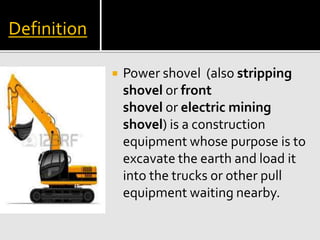
 Power shovel (also stripping
shovel or front
shovel or electric mining
shovel) is a construction
equipment whose purpose is to
excavate the earth and load it
into the trucks or other pull
equipment waiting nearby.
 Type of power shovel is described by its
mounting -
1. If it is mounted on crawler track, it is called
crawler-mounted power shovel.
2. If it is mounted on rubber tyred wheels it is
referred as wheel-mounted power shovel.
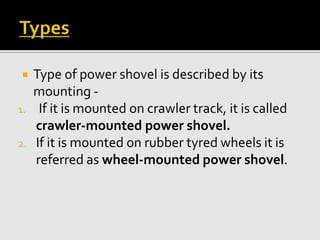
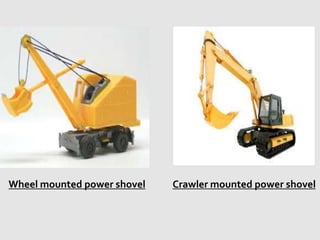
Wheel mounted power shovel Crawler mounted power shovel
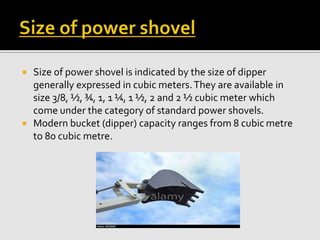
 Size of power shovel is indicated by the size of dipper
generally expressed in cubic meters.They are available in
size 3/8, ½, ¾, 1, 1 ¼, 1 ½, 2 and 2 ½ cubic meter which
come under the category of standard power shovels.
 Modern bucket (dipper) capacity ranges from 8 cubic metre
to 80 cubic metre.
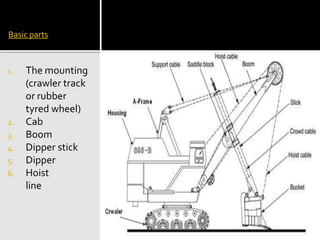
Basic parts
1. The mounting
(crawler track
or rubber
tyred wheel)
2. Cab
3. Boom
4. Dipper stick
5. Dipper
6. Hoist
line
The shovel operates using several main motions:
• hoist - pulling the bucket up through the bank (i.e.
the bank of material being dug)
• crowd - moving the dipper handle out or in to
control the depth of cut and when positioning to
dump
• swing - rotating the shovel between digging and
dumping
• propel - moving the shovel unit to different
locations or dig positions
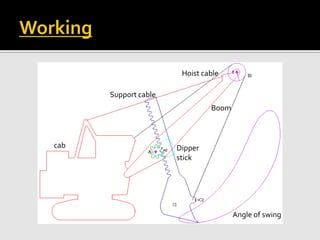
Support cable
Angle of swing
Hoist cable
Boom
Dipper
stick
cab
Best type is decided after considering various
techno-economic factors :
a)Job location
 Numerous Small jobs – Rubber tyred
 Large job – Crawler mounted
b)Type of footing
 Soft and muddy soil – Crawler mounted
.
For selecting the best size of the shovel for the given
job, the following factors must be examined :
a) The cost of per cubic meter of output : Minimum cost
per cubic metre of output.
 Size of job
 Cost of transporting
 Depreciation rate
 Downtime cost – Time lost during repair & adjustments
 Cost of wage – Less for large shovel
 Cost of drilling , blasting, excavating- Less expenditure
for large size shovel
b) The job/site conditions
 For high lifts to dump - long boom of a large shovel.
 For excavating blasted rocks, hard and tough bed of
soil - large size dipper.
 High hourly output - large shovel
 Size of hauling unit determines size of shovel.
 The optimum depth of cut is that depth
which produces the greatest output and at
which the dipper comes up with full load
without excessive downward pressure and
tension.This depth varies with the type of the
soil and the size of the dipper.
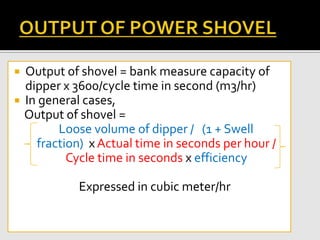
 Output of shovel = bank measure capacity of
dipper x 3600/cycle time in second (m3/hr)
 In general cases,
Output of shovel =
Loose volume of dipper / (1 + Swell
fraction) x Actual time in seconds per hour /
Cycle time in seconds x efficiency
Expressed in cubic meter/hr
a) Class of material
According to Power Crane and shovel association, USA -
Moist loam or light sandy clay > Sand and gravel > good common earth > Hard ,
tough clay >Wet, sticky clay > Poorly blasted rock
b) Depth of cut
Depth shallow – output reduced
Depth greater – output increased
c) Angle of swing
Horizontal angle (ex-pressed in degrees) between the position of the dipper
when it is excavating and the position when it is discharging the load.The output
of shovel is inversely proportion of the cycle time and thus to the angle of swing.
d) Job conditions
Job conditions may be classified as excellent, good, fair and poor depending
upon the situations of work site and climatic condition
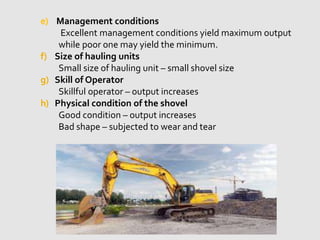
e) Management conditions
Excellent management conditions yield maximum output
while poor one may yield the minimum.
f) Size of hauling units
Small size of hauling unit – small shovel size
g) Skill of Operator
Skillful operator – output increases
h) Physical condition of the shovel
Good condition – output increases
Bad shape – subjected to wear and tear
 Suitable for dragging softer material.
 Can remove big size boulders with prior loosening.
 It is used in various types of jobs such as digging in gravel
banks, clay pits, digging cuts in road works, road side
berms etc.
 It is very useful for excavating trenches .
 It is mostly used in the excavation for canals and
depositing on the embankment without hauling units.
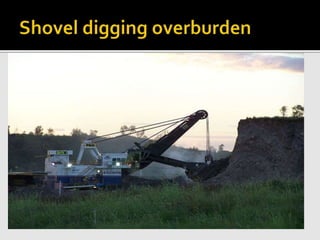
 Used for excavation and removal of overburden .
Thank you

Power shovel

  • 1.
    Submitted by: Arpit Saini(CO13214) Ashi Gupta (CO13215)
  • 2.
    Definition  Power shovel(also stripping shovel or front shovel or electric mining shovel) is a construction equipment whose purpose is to excavate the earth and load it into the trucks or other pull equipment waiting nearby.
  • 3.
     Type ofpower shovel is described by its mounting - 1. If it is mounted on crawler track, it is called crawler-mounted power shovel. 2. If it is mounted on rubber tyred wheels it is referred as wheel-mounted power shovel.
  • 4.
    Wheel mounted powershovel Crawler mounted power shovel
  • 5.
     Size ofpower shovel is indicated by the size of dipper generally expressed in cubic meters.They are available in size 3/8, ½, ¾, 1, 1 ¼, 1 ½, 2 and 2 ½ cubic meter which come under the category of standard power shovels.  Modern bucket (dipper) capacity ranges from 8 cubic metre to 80 cubic metre.
  • 6.
    Basic parts 1. Themounting (crawler track or rubber tyred wheel) 2. Cab 3. Boom 4. Dipper stick 5. Dipper 6. Hoist line
  • 7.
    The shovel operatesusing several main motions: • hoist - pulling the bucket up through the bank (i.e. the bank of material being dug) • crowd - moving the dipper handle out or in to control the depth of cut and when positioning to dump • swing - rotating the shovel between digging and dumping • propel - moving the shovel unit to different locations or dig positions
  • 8.
    Support cable Angle ofswing Hoist cable Boom Dipper stick cab
  • 9.
    Best type isdecided after considering various techno-economic factors : a)Job location  Numerous Small jobs – Rubber tyred  Large job – Crawler mounted b)Type of footing  Soft and muddy soil – Crawler mounted .
  • 10.
    For selecting thebest size of the shovel for the given job, the following factors must be examined : a) The cost of per cubic meter of output : Minimum cost per cubic metre of output.  Size of job  Cost of transporting  Depreciation rate  Downtime cost – Time lost during repair & adjustments  Cost of wage – Less for large shovel  Cost of drilling , blasting, excavating- Less expenditure for large size shovel b) The job/site conditions  For high lifts to dump - long boom of a large shovel.  For excavating blasted rocks, hard and tough bed of soil - large size dipper.  High hourly output - large shovel  Size of hauling unit determines size of shovel.
  • 11.
     The optimumdepth of cut is that depth which produces the greatest output and at which the dipper comes up with full load without excessive downward pressure and tension.This depth varies with the type of the soil and the size of the dipper.
  • 12.
     Output ofshovel = bank measure capacity of dipper x 3600/cycle time in second (m3/hr)  In general cases, Output of shovel = Loose volume of dipper / (1 + Swell fraction) x Actual time in seconds per hour / Cycle time in seconds x efficiency Expressed in cubic meter/hr
  • 13.
    a) Class ofmaterial According to Power Crane and shovel association, USA - Moist loam or light sandy clay > Sand and gravel > good common earth > Hard , tough clay >Wet, sticky clay > Poorly blasted rock b) Depth of cut Depth shallow – output reduced Depth greater – output increased c) Angle of swing Horizontal angle (ex-pressed in degrees) between the position of the dipper when it is excavating and the position when it is discharging the load.The output of shovel is inversely proportion of the cycle time and thus to the angle of swing. d) Job conditions Job conditions may be classified as excellent, good, fair and poor depending upon the situations of work site and climatic condition
  • 14.
    e) Management conditions Excellentmanagement conditions yield maximum output while poor one may yield the minimum. f) Size of hauling units Small size of hauling unit – small shovel size g) Skill of Operator Skillful operator – output increases h) Physical condition of the shovel Good condition – output increases Bad shape – subjected to wear and tear
  • 15.
     Suitable fordragging softer material.  Can remove big size boulders with prior loosening.  It is used in various types of jobs such as digging in gravel banks, clay pits, digging cuts in road works, road side berms etc.  It is very useful for excavating trenches .  It is mostly used in the excavation for canals and depositing on the embankment without hauling units.  Used for excavation and removal of overburden .
  • 17.