Topics
 PET CT in Hodgkins Disease
 Treatment overview
 Chemotherapy in early stage HD
 Chemotherapy in advanced stage HD
 Positron emission tomography (especially with fused CT
images (PET-CT scan), has become an important
component of initial staging in Hodgkin lymphoma.
 PET-CT is an essential study for response assessment,
evaluation of residual masses detected by CT scanning
and a useful prognostic indicator when repeated after a
portion of chemotherapy has been administered
Diagnosis
 For nodal involvement FDG PET/ CT was 94% sensitive
and 100% specific, while CECT alone was 88% sensitive
and 86% specific.
 For organ involvement, FDG PET/CT showed sensitivity of
88% and specificity of 100%, whereas CECT alone had
sensitivity of 50% and specificity of 90%
 Hodgkin lymphoma will be upstaged in 32% and
downstaged in 15%f patients with FDG PET/CT, thus
possibly leading to treatment change in up to 33%
 Bone marrow biopsy may be obviated in patients with
hodgkin lymphoma and aggressive non-hodgkin
lymphoma if FDG PET/CT is clearly positive for marrow
involvement.
 Sensitivity and specificity of FDG PET/CT for detection of
focal or diffuse marrow involvement are reported at 94%
and 100%, respectively
Response Assessment
 Interim PET
 The advantage of PET over conventional imaging techniques
such as computed tomography (CT) or magnetic resonance
imaging is its ability to distinguish between viable tumor and
necrosis or fibrosis in residual mass(es) often present after
treatment
 The Lugano Classification : The goal of the Lugano
classification is the simplification and standardization of
response assessment and reporting
WHO 2008 classification
 Nodular Lymphocyte Predominant (nLPHD)
 Classical Hodgkin’s
 Nodular sclerosis
 Mixed cellularity
 Lymphocyte rich
 Lymphocyte depleted
Evolution of CCT
Single
agents
MOPP (USA)
COPP (UK)
MOPP
variants
ABVD
ABVD MOPP
Alternating
ABVD MOPP
Hybrids
More intense
therapy ??
1st Generation 2nd Generation 3rd Generation 4th Generation
Efficacy of Single Agents
0 10 20 30 40 50 60 70 80
Nitrogen Mustard
Vincristine
Procarbazine
Prednisone
Cyclophosphamide
Chlorambucil
Vinblastine
BCNU
Doxorubicin
Bleomycin
DTIC
Etoposide
Cisplatin
% RR
%CR
Problems with Single agents
 Response rates were in the order of 50-60%
 CR were much lower in the tune of 10-30%
 Responses were not durable with unmaintained
remissions lasting ~ 3 months
 Patients on maintenance chemotherapy had remissions
lasting for ~ 8 months
Principles of CCT
 Drugs known to be active as single agents should be selected, especially
those that have produced some complete remissions
 Drugs should be given in doses at or above minimally effective doses.
 Drugs with different mechanisms of action should be combined. This
should, in theory, allow multiple attacks on the biochemistry of the
cancer cell, with additive, perhaps even synergistic effect
 Drugs with different dose-limiting toxicities should be combined so that
each drug can be given at or near full therapeutic doses.
 Drugs with different patterns of resistance should be combined.
COMBINATION CHEMOTHERAPY
 MOPP
 MOPP variants
 ABVD : Gold Standard
 Stanford V
 BEACOPP
MOPP
 1970; DeVita etal
 Regimen
 Mechloretamine 6mg/m² i/v D1,D8
 Vincristine 1.4mg/m² i/v D1,D8
 Procarbazine 100mg/m² PO D1-D14
 Prednisolone 40mg/m² PO D1-D14
 Cycle repeated every 28 days
Toxicity
 Emetogenic
 Skin necrosis if nitrogen mustard extravasated
 Main dose limiting toxicity is myelopsuppresssion
 Platelets count <50,000 in 15% of treated pts
 Neurotoxicity
 2nd malignancies (acute leukemia)
 Azoospermia in >90% of males treated at any age
 Infertility and premature menopause
Regimen CR FFR OS Efficacy
compared to
MOPP
Toxicity compared
to MOPP
Reference
MVPP 76% 65%
(5yr)
Equivalent Less neurotoxicity St
Bartholomew
ChlVPP 85% 71%
(10yr)
65%
(10yr)
Equivalent Less N&V, alopecia &
neurotoxicity
Royal
Marsden
LOPP 57% 55%
(10yr)
54% Equivalent Less N&V,
Myelosuppression
BNLI
BOPP 67% 55%
(5yr)
50% Equivalent Equivalent CALBG
DOXORUBICIN
 With the introduction of doxorubicin (Adriamycin),
completely novel drug combinations were developed
 Most successful : ABVD
 Regimen
 Doxorubicin 25mg/m² i/v D1,D15
 Bleomycin 10units/ m² i/v D1,D15
 Vinblastine 6mg/m² i/v D1,D15
 Dacarbazine 375mg/m² i/v D1,D15
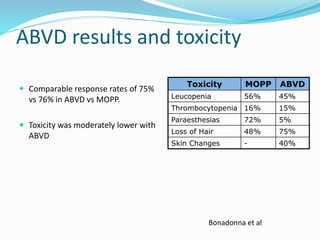
ABVD results and toxicity
 Comparable response rates of 75%
vs 76% in ABVD vs MOPP.
 Toxicity was moderately lower with
ABVD
Toxicity MOPP ABVD
Leucopenia 56% 45%
Thrombocytopenia 16% 15%
Paraesthesias 72% 5%
Loss of Hair 48% 75%
Skin Changes - 40%
Bonadonna et al
STANFORD V
Designed to:
 Shorten the duration of treatment
 Significantly reduce cumulative doses of alkylating agents,
doxorubicin, and bleomycin
 Maintain dose-intensity (DI)
 This brief chemotherapy was combined with radiation
therapy (RT) to bulky disease sites.
DeVita, Hellman, and Rosenberg’s Cancer Principles & Practice of
Oncology 10th edition
Regimen
 Doxorubicin 25mg/m² IV D 1, D15
 Vinblastine 6mg/m² IV D 1, D15
 Nitrogen mustard 6 mg/m² IV D 1
 Vincristine 1.4mg/m² IV D8, D22
 Bleomycin 5 mg/m² IV D8, D22
 Etoposide 60 mg/m² IV D15, D16
 Prednisone 40 mg/m² PO Every other day
BEACOPP
 As another approach, in an effort to enhance efficacy, the
German Hodgkin Study Group (GHSG) developed the
BEACOPP regimen, which may be administered in a
baseline, escalated, or 14-day schedule
 Increase efficacy by two modifications: dose-density and
dose-intensity
DeVita, Hellman, and Rosenberg’s Cancer Principles & Practice of
Oncology 10th edition
 Important features:
 90-95% cure rates expected
 Disease is radiosensitive and radiocurable
 Also chemosensitive and chemocurable
 Relapses rare and easily salvaged
 Optimization of treatment needed:
 Reduce long term side effects
 Maintain cure rates
DeVita, Hellman, and Rosenberg’s Cancer Principles & Practice of
Oncology 10th edition
N=1370
Group 1
346
Group 2
340
Group 3
341
Group 4
343
4 x ABVD
30Gy IFRT
2 x ABVD
20Gy IFRT
2 x ABVD
30Gy IFRT
4 x ABVD
20Gy IFRT
GHSG HD 10 Trial
CONCLUSION
 In patients with early-stage Hodgkin’s lymphoma and a
favorable prognosis, treatment with two cycles of ABVD
followed by 20 Gy of involved-field radiation therapy is as
effective as, and less toxic than, four cycles of ABVD
followed by 30 Gy of involved-field radiation therapy.
N=1570
Group 1
386
Group 2
395
Group 3
394
Group 4
395
4 x ABVD
30Gy IFRT
4 x BEACOPP
20Gy IFRT
4 x BEACOPP
30Gy IFRT
4 x ABVD
20Gy IFRT
GHSG HD 11
RESULTS
 BEACOPP was more effective than ABVD when followed
by 20 Gy of IFRT (5-year FFTF difference : 5.7%)
 There was no difference between BEACOPP and ABVD
when followed by 30 Gy of IFRT (5-year FFTF difference :
1.6%)
 After four cycles of BEACOPP, 20 Gy was not inferior to 30
Gy (5-year FFTF difference : 0.8%)
 Inferiority of 20 Gy cannot be excluded after four cycles of
ABVD (5-year FFTF difference : 4.7%)
CONCLUSION
 Moderate dose escalation using BEACOPP did not
significantly improve outcome in early unfavorable HL.
 Four cycles of ABVD should be followed by 30 Gy of IFRT
CHEMOTHERAPY ALONE
 Recognition of the long-term toxicity of EFRT led many
investigators to test approaches by which radiotherapy
may be omitted altogether from the treatment of early
HL.
 Two large randomized trials have been performed, in
pediatric and adult patients and both demonstrated that
the omission of radiotherapy slightly reduced control of
the disease reflected in lower progression-free survival,
but had no adverse impact on overall survival
DeVita, Hellman, and Rosenberg’s Cancer Principles & Practice of
Oncology 10th edition
 A metaanalysis was performed using the intergroup
study ABVD-alone group and the comparable patients
from the GHSG HD10 and HD 11 studies who
received ABVD and IFRT.
 This showed that the short-term disease control was
inferior with ABVD alone, reflected in worse 8-year
time to progression (93% versus 87%) but that overall
survival was not adversely affected in these groups,
with 95% alive in the long-term follow-up
DeVita, Hellman, and Rosenberg’s Cancer Principles & Practice of
Oncology 10th edition
 In patients with advanced-stage HL (stages IIB to IV), the
introduction of more effective and less toxic front-line
treatment regimens during the last few decades has steadily
improved the prognosis.
 However, complete remissions after initial therapy are not
achieved in approximately 20% of patients with stage III to IV
disease, eventually leading to disease progression.
 The current clinical challenge in patients with advanced stage
disease is to increase the number of patients with durable
remissions and a favorable outcome after initial treatment,
while decreasing the incidence of long-term toxicities.
 The identification of poor prognostic features may allow for a
risk-adapted approach to therapy to potentially increase the
likelihood of cure and also to minimize side effects.
DeVita, Hellman, and Rosenberg’s Cancer Principles & Practice of Oncology 10th
edition
IPS
Adverse Prognostic Factors for Advanced Hodgkin’s
Lymphoma
 ≥45 years
 Stage IV
 Male
 WBC ≥ 15,000 cells/μl
 Lymphocytes < 600 cells/μl or <8% of WBC count, or both
 Albumin < 4.0 g/dL
 Hemoglobin < 10.5 g/dL
DeVita, Hellman, and Rosenberg’s Cancer Principles & Practice
of Oncology 10th edition
Author Regimens Stage CR FFS OS
Canellos et
al –
(CALGB)1
MOPP x 6 - 8 III A/B
IV A/B
Relapse
67% 51% 66%
ABVD x 6 - 8 82% 61% 73%
MOPP/ABVD x 12 83% 65% 75%
MILAN MOPP x 6 IIB ,III,
IV
57 % 43 % 57 %
ABVD x 6 59 % 60 % 65 %
Anderson
et al (NCI)3
MOPP x 6-8 III A/B
IV A/B
Relapse
69 % 48 % 66 %
ABVD x 6-8 81 % 64 % 74 %
MOPP /ABVD x 6-8 82 % 64 % 76 %
 The results of these trials led to ABVD chemotherapy
being regarded as a standard of care for patients with
advanced HL based on the clinical efficacy of the
combination, the ease of administration, and the
acceptable toxicity profile
DeVita, Hellman, and Rosenberg’s Cancer Principles & Practice of Oncology 10th
edition
E2496 ABVD versus Stanford V with
or without EBRT
No significant difference in
the overall response rate
between the two arms, with
complete remission rates of
73% for ABVD and 69% for
Stanford V.
HD9601 ABVD versus Stanford V versus
MOPP/EBV/CAD
The 10-year failure-free
survival was 75%, 74%, and
49% in the ABVD, MEC, and
StV arms, respectively (P
.001).
The long-term analysis
confirmed ABVD and MEC
superiority to StV
ISRCTN 64141244 Stanford V versus ABVD During a median follow-up of
4.3 years, there was no
evidence of a difference in
projected 5-year PFS and
overall survival (OS) rates.
More pulmonary toxicity was
reported for ABVD, whereas
other toxicities were more
frequent with Stanford V
 Overall, ABVD is felt to be superior to Stanford V in
patients with advanced disease
DeVita, Hellman, and Rosenberg’s Cancer Principles & Practice of Oncology 10th
edition
Escalated-Dose BEACOPP in the
Treatment of Patients With
Advanced-Stage Hodgkin’s
Lymphoma: 10 Years of Follow-Up
of the GHSG HD9 Study
CS IIB-IIIA with risk factors
CS IIIB-IV
Arm A
4 × COPP+ABVD
 RT
Arm B
8 × BEACOPP
baseline
 RT
Arm C
8 × BEACOPP
escalated
 RT
RT to initial bulk and residual tumor
GHSG: HD9 Trial Design (1992- 96)
Randomisation
CONCLUSION:
 The 10-year follow-up of the HD9 trial demonstrates a
stabilized significant improvement in long-term FFTF and
OS for BEACOPP escalated in advanced-stage HL. These
results challenge ABVD as standard of care for this patient
population
 Patients with limited presentations of NLPHD may achieve
long-term disease-free survival after treatment with
involved-field or slightly extended field irradiation alone
 In the retrospective review of experience with NLPHD in
the GHSG, there was no significant difference in response
induction, freedom from treatment failure, or overall
survival for involved-field irradiation versus extended-
field irradiation versus combined-modality therapy.
Perez and brady’s principles and practice of radiation oncology (sixth
edition)
Hodgkin chemo final

Hodgkin chemo final

  • 2.
    Topics  PET CTin Hodgkins Disease  Treatment overview  Chemotherapy in early stage HD  Chemotherapy in advanced stage HD
  • 3.
     Positron emissiontomography (especially with fused CT images (PET-CT scan), has become an important component of initial staging in Hodgkin lymphoma.  PET-CT is an essential study for response assessment, evaluation of residual masses detected by CT scanning and a useful prognostic indicator when repeated after a portion of chemotherapy has been administered
  • 4.
    Diagnosis  For nodalinvolvement FDG PET/ CT was 94% sensitive and 100% specific, while CECT alone was 88% sensitive and 86% specific.  For organ involvement, FDG PET/CT showed sensitivity of 88% and specificity of 100%, whereas CECT alone had sensitivity of 50% and specificity of 90%  Hodgkin lymphoma will be upstaged in 32% and downstaged in 15%f patients with FDG PET/CT, thus possibly leading to treatment change in up to 33%
  • 5.
     Bone marrowbiopsy may be obviated in patients with hodgkin lymphoma and aggressive non-hodgkin lymphoma if FDG PET/CT is clearly positive for marrow involvement.  Sensitivity and specificity of FDG PET/CT for detection of focal or diffuse marrow involvement are reported at 94% and 100%, respectively
  • 6.
    Response Assessment  InterimPET  The advantage of PET over conventional imaging techniques such as computed tomography (CT) or magnetic resonance imaging is its ability to distinguish between viable tumor and necrosis or fibrosis in residual mass(es) often present after treatment  The Lugano Classification : The goal of the Lugano classification is the simplification and standardization of response assessment and reporting
  • 9.
    WHO 2008 classification Nodular Lymphocyte Predominant (nLPHD)  Classical Hodgkin’s  Nodular sclerosis  Mixed cellularity  Lymphocyte rich  Lymphocyte depleted
  • 14.
    Evolution of CCT Single agents MOPP(USA) COPP (UK) MOPP variants ABVD ABVD MOPP Alternating ABVD MOPP Hybrids More intense therapy ?? 1st Generation 2nd Generation 3rd Generation 4th Generation
  • 16.
    Efficacy of SingleAgents 0 10 20 30 40 50 60 70 80 Nitrogen Mustard Vincristine Procarbazine Prednisone Cyclophosphamide Chlorambucil Vinblastine BCNU Doxorubicin Bleomycin DTIC Etoposide Cisplatin % RR %CR
  • 17.
    Problems with Singleagents  Response rates were in the order of 50-60%  CR were much lower in the tune of 10-30%  Responses were not durable with unmaintained remissions lasting ~ 3 months  Patients on maintenance chemotherapy had remissions lasting for ~ 8 months
  • 19.
    Principles of CCT Drugs known to be active as single agents should be selected, especially those that have produced some complete remissions  Drugs should be given in doses at or above minimally effective doses.  Drugs with different mechanisms of action should be combined. This should, in theory, allow multiple attacks on the biochemistry of the cancer cell, with additive, perhaps even synergistic effect  Drugs with different dose-limiting toxicities should be combined so that each drug can be given at or near full therapeutic doses.  Drugs with different patterns of resistance should be combined.
  • 20.
    COMBINATION CHEMOTHERAPY  MOPP MOPP variants  ABVD : Gold Standard  Stanford V  BEACOPP
  • 21.
    MOPP  1970; DeVitaetal  Regimen  Mechloretamine 6mg/m² i/v D1,D8  Vincristine 1.4mg/m² i/v D1,D8  Procarbazine 100mg/m² PO D1-D14  Prednisolone 40mg/m² PO D1-D14  Cycle repeated every 28 days
  • 22.
    Toxicity  Emetogenic  Skinnecrosis if nitrogen mustard extravasated  Main dose limiting toxicity is myelopsuppresssion  Platelets count <50,000 in 15% of treated pts  Neurotoxicity  2nd malignancies (acute leukemia)  Azoospermia in >90% of males treated at any age  Infertility and premature menopause
  • 23.
    Regimen CR FFROS Efficacy compared to MOPP Toxicity compared to MOPP Reference MVPP 76% 65% (5yr) Equivalent Less neurotoxicity St Bartholomew ChlVPP 85% 71% (10yr) 65% (10yr) Equivalent Less N&V, alopecia & neurotoxicity Royal Marsden LOPP 57% 55% (10yr) 54% Equivalent Less N&V, Myelosuppression BNLI BOPP 67% 55% (5yr) 50% Equivalent Equivalent CALBG
  • 24.
    DOXORUBICIN  With theintroduction of doxorubicin (Adriamycin), completely novel drug combinations were developed  Most successful : ABVD  Regimen  Doxorubicin 25mg/m² i/v D1,D15  Bleomycin 10units/ m² i/v D1,D15  Vinblastine 6mg/m² i/v D1,D15  Dacarbazine 375mg/m² i/v D1,D15
  • 25.
    ABVD results andtoxicity  Comparable response rates of 75% vs 76% in ABVD vs MOPP.  Toxicity was moderately lower with ABVD Toxicity MOPP ABVD Leucopenia 56% 45% Thrombocytopenia 16% 15% Paraesthesias 72% 5% Loss of Hair 48% 75% Skin Changes - 40% Bonadonna et al
  • 26.
    STANFORD V Designed to: Shorten the duration of treatment  Significantly reduce cumulative doses of alkylating agents, doxorubicin, and bleomycin  Maintain dose-intensity (DI)  This brief chemotherapy was combined with radiation therapy (RT) to bulky disease sites. DeVita, Hellman, and Rosenberg’s Cancer Principles & Practice of Oncology 10th edition
  • 27.
    Regimen  Doxorubicin 25mg/m²IV D 1, D15  Vinblastine 6mg/m² IV D 1, D15  Nitrogen mustard 6 mg/m² IV D 1  Vincristine 1.4mg/m² IV D8, D22  Bleomycin 5 mg/m² IV D8, D22  Etoposide 60 mg/m² IV D15, D16  Prednisone 40 mg/m² PO Every other day
  • 31.
    BEACOPP  As anotherapproach, in an effort to enhance efficacy, the German Hodgkin Study Group (GHSG) developed the BEACOPP regimen, which may be administered in a baseline, escalated, or 14-day schedule  Increase efficacy by two modifications: dose-density and dose-intensity DeVita, Hellman, and Rosenberg’s Cancer Principles & Practice of Oncology 10th edition
  • 34.
     Important features: 90-95% cure rates expected  Disease is radiosensitive and radiocurable  Also chemosensitive and chemocurable  Relapses rare and easily salvaged  Optimization of treatment needed:  Reduce long term side effects  Maintain cure rates DeVita, Hellman, and Rosenberg’s Cancer Principles & Practice of Oncology 10th edition
  • 37.
    N=1370 Group 1 346 Group 2 340 Group3 341 Group 4 343 4 x ABVD 30Gy IFRT 2 x ABVD 20Gy IFRT 2 x ABVD 30Gy IFRT 4 x ABVD 20Gy IFRT GHSG HD 10 Trial
  • 39.
    CONCLUSION  In patientswith early-stage Hodgkin’s lymphoma and a favorable prognosis, treatment with two cycles of ABVD followed by 20 Gy of involved-field radiation therapy is as effective as, and less toxic than, four cycles of ABVD followed by 30 Gy of involved-field radiation therapy.
  • 46.
    N=1570 Group 1 386 Group 2 395 Group3 394 Group 4 395 4 x ABVD 30Gy IFRT 4 x BEACOPP 20Gy IFRT 4 x BEACOPP 30Gy IFRT 4 x ABVD 20Gy IFRT GHSG HD 11
  • 47.
    RESULTS  BEACOPP wasmore effective than ABVD when followed by 20 Gy of IFRT (5-year FFTF difference : 5.7%)  There was no difference between BEACOPP and ABVD when followed by 30 Gy of IFRT (5-year FFTF difference : 1.6%)  After four cycles of BEACOPP, 20 Gy was not inferior to 30 Gy (5-year FFTF difference : 0.8%)  Inferiority of 20 Gy cannot be excluded after four cycles of ABVD (5-year FFTF difference : 4.7%)
  • 48.
    CONCLUSION  Moderate doseescalation using BEACOPP did not significantly improve outcome in early unfavorable HL.  Four cycles of ABVD should be followed by 30 Gy of IFRT
  • 51.
    CHEMOTHERAPY ALONE  Recognitionof the long-term toxicity of EFRT led many investigators to test approaches by which radiotherapy may be omitted altogether from the treatment of early HL.  Two large randomized trials have been performed, in pediatric and adult patients and both demonstrated that the omission of radiotherapy slightly reduced control of the disease reflected in lower progression-free survival, but had no adverse impact on overall survival DeVita, Hellman, and Rosenberg’s Cancer Principles & Practice of Oncology 10th edition
  • 52.
     A metaanalysiswas performed using the intergroup study ABVD-alone group and the comparable patients from the GHSG HD10 and HD 11 studies who received ABVD and IFRT.  This showed that the short-term disease control was inferior with ABVD alone, reflected in worse 8-year time to progression (93% versus 87%) but that overall survival was not adversely affected in these groups, with 95% alive in the long-term follow-up DeVita, Hellman, and Rosenberg’s Cancer Principles & Practice of Oncology 10th edition
  • 55.
     In patientswith advanced-stage HL (stages IIB to IV), the introduction of more effective and less toxic front-line treatment regimens during the last few decades has steadily improved the prognosis.  However, complete remissions after initial therapy are not achieved in approximately 20% of patients with stage III to IV disease, eventually leading to disease progression.  The current clinical challenge in patients with advanced stage disease is to increase the number of patients with durable remissions and a favorable outcome after initial treatment, while decreasing the incidence of long-term toxicities.  The identification of poor prognostic features may allow for a risk-adapted approach to therapy to potentially increase the likelihood of cure and also to minimize side effects. DeVita, Hellman, and Rosenberg’s Cancer Principles & Practice of Oncology 10th edition
  • 56.
    IPS Adverse Prognostic Factorsfor Advanced Hodgkin’s Lymphoma  ≥45 years  Stage IV  Male  WBC ≥ 15,000 cells/μl  Lymphocytes < 600 cells/μl or <8% of WBC count, or both  Albumin < 4.0 g/dL  Hemoglobin < 10.5 g/dL DeVita, Hellman, and Rosenberg’s Cancer Principles & Practice of Oncology 10th edition
  • 60.
    Author Regimens StageCR FFS OS Canellos et al – (CALGB)1 MOPP x 6 - 8 III A/B IV A/B Relapse 67% 51% 66% ABVD x 6 - 8 82% 61% 73% MOPP/ABVD x 12 83% 65% 75% MILAN MOPP x 6 IIB ,III, IV 57 % 43 % 57 % ABVD x 6 59 % 60 % 65 % Anderson et al (NCI)3 MOPP x 6-8 III A/B IV A/B Relapse 69 % 48 % 66 % ABVD x 6-8 81 % 64 % 74 % MOPP /ABVD x 6-8 82 % 64 % 76 %
  • 61.
     The resultsof these trials led to ABVD chemotherapy being regarded as a standard of care for patients with advanced HL based on the clinical efficacy of the combination, the ease of administration, and the acceptable toxicity profile DeVita, Hellman, and Rosenberg’s Cancer Principles & Practice of Oncology 10th edition
  • 63.
    E2496 ABVD versusStanford V with or without EBRT No significant difference in the overall response rate between the two arms, with complete remission rates of 73% for ABVD and 69% for Stanford V. HD9601 ABVD versus Stanford V versus MOPP/EBV/CAD The 10-year failure-free survival was 75%, 74%, and 49% in the ABVD, MEC, and StV arms, respectively (P .001). The long-term analysis confirmed ABVD and MEC superiority to StV ISRCTN 64141244 Stanford V versus ABVD During a median follow-up of 4.3 years, there was no evidence of a difference in projected 5-year PFS and overall survival (OS) rates. More pulmonary toxicity was reported for ABVD, whereas other toxicities were more frequent with Stanford V
  • 64.
     Overall, ABVDis felt to be superior to Stanford V in patients with advanced disease DeVita, Hellman, and Rosenberg’s Cancer Principles & Practice of Oncology 10th edition
  • 65.
    Escalated-Dose BEACOPP inthe Treatment of Patients With Advanced-Stage Hodgkin’s Lymphoma: 10 Years of Follow-Up of the GHSG HD9 Study
  • 66.
    CS IIB-IIIA withrisk factors CS IIIB-IV Arm A 4 × COPP+ABVD  RT Arm B 8 × BEACOPP baseline  RT Arm C 8 × BEACOPP escalated  RT RT to initial bulk and residual tumor GHSG: HD9 Trial Design (1992- 96) Randomisation
  • 69.
    CONCLUSION:  The 10-yearfollow-up of the HD9 trial demonstrates a stabilized significant improvement in long-term FFTF and OS for BEACOPP escalated in advanced-stage HL. These results challenge ABVD as standard of care for this patient population
  • 74.
     Patients withlimited presentations of NLPHD may achieve long-term disease-free survival after treatment with involved-field or slightly extended field irradiation alone  In the retrospective review of experience with NLPHD in the GHSG, there was no significant difference in response induction, freedom from treatment failure, or overall survival for involved-field irradiation versus extended- field irradiation versus combined-modality therapy. Perez and brady’s principles and practice of radiation oncology (sixth edition)