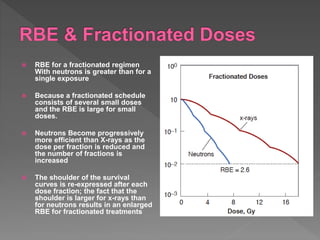
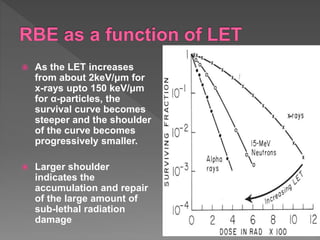
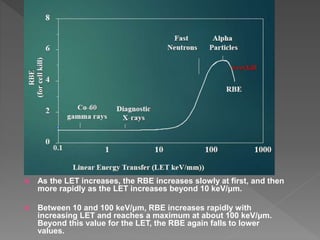
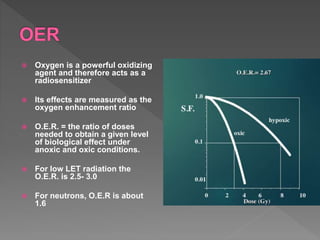
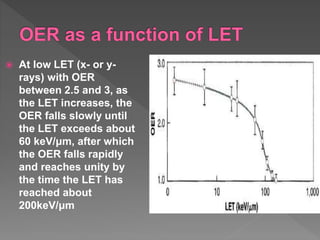
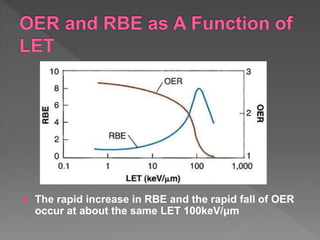
X-rays and neutrons interact differently with biological material based on their ionizing ability. X-rays produce sparse ionization while neutrons produce more dense ionization. Linear energy transfer (LET) quantifies the energy deposited over track length and is used to compare radiation types. Higher LET radiation like alpha particles are more biologically effective due to producing denser ionization over shorter tracks. The relative biological effectiveness (RBE) of radiation depends on factors like dose, fractions, and biological system and is calculated as the ratio of doses needed for equal effect compared to a reference radiation like x-rays. RBE increases with increasing LET up to 100keV/μm then decreases with further increases in LET. Oxygen enhancement ratio (