Technique
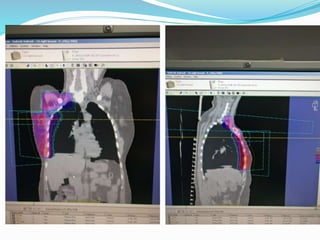
 Two tangential fields are used
 Additional fields for SCF, IMC nodes
Perez and Brady’s Principles and Practice of Radiation Oncology (sixth edition)
Conventional Planning
 Upper margin : 2nd ICS (angle of Louis)
 Medial margin :
 If no internal mammary portal is
used, should be at or 1 cm over the
midline
 If an internal mammary field is used :
the medial tangential portal is
located at the lateral margin of the
internal mammary field.
 Lateral-posterior margin : 2 cm beyond
all palpable breast tissue, which is
usually near the midaxillary line
 Inferior margin : 2 to 3 cm below the
inframammary fold
Perez and Brady’s Principles and Practice of Radiation Oncology
(sixth edition)
Borders can be modified in order to
cover entire breast tissue
DO NOT MISS THE TARGET VOLUME
SCF field
 Upper border : thyrocricoid
groove
 Medial border : at or 1cm
across midline
 Lateral border: just medial to
the humeral head, insertion of
deltoid muscle
 Lower border : matched with
upper border of tangential
fields usually just below clavicle
head
Perez and Brady’s Principles and Practice of
Radiation Oncology (sixth edition)
Internal Mammary Nodes
 The medial border of the tangential field is moved 3 to 5
cm across the midline to cover the internal mammary
nodes in the first three intercostal spaces
 SEPARATE IMC FIELD
 Medial border – midline
 Lateral border – 5-6cm from midline
 Superior border – lower border of clavicle
 Inferior border – at xiphoid or higher if 1st three ICS
covered
Perez and Brady’s Principles and Practice of Radiation Oncology (sixth edition)
Issues with direct anterior field
 A: cold region exists if internal mammary (IM)- tangential matchline overlies
large amount of breast tissue.
 B: The cold area may be negligible if the breast tissue beneath the matchline
is thin.
 C: it can be avoided by including the internal mammary nodes in the
tangential field. but can result in irradiation of an excessive volume of lung
Perez and Brady’s Principles and Practice of Radiation Oncology (sixth edition)
Photon-Electron Combination
 To spare underlying lung, mediastinum, and spinal cord,
electrons in the range of 12 to 16 MeV are preferred for a
portion of the treatment
 14.4 to 16.2Gy delivered with 6MV photons and 30.6 to
32.4 Gy with electrons
Perez and Brady’s Principles and Practice of
Radiation Oncology (sixth edition)
Alignment of the Tangential Beam
with the Chest Wall Contour
 Due to the obliquity of the anterior chest wall, the
tangential fields require collimation so as to reduce
the amount of lung irradiated.
 Can be done by
 Rotating Collimators
 Breast Board
 Multileaf Collimation
Perez and Brady’s Principles and Practice of Radiation Oncology (sixth edition)
Rotating Collimators
However in a collimated field,
junction matching between the
bitangential fields and the
anterior SCF field becomes
problematic resulting in
hot/cold spots.
The need for collimation can
be eliminated if the upper
torso is elevated so as to make
the chest wall horizontal.
This is done by Breast Board
Matching SCF & chest wall fields
 A hot spot caused by divergence of the tangential & the SCF
field at the junction
 This may result in severe match line fibrosis or even rib
fracture.
 The divergence of fields can be eliminated by
 Angling the foot of the treatment couch away from the radiation
 Collimator rotation
 Hanging block
 Half beam block
Perez and Brady’s Principles and Practice of Radiation Oncology (sixth edition)
The Single Isocenter Technique for Matching Supraclavicular and
Tangential Fields
Single isocenter is set at the match between the supraclavicular and tangential fields.
The inferior portion of the beam is blocked for the supraclavicular treatment and the
superior blocked for the tangential field, with no movement of the isocenter, resulting
in an ideal match. Blocks are drawn as indicated to shield lung and heart. The field
should be viewed clinically to ensure that the blocks drawn to shield the heart and
lungs to not block target tissue on the breast–chest wall
Perez and Brady’s Principles and Practice of Radiation Oncology (sixth edition)
Selection of appropriate energy
 X-ray energies of 4 to 6 MV are preferred
 If tangential field separation is >22 cm :significant dose
inhomogeneity in the breast
 So higher-energy photons (10 to 18 MV) can be used to deliver
a portion of the breast radiation (approximately 50%) as
determined with treatment planning to maintain the
inhomogeneity throughout the entire breast to between 93
and 105%.
 IMRT techniques such as field-in-field or dynamic multileaf
collimators (MLCs) may be utilized to reduce dose
inhomogeneity
Perez and Brady’s Principles and Practice of Radiation Oncology (sixth edition)
Doses To Lung By Tangential Fields
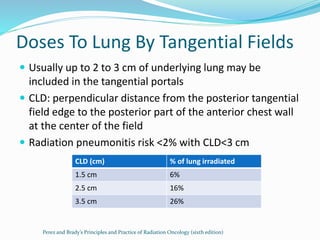
 Usually up to 2 to 3 cm of underlying lung may be
included in the tangential portals
 CLD: perpendicular distance from the posterior tangential
field edge to the posterior part of the anterior chest wall
at the center of the field
 Radiation pneumonitis risk <2% with CLD<3 cm
CLD (cm) % of lung irradiated
1.5 cm 6%
2.5 cm 16%
3.5 cm 26%
Perez and Brady’s Principles and Practice of Radiation Oncology (sixth edition)
Heart Dose
 When the CLD is >3 cm, in treatment of the left breast, a
significant volume of heart will also be irradiated
 Dose to heart can be minimized by
 Median tangential breast port
 Cardiac block & electron field
 Breath hold
 Gating
Perez and Brady’s Principles and Practice of Radiation Oncology (sixth edition)
Localization of lumpectomy cavity
 The combination of surgical clips with a treatment
planning CT is most ideal.
 In the absence of surgical clips, CT scan of biopsy cavity or
postsurgical changes, in combination with clinical
information including mammography, scar location,
operative reports, and patient input, provide accurate
information regarding placement of the field and energy
of the electron boost
Perez and Brady’s Principles and Practice of Radiation Oncology (sixth edition)
Electron Boost
 Approximate size of boost field = lumpectomy cavity + a
margin of 2 cm in all directions
 90% isodose should cover tumor bed
 Usual range is 9 to 16 mev electrons
 Electron beam boost preferred because of
 Relative ease in setup
 Outpatient setting
 Lower cost
 Decreased time demands on the physician
Perez and Brady’s Principles and Practice of Radiation Oncology (sixth edition)
Boost photon:
Mini tangential fields used to boost target volume
Interstitial boost:
1 or 2 planes of needles are usually needed to cover the
PTV depending upon size
Perez and Brady’s Principles and Practice of Radiation Oncology (sixth edition)
Three-Dimensional Conformal
Radiation Therapy
 Standard opposed tangential fields with appropriate use of
wedges to optimize dose homogeneity remains the most
commonly employed method for delivery of whole-breast
irradiation
 May improve dose to target volume & reduction in dose to
normal tissues & critical organs
 Better cosmetic results
 Less dose to heart and lung
Perez and Brady’s Principles and Practice of Radiation Oncology (sixth edition)
RTOG Consensus Definitions
 Lumpectomy GTV: Surgical cavity from lumpectomy
 Lumpectomy CTV: GTV +1 cm margin
 Lumpectomy PTV: CTV+ 7 mm (exclude heart)
 Breast CTV: Includes all palpable breast tissue. Takes into
account clinical borders at the time of CT simulation.
Limited anteriorly within 5 mm from skin & posteriorly to
the anterior surface of the chest wall
 Breast PTV: Breast CTV + 7 mm expansion
Forward planning IMRT: field
within field
 In this technique a pair of conventional open tangential
fields is produced first
 MLCs are used to shape the fields & spare OARs
 Wedge angle & relative weight of beams optimized to
produce plan
 To ovoid hotspots and large doses to OAR & to obtain a
homogenous dose distribution (range 95-107%) the dose
delivered with open fields is reduced to 90-93% of total
dose
 New tangential beam with same gantry & wedge angles
are designed for remaining dose
 PARTIAL BREAST IRRADIATION: The target volume
irradiated is only the post lumpectomy tumor bed with 1-
2cm margin
 ACCELERATED DOSE DELIVERY: the dose is delivered in a
shorter interval than the standard 5 – 6 weeks
Rationale
• 15% to 30% of patients who undergo lumpectomy
do not receive radiation therapy
Accelerated Partial Breast Irradiation (APBI):A review of available techniques Njeh et al.
Why…
● Commitment to the 6- 7 week course of adjuvant
conventional RT
● Cost
● Distance from the radiation therapy facility
● Lack of transportation
● Lack of social support structure
● Poor ambulatory status of the patient
● Physician bias
● Patient age
● Fear of radiation treatments
● Shortage of resources
Accelerated Partial Breast Irradiation (APBI):A review of available techniques Njeh et al.
• 44% to 86% of local
recurrence occurs close to
the tumor bed.
• Ipsilateral breast recurrence
in areas other than tumor bed
occurred rarely in3% to 4% of cases.
(similar to recurrence of contralateral second
primary breast cancer)
Based upon this evidence, BCT, with whole breast
irradiation has been criticized as an
overtreatment.
Accelerated Partial Breast Irradiation (APBI):A review of available techniques Njeh et al.
APBI
• An approach that treats only the lumpectomy bed
plus a 1-2 cm margin
• By increasing the radiation fraction size and
decreasing the target volume, it allows the
treatment to be accomplished in a shorter period
Accelerated Partial Breast Irradiation (APBI):A review of available techniques Njeh et al.
Techniques of APBI
• Multi-catheter Interstitial Brachytherapy
• Balloon based Brachytherapy
• Hybrid Brachytherapy
• EBRT
• IORT
Accelerated Partial Breast Irradiation (APBI):A review of available techniques Njeh et al.
Factor Suitable group Cautionary Unsuitable
Patient Factors
•Age
•BRCA1/2 mutation
>60years
Absent
50-59 years Age <50 years
Present
Pathologic factors
•Tumor size
•T stage
•Margins
•Grade
•LVSI
•ER status
•Multicentricity
•Multifocality
<2cm
T1
Negative (> 2 mm)
Any
N0
Positive
Unicentric only
Unifocal
2.1-3
T0, T2
Close (<2mm)
Limited/focal
Negative
>3cm
T3,T4
Positive
Present extensive
Present
Present
Histology
•Pure DCIS or EIC
Invasive ductal or favorable
Not allowed
Invasive lobular
≤ 3 cm >3cm
Nodal factors
•N stage
•Nodal surgery
pN0
SN Bx or ALND
PN1, N2, N3
Treatment factors
•Neoadjuvant
therapy
Not allowed Used
Advantages
External Beam RT
• 6 weeks (30 fractions)
• Homogeneous dose
• Logistical problem for patients
• Difficult for frail, elderly, or
chronically ill patients
Breast Brachytherapy
• 5 days (10 fractions)
• Dose is higher to tissue at
greatest risk for sub-clinical
malignant cells
• Reduction in cardiac and lung
dose
• Ideal for patients who live far
from RT Center
• May increase number of
women treated with BCT
Accelerated Partial Breast Irradiation (APBI):A review of
available techniques Njeh et al.
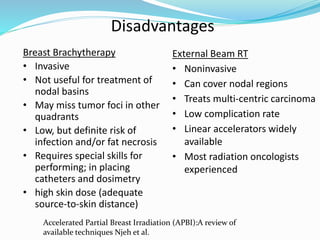
Disadvantages
External Beam RT
• Noninvasive
• Can cover nodal regions
• Treats multi-centric carcinoma
• Low complication rate
• Linear accelerators widely
available
• Most radiation oncologists
experienced
Breast Brachytherapy
• Invasive
• Not useful for treatment of
nodal basins
• May miss tumor foci in other
quadrants
• Low, but definite risk of
infection and/or fat necrosis
• Requires special skills for
performing; in placing
catheters and dosimetry
• high skin dose (adequate
source-to-skin distance)
Accelerated Partial Breast Irradiation (APBI):A review of
available techniques Njeh et al.
75432 11 1210
16
20
MULTI CATHETER INTERSTITIAL BRACHYTHERAPY (MIB)
• Flexible after-loading catheters are placed through
the breast tissues surrounding the lumpectomy.
• The catheters are inserted at 1 to 1.5 cm intervals
in several planes (usually 2) to ensure adequate
coverage of the lumpectomy cavity plus margins
and to avoid hot and cold spots
• 14-20 catheters are inserted to assure proper
dose coverage
Accelerated Partial Breast Irradiation (APBI):A review of available techniques Njeh et al.
• Low dose rate (LDR) brachytherapy: sources of Ir-
192 sources are implanted for approximately 2 to
5 days while the patient is admitted.
• High dose rate (HDR) brachytherapy: outpatient
procedure, fractionated over the course of a week
• Typical doses with HDR = 30-36Gy/10# bid and
LDR = 45Gy in 4.5days
Accelerated Partial Breast Irradiation (APBI):A review of available techniques Njeh et al.
Results
Intracavitary Brachytherapy
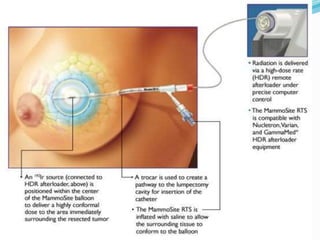
Balloon based brachytherapy include:
1. Mammosite
1. Axxent electronic brachytherapy
1. Contura
Accelerated Partial Breast Irradiation (APBI):A review of available techniques Njeh et al.
Mammosite Brachytherapy System
Structure
• Silicone balloon
• Double-lumen catheter (15 cm length and 6 mm in
diameter)
• Inflation channel: saline solution mixed with a small
amount of contrast material to aid visualization.
• Source channel: for passage of an Ir-192 high dose
rate (HDR) brachytherapy source.
• Source channel runs centrally through the length of
the balloon.
Accelerated Partial Breast Irradiation (APBI):A review of available techniques Njeh et al.
• The catheter is placed in the breast cavity either
during the lumpectomy procedure or later through a
closed technique
• Balloon is inflated with 35-70mL of saline mixed with
a small amount of contrast material, depending on
the size of the lumpectomy cavity
• CT imaging to assess the adequate placement of the
device
• An Ir-192 radioactive source, connected to a
computer-controlled HDR remote after-loader, is
inserted through the catheter into the balloon to
deliver the prescription radiation dose
Accelerated Partial Breast Irradiation (APBI):A review of available techniques Njeh et al.
DOSE:
As sole modality: 34Gy/10# over 5 days,
2 # per day 6hrs apart
As boost: 14–16Gy/4# over 2 days,
2 # per day 6hrs apart
(The prescription point is 1cm from the balloon
surface)
Accelerated Partial Breast Irradiation (APBI):A review of available techniques Njeh et al.
Difficulties with Mammosite
• Balloon must conform
to cavity shape without
air gaps. Device
explanted in about 10-
15% patients.
• Ideal is to have 7 mm
distance b/w balloon
and skin to decrease
risk of erythema.
Accelerated Partial Breast Irradiation (APBI):A review of
available techniques Njeh et al.
Results of Mammosite
Toxicities of Mammosite
1. Seroma formation: Risk is increased with open
technique for placement.
2. Fat necrosis
Accelerated Partial Breast Irradiation (APBI):A review of available techniques Njeh et al.
Axxent electronic brachytherapy
Balloon is radiolucent :- no need of contrast
Third port for drainage of seroma fluid or air surrounding the cavity.
Accelerated Partial Breast Irradiation (APBI):A review of available techniques Njeh et al.
eB controller
•Portable unit
•Digital touch-screen for the
Physician and Physicist
to input treatment data and
monitor treatment progress.
Accelerated Partial Breast Irradiation (APBI):A review of available techniques Njeh et al.
Advantages
• Specifically shielded radiation room or an HDR
afterloader unit are not required.
• This reduces costs and allows for portability of
the system, which can lead to greater access
for patients particularly in more remote or
rural locations
• Can be used intra-operatively
Accelerated Partial Breast Irradiation (APBI):A review of available techniques Njeh et al.
Contura
• Has multiple lumens for passage of an Ir-192 HDR
source.
• In addition to a central lumen, the Contura
balloon has four surrounding channels to
accommodate the HDR source.
• Additional source positions allows increased dose
flexibility compared with a single-catheter
approach.
• Reduce the dose to normal tissues (chest wall and
skin) and better protection of organs at risk such
as the heart and lungs.
• Vacuum port to remove fluid or air around the
lumpectomy cavity.
Accelerated Partial Breast Irradiation (APBI):A review of available techniques Njeh et al.
HYBRID BRACHYTHERAPY
• Hybrid devices have the convenience of a
single entry device with dosimetric conformity
of multicatheter interstitial brachytherapy
• Two devices are available
1. Struts Adjusted Volume Implant (SAVI)
2. ClearPath
Accelerated Partial Breast Irradiation (APBI):A review of available techniques Njeh et al.
Struts Adjusted Volume Implant (SAVI)
• Consists of a central strut surrounded by 6, 8
or 10 peripheral struts
• Peripheral struts can be differentially loaded
with a HDR source
• Radio-opaque markers are present on three
peripheral struts for identification during the
reconstruction process in treatment planning
Accelerated Partial Breast Irradiation (APBI):A review of available techniques Njeh et al.
Strut Adjusted Volume Implant (SAVI)
• Surgically implanted on an outpatient basis by the Radiation
oncologist using ultrasound guidance.
• Device is inserted in collapsed form through a small incision,
then expanded to fit the lumpectomy cavity by clockwise
rotation of a knurled knob at the proximal end of the
expansion device providing a pressure fit.
• The outward pressure exerted by the expanded struts pushes
against the cavity walls securing the struts in place.
• CT scan is acquired immediately following the implant surgery
Accelerated Partial Breast Irradiation (APBI):A review of available techniques Njeh et al.
ClearPath (CP)
• Consists of both inner and outer catheters that expand
by rotating a knob on the base of the device
• CP device contains six outer expandable plastic tubes to
displace the tissue.
• In the center of the expandable tubes is a central
catheter surrounded by six additional catheters that
allow the passage of an HDR Ir192 source.
Accelerated Partial Breast Irradiation (APBI):A review of available techniques Njeh et al.
cap placed over the HDR channels
External Beam Radiation Therapy (EBRT)
1. 3D-conformal radiation therapy (3D-CRT)
2. Intensity modulated radiation therapy (IMRT)
3. Proton beams
Accelerated Partial Breast Irradiation (APBI):A review of available techniques Njeh et al.
• 3D-CRT technique uses four to five tangentially
positioned non-coplanar beams
• The tumor bed is defined by the CT visualized seroma
cavity, postoperative changes, and surgical clips, when
available
• CTV includes tumor bed with a 1.5 cm margin limited by
0.5 cm from the skin and chest wall
• PTV includes CTV with 1cm margin
• The prescription dose : 3.85Gy twice daily (separated by
at least 6 hours) to a total dose of 38.5Gy delivered
within 1 week
Accelerated Partial Breast Irradiation (APBI):A review of available techniques Njeh et al.
• EBRT has many potential advantages
1. Non-invasive and the treatment can wait until
completion of pathological analysis about the
original tumor and the status of the resection
margins are available.
2. Widespread availability
3. Easier to adopt than brachytherapy
techniques because the technical demands
and quality assurance issues are much
simpler.
4. Generate better dose homogeneity
Accelerated Partial Breast Irradiation (APBI):A review of available techniques Njeh et al.
Results
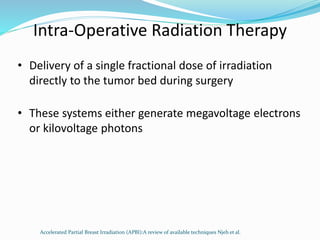
Intra-Operative Radiation Therapy
• Delivery of a single fractional dose of irradiation
directly to the tumor bed during surgery
• These systems either generate megavoltage electrons
or kilovoltage photons
Accelerated Partial Breast Irradiation (APBI):A review of available techniques Njeh et al.
Advantages
• Delivering of the radiation before tumor cells have a chance to
proliferate.
• Tissues under surgical intervention have a rich vascularization, with
aerobic metabolism, which makes them more sensitive to the action
of the radiation.
• Radiation is delivered under direct visualization at the time of
surgery.
• Minimize potential side effects since skin and the subcutaneous
tissue can be displaced during the IORT to decrease dose to these
structures, and the spread of irradiation to lung and heart is
reduced significantly.
Accelerated Partial Breast Irradiation (APBI):A
review of available techniques Njeh et al.
• IORT eliminates the risk of patients not completing
the prescribed course of conventional radiotherapy.
• IORT eliminates risk of geographical miss in which the
prescribed radiation dose is inaccurately and
incompletely delivered to the tumor bed.
Geographical miss may result from patient
movement, inconsistent patient setup, and difficulty
identifying the tumor site weeks or months
postoperatively
Accelerated Partial Breast Irradiation (APBI):A
review of available techniques Njeh et al.
Criticism
 With IORT the final pathology reports arrives days
post-festum.
Accelerated Partial Breast Irradiation (APBI):A
review of available techniques Njeh et al.
Intrabeam: mobile X-ray intraoperative radiation therapy device
Various spherical applicators with diameters 1.5 -5cm used
The mobile electron intraoperative radiation therapy devices: (a) Novac7 (b)
Mobetron intra-operative electron device
Radiotherapy toxicity was lower in the targeted intraoperative radiotherapy
group (6 patients [0·5%]) than in the external beam radiotherapy group (23
patients [2·1%]; p=0·002).
Intraoperative radiotherapy versus external
radiotherapy for early breast cancer (ELIOT): a
randomised controlled equivalence trial
•Age : 48–75 years
•Maximum tumour diameter : 2.5 cm
•randomly assigned in a 1:1 ratio
•Intraoperative radiotherapy group received one dose
of 21 Gy to the tumour bed
•External radiotherapy group received 50 Gy/25#,
followed by a boost of 10 Gy in five fractions.
ELIOT
Results and Interpretation
 Medium follow-up - 5·8 years
 35 patients in the intraoperative radiotherapy group and four
patients in the EBRT had an IBTR (p<0·0001)
 Significantly fewer skin side-effects in women in the
intraoperative radiotherapy group than in EBRT(p=0·0002).
 Although the rate of IBTR in the intraoperative radiotherapy
group was within the prespecifi ed equivalence margin, the
rate was significantly greater than with external radiotherapy,
and overall survival did not differ between groups. Improved
selection of patients could reduce the rate of IBTR with
intraoperative radiotherapy with electrons.
Results
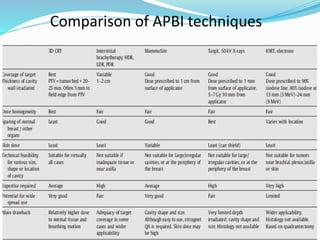
Comparison of APBI techniques
 Lymphedema and Breast Edema
 Skin and Breast Complications
 Brachial Plexopathy
 Pulmonary Sequelae
 Cardiac Sequelae
 Contralateral Breast Cancer and Irradiation
 Incidence of Other Second Malignancies
 Post irradiation Angiosarcoma of the Breast
Perez and Brady’s Principles and Practice of Radiation Oncology (sixth edition)
Arm Lymphedema
 Risk of arm edema increases with axillary dissection and
RT
 Associated with swelling, weakness, limitation in range of
movement, stiffness pain & numbness
 Differentiate between treatment-associated
complications and tumor recurrence in regional
lymphatics
 Compression pump, along with skin care, exercise, and
compression garments
Perez and Brady’s Principles and Practice of
Radiation Oncology (sixth edition)
Pulmonary sequalae
 Rate of symptomatic pneumonitis 1-2% after WBRT
 Patients present with dry cough, shortness of breath, pleuritic chest pain
or fever and on radiographic studies a pulmonary infiltrate is observed in
the irradiated volume.
 Responds well to steroids
 The risk is related to
 Age>60 yrs
 Previous lung disease
 RT dose, fractionation
 Volume of lung irradiated.
 Regional nodal radiation therapy
 Concurrent chemo (taxanes)
Perez and Brady’s Principles and Practice of
Radiation Oncology (sixth edition)
Cardiac sequalae
 May be acute or chronic
 Pericarditis is acute transient but may be chronic
 Late injury includes CHF ,ischemia, CAD,MI
 Risk of cardiac toxicity greater in
 Left-sided breast cancers
 Patients receiving other cardiotoxic therapies, including
adriamycin, epirubicin, and trastuzumab.
 Old RT techniques
 IMC irradiation
Perez and Brady’s Principles and Practice of
Radiation Oncology (sixth edition)
Dose Constraints
Volume Segment End point Dose (Gy) Rate
Lung -Whole Organ Symptomatic
Pneumonitis
V20≤30% <20
Mean dose = 13 10
Mean dose = 20 20
Heart - Pericardium Pericarditis Mean dose <26 <15
Whole organ Long term cardiac
mortality
V25<10% <1
Radiation Dose Constraints for Organs at Risk
Brachial Plexopathy
 Incidence:1-2%
 Possible complication of regional nodal radiation therapy
 Pain, loss of sensation, muscle weakness ,paralysis
muscles of the shoulder and upper limb
 Risk factors includes
 Axillary dose >50 Gy
 Concomitant chemotherapy
 Important to distinguish between metastatic and
radiation-induced brachial plexopathy.
Perez and Brady’s Principles and Practice of Radiation Oncology (sixth edition)
Contralateral Breast Cancer
 Although all patients with a diagnosis of breast cancer are at
increased risk for developing a contralateral breast cancer, the
additional risk contributed by radiation treatment appears to
be minimal, with modern techniques
 EBCTCG 2005 overview analysis does suggest an elevated
incidence of contralateral breast cancer in patients receiving
radiation compared with those who did not receive radiation
(p=.002).
 Although the excess risk appears to be driven primarily by
older trials using antiquated techniques, these data highlight
the need to maintain dose to the contralateral breast as low as
possible.
Perez and Brady’s Principles and Practice of Radiation Oncology (sixth edition)
Incidence of Other Second
Malignancies
 EBCTCG overview analysis did demonstrate an excess risk
of secondary cancers of the lung and esophagus as well as
leukemia and sarcoma in all randomized trials of breast
cancer that compared patients treated with and without
radiation
 The total relative risk for all secondary nonbreast
malignancies was 1.20 (± 0.06; P = .001).
Perez and Brady’s Principles and Practice of Radiation Oncology (sixth edition)
Post Irradiation Angiosarcoma of
the Breast
 Rare but severe long-term
complication of patients
treated with radiotherapy
 Special attention should
be paid to uncommon skin
changes of the treated
breast
 The primary therapy is
simple mastectomy if wide
tumor-free margins can be
achieved
Perez and Brady’s Principles and Practice of Radiation Oncology (sixth edition)
RT breast apbi

RT breast apbi

  • 2.
    Technique  Two tangentialfields are used  Additional fields for SCF, IMC nodes Perez and Brady’s Principles and Practice of Radiation Oncology (sixth edition)
  • 3.
    Conventional Planning  Uppermargin : 2nd ICS (angle of Louis)  Medial margin :  If no internal mammary portal is used, should be at or 1 cm over the midline  If an internal mammary field is used : the medial tangential portal is located at the lateral margin of the internal mammary field.  Lateral-posterior margin : 2 cm beyond all palpable breast tissue, which is usually near the midaxillary line  Inferior margin : 2 to 3 cm below the inframammary fold Perez and Brady’s Principles and Practice of Radiation Oncology (sixth edition) Borders can be modified in order to cover entire breast tissue DO NOT MISS THE TARGET VOLUME
  • 4.
    SCF field  Upperborder : thyrocricoid groove  Medial border : at or 1cm across midline  Lateral border: just medial to the humeral head, insertion of deltoid muscle  Lower border : matched with upper border of tangential fields usually just below clavicle head Perez and Brady’s Principles and Practice of Radiation Oncology (sixth edition)
  • 5.
    Internal Mammary Nodes The medial border of the tangential field is moved 3 to 5 cm across the midline to cover the internal mammary nodes in the first three intercostal spaces  SEPARATE IMC FIELD  Medial border – midline  Lateral border – 5-6cm from midline  Superior border – lower border of clavicle  Inferior border – at xiphoid or higher if 1st three ICS covered Perez and Brady’s Principles and Practice of Radiation Oncology (sixth edition)
  • 6.
    Issues with directanterior field  A: cold region exists if internal mammary (IM)- tangential matchline overlies large amount of breast tissue.  B: The cold area may be negligible if the breast tissue beneath the matchline is thin.  C: it can be avoided by including the internal mammary nodes in the tangential field. but can result in irradiation of an excessive volume of lung Perez and Brady’s Principles and Practice of Radiation Oncology (sixth edition)
  • 7.
    Photon-Electron Combination  Tospare underlying lung, mediastinum, and spinal cord, electrons in the range of 12 to 16 MeV are preferred for a portion of the treatment  14.4 to 16.2Gy delivered with 6MV photons and 30.6 to 32.4 Gy with electrons Perez and Brady’s Principles and Practice of Radiation Oncology (sixth edition)
  • 8.
    Alignment of theTangential Beam with the Chest Wall Contour  Due to the obliquity of the anterior chest wall, the tangential fields require collimation so as to reduce the amount of lung irradiated.  Can be done by  Rotating Collimators  Breast Board  Multileaf Collimation Perez and Brady’s Principles and Practice of Radiation Oncology (sixth edition)
  • 9.
  • 10.
    However in acollimated field, junction matching between the bitangential fields and the anterior SCF field becomes problematic resulting in hot/cold spots. The need for collimation can be eliminated if the upper torso is elevated so as to make the chest wall horizontal. This is done by Breast Board
  • 11.
    Matching SCF &chest wall fields  A hot spot caused by divergence of the tangential & the SCF field at the junction  This may result in severe match line fibrosis or even rib fracture.  The divergence of fields can be eliminated by  Angling the foot of the treatment couch away from the radiation  Collimator rotation  Hanging block  Half beam block Perez and Brady’s Principles and Practice of Radiation Oncology (sixth edition)
  • 12.
    The Single IsocenterTechnique for Matching Supraclavicular and Tangential Fields Single isocenter is set at the match between the supraclavicular and tangential fields. The inferior portion of the beam is blocked for the supraclavicular treatment and the superior blocked for the tangential field, with no movement of the isocenter, resulting in an ideal match. Blocks are drawn as indicated to shield lung and heart. The field should be viewed clinically to ensure that the blocks drawn to shield the heart and lungs to not block target tissue on the breast–chest wall Perez and Brady’s Principles and Practice of Radiation Oncology (sixth edition)
  • 14.
    Selection of appropriateenergy  X-ray energies of 4 to 6 MV are preferred  If tangential field separation is >22 cm :significant dose inhomogeneity in the breast  So higher-energy photons (10 to 18 MV) can be used to deliver a portion of the breast radiation (approximately 50%) as determined with treatment planning to maintain the inhomogeneity throughout the entire breast to between 93 and 105%.  IMRT techniques such as field-in-field or dynamic multileaf collimators (MLCs) may be utilized to reduce dose inhomogeneity Perez and Brady’s Principles and Practice of Radiation Oncology (sixth edition)
  • 15.
    Doses To LungBy Tangential Fields  Usually up to 2 to 3 cm of underlying lung may be included in the tangential portals  CLD: perpendicular distance from the posterior tangential field edge to the posterior part of the anterior chest wall at the center of the field  Radiation pneumonitis risk <2% with CLD<3 cm CLD (cm) % of lung irradiated 1.5 cm 6% 2.5 cm 16% 3.5 cm 26% Perez and Brady’s Principles and Practice of Radiation Oncology (sixth edition)
  • 16.
    Heart Dose  Whenthe CLD is >3 cm, in treatment of the left breast, a significant volume of heart will also be irradiated  Dose to heart can be minimized by  Median tangential breast port  Cardiac block & electron field  Breath hold  Gating Perez and Brady’s Principles and Practice of Radiation Oncology (sixth edition)
  • 17.
    Perez and Brady’sPrinciples and Practice of Radiation Oncology (sixth edition)
  • 19.
    Localization of lumpectomycavity  The combination of surgical clips with a treatment planning CT is most ideal.  In the absence of surgical clips, CT scan of biopsy cavity or postsurgical changes, in combination with clinical information including mammography, scar location, operative reports, and patient input, provide accurate information regarding placement of the field and energy of the electron boost Perez and Brady’s Principles and Practice of Radiation Oncology (sixth edition)
  • 20.
    Electron Boost  Approximatesize of boost field = lumpectomy cavity + a margin of 2 cm in all directions  90% isodose should cover tumor bed  Usual range is 9 to 16 mev electrons  Electron beam boost preferred because of  Relative ease in setup  Outpatient setting  Lower cost  Decreased time demands on the physician Perez and Brady’s Principles and Practice of Radiation Oncology (sixth edition)
  • 21.
    Boost photon: Mini tangentialfields used to boost target volume Interstitial boost: 1 or 2 planes of needles are usually needed to cover the PTV depending upon size Perez and Brady’s Principles and Practice of Radiation Oncology (sixth edition)
  • 22.
    Three-Dimensional Conformal Radiation Therapy Standard opposed tangential fields with appropriate use of wedges to optimize dose homogeneity remains the most commonly employed method for delivery of whole-breast irradiation  May improve dose to target volume & reduction in dose to normal tissues & critical organs  Better cosmetic results  Less dose to heart and lung Perez and Brady’s Principles and Practice of Radiation Oncology (sixth edition)
  • 23.
    RTOG Consensus Definitions Lumpectomy GTV: Surgical cavity from lumpectomy  Lumpectomy CTV: GTV +1 cm margin  Lumpectomy PTV: CTV+ 7 mm (exclude heart)  Breast CTV: Includes all palpable breast tissue. Takes into account clinical borders at the time of CT simulation. Limited anteriorly within 5 mm from skin & posteriorly to the anterior surface of the chest wall  Breast PTV: Breast CTV + 7 mm expansion
  • 24.
    Forward planning IMRT:field within field  In this technique a pair of conventional open tangential fields is produced first  MLCs are used to shape the fields & spare OARs  Wedge angle & relative weight of beams optimized to produce plan  To ovoid hotspots and large doses to OAR & to obtain a homogenous dose distribution (range 95-107%) the dose delivered with open fields is reduced to 90-93% of total dose  New tangential beam with same gantry & wedge angles are designed for remaining dose
  • 28.
     PARTIAL BREASTIRRADIATION: The target volume irradiated is only the post lumpectomy tumor bed with 1- 2cm margin  ACCELERATED DOSE DELIVERY: the dose is delivered in a shorter interval than the standard 5 – 6 weeks
  • 29.
    Rationale • 15% to30% of patients who undergo lumpectomy do not receive radiation therapy Accelerated Partial Breast Irradiation (APBI):A review of available techniques Njeh et al.
  • 30.
    Why… ● Commitment tothe 6- 7 week course of adjuvant conventional RT ● Cost ● Distance from the radiation therapy facility ● Lack of transportation ● Lack of social support structure ● Poor ambulatory status of the patient ● Physician bias ● Patient age ● Fear of radiation treatments ● Shortage of resources Accelerated Partial Breast Irradiation (APBI):A review of available techniques Njeh et al.
  • 31.
    • 44% to86% of local recurrence occurs close to the tumor bed. • Ipsilateral breast recurrence in areas other than tumor bed occurred rarely in3% to 4% of cases. (similar to recurrence of contralateral second primary breast cancer) Based upon this evidence, BCT, with whole breast irradiation has been criticized as an overtreatment. Accelerated Partial Breast Irradiation (APBI):A review of available techniques Njeh et al.
  • 32.
    APBI • An approachthat treats only the lumpectomy bed plus a 1-2 cm margin • By increasing the radiation fraction size and decreasing the target volume, it allows the treatment to be accomplished in a shorter period Accelerated Partial Breast Irradiation (APBI):A review of available techniques Njeh et al.
  • 33.
    Techniques of APBI •Multi-catheter Interstitial Brachytherapy • Balloon based Brachytherapy • Hybrid Brachytherapy • EBRT • IORT Accelerated Partial Breast Irradiation (APBI):A review of available techniques Njeh et al.
  • 35.
    Factor Suitable groupCautionary Unsuitable Patient Factors •Age •BRCA1/2 mutation >60years Absent 50-59 years Age <50 years Present Pathologic factors •Tumor size •T stage •Margins •Grade •LVSI •ER status •Multicentricity •Multifocality <2cm T1 Negative (> 2 mm) Any N0 Positive Unicentric only Unifocal 2.1-3 T0, T2 Close (<2mm) Limited/focal Negative >3cm T3,T4 Positive Present extensive Present Present Histology •Pure DCIS or EIC Invasive ductal or favorable Not allowed Invasive lobular ≤ 3 cm >3cm Nodal factors •N stage •Nodal surgery pN0 SN Bx or ALND PN1, N2, N3 Treatment factors •Neoadjuvant therapy Not allowed Used
  • 36.
    Advantages External Beam RT •6 weeks (30 fractions) • Homogeneous dose • Logistical problem for patients • Difficult for frail, elderly, or chronically ill patients Breast Brachytherapy • 5 days (10 fractions) • Dose is higher to tissue at greatest risk for sub-clinical malignant cells • Reduction in cardiac and lung dose • Ideal for patients who live far from RT Center • May increase number of women treated with BCT Accelerated Partial Breast Irradiation (APBI):A review of available techniques Njeh et al.
  • 37.
    Disadvantages External Beam RT •Noninvasive • Can cover nodal regions • Treats multi-centric carcinoma • Low complication rate • Linear accelerators widely available • Most radiation oncologists experienced Breast Brachytherapy • Invasive • Not useful for treatment of nodal basins • May miss tumor foci in other quadrants • Low, but definite risk of infection and/or fat necrosis • Requires special skills for performing; in placing catheters and dosimetry • high skin dose (adequate source-to-skin distance) Accelerated Partial Breast Irradiation (APBI):A review of available techniques Njeh et al.
  • 38.
    75432 11 1210 16 20 MULTICATHETER INTERSTITIAL BRACHYTHERAPY (MIB)
  • 39.
    • Flexible after-loadingcatheters are placed through the breast tissues surrounding the lumpectomy. • The catheters are inserted at 1 to 1.5 cm intervals in several planes (usually 2) to ensure adequate coverage of the lumpectomy cavity plus margins and to avoid hot and cold spots • 14-20 catheters are inserted to assure proper dose coverage Accelerated Partial Breast Irradiation (APBI):A review of available techniques Njeh et al.
  • 40.
    • Low doserate (LDR) brachytherapy: sources of Ir- 192 sources are implanted for approximately 2 to 5 days while the patient is admitted. • High dose rate (HDR) brachytherapy: outpatient procedure, fractionated over the course of a week • Typical doses with HDR = 30-36Gy/10# bid and LDR = 45Gy in 4.5days Accelerated Partial Breast Irradiation (APBI):A review of available techniques Njeh et al.
  • 41.
  • 42.
    Intracavitary Brachytherapy Balloon basedbrachytherapy include: 1. Mammosite 1. Axxent electronic brachytherapy 1. Contura Accelerated Partial Breast Irradiation (APBI):A review of available techniques Njeh et al.
  • 43.
  • 44.
    Structure • Silicone balloon •Double-lumen catheter (15 cm length and 6 mm in diameter) • Inflation channel: saline solution mixed with a small amount of contrast material to aid visualization. • Source channel: for passage of an Ir-192 high dose rate (HDR) brachytherapy source. • Source channel runs centrally through the length of the balloon. Accelerated Partial Breast Irradiation (APBI):A review of available techniques Njeh et al.
  • 45.
    • The catheteris placed in the breast cavity either during the lumpectomy procedure or later through a closed technique • Balloon is inflated with 35-70mL of saline mixed with a small amount of contrast material, depending on the size of the lumpectomy cavity • CT imaging to assess the adequate placement of the device • An Ir-192 radioactive source, connected to a computer-controlled HDR remote after-loader, is inserted through the catheter into the balloon to deliver the prescription radiation dose Accelerated Partial Breast Irradiation (APBI):A review of available techniques Njeh et al.
  • 47.
    DOSE: As sole modality:34Gy/10# over 5 days, 2 # per day 6hrs apart As boost: 14–16Gy/4# over 2 days, 2 # per day 6hrs apart (The prescription point is 1cm from the balloon surface) Accelerated Partial Breast Irradiation (APBI):A review of available techniques Njeh et al.
  • 48.
    Difficulties with Mammosite •Balloon must conform to cavity shape without air gaps. Device explanted in about 10- 15% patients. • Ideal is to have 7 mm distance b/w balloon and skin to decrease risk of erythema. Accelerated Partial Breast Irradiation (APBI):A review of available techniques Njeh et al.
  • 49.
  • 50.
    Toxicities of Mammosite 1.Seroma formation: Risk is increased with open technique for placement. 2. Fat necrosis Accelerated Partial Breast Irradiation (APBI):A review of available techniques Njeh et al.
  • 51.
    Axxent electronic brachytherapy Balloonis radiolucent :- no need of contrast Third port for drainage of seroma fluid or air surrounding the cavity. Accelerated Partial Breast Irradiation (APBI):A review of available techniques Njeh et al.
  • 52.
    eB controller •Portable unit •Digitaltouch-screen for the Physician and Physicist to input treatment data and monitor treatment progress. Accelerated Partial Breast Irradiation (APBI):A review of available techniques Njeh et al.
  • 53.
    Advantages • Specifically shieldedradiation room or an HDR afterloader unit are not required. • This reduces costs and allows for portability of the system, which can lead to greater access for patients particularly in more remote or rural locations • Can be used intra-operatively Accelerated Partial Breast Irradiation (APBI):A review of available techniques Njeh et al.
  • 54.
  • 55.
    • Has multiplelumens for passage of an Ir-192 HDR source. • In addition to a central lumen, the Contura balloon has four surrounding channels to accommodate the HDR source. • Additional source positions allows increased dose flexibility compared with a single-catheter approach. • Reduce the dose to normal tissues (chest wall and skin) and better protection of organs at risk such as the heart and lungs. • Vacuum port to remove fluid or air around the lumpectomy cavity. Accelerated Partial Breast Irradiation (APBI):A review of available techniques Njeh et al.
  • 56.
    HYBRID BRACHYTHERAPY • Hybriddevices have the convenience of a single entry device with dosimetric conformity of multicatheter interstitial brachytherapy • Two devices are available 1. Struts Adjusted Volume Implant (SAVI) 2. ClearPath Accelerated Partial Breast Irradiation (APBI):A review of available techniques Njeh et al.
  • 57.
    Struts Adjusted VolumeImplant (SAVI) • Consists of a central strut surrounded by 6, 8 or 10 peripheral struts • Peripheral struts can be differentially loaded with a HDR source • Radio-opaque markers are present on three peripheral struts for identification during the reconstruction process in treatment planning Accelerated Partial Breast Irradiation (APBI):A review of available techniques Njeh et al.
  • 58.
    Strut Adjusted VolumeImplant (SAVI)
  • 59.
    • Surgically implantedon an outpatient basis by the Radiation oncologist using ultrasound guidance. • Device is inserted in collapsed form through a small incision, then expanded to fit the lumpectomy cavity by clockwise rotation of a knurled knob at the proximal end of the expansion device providing a pressure fit. • The outward pressure exerted by the expanded struts pushes against the cavity walls securing the struts in place. • CT scan is acquired immediately following the implant surgery Accelerated Partial Breast Irradiation (APBI):A review of available techniques Njeh et al.
  • 61.
    ClearPath (CP) • Consistsof both inner and outer catheters that expand by rotating a knob on the base of the device • CP device contains six outer expandable plastic tubes to displace the tissue. • In the center of the expandable tubes is a central catheter surrounded by six additional catheters that allow the passage of an HDR Ir192 source. Accelerated Partial Breast Irradiation (APBI):A review of available techniques Njeh et al.
  • 62.
    cap placed overthe HDR channels
  • 63.
    External Beam RadiationTherapy (EBRT) 1. 3D-conformal radiation therapy (3D-CRT) 2. Intensity modulated radiation therapy (IMRT) 3. Proton beams Accelerated Partial Breast Irradiation (APBI):A review of available techniques Njeh et al.
  • 64.
    • 3D-CRT techniqueuses four to five tangentially positioned non-coplanar beams • The tumor bed is defined by the CT visualized seroma cavity, postoperative changes, and surgical clips, when available • CTV includes tumor bed with a 1.5 cm margin limited by 0.5 cm from the skin and chest wall • PTV includes CTV with 1cm margin • The prescription dose : 3.85Gy twice daily (separated by at least 6 hours) to a total dose of 38.5Gy delivered within 1 week Accelerated Partial Breast Irradiation (APBI):A review of available techniques Njeh et al.
  • 65.
    • EBRT hasmany potential advantages 1. Non-invasive and the treatment can wait until completion of pathological analysis about the original tumor and the status of the resection margins are available. 2. Widespread availability 3. Easier to adopt than brachytherapy techniques because the technical demands and quality assurance issues are much simpler. 4. Generate better dose homogeneity Accelerated Partial Breast Irradiation (APBI):A review of available techniques Njeh et al.
  • 66.
  • 67.
    Intra-Operative Radiation Therapy •Delivery of a single fractional dose of irradiation directly to the tumor bed during surgery • These systems either generate megavoltage electrons or kilovoltage photons Accelerated Partial Breast Irradiation (APBI):A review of available techniques Njeh et al.
  • 68.
    Advantages • Delivering ofthe radiation before tumor cells have a chance to proliferate. • Tissues under surgical intervention have a rich vascularization, with aerobic metabolism, which makes them more sensitive to the action of the radiation. • Radiation is delivered under direct visualization at the time of surgery. • Minimize potential side effects since skin and the subcutaneous tissue can be displaced during the IORT to decrease dose to these structures, and the spread of irradiation to lung and heart is reduced significantly. Accelerated Partial Breast Irradiation (APBI):A review of available techniques Njeh et al.
  • 69.
    • IORT eliminatesthe risk of patients not completing the prescribed course of conventional radiotherapy. • IORT eliminates risk of geographical miss in which the prescribed radiation dose is inaccurately and incompletely delivered to the tumor bed. Geographical miss may result from patient movement, inconsistent patient setup, and difficulty identifying the tumor site weeks or months postoperatively Accelerated Partial Breast Irradiation (APBI):A review of available techniques Njeh et al.
  • 70.
    Criticism  With IORTthe final pathology reports arrives days post-festum. Accelerated Partial Breast Irradiation (APBI):A review of available techniques Njeh et al.
  • 71.
    Intrabeam: mobile X-rayintraoperative radiation therapy device Various spherical applicators with diameters 1.5 -5cm used
  • 72.
    The mobile electronintraoperative radiation therapy devices: (a) Novac7 (b) Mobetron intra-operative electron device
  • 74.
    Radiotherapy toxicity waslower in the targeted intraoperative radiotherapy group (6 patients [0·5%]) than in the external beam radiotherapy group (23 patients [2·1%]; p=0·002).
  • 75.
    Intraoperative radiotherapy versusexternal radiotherapy for early breast cancer (ELIOT): a randomised controlled equivalence trial •Age : 48–75 years •Maximum tumour diameter : 2.5 cm •randomly assigned in a 1:1 ratio •Intraoperative radiotherapy group received one dose of 21 Gy to the tumour bed •External radiotherapy group received 50 Gy/25#, followed by a boost of 10 Gy in five fractions.
  • 76.
  • 77.
    Results and Interpretation Medium follow-up - 5·8 years  35 patients in the intraoperative radiotherapy group and four patients in the EBRT had an IBTR (p<0·0001)  Significantly fewer skin side-effects in women in the intraoperative radiotherapy group than in EBRT(p=0·0002).  Although the rate of IBTR in the intraoperative radiotherapy group was within the prespecifi ed equivalence margin, the rate was significantly greater than with external radiotherapy, and overall survival did not differ between groups. Improved selection of patients could reduce the rate of IBTR with intraoperative radiotherapy with electrons.
  • 78.
  • 79.
  • 81.
     Lymphedema andBreast Edema  Skin and Breast Complications  Brachial Plexopathy  Pulmonary Sequelae  Cardiac Sequelae  Contralateral Breast Cancer and Irradiation  Incidence of Other Second Malignancies  Post irradiation Angiosarcoma of the Breast Perez and Brady’s Principles and Practice of Radiation Oncology (sixth edition)
  • 82.
    Arm Lymphedema  Riskof arm edema increases with axillary dissection and RT  Associated with swelling, weakness, limitation in range of movement, stiffness pain & numbness  Differentiate between treatment-associated complications and tumor recurrence in regional lymphatics  Compression pump, along with skin care, exercise, and compression garments Perez and Brady’s Principles and Practice of Radiation Oncology (sixth edition)
  • 83.
    Pulmonary sequalae  Rateof symptomatic pneumonitis 1-2% after WBRT  Patients present with dry cough, shortness of breath, pleuritic chest pain or fever and on radiographic studies a pulmonary infiltrate is observed in the irradiated volume.  Responds well to steroids  The risk is related to  Age>60 yrs  Previous lung disease  RT dose, fractionation  Volume of lung irradiated.  Regional nodal radiation therapy  Concurrent chemo (taxanes) Perez and Brady’s Principles and Practice of Radiation Oncology (sixth edition)
  • 84.
    Cardiac sequalae  Maybe acute or chronic  Pericarditis is acute transient but may be chronic  Late injury includes CHF ,ischemia, CAD,MI  Risk of cardiac toxicity greater in  Left-sided breast cancers  Patients receiving other cardiotoxic therapies, including adriamycin, epirubicin, and trastuzumab.  Old RT techniques  IMC irradiation Perez and Brady’s Principles and Practice of Radiation Oncology (sixth edition)
  • 85.
    Dose Constraints Volume SegmentEnd point Dose (Gy) Rate Lung -Whole Organ Symptomatic Pneumonitis V20≤30% <20 Mean dose = 13 10 Mean dose = 20 20 Heart - Pericardium Pericarditis Mean dose <26 <15 Whole organ Long term cardiac mortality V25<10% <1 Radiation Dose Constraints for Organs at Risk
  • 86.
    Brachial Plexopathy  Incidence:1-2% Possible complication of regional nodal radiation therapy  Pain, loss of sensation, muscle weakness ,paralysis muscles of the shoulder and upper limb  Risk factors includes  Axillary dose >50 Gy  Concomitant chemotherapy  Important to distinguish between metastatic and radiation-induced brachial plexopathy. Perez and Brady’s Principles and Practice of Radiation Oncology (sixth edition)
  • 87.
    Contralateral Breast Cancer Although all patients with a diagnosis of breast cancer are at increased risk for developing a contralateral breast cancer, the additional risk contributed by radiation treatment appears to be minimal, with modern techniques  EBCTCG 2005 overview analysis does suggest an elevated incidence of contralateral breast cancer in patients receiving radiation compared with those who did not receive radiation (p=.002).  Although the excess risk appears to be driven primarily by older trials using antiquated techniques, these data highlight the need to maintain dose to the contralateral breast as low as possible. Perez and Brady’s Principles and Practice of Radiation Oncology (sixth edition)
  • 88.
    Incidence of OtherSecond Malignancies  EBCTCG overview analysis did demonstrate an excess risk of secondary cancers of the lung and esophagus as well as leukemia and sarcoma in all randomized trials of breast cancer that compared patients treated with and without radiation  The total relative risk for all secondary nonbreast malignancies was 1.20 (± 0.06; P = .001). Perez and Brady’s Principles and Practice of Radiation Oncology (sixth edition)
  • 89.
    Post Irradiation Angiosarcomaof the Breast  Rare but severe long-term complication of patients treated with radiotherapy  Special attention should be paid to uncommon skin changes of the treated breast  The primary therapy is simple mastectomy if wide tumor-free margins can be achieved Perez and Brady’s Principles and Practice of Radiation Oncology (sixth edition)