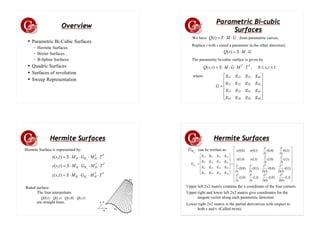
Overview
● Parametric Bi-Cubic Surfaces
– Hermite Surfaces
– Bézier Surfaces
– B-Spline Surfaces
● Quadric Surfaces
● Surfaces of revolution
● Sweep Representation
We have from parametric curves.
Parametric Bi-cubic
Surfaces
GMTtQ ⋅⋅=)(
Replace t with s (need a parameter in the other direction).
GMSsQ ⋅⋅=)(
The parametric bi-cubic surface is given by
1,0,),( ≤≤⋅⋅⋅⋅= tsTMGMStsQ TT
⎥
⎥
⎥
⎥
⎦
⎤
⎢
⎢
⎢
⎢
⎣
⎡
=
44342414
43332313
42322212
41312111
gggg
gggg
gggg
gggg
G
where
Ruled surface:
The four interpolants
are straight lines.
Hermite Surfaces
Hermite Surface is represented by:
TT
HHH
TT
HHH
TT
HHH
TMGMStsz
TMGMStsy
TMGMStsx
z
y
x
⋅⋅⋅⋅=
⋅⋅⋅⋅=
⋅⋅⋅⋅=
),(
),(
),(
)1,()0,(),1(),0( sQsQtQtQ
Hermite Surfaces
can be written as:
⎥
⎥
⎥
⎥
⎥
⎥
⎥
⎥
⎦
⎤
⎢
⎢
⎢
⎢
⎢
⎢
⎢
⎢
⎣
⎡
∂∂
∂
∂∂
∂
∂
∂
∂
∂
∂∂
∂
∂∂
∂
∂
∂
∂
∂
∂
∂
∂
∂
∂
∂
∂
∂
=
⎥
⎥
⎥
⎥
⎦
⎤
⎢
⎢
⎢
⎢
⎣
⎡
=
)1,1()0,1()1,1()0,1(
)1,0()0,0()1,0()0,0(
)1,1()0,1()1,1()0,1(
)1,0()0,0()1,0()0,0(
22
22
44342414
43332313
42322212
41312111
ststss
ststss
tt
xx
tt
xx
gggg
gggg
gggg
gggg
G xH
xHG
Upper left 2x2 matrix contains the x coordinate of the four corners.
Upper right and lower left 2x2 matrix give coordinates for the
tangent vector along each parametric direction.
Lower right 2x2 matrix is the partial derivatives with respect to
both s and t. (Called twist).
Hermite permits C1
and G1
continuity from one curve segment
to the next.
Conditions for C1
continuity are that the control points along
the edge, the tangent vectors
and the twist vectors to be
equal.
For G1
the vectors must have
the same direction
(not the same magnitude).
Hermite Surfaces
Hermite surfaces are a restricted
form of Coons patch.
Consists of two ruled surfaces
and one bilinear blend.
ruled + ruled - bilinear
Coons Patch
uvvu rrrx −+=
Bézier Surfaces
Derived the same way as the Hermite:
TT
BBB
TT
BBB
TT
BBB
TMGMStsz
TMGMStsy
TMGMStsx
z
y
x
⋅⋅⋅⋅=
⋅⋅⋅⋅=
⋅⋅⋅⋅=
),(
),(
),(
The geometry matrix G consists of 16 control points.
Bézier surfaces are attractive in interactive design.
The surface interpolates some control points
Convex hull
Subdivision
Bézier Surfaces
C0
and G0
is created by making the four common control
points equal.
G1
occurs when two sets of four control points on either side of
the edge are collinear with the points on the edge.
Bézier Surfaces
[ ]
⎥
⎥
⎥
⎥
⎦
⎤
⎢
⎢
⎢
⎢
⎣
⎡
−
−
−
⋅⋅−−−=
3
2
2
3
3223
)1(3
)1(3
)1(
)1(3)1(3)1(),(
s
ss
ss
s
Gtttttttsx xB
A Bézier surface can be displayed using the following equation:
B-Spline Surfaces
TT
BsBsBs
TT
BsBsBs
TT
BsBsBs
TMGMStsz
TMGMStsy
TMGMStsx
z
y
x
⋅⋅⋅⋅=
⋅⋅⋅⋅=
⋅⋅⋅⋅=
),(
),(
),(
B-spline surfaces are represented as:
B-spline surfaces come naturally with C2
continuity.
All techniques for subdivision and display carry over to
the bi-cubic case.
Surface Normal
The normal to a bi-cubic surface is needed for shading.
The s tangent vectors and the t tangent vectors are both parallel
to the surface at the point (s,t) and their cross product is
perpendicular to the surface.
The normal can then be calculated:
[ ]sttssttsstts yxyxxzxzzyzytsQ
t
tsQ
s
−−−=
∂
∂
×
∂
∂
),(),(
The implicit surface equation
defines a family of quadric surfaces. An alternative to rational
surfaces if only quadric surfaces are being represented.
Useful in specialized applications, such as molecular modeling.
Other objects are spheres, ellipsoids, tori, parapoloids and hyperbolas.
Quadric Surfaces
A frequently used class of objects, which are described with second-
degree equations.
0222222),,( 222
=+++++++++= kjzhygxfxzeyzdxyczbyaxzyxf
Surface of Revolution
A very simple way of defining objects is obtained by rotating a
curve or a line around an axis.
A circular cylinder is formed by rotating a line segment parallel
to the z-axis through an angle of 360° around the same axis.
Any point on the surface
of revolution is a function
of t and θ.
[ ])(,sin)(,cos)(),( tztxtxtP θθθ =
Surface of Revolution
A simple torus is generated by rotating a circle in the xz-plane
around the z-axis.
[ ]φθφθφθφ sin,sin)cos(,cos)cos(),( araraP ++=
The torus is represented by:
Surface of Revolution
Surfaces of revolution can also be obtained by rotating a curve
around an axis.
Sweep Representation
A technique to produce 3D objects.
Specify a 2D shape and sweep the shape through a region.
The sweep transformation can contain translation, scaling or
rotation.
Translational Sweep

curve two

  • 1.
    Overview ● Parametric Bi-CubicSurfaces – Hermite Surfaces – Bézier Surfaces – B-Spline Surfaces ● Quadric Surfaces ● Surfaces of revolution ● Sweep Representation We have from parametric curves. Parametric Bi-cubic Surfaces GMTtQ ⋅⋅=)( Replace t with s (need a parameter in the other direction). GMSsQ ⋅⋅=)( The parametric bi-cubic surface is given by 1,0,),( ≤≤⋅⋅⋅⋅= tsTMGMStsQ TT ⎥ ⎥ ⎥ ⎥ ⎦ ⎤ ⎢ ⎢ ⎢ ⎢ ⎣ ⎡ = 44342414 43332313 42322212 41312111 gggg gggg gggg gggg G where Ruled surface: The four interpolants are straight lines. Hermite Surfaces Hermite Surface is represented by: TT HHH TT HHH TT HHH TMGMStsz TMGMStsy TMGMStsx z y x ⋅⋅⋅⋅= ⋅⋅⋅⋅= ⋅⋅⋅⋅= ),( ),( ),( )1,()0,(),1(),0( sQsQtQtQ Hermite Surfaces can be written as: ⎥ ⎥ ⎥ ⎥ ⎥ ⎥ ⎥ ⎥ ⎦ ⎤ ⎢ ⎢ ⎢ ⎢ ⎢ ⎢ ⎢ ⎢ ⎣ ⎡ ∂∂ ∂ ∂∂ ∂ ∂ ∂ ∂ ∂ ∂∂ ∂ ∂∂ ∂ ∂ ∂ ∂ ∂ ∂ ∂ ∂ ∂ ∂ ∂ ∂ ∂ = ⎥ ⎥ ⎥ ⎥ ⎦ ⎤ ⎢ ⎢ ⎢ ⎢ ⎣ ⎡ = )1,1()0,1()1,1()0,1( )1,0()0,0()1,0()0,0( )1,1()0,1()1,1()0,1( )1,0()0,0()1,0()0,0( 22 22 44342414 43332313 42322212 41312111 ststss ststss tt xx tt xx gggg gggg gggg gggg G xH xHG Upper left 2x2 matrix contains the x coordinate of the four corners. Upper right and lower left 2x2 matrix give coordinates for the tangent vector along each parametric direction. Lower right 2x2 matrix is the partial derivatives with respect to both s and t. (Called twist).
  • 2.
    Hermite permits C1 andG1 continuity from one curve segment to the next. Conditions for C1 continuity are that the control points along the edge, the tangent vectors and the twist vectors to be equal. For G1 the vectors must have the same direction (not the same magnitude). Hermite Surfaces Hermite surfaces are a restricted form of Coons patch. Consists of two ruled surfaces and one bilinear blend. ruled + ruled - bilinear Coons Patch uvvu rrrx −+= Bézier Surfaces Derived the same way as the Hermite: TT BBB TT BBB TT BBB TMGMStsz TMGMStsy TMGMStsx z y x ⋅⋅⋅⋅= ⋅⋅⋅⋅= ⋅⋅⋅⋅= ),( ),( ),( The geometry matrix G consists of 16 control points. Bézier surfaces are attractive in interactive design. The surface interpolates some control points Convex hull Subdivision Bézier Surfaces C0 and G0 is created by making the four common control points equal. G1 occurs when two sets of four control points on either side of the edge are collinear with the points on the edge.
  • 3.
    Bézier Surfaces [ ] ⎥ ⎥ ⎥ ⎥ ⎦ ⎤ ⎢ ⎢ ⎢ ⎢ ⎣ ⎡ − − − ⋅⋅−−−= 3 2 2 3 3223 )1(3 )1(3 )1( )1(3)1(3)1(),( s ss ss s GtttttttsxxB A Bézier surface can be displayed using the following equation: B-Spline Surfaces TT BsBsBs TT BsBsBs TT BsBsBs TMGMStsz TMGMStsy TMGMStsx z y x ⋅⋅⋅⋅= ⋅⋅⋅⋅= ⋅⋅⋅⋅= ),( ),( ),( B-spline surfaces are represented as: B-spline surfaces come naturally with C2 continuity. All techniques for subdivision and display carry over to the bi-cubic case. Surface Normal The normal to a bi-cubic surface is needed for shading. The s tangent vectors and the t tangent vectors are both parallel to the surface at the point (s,t) and their cross product is perpendicular to the surface. The normal can then be calculated: [ ]sttssttsstts yxyxxzxzzyzytsQ t tsQ s −−−= ∂ ∂ × ∂ ∂ ),(),( The implicit surface equation defines a family of quadric surfaces. An alternative to rational surfaces if only quadric surfaces are being represented. Useful in specialized applications, such as molecular modeling. Other objects are spheres, ellipsoids, tori, parapoloids and hyperbolas. Quadric Surfaces A frequently used class of objects, which are described with second- degree equations. 0222222),,( 222 =+++++++++= kjzhygxfxzeyzdxyczbyaxzyxf
  • 4.
    Surface of Revolution Avery simple way of defining objects is obtained by rotating a curve or a line around an axis. A circular cylinder is formed by rotating a line segment parallel to the z-axis through an angle of 360° around the same axis. Any point on the surface of revolution is a function of t and θ. [ ])(,sin)(,cos)(),( tztxtxtP θθθ = Surface of Revolution A simple torus is generated by rotating a circle in the xz-plane around the z-axis. [ ]φθφθφθφ sin,sin)cos(,cos)cos(),( araraP ++= The torus is represented by: Surface of Revolution Surfaces of revolution can also be obtained by rotating a curve around an axis. Sweep Representation A technique to produce 3D objects. Specify a 2D shape and sweep the shape through a region. The sweep transformation can contain translation, scaling or rotation. Translational Sweep