@ABOUT Mohr’s Circle@
1.Mohr’s circle, named after Christian Otto Mohr.
2.GRAPHICAL REPRESENTATION.
3.Quick & easy to solve the problem than
analytical.
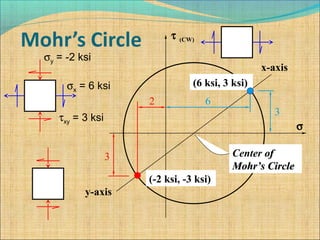
4.It is used to determine graphically the stress
components acting on a rotated coordinate
system, i.e., acting on a differently oriented plane
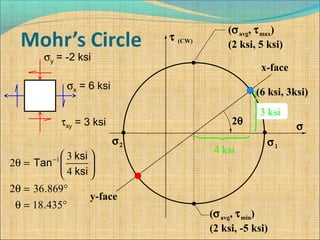
passing through that point.
@FORMULA@
MAX. PRINCIPLE STRESS=>
(X+Y)/2+[{(X-Y)/2}^2+(Zxy)^2]^(.5)=C+R
MIN. PRINCIPLE STRESS=>
(X+Y)/2-[{(X-Y)/2}^2+(Zxy)^2]^(.5)=C-R
COORDINATE(C)=(X+Y)/2
RADIUS OF CIRCLE(R)=[{(X-Y)/2}^2+(Zxy)^2]^(.5)
Where X=Stress in x-direction, Y=Stress in y-
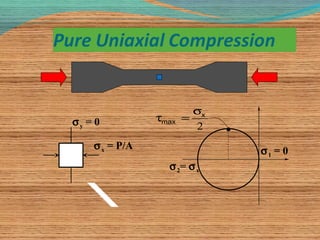
direction and Zxy=Shear stress.
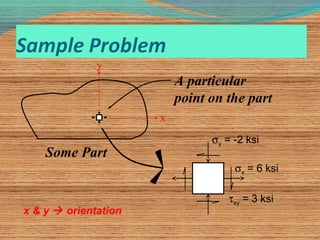
σx = 6 ksi
σy = -2 ksi
τxy = 3 ksi
Some Part
A particular
point on the part
x
y
x & y  orientation
τ (CW)
σ
x-axis
y-axis
σx = 6 ksi
σy = -2 ksi
τxy = 3 ksi
(6 ksi, 3 ksi)
6
3
(-2 ksi, -3 ksi)
2
3 Center ofof
Mohr’s CircleMohr’s Circle
τ (CW)
σ
σ1σavg =
2 ksi
x-face
y-face
(6 ksi, 3ksi)
(-2 ksi, -3ksi)
σ2
(σavg, τmax)
σx = 6 ksi
σy = -2 ksi
τxy = 3 ksi
(σavg, τmin)ksi
yx
avg 2
2
=
σ+σ
=σ
τ (CW)
σ
σ1
x-face
y-face
(6 ksi, 3ksi)
σ2
σx = 6 ksi
σy = -2 ksi
τxy = 3 ksi
4 ksi
σ1 = σavg + R = 7 ksi
σ2 = σavg – R = −3
(σavg, τmax)
(2 ksi, 5 ksi)
(σavg, τmin)
(2 ksi, -5 ksi)
3 ksi
max
22
5
)4()3(
τ=
=
+=
R
ksi
ksiksiR
R
τ (CW)
σ
σ1
x-face
y-face
(6 ksi, 3ksi)
σ2
σx = 6 ksi
σy = -2 ksi
τxy = 3 ksi 2θ
4 ksi
(σavg, τmax)
(2 ksi, 5 ksi)
(σavg, τmin)
(2 ksi, -5 ksi)
3 ksi
°=θ
°=θ






=θ −
43518
869362
4
3
2 1
.
.
ksi
ksi
Tan
τ (CW)
σ
σ1
x-face
(6 ksi, 3ksi)
σ2
σ1 = 7 ksi
σ2 = -3 ksi
2θ
4 ksi
(σavg, τmax)
(2 ksi, 5 ksi)
(σavg, τmin)
(2 ksi, -5 ksi)
3 ksi
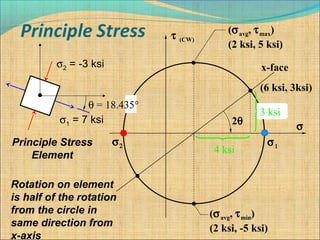
θ = 18.435°
Principle Stress
Element
Rotation on element
is half of the rotation
from the circle in
same direction from
x-axis
τ (CW)
σ
σ1
x-face
y-face
(6 ksi, 3ksi)
σ2
σavg = 2 ksi
σavg = 2 ksi
τmax = 5 ksi
2θ
4 ksi
(σavg, τmax)
(2 ksi, 5 ksi)
(σavg, τmin)
(2 ksi, -5 ksi)
3 ksi
°=φ
°=φ
°−=φ
θ−°=φ
56526
130532
86936902
2902
.
.
.
2φ
Maximum Shear
Stress Element
φ = 26.565°
σavg = 2 ksi
σavg = 2 ksi
τmax = 5 ksi
φ = 26.565°
σ1 = 7 ksi
σ2 = -3 ksi
σx = 6 ksi
σy = -2 ksi
τxy = 3 ksi
θ = 18.435°
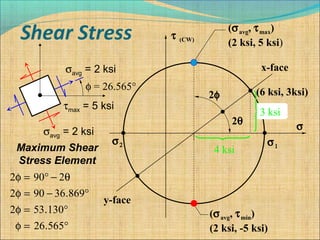
θ+ φ = 18.435 ° + 26.565 ° = 45 °,[Z=(X1-Y1)/2 sin2#+Zxy cos2#],
Where #=45*, Now we get Zmax=(X1-Y1)/2.
Next: Special Cases
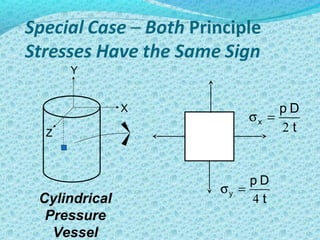
Cylindrical
Pressure
Vessel
X
Y
Z t
Dp
x
2
=σ
t
Dp
y
4
=σ
σx
τ (CW)
σ
σy
σx
σy
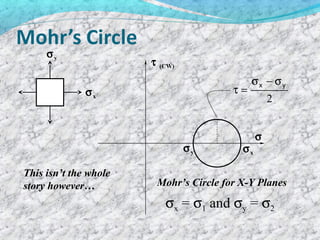
2
yx σ−σ
=τ
Mohr’s Circle for X-Y Planes
This isn’t the whole
story however…
σx = σ1 and σy = σ2
σ1
τ (CW)
σ
σy
σx
σz
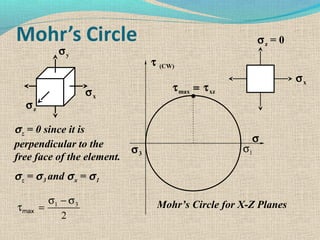
σz = 0 since it is
perpendicular to the
free face of the element.
σz = σ3 and σx = σ1
σ3
Mohr’s Circle for X-Z Planes
σx
σz = 0
τmax = τxz
2
31 σ−σ
=τmax
σ1
τ (CW)
σ
σ2
σy
σx
σz
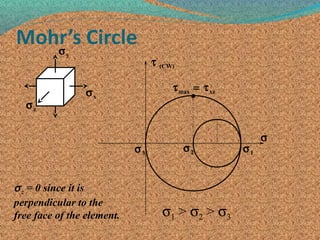
σz = 0 since it is
perpendicular to the
free face of the element.
σ3
τmax = τxz
σ1 > σ2 > σ3
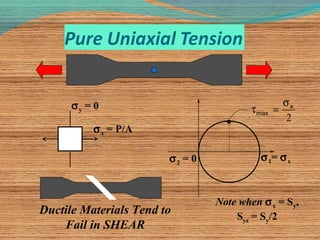
σy = 0
σx = P/A
Ductile Materials Tend to
Fail in SHEAR
σ1= σx
2
x
max
σ
=τ
σ2 = 0
Note when σx = Sy,
Sys = Sy/2
σy = 0
σx = P/A
2
x
max
σ
=τ
σ1 = 0
σ2= σx
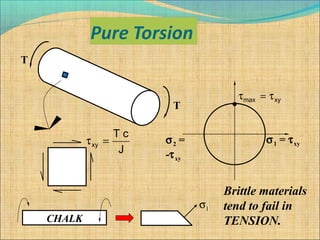
T
T
J
cT
xy =τ
xymax τ=τ
σ1 = τxyσ2 =
-τxy
CHALK
σ1
Brittle materials
tend to fail in
TENSION.
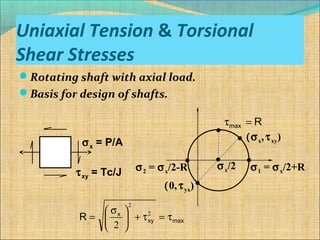
Uniaxial Tension & Torsional
Shear Stresses
Rotating shaft with axial load.
Basis for design of shafts.
σx = P/A
τxy = Tc/J
Rmax =τ
σ1 = σx/2+Rσx/2
(σx,τxy)
σ2 = σx/2-R
(0,τyx)
maxxy
x
R τ=τ+




 σ
= 2
2
2
Mohr's circle Samriddha Shil.....S@S

Mohr's circle Samriddha Shil.....S@S

  • 2.
    @ABOUT Mohr’s Circle@ 1.Mohr’scircle, named after Christian Otto Mohr. 2.GRAPHICAL REPRESENTATION. 3.Quick & easy to solve the problem than analytical. 4.It is used to determine graphically the stress components acting on a rotated coordinate system, i.e., acting on a differently oriented plane passing through that point.
  • 3.
    @FORMULA@ MAX. PRINCIPLE STRESS=> (X+Y)/2+[{(X-Y)/2}^2+(Zxy)^2]^(.5)=C+R MIN.PRINCIPLE STRESS=> (X+Y)/2-[{(X-Y)/2}^2+(Zxy)^2]^(.5)=C-R COORDINATE(C)=(X+Y)/2 RADIUS OF CIRCLE(R)=[{(X-Y)/2}^2+(Zxy)^2]^(.5) Where X=Stress in x-direction, Y=Stress in y- direction and Zxy=Shear stress.
  • 4.
    σx = 6ksi σy = -2 ksi τxy = 3 ksi Some Part A particular point on the part x y x & y  orientation
  • 5.
    τ (CW) σ x-axis y-axis σx =6 ksi σy = -2 ksi τxy = 3 ksi (6 ksi, 3 ksi) 6 3 (-2 ksi, -3 ksi) 2 3 Center ofof Mohr’s CircleMohr’s Circle
  • 6.
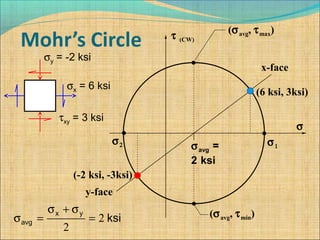
    τ (CW) σ σ1σavg = 2ksi x-face y-face (6 ksi, 3ksi) (-2 ksi, -3ksi) σ2 (σavg, τmax) σx = 6 ksi σy = -2 ksi τxy = 3 ksi (σavg, τmin)ksi yx avg 2 2 = σ+σ =σ
  • 7.
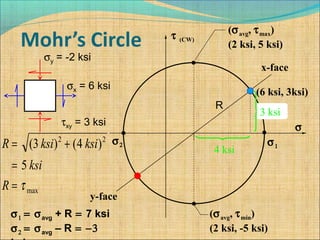
    τ (CW) σ σ1 x-face y-face (6 ksi,3ksi) σ2 σx = 6 ksi σy = -2 ksi τxy = 3 ksi 4 ksi σ1 = σavg + R = 7 ksi σ2 = σavg – R = −3 (σavg, τmax) (2 ksi, 5 ksi) (σavg, τmin) (2 ksi, -5 ksi) 3 ksi max 22 5 )4()3( τ= = += R ksi ksiksiR R
  • 8.
    τ (CW) σ σ1 x-face y-face (6 ksi,3ksi) σ2 σx = 6 ksi σy = -2 ksi τxy = 3 ksi 2θ 4 ksi (σavg, τmax) (2 ksi, 5 ksi) (σavg, τmin) (2 ksi, -5 ksi) 3 ksi °=θ °=θ       =θ − 43518 869362 4 3 2 1 . . ksi ksi Tan
  • 9.
    τ (CW) σ σ1 x-face (6 ksi,3ksi) σ2 σ1 = 7 ksi σ2 = -3 ksi 2θ 4 ksi (σavg, τmax) (2 ksi, 5 ksi) (σavg, τmin) (2 ksi, -5 ksi) 3 ksi θ = 18.435° Principle Stress Element Rotation on element is half of the rotation from the circle in same direction from x-axis
  • 10.
    τ (CW) σ σ1 x-face y-face (6 ksi,3ksi) σ2 σavg = 2 ksi σavg = 2 ksi τmax = 5 ksi 2θ 4 ksi (σavg, τmax) (2 ksi, 5 ksi) (σavg, τmin) (2 ksi, -5 ksi) 3 ksi °=φ °=φ °−=φ θ−°=φ 56526 130532 86936902 2902 . . . 2φ Maximum Shear Stress Element φ = 26.565°
  • 11.
    σavg = 2ksi σavg = 2 ksi τmax = 5 ksi φ = 26.565° σ1 = 7 ksi σ2 = -3 ksi σx = 6 ksi σy = -2 ksi τxy = 3 ksi θ = 18.435° θ+ φ = 18.435 ° + 26.565 ° = 45 °,[Z=(X1-Y1)/2 sin2#+Zxy cos2#], Where #=45*, Now we get Zmax=(X1-Y1)/2.
  • 12.
  • 13.
  • 14.
    σx τ (CW) σ σy σx σy 2 yx σ−σ =τ Mohr’sCircle for X-Y Planes This isn’t the whole story however… σx = σ1 and σy = σ2
  • 15.
    σ1 τ (CW) σ σy σx σz σz =0 since it is perpendicular to the free face of the element. σz = σ3 and σx = σ1 σ3 Mohr’s Circle for X-Z Planes σx σz = 0 τmax = τxz 2 31 σ−σ =τmax
  • 16.
    σ1 τ (CW) σ σ2 σy σx σz σz =0 since it is perpendicular to the free face of the element. σ3 τmax = τxz σ1 > σ2 > σ3
  • 17.
    σy = 0 σx= P/A Ductile Materials Tend to Fail in SHEAR σ1= σx 2 x max σ =τ σ2 = 0 Note when σx = Sy, Sys = Sy/2
  • 18.
    σy = 0 σx= P/A 2 x max σ =τ σ1 = 0 σ2= σx
  • 19.
    T T J cT xy =τ xymax τ=τ σ1= τxyσ2 = -τxy CHALK σ1 Brittle materials tend to fail in TENSION.
  • 20.
    Uniaxial Tension &Torsional Shear Stresses Rotating shaft with axial load. Basis for design of shafts. σx = P/A τxy = Tc/J Rmax =τ σ1 = σx/2+Rσx/2 (σx,τxy) σ2 = σx/2-R (0,τyx) maxxy x R τ=τ+      σ = 2 2 2