HITB Labs:
Practical Attacks
Against 3G/4G
Telecommunication
Networks
        Jim Geovedi
        Daniel Mende


jim@geovedi.com, dmende@ernw.de
Agenda

 Overview 3G / 4G
 Backhaul Networks
 Backend Protocols in depth
 The Lab
 The Tools

 Exercises
 Conclusions
Overview 3G / 4G
Standards

 In mobile telco world everything standardized by 3GPP
 3GPP: collaboration between groups of telco standard orgs
   Which “type of documents” do you think these guys produce? ;-)


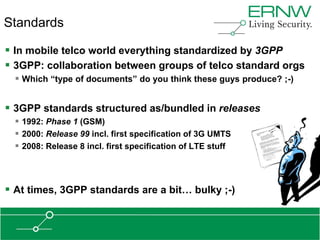
 3GPP standards structured as/bundled in releases
   1992: Phase 1 (GSM)
   2000: Release 99 incl. first specification of 3G UMTS
   2008: Release 8 incl. first specification of LTE stuff


 At times, 3GPP standards are a bit… bulky ;-)
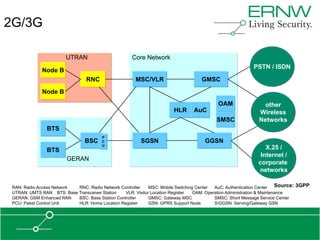
2G/3G

                         UTRAN                         Core Network
                                                                                                             PSTN / ISDN
              Node B
                                  RNC                   MSC/VLR                       GMSC
              Node B
                                                                                             OAM                 other
                                                                         HLR      AuC                           Wireless
                                                                                             SMSC               Networks
                BTS
                                         P
                                 BSC     C                 SGSN                        GGSN
                                         U
                BTS                                                                                                X.25 /
                                                                                                                 Internet /
                         GERAN
                                                                                                                corporate
                                                                                                                networks

 RAN: Radio Access Network RNC: Radio Network Controller     MSC: Mobile Switching Center  AuC: Authentication Center    Source:   3GPP
 UTRAN: UMTS RAN BTS: Base Transceiver Station   VLR: Visitor Location Register   OAM: Operation Administration & Maintenance
 GERAN: GSM Enhanced RAN   BSC: Base Station Controller      GMSC: Gateway MSC             SMSC: Short Message Service Center
 PCU: Paket Control Unit   HLR: Home Location Register       GSN: GPRS Support Node        S/GGSN: Serving/Gateway GSN
4G
Backhaul Networks
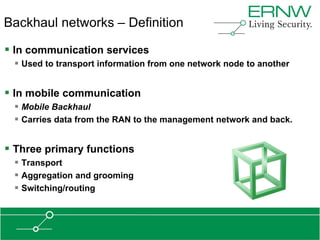
Backhaul networks – Definition

 In communication services
  Used to transport information from one network node to another


 In mobile communication
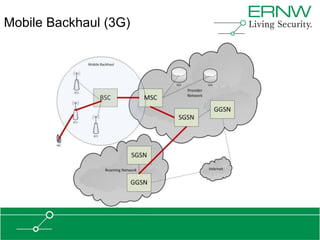
  Mobile Backhaul
  Carries data from the RAN to the management network and back.


 Three primary functions
  Transport
  Aggregation and grooming
  Switching/routing
Mobile Backhaul (3G)
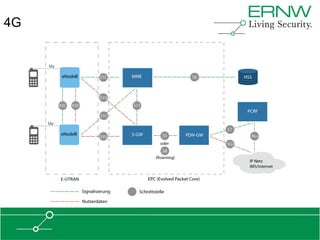
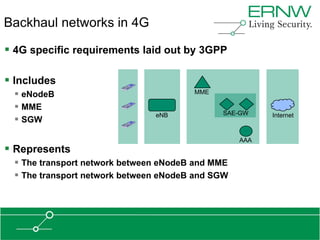
Backhaul networks in 4G

 4G specific requirements laid out by 3GPP

 Includes
  eNodeB                              MME

  MME
                               eNB           SAE-GW     Internet
  SGW

                                                  AAA
 Represents
  The transport network between eNodeB and MME
  The transport network between eNodeB and SGW
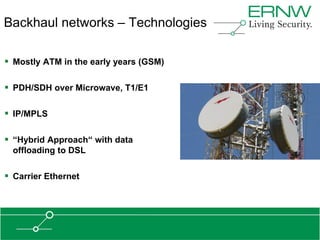
Backhaul networks – Technologies

 Mostly ATM in the early years (GSM)

 PDH/SDH over Microwave, T1/E1

 IP/MPLS

 “Hybrid Approach“ with data
  offloading to DSL

 Carrier Ethernet
How to get into backhaul

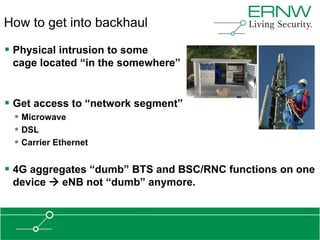
 Physical intrusion to some
 cage located “in the somewhere”


 Get access to “network segment”
  Microwave
  DSL
  Carrier Ethernet

 4G aggregates “dumb” BTS and BSC/RNC functions on one
 device  eNB not “dumb” anymore.
Once you’re in (a backhaul network)

 Attack components
  3G: SGSN, RNC, NodeB
  4G: MME, eNB, SAE-GW
  Routers/Switches

 Eavesdropping
  Will get you some key material
    but what would you need this for? Pretty much everything is unencrypt. here anyway.
  That‟s why 3GPP insists on using IPsec gateways.
  Subsequent question: do (which) operators implement this?
  In standard bodies $SOME_BIG_COUNTRY (hint: in Asia) strongly
   opposed this recommendation.
Protocols used in Backend
GTP

 GPRS Tunneling Protocol

 IP-based protocol initially used
 to carry GPRS within GSM and
 UMTS networks.
   Plays major role in 4G networks as well.


 Three variants
   GTP-C used for control plane (signaling)
   GTP-U used for user data
   GTP„ used for charging data
GTP

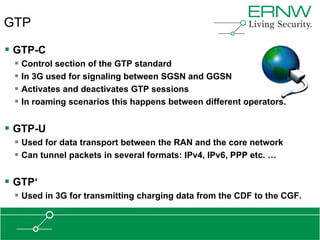
 GTP-C
  Control section of the GTP standard
  In 3G used for signaling between SGSN and GGSN
  Activates and deactivates GTP sessions
  In roaming scenarios this happens between different operators.

 GTP-U
  Used for data transport between the RAN and the core network
  Can tunnel packets in several formats: IPv4, IPv6, PPP etc. …

 GTP„
  Used in 3G for transmitting charging data from the CDF to the CGF.
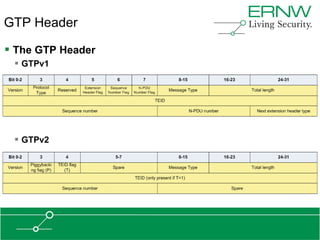
GTP Header

 The GTP Header
  GTPv1


  GTPv2
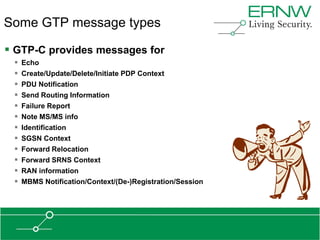
Some GTP message types

 GTP-C provides messages for
    Echo
    Create/Update/Delete/Initiate PDP Context
    PDU Notification
    Send Routing Information
    Failure Report
    Note MS/MS info
    Identification
    SGSN Context
    Forward Relocation
    Forward SRNS Context
    RAN information
    MBMS Notification/Context/(De-)Registration/Session
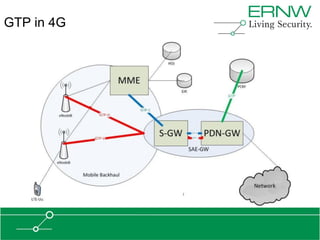
GTP in 4G
GTP-C

 Control protocol for GTP session


 Very complex protocol

 A lots of different mandatory TLVs are
 defined for all the different Message types

 Even more optional TLVs are defined, plus
 vendor specific „secret‟ TLVs
GTP-U

 Tunneling protocol for ME-traffic.
 Static header length.
 Endpoint multiplexing done by 32bit TEID.
 (Tunnel Endpoint Identifier, more on that later)


 User data is transported in clear text
 No authentication mechanism in the protocol itself
GTP from a security perspective

 Unauthenticated protocol
 No inherent security properties
 Trusted environment assumed

 Is used to perform “quite some functions“
   Session establishment (“activate PDP context“)
   Forwarding of packets
   Charging related stuff

 All these functions rely on certain protocol fields
   Presumably only known to valid peers... which are isolated anyway...


                      © ERNW GmbH | Breslauer Str. 28 | D-69124 Heidelberg | www.ernw.de   22
The PDP-Context

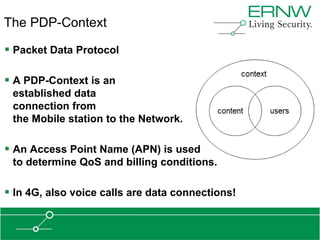
 Packet Data Protocol

 A PDP-Context is an
 established data
 connection from
 the Mobile station to the Network.

 An Access Point Name (APN) is used
 to determine QoS and billing conditions.

 In 4G, also voice calls are data connections!
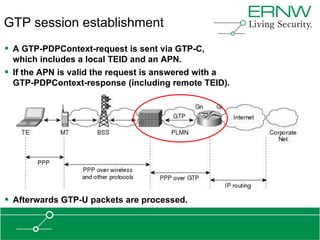
GTP session establishment
 A GTP-PDPContext-request is sent via GTP-C,
  which includes a local TEID and an APN.
 If the APN is valid the request is answered with a
  GTP-PDPContext-response (including remote TEID).


 Afterwards GTP-U packets are processed.
TEID in detail


 Tunnel Endpoint Identifier

 Do I need to explain that it serves
 to identify endpoints of tunnels? ;-)
   For each (user) data session.
TEID in detail

 Apparently some discussion about it being random
  For obvious (?) security reasons.
  Although we were not able to find spec prescribing this.

 What we observed
  0x00005c35
  0x00005c4d
  0x00005c65
  0x00005c7d
  0x00005c95
  […]
  Does this look random to you ?
S1AP

 S1 Application Protocol

 Used in 4G between eNodeB and MME (the S1 interface).
 Replaces GTP-C which is used in 3G on that interface.
 Uses SCTP for transport.

 Protocol is defined in ASN.1 only (!) in the 3GPP spec.
 Vendors implement proprietary
 extensions.

 What could possibly go wrong ;-)
S1AP – Details
 We had the opportunity to test an eNodeB – MME pair,
  actively communicating over S1AP.
 Some things came to eyes early:
   No authentication used whatsoever.
   SCTP session is used to keep track of neighbor state.
     -> DoS via spoofed SCTP-ABORT packages.


 Others needed an fuzzing approach to come clear:
   No good parsing of the (ASN.1 defined) protocol.
   Fuzzing lead to major crash of the device.


 No tools or details released here, due to NDA.
     SORRY!
SCTP - Overview

 SCTP
  Stream Control Transmission Protocol
  Specified by IETF, maintained IETF Transport Area (TSVWG) WG


 Specs:
  RFC 3286 (Introduction)
  RFC 2960 (2000)
  RFC 3309
  RFC 4960 (2007)
  RFC 5062
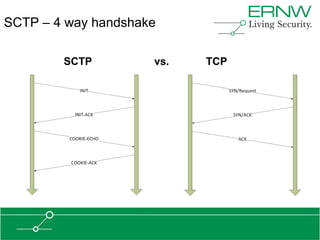
SCTP – 4 way handshake

        SCTP         vs.   TCP
SCTP – Timeline

 RFC 2960 (2000): initial spec
 RFC 4960 (2007): “major rewrite“
 RFC 5062 (2007) Security Attacks Found Against the Stream
 Control Transmission Protocol (SCTP) and Current
 Countermeasures”

 So, over time SCTP has changed a bit…
Tests in SCTP space ‒ Practical problems

 Current tools… do not work very well
   Probably due to stack rewrites based on RFC 5206 and 4960

 nmap SCTP does not work “in a satisfactory manner”
   -sZ does give results
   -sY (“half-open handshake”) didn‟t show anything useful
     But we _knew_ the ports were there…


 Philippe Langlois„ SCTPscan
 didn„t work either.

 Daniel wrote quick+dirty “simple SCTP port scanner“.
SCTP hacked scanner ;)
s = socket.socket(socket.AF_INET, socket.SOCK_SEQPACKET)
for i in ip:
    for j in xrange(sys.argv[2], sys.argv[3]):
        time.sleep(0.01)
        try:
            s.connect((j, i))
        except Exception, e:
            print "Port %d closed on %s: %s" % (i, j, e)
        else:
            print "Port %d open on %s" % (i, j)
            s.close()

        (this is more port-knocking no real port-scanning)
UDP vs. SCTP

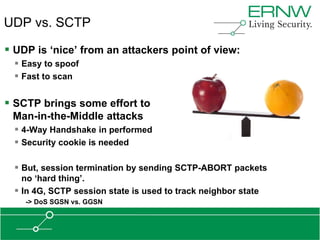
 UDP is „nice‟ from an attackers point of view:
   Easy to spoof
   Fast to scan

 SCTP brings some effort to
 Man-in-the-Middle attacks
   4-Way Handshake in performed
   Security cookie is needed

   But, session termination by sending SCTP-ABORT packets
    no „hard thing‟.
   In 4G, SCTP session state is used to track neighbor state
    -> DoS SGSN vs. GGSN
The VMware
The virtual machine

 Minimal gentoo linux with
  Username „root‟
  Password „toor‟
 Tools and dependencies preinstalled
  Tools in /root/tools
  GTP dizz files in /root/tools/dizzes


 Wireshark on the host system
 is recommended
The virtual machine

 Please make sure the virtual machine is running on your
  system.
 You will need it to follow the next part of the session.

 If you‟re lacking Wireshark or VMware,
 both can be found in the local net:

 http://10.0.0.1/
The Lab
GTP on 7200VXR

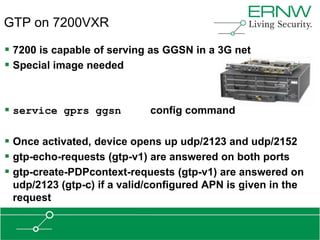
 7200 is capable of serving as GGSN in a 3G net
 Special image needed


 service gprs ggsn          config command

 Once activated, device opens up udp/2123 and udp/2152
 gtp-echo-requests (gtp-v1) are answered on both ports
 gtp-create-PDPcontext-requests (gtp-v1) are answered on
 udp/2123 (gtp-c) if a valid/configured APN is given in the
 request
Lab ranges


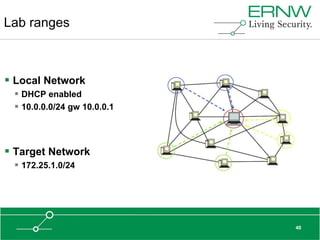
 Local Network
  DHCP enabled
  10.0.0.0/24 gw 10.0.0.1


 Target Network
  172.25.1.0/24


                             40
The Tools
gtp_scan

 Scans a host to find gtp services on udp/sctp
 Python based
 Requires IPy


 Source:
  http://c0decafe.de/tools/gtp_scan-0.7.tar.gz
gtp_scan – cmd

$ python gtp-scan.py --help
Usage: gtp-scan.py [options] address[/net]

Options:
  --version    show program's version number and
 exit
  -h, --help   show this help message and exit
  -w SEC       Time to wait for cooldown
  -s           Use SCTP for transport, instead of
 UDP


                                              43
gtp_scan – detail

 GTP inbuilt ping mechanism is used to discover services.
 Scans for GTP-U, GTP-C and GTP‟.
 Each port is tested with GTPv1 and GTPv2 echo_requests.

 Listening Services will send back a GTP echo_response, if
 no filtering is applied on the path.

 As hosts answer „nicely‟ and UDP is used for transport, fast
 scanning of wide network ranges is possible.
Some statistics (GTP-C)

                             Version 1               Version 2

     AfriNIC                 26 (31)                 11 (26)
     APNIC                   81 (131)                97 (90)
     ARIN                    52 (29)                 45 (51)
     LACNIC                  22 (14)                 10 (18)
     RIPE                    129 (97)                94 (435)

     UP                      310 (302)               257 (620)
     [Values in brackets are the results from our last scan, some months ago]
apnbf

 Script that brute forces the APN (Access Point Name)
  in GTPv1c.
 Python based


 Source:
  http://c0decafe.de/tools/apnbf-0.1.tar.gz
apnbf – cmd

$ python apnbf.py --help
Usage: apnbf.py [options] address

Options:
  --version     show program's version number and
 exit
  -h, --help    show this help message and exit
  -w WORDLIST   Wordlist to use
  -d SEC        BruteForce delay
  -v            Be verbose
apnbf – detail

 Host are scanned for the possibility to establish
 a new PDP_context.
   This requires a valid APN name.
   If the establishment is possible, further attacks could be launched.


 Given list for APN names is brute forced.
 Returned error code gives a good
 impression of the hosts „shape‟.
APNBF – results from the internetz

 List of most used APNs in the Wild:
  internet (12)
  INTERNET (10)
  Internet (10)
  wap (5)
  mms (5)
  airtelnet.es (4)
  online.telia.se (3)
  cmnet (3)

 Some gtp speakers don‟t care about the APN at all ;-)
 Python based fuzzing framework
  Useful to fuzz GTP spreaker


 Requires pylibpcap and libdnet


 Source:
  http://c0decafe.de/tools/dizzy-0.5.tar.gz


                                               50
GTP on 7200VXR – DoS

 Sending out _a_lot_ of gtp-echo-requests will stress the
 7200er CPU to 100%, so that
   No ICMP pings answered anymore.
   No remote mgmt (ssh/telnet) possible
    (refuses connections on tcp/22).
   No further GTP requests processed.

 Sending out _a_lot_ of gtp-create-PDPcontext-requests will
  also stress the device, so that only ~30% of all
  (valid and bogus) requests are answered.
 However a valid APN is needed
   We‟ll get back to this 
Exercises
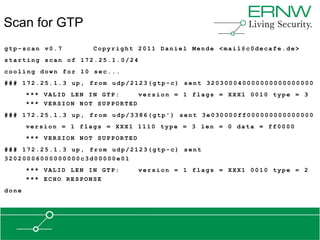
Scan for GTP

 Scan the target range [172.25.1.0/24] for GTP* speaking
 devices.

#cd /root/tools/gtp_scan-0.7/

#python gtp-scan.py 172.25.1.0/24
Scan for GTP
gtp-scan v0.7         Copyright 2011 Daniel Mende <mail@c0decafe.de>
starting scan of 172.25.1.0/24
cooling down for 10 sec...
### 172.25.1.3 up, from udp/2123(gtp-c) sent 320300040000000000000000
       *** VALID LEN IN GTP:     version = 1 flags = XXX1 0010 type = 3
       *** VERSION NOT SUPPORTED
### 172.25.1.3 up, from udp/3386(gtp') sent 3e030000ff000000000000000
       version = 1 flags = XXX1 1110 type = 3 len = 0 data = ff0000
       *** VERSION NOT SUPPORTED
### 172.25.1.3 up, from udp/2123(gtp-c) sent
32020006000000000c3d00000e01
       *** VALID LEN IN GTP:       version = 1 flags = XXX1 0010 type = 2
       *** ECHO RESPONSE
done
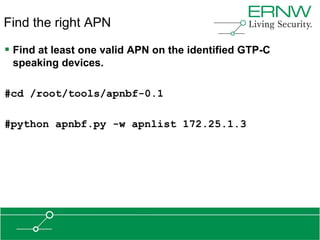
Find the right APN

 Find at least one valid APN on the identified GTP-C
 speaking devices.

#cd /root/tools/apnbf-0.1

#python apnbf.py -w apnlist 172.25.1.3
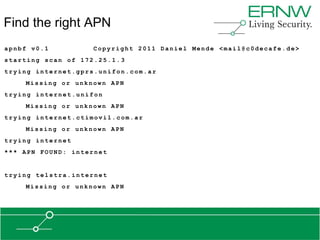
Find the right APN
apnbf v0.1          Copyright 2011 Daniel Mende <mail@c0decafe.de>
starting scan of 172.25.1.3
trying internet.gprs.unifon.com.ar
    Missing or unknown APN
trying internet.unifon
    Missing or unknown APN
trying internet.ctimovil.com.ar
    Missing or unknown APN
trying internet
*** APN FOUND: internet


trying telstra.internet
    Missing or unknown APN
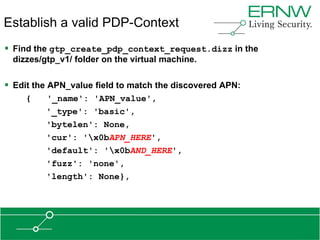
Establish a valid PDP-Context
 Find the gtp_create_pdp_context_request.dizz in the
 dizzes/gtp_v1/ folder on the virtual machine.

 Edit the APN_value field to match the discovered APN:
     {   '_name': 'APN_value',
         '_type': 'basic',
         'bytelen': None,
         'cur': 'x0bAPN_HERE',
         'default': 'x0bAND_HERE',
         'fuzz': 'none',
         'length': None},
Establish a valid PDP-Context

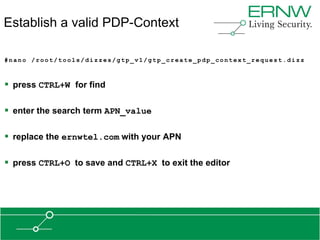
#nano /root/tools/dizzes/gtp_v1/gtp_create_pdp_context_request.dizz


 press CTRL+W for find

 enter the search term APN_value

 replace the ernwtel.com with your APN

 press CTRL+O to save and CTRL+X to exit the editor
Establish a valid PDP-Context

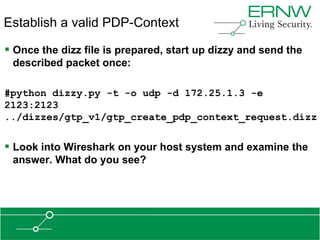
 Once the dizz file is prepared, start up dizzy and send the
 described packet once:

#python dizzy.py -t -o udp -d 172.25.1.3 -e
2123:2123
../dizzes/gtp_v1/gtp_create_pdp_context_request.dizz


 Look into Wireshark on your host system and examine the
 answer. What do you see?
Move on to real fuzzing

 Establishing a valid PDP-context is nice and the first step
 for GTP state-full fuzzing, but we will stay with state-less
 fuzzing for this time, because:
   This a 3G/4G lab session, no fuzzing training ;)
   I don‟t had the time (yet) to write state-full fuzzing scripts (although
    dizzy is usable as a state-full fuzzer)
   We don‟t want to kill the telco industry today :-D
Move on to real fuzzing

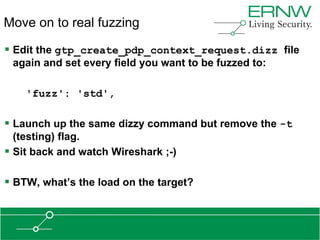
 Edit the gtp_create_pdp_context_request.dizz file
 again and set every field you want to be fuzzed to:

    'fuzz': 'std',

 Launch up the same dizzy command but remove the -t
  (testing) flag.
 Sit back and watch Wireshark ;-)

 BTW, what‟s the load on the target?
Conclusions

 We expect to see a number of attacks in 3G and 4G mobile
 telco networks in the next years, for some reasons
   Walled (telco) gardens are vanishing.
   At the same time “terminals“ get more and more powerful.
   In the future it„s all IP in those networks.
   There„s a complex (IP based) protocol landscape.
   And potentially ppl_outside_telcos are able to understand these prots.
   As there are apparently people understanding Siemens PCS 7...


 Theory ≠ reality
There’s never enough time…


   THANK YOU…                ...for yours!

HITB Labs: Practical Attacks Against 3G/4G Telecommunication Networks

  • 1.
    HITB Labs: Practical Attacks Against3G/4G Telecommunication Networks Jim Geovedi Daniel Mende jim@geovedi.com, dmende@ernw.de
  • 2.
    Agenda  Overview 3G/ 4G  Backhaul Networks  Backend Protocols in depth  The Lab  The Tools  Exercises  Conclusions
  • 3.
  • 4.
    Standards  In mobiletelco world everything standardized by 3GPP  3GPP: collaboration between groups of telco standard orgs  Which “type of documents” do you think these guys produce? ;-)  3GPP standards structured as/bundled in releases  1992: Phase 1 (GSM)  2000: Release 99 incl. first specification of 3G UMTS  2008: Release 8 incl. first specification of LTE stuff  At times, 3GPP standards are a bit… bulky ;-)
  • 5.
    2G/3G UTRAN Core Network PSTN / ISDN Node B RNC MSC/VLR GMSC Node B OAM other HLR AuC Wireless SMSC Networks BTS P BSC C SGSN GGSN U BTS X.25 / Internet / GERAN corporate networks RAN: Radio Access Network RNC: Radio Network Controller MSC: Mobile Switching Center AuC: Authentication Center Source: 3GPP UTRAN: UMTS RAN BTS: Base Transceiver Station VLR: Visitor Location Register OAM: Operation Administration & Maintenance GERAN: GSM Enhanced RAN BSC: Base Station Controller GMSC: Gateway MSC SMSC: Short Message Service Center PCU: Paket Control Unit HLR: Home Location Register GSN: GPRS Support Node S/GGSN: Serving/Gateway GSN
  • 6.
  • 7.
  • 8.
    Backhaul networks –Definition  In communication services  Used to transport information from one network node to another  In mobile communication  Mobile Backhaul  Carries data from the RAN to the management network and back.  Three primary functions  Transport  Aggregation and grooming  Switching/routing
  • 9.
  • 10.
    Backhaul networks in4G  4G specific requirements laid out by 3GPP  Includes  eNodeB MME  MME eNB SAE-GW Internet  SGW AAA  Represents  The transport network between eNodeB and MME  The transport network between eNodeB and SGW
  • 11.
    Backhaul networks –Technologies  Mostly ATM in the early years (GSM)  PDH/SDH over Microwave, T1/E1  IP/MPLS  “Hybrid Approach“ with data offloading to DSL  Carrier Ethernet
  • 12.
    How to getinto backhaul  Physical intrusion to some cage located “in the somewhere”  Get access to “network segment”  Microwave  DSL  Carrier Ethernet  4G aggregates “dumb” BTS and BSC/RNC functions on one device  eNB not “dumb” anymore.
  • 13.
    Once you’re in(a backhaul network)  Attack components  3G: SGSN, RNC, NodeB  4G: MME, eNB, SAE-GW  Routers/Switches  Eavesdropping  Will get you some key material  but what would you need this for? Pretty much everything is unencrypt. here anyway.  That‟s why 3GPP insists on using IPsec gateways.  Subsequent question: do (which) operators implement this?  In standard bodies $SOME_BIG_COUNTRY (hint: in Asia) strongly opposed this recommendation.
  • 14.
  • 15.
    GTP  GPRS TunnelingProtocol  IP-based protocol initially used to carry GPRS within GSM and UMTS networks.  Plays major role in 4G networks as well.  Three variants  GTP-C used for control plane (signaling)  GTP-U used for user data  GTP„ used for charging data
  • 16.
    GTP  GTP-C Control section of the GTP standard  In 3G used for signaling between SGSN and GGSN  Activates and deactivates GTP sessions  In roaming scenarios this happens between different operators.  GTP-U  Used for data transport between the RAN and the core network  Can tunnel packets in several formats: IPv4, IPv6, PPP etc. …  GTP„  Used in 3G for transmitting charging data from the CDF to the CGF.
  • 17.
    GTP Header  TheGTP Header  GTPv1  GTPv2
  • 18.
    Some GTP messagetypes  GTP-C provides messages for  Echo  Create/Update/Delete/Initiate PDP Context  PDU Notification  Send Routing Information  Failure Report  Note MS/MS info  Identification  SGSN Context  Forward Relocation  Forward SRNS Context  RAN information  MBMS Notification/Context/(De-)Registration/Session
  • 19.
  • 20.
    GTP-C  Control protocolfor GTP session  Very complex protocol  A lots of different mandatory TLVs are defined for all the different Message types  Even more optional TLVs are defined, plus vendor specific „secret‟ TLVs
  • 21.
    GTP-U  Tunneling protocolfor ME-traffic.  Static header length.  Endpoint multiplexing done by 32bit TEID. (Tunnel Endpoint Identifier, more on that later)  User data is transported in clear text  No authentication mechanism in the protocol itself
  • 22.
    GTP from asecurity perspective  Unauthenticated protocol  No inherent security properties  Trusted environment assumed  Is used to perform “quite some functions“  Session establishment (“activate PDP context“)  Forwarding of packets  Charging related stuff  All these functions rely on certain protocol fields  Presumably only known to valid peers... which are isolated anyway... © ERNW GmbH | Breslauer Str. 28 | D-69124 Heidelberg | www.ernw.de 22
  • 23.
    The PDP-Context  PacketData Protocol  A PDP-Context is an established data connection from the Mobile station to the Network.  An Access Point Name (APN) is used to determine QoS and billing conditions.  In 4G, also voice calls are data connections!
  • 24.
    GTP session establishment A GTP-PDPContext-request is sent via GTP-C, which includes a local TEID and an APN.  If the APN is valid the request is answered with a GTP-PDPContext-response (including remote TEID).  Afterwards GTP-U packets are processed.
  • 25.
    TEID in detail Tunnel Endpoint Identifier  Do I need to explain that it serves to identify endpoints of tunnels? ;-)  For each (user) data session.
  • 26.
    TEID in detail Apparently some discussion about it being random  For obvious (?) security reasons.  Although we were not able to find spec prescribing this.  What we observed  0x00005c35  0x00005c4d  0x00005c65  0x00005c7d  0x00005c95  […]  Does this look random to you ?
  • 27.
    S1AP  S1 ApplicationProtocol  Used in 4G between eNodeB and MME (the S1 interface).  Replaces GTP-C which is used in 3G on that interface.  Uses SCTP for transport.  Protocol is defined in ASN.1 only (!) in the 3GPP spec.  Vendors implement proprietary extensions.  What could possibly go wrong ;-)
  • 28.
    S1AP – Details We had the opportunity to test an eNodeB – MME pair, actively communicating over S1AP.  Some things came to eyes early:  No authentication used whatsoever.  SCTP session is used to keep track of neighbor state. -> DoS via spoofed SCTP-ABORT packages.  Others needed an fuzzing approach to come clear:  No good parsing of the (ASN.1 defined) protocol.  Fuzzing lead to major crash of the device.  No tools or details released here, due to NDA. SORRY!
  • 29.
    SCTP - Overview SCTP  Stream Control Transmission Protocol  Specified by IETF, maintained IETF Transport Area (TSVWG) WG  Specs:  RFC 3286 (Introduction)  RFC 2960 (2000)  RFC 3309  RFC 4960 (2007)  RFC 5062
  • 30.
    SCTP – 4way handshake SCTP vs. TCP
  • 31.
    SCTP – Timeline RFC 2960 (2000): initial spec  RFC 4960 (2007): “major rewrite“  RFC 5062 (2007) Security Attacks Found Against the Stream Control Transmission Protocol (SCTP) and Current Countermeasures”  So, over time SCTP has changed a bit…
  • 32.
    Tests in SCTPspace ‒ Practical problems  Current tools… do not work very well  Probably due to stack rewrites based on RFC 5206 and 4960  nmap SCTP does not work “in a satisfactory manner”  -sZ does give results  -sY (“half-open handshake”) didn‟t show anything useful  But we _knew_ the ports were there…  Philippe Langlois„ SCTPscan didn„t work either.  Daniel wrote quick+dirty “simple SCTP port scanner“.
  • 33.
    SCTP hacked scanner;) s = socket.socket(socket.AF_INET, socket.SOCK_SEQPACKET) for i in ip: for j in xrange(sys.argv[2], sys.argv[3]): time.sleep(0.01) try: s.connect((j, i)) except Exception, e: print "Port %d closed on %s: %s" % (i, j, e) else: print "Port %d open on %s" % (i, j) s.close() (this is more port-knocking no real port-scanning)
  • 34.
    UDP vs. SCTP UDP is „nice‟ from an attackers point of view:  Easy to spoof  Fast to scan  SCTP brings some effort to Man-in-the-Middle attacks  4-Way Handshake in performed  Security cookie is needed  But, session termination by sending SCTP-ABORT packets no „hard thing‟.  In 4G, SCTP session state is used to track neighbor state -> DoS SGSN vs. GGSN
  • 35.
  • 36.
    The virtual machine Minimal gentoo linux with  Username „root‟  Password „toor‟  Tools and dependencies preinstalled  Tools in /root/tools  GTP dizz files in /root/tools/dizzes  Wireshark on the host system is recommended
  • 37.
    The virtual machine Please make sure the virtual machine is running on your system.  You will need it to follow the next part of the session.  If you‟re lacking Wireshark or VMware, both can be found in the local net: http://10.0.0.1/
  • 38.
  • 39.
    GTP on 7200VXR 7200 is capable of serving as GGSN in a 3G net  Special image needed  service gprs ggsn config command  Once activated, device opens up udp/2123 and udp/2152  gtp-echo-requests (gtp-v1) are answered on both ports  gtp-create-PDPcontext-requests (gtp-v1) are answered on udp/2123 (gtp-c) if a valid/configured APN is given in the request
  • 40.
    Lab ranges  LocalNetwork  DHCP enabled  10.0.0.0/24 gw 10.0.0.1  Target Network  172.25.1.0/24 40
  • 41.
  • 42.
    gtp_scan  Scans ahost to find gtp services on udp/sctp  Python based  Requires IPy  Source:  http://c0decafe.de/tools/gtp_scan-0.7.tar.gz
  • 43.
    gtp_scan – cmd $python gtp-scan.py --help Usage: gtp-scan.py [options] address[/net] Options: --version show program's version number and exit -h, --help show this help message and exit -w SEC Time to wait for cooldown -s Use SCTP for transport, instead of UDP 43
  • 44.
    gtp_scan – detail GTP inbuilt ping mechanism is used to discover services.  Scans for GTP-U, GTP-C and GTP‟.  Each port is tested with GTPv1 and GTPv2 echo_requests.  Listening Services will send back a GTP echo_response, if no filtering is applied on the path.  As hosts answer „nicely‟ and UDP is used for transport, fast scanning of wide network ranges is possible.
  • 45.
    Some statistics (GTP-C) Version 1 Version 2 AfriNIC 26 (31) 11 (26) APNIC 81 (131) 97 (90) ARIN 52 (29) 45 (51) LACNIC 22 (14) 10 (18) RIPE 129 (97) 94 (435) UP 310 (302) 257 (620) [Values in brackets are the results from our last scan, some months ago]
  • 46.
    apnbf  Script thatbrute forces the APN (Access Point Name) in GTPv1c.  Python based  Source:  http://c0decafe.de/tools/apnbf-0.1.tar.gz
  • 47.
    apnbf – cmd $python apnbf.py --help Usage: apnbf.py [options] address Options: --version show program's version number and exit -h, --help show this help message and exit -w WORDLIST Wordlist to use -d SEC BruteForce delay -v Be verbose
  • 48.
    apnbf – detail Host are scanned for the possibility to establish a new PDP_context.  This requires a valid APN name.  If the establishment is possible, further attacks could be launched.  Given list for APN names is brute forced.  Returned error code gives a good impression of the hosts „shape‟.
  • 49.
    APNBF – resultsfrom the internetz  List of most used APNs in the Wild:  internet (12)  INTERNET (10)  Internet (10)  wap (5)  mms (5)  airtelnet.es (4)  online.telia.se (3)  cmnet (3)  Some gtp speakers don‟t care about the APN at all ;-)
  • 50.
     Python basedfuzzing framework  Useful to fuzz GTP spreaker  Requires pylibpcap and libdnet  Source:  http://c0decafe.de/tools/dizzy-0.5.tar.gz 50
  • 51.
    GTP on 7200VXR– DoS  Sending out _a_lot_ of gtp-echo-requests will stress the 7200er CPU to 100%, so that  No ICMP pings answered anymore.  No remote mgmt (ssh/telnet) possible (refuses connections on tcp/22).  No further GTP requests processed.  Sending out _a_lot_ of gtp-create-PDPcontext-requests will also stress the device, so that only ~30% of all (valid and bogus) requests are answered.  However a valid APN is needed  We‟ll get back to this 
  • 52.
  • 53.
    Scan for GTP Scan the target range [172.25.1.0/24] for GTP* speaking devices. #cd /root/tools/gtp_scan-0.7/ #python gtp-scan.py 172.25.1.0/24
  • 54.
    Scan for GTP gtp-scanv0.7 Copyright 2011 Daniel Mende <mail@c0decafe.de> starting scan of 172.25.1.0/24 cooling down for 10 sec... ### 172.25.1.3 up, from udp/2123(gtp-c) sent 320300040000000000000000 *** VALID LEN IN GTP: version = 1 flags = XXX1 0010 type = 3 *** VERSION NOT SUPPORTED ### 172.25.1.3 up, from udp/3386(gtp') sent 3e030000ff000000000000000 version = 1 flags = XXX1 1110 type = 3 len = 0 data = ff0000 *** VERSION NOT SUPPORTED ### 172.25.1.3 up, from udp/2123(gtp-c) sent 32020006000000000c3d00000e01 *** VALID LEN IN GTP: version = 1 flags = XXX1 0010 type = 2 *** ECHO RESPONSE done
  • 55.
    Find the rightAPN  Find at least one valid APN on the identified GTP-C speaking devices. #cd /root/tools/apnbf-0.1 #python apnbf.py -w apnlist 172.25.1.3
  • 56.
    Find the rightAPN apnbf v0.1 Copyright 2011 Daniel Mende <mail@c0decafe.de> starting scan of 172.25.1.3 trying internet.gprs.unifon.com.ar Missing or unknown APN trying internet.unifon Missing or unknown APN trying internet.ctimovil.com.ar Missing or unknown APN trying internet *** APN FOUND: internet trying telstra.internet Missing or unknown APN
  • 57.
    Establish a validPDP-Context  Find the gtp_create_pdp_context_request.dizz in the dizzes/gtp_v1/ folder on the virtual machine.  Edit the APN_value field to match the discovered APN: { '_name': 'APN_value', '_type': 'basic', 'bytelen': None, 'cur': 'x0bAPN_HERE', 'default': 'x0bAND_HERE', 'fuzz': 'none', 'length': None},
  • 58.
    Establish a validPDP-Context #nano /root/tools/dizzes/gtp_v1/gtp_create_pdp_context_request.dizz  press CTRL+W for find  enter the search term APN_value  replace the ernwtel.com with your APN  press CTRL+O to save and CTRL+X to exit the editor
  • 59.
    Establish a validPDP-Context  Once the dizz file is prepared, start up dizzy and send the described packet once: #python dizzy.py -t -o udp -d 172.25.1.3 -e 2123:2123 ../dizzes/gtp_v1/gtp_create_pdp_context_request.dizz  Look into Wireshark on your host system and examine the answer. What do you see?
  • 60.
    Move on toreal fuzzing  Establishing a valid PDP-context is nice and the first step for GTP state-full fuzzing, but we will stay with state-less fuzzing for this time, because:  This a 3G/4G lab session, no fuzzing training ;)  I don‟t had the time (yet) to write state-full fuzzing scripts (although dizzy is usable as a state-full fuzzer)  We don‟t want to kill the telco industry today :-D
  • 61.
    Move on toreal fuzzing  Edit the gtp_create_pdp_context_request.dizz file again and set every field you want to be fuzzed to: 'fuzz': 'std',  Launch up the same dizzy command but remove the -t (testing) flag.  Sit back and watch Wireshark ;-)  BTW, what‟s the load on the target?
  • 62.
    Conclusions  We expectto see a number of attacks in 3G and 4G mobile telco networks in the next years, for some reasons  Walled (telco) gardens are vanishing.  At the same time “terminals“ get more and more powerful.  In the future it„s all IP in those networks.  There„s a complex (IP based) protocol landscape. And potentially ppl_outside_telcos are able to understand these prots. As there are apparently people understanding Siemens PCS 7...  Theory ≠ reality
  • 63.
    There’s never enoughtime… THANK YOU… ...for yours!