Prepared by
LTE PM
Date
28.05.2019
Page
1/188
Nokia
LTE RAN
Approved by
Head of LTE PM
Doc number Version
2.0
LTE RAN Release FDD-LTE 19
New Feature Document
Prepared by
LTE PM
Date
28.05.2019
Page
2/188
Nokia
LTE RAN
Approved by
Head of LTE PM
Doc number Version
2.0
The information in this document applies solely to the hardware/software product ("Product")
specified herein, and only as specified herein. Reference to "Nokia" later in this document shall
mean the respective company within Nokia Group of Companies with whom you have entered
into the Agreement (as defined below).
This document is intended for use by Nokia's customers ("You") only, and it may not be used
except for the purposes defined in the agreement between You and Nokia ("Agreement") under
which this document is distributed. No part of this document may be used, copied, reproduced,
modified or transmitted in any form or means without the prior written permission of Nokia. If
You have not entered into an Agreement applicable to the Product, or if that Agreement has
expired or has been terminated, You may not use this document in any manner and You are
obliged to return it to Nokia and destroy or delete any copies thereof.
The document has been prepared to be used by professional and properly trained personnel, and
You assume full responsibility when using it. Nokia welcomes your comments as part of the
process of continuous development and improvement of the documentation.
This document and its contents are provided as a convenience to You. Any information or
statements concerning the suitability, capacity, fitness for purpose or performance of the Product
are given solely on an "as is" and "as available" basis in this document, and Nokia reserves the
right to change any such information and statements without notice. Nokia has made all
reasonable efforts to ensure that the content of this document is adequate and free of material
errors and omissions, and Nokia will correct errors that You identify in this document. Nokia's
total liability for any errors in the document is strictly limited to the correction of such error(s).
Nokia does not warrant that the use of the software in the Product will be uninterrupted or error-
free.
NO WARRANTY OF ANY KIND, EITHER EXPRESS OR IMPLIED, INCLUDING BUT
NOT LIMITED TO ANY WARRANTY OF AVAILABILITY, ACCURACY, RELIABILITY,
TITLE, NON-INFRINGEMENT, MERCHANTABILITY OR FITNESS FOR A PARTICULAR
PURPOSE, IS MADE IN RELATION TO THE CONTENT OF THIS DOCUMENT. IN NO
EVENT WILL NOKIA BE LIABLE FOR ANY DAMAGES, INCLUDING BUT NOT
LIMITED TO SPECIAL, DIRECT, INDIRECT, INCIDENTAL OR CONSEQUENTIAL OR
ANY LOSSES, SUCH AS BUT NOT LIMITED TO LOSS OF PROFIT, REVENUE,
BUSINESS INTERRUPTION, BUSINESS OPPORTUNITY OR DATA THAT MAY ARISE
FROM THE USE OF THIS DOCUMENT OR THE INFORMATION IN IT, EVEN IN THE
CASE OF ERRORS IN OR OMISSIONS FROM THIS DOCUMENT OR ITS CONTENT.
This document is Nokia proprietary and confidential information, which may not be distributed
or disclosed to any third parties without the prior written consent of Nokia.
Nokia is a registered trademark of Nokia Corporation. Other product names mentioned in this
document may be trademarks of their respective owners.
Copyright © 2019 Nokia. All rights reserved.
Prepared by
LTE PM
Date
28.05.2019
Page
3/188
Nokia
LTE RAN
Approved by
Head of LTE PM
Doc number Version
2.0
Table of Contents
1 Introduction............................................................................................................................. 6
2 History..................................................................................................................................... 8
3 BTS Site Solution ................................................................................................................... 9
3.1.1 BTS Configurations with mixed centralized RFMs.................................................. 9
3.1.2 AirScale Common ASIB & ASIBA ....................................................................... 10
3.1.3 Additional WCDMA/LTE C-RFS configurations with LTE AirScale Indoor....... 13
3.1.4 AFAA AirScale PIM Cancellation Unit ................................................................. 17
3.1.5 Classical WCDMA/LTE RF-sharing with LTE 4T/4R-mode on 6Tx RF-module 20
3.1.6 SHDF based RF sharing.......................................................................................... 22
3.1.7 AirScale PIMC Unit initial configuration for Nokia-CPRI and CPRI-A Radio Units
24
3.1.8 PIM cancellation functionality for AFAA Airscale PIM Cancellation Unit .......... 27
3.1.9 AirScale MAA 16T16R B66 100W AAIB............................................................. 29
3.1.10 AirScale RRH 4T4R B26a 100W AHCC............................................................... 30
3.1.11 AirScale MAA 16T16R B25 100W AAFB............................................................ 33
3.1.12 16TRX FDD mMIMO configurations with Airscale SM....................................... 35
3.1.13 AMOD AirScale outdoor subrack 5G full compatible ........................................... 36
3.1.14 AirScale Dual MAA 16T16R B25/66 200W AAFIA............................................. 38
3.1.15 AirScale MAA 16T16R B25/66 250W AAFIB...................................................... 39
3.1.16 AirScale MAA 16T16R B66 150W AAIC............................................................. 41
3.1.17 AirScale RFM 6T6R B1 480W ARGA .................................................................. 42
3.1.18 AirScale RRH 2T4R B28 120W AHPD................................................................. 44
3.1.19 AirScale RFM 6T6R B5 480W ARCA .................................................................. 47
3.1.20 OBSAI and Nokia-CPRI auto-detection and mixture on Flexi 10 System Module
optical ports level.................................................................................................................. 49
3.1.21 OBSAI and CPRI radio mixed configuration with Airscale................................... 51
3.1.22 Nokia 4Tx radio split mode configuration with Airscale SM................................. 53
3.1.23 AirScale PIMC Unit configuration with AHLBA and UHLC Radio Units ........... 55
4 Transmission......................................................................................................................... 57
4.1 Physical TRS Interfaces ................................................................................................. 57
4.1.1.1 Electrical 100/1000-Base-T Interface.............................................................. 57
4.1.1.2 Small Form Factor Plugable Slot (SFP slot) ................................................... 59
4.1.1.3 1000Base-SX Optical GE Interface................................................................. 60
4.1.1.4 1000Base-LX Optical GE Interface ................................................................ 61
4.1.1.5 1000Base-ZX Optical GE Interface ................................................................ 63
4.1.1.6 1000Base-BX Optical GE Interface ................................................................ 64
4.1.1.7 Fronthaul Protection Switch with WDM......................................................... 65
4.2 Ethernet Transport.......................................................................................................... 67
4.2.1.1 Ethernet Termination....................................................................................... 67
4.2.1.2 Multiple VLAN interfaces............................................................................... 68
4.3 IP Transport.................................................................................................................... 70
Prepared by
LTE PM
Date
28.05.2019
Page
4/188
Nokia
LTE RAN
Approved by
Head of LTE PM
Doc number Version
2.0
4.3.1.1 IPv4/IPv6 Transport Stack............................................................................... 70
4.3.1.2 Basic IP routing for SSE traffic....................................................................... 73
4.4 TRS QoS ........................................................................................................................ 74
4.4.1.1 BTS QoS Support for Terminated and Routed Traffic.................................... 74
4.5 Synchronization.............................................................................................................. 78
4.5.1.1 1PPS&ToD Sync from External GNSS receiver............................................. 78
4.5.1.2 BTS Synchronization Mode Support............................................................... 81
4.5.1.3 1PPS&ToD Sync from Sync Hub Master ....................................................... 83
4.5.1.4 SBTS Flexible Sync Input Priority.................................................................. 84
4.5.1.5 Synchronization Holdover Support ................................................................. 86
4.6 TRS Porting.................................................................................................................... 87
4.6.1.1 Legacy Transport Feature Evolution to Common Transport........................... 87
4.7 TRS Adapter................................................................................................................... 92
4.7.1.1 IPv4 based S1/X2 ............................................................................................ 92
4.7.1.2 IPv4 based M1/M3 .......................................................................................... 94
4.7.1.3 IPv4 based SBTS Management Plane ............................................................. 96
4.8 TRS Operability ............................................................................................................. 97
4.8.1.1 SRAN Harmonized Object Model for LTE..................................................... 97
5 Radio Resource Management and Telecom ......................................................................... 99
5.1 LTE:Mobility ................................................................................................................. 99
5.1.1.1 Cat-M1: Separate A1, A2 & A3 HO Thresholds from WB LTE.................... 99
5.2 LTE:Coverage, capacity and peak rates....................................................................... 101
5.2.1.1 FDD downlink carrier aggregation 6CC ....................................................... 101
5.2.1.2 Split L1 with fixed beam sectorization for 16TRX FDD mMIMO............... 103
5.2.1.3 Additional FDD-TDD Carrier Aggregation band combinations - VII.......... 106
5.2.1.4 NB-IoT: 100km cell range............................................................................. 109
5.2.1.5 Blind Carrier Aggregation with LTE-NR DC Option 3X............................. 111
5.2.1.6 FDD-TDD LAA 5CC .................................................................................... 113
5.2.1.7 Licensed-Assisted Access 7CC ..................................................................... 118
5.2.1.8 UE CA capability signaling - skip fallback................................................... 122
5.2.1.9 Cat-M1: Peak UL Throughput of 1 Mbps (Rel-14)....................................... 123
5.2.1.10 Additional DL and UL CA band combinations – IX..................................... 125
5.2.1.11 NB-IoT Guardband/Inband with Baseband Pooling ..................................... 128
5.2.1.12 NB-IoT: 3 Standalone Carriers...................................................................... 130
5.3 LTE:QoS, services and end user experience................................................................ 131
5.3.1.1 VoLTE coverage extension by codec rate adaptation ................................... 131
5.3.1.2 Access Class Barring Support for Cat-M1 .................................................... 133
5.3.1.3 Standalone NB-IoT in B85............................................................................ 137
5.3.1.4 Cat-M1: VoLTE scheduling during WB Congestion.................................... 138
5.3.1.5 NB-IoT: Coexistence with UL CoMP........................................................... 140
5.4 LTE:Supplementary RRM functions ........................................................................... 141
5.4.1.1 Software antenna port re-mapping ................................................................ 141
5.4.1.2 Mobility and Carrier Aggregation Operation Robustness for CBRS............ 143
Prepared by
LTE PM
Date
28.05.2019
Page
5/188
Nokia
LTE RAN
Approved by
Head of LTE PM
Doc number Version
2.0
5.4.1.3 MDT inter-frequency UE periodic measurement enhancement to support more
than one frequency.......................................................................................................... 145
5.5 LTE:Basic LTE call handling and interworking.......................................................... 147
5.5.1.1 LTE-NR Dual Connectivity Option 3X......................................................... 147
5.5.1.2 Dynamic Trigger for LTE-NR DC Option 3X .............................................. 150
5.5.1.3 gNB Initiated EN-DC Configuration Update ................................................ 152
6 Operability .......................................................................................................................... 153
6.1 Network Monitoring and Maintenance ........................................................................ 153
6.1.1.1 BTS Mediator introduction to LTE ............................................................... 153
6.1.1.2 BTSMED Operability and Maintenance ....................................................... 155
6.1.1.3 BTSMED NTP proxy and syslog server support .......................................... 157
6.1.1.4 BTSMED Resiliency (Active-Active)........................................................... 158
6.1.1.5 System Upgrade to FDD-LTE 19 and TD-LTE 19....................................... 160
6.1.1.6 BTS Rx-Sniffing............................................................................................ 163
6.1.1.7 Cat-M1: PCMD Enhancements..................................................................... 165
6.2 Configuration Management.......................................................................................... 167
6.2.1.1 Common Element Manager for LTE and SRAN .......................................... 167
6.2.1.2 Web Element Manager enhancements .......................................................... 169
6.2.1.3 Dual Stack IPv4/IPv6 for M-plane................................................................ 171
6.2.1.4 AMIA and AMOB subracks recognization in Site Manager/WebUI............ 172
6.3 Network Administration............................................................................................... 173
6.3.1.1 Fast Pass compliant HW inventory ............................................................... 173
6.3.1.2 Web Element Manager improvements - part 1.............................................. 175
6.4 O&M Security.............................................................................................................. 176
6.4.1.1 Continuous BTS product security improvements Part 4 ............................... 176
6.5 Supplementary O&M features ..................................................................................... 178
6.5.1.1 BTS Transport connection to BTS Mediator Service.................................... 178
6.6 LTE:Troubleshoot........................................................................................................ 182
6.6.1.1 GPS, time and synchronization management via WebEM Remote Tool...... 182
6.6.1.2 WebEM Remote Tool feature parity with BTS Site Manager ...................... 184
6.6.2 BTSMED for bare-metal....................................................................................... 186
6.6.3 Multiple BTSMEDs.............................................................................................. 187
Prepared by
LTE PM
Date
28.05.2019
Page
6/188
Nokia
LTE RAN
Approved by
Head of LTE PM
Doc number Version
2.0
1 Introduction
This document provides the list of feature candidates for the LTE Radio Access System Release
FDD-LTE 19.
The scope of the document includes evolved NodeB (eNB) and Transmission. The LTE is
managed with the NetAct Operations Support System (OSS) and its interfaces with Packet
Switched (PS) Core Networks (CN) over the S1 interface. Operation Mediation Subsystem
(OMS) is used to aggregate O&M traffic and mediate data format towards the NetAct. OMS is
usually located at the NetAct.
The LTE Flexi Multiradio BTS functionality is implemented in compliance with the 3GPP
interface specification baseline Rel. 15 (12/2018) ASN.1 on top of Rel.14 (03/2018). There may
be changes to the final solutions due to the final release definition process and 3GPP's
standardization changes. This document covers only Nokia's LTE RAN level issues and the high
level dependencies for the Core Network, WCDMA, GSM system and Mobile Station support.
The Flexi Multiradio BTS functionality may not work if the support in one or multiple other
network elements, e.g. eNode Bs, UEs, MME, S-GW, eSMLC, MSC, BTS, Node B etc is not
provided. The UE dependency is outlined in the SW dependencies field ‘UE’. The other RAT
dependencies are outlined in the field ‘dependencies to other RATs’. The core network
dependencies to EPC are outlined in the fields ‘MME’ and ‘S-GW’.
In the fields ‘BTS Flexi’, ‘BTS Flexi 10’, ‘AirScale FDD’, ‘Flexi Zone Micro’, ‘FZC FDD’,
‘FZAP FDD’ support of the feature is indicated with release name; blank means not supported.
In the field ‘HW requirements’ it will be indicated if the feature requires additionally a specific
HW in RAN LTE portfolio. It is left blank if the feature describes a HW item itself or has no
specific requirements.
The Flexi Multiradio BTS and Flexi AirScale functionality may rely on the activation of other
eNode B features. This feature interdependency is outlined in the field ‘interdependencies
between Features’.
IOTs with other network elements, e.g. eNode Bs, MME, S-GW, eSMLC, MSC, BTS, Node B
etc., UEs or applications have to be conducted well in advance in order to ensure the
interoperability with other network elements on protocol level. Such testing need to be agreed
with Nokia IOT department according IOT standard process. 3GPP has not defined the
interworking of algorithms, i.e. KPI may depend on multi-vendor scenarios.
The actual performance of the feature in field will depend on several external factors e.g. radio
condition, antenna configuration, UE location, UE speed, cell load, transport network
dimensioning, etc.
Prepared by
LTE PM
Date
28.05.2019
Page
7/188
Nokia
LTE RAN
Approved by
Head of LTE PM
Doc number Version
2.0
In ‘SW Sales Information’ the optional Sales Items are indicated with ‘ASW’ (Application SW).
‘ASW NetAct’ refer to Sales Items defined within NetAct. Basic SW items are indicated with
‘BSW’. LTE RAN SW is using SW Asset Monitoring as licensing approach.
This document is NON BINDING.
Prepared by
LTE PM
Date
28.05.2019
Page
8/188
Nokia
LTE RAN
Approved by
Head of LTE PM
Doc number Version
2.0
2 History
Version Date Author Changes
1.0 8.01.19 LTE PM C3 version
1.1 11.01.19 LTE PM Minor updates to feature descriptions
1.2 14.02.19 LTE PM Minor updates to feature descriptions
1.3 29.03.19 LTE PM CP version
2.0 28.05.19 LTE PM C5 version, updated feature content. Removed LTE3331,
LTE3933, LTE4581, LTE4623, LTE4713, LTE4759,
LTE3656. Scope changed for features LTE5268 and LTE5205.
Removed SC features as C5 for SC content is scheduled later
than macro
Prepared by
LTE PM
Date
28.05.2019
Page
9/188
Nokia
LTE RAN
Approved by
Head of LTE PM
Doc number Version
2.0
3 BTS Site Solution
3.1.1 BTS Configurations with mixed centralized RFMs
Unique ID: 2944
Short Description:
BTS configurations with RFMs of different type in centralized installation
Benefits for the Customer:
Easy site extension and repair for phase out RFM types
Functional Description:
With this feature it will be allowed to use RFMs of different type in same cell set or BTS sub-
configuration for centralized deployment.
Centralized deployment for RFM covers following antenna configurations:
• H-type: two RFM 3Tx serving 3-sectors in 2Tx/2Rx
• K-type: two RFM 3Tx serving 3-sectors in 2Tx/4Rx
• V-type: four RFM 3Tx serving 3-sectors in 4Tx/4Rx
Additionally it shall be allowed as well to mix different RRH for configurations in which two
RRH 2Tx are feeding Tx and Rx to the same 4Rx cell:
• N-type: two RRH 2Tx serving one sector in 4Tx/4Rx
• Ka-type: two RRH 2Tx serving one sector in 2Tx/4Rx
With this feature only OBSAI based module can be mixed with another OBSAI radio. No
OBSAI/CPRI-N mixing allowed.
In case of mixed RFMs, all RFMs in cell set must provide the same number of Tx and Rx pipes.
In case of mixed RRH configurations, dual band RRH in single band operation are allowed to be
mixed with single band RRH.
Without that feature, all radio units that in above listed sub-configurations (call cell set) need to
be of the same type.
BTS installations with mixed RF unit types will fully comply to all specifications valid for the
older one of the RF units. All RF specifications defined for the installation with the older RF unit
type are applicable to the mixed RFM installation as well.
HW Requirements:
no specific HW requirements
Interdependencies between Features:
Prepared by
LTE PM
Date
28.05.2019
Page
10/188
Nokia
LTE RAN
Approved by
Head of LTE PM
Doc number Version
2.0
no feature interdependencies
Dependency to other RATs:No dependency
RL Software Dependencies:
LTE BTS
Flexi
BTS
Flexi 10
Airscale
FDD
Flexi
Zone
Micro
FZC FDD FZAP
FDD
Release FDD-
LTE 19
not
supported
FL19 FL19 not
supported
Not
Applicable
not
supported
NetAct OMS MME SAE GW UE
Release NetAct
18A
SP1904
- -
SW Sales Information:
BSW/ASW Licence Control in Network
Element
Licence Control Attributes
BSW - -
3.1.2 AirScale Common ASIB & ASIBA
Unique ID: 3178
Short Description:
The AirScale Common ASIB is enhanced capacity plug-in unit for next generation of highly
integrated AirScale System Module Indoor.
The ASIB Common Unit provides Transport interfaces and centralized processing. Cell specific
baseband processing is in AirScale Capacity plug-in units.
Processing capacity of the AirScale System Module can be flexibly expanded by adding
Capacity plug-in units.
AirScale Common ASIBA is a variant of AirScale Common ASIB - with special DC lug. All
ASIB functions and interfaces remain not changed.
Prepared by
LTE PM
Date
28.05.2019
Page
11/188
Nokia
LTE RAN
Approved by
Head of LTE PM
Doc number Version
2.0
The ASIB and ASIBA has its own product code.
Benefits for the Customer:
The AirScale Common ASIB/ASIBA is a successor of the AirScale Common ASIA/ASIAA
plug-in unit. In comparison to the ASIA/ASIAA, the ASIB/ASIBA provides extended Transport
and control capacity, enhanced resiliency and redundancy capabilities in the same AirScale
Common Indoor platform.
The AirScale Common ASIB/ASIBA is next technology step for supporting higher capacity and
higher performance system configurations with high number of cells, higher traffic load and
future advanced features.
Functional Description:
The ASIB/ASIBA Common plug-in unit is mechanically and functionally compatible with the
AirScale Subrack AMIA (LTE2262) and with the AirScale Capacity Extension plug-in units
(LTE2261), except that the ASIBA replaces the ASIB's clamped connector with lug connector.
One AMIA Subrack can accommodate mechanically:
- Up to 2 ASIB/ASIBA (or 2 ASIA/ASIAA) Common plug-in units, and
- Up to 6 ABIA Capacity plug-in units.
as 2 separate eNB (each half sub-rack as one logical eNB) or single eNB configuration.
Alternatively, one AMIA Subrack can accommodate:
- 1 ASIA/ASIAA Common plug-in unit (LTE2114), and
- 1 ASIB/ASIBA Common plug-in unit, and
- Up to 6 ABIA Capacity plugin units.
as 2 separate eNB (each half sub-rack as one eNB) configuration.
The mixed ASIA+ASIB configuration as one eNB is not covered by this feature, upon need
separate feature shall be defined to cover it.
Prepared by
LTE PM
Date
28.05.2019
Page
12/188
Nokia
LTE RAN
Approved by
Head of LTE PM
Doc number Version
2.0
The AirScale System Module with two ASIB/ASIBA Common plug-in units as one eNB
configuration supports enhanced robustness in case of failure by separate SW features. In failure
scenario, either of the two ASIB/ASIBA Common plug-in units can control up to 6 ABIA
Capacity plug-in units.
Supported AirScale System Module configurations and resiliency features are defined by
separate features on SW release basis.
The AirScale System Module indoor is IP20 ingress protected.
The operating temperature range is from -5 C to +55 C.
Max. weight of ASIB/ASIBA common unit is 2.5kg.
Max power consumption of ASIB/ASIBA will not exceed that for ASIA/ASIAA.
The ASIB/ASIBA MTBF is same or higher than that of ASIA/ASIAA.
The following functions are integrated into the ASIB/ASIBA Common plug-in unit:
- Ethernet transport,
- Clock and control functions,
- Fan control and
- Status LEDs
The ASIB/ASIBA common unit provides same interfaces on front panel as ASIA/ASIAA with
following exception:
- 2 x QSFP+ (instead of 2x miniSASHD) interface for external system module extension.
- 1 instead of 2 SrIO (Serial Rapid Input/Output) interface for eternal system module extension.
The ASIB/ASIBA common unit supports the same synchronisation options as ASIA/ASIAA. It
provides provide the same holdover performances as ASIA/ASIAA as well.
Prepared by
LTE PM
Date
28.05.2019
Page
13/188
Nokia
LTE RAN
Approved by
Head of LTE PM
Doc number Version
2.0
HW Requirements:
AirScale AMIA Subrack
Interdependencies between Features:
Dependency to other RATs:No dependency
RL Software Dependencies:
LTE BTS
Flexi
BTS
Flexi 10
Airscale
FDD
Flexi
Zone
Micro
FZC FDD FZAP
FDD
Release FDD-
LTE 19
not
supported
not
supported
FL19 not
supported
Not
Applicable
not
supported
NetAct OMS MME SAE GW UE
Release NetAct
18A
SP1904
- -
SW Sales Information:
BSW/ASW Licence Control in Network
Element
Licence Control Attributes
BSW - -
Warning! Operator hint for C5 planned for correction at FL19A, FL19B:
ASIB does not support UL COMP, TDD mMIMO.
3.1.3 Additional WCDMA/LTE C-RFS configurations with LTE AirScale
Indoor
Unique ID: 3559
Prepared by
LTE PM
Date
28.05.2019
Page
14/188
Nokia
LTE RAN
Approved by
Head of LTE PM
Doc number Version
2.0
Short Description:
This feature releases additional classical WCDMA/LTE RF-sharing configurations for LTE
AirScale and WCDMA FSM Rel.2/3 System Module.
Benefits for the Customer:
Releasing additional WCDMA/LTE RF-sharing configurations with LTE AirScale Indoor.
Functional Description:
This feature releases existing classical WCDMA/LTE RF-sharing configurations for LTE
AirScale ID for
• for macro installations (supporting latest RF-units like FRGX)
• Indoor installations
Existing RF-sharing configurations means, configurations, already released for WCDMA/LTE
RF-sharing with LTE FSMF.
Please note that a first set of existing WCDMA/LTE RF-sharing configurations has been already
released with LTE2483 and this feature aims to reach configuration parity regarding existing
WCDMA/LTE RF-sharing configurations, released for LTE FSMF and LTE AirScale.
RF-sharing configurations:
• LTE 1Tx/1Rx-mode*, WCDMA 1Tx/1Rx-mode
WCDMA 2+2+2 plus LTE 1+1+1, up to 10 MHz
LTE-and WCDMA carriers mapped on shared or dedicated Tx-paths.
*LTE A-type configuration with un-commissioned 2nd Rx-path (terminated by dummy
load)
• LTE 1Tx/2Rx-mode, WCDMA 1Tx/2Rx-mode
WCDMA 1+1+1+1+1+1 plus LTE 1+1+1+1+1+1, up to 15 MHz
LTE-and WCDMA carriers mapped on shared or dedicated Tx-paths.
• LTE 2Tx/2Rx-mode, WCDMA 1Tx/1Rx-mode
WCDMA 1+1+1+1+1+1 plus LTE 1+1+1, up to 10 MHz
LTE-and WCDMA carriers mapped on shared or dedicated Tx-paths.
Prepared by
LTE PM
Date
28.05.2019
Page
15/188
Nokia
LTE RAN
Approved by
Head of LTE PM
Doc number Version
2.0
• LTE 2Tx/2Rx, WCDMA 1Tx/2Rx
WCDMA 2+2+2 plus LTE 1+1+1, up to 20 MHz
• LTE 2Tx/2Rx, WCDMA 2Tx/2Rx
WCDMA 1+1+1 plus LTE 1+1+1, up to 15 MHz
• LTE 2Tx/4Rx, WCDMA 2Tx/4Rx
WCDMA 1+1+1 plus LTE 1+1+1, up to 15 MHz
• RF-units
o 2Tx Remote Radio Heads
existing A-type and I-type antenna configurations
o 3Tx-RF-modules:
existing A-type, B-type-, C-type-, F-type, H-type-, G-type antenna configurations
o 6 Tx RF-modules
existing A-type and I-type antenna configurations
NOTES:
• Single band RF-sharing 3x sectors @ 5/10/15/20MHz 1Tx2Rx or 2Tx2Rx requires 0.5
ABIA
• Dual-band RF-sharing 3x sectors @ 5/10/15/20MHz 1Tx2Rx or 2Tx2Rx requires 0.5
ABIA
• Single band RF-sharing with LTE 4Rx-diversity, 3x sectors @ 5/10/15/20MHz
o If BB pooling disabled: extended cell set = 1*ABIA
o If BB pooling enabled: packed cell set = 0,5 ABIA
• Dedicated LTE-bands can be connected to any available cell set left on ABIA
Prepared by
LTE PM
Date
28.05.2019
Page
16/188
Nokia
LTE RAN
Approved by
Head of LTE PM
Doc number Version
2.0
• NB-IoT with WCDMA/LTE RF-sharing is supported as follows:
o Inband NB-IoT, according to LTE3509 (without BB-pooling)
o Stand-alone NB-IoT, according to LTE3543 (without BB-pooling)
HW Requirements:
System Module
LTE: AirScale Indoor
WCDMA: FSM Rel. 2/3
RF HW
RF-sharing:
FRGP.a Flexi RF Module 2100 Triple FRIE Flexi RF Module 1.7/2.1 Triple FXFA Flexi RF
Module 1900 Triple FRGT Flexi RF Module 3TX 2100 FRGS Flexi RF Module 3TX 2100
FXCA Flexi RF Module 850 Triple FXDA Flexi RF Module 3TX 900 FXDB Flexi RF Module
3TX 900 FXCB Flexi RF Module 850 FXFC Flexi RF Module 1900 FHGA Low Power RRH
2TX 2100 FRII Flexi RF Module 6TX 1.7/2.1 FHDG Low Power RRH 2TX 900 FRGU Flexi
RF Module 6TX 2100 FHDB Flexi RRH 2TX 900 FRGX Flexi RF Module 2100 FHFB Flexi
RRH 4TX1900 FRIJ Flexi RRH 4TX1.7/2.1
Dedicated LTE
Any Radio unit, released for LTE
Interdependencies between Features:
Following features are prerequisited
LTE2483 RAN3331 CNI-13251 (corresponding WCDMA-item on HetRAN side)
Dependency to other RATs:No dependency
RL Software Dependencies:
Prepared by
LTE PM
Date
28.05.2019
Page
17/188
Nokia
LTE RAN
Approved by
Head of LTE PM
Doc number Version
2.0
LTE BTS
Flexi
BTS
Flexi 10
Airscale
FDD
Flexi
Zone
Micro
FZC FDD FZAP
FDD
Release FDD-
LTE 19
not
supported
not
supported
FL19 not
supported
Not
Applicable
not
supported
NetAct OMS MME SAE GW UE
Release - - - n/a
SW Sales Information:
BSW/ASW Licence Control in Network
Element
Licence Control Attributes
BSW - -
3.1.4 AFAA AirScale PIM Cancellation Unit
Unique ID: 3685
Short Description:
PIM Cancellation mitigates performance degradation caused by intermodulation distortion of the
own transmitter signal generated in the passive antenna line. RRH integrated PIM cancellation
solution, does not provide solution for legacy networks and it does not cover air-generated PIM
signals so an external PIM Cancellation solution is needed. AFAA is a standalone outdoor
product.
Benefits for the Customer:
Lower performance degradation in wide bandwidth deployments caused by intermodulation
distortion in the antenna line.
PIM cancellation enables to use antenna line solution with -145 ... -150 dBc PIM suppression
causing less than 3 dB sensitivity degradation in wideband deployments. Intermodulation
distortion gets worse due ageing and corrosion of the antenna line so its life time can be extended
with PIM cancellation.
AFAA provides solution to AIR PIM products that is not provided by PIM cancellation in the
radio unit based solution. AFAA provides PIM cancellation also to legacy sites in the wired
conducted path scenario as several radio unit configurations are supported.
PIM cancellation provides compensation of distortions falling into RX channel caused by
connectors/antenna/cabling/AIR (Passive InterModulation) components.
Mainly 2600/1900/1800/900/850/EU800/APT700/US700 bands suffer from receiver
desensitization/throughput degradation due PIM.
Prepared by
LTE PM
Date
28.05.2019
Page
18/188
Nokia
LTE RAN
Approved by
Head of LTE PM
Doc number Version
2.0
Functional Description:
This feature introduces a new AFAA HW Unit which can be used either as a Fronthaul Switch or
as a PIM Cancellation Unit. LTE3685 itself includes only a basic Software support which
enables a connection between Airscale System Module and AFAA Unit. Usage of this device as
a Fronthaul Switch or as a PIM Cancellation Unit will require also other features to fulfill all
functionalities of these products.
Actual PIM cancellation functionality will be introduced via LTE4082 feature. Supported ePIMC
configurations are defined via separate features.
Passive InterModulation (PIM) is the unwanted signal or signals generated by the non-linear
mixing of 2 or more frequencies in a passive (or linear) device such as a connector or cable or it
can be generated in AIR where PIM sources are generated outside of conducted paths.
If those signals are falling on UL channel/s receiver performance becomes very poor. Broadband
radios suffer in UL from PIM in particular with MIMO and multicarrier radios.
PIM Cancellation in AFAA is based on a digital HW/SW algorithm in a Module located in the
CPRI/OBSAI interface between the Radio unit and System module. The PIM Cancellation
algorithm correlates transmitted signal with the received signal, detects the intermodulation
distortion components and removes them from the received signal. Intermodulation distortion of
the downlink signal generated either in the wired conducted path or over the air (outside
conducted path) shall be detected and cancelled. Several radio per antenna port architectures are
supported.
PIM cancellation for AFAA is activated/deactivated by an O&M message from System Module.
Feature will require a license activated by NetAct.
Main features:
• IP65, -35C to +55C, NEBS Outdoor, Fan-Optional, AC or DC Power
• Total number of SFP: Bottom Panel, 12
• Number of SFP Ports for RFM Interface: 10 max ports Rate 7, CPRI-N or CPRI-A.
(OBSAI Hardware Ready)
• Number of SFP Ports for BBU Interface: FSM4, 4 max ports Rate 7 w/compression,
CPRI-N. (FSM3 OBSAI Hardware Ready)
• Support of RF Chaining: Yes
• Multiband Operation: 3 Max TX Bands, 2 Max RX Bands i.e. B12 B14 & B29
• Carrier Configurations: 9 Max RRH, 4T4R, 40 MHz OBW per antenna port, 4 max
carriers per port, 12 Max TX carriers, 8 Max RX carriers. LTE Only.
• PIM Correction: Same Sector, Same Band, Cross Band Cancellation all Supported
• PIM Suppression:
o Correction for IM3 and IM5 products
o <1dB of degradation to RX sens. For PIM < -140dBC
Prepared by
LTE PM
Date
28.05.2019
Page
19/188
Nokia
LTE RAN
Approved by
Head of LTE PM
Doc number Version
2.0
o <3dB of degradation to RX sens. For -140dBc PIM < -130dBC
• Maximum Fiber Length:
o fALU RRH: 10km (15 km supported in Rel 18SP, LTE3554)
o AirScale: 23 km (single span)
External Interfaces
• 12 x SFP; SFP+ optical
• 1 x QSFP; Optical
• 2 x RJ45: LMP, 10GE
• 2 x HDMI; SiSu
• Power; DC terminal
• Grounding
Installation options:
• Bookshelf
• Adapter kit for FSMF
• Optional fan
HW Requirements:
no specific HW requirements
Interdependencies between Features:
LTE2428 provides support for CPRI interface
LTE3331:Front Haul Switch (FHS) in FDD LTE AirScale configurations -feature will bring
configuration support for AFAA
Dependency to other RATs:No dependency
RL Software Dependencies:
LTE BTS
Flexi
BTS
Flexi 10
Airscale
FDD
Flexi
Zone
Micro
FZC
FDD
FZAP
FDD
Release FDD-
LTE 19
not
supported
not
supported
FL19 not
supported
not
supported
not
supported
NetAct OMS MME SAE GW UE
Prepared by
LTE PM
Date
28.05.2019
Page
20/188
Nokia
LTE RAN
Approved by
Head of LTE PM
Doc number Version
2.0
Release NetAct
18A
SP1904
- -
SW Sales Information:
BSW/ASW Licence Control in Network
Element
Licence Control Attributes
BSW - -
3.1.5 Classical WCDMA/LTE RF-sharing with LTE 4T/4R-mode on 6Tx RF-
module
Unique ID: 3696
Short Description:
This feature introduces new classical WCDMA/LTE RF-sharing configurations with LTE
4T/4R-mode on 6Tx RF-modules between LTE (FSM Rel. 3, AirScale) and WCDMA (FSM Rel.
2/3).
Benefits for the Customer:
Supporting classical WCDMA/LTE RF-sharing configurations with least RF-footprint (6Tx RF-
modules)
Functional Description:
Following RF-sharing configurations are released:
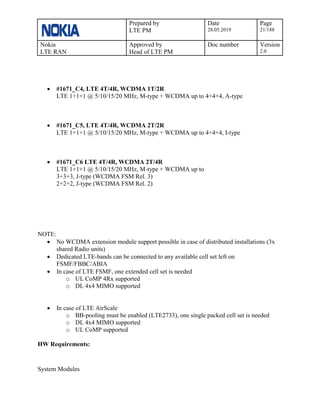
• #1671_C1 LTE 4T/4R, WCDMA 1T/2R
LTE 1+1+1 @ 5/10/15/20 MHz, N-type + WCDMA up to 4+4+4, A-type
• #1671_C2, LTE 4T/4R, WCDMA 2T/2R
LTE 1+1+1 @ 5/10/15/20 MHz, N-type + WCDMA up to 4+4+4, H-type
• #1671_C3, LTE 4T/4R, WCDMA 2T/4R
LTE 1+1+1 @ 5/10/15/20 MHz, N-type + WCDMA up to
3+3+3, K-type (in case of WCDMA FSM Rel. 3)
2+2+2, K-type (in case of WCDMA FSM Rel. 2)
Prepared by
LTE PM
Date
28.05.2019
Page
21/188
Nokia
LTE RAN
Approved by
Head of LTE PM
Doc number Version
2.0
• #1671_C4, LTE 4T/4R, WCDMA 1T/2R
LTE 1+1+1 @ 5/10/15/20 MHz, M-type + WCDMA up to 4+4+4, A-type
• #1671_C5, LTE 4T/4R, WCDMA 2T/2R
LTE 1+1+1 @ 5/10/15/20 MHz, M-type + WCDMA up to 4+4+4, I-type
• #1671_C6 LTE 4T/4R, WCDMA 2T/4R
LTE 1+1+1 @ 5/10/15/20 MHz, M-type + WCDMA up to
3+3+3, J-type (WCDMA FSM Rel. 3)
2+2+2, J-type (WCDMA FSM Rel. 2)
NOTE:
• No WCDMA extension module support possible in case of distributed installations (3x
shared Radio units)
• Dedicated LTE-bands can be connected to any available cell set left on
FSMF/FBBC/ABIA
• In case of LTE FSMF, one extended cell set is needed
o UL CoMP 4Rx supported
o DL 4x4 MIMO supported
• In case of LTE AirScale
o BB-pooling must be enabled (LTE2733), one single packed cell set is needed
o DL 4x4 MIMO supported
o UL CoMP supported
HW Requirements:
System Modules
Prepared by
LTE PM
Date
28.05.2019
Page
22/188
Nokia
LTE RAN
Approved by
Head of LTE PM
Doc number Version
2.0
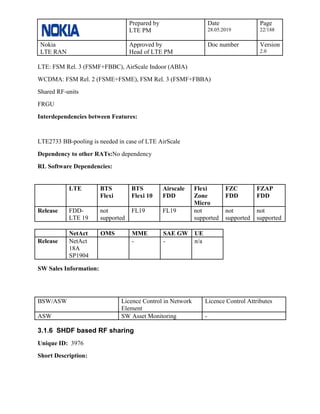
LTE: FSM Rel. 3 (FSMF+FBBC), AirScale Indoor (ABIA)
WCDMA: FSM Rel. 2 (FSME+FSME), FSM Rel. 3 (FSMF+FBBA)
Shared RF-units
FRGU
Interdependencies between Features:
LTE2733 BB-pooling is needed in case of LTE AirScale
Dependency to other RATs:No dependency
RL Software Dependencies:
LTE BTS
Flexi
BTS
Flexi 10
Airscale
FDD
Flexi
Zone
Micro
FZC
FDD
FZAP
FDD
Release FDD-
LTE 19
not
supported
FL19 FL19 not
supported
not
supported
not
supported
NetAct OMS MME SAE GW UE
Release NetAct
18A
SP1904
- - n/a
SW Sales Information:
BSW/ASW Licence Control in Network
Element
Licence Control Attributes
ASW SW Asset Monitoring -
3.1.6 SHDF based RF sharing
Unique ID: 3976
Short Description:
Prepared by
LTE PM
Date
28.05.2019
Page
23/188
Nokia
LTE RAN
Approved by
Head of LTE PM
Doc number Version
2.0
RF sharing solution based on Sync Hub Direct Forward (SHDF) solution where inter-system
module synchronization is done via 1PPS&ToD over dedicated sync cable. Temporary radio
master role for LTE is also introduced with this feature.
Benefits for the Customer:
Operators can get lowest TCO site solution with RF sharing and at the same time be able to
exploit the great benefits of following phase and time sync dependent radio features: Dynamic
Frequency Carrier Allocation (DFCA) GSM, OTDOA, eICIC, eMBMS, etc.
Better reliability and availability of RF sharing site solution thanks to the holdover function and
the ability for radio slave to temporary take over radio master role, in case the previous radio
master has failed.
Functional Description:
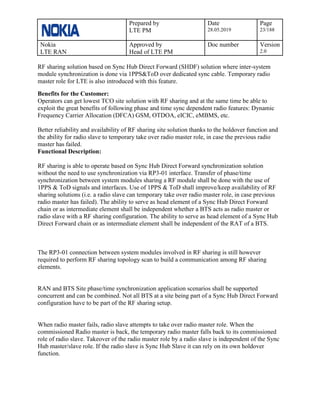
RF sharing is able to operate based on Sync Hub Direct Forward synchronization solution
without the need to use synchronization via RP3-01 interface. Transfer of phase/time
synchronization between system modules sharing a RF module shall be done with the use of
1PPS & ToD signals and interfaces. Use of 1PPS & ToD shall improve/keep availability of RF
sharing solutions (i.e. a radio slave can temporary take over radio master role, in case previous
radio master has failed). The ability to serve as head element of a Sync Hub Direct Forward
chain or as intermediate element shall be independent whether a BTS acts as radio master or
radio slave with a RF sharing configuration. The ability to serve as head element of a Sync Hub
Direct Forward chain or as intermediate element shall be independent of the RAT of a BTS.
The RP3-01 connection between system modules involved in RF sharing is still however
required to perform RF sharing topology scan to build a communication among RF sharing
elements.
RAN and BTS Site phase/time synchronization application scenarios shall be supported
concurrent and can be combined. Not all BTS at a site being part of a Sync Hub Direct Forward
configuration have to be part of the RF sharing setup.
When radio master fails, radio slave attempts to take over radio master role. When the
commissioned Radio master is back, the temporary radio master falls back to its commissioned
role of radio slave. Takeover of the radio master role by a radio slave is independent of the Sync
Hub master/slave role. If the radio slave is Sync Hub Slave it can rely on its own holdover
function.
Prepared by
LTE PM
Date
28.05.2019
Page
24/188
Nokia
LTE RAN
Approved by
Head of LTE PM
Doc number Version
2.0
It is important to note that Sync Hub Direct Forward RF sharing does not replace the legacy
RP3-01 sync based RF sharing. The legacy RP3-01 sync based RF sharing remains to be
supported to provide backward compatibility.
HW Requirements:
no specific HW requirements
Interdependencies between Features:
Require LTE1710 and LTE2330 as pre-requisite
Dependency to other RATs:No dependency
RL Software Dependencies:
LTE BTS
Flexi
BTS
Flexi 10
Airscale
FDD
Flexi
Zone
Micro
FZC
FDD
FZAP
FDD
Release FDD-
LTE 19
not
supported
FL19 future
study
item
not
supported
not
supported
not
supported
NetAct OMS MME SAE GW UE
Release - - -
SW Sales Information:
BSW/ASW Licence Control in Network
Element
Licence Control Attributes
BSW - -
3.1.7 AirScale PIMC Unit initial configuration for Nokia-CPRI and CPRI-A
Radio Units
Unique ID: 4075
Short Description:
Prepared by
LTE PM
Date
28.05.2019
Page
25/188
Nokia
LTE RAN
Approved by
Head of LTE PM
Doc number Version
2.0
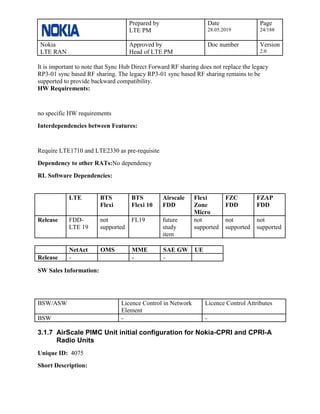
This feature defines ePIMC box (AFAA) initial configurations for Nokia-CPRI and CPRI-A
Radio Units.
Benefits for the Customer:
This feature provides:
• FHS (Fronthaul Switch) function which reduces the number of optical fibers needed to
connect distributed radio units (Nokia CPRI, CPRI-A) to a AirScale system module
• external Passive Intermodulation Cancellation function to remove Passive
Intermodulation Products
Functional Description:
This feature defines ePIMC box (LTE3685 AFAA) initial configurations that provide:
• FHS (Fronthaul Switch) function which reduces the number of optical fibers needed to
connect distributed radio units (Nokia CPRI, CPRI-A) to a AirScale system module
• external Passive Intermodulation Cancellation function to remove Passive
Intermodulation Products created bewteen different Radios Units but those Radios Units
have to be connected to the same ePIMC box.
LTE4075 supported configuration is presented in figure below. Only UHLA/UHLB, FRBI,
UHLC Radio Units are supported by LTE4075 feature.
LTE3236 Automatic recovery/optical delay compensation of CPRI IF link problems is
supported:
• on links between System Module and ePIMC box(AFAA)
• on links between ePIMC box(AFAA) and Radio Units
Prepared by
LTE PM
Date
28.05.2019
Page
26/188
Nokia
LTE RAN
Approved by
Head of LTE PM
Doc number Version
2.0
HW Requirements:
ePIMC box: LTE3685 AFAA
AirScale System Module
Nokia-CPRI Radio Unit: FRBI
CPRI-A Radio Units: UHLA/UHLB, UHLC
Note: OBSAI radio units are not supported with LTE4075
Interdependencies between Features:
LTE3933 is not supported with LTE4075.
LTE2492 needs to be enabled to support I/Q compression on Nokia-CPRI links
OBSA Radio Units are not supported by LTE4075 i.e. no OBSAI Radio Units connected to
ePIMC box or directly to ABIA in the LTE4075.
Radio Units connected in chains are not supported by LTE4075.
Prepared by
LTE PM
Date
28.05.2019
Page
27/188
Nokia
LTE RAN
Approved by
Head of LTE PM
Doc number Version
2.0
ePIMC delay buffering to support continuous 0-23km (or more) fiber length for CPRI-A RRHs
is not included in LTE4075.
Dependency to other RATs:No dependency
RL Software Dependencies:
LTE BTS
Flexi
BTS
Flexi 10
Airscale
FDD
Flexi
Zone
Micro
FZC
FDD
FZAP
FDD
Release FDD-
LTE 19
not
supported
not
supported
FL19 not
supported
not
supported
not
supported
NetAct OMS MME SAE GW UE
Release NetAct
18A
SP1904
- -
SW Sales Information:
BSW/ASW Licence Control in Network
Element
Licence Control Attributes
BSW - -
3.1.8 PIM cancellation functionality for AFAA Airscale PIM Cancellation
Unit
Unique ID: 4082
Short Description:
This feature defines PIM cancellation functionality for AFAA Unit. It also defines feature
activation, new parameter introduction and performance monitoring of PIM Cancellation
functionality.
Benefits for the Customer:
This feature provides with AFAA unit external Passive Intermodulation Cancellation
activation(enabling) to remove Passive Intermodulation Products from UL. This will improve
UL receiver performance if PIM rf-components are causing Passive Intermodulation into UL
channels.
Functional Description:
Prepared by
LTE PM
Date
28.05.2019
Page
28/188
Nokia
LTE RAN
Approved by
Head of LTE PM
Doc number Version
2.0
This feature defines PIM Cancellation functionality for AFAA PIM Cancellation (PIMC) Unit.
AFAA PIMC Unit is introduced via LTE3685 feature. PIMC Unit with PIM Cancellation
functionality shall be able to remove Passive Intermodulation created between same or different
Radios Units. These Radio Units have to be connected to the same PIMC Unit.
Passive InterModulation (PIM) is the unwanted signal or signals generated by the non-linear
mixing of 2 or more frequencies in a passive (or linear) device such as a connector or cable. If
those signals are falling on UL channel/s receiver performance becomes very poor. Broadband
radios suffer in UL from PIM in particular with MIMO and multicarrier radios.
PIM Cancellation for AFAA is based on a FHS unit with additional FPGA’s into separate HW
block. PIM Cancellation is based on a digital HW/SW algorithm. AFAA PIMC Unit shall be
connected between the Airscale System module and the Radio Units.
PIM Cancellation functionality for AFAA is activated/deactivated by an O&M parameter. PIMC
functionality will need a license activated by NetAct. Licensing and activation functionalities are
also part of this feature.
HW Requirements:
ePIMC box: LTE3685 AFAA
AirScale System Module
Nokia-CPRI Radio Units
CPRI-A Radio Units
Interdependencies between Features:
LTE2492 needs to be enabled to support I/Q compression on Nokia-CPRI links
Dependency to other RATs:No dependency
RL Software Dependencies:
LTE BTS
Flexi
BTS
Flexi 10
Airscale
FDD
Flexi
Zone
Micro
FZC
FDD
FZAP
FDD
Release FDD-
LTE 19
not
supported
not
supported
FL19 not
supported
not
supported
not
supported
Prepared by
LTE PM
Date
28.05.2019
Page
29/188
Nokia
LTE RAN
Approved by
Head of LTE PM
Doc number Version
2.0
NetAct OMS MME SAE GW UE
Release NetAct
18A
SP1904
- -
SW Sales Information:
BSW/ASW Licence Control in Network
Element
Licence Control Attributes
ASW - -
3.1.9 AirScale MAA 16T16R B66 100W AAIB
Unique ID: 4229
Short Description:
AAIB is the radio subassembly used in 16T16R FDD-LTE/5G 3GPP Band 66 multi-beam active
antenna (MAA) solutions. When integrated with an active antenna it supplies up to 6.3W output
power per pipe and two CPRI 9.8Gb/s front-haul connections.
Benefits for the Customer:
•Enable customer to provide high capacity solution for faster mobile traffic growth and ultra
dense network areas deployment
•Save customer OPEX/CAPEX from no RF jumpers required and indoor coverage supplemental.
•Help customer more easily find out place to construct site for macro/high-building coverage use
cases supporting
HW Requirements:
no specific HW requirements
Interdependencies between Features:
LTE115 needs to be enabled to use LTE 5MHz carriers
LTE114 needs to be enabled to use LTE 10MHz carriers
LTE113 needs to be enabled to use LTE 15MHz carriers
LTE112 needs to be enabled to use LTE 20MHz carriers
Prepared by
LTE PM
Date
28.05.2019
Page
30/188
Nokia
LTE RAN
Approved by
Head of LTE PM
Doc number Version
2.0
With LTE614 AAIB can be used in distributed sites with up to 23km fiber length to the system
module.
LTE2508 needs to be enabled to use BTS Embedded Power Meter for Energy Efficiency
Monitoring
LTE2428 provides support for CPRI interface
Dependency to other RATs:No dependency
RL Software Dependencies:
LTE BTS
Flexi
BTS
Flexi 10
Airscale
FDD
Flexi
Zone
Micro
FZC FDD FZAP
FDD
Release FDD-
LTE 19
not
supported
not
supported
FL19 not
supported
Not
Applicable
not
supported
NetAct OMS MME SAE GW UE
Release NetAct
18A
SP1904
- -
SW Sales Information:
BSW/ASW Licence Control in Network
Element
Licence Control Attributes
BSW - -
3.1.10 AirScale RRH 4T4R B26a 100W AHCC
Unique ID: 4260
Short Description:
AHCC is an AirScale RRH with four transmitters and four receivers for a subset of 3GPP band
26a with four pipes which can be configured for either 2x40W or 4x25W for 100W total output
power.
Benefits for the Customer:
AirScale RRH 4T4R B26a 100W
Prepared by
LTE PM
Date
28.05.2019
Page
31/188
Nokia
LTE RAN
Approved by
Head of LTE PM
Doc number Version
2.0
AHCC has 4 Power Amplifiers enabling it to support one sector with 2x40W or 4*25W 4TX
MIMO at the BTS antenna connectors, both configurations supporting 4Rx. This 4Rx capability
extends the reach for VoLTE, enabling the discontinuation of CDMA service.
The environmental protection class is IP65.
Filter bandwidth is selective to former iDEN B26a subset.
Functional Description:
AHCC is a 4T4R RRH optimized for distributed macro BTS installations.
It supports 3GPP FDD band 26a
AHCC frequency supported for FDD:
- Band 26a: UL (RX) 817 MHz – 824 MHz, DL (TX) 862 MHz – 869 MHz
Support of modulation schemes up to QAM256 (DL)
Support of modulation schemes up to QAM64 (UL)
Supported radio technologies by RF HW: FDD LTE according 3GPP Capability set CS2
In LTE operation following carrier bandwidths are supported: 1.4 MHz, 3 MHz, 5 MHz and
standalone NB-IoT
Max output power per Tx path: Support of max power 4x25W or 2x40W, configurable with 0.1
dB intervals
Max occupied BW and instantaneous BW are 7MHz (carriers placed inside this BW window)
Filter BW is 7MHz in uplink and downlink
List of AHCC external interfaces:
- 4 TX/RX ports with 4.3-10plus connector, Rx Gain control for external MHAs up to 12 dB.
AISG & BiasT support on ANT1 and 3.
- no RX only ports
- no RX out ports
- 2 optical RF ports SFP with R2CT IP Caps
---- CPRI data rates up to 9.8 Gb/s are supported
- one DC in 2 position circular connector
- one ASIG interface via 8-pin circular connector conforming to IEC 60130-9 - Ed. 3.0 and via
antenna connectors that two TX/RX ports have control and 14.5 V power feed and two ports
only read capability (for auto-detection PING)
- one EAC in MDR26 connector (4 alarm inputs and 1 control output)
Natural convectional cooling (and optional fan for forced convection cooling).
Environmental Operating conditions: -40 ... +55 ˚C max Ambient temperature, Cold start from -
50 ˚C.
Physical dimensions: tbd
Weight: tbd
Supported mounting options:
- pole mounting: vertical, horizontal with optional fan
Prepared by
LTE PM
Date
28.05.2019
Page
32/188
Nokia
LTE RAN
Approved by
Head of LTE PM
Doc number Version
2.0
- wall mounting: vertical, horizontal with optional fan
- bookshelf mounting: tbd
The following features are introduced separately:
Antenna Path Delay Measurements for OTDoA
Support for providing a snapshot of TX signal in RF Sniffer (in addition to RX view).
HW Requirements:
no specific HW requirements
Interdependencies between Features:
Supported BTS configurations: For single carrier LTE: all released AirScale BTS configurations
valid for RRH 4Tx RF units For multi carrier LTE: released AirScale LTE BTS configurations
supporting dual carrier and multicarrier configurationsLTE117 needs to be enabled to use LTE
1.4MHz carriers
LTE116 needs to be enabled to use LTE 3MHz carriers
LTE115 needs to be enabled to use LTE 5MHz carriers
With LTE614 AHCC can be used in distributed sites with up to 23km fiber length to the system
module.
With LTE2541 AHCC supports Nokia CPRI chain of up to 4 radio units
LTE3036 needs to be enabled to use Micro DTX feature
LTE2508 needs to be enabled to use energy metering feature
LTE1103 needs to be enabled to use Load based Power Saving for multi-layer networks
LTE1203 needs to be enabled to use Load based Power Saving with Tx path switching off
LTE2428 provides support for CPRI interface
Dependency to other RATs:No dependency
RL Software Dependencies:
Prepared by
LTE PM
Date
28.05.2019
Page
33/188
Nokia
LTE RAN
Approved by
Head of LTE PM
Doc number Version
2.0
LTE BTS
Flexi
BTS
Flexi 10
Airscale
FDD
Flexi
Zone
Micro
FZC FDD FZAP
FDD
Release FDD-
LTE 19
not
supported
not
supported
FL19 not
supported
Not
Applicable
not
supported
NetAct OMS MME SAE GW UE
Release NetAct
18A
SP1904
LTE
OMS17
- -
SW Sales Information:
BSW/ASW Licence Control in Network
Element
Licence Control Attributes
BSW - -
Warning! Operator hint for C5 planned for correction at FL19A:
When both thresholds for VSWR alarms (Minor, Major) are configured to the same and
maximum value, and the reflection of the signal in the TX path exceeds VSWR thresholds, the
proper alarm might be not reported and may cause HW damage. The problem is related to radio
modules which support “VSWR suppression”.
Recovery action: The reconfiguration at least one of VSWR thresholds, to different value than
maximum.
3.1.11 AirScale MAA 16T16R B25 100W AAFB
Unique ID: 4264
Short Description:
AAFB is the radio subassembly used in 16T16R FDD-LTE/5G 3GPP Band 25 multi-beam active
antenna (MAA) solutions. When integrated with an active antenna it supplies up to 6.3W output
power per pipe and two CPRI 9.8Gb/s front-haul connections.
Benefits for the Customer:
•Enable customer to provide high capacity solution for faster mobile traffic growth and ultra
dense network areas deployment
•Save customer OPEX/CAPEX from no RF jumpers required and indoor coverage supplemental.
Prepared by
LTE PM
Date
28.05.2019
Page
34/188
Nokia
LTE RAN
Approved by
Head of LTE PM
Doc number Version
2.0
•Help customer more easily find out place to construct site for macro/high-building coverage use
cases supporting
HW Requirements:
no specific HW requirements
Interdependencies between Features:
LTE115 needs to be enabled to use LTE 5MHz carriers
LTE114 needs to be enabled to use LTE 10MHz carriers
LTE113 needs to be enabled to use LTE 15MHz carriers
LTE112 needs to be enabled to use LTE 20MHz carriers
With LTE614 AAFB can be used in distributed sites with up to 23km fiber length to the system
module.
LTE2508 needs to be enabled to use BTS Embedded Power Meter for Energy Efficiency
Monitoring
LTE3036 needs to be enabled to use Micro DTX extension
LTE3037 needs to be enabled to use Load based PA efficiency improvement - SDVM
LTE2428 provides support for CPRI interface
Dependency to other RATs:No dependency
RL Software Dependencies:
LTE BTS
Flexi
BTS
Flexi 10
Airscale
FDD
Flexi
Zone
Micro
FZC FDD FZAP
FDD
Release FDD-
LTE 19
not
supported
not
supported
FL19 not
supported
Not
Applicable
not
supported
NetAct OMS MME SAE GW UE
Release NetAct
18A
SP1904
- -
Prepared by
LTE PM
Date
28.05.2019
Page
35/188
Nokia
LTE RAN
Approved by
Head of LTE PM
Doc number Version
2.0
SW Sales Information:
BSW/ASW Licence Control in Network
Element
Licence Control Attributes
BSW - -
3.1.12 16TRX FDD mMIMO configurations with Airscale SM
Unique ID: 4305
Short Description:
This feature provides a set of BTS configurations for AirScale to support the 16Trx mMIMO for
FDD.
Functional Description:
This feature introduces a basic set of Airscale FDD LTE mMIMO site configurations based on
the fixed beam mMIMO solution (LTE4265) utilizing the new mMIMO radios AAIB(LTE4229
), AAFB(LTE4264)., AAFIA(LTE4529), AAFIB(LTE4607).
mMIMO capacity dimensioning: one baseband pool(1/2 ABIA) supports one 5/10/15/20MHz
16Tx16Rx mMIMO carrier . The following defined configurations need to be supported:
1.)One Sector single band configuration with packed cell set:
- 1*20MHz 16Tx16Rx mMIMO with single carrier.
2.)One Sector single band configuration with dual packed cell set:
- 20MHz+20MHz 16Tx16Rx mMIMO with single band dual carrier.
3.) One Sector dual band dual carrier mMIMO configuration with dual packed cell set:
- Band A: 20MHz 16Tx16Rx + Band B:20MHz 16Tx16Rx.
4.) One Sector dual band three carrier mMIMO configuration with triple packed cell set:
- Band A:20MHz + 20MHz 16Tx16Rx + Band B: 20MHz 16Tx16Rx.
5.) One Sector dual band four carrier mMIMO configuration with two dual-packed cell sets:
- Band A: 20MHz +20MHz 16Tx16Rx + Band B:20MHz + 20MHz 16Tx16Rx.
6.) One Sector dual band four carrier mMIMO configuration with two dual-packed cell sets in a
cross-subrack arrangement:
- Band A: 20MHz +20MHz 16Tx16Rx + Band B:20MHz + 20MHz 16Tx16Rx.
A new front haul interface (9.8G FD CPRI) will be used within this feature which is defined in
LTE4265. One 9.8G FD CPRI can support one 5/10/15/20MHz massive MIMO carrier with two-
times 4T4R vCells.
HW Requirements:
Prepared by
LTE PM
Date
28.05.2019
Page
36/188
Nokia
LTE RAN
Approved by
Head of LTE PM
Doc number Version
2.0
no specific HW requirements
Interdependencies between Features:
LTE2733 Baseband pooling LTE4229 AAIB Airscale MAA 16T16R B66 80W LTE4264
AAFB Airscale MAA 16T16R B25 80W LTE4265 Split L1 with fixed beam sectorization for
16TRX FDD mMIMO LTE4529 AirScale Dual MAA 16T16R B25/66 200W AAFIA LTE4607
AirScale Dual MAA 16T16R B25/66a 160W AAFIB
Dependency to other RATs:No dependency
RL Software Dependencies:
LTE BTS
Flexi
BTS
Flexi 10
Airscale
FDD
Flexi
Zone
Micro
FZC
FDD
FZAP
FDD
Release FDD-
LTE 19
not
supported
not
supported
FL19 not
supported
not
supported
not
supported
NetAct OMS MME SAE GW UE
Release - - -
SW Sales Information:
BSW/ASW Licence Control in Network
Element
Licence Control Attributes
BSW - -
3.1.13 AMOD AirScale outdoor subrack 5G full compatible
Unique ID: 4525
Short Description:
AMOD enclosure with Fresh Air Cooling can support 4G/5G and full 5G configurations in phase
with known BTS evolution plans.
Prepared by
LTE PM
Date
28.05.2019
Page
37/188
Nokia
LTE RAN
Approved by
Head of LTE PM
Doc number Version
2.0
AMOD could offer reduced acoustic level than AMOB and long term boards reliability.
AMOD is respectful of environmental European standards regarding global warming.
Benefits for the Customer:
Support full 5G (or LTE/5G) high capacity installation in outdoor;
Reduced acoustic level;
Long term boards reliability;
Generate increased revenue for customer (allow 5G full capacity and 4G/5G collocation);
Optimize CAPEX, reduce OPEX (use one subrack for both 4G/5G configurations instead of 2
separated subracks).
Environmental friendly (No more restricted substance of current Heat Exchanger (HEX) coolant
with impact on global warming. Reduced noise. Reduced energy consumption.)
Functional Description:
•OUTOOR, IP 55 ingress protection
•Cooling based on high performance and long lasting Fresh air Filter (Gore type)
•Re-use AMIA backplane for plug in units (changes in backplane, similar to ones done for
AMOC) may be required for alarms and detection purposes.
•Size**: 487(W)x 665(D)x 488.1 (H) mm
•Weight: target ~35kg (not include muffler)
•Front to Back airflow
•Pressure sensor for the Fresh Air filter end of life detection
•Door intrusion alarm
•Increased input max current to 60A for 5G
•Improved acoustic level, ETSI target
•Optional muffler for very noise sensitive customers** (below ETSI)
•Improved boards reliability at high temperatures
•Support 3U stacking, wall/pole installation, stand alone
•Improved cable entry (user friendly solution)
NB: FCOA and other 19 inch rack installation may NOT be supported due the rack size (bigger
size is needed to fulfill other critical requirements as acoustic and reliability)
•AMOD controller FW remote upgrade wished
•FYGM or AYGA GPS module can be accomodated in AMOD
•AMOD could be managed by NetAct
•AMOD could be visualized in Site Manager/WebUI.
•AMOD internal function units alarm could be reported to NetAct
HW Requirements:
Prepared by
LTE PM
Date
28.05.2019
Page
38/188
Nokia
LTE RAN
Approved by
Head of LTE PM
Doc number Version
2.0
no specific HW requirements
Interdependencies between Features:
no feature interdependencies
Dependency to other RATs:No dependency
RL Software Dependencies:
LTE BTS
Flexi
BTS
Flexi 10
Airscale
FDD
Flexi
Zone
Micro
FZC
FDD
FZAP
FDD
Release FDD-
LTE 19
not
supported
not
supported
FL19 not
supported
not
supported
not
supported
NetAct OMS MME SAE GW UE
Release - - -
SW Sales Information:
BSW/ASW Licence Control in Network
Element
Licence Control Attributes
BSW - -
3.1.14 AirScale Dual MAA 16T16R B25/66 200W AAFIA
Unique ID: 4529
Short Description:
AAFIA is a dual band 66 and band 25 multi-beam active antenna (MAA) system including fully
integrated radios and beam forming antennas.Each band shares an 8 column 16T16R MIMO
adaptive antenna (MAA) with up to 6.3 W output power per pipe per band.
The system will incorporate innovations to deliver 3GPP release 14 LTE 4G evolution as well as
what's expected in release 15 for 5G New Radio functionality.
Prepared by
LTE PM
Date
28.05.2019
Page
39/188
Nokia
LTE RAN
Approved by
Head of LTE PM
Doc number Version
2.0
HW Requirements:
no specific HW requirements
Interdependencies between Features:
LTE4229 AAIB provide support for band 66 Radio
LTE4264 AAFB provide support for band 25 radio
Dependency to other RATs:No dependency
RL Software Dependencies:
LTE BTS
Flexi
BTS
Flexi 10
Airscale
FDD
Flexi
Zone
Micro
FZC FDD FZAP
FDD
Release FDD-
LTE 19
not
supported
not
supported
FL19 not
supported
Not
Applicable
not
supported
NetAct OMS MME SAE GW UE
Release NetAct
18A
SP1904
- -
SW Sales Information:
BSW/ASW Licence Control in Network
Element
Licence Control Attributes
BSW - -
3.1.15 AirScale MAA 16T16R B25/66 250W AAFIB
Unique ID: 4607
Short Description:
Prepared by
LTE PM
Date
28.05.2019
Page
40/188
Nokia
LTE RAN
Approved by
Head of LTE PM
Doc number Version
2.0
AAFIB is a dual band 66 and band 25 multi-beam active antenna (MAA) system including fully
integrated radios and beam forming antennas.
Each band is supported by an 4 column 16T16R MIMO adaptive antenna (MAA) with up to 9.3
W output power per pipe for B66 and 6.3W for B25. Total max power is 250W.
The system will incorporate innovations to deliver 3GPP release 14 LTE 4G evolution as well as
what's expected in release 15 for 5G New Radio functionality
Functional Description:
AirScale Dual MAA 16T16R B25/66 250W AAFIB delivers massive multiple input multiple
output (mMIMO) in 3GPP bands 25 and 66. This fully integrated radio + antenna system
supports horizontal and vertical sectorization as well as azimuth beamforming.
This product will also support TM9 devices. It would also support 8 port CSI-RS ports.
4 column Antenna
The tilt angle of each set can be adjusted remotely. Bands share the antenna, thus both bands will
have the same tilt angle.
Specification Summary-Configuration: Four +/-45 degree cross polarized columns
• Gain: average 16 dBi (B1 Beam). 20dBi (S1 Beam)
• Beam steering range: +/-30 degrees
• Elevation beamwidth: 10+-2 degrees
• Vertical tilt range for remote adjustment: two sections +2 to +12 +-0.5 degrees
• Size: 1820mm x 432mm x 250mm, 103kg
• Input power: -48V DC circular connector, 1250W typical
Radio definitions are contains in the submodule platform features LTE4264 (AAFB) and LTE
4608 (AAIC).
HW Requirements:
no specific HW requirements
Interdependencies between Features:
LTE4608 AAIC provide support for band 66 Radio
LTE4264 AAFB provide support for band 25 radio
Dependency to other RATs:No dependency
RL Software Dependencies:
Prepared by
LTE PM
Date
28.05.2019
Page
41/188
Nokia
LTE RAN
Approved by
Head of LTE PM
Doc number Version
2.0
LTE BTS
Flexi
BTS
Flexi 10
Airscale
FDD
Flexi
Zone
Micro
FZC FDD FZAP
FDD
Release FDD-
LTE 19
not
supported
not
supported
FL19 not
supported
Not
Applicable
not
supported
NetAct OMS MME SAE GW UE
Release NetAct
18A
SP1904
- -
SW Sales Information:
BSW/ASW Licence Control in Network
Element
Licence Control Attributes
BSW - -
3.1.16 AirScale MAA 16T16R B66 150W AAIC
Unique ID: 4608
Short Description:
AAIC is the radio subassembly used in 16T16R FDD-LTE/5G 3GPP Band 66 multi-beam active
antenna (MAA) solutions. When integrated with an active antenna it supplies up to 9.4W output
power per pipe and two CPRI 9.8Gb/s front-haul connections.
Benefits for the Customer:
•Enable customer to provide high capacity solution for faster mobile traffic growth and ultra
dense network areas deployment
•Save customer OPEX/CAPEX from no RF jumpers required and indoor coverage supplemental.
•Help customer more easily find out place to construct site for macro/high-building coverage use
cases supporting
HW Requirements:
no specific HW requirements
Interdependencies between Features:
Prepared by
LTE PM
Date
28.05.2019
Page
42/188
Nokia
LTE RAN
Approved by
Head of LTE PM
Doc number Version
2.0
LTE115 needs to be enabled to use LTE 5MHz carriers
LTE114 needs to be enabled to use LTE 10MHz carriers
LTE113 needs to be enabled to use LTE 15MHz carriers
LTE112 needs to be enabled to use LTE 20MHz carriers
With LTE614 AAIC can be used in distributed sites with up to 23km fiber length to the system
module.
LTE2508 needs to be enabled to use BTS Embedded Power Meter for Energy Efficiency
Monitoring
LTE2428 provides support for CPRI interface
Dependency to other RATs:No dependency
RL Software Dependencies:
LTE BTS
Flexi
BTS
Flexi 10
Airscale
FDD
Flexi
Zone
Micro
FZC FDD FZAP
FDD
Release FDD-
LTE 19
not
supported
not
supported
FL19 not
supported
Not
Applicable
not
supported
NetAct OMS MME SAE GW UE
Release NetAct
18A
SP1904
- -
SW Sales Information:
BSW/ASW Licence Control in Network
Element
Licence Control Attributes
BSW - -
3.1.17 AirScale RFM 6T6R B1 480W ARGA
Unique ID: 4640
Short Description:
Prepared by
LTE PM
Date
28.05.2019
Page
43/188
Nokia
LTE RAN
Approved by
Head of LTE PM
Doc number Version
2.0
ARGA is an AirScale RFM with six transmitters and six receivers for 3GPP band 1 with 6 pipes
at 80W max per pipe.
Benefits for the Customer:
AirScale RFM 6T6R B1 480W ARGA has 6 Power Amplifiers enabling it to support one sector
with up to 6*80W output power at the BTS antenna connectors.
The environmental protection class is IP65.
ARGA filter bandwidth is supporting whole 3GPP band 1 (60 MHz).
HW Requirements:
no specific HW requirements
Interdependencies between Features:
Supported BTS configurations: For single carrier LTE: all released AirScale BTS configurations
valid for RRH 6Tx RF units For multi carrier LTE: released AirScale LTE BTS configurations
supporting dual carrier and multicarrier configurationsLTE115 needs to be enabled to use LTE
5MHz carriers
LTE114 needs to be enabled to use LTE 10MHz carriers
LTE113 needs to be enabled to use LTE 15MHz carriers
LTE112 needs to be enabled to use LTE 20MHz carriers
With LTE614 ARGA can be used in distributed sites with up to 23km fiber length to the system
module.
With LTE2541 ARGA supports Nokia CPRI chain of up to 4 radio units
LTE3036 needs to be enabled to use Micro DTX feature
LTE3037 needs to be enabled to use Load based PA efficiency improvement - SDVM
LTE2508 needs to be enabled to use energy metering feature
LTE1103 needs to be enabled to use Load based Power Saving for multi-layer networks
LTE1203 needs to be enabled to use Load based Power Saving with Tx path switching off
LTE2428 provides support for CPRI interface
Dependency to other RATs:No dependency
Prepared by
LTE PM
Date
28.05.2019
Page
44/188
Nokia
LTE RAN
Approved by
Head of LTE PM
Doc number Version
2.0
RL Software Dependencies:
LTE BTS
Flexi
BTS
Flexi 10
Airscale
FDD
Flexi
Zone
Micro
FZC FDD FZAP
FDD
Release FDD-
LTE 19
not
supported
FL19 FL19 not
supported
Not
Applicable
not
supported
NetAct OMS MME SAE GW UE
Release NetAct
18A
SP1904
LTE
OMS17
- -
SW Sales Information:
BSW/ASW Licence Control in Network
Element
Licence Control Attributes
BSW - -
3.1.18 AirScale RRH 2T4R B28 120W AHPD
Unique ID: 4660
Short Description:
AHPD is a AirScale RRH with two transmitters and four receivers for 3GPP band 28 (EU) with
up to 60W per pipe.
Benefits for the Customer:
AirScale RRH 2T4R B28 120W AHPD has 2 Power Amplifiers enabling it to support one sector
with up to 2*60W 2TX MIMO output power at the BTS antenna connectors.
The environmental protection class is IP65.
AHPA filter bandwidth is supporting 3GPP band 28 for EU region(30 MHz).
Functional Description:
AHPD is a 2T4R RRH optimized for distributed macro BTS installations.
It supports 3GPP FDD band 28 (EU)
AHPD frequency supported for FDD:
• Band 28(EU): UL (RX) 703 MHz - 733 MHz, DL (TX) 758 MHz - 788 MHz
Support of modulation schemes up to QAM256 (DL)
Prepared by
LTE PM
Date
28.05.2019
Page
45/188
Nokia
LTE RAN
Approved by
Head of LTE PM
Doc number Version
2.0
Support of modulation schemes up to QAM64 (UL)
Supported radio technologies by RF HW: FDD LTE
In LTE operation following carrier bandwidths are supported:3 MHz, 5 MHz, 10 MHz, 15 MHz,
20 MHz and NB-IoT in stand alone, in-band and guard band modes.
Max output power per Tx path: 60W
Support of max power 60 W and configurable with 0.1 dB intervals
Max 3 carriers per pipe the maximum occupied bandwidth is 30 MHz
Max instantaneous BW is 30 MHz (multiple carriers have to be placed inside this BW window
Filter BW is 30 MHz in uplink and downlink
AHPD supports a licensed feature for cancellation of intermodulation products in the receiver
created by the transmitter in the same antenna port (PIM Cancellation).
Implementation and configurations for RF sharing on system level please refer to SW release
feature roadmap and release documentation.
List of AHPD external interfaces:
• 2 TX/RX ports with 4.3-10 connector
• 2 RX only ports with 4.3-10 connector
• no RX out ports
• 2 optical RF ports (SFP slots, for list of compatible SFPs see xxxx)
• --- CPRI data rates up to 9.8 Gb/s
• --- I/Q compression is supported for 10, 15 and 20 MHz LTE, data rate down-sampling
for LTE 20 MHz
• one DC in 2 position circular connector
• one AISG interface via 8-pin circular connector conforming to IEC 60130-9 - Ed. 3.0 and
via antenna connectors that TX/RX ports have control and 14.5 V power feed and RX
ports only read capability (for auto-detection PING)
• one EAC in MDR26 connector (4 alarm inputs and 1 control output)
Natural convectional cooling and optional fan for forced convection cooling.
Environmental Operating conditions: -40 ... +55 ˚C max Ambient temperature, Cold start from -
50 ˚C.
Physical dimensions: 336x295x120mm, Volume: < 14L
Weight: max 14 kg
Supported mounting options:
• pole mounting: vertical, horizontal with optional fan
• wall mounting: vertical, horizontal with optional fan
• compatible to RAS mounting: vertical
• bookshelf mounting
HW Requirements:
no specific HW requirements
Interdependencies between Features:
Prepared by
LTE PM
Date
28.05.2019
Page
46/188
Nokia
LTE RAN
Approved by
Head of LTE PM
Doc number Version
2.0
Supported BTS configurations: For single carrier LTE: all released BTS configurations valid for
RRH 2Tx RF units For multi carrier LTE: released LTE BTS configurations supporting dual
carrier and multicarrier configurationsLTE116 needs to be enabled to use LTE 3MHz carriers
LTE115 needs to be enabled to use LTE 5MHz carriers
LTE114 needs to be enabled to use LTE 10MHz carriers
LTE113 needs to be enabled to use LTE 15MHz carriers
LTE112 needs to be enabled to use LTE 20MHz carriers
With LTE614 AHPD can be used in distributed sites with up to 23km fiber length to the system
module.
With LTE2541 AHPD supports Nokia CPRI chain of up to 4 radio units
LTE2508 needs to be enabled to use energy metering feature
LTE1103 or LTE1203 need to be enabled to use PA shutdown feature
Dependency to other RATs:No dependency
RL Software Dependencies:
LTE BTS
Flexi
BTS
Flexi 10
Airscale
FDD
Flexi
Zone
Micro
FZC
FDD
FZAP
FDD
Release FDD-
LTE 19
not
supported
FL19 FL19 not
supported
not
supported
not
supported
NetAct OMS MME SAE GW UE
Release NetAct
18A
SP1904
- -
SW Sales Information:
BSW/ASW Licence Control in Network
Element
Licence Control Attributes
Prepared by
LTE PM
Date
28.05.2019
Page
47/188
Nokia
LTE RAN
Approved by
Head of LTE PM
Doc number Version
2.0
BSW - -
3.1.19 AirScale RFM 6T6R B5 480W ARCA
Unique ID: 4662
Short Description:
ARCA is an AirScale RFM with six transmitters and six receivers for 3GPP band 5 with 6 pipes
at 80W max per pipe.
Benefits for the Customer:
AirScale RFM 6T6R B5 480W ARCA has 6 Power Amplifiers enabling it to support one sector
with up to 6*80W output power at the BTS antenna connectors.
The environmental protection class is IP65.
ARCA filter bandwidth is supporting whole 3GPP band 5 (25 MHz).
Functional Description:
ARCA is a 6T6R RFM optimized for distributed macro BTS installations.
It supports 3GPP FDD band 5
ARCA frequency supported for FDD:
- Band 5: UL (RX) 824 - 849 MHz DL (TX) 869 - 894 MHz
Support of modulation schemes up to QAM256 (DL)
Support of modulation schemes up to QAM64 (UL)
Supported radio technologies by RF HW: FDD LTE, WCDMA and WCDMA-LTE-GSM RF
sharing according 3GPP Capability set CS7
In LTE operation following carrier bandwidths are supported: 1.4 MHz, 3 MHz, 5 MHz, 10 MHz
Max output power per Tx path: Support of max power 80 W in 6T6R mode configurable with
0.1 dB intervals
Max occupied BW and instantaneous BW supported by HW are 25 MHz .
Filter BW is 25MHz in uplink and downlink
ARCA supports a licensed feature for cancellation of intermodulation products in the receiver
created by the transmitter in the same antenna port (PIM Cancellation).
List of ARCA external interfaces:
- 6 TX/RX ports with 4.3-10plus connector, Rx Gain control for external MHAs up to 12 dB (or
32dB). AISG & BiasT support on ANT1 & 3 & 5
- 3 optical RF ports SFP with IP Caps
---- CPRI data rates up to 9.8 Gb/s are supported
Prepared by
LTE PM
Date
28.05.2019
Page
48/188
Nokia
LTE RAN
Approved by
Head of LTE PM
Doc number Version
2.0
---- I/Q compression is supported for 10, 15 and 20 MHz LTE, data rate down-sampling for LTE
20 MHz
- one DC in 2 position circular connector
- one AISG interface via 8-pin circular connector conforming to IEC 60130-9 - Ed. 3.0 and via
antenna connectors that two TX/RX ports have control and 14.5 V power feed and two ports
only read capability (for auto-detection PING)
- one EAC in MDR36 connector (4 alarm inputs and 1 control output)
Fan cooling
Environmental Operating conditions: -35 ... +55 ˚C max Ambient temperature, Cold start from -
50 ˚C.
Physical dimensions: <25 l
Weight: max <25 kg
Supported mounting options:
- pole mounting: vertical, horizontal
- wall mounting: vertical, horizontal
- Stacked
HW Requirements:
no specific HW requirements
Interdependencies between Features:
Supported BTS configurations: For single carrier LTE: all released AirScale BTS configurations
valid for RRH 6Tx RF units For multi carrier LTE: released AirScale LTE BTS configurations
supporting dual carrier and multicarrier configurations LTE4787 defined configurations with
FSMF LTE4760 defined configurations with AirScale SMLTE117 needs to be enabled to use
LTE 1.4MHz carriers
LTE116 needs to be enabled to use LTE 3MHz carriers
LTE115 needs to be enabled to use LTE 5MHz carriers
LTE114 needs to be enabled to use LTE 10MHz carriers
With LTE614 ARCA can be used in distributed sites with up to 23km fiber length to the system
module.
With LTE2541 ARCA supports Nokia CPRI chain of up to 4 radio units
Prepared by
LTE PM
Date
28.05.2019
Page
49/188
Nokia
LTE RAN
Approved by
Head of LTE PM
Doc number Version
2.0
LTE3036 needs to be enabled to use Micro DTX feature
LTE3037 needs to be enabled to use Load based PA efficiency improvement - SDVM
LTE2508 needs to be enabled to use energy metering feature
LTE1103 needs to be enabled to use Load based Power Saving for multi-layer networks
LTE1203 needs to be enabled to use Load based Power Saving with Tx path switching off
LTE2428 provides support for CPRI interface
Dependency to other RATs:No dependency
RL Software Dependencies:
LTE BTS
Flexi
BTS
Flexi 10
Airscale
FDD
Flexi
Zone
Micro
FZC FDD FZAP
FDD
Release FDD-
LTE 19
not
supported
FL19 FL19 not
supported
Not
Applicable
not
supported
NetAct OMS MME SAE GW UE
Release NetAct
18A
SP1904
LTE
OMS17
- -
SW Sales Information:
BSW/ASW Licence Control in Network
Element
Licence Control Attributes
BSW - -
3.1.20 OBSAI and Nokia-CPRI auto-detection and mixture on Flexi 10
System Module optical ports level
Unique ID: 4669
Short Description:
Radio Modules or RRHs that use OBSAI or Nokia-CPRI can be connected to the same BB
module in the Flexi 10 System Module.
Prepared by
LTE PM
Date
28.05.2019
Page
50/188
Nokia
LTE RAN
Approved by
Head of LTE PM
Doc number Version
2.0
Benefits for the Customer:
The customer can easily install OBSAI or Nokia-CPRI capable Radio Modules or RRHs in the
same baseband module (FSMF, FBBA, FBBC, FSIH, FBIH) of Flexi 10 System Module.
Functional Description:
Flexi 10 System Module is defined as Flexi 10 FDD or Flexi 10 TDD or Flexi 10 Indoor TD-
LTE.
It is a generic feature allowing RRH/RFM units utilizing OBSAI or Nokia-CPRI of baseband
interface protocols to be connected to the same baseband module (FSMF, FBBA, FBBC, FSIH,
FBIH) of Flexi 10 System Module. However, supported customer radio site configurations are
defined in the separate/dedicated eNodeB configuration feature(s).
This feature is for the baseband module (FSMF, FBBA, FBBC, FSIH, FBIH) of Flexi 10 System
Module to automatically detect the connected protocol type (OBSAI or Nokia-CPRI) to any
optical port.
It permits the mixture of OBSAI and Nokia-CPRI protocol types within the same baseband
module (FSMF, FBBA, FBBC, FSIH, FBIH) of Flexi 10 System Module.
In every defined cell set for Flexi 10 System Module, it is possible to mix OBSAI and Nokia-
CPRI Radio Modules or RRHs on optical ports level of baseband module (FSMF, FBBA, FBBC,
FSIH, FBIH) of Flexi 10 System Module. Example: As initial situation, all RRHs connected to
Flexi 10 System Module (FSMF or FBBA or FBBC or FSIH or FBIH) are OBSAI type RRHs.
Then, after long operation time it might happen that randomly any OBSAI RRH fails. Thanks to
LTE4669 feature, the customer can use Nokia-CPRI RRH as replacement of faulty OBSAI RRH
(according to replacement list and supported configurations).
Supported fiber length between OBSAI or Nokia-CPRI Radio Modules or RRHs and baseband
module (FSMF, FBBA, FBBC, FSIH, FBIH) of Flexi 10 System Module is according to
LTE614 feature specification.
Note: LTE4669 does not support the mix of OBSAI Radio Units and Nokia-CPRI Radio Units in
the same RF chain.
The eNodeB startup time may be affected.
____________________________________
HW Requirements:
Flexi 10 System Module (FSMF, FBBA, FBBC, FSIH, FBIH), OBSAI RRHs/RFMs, Nokia-
CPRI RRHs/RFMs
Interdependencies between Features:
Prepared by
LTE PM
Date
28.05.2019
Page
51/188
Nokia
LTE RAN
Approved by
Head of LTE PM
Doc number Version
2.0
Configurations of cells that span across multiple radios with different protocol types are not
supported.
Radio chaining of mixed fronhaul protocols within inter-radio hops is not supported. In other
words: all radio modules within a chain must use the same protocol type.
Dependency to other RATs:No dependency
RL Software Dependencies:
LTE BTS
Flexi
BTS
Flexi 10
Airscale
FDD
Flexi
Zone
Micro
FZC
FDD
FZAP
FDD
Release FDD-
LTE 19
not
supported
FL19 not
supported
not
supported
not
supported
not
supported
NetAct OMS MME SAE GW UE
Release - - -
SW Sales Information:
BSW/ASW Licence Control in Network
Element
Licence Control Attributes
BSW - -
3.1.21 OBSAI and CPRI radio mixed configuration with Airscale
Unique ID: 4958
Short Description:
This feature define some basic CPRI and OBSAI mixed configuration within one baseband pool
and allow customer rollout with optimized configuration.
Benefits for the Customer:
allow CPRI and OBSAI radio mixed in one half ABIA
Functional Description:
-Functionality CPRI and OBSAI mixed in one baseband pooling is defined in LTE2745.
Prepared by
LTE PM
Date
28.05.2019
Page
52/188
Nokia
LTE RAN
Approved by
Head of LTE PM
Doc number Version
2.0
-LTE4958 define some basic single CPRI and OBSAI mixed configuration allow customer
rollout with optimized configuration.
-LTE4958 defined the following packed and dual packed cell set configurations as following.
More information see topology diagram.
Packed cell set:
• Three sectors dual bands single carrier 10Mhz 4Rx configuration --
>3*10MHz+3*10MHz 4Rx
• Three sectors dual bands single carrier 2Rx configuration -->3*20MHz+3*20MHz 2Rx
• Four sectors dual bands single carrier 2Rx configuration -->4*20MHz+4*10MHz 2Rx
Dual Packed cell set:
• 2T2R and 4T4R Mix configuration support in single ABIAà4*20MHz 4Rx + 3*10MHz
2Rx
HW Requirements:
no specific HW requirements
Interdependencies between Features:
no feature interdependencies
Dependency to other RATs:No dependency
RL Software Dependencies:
LTE BTS
Flexi
BTS
Flexi 10
Airscale
FDD
Flexi
Zone
Micro
FZC
FDD
FZAP
FDD
Release FDD-
LTE 19
not
supported
not
supported
FL19 not
supported
not
supported
not
supported
NetAct OMS MME SAE GW UE
Release - - -
SW Sales Information:
BSW/ASW Licence Control in Network
Element
Licence Control Attributes
Prepared by
LTE PM
Date
28.05.2019
Page
53/188
Nokia
LTE RAN
Approved by
Head of LTE PM
Doc number Version
2.0
BSW - -
3.1.22 Nokia 4Tx radio split mode configuration with Airscale SM
Unique ID: 5045
Short Description:
This feature provide a set of 1Tx2Rx and 2Tx2Rx configuration with Nokia 4Tx radio.
Benefits for the Customer:
Customer can use one 4Tx radio split as two sectors 2Rx, reduce customer's HW cost.
Functional Description:
-LTE5045 offer a set of 1Tx2Rx or 2Tx2Rx Airscale configurations for parts of Nokia 4Tx
radios which is capable to do split mode. Split mode means that one 4Tx/6Tx radio can be used
as two or three 2Tx radios. Each 2Tx radio can be configured as single intra frequency cells or as
inter frequency cells. In this feature focus on 4Tx radio split as two 2Tx radios.
-OBSAI 3G/6G, CPRI Rate5(4.9Gbps) and Rate7(9.8Gbps) link speeds are required.
-NOKIA CPRI IQC(LTE2492) is required for parts of configuration. IQC carrier(15/20MHz)
and non IQC carrier(5/10MHz) are doable combination within one 9.8G fiber link.
-FDD BTS configurations are defined as building blocks (=cell sets) that can be combined with
each other to build a full BTS configuration.
-The defined configurations can be up to one full sub rack, LTE2866 is a pre-requisite for this
case.
-One complete BTS configuration is generated by combining up to 12 cell sets, following cell set
types are defined for use with BB pooling.
• packed cell set: occupies one BB pool on ABIA; Max two packed cell sets per ABIA are
possible if two licenses LTE2517 are available.
-LTE5045 defined packed cell set configuration as following:
• 6*20MHz 2Rx cells configuration with 3*4Tx CPRI radios.
• 4*(20MHz+10MHz) 2Rx configuration with 2*4Tx CPRI radios.
• 3*(20MHz+20MHz) 2Rx configuration with 2*4Tx CPRI radios.
• 2*(20MHz+20MHz+20MHz) 2Rx configuration with one 4Tx CPRI radios.
• 6*20MHz 2Rx cells configuration with 3*4Tx OBSAI radios.
• 4*(20MHz+10MHz) 2Rx configuration with 2*4Tx OBSAI radios.
• 2*(20MHz+10MHz+10MHz) 2Rx configuration with one 4Tx OBSAI radios.
•RRM features UL CoMP(LTE1402, LTE1691) , and super cell(LTE1542, LTE2091) are
supported for cells mapped to same BB pool. In dual packed cell set, this principle is still valid
for each BB pool included.
•Following CoMP sets are supported by each BB pool:
o2 CoMP sets @ 3 cells 5..20MHz in 2Tx/2Rx; 2 CoMP sets @ 3 cells 5/10 MHz with 4Rx; 1
CoMP set @ 3 cells 15/20 MHz with 4Rx
Prepared by
LTE PM
Date
28.05.2019
Page
54/188
Nokia
LTE RAN
Approved by
Head of LTE PM
Doc number Version
2.0
-Mixture of cells in a CoMP set and cells not in a CoMP set on same packed cell set is supported.
However, if CoMP is used, max number of 10MHz 2Tx/2Rx cells is reduced from 8 to 6.
•For SuperCells according LTE1542 & LTE2091, any pair of normal cells 2Tx/2Rx on same
frequency can be combined to one SuperCell. Therefore we can support per packed cell set (=
BB pool) up to
o4 SuperCells 10 MHz; 3 SuperCells 20 MHz
-Mixture of SuperCells and normal cells inside one cell set is possible as well up to the max
number of supported cells with one SuperCell counts as two normal cells.
-As LTE2733 allows to move cells between the BB pools on same ABIA, the cell mapping to the
BB pool might differ from the pack cell set definition used in configuration specification.
-With feature LTE614 optical fiber length of up to 23km between System Module and radio unit
can be supported.
- Mapping of carriers to 3GPP frequency bands: Whenever RF modules support more than one
3GPP defined frequency band (due to partially overlapping band definitions), multiple carriers
on the same RF module can be inside the same or inside different frequency bands. This also
applies to true multi band RF modules.
- Each configuration defined for 2Tx/2Rx supports 2 x 2 MIMO and can be operated in 1 x 2
SIMO (1Tx/2Rx) as well. Each configuration defined for 4Tx/4Rx can be operated in either of
the following modes:
2 x 2 MIMO with 4 Rx diversity; 4 x 2 MIMO; 4 x 4 MIMO
HW Requirements:
no specific HW requirements
Interdependencies between Features:
LTE4433: Block multi-sector usage for RRH https://focalpoint-
prod.int.net.nokia.com/fp/workspace/38/view/515/tree/48061
Dependency to other RATs:No dependency
RL Software Dependencies:
LTE BTS
Flexi
BTS
Flexi 10
Airscale
FDD
Flexi
Zone
Micro
FZC
FDD
FZAP
FDD
Release FDD-
LTE 19
not
supported
not
supported
FL19 not
supported
not
supported
not
supported
NetAct OMS MME SAE GW UE
Prepared by
LTE PM
Date
28.05.2019
Page
55/188
Nokia
LTE RAN
Approved by
Head of LTE PM
Doc number Version
2.0
Release - - -
SW Sales Information:
BSW/ASW Licence Control in Network
Element
Licence Control Attributes
BSW - -
3.1.23 AirScale PIMC Unit configuration with AHLBA and UHLC Radio
Units
Unique ID: 5152
Short Description:
This feature defines ePIMC box (AFAA) initial configurations for AHLBA and UHLC Radio
Units Radio Units.
Benefits for the Customer:
This feature provides:
• FHS (Fronthaul Switch) function which reduces the number of optical fibers needed to
connect distributed radio units to a AirScale system module
• external Passive Intermodulation Cancellation function to remove Passive Intermodulation
Products
Functional Description:
This feature defines ePIMC box (LTE3685 AFAA) initial configurations that provide:
• FHS (Fronthaul Switch) function which reduces the number of optical fibers needed to
connect distributed radio units (Nokia CPRI, CPRI-A) to a AirScale system module
• external Passive Intermodulation Cancellation function to remove Passive
Intermodulation Products created bewteen different Radios Units but those Radios Units
have to be connected to the same ePIMC box.
LTE5152 supported configuration is presented in figure below. Only AHLBA and UHLC Radio
Units are supported by AFAA/PIMC Unit.
________________________________
Prepared by
LTE PM
Date
28.05.2019
Page
56/188
Nokia
LTE RAN
Approved by
Head of LTE PM
Doc number Version
2.0
HW Requirements:
ePIMC box: LTE3685 AFAA
AirScale System Module
Nokia-CPRI Radio Unit: AHLBA only can be connected to AFAA
CPRI-A Radio Unit: UHLC only can be connected to AFAA
Note: OBSAI radio units are not supported with LTE5152
Interdependencies between Features:
LTE3933 is not supported with LTE5152.
ePIMC delay buffering to support continuous 0-23km (or more) fiber length for CPRI-A RRHs
is not included in LTE5152 but it is a part of LTE4458.
Dependency to other RATs:No dependency
RL Software Dependencies:
Prepared by
LTE PM
Date
28.05.2019
Page
57/188
Nokia
LTE RAN
Approved by
Head of LTE PM
Doc number Version
2.0
LTE BTS
Flexi
BTS
Flexi 10
Airscale
FDD
Flexi
Zone
Micro
FZC FDD FZAP
FDD
Release FDD-
LTE 19
not
supported
not
supported
FL19 not
supported
Not
Applicable
not
supported
NetAct OMS MME SAE GW UE
Release NetAct
18A
SP1904
- -
SW Sales Information:
BSW/ASW Licence Control in Network
Element
Licence Control Attributes
ASW - -
4 Transmission
4.1 Physical TRS Interfaces
4.1.1.1 Electrical 100/1000-Base-T Interface
Unique ID: 1313
Short Description:
Standard Electrical Ethernet interface
Benefits for the Customer:
The support of standard Ethernet interfaces allows the connection of widely available Ethernet
based infrastructure
Functional Description:
This feature provides the availability of one or more 100 Base-Tx/1000Base-T transport Ethernet
interfaces at a BTS. Scope of the feature is the physical layer starting with the connector up to,
including the physical coding sub-layer of an Ethernet interface.
The electrical 100/1000 Base-T interfaces feature the following:
• Provision of one or more 100 Base-Tx/1000 Base-T transport Ethernet interfaces
according to IEEE802.3-2012.
Prepared by
LTE PM
Date
28.05.2019
Page
58/188
Nokia
LTE RAN
Approved by
Head of LTE PM
Doc number Version
2.0
• Automatic MDI/MDIX detection and swapping of RX/TX directions
• Link speed downshift (1000 Base-T to 100 Base-Tx)
• Full-duplex transmission mode only (also advertised by the auto-negotiation function)
• Auto-negotiation: Line rates of 100/1000 Mbps will be negotiated.
• Ability to disable auto-negotiation and operate an Ethernet interface at forced mode, by
manual configuration.
• Ability to control master/slave clock in 1000Base-T mode (Synchronous Ethernet sync)
• Need is for Synchronous Ethernet
• With 1000 Base-T "forced mode" auto-negotiation is not disabled, but only 1000 Base-T
is advertised as technology.
• RJ-45 (8P8C) Connector type with IEEE802.3-2012 compliant pinning.
• Impedance 100 Ohm
• Outdoor overvoltage protection with use of shielded twisted pair cable
HW Requirements:
no specific HW requirements
Interdependencies between Features:
no feature interdependencies
RL Software Dependencies:
LTE BTS
Flexi
BTS
Flexi 10
Airscale
FDD
Flexi
Zone
Micro
FZC
FDD
FZAP
FDD
Release FDD-
LTE 19
not
supported
FL19 FL19 not
supported
not
supported
not
supported
NetAct OMS MME SAE GW UE
Release NetAct
18A
SP1904
- -
SW Sales Information:
Prepared by
LTE PM
Date
28.05.2019
Page
59/188
Nokia
LTE RAN
Approved by
Head of LTE PM
Doc number Version
2.0
BSW/ASW Licence Control in Network
Element
Licence Control Attributes
ASW - -
4.1.1.2 Small Form Factor Plugable Slot (SFP slot)
Unique ID: 1314
Short Description:
Slot for Multi-Sourcing Agreement (MSA) compliant SFP transceiver module
Benefits for the Customer:
Flexibility with regards to the optical physical media selection
Functional Description:
This feature offers the availability of a Small Form Factor Plugable Slot (SFP Slot). It provides
generic functions usable with SFP transceiver modules.
Mechanical Slot for plugging in Multi-Sourcing Agreement (MSA) compliant SFP transceiver
modules, providing:
• SFP module detection
• SFP transceiver type validation
• Basic SFP diagnostic support
• Dependent on BTS hardware up to 1.5 W (Power Level II modules) or 2.5 Watt max.
heat dissipation
• LOS detection pin support.
• Field pluggable/replacable
Used SFP transceiver modules have to
• Be compliant to Industrial temperature range -40°C...+85°C
• Provide Extraction Bail Latch Actuator
• Be Laser Class1 compliant
Note: MSA direct/standard, Push pull, Dog leg Latch Actuator must not be used
Note: Supported types of SFP transceiver modules (e.g. for transceiver type validation) like 1000
Base-SX, etc. are subject to dedicated features.
HW Requirements:
no specific HW requirements
Interdependencies between Features:
no feature interdependencies
Prepared by
LTE PM
Date
28.05.2019
Page
60/188
Nokia
LTE RAN
Approved by
Head of LTE PM
Doc number Version
2.0
RL Software Dependencies:
LTE BTS
Flexi
BTS
Flexi 10
Airscale
FDD
Flexi
Zone
Micro
FZC
FDD
FZAP
FDD
Release FDD-
LTE 19
not
supported
FL19 FL19 not
supported
not
supported
not
supported
NetAct OMS MME SAE GW UE
Release NetAct
18A
SP1904
- -
SW Sales Information:
BSW/ASW Licence Control in Network
Element
Licence Control Attributes
ASW - -
4.1.1.3 1000Base-SX Optical GE Interface
Unique ID: 1315
Short Description:
Short-haul optical GE interface
Benefits for the Customer:
Provision of a cost effective short-haul optical GE interface
Functional Description:
This feature provides the capability to operate a 1000Base-SX Gigabit Ethernet Interface at a
transport SFP slot of the BTS.
• 1000Base-SX according to IEEE802.3-2012, clause 38.3.
• Wavelength: 850nm MM
• 220m max. distance (with 62.5 µm multi-mode fiber)
• 500m max. distance (with 50µm multi-mode fiber)
• Auto-negotiation can be enabled/disabled
• Full-duplex transmission mode only (also advertised by the auto-negotiation function)
Supported via an optional SFP tranceiver module (INF 8074i, SFF committee).
Prepared by
LTE PM
Date
28.05.2019
Page
61/188
Nokia
LTE RAN
Approved by
Head of LTE PM
Doc number Version
2.0
The SFP module is field plugable/replacable.
HW Requirements:
no specific HW requirements
Interdependencies between Features:
no feature interdependencies
RL Software Dependencies:
LTE BTS
Flexi
BTS
Flexi 10
Airscale
FDD
Flexi
Zone
Micro
FZC
FDD
FZAP
FDD
Release FDD-
LTE 19
not
supported
FL19 FL19 not
supported
not
supported
not
supported
NetAct OMS MME SAE GW UE
Release - - -
SW Sales Information:
BSW/ASW Licence Control in Network
Element
Licence Control Attributes
BSW - -
4.1.1.4 1000Base-LX Optical GE Interface
Unique ID: 1863
Short Description:
Medium-haul optical GE interface
Benefits for the Customer:
Provision of a cost effective medium-haul optical GE interface
Functional Description:
Prepared by
LTE PM
Date
28.05.2019
Page
62/188
Nokia
LTE RAN
Approved by
Head of LTE PM
Doc number Version
2.0
This feature provides the capability to operate a 1000Base-LX Gigabit Ethernet Interface at a
transport SFP slot available at a BTS.
• 1000Base-LX according to IEEE802.3-2012, clause 38:4.
• Wavelength: 1310nm (1270 - 1355nm)
• At least 5km distance with single-mode fiber (10µm single-mode fiber)
• At least 550m distance with multi-mode fiber (62,5µm multi-mode fiber)
• Auto-negotiation can be enabled/disabled
• Full-duplex transmission mode only (also advertise by the auto-negotiation function)
Supported via an optional SFP tranceiver module (INF 8074i, SFF committee).
The SFP module is field plugable/replacable
HW Requirements:
no specific HW requirements
Interdependencies between Features:
no feature interdependencies
Dependency to other RATs:No dependency
RL Software Dependencies:
LTE BTS
Flexi
BTS
Flexi 10
Airscale
FDD
Flexi
Zone
Micro
FZC
FDD
FZAP
FDD
Release FDD-
LTE 19
not
supported
FL19 FL19 not
supported
not
supported
not
supported
NetAct OMS MME SAE GW UE
Release - - -
SW Sales Information:
BSW/ASW Licence Control in Network
Element
Licence Control Attributes
BSW - -
Prepared by
LTE PM
Date
28.05.2019
Page
63/188
Nokia
LTE RAN
Approved by
Head of LTE PM
Doc number Version
2.0
4.1.1.5 1000Base-ZX Optical GE Interface
Unique ID: 1864
Short Description:
Long-haul optical GE interface
Benefits for the Customer:
Provision of a BTS integrated cost efficient long-haul optical GE interface
Functional Description:
This feature provides the capability to operate a 1000Base-ZX Gigabit Ethernet Interface at a
transport SFP slot available at a BTS.
• 1000Base-ZX is a non-standard but industry accepted term
• Wavelength: 1550nm
• Distance: typically up to 80km
• Auto-negotiation can be enabled/disabled
• Full-duplex transmission mode only (also advertise by the auto-negotiation function)
• Supported via an optional SFP tranceiver module (INF 8074i, SFF committee).
The SFP module is field plugable/replacable
HW Requirements:
no specific HW requirements
Interdependencies between Features:
no feature interdependencies
Dependency to other RATs:No dependency
RL Software Dependencies:
LTE BTS
Flexi
BTS
Flexi 10
Airscale
FDD
Flexi
Zone
Micro
FZC
FDD
FZAP
FDD
Release FDD-
LTE 19
not
supported
FL19 FL19 not
supported
not
supported
not
supported
NetAct OMS MME SAE GW UE
Prepared by
LTE PM
Date
28.05.2019
Page
64/188
Nokia
LTE RAN
Approved by
Head of LTE PM
Doc number Version
2.0
Release - - -
SW Sales Information:
BSW/ASW Licence Control in Network
Element
Licence Control Attributes
BSW - -
4.1.1.6 1000Base-BX Optical GE Interface
Unique ID: 1865
Short Description:
Bi-directional (single fiber) optical GE interface
Benefits for the Customer:
Provision of a cost effective single fiber optical GE interface
Functional Description:
This feature provides the capability to operate a 1000Base-BX Gigabit Ethernet Interface at a
transport SFP slot available at a BTS.
• A 1000Base-BX-D (downstream) SFP and a 1000Base-BX-U (upstream) SFP always
operate as a pair over a single fiber (single-mode)
• Max. distances: 10km (40km supported depending on SFP type)
• 1000Base-BX10-D transmits at 1490nm and receives at 1310nm
• 1000Base-BX10-U transmits at 1310nm and receives at 1490nm
• Auto-negotiation can be enabled/disabled
• Full-duplex transmission mode only (also advertise by the auto-negotiation function)
Supported via an optional SFP tranceiver module (INF 8074i, SFF committee)
The SFP module is field plugable/replacable.
HW Requirements:
no specific HW requirements
Interdependencies between Features:
no feature interdependencies
Prepared by
LTE PM
Date
28.05.2019
Page
65/188
Nokia
LTE RAN
Approved by
Head of LTE PM
Doc number Version
2.0
Dependency to other RATs:No dependency
RL Software Dependencies:
LTE BTS
Flexi
BTS
Flexi 10
Airscale
FDD
Flexi
Zone
Micro
FZC
FDD
FZAP
FDD
Release FDD-
LTE 19
not
supported
FL19 FL19 not
supported
not
supported
not
supported
NetAct OMS MME SAE GW UE
Release - - -
SW Sales Information:
BSW/ASW Licence Control in Network
Element
Licence Control Attributes
BSW - -
4.1.1.7 Fronthaul Protection Switch with WDM
Unique ID: 3262
Short Description:
This feature introduces Fronthaul Protection Switch with WDM for resilience.
Functional Description:
•The solution supports auto switching of WDM channels over ring topology in Fronthaul when
link break is detected.
•Can be coupled with OPS for “band” protection (group of channels)
•CPRIOBSAI links between AirScaleFlexi System Module & RFMRRH
•Proven interoperability and performance with AirScaleFlexi System Module & all
RFMsRRHs .
Prepared by
LTE PM
Date
28.05.2019
Page
66/188
Nokia
LTE RAN
Approved by
Head of LTE PM
Doc number Version
2.0
HW Requirements:
no specific HW requirements
Interdependencies between Features:
no feature interdependencies
Dependency to other RATs:No dependency
RL Software Dependencies:
LTE BTS
Flexi
BTS
Flexi 10
Airscale
FDD
Flexi
Zone
Micro
FZC FDD FZAP
FDD
Release FDD-
LTE 19
not
supported
not
supported
not
supported
not
supported
Not
Applicable
not
supported
Prepared by
LTE PM
Date
28.05.2019
Page
67/188
Nokia
LTE RAN
Approved by
Head of LTE PM
Doc number Version
2.0
NetAct OMS MME SAE GW UE
Release - - -
SW Sales Information:
BSW/ASW Licence Control in Network
Element
Licence Control Attributes
BSW - -
4.2 Ethernet Transport
4.2.1.1 Ethernet Termination
Unique ID: 1312
Short Description:
Ethernet layer 2 interface termination in BTS
Benefits for the Customer:
Basic feature needed with every Ethernet interface (including Ethernet termination and Ethernet
forwarding).
Key differentiators: Jumbo frame support (ready for IPv6 with IPv6 IPsec)
Functional Description:
This feature provides basic functions of an Ethernet Interface Service for IP-/Ethernet Layer
applications (e.g. IPv4, IPv6, EthOAM, SyncEth, Ethernet switching).
It is focusing on Ethernet framing related functions between Physical layer and MAC client layer
according to IEEE 802.3.
It supports
- Administrative state control of an Ethernet interface (in use/out of use)
- Services for VLAN support of all Ethernet frames (except Ethernet control plane fames, like
Link layer OAM, SyncE SSM, RSTP-BPDUs, ...)
- Administrate global unique MAC address per Ethernet transport interface
- Ingress rate limiting for protection of the BTS
- Jumbo frames of at least 2000 octets size
- Ethernet port mirroring
Ingress rate limiting is applied to protect the BTS from flooding and interfering with the internal
message flows of the BTS. It can be configured per ingress port. It can be switched off as well,
which is the default.
Prepared by
LTE PM
Date
28.05.2019
Page
68/188
Nokia
LTE RAN
Approved by
Head of LTE PM
Doc number Version
2.0
HW Requirements:
no specific HW requirements
Interdependencies between Features:
no feature interdependencies
RL Software Dependencies:
LTE BTS
Flexi
BTS
Flexi 10
Airscale
FDD
Flexi
Zone
Micro
FZC
FDD
FZAP
FDD
Release FDD-
LTE 19
not
supported
FL19 FL19 not
supported
not
supported
not
supported
NetAct OMS MME SAE GW UE
Release - - -
SW Sales Information:
BSW/ASW Licence Control in Network
Element
Licence Control Attributes
BSW - -
4.2.1.2 Multiple VLAN interfaces
Unique ID: 1316
Short Description:
Enables the use of multiple VLAN interfaces
Benefits for the Customer:
Ability to separate different traffic types to different VLAN interfaces.
It enables use cases like
- Traffic separation, e.g. to transmit different traffic types over last mile connections with
different characteristics.
Prepared by
LTE PM
Date
28.05.2019
Page
69/188
Nokia
LTE RAN
Approved by
Head of LTE PM
Doc number Version
2.0
- Traffic aggregation, e.g. aggregate the same traffic types from several BTSs into the same
VLAN, to enable the same QoS in the backhaul network.
- Traffic prioritization based on VLAN IDs - if the backhaul network does not support other
means like DSCP or PCP.
- Enables in conjunction with overall load distribution features to allocate shares of traffic to
different VLANs
- To facilitate mapping of BTS traffic types to different traffic streams at the transport network
(e.g. different MPLS paths).
Functional Description:
"Multiple VLAN interfaces" allows configuring several VLAN interfaces. It allows the operator
to tag IP/Ethernet egress traffic with different VLAN IDs.
VLAN tagging is in accordance with the IEEE802.1Q standard.
In the Ethernet backhaul network, VLAN tags are used for differentiation of traffic into logically
separated networks (VLANs) which possibly provide different QoS.
HW Requirements:
no specific HW requirements
Interdependencies between Features:
no feature interdependencies
RL Software Dependencies:
LTE BTS
Flexi
BTS
Flexi 10
Airscale
FDD
Flexi
Zone
Micro
FZC
FDD
FZAP
FDD
Release FDD-
LTE 19
not
supported
FL19 FL19 not
supported
not
supported
not
supported
NetAct OMS MME SAE GW UE
Release NetAct
18A
SP1904
- -
SW Sales Information:
Prepared by
LTE PM
Date
28.05.2019
Page
70/188
Nokia
LTE RAN
Approved by
Head of LTE PM
Doc number Version
2.0
BSW/ASW Licence Control in Network
Element
Licence Control Attributes
ASW SW Asset Monitoring -
4.3 IP Transport
4.3.1.1 IPv4/IPv6 Transport Stack
Unique ID: 1869
Short Description:
Use of IP transport on the transport network according to 3GPP
Benefits for the Customer:
This feature is the foundation for IP based Iub, IP based Packet Abis over IP/Ethernet, and IP
based S1/X2 , which allow to make use of cost efficient and state of the art packet transport for
mobile backhaul.
Functional Description:
Layer 3 protocol support:
The BTS supports an IPv4/IPv6 dual stack for the external transport interfaces. These can be
used for the connections of the U-, C-, M-, and S-plane, and the transport network control plane
protocols (such as ICMP or BFD). However, this feature provides only the transport layer
foundation for all these functions, the applications (like U-plane, management functions, or
BFD) are subject to further features.
IPv4 and IPv6 can be used in parallel (dual stack support), however, the features making use of
this generic protocol stack may introduce configuration restrictions.
The generic IPv6 functions (such as link local address generation, neighbour discovery, etc.) are
activated when an IPv6 address is configured to the base station.
Routing support:
The BTS supports static routing of packets generated by the base station itself. It is supported for
all U-, C-, M-, and S-plane packets for both IPv4 and IPv6. Default routes are supported and
route preferences are provided to support redundant static routes.
IP packets are fragmented according to the configured MTUs of the different Layer 2 interfaces
and reassembled as needed.
Prepared by
LTE PM
Date
28.05.2019
Page
71/188
Nokia
LTE RAN
Approved by
Head of LTE PM
Doc number Version
2.0
Additionally the feature allows to control fragmentation for particular destination IP
addresses/subnets by providing a parameter for the maximum allowed fragment size.
According to RFC, forwarded IPv6 packets will not be fragmented or reassembled, though.
Layer 4 protocol support:
UDP, TCP, and SCTP transport layer protocols are supported:
- UDP for e.g. the user plane protocols,
- TCP for e.g. the management plane protocols,
- SCTP for e.g. the control plane and GSM management plane protocols
SCTP support includes the following options:
- Single homed, asymmetrically multihomed (using two IP addresses in the peer and just a single
one in BTS), and symmetrically multihomed (using two IP addresses in both ends) SCTP
associations are supported.
- The endpoints of multihomed SCTP associations can utilize a single or two different physical
interfaces.
The BTS allows running different UDP, TCP, and SCTP based applications on the same IP
address based on distinct Layer 4 port numbers.
IP support protocols
- ICMPv4 and ICMPv6 are supported for diagnosis and error reporting, i.e.
- Ping,
- Traceroute responder (UDP),
- "On demand" Path MTU Discovery during commissioning and ad hoc on user demand is
supported. The measured PMTU is displayed and in case of mismatch with the configured MTU
an alarm is raised.
- The following ICMP messages are supported both for ICMPv4 and ICMPv6:
- Destination unreachable,
- Time exceeded,
- Parameter problem,
- Echo request and reply
- The following ICMP messages are supported for ICMPv6 in addition:
- Neighbor solicitation and advertisement,
- Multicast Listener Query and MLDv2 Multicast Listener Report
- MLDv2 is supported
- NDP is supported for L2 Ethernet address resolution for IPv6
- ARP is supported for L2 Ethernet address resolution for IPv4
- Proxy-ARP and gratuitous ARP are optionally supported for IPv4
Prepared by
LTE PM
Date
28.05.2019
Page
72/188
Nokia
LTE RAN
Approved by
Head of LTE PM
Doc number Version
2.0
IP addressing
- U-, C-, M-, and S-plane applications can be bound to virtual, logical, or physical interface
addresses.
- Alias IP addresses are supported for logical and physical interfaces. Alias addresses on the
same interface may be located in the same or different subnets.
- IP addresses on different logical interfaces (e.g. VLANs) or different physical interfaces (incl.
LMP) need to be configured to separate subnets.
- Supported global unicast address prefix for IPv6 addresses: 2000::/3..127
- Supported unique local unicast prefix for IPv6 addresses: FC00::/7..127
HW Requirements:
no specific HW requirements
Interdependencies between Features:
no feature interdependencies
Dependency to other RATs:No dependency
RL Software Dependencies:
LTE BTS
Flexi
BTS
Flexi 10
Airscale
FDD
Flexi
Zone
Micro
FZC
FDD
FZAP
FDD
Release FDD-
LTE 19
not
supported
FL19 FL19 not
supported
not
supported
not
supported
NetAct OMS MME SAE GW UE
Release - - -
SW Sales Information:
BSW/ASW Licence Control in Network
Element
Licence Control Attributes
BSW - -
Prepared by
LTE PM
Date
28.05.2019
Page
73/188
Nokia
LTE RAN
Approved by
Head of LTE PM
Doc number Version
2.0
4.3.1.2 Basic IP routing for SSE traffic
Unique ID: 3562
Short Description:
The BTS supports an IP subnet for Site Support Equipment (SSE) traffic and routing between
this subnet and the backhaul interfaces
Benefits for the Customer:
More flexibility connecting site support equipment (SSE) by using transport interface
(independent subnet from O&M and U/C/S plane)
Functional Description:
The BTS transport supports an IP subnet for SSE and routing between this subnet and the
backhaul interface. IP traffic for SSE maybe transported to any of BTS's paths.
The SSE is allowed to be connected to SSE/LMP port of BTS.
The routing is done between layer 2 interfaces which can be either plain Ethernet or VLAN
interfaces.
Routing is supported for both IPv4 and IPv6 traffic.
Fragmentation is supported on BTS's IPv4 router.
Note: SSE traffic is allowed to be transported over IPsec (part of BTS IPsec functionality). Post-
fragmentation is supported on BTS IPsec tunnel endpoints.
The IPv4/v6 routing capacity is limited to 4 Mbps for SSE traffic (2Mbit/s bidirectional =
4Mbit/s (up to 5000 packets/s @100 octets/packet)). BTS own application is not included in the
4Mbps traffic.
HW Requirements:
no specific HW requirements
Interdependencies between Features:
no feature interdependencies
Dependency to other RATs:No dependency
RL Software Dependencies:
Prepared by
LTE PM
Date
28.05.2019
Page
74/188
Nokia
LTE RAN
Approved by
Head of LTE PM
Doc number Version
2.0
LTE BTS
Flexi
BTS
Flexi 10
Airscale
FDD
Flexi
Zone
Micro
FZC FDD FZAP
FDD
Release FDD-
LTE 19
not
supported
FL19 FL19 not
supported
Not
Applicable
not
supported
NetAct OMS MME SAE GW UE
Release - - -
SW Sales Information:
BSW/ASW Licence Control in Network
Element
Licence Control Attributes
BSW - -
4.4 TRS QoS
4.4.1.1 BTS QoS Support for Terminated and Routed Traffic
Unique ID: 1317
Short Description:
Provides a flexible QoS scheduling, shaping and DSCP - PCP mapping mechanism
Benefits for the Customer:
Transport networks, if not over-dimensioned, can cause packet loss or delay due to transport
equipments buffers, traffic prioritization in case of overload or due to policing in case of SLA
agreements for leased line networks.
The above described QoS mechanism limits the possible traffic loss and maps the traffic to a
suitable transport network QoS class. Accordingly the QoE for the end-users is improved.
This QoS mechanism can fulfill operators own requirements towards separating, limiting and
measuring the traffic of the different radio technologies or the traffic of the services within it.
This feature furthermore enables the usage of many different types of transport networks and
configurations of those networks.
Functional Description:
A BTS needs to support a variety of services possibly even of different radio technologies
(RAT's). The traffic of different planes (C/U/M/S) and services have specific QoS requirements
i.e. specific requirements concerning throughput, delay, delay variation, and loss.
Prepared by
LTE PM
Date
28.05.2019
Page
75/188
Nokia
LTE RAN
Approved by
Head of LTE PM
Doc number Version
2.0
In addition, the characteristics of the transport network lead to requirements for the egress traffic
of the BTS. E.g. the number of QoS classes supported in the transport network and the
bandwidth offered per QoS class set constraints on how the BTS should accumulate traffic flows
and shape accumulated traffic flows.
Moreover operators may have specific requirements how to split the bandwidth offered by the
transport network between RATs and / or services, or how to limit the traffic volume for a given
RAT or service.
With this feature the BTS provides a tool box of flexible QoS mechanisms on IP level which
allows aggregation, scheduling and shaping of egress traffic (i. e. user data flows originated in
the BTS and user data flows routed via the BTS) in such a way that above requirements can be
met.
Even if this toolbox provides a very flexible mechanism for e.g. multi-RAT BTS's, existing
single-RAT BTS configurations can be reused.
Mapping of QoS information from DSCP bits to PCP bits and PHB's is also provided.
Scheduling / Shaping
This feature supports a hierarchical scheduling / shaping function as outlined in the figure.
The internal IP-Router routes the packets of the different applications/planes of possibly different
RAT's as well as external traffic, routed via the BTS, towards Network IP interfaces.
Behind Network IP interfaces there are so called 1st level scheduling / shaping blocks. Such a
block multiplexes the traffic of one or more Network IP interfaces and schedules incoming
traffic flows in a QoS aware manner and shapes the "accumulated traffic flows" to a configurable
peak rate. In case more than one first level scheduling/shaping blocks are configured for a
Network IP interface a flow classifier is used to decide to which scheduling / shaping block an
incoming packet is to be forwarded.
Additionally within this feature 2nd level scheduler/shaper blocks are provided to prioritize and
limit the total of all traffic going towards physical interfaces (Ethernet port or PPP/ML-PPP
interface).
1st Level Scheduling / Shaping blocks
A 1st level scheduling/shaping block includes
- three strict priority queues and five WFQ queues
Prepared by
LTE PM
Date
28.05.2019
Page
76/188
Nokia
LTE RAN
Approved by
Head of LTE PM
Doc number Version
2.0
(certain hardware might have less strict priority queues)
- a common shaper for the strict priority queues, which limits the rate at which traffic can enter
the queues (can be used to limit e.g. GSM voice traffic not controlled via CAC)
- a ∆t-function (needed at least for GSM) which drops packets which have been longer than a
configurable time in a queue.
- a shaper limiting the egress rate and burst size of the 1st level scheduling / shaping block
There are many ways how to make use of first level scheduler /shaping blocks. In the most
simple example just one 1st level scheduler /shaping block is used per L2 interface. However, if
an operator for example wants to limit in a muli-RAT case the bandwidth accessible for LTE
User plane traffic, he can route all LTE user plane traffic via a specific 1st level scheduler and
configure a peak rate for this type of traffic. First level scheduler / shaping blocks can also be
used to shape egress traffic in such a way that the peak rate of the accumulated traffic flow
complies with a policing function at the ingress of the transport network.
2nd Level Scheduler / Shaping Blocks
A 2nd level scheduling/shaping block multiplexes traffic coming from a set of 1st level
schedulers and shapes the peak rate of the accumulated outgoing traffic. A WFQ scheduler is
used to multiplex the traffic of the 1st level schedulers. The 2nd level scheduling / shaping block
does not queue the traffic coming from the 1st level scheduler /shaping blocks. Packets are
waiting in the 1st level schedulers until they are scheduled by the 2nd level scheduler. This is
important in order to:
- Avoid dropping packets in a non-QoS aware manner
- Guarantee that a packet using a strict priority queue can overtake all packets which are using a
WFQ-queue of the same 1st level scheduler and have not yet left the BTS
There is
- one 2nd level scheduling /shaping block for traffic which is forwarded by the BTS internal
routing function to a port of the optional BTS internal Ethernet switch
- one 2nd level scheduler/shaping block per per PPP/ML-PPP interface. PPP/ML-PPP traffic
does not go through the internal Ethernet switch.
-one 2nd level scheduling /shaping block for each external Ethernet interface directly connected
to the BTS internal router.
Prepared by
LTE PM
Date
28.05.2019
Page
77/188
Nokia
LTE RAN
Approved by
Head of LTE PM
Doc number Version
2.0
The weights of the 2nd level scheduler/shapers (one weight per 1st level scheduler) are freely
configurable. The weights define the bandwidth portions under congestion for the respective 1st
level schedulers.
BTS External Traffic
External traffic coming into the BTS can be forwarded directly to the internal Ethernet switch
bypassing the BTS internal router and the hierarchical scheduling / shaping function. This
requires and uses the BTS QoS Aware Switching feature.
Alternately external traffic coming into the BTS can be routed via the internal IP router and will
then use the hierarchical scheduling / shaping function described above. This requires additional
features.
QoS Classification
DSCP marking of all egress traffic is performed by the respective C-/U-/M-plane applications.
This feature provides:
- DSCP to PCP mapping which translates QoS information of BTS internal and external traffic
from IP layer to Ethernet layer; related marking is configurable per BTS.
- DSCP to PHB mapping which ensures the desired queuing of BTS internal and external traffic
and is configurable per BTS.
- Configurable PCP marking for ARP traffic. This is configurable per BTS.
Special Traffic
ToP traffic (IP based)
- Will be inserted behind the 2nd level scheduler/shaper
IP layer control traffic
- There is generally one instance per accumulated traffic flow in the transport network
- Will be routed to the related 1st level scheduler/shaper of the particular accumulated traffic
flow
Ethernet layer OAM traffic
Prepared by
LTE PM
Date
28.05.2019
Page
78/188
Nokia
LTE RAN
Approved by
Head of LTE PM
Doc number Version
2.0
- Link specific Ethernet control traffic: Link OAM, ToP (ETH based), STP; this type of traffic
added by a multiplexer behind the 2nd level scheduler/shaper
HW Requirements:
no specific HW requirements
Interdependencies between Features:
no feature interdependencies
RL Software Dependencies:
LTE BTS
Flexi
BTS
Flexi 10
Airscale
FDD
Flexi
Zone
Micro
FZC
FDD
FZAP
FDD
Release FDD-
LTE 19
not
supported
FL19 FL19 not
supported
not
supported
not
supported
NetAct OMS MME SAE GW UE
Release - - -
SW Sales Information:
BSW/ASW Licence Control in Network
Element
Licence Control Attributes
BSW - -
4.5 Synchronization
4.5.1.1 1PPS&ToD Sync from External GNSS receiver
Unique ID: 2328
Short Description:
External Global Navigation Satellite System (GNSS) receiver can be used to synchronize the
BTS in frequency, phase and time. It can provide geographical coordinates and time information.
Prepared by
LTE PM
Date
28.05.2019
Page
79/188
Nokia
LTE RAN
Approved by
Head of LTE PM
Doc number Version
2.0
Benefits for the Customer:
Synchronization can be provided to BTS in remote area for e.g. an island
Network level Phase and Time synchronization which is mandatory for TD-LTE and certain
phase and time sync dependent radio applications in LTE (and LTE-A) or GSM can be
supported.
Functional Description:
The external GNSS receiver is a device that receives and digitally processes the signals from a
GNSS satellite constellation in order to provide position and accurate time informationto the
BTS.
The GNSS receiver needs to be installed with clear satellite visibility and can be directly
connected to the Sync Input of the BTS. DC power for the GNSS receiver is supported through
the combined power and control cable connected to the Sync Input of the BTS. The BTS
provides an integrated power feeding to the external GNSS receiver enabling cable lengths of
equal to or more than 300m.
The GNSS receiver is operated under the control of the BTS. It provides 1PPS (pulse-per-
second) output, synchronized to GPS or UTC time, enabling the BTS to recover
frequency/phase/time sync with an accuracy as required by the most demanding RAN level
frequency/phase/time sync dependent radio applications. The 1PPS output and data signals
conform to the RS-422 standard and support long cable equal to or more than 300m. The GNSS
receiver also reports time information related to each preceding 1PPS on a dedicated serial port,
it can accept an external event input (command packet) and report time stamps in response to an
event input signal. The communication between GNSS receiver and BTS is done by TSIP
protocol.
The BTS is expecting following information from GNSS receiver:
- 1PPS signal
- Time of Day (ToD)
- GNSS coordinates in terms of longitude, latitude and altitude values
- GNSS identification information, GNSS receiver needs to be able to identify itself to the BTS
and report if it is not able to recover frequency/phase and time synchronization.
- Additional information such as quantization error
The GNSS receiver shall be able to provide ToD which could be either GPS or UTC time,
including the UTC-GPS offset (leap seconds), such that both UTC time and GPS time can be
determined in the BTS.
When BTS is configured in frequency synchronization mode, the 1PPS signal can be used to
provide network level frequency synchronization. The ToD information provided by GNSS
receiver though not used for frequency synchronization can be used to provide BTS central time
information which can be used for O&M purposes such as time stamp for messages, alarms,
notfications and performance measurement files, trace records and log files.
When BTS is configured in phase synchronization mode, the 1PPS&ToD signal is used for
network level phase synchronization and system frame number (SFN) alignement. The ToD
together with the rising edge of 1PPS pulse is used to calculate the accurate SFN value. The ToD
Prepared by
LTE PM
Date
28.05.2019
Page
80/188
Nokia
LTE RAN
Approved by
Head of LTE PM
Doc number Version
2.0
is used as well here for BTS central time information. The quantization error received at the BTS
from external GNSS receiver is used to reduce the effective amount of jitter on the PPS pulse.
The configuraiton of time zone cannot be derived via GNSS receiver and is done during site
commissioning.
The GNSS receiver shall be able to support multiple GNSS systems such as GPS, GLONASS
and COMPASS.
HW Requirements:
Support 1PPS&ToD Synchronization from following GPS/GNSS receiver: FYGB, FYGE,
FYGD, FYGG.
Interdependencies between Features:
no feature interdependencies
Dependency to other RATs:No dependency
RL Software Dependencies:
LTE BTS
Flexi
BTS
Flexi 10
Airscale
FDD
Flexi
Zone
Micro
FZC FDD FZAP
FDD
Release FDD-
LTE 19
not
supported
FL19 FL19 not
supported
Not
Applicable
not
supported
NetAct OMS MME SAE GW UE
Release NetAct
18A
SP1904
- -
SW Sales Information:
BSW/ASW Licence Control in Network
Element
Licence Control Attributes
ASW - -
Prepared by
LTE PM
Date
28.05.2019
Page
81/188
Nokia
LTE RAN
Approved by
Head of LTE PM
Doc number Version
2.0
4.5.1.2 BTS Synchronization Mode Support
Unique ID: 2329
Short Description:
The BTS is able to be frequency synchronized or phase and time synchronized to available
synchronization sources.
Benefits for the Customer:
Synchronization is the basic requirement for BTS to operate. By supporting both frequency and
phase (time) synchronization, operators can selectively choose the kind of synchronization
support that meet their requirement.
Network level phase and time synchronization which is mandatory for TDD-LTE and certain
radio applications in LTE or GSM can be supported
Functional Description:
The BTS can be configured to operate in either frequency synchronization mode or Phase (and
Time) synchronization mode.
When BTS is configured in frequency synchronization mode, it is frequency synchronized to its
synchornization source by tuning its oscillator according to the synchronization input. The
generated radio frame in the air interface is frequency synchronized to synchronization sources.
Network level frequency synchronization
When the synchronization sources are frequency synchronized and traceable back to Primary
Reference Clock (PRC), the BTS is frequency synchronized to other BTSs or network elements
that are also frequency traceable to the same PRC
Site level frequency synchronization
When the synchronization sources are not traceable back to PRC, the BTS is frequency
synchronized to its synchronization source only and hence is not frequency synchronized to other
BTSs or network elements in the network.
When the BTS is configured in phase synchronization mode, it is phase and time synchronized to
its synchronization source by tuning its oscillator according to the synchronization input.
Network level phase and time synchronization
When the synchronization sources are phase and time synchronized and traceable back to
Primary Time Reference Clock (PRTC), the BTS can achieve network level phase and time
synchronization, i.e. itself is phase and time synchronized to other BTSs or network elements
that are also phase and time traceable to the same PRTC.
Site level phase and time synchronization
When the synchronization sources are not traceable back to PRTC, the BTS is phase and time
synchronized to its synchronization source only and hence is not phase and time synchronized to
other BTSs or network elements in the network.
With the BTS being phase and time synchronized, the BTS is able to generate a radio
frame which is in phase with transition of absolute time reference like UTC in the case of
network level phase and time synchronization. In the case of site level phase and time
Prepared by
LTE PM
Date
28.05.2019
Page
82/188
Nokia
LTE RAN
Approved by
Head of LTE PM
Doc number Version
2.0
synchronization, the generated radio frame of the BTS shall be phase and time
synchronized to its synchronization source (e.g. sync to radio frame generated by Sync
Hub Master BTS).
The BTS also generates System Frame Number (SFN) based on the receiving time information
from synchronization sources. The BTS shall periodically check if the used sequence
numberiung is still matching with the values calculated from time information. In case of a
mismatch, the BTS shall re-align the SFNs to the calculated new values.
When the BTS receives synchronization signal from its Sync Input interface (e.g. 1PPS&ToD),
the BTS is able to compensate the propagation delay between the synchronization source and the
Sync Input interface.
HW Requirements:
no specific HW requirements
Interdependencies between Features:
no feature interdependencies
Dependency to other RATs:No dependency
RL Software Dependencies:
LTE BTS
Flexi
BTS
Flexi 10
Airscale
FDD
Flexi
Zone
Micro
FZC FDD FZAP
FDD
Release FDD-
LTE 19
not
supported
FL19 FL19 not
supported
Not
Applicable
not
supported
NetAct OMS MME SAE GW UE
Release - - -
SW Sales Information:
BSW/ASW Licence Control in Network
Element
Licence Control Attributes
BSW - -
Prepared by
LTE PM
Date
28.05.2019
Page
83/188
Nokia
LTE RAN
Approved by
Head of LTE PM
Doc number Version
2.0
4.5.1.3 1PPS&ToD Sync from Sync Hub Master
Unique ID: 2330
Short Description:
BTS is able to take 1PPS&ToD signal not only from GNSS receiver but as well from another
BTS or other equipments that provide the BTS's supported 1PPS&ToD signal as output. The
1PPS&ToD signal is used for synchronization of the BTS
Benefits for the Customer:
Customers who are using big site configurations with multiple system modules and require
features that require phase and time synchronization (e.g. DFCA, eICIC, etc) can share a single
common 1PPS&ToD source (e.g. one GNSS receiver) hence the site cost can be reduced
significantly.
Functional Description:
BTS (i.e. Sync hub Slave) is able to take 1PPS&ToD signal from a Sync Hub Master (i.e.
another BTS or other equipments) for synchronization without having to establish any
communication protocol with the Sync Hub Master.
The 1PPS&ToD output is expected to be sent out periodically from Sync Out interface of Sync
Hub Master BTS. The 1PPS&ToD signal is then provided to Sync In interface of the Sync Hub
Slave BTS. It is important to note that the Sync Hub slaves do not necessarily need to be directly
connected to Sync Hub Master via sync cable but it could also obtain 1PPS&ToD signal from
another Sync Hub Slave (i.e. the 1PPS&ToD signal is directly forwarded from Sync In interface
to Sync Out interface of another Sync Hub Slave).
The 1PPS signal is 1 pulse per second signal.
The ToD information is encoded with Trimble Standard Interface Protocol (TSIP).
The Sync Hub Slave does not communicate with the Sync Hub master hence the sending of TSIP
control messages at the Sync In interface shall be disabled.
Sync Hub Slave can take 1PPS&ToD into use for both frequency synchronization (frequency
sync mode) and Phase synchronization (phase sync mode)
When Sync Hub Slave is configured in frequency synchronization mode, 1PPS input is used for
frequency synchronization and ToD input is used to provide O&M time information.
When Sync Hub Slave is configured in phase synchronization mode, both 1PPS&ToD input is
used for Phase and System Frame Number (SFN) synchronization. The ToD is used as well to
provide O&M time information.
The ToD information is more accurate when the previous nodes involve in sync chaining are
operated in phase synchronization mode.
The Sync Hub Slave expects as well additional information from Sync Hub Master such as phase
accuracy information, holdover phase accuracy, sync mode of operation and internal phase time
of Sync Hub Master.
HW Requirements:
Prepared by
LTE PM
Date
28.05.2019
Page
84/188
Nokia
LTE RAN
Approved by
Head of LTE PM
Doc number Version
2.0
support 1PPS&ToD sync from Nokia BTS which is used Sync Hub Master in Sync Hub Direct
Forward solution.
Interdependencies between Features:
no feature interdependencies
Dependency to other RATs:No dependency
RL Software Dependencies:
LTE BTS
Flexi
BTS
Flexi 10
Airscale
FDD
Flexi
Zone
Micro
FZC FDD FZAP
FDD
Release FDD-
LTE 19
not
supported
FL19 FL19 not
supported
Not
Applicable
not
supported
NetAct OMS MME SAE GW UE
Release NetAct
18A
SP1904
- -
SW Sales Information:
BSW/ASW Licence Control in Network
Element
Licence Control Attributes
ASW - -
4.5.1.4 SBTS Flexible Sync Input Priority
Unique ID: 3458
Short Description:
SBTS is able to freely configure the priority of synchronization sources regardless if
synchronization sources are coming from core modules or transport interfaces.
Benefits for the Customer:
Prepared by
LTE PM
Date
28.05.2019
Page
85/188
Nokia
LTE RAN
Approved by
Head of LTE PM
Doc number Version
2.0
The operator can flexibly design their synchronization redundancy solution according to the
available synchronization sources and preference. For e.g. some operators may view that ToP
with Phase sync is more reliable than GNSS receiver due to GPS jamming problem
Functional Description:
The priority of synchronization sources in the priority list can be freely configured according to
operator deployment strategy for e.g. ToP with Phase synchronization can be primary
synchronization source and GNSS receiver can be secondary synchronization source.
HW Requirements:
no specific HW requirements
Interdependencies between Features:
no feature interdependencies
Dependency to other RATs:No dependency
RL Software Dependencies:
LTE BTS
Flexi
BTS
Flexi 10
Airscale
FDD
Flexi
Zone
Micro
FZC FDD FZAP
FDD
Release FDD-
LTE 19
not
supported
FL19 FL19 not
supported
Not
Applicable
not
supported
NetAct OMS MME SAE GW UE
Release - - -
SW Sales Information:
BSW/ASW Licence Control in Network
Element
Licence Control Attributes
BSW - -
Prepared by
LTE PM
Date
28.05.2019
Page
86/188
Nokia
LTE RAN
Approved by
Head of LTE PM
Doc number Version
2.0
4.5.1.5 Synchronization Holdover Support
Unique ID: 3459
Short Description:
SRAN BTS is able to continue its service for limited period of time when synchronization
references are lost, without performance degradation.
Benefits for the Customer:
SRAN BTS remains in service when synchronization source is lost and hence end users are not
impact.
Holdover performance also provides operator sufficient time to visit the site and fix the problem
is site visit is required
Functional Description:
SRAN BTS is able to perform holdover function so that when synchronization sources are lost, it
can still maintain the ongoing service without performance degradation, for a limited period of
time.
Frequency Holdover Performance Requirement
SRAN BTS can operate without frequency synchronization reference and maintain a frequency
accuracy of +/-50ppb in the air interface compare to Primary Reference Clock (PRC) for period
of no less than 14 days, provided that the BTS has been turned on and supplied with accurate and
stable frequency synchronization reference for period of no less than 7 days.
Phase Holdover Performance Requirement
SRAN BTS based on FSMF system module can operate withput phase and time synchronization
references with following holdover performance:
• 10us for 8 hrs
• 3us for 6 hrs
The phase accuracy is referred to phase alignment accuracy between radio frame generated on air
interface and Primary Reference Time Clock (PRTC) with the following conditions:
• BTS has been powered on and supply with accurate phase sync sources for period no less
than 7 days
• Assume constant temperature during holdover
• Performance is typical (90% of the time) but not guarantee (100% of the time)
HW Requirements:
no specific HW requirements
Interdependencies between Features:
Prepared by
LTE PM
Date
28.05.2019
Page
87/188
Nokia
LTE RAN
Approved by
Head of LTE PM
Doc number Version
2.0
no feature interdependencies
Dependency to other RATs:No dependency
RL Software Dependencies:
LTE BTS
Flexi
BTS
Flexi 10
Airscale
FDD
Flexi
Zone
Micro
FZC FDD FZAP
FDD
Release FDD-
LTE 19
not
supported
FL19 FL19 not
supported
Not
Applicable
not
supported
NetAct OMS MME SAE GW UE
Release - - -
SW Sales Information:
BSW/ASW Licence Control in Network
Element
Licence Control Attributes
BSW - -
4.6 TRS Porting
4.6.1.1 Legacy Transport Feature Evolution to Common Transport
Unique ID: 2113
Short Description:
Introduction of the common Transport Platform which serves Single RAN and LTE on Flexi
Multiradio 10 BTS and AirScale
Benefits for the Customer:
Main value for operator is reduction in operating expenses in multiple phases of the lifecycle, i.e.
planning, operation and maintenance due to same TRS feature set and detailed behavior in Flexi
Multiradio 10 and AirScale in case operating either LTE or SRAN.
Functional Description:
This feature introduces for BTS the common Transport Platform which serves
Prepared by
LTE PM
Date
28.05.2019
Page
88/188
Nokia
LTE RAN
Approved by
Head of LTE PM
Doc number Version
2.0
• Single RAN (concurrent operation of multiple Radio Access Technologies with a single
Transport)
• LTE-only
deployments on
• FlexiMultiradio10 BTS (FSMF and FSIH)
• AirScale Indoor System Module (ASIA)
and consequently provides a unified Transport operability.
The common transport harmonizes feature set between SRAN and LTE such that it provides
operator more simplicity in handling both SRAN and LTE in same BTS. Due to this
harmonization, certain LTE transport features need to be aligned with SRAN product. There are
features that will be obsoleted, updated and newly created.
New features
Following new Transport features, being harmonized with SRAN, will be introduced in "LTE
Dedicated Mode" and replace legacy LTE Transport features (reference for legacy is FDD/TD-
LTE 18 release) summarized in next paragraph
Physical Interfaces
• LTE1313 Electrical 100/1000-Base-T Interface, equivalent to SR000365
• LTE1314 Small Form Factor Plugable Slot (SFP slot), equivalent to SR000367
• LTE1315 1000Base-SX Optical GE Interface, equivalent to SR000368
• LTE1863 1000Base-LX Optical GE Interface, equivalent to SR000369
• LTE1864 1000Base-ZX Optical GE Interface, equivalent to SR000370
• LTE1865 1000Base-BX Optical GE Interface, equivalent to SR000371
Ethernet Transport
• LTE1312 Ethernet Termination, equivalent to SR000350
• LTE1316 Multiple VLAN interfaces, equivalent to SR000382
IP Transport
• LTE1869 IPv4/IPv6 Transport Stack, equivalent to SR000589
• LTE3562 Basic Routing for SSE Traffic
Quality of Service
• LTE1317 BTS QoS Support for Terminated and Routed Traffic, equivalent to SR000402
Synchronization
• LTE2330 1PPS&ToD Sync from Sync Hub Master equivalent to SR000567
• LTE2328 1PPS&ToD Sync from external GNSS receiver equivalent to SR000788
• LTE2329 BTS Synchronization Mode Support equivalent to SR000847
• LTE3458 Common Flexible Sync Input Priority equivalent to SR001103
• LTE3459 Synchronization Holdover Support equivalent to SR001041
TRS Adapters
• LTE1397 IPv4 based S1/X2, equivalent to SR000395
• LTE2227 IPv4 based M1/M3, equivalent to SR000798
Prepared by
LTE PM
Date
28.05.2019
Page
89/188
Nokia
LTE RAN
Approved by
Head of LTE PM
Doc number Version
2.0
• LTE3457 IPv4 based Management Plane
Site Solution
• LTE3976 SHDF based RF sharing
Replaced legacy features
Following legacy LTE Transport features (reference for legacy is FDD/TD-LTE 18 release) are
in LTE Dedicated Mode and replaced by the new Transport features listed above
Originating from RL09
• LTE118 Fast Ethernet (FE) / Gigabit Ethernet (GE) electrical interface
• LTE119 Gigabit Ethernet (GE) optical interface
• LTE664 LTE transport protocol stack
Originating from RL05TD
• LTE911 TDD Frame synchronized operation
Originating from RL10
• LTE129 Traffic prioritization on Ethernet layer
• LTE131 Traffic prioritization on IP layer (Diffserv)
• LTE132 VLAN based traffic differentiation
• LTE138 Traffic Shaping (UL)
• LTE871 TRS Support for Site Support Equipment
• LTE875 Different IP addresses for U/C/M/S-plane
• LTE663 GPS location and time retrieval
• LTE80 GPS synchronization
Originating from RL20
• LTE775 SCTP Multihoming (MME)
• LTE491 FlexiPacket Radio Connectivity
Originating from RL30
• LTE931 Ethernet Jumbo Frames
Originating from RL60
• LTE1401 Measurement based TAC
Originating from RL70
• LTE648 SCTP Multihoming
Originating from FDD/TD-LTE 15A
• LTE1559 SCTP enhancements
Originating from FDD/TD-LTE16
• LTE2184 Flexible Sync Input Priority
Note:
Prepared by
LTE PM
Date
28.05.2019
Page
90/188
Nokia
LTE RAN
Approved by
Head of LTE PM
Doc number Version
2.0
Following legacy LTE Transport features remain valid, partially however experience changes in
detail to become harmonized with SRAN for e.g. update of object model:
Physical Interfaces
• LTE1738 10GBase-LR Optical GE Interface
• LTE1652 Small Form Factor Pluggable (Plus) Slot
• LTE1554 10GBase-SR Optical GE Interface
Ethernet Transport
• LTE649 QoS Aware Ethernet Switching
IP Transport
• LTE866 Fast IP Rerouting
• LTE1244 Source based Routing in BTS
• LTE2299 Dual Stack IPv4/IPv6
• LTE1981 IPv6 for S-plane
• LTE1980 IPv4/IPv6 concurrent IPsec Tunnel
• LTE2807 IPv6 for M1/M3
TRS Security
• LTE689 IPsec for BTS
• LTE1390 IPsec Emergency Bypass
• LTE1753 Backup IPsec Tunnel
• LTE2401 Flexible IP Addressing for PKI
• LTE2580 IPsec Expert Mode
• LTE739 IPsec for BTS (Rel.13)
• LTE692 BTS Firewall
• LTE746 IP based filtering for BTS SSE - see note 1)
• LTE2580 IPsec Expert Mode
• LTE1048 X2 mesh connectivity with IPsec
TRS Adapters LTE
• LTE1771 LTE Dual U-plane IP addresses
• LTE505 Transport Separation for LTE RAN Sharing (Note the change in feature title)
• LTE1240 LTE User Layer TCP MSS clamping
TRS OAM
• LTE592 Link Supervision with BFD
• LTE140 Ethernet OAM
• LTE574 IP Transport Network Measurements
• LTE1460 Local and Remote IP Traffic Capturing
• LTE2417 IP Traffic Capacity
• LTE2788 Stateful Reflector for TWAMP
Synchronization
• LTE711 Synchronization from 2.048MHz signal
• LTE710 Synchronization from PDH interface
• LTE713 Synchronous Ethernet
Prepared by
LTE PM
Date
28.05.2019
Page
91/188
Nokia
LTE RAN
Approved by
Head of LTE PM
Doc number Version
2.0
• LTE134 Timing over Packet with Frequency Synchronization
• LTE610 Timing over Packet Resilience
• LTE891 Timing over Packet with Phase Synchronization
• LTE942 Hybrid Synchronization
• LTE612 Synchronization Hub
• LTE1710 Sync Hub Direct Forward
• LTE2645 GNSS Manual Location Entry
• LTE563 Synchronous Ethernet Generation
• LTE3046 ToP with Phase Sync Resiliency
• LTE2438 GNSS - Operation Mode and Tracking
• LTE3480 Loose Phase and Time Synchronization
Others
• LTE1068 S1/X2 satellite communication
• LTE2414 Transport Overload Protection
• LTE2841 Transport Overload Protection (AirScale)
• LTE2763 Fronthaul Passive WDM
• LTE2855 Fronthaul Active WDM
• LTE3456 7750-SR as Security Gateway
• LTE3449 Fronthaul SFPs for fAlu site adaptation for LTE FDD and TDD
note 1.) “LTE746 IP based Filtering for Site support equipment” shall not be ported as currently
available in legacy LTE:
The related functions are provided/inherited with/for SOAM by “RP/SR001646 – IP based
Filtering for BTS Site Support Equipment” as implemented in SRAN18. I.e. the support of IPv6
is inherited from SRAN18A implementation to LTE
HW Requirements:
no specific HW requirements
Interdependencies between Features:
None
Dependency to other RATs:No dependency
RL Software Dependencies:
LTE BTS
Flexi
BTS
Flexi 10
Airscale
FDD
Flexi
Zone
Micro
FZC
FDD
FZAP
FDD
Prepared by
LTE PM
Date
28.05.2019
Page
92/188
Nokia
LTE RAN
Approved by
Head of LTE PM
Doc number Version
2.0
Release FDD-
LTE 19
not
supported
FL19 FL19 not
supported
not
supported
not
supported
NetAct OMS MME SAE GW UE
Release - - -
SW Sales Information:
BSW/ASW Licence Control in Network
Element
Licence Control Attributes
BSW - -
4.7 TRS Adapter
4.7.1.1 IPv4 based S1/X2
Unique ID: 1397
Short Description:
Mobile backhaul transport support of LTE U/C-Plane on S1 and X2 interfaces and LTE M-Plane
Benefits for the Customer:
Standards based backhaul solution for LTE S1 and X2 transport.
Functional Description:
This feature makes use of the IPv4 transport functions (including UDP/TCP/SCTP), provided by
the underlying feature "IPv4/IPv6 Transport Stack".
The feature provides the LTE specific functionality to support the S1 and X2 interfaces of the
eNB user and control plane (U- & C-plane) as well as the eNB management plane (M-plane).
This feature provides the following LTE applications:
- LTE user plane transport over GTP-U/UDP/IPv4 (according to 3GPP 36.414, 36.424),
- LTE control plane transport over SCTP/IPv4 (according to 3GPP 36.412, 36.422),
- LTE management plane transport over UDP and TCP/IPv4.
This feature allows to bind the configured IP addresses to:
- LTE user plane (identical address for S1 and X2),
- LTE control plane (identical address(es) S1 and X2, SCTP Multi-homing supported),
- LTE management plane
The base station supports to share IP addresses for multiple functions, provided that protocols
and port ranges do not overlap. But it is also possible to configure a dedicated IP address for all
Prepared by
LTE PM
Date
28.05.2019
Page
93/188
Nokia
LTE RAN
Approved by
Head of LTE PM
Doc number Version
2.0
of the planes mentioned above. Applications can bind to interface IP addresses (incl. alias IP
addresses) or to virtual IP addresses.
This feature provides configurable traffic marking for the LTE traffic:
- DSCP values for the U-plane traffic are configurable per QCI value,
- DSCP values for C-/M-planes are directly configurable through the management system
Based on these markings the generic capabilities provided by feature BTS QoS support for
Terminated and Routed Traffic is leveraged to implement transport layer QoS.
Measurement based Transport Admission Control (MBTAC):
The MBTAC function accepts additional GBR connections only if the total bit rate of all
applicable GBR connection does not exceed the transport capacity for guaranteed traffic.
HW Requirements:
no specific HW requirements
Interdependencies between Features:
no feature interdependencies
RL Software Dependencies:
LTE BTS
Flexi
BTS
Flexi 10
Airscale
FDD
Flexi
Zone
Micro
FZC
FDD
FZAP
FDD
Release FDD-
LTE 19
not
supported
FL19 FL19 not
supported
not
supported
not
supported
NetAct OMS MME SAE GW UE
Release NetAct
18A
SP1904
- -
SW Sales Information:
BSW/ASW Licence Control in Network
Element
Licence Control Attributes
ASW SW Asset Monitoring -
Prepared by
LTE PM
Date
28.05.2019
Page
94/188
Nokia
LTE RAN
Approved by
Head of LTE PM
Doc number Version
2.0
4.7.1.2 IPv4 based M1/M3
Unique ID: 2227
Short Description:
BTS IPv4 transport support of LTE M1/M3 interface for use by eMBMS.
Benefits for the Customer:
Standard based backhaul solution for eMBMS M1 and M3 interfaces
Functional Description:
The feature provides the LTE specific transport functionality to support the M1 an M3 interfaces
of the eMBMS BTS user and control plane.
This feature makes use of the IPv4 unicast and multicast transport functions (including
UDP/SCTP), provided by the underlying feature "IPv4/IPv6 Transport Stack".
This feature provides the following eMBMS applications:
• eMBMS user plane (user plane PDUs and SYNC) transport from eMBMS gateway (M1
interface) over GTP-U/UDP/IPv4 multicast (accordng to section 4.1 in 3GPP TS36.445)
o On IP multicast mode, the transport bearer is identified by the GTP-U C-TEID
and the IP multicast address
o Up to 8 GTP-U tunnels are supported
• eMBMS control plane (M3AP) transport between MCE (integrated in BTS) and MME
(M3 interface) over SCTP/UDP/IPv4 unicast (according to section 5.1 in 3GPP
TS36.422)
o The MCE is a logical MBMS entity which is implemented in BTS software, i.e.
from transport viewpoint signaling happens between MME and BTS.
o SCTP multihoming function is supported in the same way as is supported for S1
control plane.
IP addressing and interface binding:
• eMBMS user plane
o The eMBMS user plane application is associated with a configurable link layer
interface which is used for IPv4 multicast transmission. The present feature uses
the underlying IPv4/IPv6 transport stack feature to join/leave IPv4 multicast
groups for the IPv4 multicast addresses and source addresses as signaled via M3
interface.
o There can be up to 8 eMBMS sessions in parallel, corresponding to up to 8 source
specific IPv4 multicast groups.
• eMBMS control plane
o eMBMS control plane shares the same IP address and network interface as S1-
control plane. The SCTP multi-homing can be applied optionally.
This feature provides configurable traffic marking for the LTE MBMS traffic:
Prepared by
LTE PM
Date
28.05.2019
Page
95/188
Nokia
LTE RAN
Approved by
Head of LTE PM
Doc number Version
2.0
• DSCP value for the M3 control plane and IGMPv3 traffic takes the same value as
configured for the C-plane traffic on S1/X2.
• DSCP values for the M1 user plane traffic are configured by the source of the traffic.
Based on these markings the generic capabilities provided by the feature BTS QoS supprt for
Terminated and Routed Traffic is leveraged to implement transport layer QoS.
Measurement based Transport Admission Control (MBTAC):
The MBTAC function accepts additional MBMS GBR connectons only if the total bit rate of all
GBR connection does not exceedthe transport capacity for guaranteed traffic.
HW Requirements:
no specific HW requirements
Interdependencies between Features:
no feature interdependencies
Dependency to other RATs:No dependency
RL Software Dependencies:
LTE BTS
Flexi
BTS
Flexi 10
Airscale
FDD
Flexi
Zone
Micro
FZC FDD FZAP
FDD
Release FDD-
LTE 19
not
supported
FL19 FL19 not
supported
Not
Applicable
not
supported
NetAct OMS MME SAE GW UE
Release NetAct
18A
SP1904
- -
SW Sales Information:
BSW/ASW Licence Control in Network
Element
Licence Control Attributes
ASW - -
Prepared by
LTE PM
Date
28.05.2019
Page
96/188
Nokia
LTE RAN
Approved by
Head of LTE PM
Doc number Version
2.0
4.7.1.3 IPv4 based SBTS Management Plane
Unique ID: 3457
Short Description:
This feature allows the management plane applications to bind to IPv4 sockets of the SBTS IP
Transport Stack. This enables the connection towards WEBUI and NetAct.
Benefits for the Customer:
Connect to SBTS from WEB GUI and from NetAct.
Functional Description:
• SBTS can have exactly one Management Plane IP address, which might be dedicated to
M-plane or shared with other applications. So separate addresses must be supported but
using the same address and separation via protocol &port must be supported as well.
• This feature allows to bind a configured IP addresses to:
o SBTS management plane TCP and UDP (for NTP and DNS) over IPv4
o Potentially additional protocols like FTP (for SW download) or SOAP are
required.
• The termination of management plane in GSM RAT application is out of scope of this
feature, but covered in following features [RP000397 IPv4 based Packet Abis Transport,
RP000926 SRAN Abis O&M Support].
• Any port used for management connections cannot be shared by and other application on
the same IP address
• Management Plane can bind to interface IP addresses (incl. alias IP addresses) or to
virtual IP addresses.
• Management Plane has own DSCP marking for the egress traffic, directly configurable
through the mgmt system. Based on this marking the generic capabilities provided by
feature BTS QoS support for Terminated and Routed Traffic is leveraged to implement
transport layer QoS.
• This Adapter defines all transport IP and L4 parameters that are required to connect
mplane from SBTS to NetAct and WebUI.
HW Requirements:
no specific HW requirements
Interdependencies between Features:
no feature interdependencies
Prepared by
LTE PM
Date
28.05.2019
Page
97/188
Nokia
LTE RAN
Approved by
Head of LTE PM
Doc number Version
2.0
Dependency to other RATs:No dependency
RL Software Dependencies:
LTE BTS
Flexi
BTS
Flexi 10
Airscale
FDD
Flexi
Zone
Micro
FZC FDD FZAP
FDD
Release FDD-
LTE 19
not
supported
FL19 FL19 not
supported
Not
Applicable
not
supported
NetAct OMS MME SAE GW UE
Release - - -
SW Sales Information:
BSW/ASW Licence Control in Network
Element
Licence Control Attributes
BSW - -
4.8 TRS Operability
4.8.1.1 SRAN Harmonized Object Model for LTE
Unique ID: 3442
Short Description:
The feature obsolete object models under FTM object in LTE17 release and replaced with new
object models that aligned to SRAN object models.
Benefits for the Customer:
Main value for operator is reduction in operating expenses in multiple phases of the lifecycle, i.e.
planning, operation and maintenance due to same TRS feature set and detailed behavior in Flexi
Multiradio 10 and AirScale in case operating either LTE or SRAN.
Functional Description:
Due to introduction of common transport SW between SRAN and LTE, the object models have
to be harmonized to be aligned between LTE and SRAN.
Prepared by
LTE PM
Date
28.05.2019
Page
98/188
Nokia
LTE RAN
Approved by
Head of LTE PM
Doc number Version
2.0
In existing LTE, many management objects are defined under "FTM". This includes not only
transport related objects but also other area like synchronization, security and operability.
The feature obsoletes "FTM" management object. The objects that have been under "FTM" are
reorganized to new object model as following:
• Transport related objects go to SRAN "TNL" object
• Synchronization related objects go to "MNL/SYNC" object
• Security related objects go to "MNL" object
• Operability related objects go to "MNL" object
The new object model introduced with this feature has to interwork with the existing object
model. The change, if needed for existing object model, will be part of this feature.
additionalFaultID for TRS faults on NetAct must be non-zero and populated with the faultID as
sent by BTS
HW Requirements:
no specific HW requirements
Interdependencies between Features:
Prepared by
LTE PM
Date
28.05.2019
Page
99/188
Nokia
LTE RAN
Approved by
Head of LTE PM
Doc number Version
2.0
Require LTE3296 as pre-requisite
Dependency to other RATs:No dependency
RL Software Dependencies:
LTE BTS
Flexi
BTS
Flexi 10
Airscale
FDD
Flexi
Zone
Micro
FZC FDD FZAP
FDD
Release FDD-
LTE 19
not
supported
FL19 FL19 not
supported
Not
Applicable
not
supported
NetAct OMS MME SAE GW UE
Release - - -
SW Sales Information:
BSW/ASW Licence Control in Network
Element
Licence Control Attributes
BSW - -
5 Radio Resource Management and Telecom
5.1 LTE:Mobility
5.1.1.1 Cat-M1: Separate A1, A2 & A3 HO Thresholds from WB LTE
Unique ID: 5109
Short Description:
Separate A1, A2 & A3 HO Thresholds for Cat-M1 vs. WB LTE
Benefits for the Customer:
Separate A1, A2 & A3 HO Thresholds for Cat-M1 vs. WB LTE allows for independent
optimization of the two systems based on their respective service needs
Functional Description:
Basic eNB Configuration
• Target platforms are Airscale, FSMF & FZM
Prepared by
LTE PM
Date
28.05.2019
Page
100/188
Nokia
LTE RAN
Approved by
Head of LTE PM
Doc number Version
2.0
• Feature is supported for 5, 10, 15 & 20 MHz
• Feature is supported for 1Tx/1Rx, 1Tx/2Rx, 2Tx/2Rx, 2Tx/4Rx and 4Tx/4Rx eNB
configurations
Following HO thresholds are separate from legacy WB to allow for independent configuration
and optimization of Cat-M1 intra and inter-freq HO
• Separate A1 threshold for Cat-M1 vs. WB LTE
• Separate A2 threshold for Cat-M1 vs. WB LTE
• Separate A3 threshold for Cat-M1 vs. WB LTE
HW Requirements:
no specific HW requirements
Interdependencies between Features:
Dependency on following Cat-M1 HO features
LTE4411 (intra-freq HO)
LTE3598 (inter-freq HO)
Dependency to other RATs:No dependency
RL Software Dependencies:
LTE BTS
Flexi
BTS
Flexi 10
Airscale
FDD
Flexi
Zone
Micro
FZC
FDD
FZAP
FDD
Release FDD-
LTE 19
not
supported
FL19 FL19 FL19 not
supported
FL19
NetAct OMS MME SAE GW UE
Release NetAct
18A
SP1904
- - 3GPP R13
mandatory
3GPP R14
mandatory
SW Sales Information:
Prepared by
LTE PM
Date
28.05.2019
Page
101/188
Nokia
LTE RAN
Approved by
Head of LTE PM
Doc number Version
2.0
BSW/ASW Licence Control in Network
Element
Licence Control Attributes
ASW SW Asset Monitoring -
5.2 LTE:Coverage, capacity and peak rates
5.2.1.1 FDD downlink carrier aggregation 6CC
Unique ID: 3775
Short Description:
The feature allows aggregating the air interface resources of up to six overlapping cells working
in licensed bands, in order to reach high downlink peak rates for individual user.
Benefits for the Customer:
Enabling higher downlink peak rates.
Efficient spectrum resource utilization in multi-layer deployments.
Functional Description:
The eNode B supports carrier aggregation in downlink for up to six component carriers (CC). A
mix of non carrier aggregation UEs and carrier aggregation UEs with up to six aggregated CCs is
supported in downlink on each cell.
The maximum aggregated downlink bandwidth is up to 120 MHz.
DL 4x4 MIMO can be enabled together with 6CC CA with maximum number of MIMO layers
per a UE determined by dedicated features, e.g. LTE3605 or LTE4203.
DL 256 QAM can be enabled on all the carriers simultaneously.
6CC 120MHz CA in combination with 20 MIMO layers and 256QAM on all carriers allows
achieving downlink peak rates of close to 2 Gbps in ideal conditions.
Achievable downlink peak rates are determined by UE capabilities, radio conditions, other traffic
and HW capabilities.
The eNode B supports the following 6CC CA band combinations with the bandwidth
combination set 0 (pls refer to 36.101) if not mentioned otherwise:
• band 2 + band 2 + band 5 + band 5 + band 66 + band 66 (band 2 non-contiguous, band 5
contiguous, band 66 non-contiguous)
• band 2 + band 2 + band 4 + band 4 + band 5 + band 5 (band 2 non-contiguous, band 4
non-contiguous, band 5 contiguous)
• band 2 + band 2 + band 5 + band 5 + band 66 + band 66 (band 2 non-contiguous, band 5
contiguous, band 66 contiguous B and C)
• band 2 + band 2 + band 4 + band 4 + band 5 + band 5 (band 2 non-contiguous, band 4
non-contiguous, band 5 non-contiguous)
Prepared by
LTE PM
Date
28.05.2019
Page
102/188
Nokia
LTE RAN
Approved by
Head of LTE PM
Doc number Version
2.0
• band 2 + band 2 + band 5 + band 5 + band 66 + band 66 (band 2 non-contiguous, band 5
non-contiguous, band 66 non-contiguous)
• band 2 + band 2 + band 5 + band 5 + band 66 + band 66 (band 2 non-contiguous, band 5
non-contiguous, band 66 contiguous B and C)
•
• band 2 + band 2 + band 12 + band 30 + band 66 + band 66, band 2 non-contiguous, band
66 non-contiguous
• band 2 + band 2 + band 5 + band 30 + band 66 + band 66, band 2 non-contiguous, band
66 non-contiguous
• band 2 + band 2 + band 14 + band 30 + band 66 + band 66, band 2 non-contiguous, band
66 non-contiguous
• band 2 + band 12 + band 30 + band 66 + band 66 + band 66, band 66 three non-
contiguous sub-blocks
• band 2 + band 14 + band 30 + band 66 + band 66 + band 66, band 66 three non-
contiguous sub-blocks
Note: only 3GPP defined band and bandwidth combinations are supported.
Downlink carrier aggregation is only applied for UEs with the related UE capabilities.
The Carrier Aggregation in uplink is supported with the dedicated feature LTE1092 'Uplink
carrier aggregation - 2 CC'. With both LTE1092 and LTE3775 features, UE can be configured
simultaneously with 6CC in downlink and 2CC in uplink.
Inter-eNB and inter-site Carrier Aggregation are supported with the dedicated features (LTE2007
'Inter eNode B carrier aggregation'; LTE3022 'Inter-site carrier aggregation').
The following additional performance counters are supported:
• Average number of DL CA capable UEs for 6 CC
• Average number of UEs with 5 configured SCells
• Average number of UEs with 5 activated SCells
The functionality can be enabled / disabled per eNode B by O&M setting.
HW Requirements:
Achievable downlink peak rates are determined by individual HW capabilities - for details please
refer to Customer Documentation.
Interdependencies between Features:
LTE4668 'Enhanced UE CA capability signaling'needs to be enabled as a prerequisite.
LTE2630 'Uplink Control Information only transmission' needs to be enabled.
LTE2305/LTE2007 needs to be enabled if inter-eNB CA is needed.
Prepared by
LTE PM
Date
28.05.2019
Page
103/188
Nokia
LTE RAN
Approved by
Head of LTE PM
Doc number Version
2.0
LTE3022 needs to be enabled if inter-site CA is needed.
LTE1987 'Downlink Adaptive Close Loop SU MIMO (4x4)' needs to be enabled for DL 4x4
MIMO functionality on particular carriers.
LTE3605 'DL 4x4 MIMO with CA - 12 layers' needs to be enabled to allow for up to 12 MIMO
layers per a UE.
LTE4203 'DL 4x4 MIMO with CA - 20 layers' needs to be enabled to allow for up to 20 MIMO
layers per a UE.
LTE2479 '256 QAM in downlink' needs to be enabled for 256 QAM functionality on particular
carriers.
The interworking with the following features is excluded:
LTE1382 Cell resource groups
Dependency to other RATs:No dependency
RL Software Dependencies:
LTE BTS
Flexi
BTS
Flexi 10
Airscale
FDD
Flexi
Zone
Micro
FZC
FDD
FZAP
FDD
Release FDD-
LTE 19
not
supported
not
supported
FL19 not
supported
not
supported
not
supported
NetAct OMS MME SAE GW UE
Release NetAct
18A
SP1904
- - 3GPP R13
UE
capabilities
SW Sales Information:
BSW/ASW Licence Control in Network
Element
Licence Control Attributes
ASW Pool license -
5.2.1.2 Split L1 with fixed beam sectorization for 16TRX FDD mMIMO
Unique ID: 4265
Prepared by
LTE PM
Date
28.05.2019
Page
104/188
Nokia
LTE RAN
Approved by
Head of LTE PM
Doc number Version
2.0
Short Description:
This features supports the basic structure for 16TRX massive MIMO in terms of introducing the
L1 split between radio module and system module. The basic beamforming mode introduced
with this feature is fixed beamforming/sectorization.
Benefits for the Customer:
Increase the site capacity and provide a new site deployment solution by delivering the
possibility to configure two sectors per carrier with a single mMIMO radio. Based on this,
configurations can be build that deliver a 6 sector solution with 3 radios instead only 3 sectors.
Functional Description:
With this feature the L1High and L1Low split from the common mMIMO platform shall be
realized. This means the interface between SM (system module) and RM (radio module) is no
longer a time domain IQ interface rather than a frequency domain IQ interface over CPRI.
OBSAI is not supported.
All 16T16R FDD mMIMO related radio modules shall be supported, i.e. LTE 4229 AAIB
Airscale MAA 16T16R B66 80W as well as LTE4264 AAFB Airscale MAA 16T16R B25 80W
or the corresponding option using both bands in parallel.
Within this feature only fixed beamforming shall be supported, i.e. no real time beamforming
control interface between SM and RM needed for this feature and the beamer is settled in the
RM.
The Operator shall be able to configure one or two logical cells (LNCEL objects as available
already) each corresponding to one cell per one of the above mentioned radios. All the concepts
and features supported for each of the LNCEL objects prior to this feature shall be inherited with
this feature.
The operator shall be able to choose a beamforming profile from a set of predefined
beamforming profiles in O&M that are finally determining the fixed beamforming weights for
the 16 antennas.
More specifically for MIMO this means that this fixed beam functionality shall support all
legacy 4T4R MIMO schemes, e.g. LTE1987 Downlink Adaptive Closed Loop SU MIMO (4x4).
This feature is just covering the basic configuration where a single mMIMO radio is connected
and hosted by a single ABIA.
Prepared by
LTE PM
Date
28.05.2019
Page
105/188
Nokia
LTE RAN
Approved by
Head of LTE PM
Doc number Version
2.0
HW Requirements:
no specific HW requirements
Interdependencies between Features:
This feature shall interwork with all legacy features. No interworking restrictions shall be
introduced with this feature.
Dependency to other RATs:No dependency
RL Software Dependencies:
Prepared by
LTE PM
Date
28.05.2019
Page
106/188
Nokia
LTE RAN
Approved by
Head of LTE PM
Doc number Version
2.0
LTE BTS
Flexi
BTS
Flexi 10
Airscale
FDD
Flexi
Zone
Micro
FZC
FDD
FZAP
FDD
Release FDD-
LTE 19
not
supported
not
supported
FL19 not
supported
not
supported
not
supported
NetAct OMS MME SAE GW UE
Release NetAct
18A
SP1904
- -
SW Sales Information:
BSW/ASW Licence Control in Network
Element
Licence Control Attributes
ASW - -
5.2.1.3 Additional FDD-TDD Carrier Aggregation band combinations - VII
Unique ID: 4519
Short Description:
Support of additional downlink FDD-TDD carrier aggregation band combinations.
Benefits for the Customer:
Higher downlink peak rates in areas with overlapping cell deployments for the below mentioned
FDD-TDD band combinations.
Functional Description:
This feature supports the following additional FDD-TDD carrier aggregation band combinations
with the bandwidth combination set 0 (pls refer to 36.101) if not mentioned otherwise. TDD
carrier applicable bandwidth is 10Mhz, or 15Mhz, or 20Mhz.
FDD-TDD 2CC (FDD as Pcell):
• band 1 + band 43
• band 2 + band 42
• band 3 + band 43
• band 8 + band 38
• band 11 + band 41
• band 11 + band 42
• band 20 + band 40 (BCS 0, BCS 1)
Prepared by
LTE PM
Date
28.05.2019
Page
107/188
Nokia
LTE RAN
Approved by
Head of LTE PM
Doc number Version
2.0
• band 20 + band 43
FDD-TDD 3CC (FDD as Pcell):
• band 1 + band 1 + band 41 (band 1 contiguous)
• band 1 + band 3 + band 43
• band 1 + band 5 + band 41
• band 1 + band 8 + band 38
• band 1 + band 8 + band 41
• band 1 + band 20 + band 43
• band 1 + band 40 + band 40 (band 40 non-contiguous)
• band 1 + band 42 + band 42 (band 42 non-contiguous)
• band 3 + band 3 + band 38 (band 3 contiguous)
• band 3 + band 5 + band 41
• band 3 + band 8 + band 38
• band 3 + band 8 + band 41
• band 3 + band 20 + band 43
• band 3 + band 42 + band 42 (band 42 non-contiguous)
• band 8 + band 39 + band 41
• band 8 + band 40 + band 40 (band 40 non-contiguous)
• band 11 + band 41 + band 41 (band 41 contiguous)
• band 11 + band 42 + band 42 (band 42 contiguous)
• band 20 + band 40 + band 40 (band 40 contiguous or non-contiguous)
• band 25 + band 25 + band 41
• band 25 + band 26 + band 41
• band 28 + band 41 + band 42
FDD-TDD 4CC (FDD as Pcell):
• band 1 + band 3 + band 3 + band 41 (band 3 contiguous)
• band 1 + band 3 + band 5 + band 41
• band 1 + band 3 + band 8 + band 41
• band 1 + band 3 + band 20 + band 43
• band 1 + band 3 + band 40 + band 40 (band 40 non-contiguous)
• band 1 + band 3 + band 41 + band 41 (band 41 contiguous)
• band 1 + band 28 + band 40 + band 40 (band 40 contiguous)
• band 1 + band 42 + band 42 + band 42 (band 42 contiguous, non-contiguous)
• band 3 + band 3 + band 7 + band 38 (band 3 contiguous)
• band 3 + band 8 + band 40 + band 40 (band 40 contiguous, non-contiguous)
• band 3 + band 28 + band 41 + band 41 (band 41 contiguous)
• band 3 + band 28 + band 41 + band 42
• band 3 + band 42 + band 42 + band 42 (band 42 contiguous, non-contiguous)
• band 7 + band 28 + band 40 + band 40 (band 40 contiguous)
• band 25 + band 25 + band 26 + band 41
• band 25 + band 25 + band 41 + band 41 (band 41 contiguous)
Prepared by
LTE PM
Date
28.05.2019
Page
108/188
Nokia
LTE RAN
Approved by
Head of LTE PM
Doc number Version
2.0
• band 25 + band 26 + band 41 + band 41 (band 41 contiguous)
• band 28 + band 41 + band 41 + band 42 (band 41 contiguous)
• band 28 + band 41 + band 42 + band 42 (band 42 contiguous)
FDD-TDD 5CC (FDD as Pcell):
• band 1 + band 42 + band 42 + band 42 + band 42 (band 42 contiguous, non-contiguous)
• band 1 + band 3 + band 28 + band 40 + band 40 (band 40 contiguous)
• band 3 + band 7 + band 28 + band 40 + band 40 (band 40 contiguous)
• band 3 + band 28 + band 41 + band 41 + band 42 (band 41 contiguous)
• band 3 + band 28 + band 41 + band 42 + band 42 (band 42 contiguous)
• band 3 + band 42 + band 42 + band 42 + band 42 (band 42 contiguous, non-contiguous)
• band 7 + band 40 + band 40 + band 40 + band 40 (band 40 contiguous)
• band 25 + band 25 + band 26 + band 41 + band 41 (band 41 contiguous)
• band 25 + band 25 + band 41 + band 41 + band 41 (band 41 contiguous)
• band 28 + band 41 + band 41 + band 42 + band 42 (band 41, band 42 contiguous)
The FDD cell acts as a PCell or Scell, and TDD cells only act as Scells.
TM3, or TM4, or TM9 could be configured for applicable site configurations. TDD frame
configuration 1 or 2 is supported in TDD cells and same TDD frame configuration is used with
TDD component carriers.
HW Requirements:
no specific HW requirements
Interdependencies between Features:
For flexi 10 based site configuration, LTE2180, or LTE2316, or LTE2337, or LTE2623 needs to
be enabled for FDD-TDD 2CC,or 3CC, or 4CC CA . The applicable flexi 10 based site
configuration for FDD-TDD CA is as LTE2270 defined.
For airscale based site configuration, LTE2735, or LTE3352, or LTE3193 needs to be enabled
for FDD-TDD 2/3CC or 4CC or 5CC CA with Airscale based site configuration.
LTE3022 needs to be enabled for inter site FDD-TDD carrier aggregation via X2 interface.
Dependency to other RATs:No dependency
RL Software Dependencies:
Prepared by
LTE PM
Date
28.05.2019
Page
109/188
Nokia
LTE RAN
Approved by
Head of LTE PM
Doc number Version
2.0
LTE BTS
Flexi
BTS
Flexi 10
Airscale
FDD
Flexi
Zone
Micro
FZC
FDD
FZAP
FDD
Release FDD-
LTE 19
not
supported
FL19 FL19 not
supported
not
supported
not
supported
NetAct OMS MME SAE GW UE
Release NetAct
18A
SP1904
- - 3GPP R12
UE
capabilities
3GPP R13
UE
capabilities
3GPP R14
UE
capabilities
3GPP R15
UE
capabilities
SW Sales Information:
BSW/ASW Licence Control in Network
Element
Licence Control Attributes
ASW Pool license -
5.2.1.4 NB-IoT: 100km cell range
Unique ID: 4547
Short Description:
With this feature NB-IoT UEs (3GPP Rel13 and later) will be able to attach to the eNB from up
to 100km distance.
Benefits for the Customer:
Increased NB-IoT cell range and hence lower density of NB-IoT eNBs.
Functional Description:
Prepared by
LTE PM
Date
28.05.2019
Page
110/188
Nokia
LTE RAN
Approved by
Head of LTE PM
Doc number Version
2.0
This feature will allow to extend the NB-IoT cell range up to 100km, reflecting the maximum
distance between UE TRX and eNB TRX antennas. All NB-IoT UEs starting with 3GPP Rel13
and later will be able to attach to the NB-IoT cell from anywhere within this 100km distance.
The operator shall be able to activate this functionality for each cell individually via an O&M
parameter. Having this feature deactivated the legacy NPRACH receiver will be used for
detection of the preambles and the timing advance estimation. If this feature is enabled for a cell
than for all UEs in this cell a new NPRACH algorithm will be run that allows for detection and
timing advance estimation for UEs up to 100km distance.
This functionality shall be possible for all NB-IoT modes, i.e. inband, guardband and standalone
NB-IoT.
With this feature also new counters shall be introduced to track the distance of the NB-IoT UEs.
The same concept of 30 timing advance bins that are configured via timing advance sets via a
parameter expectedCellSize shall be adopted from LTE.
HW Requirements:
no specific HW requirements
Interdependencies between Features:
no feature interdependencies
Dependency to other RATs:No dependency
RL Software Dependencies:
LTE BTS
Flexi
BTS
Flexi 10
Airscale
FDD
Flexi
Zone
Micro
FZC
FDD
FZAP
FDD
Release FDD-
LTE 19
not
supported
FL19 FL19 not
supported
not
supported
not
supported
NetAct OMS MME SAE GW UE
Release NetAct
18A
SP1904
- - 3GPP R13
UE
capabilities
SW Sales Information:
Prepared by
LTE PM
Date
28.05.2019
Page
111/188
Nokia
LTE RAN
Approved by
Head of LTE PM
Doc number Version
2.0
BSW/ASW Licence Control in Network
Element
Licence Control Attributes
ASW Pool license -
5.2.1.5 Blind Carrier Aggregation with LTE-NR DC Option 3X
Unique ID: 4575
Short Description:
LTE4575 enables LTE Carrier Aggregation on 5G NSA capable UE. At LTE-NR Dual
Connectivity establishment, under some conditions, in particular support by UE, an EN-DC band
combination comprising multiple LTE component carriers can be setup.
Benefits for the Customer:
It is possible to demonstrate downlink Carrier Aggregation on 5G NSA capable UE, in LTE with
LTE CA and in both LTE and NR with LTE-NR DC.
Functional Description:
LTE4575 delivers support of LTE Carrier Aggregation for 5G NSA capable UE and of EN-DC
band combinations with multiple LTE component carriers in LTE-NR Dual Connectivity.
Standardization by 3GPP of the EN-DC Band Combinations reported by the UE is not verified.
LTE4575 enables use of all the variants of LTE DL CA with 5G-capable UE, without restriction
when EN-DC is not established, with restriction defined below when EN-DC is established.
eNB requires the EN-DC Band Combinations supported by the UE. When LTE-NR Dual
Connectivity is established, eNB selects as allowed Band Combinations a set of the Band
Combinations supported by the UE that:
• have same, common list of LTE bands as required by the standard,
• have in the set at least one band combination supporting one of the bands of the target
PSCell,
• are compatible with the PCell,
• include same set of LTE DL component carriers from currently configured LTE
component carriers that allows to keep more or same DL aggregated bandwidth from
currently configured LTE component carriers than other possible sets of EN-DC band
combinations supported by the UE,
• are compatible with the LTE MIMO configuration selected for DL aggregated
bandwidth.
If SgNB Addition is successful, eNB reconfigures the LTE DL component carriers according to
the selected band combination.
Prepared by
LTE PM
Date
28.05.2019
Page
112/188
Nokia
LTE RAN
Approved by
Head of LTE PM
Doc number Version
2.0
While EN-DC is established, eNB does not add SCell and CA driven intra-cell Handover and
PCell Swap are not supported.
SgNB Initiated SgNB Release triggers either SCell addition for UE in non LTE CA mode for
One-Step CA, or L2 buffer monitoring if SCell addition is possible for Step-wise CA. Other EN-
DC release causes do not trigger CA action, the CA configuration corresponds to the LTE
component carriers configured by EN-DC.
The functionality can be activated/deactivated per eNB.
HW Requirements:
no specific HW requirements
Interdependencies between Features:
LTE4088 LTE-NR Dual Connectivity Option 3X
LTE2612 ProSe Direct Communications for Public Safety cannot be activated with LTE4575
Dependency to other RATs:No dependency
RL Software Dependencies:
LTE BTS
Flexi
BTS
Flexi 10
Airscale
FDD
Flexi
Zone
Micro
FZC FDD FZAP
FDD
Release FDD-
LTE 19
not
supported
FL19 FL19 FL19 Not
Applicable
FL19
NetAct OMS MME SAE GW UE
Release NetAct
18A
SP1904
- - 3GPP R15
mandatory
3GPP R15
UE
capabilities
SW Sales Information:
Prepared by
LTE PM
Date
28.05.2019
Page
113/188
Nokia
LTE RAN
Approved by
Head of LTE PM
Doc number Version
2.0
BSW/ASW Licence Control in Network
Element
Licence Control Attributes
BSW SW Asset Monitoring -
5.2.1.6 FDD-TDD LAA 5CC
Unique ID: 4603
Short Description:
Support for downlink FDD-TDD LAA (Licensed-Assisted Access) 5CC with licensed (FDD,
TDD spectrums) and 5Ghz unlicensed spectrums.
Benefits for the Customer:
Enabling higher downlink peak rates with licensed FDD, TDD and 5Ghz unlicensed spectrums
in LAA scenarios.
Higher flexibility in licensed and unlicensed spectrum utilization.
Functional Description:
This feature extends the LTE4224 ''Licensed-Assisted Access 5CC" so that the eNode B supports
up to five component carrier aggregation for the mix of licensed FDD & TDD and unlicensed
spectrum. Maximum aggregated downlink bandwidth is up to 100 MHz, with up to 20 MHz per
single carrier. TDD carrier applicable bandwidth is 10Mhz, or 15Mhz, or 20Mhz.
Licensed carrier cells (FDD cells, TDD cells) are hosted by different logical eNode Bs (via X2
interface as LTE3022/LTE4537 defined). Unlicensed carrier cells are located in eNode B with
FDD cells configured.
The FDD licensed carriers is used as a PCell or Scell. TDD carriers or unlicensed carries are
used only as Scells.
The unlicensed band is used as a Supplemental Downlink (SDL) carrier with a Frame Structure
Type-3.
The eNode B supports the FDD-TDD LAA 5CC with combination of:
• 4 CC from licensed band (3 FDD & 1 TDD band, or 2 FDD & 2 TDD band) + 1 CC from
unlicensed band
• 3 CC from licensed band (2 FDD & 1 TDD band, 1 FDD & 2 TDD band) + 2 CC from
unlicensed band
• 2 CC from licensed band (1 FDD & 1 TDD band) + 3 CC from unlicensed band
The following FDD-TDD LAA 3CC and 4CC combinations are supported (also for fallback
support from above FDD-TDD LAA 5CC):
FDD-TDD LAA 4CC:
• 3 CC from licensed band (2 FDD & 1 TDD band, 1 FDD & 2 TDD band) + 1 CC from
unlicensed band
• 2 CC from licensed band (1 FDD & 1 TDD band) + 2 CC from unlicensed band
FDD-TDD LAA 3CC:
Prepared by
LTE PM
Date
28.05.2019
Page
114/188
Nokia
LTE RAN
Approved by
Head of LTE PM
Doc number Version
2.0
• 2 CC from licensed band (1 FDD & 1 TDD band) + 1 CC from unlicensed band
DL 4x4 MIMO is supported on licensed carriers only. Maximum number of MIMO layers per a
UE follows the limits of corresponding DL 4x4 MIMO with CA features. Any subsets of the
maximum configurations above in terms of number of component carriers and MIMO layers are
also supported.
DL 256 QAM can be enabled on all the carriers simultaneously.
The eNode B supports the following FDD-TDD LAA 5CC band and bandwidth combinations:
• 2A-2A-4A-46A-48A
• 2A-2A-5A-46A-48A
• 2A-2A-13A-46A-48A
• 2A-2A-46A-48A-66A
• 2A-4A-4A-46A-48A
• 2A-4A-5A-46A-48A
• 2A-4A-13A-46A-48A
• 2A-5A-46A-48A-66A
• 2A-5B-46A-48A
• 2A-13A-46A-48A-66A
• 2A-46A-48A-66A-66A
• 2A-46A-48A-66B
• 2A-46A-48A-66C
• 4A-4A-5A-46A-48A
• 4A-4A-13A-46A-48A
• 4A-5B-46A-48A
• 5A-5A-46A-48A-66A
• 5A-46A-48A-66A-66A
• 5A-46A-48A-66B
• 5A-46A-48A-66C
• 5B-46A-48A-66A
• 13A-46A-48A-66A-66A
• 13A-46A-48A-66B
• 13A-46A-48A-66C
• 46A-48A-66A-66A-66A
• 46A-48A-66A-66C
• 2A-2A-46A-48C
• 2A-4A-46A-48C
• 2A-5A-46A-48C
• 2A-13A-46A-48C
• 2A-46A-48C-66A
• 4A-4A-46A-48C
• 4A-5A-46A-48C
• 4A-13A-46A-48C
Prepared by
LTE PM
Date
28.05.2019
Page
115/188
Nokia
LTE RAN
Approved by
Head of LTE PM
Doc number Version
2.0
• 5A-5A-46A-48C
• 5A-46A-48C-66A
• 5B-46A-48C
• 13A-46A-48C-66A
• 46A-48C-66A-66A
• 46A-48C-66B
• 46A-48C-66C
• 2A-2A-46C-48A
• 2A-4A-46C-48A
• 2A-5A-46C-48A
• 2A-13A-46C-48A
• 2A-46C-48A-66A
• 4A-4A-46C-48A
• 4A-5A-46C-48A
• 4A-13A-46C-48A
• 5A-5A-46C-48A
• 5A-46C-48A-66A
• 5B-46C-48A
• 13A-46C-48A-66A
• 46C-48A-66A-66A
• 46C-48A-66B
• 46C-48A-66C
• 2A-46C-48C
• 46C-48C-66A
• 2A-46D-48A
• 4A-46D-48A
• 5A-46D-48A
• 13A-46D-48A
• 46D-48A-66A
The eNode B supports the following FDD-TDD LAA 4CC and 3CC band and bandwidth
combinations:
FDD-TDD LAA 4CC
• 2A-2A-46A-48A
• 2A-4A-46A-48A
• 2A-5A-46A-48A
• 2A-13A-46A-48A
• 2A-46A-48A-66A
• 4A-4A-46A-48A
• 4A-5A-46A-48A
• 4A-13A-46A-48A
• 5A-5A-46A-48A
Prepared by
LTE PM
Date
28.05.2019
Page
116/188
Nokia
LTE RAN
Approved by
Head of LTE PM
Doc number Version
2.0
• 5A-46A-48A-66A
• 5B-46A-48A
• 13A-46A-48A-66A
• 46A-48A-66A-66A
• 46A-48A-66B
• 46A-48A-66C
• 2A-46A-48C
• 4A-46A-48C
• 5A-46A-48C
• 13A-46A-48C
• 46A-48C-66A
• 2A-46C-48A
• 5A-46C-48A
• 4A-46C-48A
• 13A-46C-48A
• 46C-48A-66A
FDD-TDD LAA 3CC
• 2A-46A-48A
• 4A-46A-48A
• 5A-46A-48A
• 13A-46A-48A
• 46A-48A-66A
The functionality can be enabled / disabled per eNode B by O&M setting.
HW Requirements:
no specific HW requirements
Interdependencies between Features:
LTE4224 (FDD LAA 5CC) needs to be enabled.
LTE2733 (Baseband pooling) needs to be enabled.
The relevant FDD-TDD downlink carrier aggregation features (LTE3022/LTE4537, etc.) needs
to be enabled.
LTE569/LTE1987 needs to be enabled for 4x4 MIMO TM4/TM9 support.
LTE2068 needs to be enabled for 8x4 MIMO support.
Prepared by
LTE PM
Date
28.05.2019
Page
117/188
Nokia
LTE RAN
Approved by
Head of LTE PM
Doc number Version
2.0
LTE2479 need to be enabled for 256 QAM support.
LTE3881/LTE4479 needs to be enabled for DL 4 layers MIMO with CA - 12/16/20 layers.
Other legacy feature interdependencies as LTE4224 and LTE2860 are followed.
LTE4216 needs to be enabled for dynamic frequency selection (DFS) support for UNII-2 (46b
and 46c) sub-band case.
LTE3635 needs to be enabled for dynamic channel selection (DCS) support for U-NII-1 and U-
NII-3 (46a and 46d) sub-band case.
FDD carriers together with LAA unlicensed carrier site configurations refer to definition in
LTE2860, LTE3664 and LTE4224, etc.
TDD carriers site configurations refer to definition in LTE3628, LTE3839, LTE4098, etc.
The interworking with the following feature is excluded:
LTE2445/LTE3625 FDD super cell
Dependency to other RATs:No dependency
RL Software Dependencies:
LTE BTS
Flexi
BTS
Flexi 10
Airscale
FDD
Flexi
Zone
Micro
FZC
FDD
FZAP
FDD
Release FDD-
LTE 19
not
supported
not
supported
FL19A not
supported
not
supported
not
supported
NetAct OMS MME SAE GW UE
Release NetAct
18A
SP1904
- - 3GPP R13
UE
capabilities
3GPP R14
UE
capabilities
3GPP R15
UE
capabilities
SW Sales Information:
Prepared by
LTE PM
Date
28.05.2019
Page
118/188
Nokia
LTE RAN
Approved by
Head of LTE PM
Doc number Version
2.0
BSW/ASW Licence Control in Network
Element
Licence Control Attributes
ASW Pool license -
5.2.1.7 Licensed-Assisted Access 7CC
Unique ID: 4753
Short Description:
Enhancement of LTE4224 'Licensed-Assisted Access 5CC' introducing support of up to 7CC
LAA:
• 3 CC from licensed band + 4 CC from unlicensed band
The following 6CC LAA configurations are supported with this feature as well:
• 2 CC from licensed band + 4 CC from unlicensed band
• 3 CC from licensed band + 3 CC from unlicensed band
• 4 CC from licensed band + 2 CC from unlicensed band
Benefits for the Customer:
Enabling higher downlink peak rates in LAA scenarios.
Higher flexibility in licensed and unlicensed spectrum utilization.
Functional Description:
This feature extends the LTE4224 ''Licensed-Assisted Access 5CC' so that the eNode B supports
up to seven component carrier aggregation for the mix of licensed and unlicensed spectrum.
Maximum supported 7CC LAA combination is:
• 3 CC from licensed band + 4 CC from unlicensed band
This feature covers also support of up to six component carrier aggregation for the following
combinations of licensed and unlicensed spectrum:
• 2 CC from licensed band + 4 CC from unlicensed band
• 3 CC from licensed band + 3 CC from unlicensed band
• 4 CC from licensed band + 2 CC from unlicensed band
Prepared by
LTE PM
Date
28.05.2019
Page
119/188
Nokia
LTE RAN
Approved by
Head of LTE PM
Doc number Version
2.0
Maximum aggregated downlink bandwidth is up to 140 MHz, with up to 20 MHz per single
carrier.
DL 4x4 MIMO is supported on licensed carriers only. Up to 20 MIMO layers per a UE is
supported. as defined with LTE4203 ‘DL 4x4 MIMO with Carrier Aggregation - 20 layers'.
Any subsets of the maximum configuration in terms of number of component carriers and
MIMO layers are also supported.
DL 256 QAM can be enabled on all the carriers simultaneously.
Maximum downlink peak rate in ideal conditions, with 256 QAM on all component carriers and
with LAA maximum channel occupancy time of 10 milliseconds, is close to:
• 1.9 Gbps for aggregation of 3 CC from licensed band + 4 CC from unlicensed band
• 1.9 Gbps for aggregation of 4 CC from licensed band + 2 CC from unlicensed band
• 1.7 Gbps for aggregation of 3 CC from licensed band + 3 CC from unlicensed band
• 1.5 Gbps for aggregation of 2 CC from licensed band + 4 CC from unlicensed band
Achievable downlink peak rates are determined by UE capabilities, radio conditions, other traffic
and HW capabilities.
The eNode B supports the following 7CC LAA band combinations with the bandwidth
combination set 0 (pls refer to 36.101) if not mentioned otherwise:
• CA_2A-46E-66A-66A
The eNode B supports the following 6CC LAA band combinations with the bandwidth
combination set 0 (pls refer to 36.101) if not mentioned otherwise:
• CA_2A-46D-66A-66A
• CA_46E-66A-66A
• CA_2A-46E-66A
• CA_2A-46D-66C
• CA_2A-2A-46C-66C
• CA_2C-46C-66A-66A
The eNode B supports the following 5CC, 4CC, and 3CC LAA band combinations, as fallbacks
from above 7CC and 6CC LAA, with the bandwidth combination set 0 (pls refer to 36.101) if not
mentioned otherwise:
• CA_2A-46C-66C
• CA_2A-46A-66C
• CA_2A-2A-46C-66A
• CA_2A-2A-46A-66C
• CA_2C-46C-66A
• CA_2C-46A-66A-66A
• CA_2A-46C-66A-66A
• CA_2A-2A-46A-66A
• CA_2C-46C
• CA_2C-46A-66A
• CA_2A-46A-66A-66A
• CA_2C-46A
Prepared by
LTE PM
Date
28.05.2019
Page
120/188
Nokia
LTE RAN
Approved by
Head of LTE PM
Doc number Version
2.0
• ...
• CA_5B-46A
• CA_5B-46C
• CA_2A-2A-46A-46A
• CA_46A-46A-66A-66A
• CA_25A-46D
• CA_25A-46C
• CA_25A-46A
• CA_4A-13A-46D
• CA_2A-4A-46D
• CA_4A-5A-46D
• CA_4A-5A-46C
• CA_4A-5A-46A
• CA_4A-4A-46D
• CA_4A-4A-46C
• CA_4A-4A-46A
• CA_5B-46D
• CA_46D-66B
• CA_46C-66B
• CA_46A-66B
• CA_5A-5A-46D
• CA_5A-5A-46C
• CA_5A-5A-46A
• CA_2A-2A-46A-46C
• CA_46A-46C-66A-66A
• CA_28A-46E
• CA_28A-46D
• CA_28A-46C
• CA_28A-46A
This feature reuses the LAA specific eNode B configurations defined with the LTE3664 ‘LAA
Micro RRH FDD Configurations for FSM4’ and LTE4224 'Licensed-Assisted Access 5CC'.
The following additional performance counters are supported:
• Average number of DL CA capable UEs for 7 CC
• Average number of DL CA capable UEs for 6 CC
• Average number of UEs with 6 configured SCells
• Average number of UEs with 5 configured SCells
• Average number of UEs with 6 activated SCells
• Average number of UEs with 5 activated SCells
The functionality can be enabled / disabled per eNode B by O&M setting.
Prepared by
LTE PM
Date
28.05.2019
Page
121/188
Nokia
LTE RAN
Approved by
Head of LTE PM
Doc number Version
2.0
HW Requirements:
no specific HW requirements
Interdependencies between Features:
LTE4224 'Licensed-Assisted Access 5CC' must be enabled as a prerequisite.
LTE4668 'Enhanced UE CA capability signaling' must be enabled as a prerequisite.
LTE4754 ‘Enhanced UE CA capability signaling II’ must be enabled as a prerequisite.
LTE2733 'Baseband pooling' must be enabled as a prerequisite.
LTE1130 'Dynamic PUCCH allocation' must be enabled as a prerequisite.
LTE1987 'Downlink Adaptive Close Loop SU MIMO (4x4)' needs to be enabled for DL 4x4
MIMO functionality on particular licensed carriers.
LTE3605 'DL 4x4 MIMO with CA - 12 layers' needs to be enabled to allow for up to 12 MIMO
layers per a UE.
LTE4203 'DL 4x4 MIMO with CA - 20 layers' needs to be enabled to allow for up to 20 MIMO
layers per a UE.
LTE2479 '256 QAM in downlink' need to be enabled for 256 QAM functionality on particular
carriers.
Other legacy feature interdependencies remains as defined for LTE4224 'Licensed-Assisted
Access 5CC'.
Dependency to other RATs:No dependency
RL Software Dependencies:
LTE BTS
Flexi
BTS
Flexi 10
Airscale
FDD
Flexi
Zone
Micro
FZC
FDD
FZAP
FDD
Release FDD-
LTE 19
not
supported
not
supported
FL19 not
supported
not
supported
not
supported
NetAct OMS MME SAE GW UE
Prepared by
LTE PM
Date
28.05.2019
Page
122/188
Nokia
LTE RAN
Approved by
Head of LTE PM
Doc number Version
2.0
Release NetAct
18A
SP1904
- - 3GPP R13
UE
capabilities
3GPP R14
UE
capabilities
3GPP R15
UE
capabilities
SW Sales Information:
BSW/ASW Licence Control in Network
Element
Licence Control Attributes
ASW Pool license -
5.2.1.8 UE CA capability signaling - skip fallback
Unique ID: 4754
Short Description:
This feature introduces 3GPP R13 enhancements for UE CA capability signaling: skip fallback.
Benefits for the Customer:
Prerequisite for 6CC+ carrier aggregation commercial deployments, including LAA.
Allows for streamlining of the list of supported CA band combinations indicated by the UE and
hence increases the probability of retrieving all the combinations needed to achieve UE best
throughput experience.
Functional Description:
The eNode B supports the 3GPP enhancements of UE CA capability signaling: R13
requestSkipFallbackComb.
This is an extension of the LTE4668 Enhanced UE CA capability signaling' feature.
This new feature allows a UE to skip (on explicit eNode B request) any CA band combination
which is a subset of reported higher order combination.
Prepared by
LTE PM
Date
28.05.2019
Page
123/188
Nokia
LTE RAN
Approved by
Head of LTE PM
Doc number Version
2.0
The feature is enabled / disabled per cell together with LTE4668 'Enhanced UE CA capability
signaling'.
HW Requirements:
no specific HW requirements
Interdependencies between Features:
LTE4754 is enabled together with LTE4668.
Corresponding carrier aggregation features need to be enabled.
Dependency to other RATs:No dependency
RL Software Dependencies:
LTE BTS
Flexi
BTS
Flexi 10
Airscale
FDD
Flexi
Zone
Micro
FZC
FDD
FZAP
FDD
Release FDD-
LTE 19
not
supported
FL19 FL19 FL19 not
supported
FL19
NetAct OMS MME SAE GW UE
Release NetAct
18A
SP1904
- - 3GPP R13
UE
capabilities
SW Sales Information:
BSW/ASW Licence Control in Network
Element
Licence Control Attributes
ASW - -
5.2.1.9 Cat-M1: Peak UL Throughput of 1 Mbps (Rel-14)
Unique ID: 4885
Short Description:
Prepared by
LTE PM
Date
28.05.2019
Page
124/188
Nokia
LTE RAN
Approved by
Head of LTE PM
Doc number Version
2.0
Feature is an evolution of LTE4222 & LTE4442 to improve peak single-user UL throughput for
Cat-M1 to 1 Mbps (at L1, without accounting for overheads) via the support of max TBS of 2984
bits on UL (Rel-14 UE)
Benefits for the Customer:
Improved peak UL throughput of 1 Mbps for Rel-14 UEs
Functional Description:
Basic eNB Configuration
• Target platforms are Airscale, FSMF &FZM
• Feature is supported for 5, 10, 15 & 20 MHz
• Feature is supported for 1Tx/1Rx, 1Tx/2Rx, 2Tx/2Rx, 2Tx/4Rx and 4Tx/4Rx eNB
configurations
Improved Cat-M1 UL throughput with HD-FDD
• Support of max TBS of 2984 bits on UL for Rel-14 UEs
• Peak UL Throughput of about 1.1 Mbps for a single RRC connected user in very good
RF conditions (5% SIM overhead is assumed as separate narrow-band for SIM is not
used)
• Feature requires an activation flag
HW Requirements:
no specific HW requirements
Interdependencies between Features:
Depends upon predecessors LTE4222 and LTE4442
Dependency to other RATs:No dependency
RL Software Dependencies:
LTE BTS
Flexi
BTS
Flexi 10
Airscale
FDD
Flexi
Zone
Micro
FZC
FDD
FZAP
FDD
Release FDD-
LTE 19
not
supported
FL19 FL19 FL19 not
supported
FL19
NetAct OMS MME SAE GW UE
Prepared by
LTE PM
Date
28.05.2019
Page
125/188
Nokia
LTE RAN
Approved by
Head of LTE PM
Doc number Version
2.0
Release NetAct
18A
SP1904
- - 3GPP R14
UE
capabilities
SW Sales Information:
BSW/ASW Licence Control in Network
Element
Licence Control Attributes
ASW SW Asset Monitoring -
5.2.1.10 Additional DL and UL CA band combinations – IX
Unique ID: 5023
Short Description:
Support of additional carrier aggregation band combinations for 2CC, 3CC, 4CC and 5CC
downlink and 2CC uplink.
Benefits for the Customer:
Operators are able to offer higher downlink peak rates in areas with overlapping cell
deployments for the introduced band combinations
Functional Description:
The eNode B supports the following DL 5CC CA band combinations with the bandwidth
combination set 0 (pls refer to 36.101) if not mentioned otherwise:
• band 2 + band 2 + band 66 + band 66 + band 66, band 2 non-contiguous, band 66 three
non-contiguous sub-blocks
• band 2 + band 2 + band 13 + band 66 + band 66, band 2 non-contiguous, band 66
contiguous C
• band 2 + band 2 + band 4 + band 5 + band 5, band 2 non-contiguous, band 5 non-
contiguous
• band 2 + band 5 + band 5 + band 66 + band 66, band 5 non-contiguous, band 66
contiguous B and C
• band 2 + band 5 + band 5 + band 66 + band 66, band 5 non-contiguous, band 66 non-
contiguous
• band 2 + band 2 + band 5 + band 5 + band 66, band 2 non-contiguous, band 5 non-
contiguous
• band 2 + band 4 + band 4 + band 5 + band 5, band 4 non-contiguous, band 5 non-
contiguous
Prepared by
LTE PM
Date
28.05.2019
Page
126/188
Nokia
LTE RAN
Approved by
Head of LTE PM
Doc number Version
2.0
• band 2 + band 12 + band 66 + band 66 + band 66, band 66 three non-contiguous sub-
blocks
• band 12 + band 30 + band 66 + band 66 + band 66, band 66 three non-contiguous sub-
blocks
• band 2 + band 2 + band 30 + band 66 + band 66, band 2 non-contiguous, band 66 non-
contiguous
• band 2 + band 30 + band 66 + band 66 + band 66, band 66 three non-contiguous sub-
blocks
• band 14 + band 30 + band 66 + band 66 + band 66, band 66 three non-contiguous sub-
blocks
The eNode B supports the following DL 4CC CA band combinations with the bandwidth
combination set 0 (pls refer to 36.101) if not mentioned otherwise:
• band 1 + band 3 + band 3 + band 20, band 3 non-contiguous
• band 2 + band 4 + band 5 + band 13
• band 5 + band 66 + band 66 + band 66, band 66 three non-contiguous sub-blocks
• band 2 + band 2 + band 5 + band 5, band 2 non-contiguous, band 5 non-contiguous
• band 2 + band 4 + band 5 + band 5, band 5 non-contiguous
• band 4 + band 4 + band 5 + band 5, band 4 non-contiguous, band 5 non-contiguous
• band 12 + band 66 + band 66 + band 66, band 66 three non-contiguous sub-blocks
• band 30 + band 66 + band 66 + band 66, band 66 three non-contiguous sub-blocks
• band 1 + band 3 + band 3 + band 28, band 3 contiguous C
• band 1 + band 3 + band 8 + band 32
The eNode B supports the following DL 3CC CA band combinations with the bandwidth
combination set 0 (pls refer to 36.101) if not mentioned otherwise:
• band 5 + band 5 + band 13, band 5 contiguous
• band 4 + band 5 + band 5, band 5 non-contiguous
• band 3 + band 8 + band 32
• band 1 + band 8 + band 32
The eNode B supports the following DL 2CC CA band combinations with the bandwidth
combination set 0 (pls refer to 36.101) if not mentioned otherwise:
• band 8 + band 32
The eNode B supports the following CA 2CC DL and 2CC UL band combinations with the
bandwidth combination set 0 (if not mentioned otherwise):
• band 2 + band 2, non-contiguous
• band 5 + band 5, non-contiguous
• band 12 + band 66
• band 30 + band 66
• band 2 + band 14
• band 14 + band 66
• band 14 + band 30
Prepared by
LTE PM
Date
28.05.2019
Page
127/188
Nokia
LTE RAN
Approved by
Head of LTE PM
Doc number Version
2.0
HW Requirements:
no specific HW requirements
Interdependencies between Features:
This feature is enabled to together with corresponding DL CA features:
LTE3775 for 6CC CA
LTE3225 for 5CC CA
LTE2531 for 4CC CA LTE1803/LTE1804 for 3CC CA LTE1089/LTE1332 for 2CC CA
Dependency to other RATs:No dependency
RL Software Dependencies:
LTE BTS
Flexi
BTS
Flexi 10
Airscale
FDD
Flexi
Zone
Micro
FZC
FDD
FZAP
FDD
Release FDD-
LTE 19
not
supported
FL19 FL19 not
supported
not
supported
not
supported
NetAct OMS MME SAE GW UE
Release NetAct
18A
SP1904
- - 3GPP R10
UE
capabilities
SW Sales Information:
BSW/ASW Licence Control in Network
Element
Licence Control Attributes
ASW Pool license -
Prepared by
LTE PM
Date
28.05.2019
Page
128/188
Nokia
LTE RAN
Approved by
Head of LTE PM
Doc number Version
2.0
5.2.1.11 NB-IoT Guardband/Inband with Baseband Pooling
Unique ID: 5205
Short Description:
This feature enables NB-IoT Guardband and NB-IoT Inband interworking with Baseband
Pooling for Airscale System Module. Baseband pools hosting NB-IoT Guardband or NB-IoT
Inband cells get capacity increase from LTE2733.
Benefits for the Customer:
Less interaction restrictions with other features, improved capacity due to Baseband pooling in
the eNB where NB-IoT Guardband or NB-IoT Inband is enabled.
Functional Description:
This feature enables the use of NB-IoT Guardband and NB-ioT Inband together with the
Baseband Pooling functionality on the AirScale System Module.
NB-IoT Guardband/Inband deployments benefit of dynamic sharing of BB resources among the
cells allocated to a BB pool hosting guardband/inband NB-IoT cells.
When BB pooling is switched on, the overall eNB capacity is increased with higher number of
cells and active users:
• Efficient resources usage benefits also to NB-IoT with larger number of
guardband/inband NB-IoT cells per eNB
• Same number of NB-IoT UEs as in LTE3071 (420 NB-IoT UEs max and limited by the
air interface)
Number of guardband/inband NB-IoT cells supported per baseband pool depends on antenna
configuration and cell bandwidth of LTE host cell. The maximum number of guardband/inband
NB-IoT cells is limited to 8 cells per baseband pool.
RF sharing with W-CDMA and GSM shall be supported.
HW Requirements:
no specific HW requirements
Interdependencies between Features:
LTE3667 is a pre-requisite.
Dependency to other RATs:No dependency
RL Software Dependencies:
Prepared by
LTE PM
Date
28.05.2019
Page
129/188
Nokia
LTE RAN
Approved by
Head of LTE PM
Doc number Version
2.0
LTE BTS
Flexi
BTS
Flexi 10
Airscale
FDD
Flexi
Zone
Micro
FZC FDD FZAP
FDD
Release FDD-
LTE 19
not
supported
not
supported
FL19 not
supported
Not
Applicable
not
supported
NetAct OMS MME SAE GW UE
Release NetAct
18A
SP1904
- -
SW Sales Information:
BSW/ASW Licence Control in Network
Element
Licence Control Attributes
ASW - -
Warning! Operator hint for C5 planned for correction at FL19A:
1. Only following or smaller configurations of cells per BB pool are supported:
a) 4R - 4 10Mhz LTE Cells + 4 NB-IoT Cells (KPI for WB cell might be degraded under heavy
load)
b) 4R- 2 20 Mhz LTE Cells + 2 NB-IoT Cells
c) 2R - 6 10Mhz LTE Cells + 3 NB-IoT Cells
d) 2R - 3 20 Mhz LTE Cells + 3 NB-IoT Cells
2. Equivalent configurations are supported where 2 10Mhz cells are equal to 1 15/20Mhz cell
e.g. 3 10Mhz LTE Cells + 3 NB-IoT Cells = 1 20Mhz LTE Cell + 1NB-IoT Cell + 1 10 Mhz
LTE Cell +1NB-IoT Cell.
2.1 Special configuration:
e) 4R - 2 20 Mhz LTE Cells + 2 NB-IoT Cells + 1 10 Mhz LTE Cell
Operator hints:
1. Bigger configurations in terms of number of cells or non-anchor carriers would lead to DSP
crash.
2. eNB might automatically calculate an unsupported configuration and then it requires manual
adjustment by the user.
Prepared by
LTE PM
Date
28.05.2019
Page
130/188
Nokia
LTE RAN
Approved by
Head of LTE PM
Doc number Version
2.0
5.2.1.12 NB-IoT: 3 Standalone Carriers
Unique ID: 5243
Short Description:
For standalone NB-IoT, triple carriers configuration with combination of LTE and NB-IoT
standalone carriers.
Benefits for the Customer:
Additional capacity for NB-IoT standalone.
Functional Description:
Following improvements to NB-IoT standalone are introduced:
• Triple carriers configuration with combination of LTE and NB-IoT Standalone carriers
shall be supported to enable the following configurations:
o 2*NB-IoT Standalone +1*LTE carrier (with or without Cat-M)
o 1*NB-IoT Standalone + 2* LTE carriers (with or without Cat-M)
o 3*NB-IoT Standalone
This feature applies to both FSMF and AirScale platforms.
For AirScale, triple carriers configuration requires BaseBand Pooling (LTE3667).
HW Requirements:
no specific HW requirements
Interdependencies between Features:
This feature enhances LTE3543 by adding 3 carrier configuration for NB-IoT Standalone.
For AirScale, 3 carrier configuration requires BaseBand Pooling (LTE3667).
Interworking with existing NB-IoT features is required.
Dependency to other RATs:No dependency
RL Software Dependencies:
Prepared by
LTE PM
Date
28.05.2019
Page
131/188
Nokia
LTE RAN
Approved by
Head of LTE PM
Doc number Version
2.0
LTE BTS
Flexi
BTS
Flexi 10
Airscale
FDD
Flexi
Zone
Micro
FZC FDD FZAP
FDD
Release FDD-
LTE 19
not
supported
FL19 FL19 not
supported
Not
Applicable
not
supported
NetAct OMS MME SAE GW UE
Release NetAct
18A
SP1904
- - 3GPP R13
mandatory
SW Sales Information:
BSW/ASW Licence Control in Network
Element
Licence Control Attributes
ASW - -
5.3 LTE:QoS, services and end user experience
5.3.1.1 VoLTE coverage extension by codec rate adaptation
Unique ID: 4244
Short Description:
RAN assistance to dynamic bit rate adaptation of audio codecs to improve coverage for voice
services
Benefits for the Customer:
By negotiating optimal codec bit rate according to radio conditions, this feature maximizes the
VoLTE coverage without impacting the user experience under good coverage.
Functional Description:
RAN-assisted codec rate adaptation provides a means for the eNB to send codec adaptation
indication with recommended bit rate to assist the UE to select or adapt to a codec rate for
MMTEL voice. It also provides a means for the UE to send a query message to its local eNB to
check if a bit rate recommended by its peer can be sustained by the eNB.
LTE4244 provides indication to a UE to increase or decrease the uplink or downlink bit rate for a
voice bearer. The indication of the recommended bit rate is sent to the UE as MAC CE as
defined in TS36.321 Rel-14.
Prepared by
LTE PM
Date
28.05.2019
Page
132/188
Nokia
LTE RAN
Approved by
Head of LTE PM
Doc number Version
2.0
The eNB can trigger the decrease of bit rate independently for UL or for DL. Trigger criteria for
bit rate decrease are related to RF resource usage and PHR. They are configurable, independently
for UL and for DL. Hysteresis associated to the criteria ensure changes occur at an acceptable
pace. It is possible and recommended to have a configuration triggering bit rate decrease before
TTI bundling and VoLTE UL coverage boosting.
The eNB can trigger the increase of the bit rate, either for UL or for DL, only if the bit rate has
previously been decreased by the RAN and is lower than the initial bit rate. Trigger criteria are
computed from the trigger criteria for bit rate decrease and ensure the bit rate can be reverted
back up to its initial value. Recommended bit rate cannot be higher than the GBR of the bearer.
Bit rate decreases and increases are done with a configured step. Separate step are supported for
decrease and increase.
LTE4244 processes recommended bit rate query from UE. The indication of the recommended
bit rate query is received from the UE as MAC CE as defined in TS36.321 Rel-14. The
recommended bit rate is sent to the UE as MAC CE as defined in TS36.321 Rel-14.
On the reception of a query, the eNB determines the highest bit rate that can be sustained and
sends back the recommended bit rate to the UE. Criteria for analysis of the query are coherent
with the configured trigger criteria for bit rate decrease. Recommended bit rate cannot be higher
than the GBR of the bearer.
The eNB uses Access Network triggered Bit Rate (ANBR) adaptation to support the ramp-up of
the voice bearer initial codec rate to the best possible voice quality (Initial Codec Mode
functionality), if one of the lowest codec modes is used at the beginning of the call to reduce the
probability of early packet drops, long delays and congestions as well as to ease inter-working
with 2G/3G CS.
The up-switch of Bit Rate is done up to the QCI1/QCI65/QCI66 GBR limit and by an O&M
configurable parameter.
New performance counters for UL and for DL are introduced by this feature:
• total numbers of unsolicited and queried RBR recommendations in UL/DL.
• distribution of the ANBR recommendations by RBR table index.
• distribution of the measured EBR by RBR table index.
The feature can be enabled / disabled per eNodeB by O&M setting.
LTE4244 does not apply to Cat-M1 and NB-IoT UEs.
HW Requirements:
no specific HW requirements
Interdependencies between Features:
Prepared by
LTE PM
Date
28.05.2019
Page
133/188
Nokia
LTE RAN
Approved by
Head of LTE PM
Doc number Version
2.0
no feature interdependencies
Dependency to other RATs:No dependency
RL Software Dependencies:
LTE BTS
Flexi
BTS
Flexi 10
Airscale
FDD
Flexi
Zone
Micro
FZC FDD FZAP
FDD
Release FDD-
LTE 19
not
supported
FL19 FL19 FL19 Not
Applicable
FL19
NetAct OMS MME SAE GW UE
Release NetAct
18A
SP1904
- - 3GPP R14
mandatory
3GPP R14
UE
capabilities
SW Sales Information:
BSW/ASW Licence Control in Network
Element
Licence Control Attributes
ASW SW Asset Monitoring -
5.3.1.2 Access Class Barring Support for Cat-M1
Unique ID: 4741
Short Description:
Access Class Barring (ACB) and Service Specific Access Control (SSAC) Support acc. to TS
22.011 sect. 4.3.1 and 4.3.2 is introduced for Cat-M UEs. This includes support of existing and
future preventive and reactive overload features making use of access class barring for Cat-M
UEs.
Benefits for the Customer:
In case of high user traffic incident operator can control access requests of new Cat-M user to
guarantee service availability of admitted and new high priority users. This feature is especially
applicable for cells shared between ‘legacy’ LTE UE and Cat-M UE, especially in the context of
MOCN sharing applied for Public Safety.
Prepared by
LTE PM
Date
28.05.2019
Page
134/188
Nokia
LTE RAN
Approved by
Head of LTE PM
Doc number Version
2.0
ACB and SSAC for Cat-M UE shall support the following two use cases:
1. Follow the same ACB & SSAC behavior as for WB-UE to allow operator applying the
same trigger criteria and parameters differentiating individual UE / UE groups e.g. access
classes, PLMN, access attempt types and service specific access control as defined in TS
22.011 to Cat-M UE
2. Apply ACB to Cat-M UE with specific ACB parameter configuration in SIB compared to
WB-UE. This enables operator by means of ACB configuration to enforce more stringent
access control to Cat-M UEs compared to WB-UEs.
Functional Description:
Nokia eNB shall support access class barring (ACB) and Service Specific Access Control
(SSAC) acc. to TS 22.011 sect. 4.3.1 and 4.3.2 for Cat-M UE. This includes support of existing
and future preventive and reactive overload features making use of access class barring for Cat-
M UEs.
ACB and SSAC for Cat-M UE shall support the following two use cases:
1. Follow the same ACB & SSAC behavior as for WB-UE to allow operator applying the
same trigger criteria and parameters differentiating individual UE / UE groups e.g. access
classes, PLMN, access attempt types and service specific access control as defined in TS
22.011 to Cat-M UE.
2. Apply ACB to Cat-M UE with specific ACB parameter configuration in SIB compared to
WB-UE. This enables operator by means of ACB configuration to enforce more stringent
access control to Cat-M UEs compared to WB-UEs.
This includes in particular
1) Support of ACB related parameters in SIB2-BR message for Cat-M including required SIB
modification functionality for those parameters. Refer to TS 22.011 sect. 4.3.1 and 4.3.2 and TS
36.331 SIB2 related parameters including
• Common ACB
• PLMN-specific ACB
• Service-specific ACB (SSAC)
• ACB skip
Note: SIB2 modification related to ACB require SIB1 systemInfoValueTag (SIVT) update. The
frequency of updates is restricted by the maximum number of 32 value tag updates within 3
hours as specified by 3GPP. However SIVT rotation (re-use) is introduced to allow more
frequent SIB2-BR ACB settings changes related to the two use cases above this means:
• Use case I: transmit the identical ACB & SSAC parameter values in SIB2-BR for Cat-M
UE as transmitted in SIB2 for WB-UE to enforce the same access class barring
configuration and resulting behavior for Cat-M as being configured for WB-UE.
• Use Case II: transmit Cat-M-specific ACB parameter set in SIB2-BR acc. to Cat-M
specific ACB profiles.
Prepared by
LTE PM
Date
28.05.2019
Page
135/188
Nokia
LTE RAN
Approved by
Head of LTE PM
Doc number Version
2.0
2) Introduce access class barring handling of Cat-M devices for existing future and preventive
overload handling features
• LTE2823 RRC connection triggered access class barring
• LTE2235 RACH load triggered access class barring
• LTE2505 Access Class Barring skip
• LTE2996 PLMN specific access class barring
3) Introduce access class barring handling of Cat-M devices for existing and future reactive
overload handling features
• LTE1788 Automatic access class barring
4) LTE4175 feature should be checked if to be applied for Cat-M. If yes, working assumption
holds to use same WB-UE trigger criteria as defined in LTE4175 for Cat-M ACB (tbc while
FS1TA)
If any of those features is enabled or disabled for WB-UE this applies for Cat-M as well.
Related to the two use cases above this means:
Use case I:
• ACB procedures applied to ‘WB UE’ shall be applied for Cat-M UEs to achieve same
behavior from operator / end user p.o.v. i.e. use common load trigger criteria (static load
related to # RR connections and dynamic load related to rate of RRC connection
requests)aggregated from both WB-UE and Cat-M UE to trigger ACB procedure
common for WB-UE and Cat-M UE
applying the same criteria for Cat-M UE differentiation e.g. Access Classes, PLMN, , access
attempt types and service specific access control as defined in TS 22.011 as for legacy LTE UE.
Uses Case II related specific Cat-M-UE handling:
• Transmit Cat-M-specific ACB parameter set in SIB2-BR acc. to Cat-M specific ACB
profiles to enable operator to enforce more stringent access control to Cat-M UEs (e.g.,
by means of higher barring rate & time) compared to WB-UE ACB configuration
o Specific Cat-M ACB profiles needs to comprise the parameters as defined in 1)
for minimum and maximum ACB step
o Note: While analysis phase decision is made whether this implies different
number of ACB steps for Cat-M and WB-UE or whether kept common while
optimizing the number of SIB2-BR modifications
Performance Counter Requirements:
• as ACB for Cat-M follows ACB for WB-UE applying common trigger criteria the
existing ACB performance counter content includes Cat-M
Add 'Support of static (OAM configuration)-triggered ACB for Cat-M:
• Use Case I: static ACB trigger for WB-UE is also applied to Cat-M (same ACB
parameters profile)
• Use Case II: Cat-M specific static ACB trigger for Cat-M UE only (specific ACB
parameter profile)
Prepared by
LTE PM
Date
28.05.2019
Page
136/188
Nokia
LTE RAN
Approved by
Head of LTE PM
Doc number Version
2.0
The functionality can be enabled / disabled per eNB by O&M settings, details tbd while analysis
phase depending on required licensing scheme and resulting (de-) activation use cases.
HW Requirements:
no specific HW requirements
Interdependencies between Features:
The feature has dependency on the following features:
LTE2823 RRC connection triggered access class barring LTE2235 RACH load triggered access
class barring LTE2505 Access Class Barring skip LTE2996 PLMN specific access class barring
LTE1788 Automatic access class barringFeature dependency means if features are
enabled/disabled this applies for both WB-UE and Cat-M UE ACB.
Dependency to other RATs:No dependency
RL Software Dependencies:
LTE BTS
Flexi
BTS
Flexi 10
Airscale
FDD
Flexi
Zone
Micro
FZC
FDD
FZAP
FDD
Release FDD-
LTE 19
not
supported
FL19 FL19 FL19 not
supported
FL19
NetAct OMS MME SAE GW UE
Release NetAct
18A
SP1904
x - 3GPP R8
UE
capabilities
SW Sales Information:
BSW/ASW Licence Control in Network
Element
Licence Control Attributes
ASW - -
Prepared by
LTE PM
Date
28.05.2019
Page
137/188
Nokia
LTE RAN
Approved by
Head of LTE PM
Doc number Version
2.0
5.3.1.3 Standalone NB-IoT in B85
Unique ID: 4858
Short Description:
This feature supports NB-IoT standalone in B85 (extended B12).
Benefits for the Customer:
Improve spectrum efficiency by supporting NB-IoT standalone in 1 MHz extension of B12
(B85).
Functional Description:
With this feature, NB-IoT standalone is supported in B85. B85 (extended B12) has been
standardised in 3GPP R15. Compared to B12, B85 contains additional 1 MHz both for UL and
DL. NB-IoT standalone is supported in that additional 1 MHz spectrum.
100 kHZ edge to edge inter carrier spacing is supported between standalone carriers and between
a standalone carrier and LTE carrier.
MFBI is not needed for B85 and B12 UEs. B85 is broadcasted in NB-IoT standalone cells and
B12 in LTE cells.
RAN sharing is supported. Different secondary PLMN IDs can be broadcasted in NB-IoT
standalone cells and LTE cells. Primary PLMN ID is configured per eNB.
2Tx/2Rx, 2Tx/4Rx, 4Tx/4Rx and 1Tx/2Rx configurations are supported.
RF diagnostics for B85 is supported.
HW Requirements:
Standalone NB-IoT in B85 is supported with following radios:
AHLOA
Interdependencies between Features:
Any NB-IoT features in releases up to 18A may be activated.
Following features are prerequisites:
LTE3543 NB-IoT Standalone LTE3571 NB-IoT: Co-existence with UL CoMP and eICIC
(when 3 NB-IoT SA carriers or 2 NB-IoT SA carriers and LTE carrier are supported)
Dependency to other RATs:No dependency
Prepared by
LTE PM
Date
28.05.2019
Page
138/188
Nokia
LTE RAN
Approved by
Head of LTE PM
Doc number Version
2.0
RL Software Dependencies:
LTE BTS
Flexi
BTS
Flexi 10
Airscale
FDD
Flexi
Zone
Micro
FZC
FDD
FZAP
FDD
Release FDD-
LTE 19
not
supported
FL19 FL19 not
supported
not
supported
not
supported
NetAct OMS MME SAE GW UE
Release NetAct
18A
SP1904
- - 3GPP R15
UE
capabilities
SW Sales Information:
BSW/ASW Licence Control in Network
Element
Licence Control Attributes
ASW - -
5.3.1.4 Cat-M1: VoLTE scheduling during WB Congestion
Unique ID: 5164
Short Description:
Scheduling of Cat-M1 VoLTE and critical signaling during WB congestion; Cat-M1 non-GBR
traffic is not scheduled during WB congestion
Benefits for the Customer:
Scheduling of Cat-M1 VoLTE and critical signaling during WB congestion; Cat-M1 non-GBR
traffic is not scheduled during WB congestion
Functional Description:
Basic eNB Configuration
• Target platforms are Airscale, FSMF & FZM
• Feature is supported for 5, 10, 15 & 20 MHz
• Feature is supported for 1Tx/1Rx, 1Tx/2Rx, 2Tx/2Rx, 2Tx/4Rx and 4Tx/4Rx eNB
configurations
Basic functionality
• Congestion monitoring, thresholds, triggers, coefficients are defined
Prepared by
LTE PM
Date
28.05.2019
Page
139/188
Nokia
LTE RAN
Approved by
Head of LTE PM
Doc number Version
2.0
• On top of defined, enhancement - during WB congestion
o Cat-M1 VoLTE traffic is scheduled normally
o SIBx-BRs are scheduled normally
o Cat-M1 SRB, Timing Advanced and mobility are supported normally
• As in defined, Cat-M1 non-GBR is not scheduled at all during WB congestion
Key feature interactions
• CEModeB is supported
• Guard-band NB-IoT configurations are supported
• In-band NB-IoT is supported
New PM Counters
• Counter to track how often cell enters WB congestion state as per parameters defined in
this feature
• Counter to track the duration of congestion events
HW Requirements:
no specific HW requirements
Interdependencies between Features:
no feature interdependencies
Dependency to other RATs:No dependency
RL Software Dependencies:
LTE BTS
Flexi
BTS
Flexi 10
Airscale
FDD
Flexi
Zone
Micro
FZC FDD FZAP
FDD
Release FDD-
LTE 19
not
supported
FL19 FL19 FL19 Not
Applicable
FL19
NetAct OMS MME SAE GW UE
Release NetAct
18A
SP1904
- - 3GPP R13
mandatory
3GPP R14
mandatory
Prepared by
LTE PM
Date
28.05.2019
Page
140/188
Nokia
LTE RAN
Approved by
Head of LTE PM
Doc number Version
2.0
SW Sales Information:
BSW/ASW Licence Control in Network
Element
Licence Control Attributes
ASW SW Asset Monitoring -
5.3.1.5 NB-IoT: Coexistence with UL CoMP
Unique ID: 5268
Short Description:
For inband and guardband NB-IoT, improving feature interactions by providing legacy UL
COMP coexistence in the hosting LTE cell where NB-IoT service is activated.
Benefits for the Customer:
Additional use cases for NB-IoT and less interaction restrictions with other features for inband
and guardband modes.
Functional Description:
This features enables following in hosting LTE cell:
• For inband and guardband modes, UL CoMP and NB-IoT coexistence in same hosting
LTE cell. UL CoMP is applied to legacy LTE devices, not to NB-IoT devices. Any
legacy UL CoMP flavors are supported which provide the possibility to either combine 2
intra-eNB cells with 2Rx (LTE1402) or combine 2 intra-eNB cells with 4Rx (LTE1691).
This feature applies to both FSMF and AirScale platforms.
HW Requirements:
no specific HW requirements
Interdependencies between Features:
Interdependency with
LTE3071, LTE3509 (NB-IoT inband)
Prepared by
LTE PM
Date
28.05.2019
Page
141/188
Nokia
LTE RAN
Approved by
Head of LTE PM
Doc number Version
2.0
LTE4499, LTE3570 (NB-IoT guardband) LTE1402, LTE1691 (legacy UL CoMP)Interworking
with existing NB-IoT features is required.
Dependency to other RATs:No dependency
RL Software Dependencies:
LTE BTS
Flexi
BTS
Flexi 10
Airscale
FDD
Flexi
Zone
Micro
FZC FDD FZAP
FDD
Release FDD-
LTE 19
not
supported
FL19 FL19 FL19 Not
Applicable
FL19
NetAct OMS MME SAE GW UE
Release NetAct
18A
SP1904
- - 3GPP R13
mandatory
SW Sales Information:
BSW/ASW Licence Control in Network
Element
Licence Control Attributes
ASW - -
Warning! Operator hint for C5 planned for correction at FL19A:
1. Only following Airscale configurations are supported per BB pool for NB-IoT with UL CoMP
interworking:
a) 4T4R - 3 10 Mhz LTE Cells + 3 NB-IoT Cells
b) 2T2R - 3 20 Mhz LTE Cells + 3 NB-IoT Cells
FSMF configuration
c) 2T2R - 3 20 Mhz LTE Cells + 3 NB-IoT Cells
2. After long run (few hours) under big load the operator can observe slow but steady KPI
degradation.
5.4 LTE:Supplementary RRM functions
5.4.1.1 Software antenna port re-mapping
Unique ID: 3639
Short Description:
Prepared by
LTE PM
Date
28.05.2019
Page
142/188
Nokia
LTE RAN
Approved by
Head of LTE PM
Doc number Version
2.0
The eNode B supports software antenna port re-mapping for 4Tx/4Rx configurations.
Benefits for the Customer:
Cost savings: software antenna port re-mapping allows for avoiding
physical antenna re-cabling.
Functional Description:
The eNode B supports software antenna port re-mapping for 4Tx/4Rx configurations.
This re-mapping is realized by re-routing I/Q data streams between particular Tx ports. I/Q data
streams re-routing is operator configurable, i.e. dedicated O&M parameters allow for defining
which Tx port the particular I/Q data stream is routed to.
Antenna port re-mapping requires cell deletion-cell setup procedure.
Antenna port re-mapping may be used to change the effective mapping between I/Q data streams
and antenna polarization, without changing physical antenna cabling.
Changing the I/Q data streams-to-antenna polarization mapping may be needed to achieve
optimal performance of 4TX transmission schemes.
The need for antenna port re-mapping depends on actual physical antenna cabling scheme.
Identification of cells requiring antenna port re-mapping is not covered with this feature.
For recommended antenna cabling and polarization schemes refer to Customer Documentation.
The feature can be enabled / disabled per cell with dedicated O&M parameter.
HW Requirements:
no specific HW requirements
Interdependencies between Features:
Prepared by
LTE PM
Date
28.05.2019
Page
143/188
Nokia
LTE RAN
Approved by
Head of LTE PM
Doc number Version
2.0
no feature interdependencies
Dependency to other RATs:No dependency
RL Software Dependencies:
LTE BTS
Flexi
BTS
Flexi 10
Airscale
FDD
Flexi
Zone
Micro
FZC
FDD
FZAP
FDD
Release FDD-
LTE 19
not
supported
FL19 FL19 not
supported
not
supported
not
supported
NetAct OMS MME SAE GW UE
Release NetAct
18A
SP1904
- - n/a
SW Sales Information:
BSW/ASW Licence Control in Network
Element
Licence Control Attributes
ASW Pool license -
5.4.1.2 Mobility and Carrier Aggregation Operation Robustness for CBRS
Unique ID: 4679
Short Description:
This feature introduces automatically frequency profile update for CBRS band mobility
enhancement and Carrier Aggregation operation enhancement in order to adapt CBSD cell
ECRFN change during negotiation with SAS.
(CBRS band also known as Band48 - defined in 3GPP)
Benefits for the Customer:
Support CBSD cell Mobility and Carrier Aggregation smooth operation in CBRS
Functional Description:
Prepared by
LTE PM
Date
28.05.2019
Page
144/188
Nokia
LTE RAN
Approved by
Head of LTE PM
Doc number Version
2.0
In CBRS environment, the carrier frequency (Band48) of CBSD cell tends to change during
negotiation between SAS and CBSD. Without additional enhancement, the dynamically changed
carrier frequency could cause the pre-configured parameters for mobility unusable and CA
interrupted.
This feature introduces frequency profile update for CBRS band(when needed) mobility
enhancement and Carrier Aggregation operation enhancement(Scell handling) in order to adapt
CBSD cell ECRFN change during negotiation with SAS.
The enhancement will focus on below CBSD mobility and CA scenarios:
Scenario One: FDD / TDD (Band48) mobility and CA:
• FDD/TDD inter eNB CA (up to 4CC)
o FDD cells work as PCells
o TDD (Band48) cells are used as SCells
• Inter eNB FDD/TDD B48 measurement-based HO (X2 based only):
o HO from TDD Band48 cell to FDD cell
• Inter eNB (FDD/TDD Band48) idle mode mobility
o Idle mode mobility from TDD Band48 cell to FDD cell
Scenario Two: TDD (Band48) Inter-enb and intra-enb mobility and CA
• Intra-eNB inter/intra freq measurement-based HO
o HO between Band48 cells is required
• Intra eNB inter/intra freq idle mode mobility:
o Idle mode mobility between Band48 cells is required
• Inter eNB mobility via measurement-based HO (X2 based only):
o HO between Band48 cells belonging to two different eNBs is required
• Inter eNB idle mode mobility
o idle mode mobility between Band48 cells belonging to two different eNBs
Notes:
For the Intra-enb TDD B48 CA, all Pcell and Scells belong to one RRH(CA scenario1).
For the Inter eNB FDD / TDD B48 CA, SCells(B48) corresponding to one PCell (FDD) belong
to one RRH.
Mobility and CA (related to Band48) including band combination functionality is covered by
dedicated CA features.
CBSD : Citizens Broadband Radio Service Device
CBRS: Citizens Broadband Radio Service
SAS: Spectrum Access System
HW Requirements:
Prepared by
LTE PM
Date
28.05.2019
Page
145/188
Nokia
LTE RAN
Approved by
Head of LTE PM
Doc number Version
2.0
no specific HW requirements
Interdependencies between Features:
Airscale CBRS basic functionality is introduced in LTE3663
CBRS band(Band48) related CA features should be enabled whenever need CA operation(i.e
LTE3884,LTE4518,LTE4536,LTE4234,LTE2179,LTE2233)
Dependency to other RATs:No dependency
RL Software Dependencies:
LTE BTS
Flexi
BTS
Flexi 10
Airscale
FDD
Flexi
Zone
Micro
FZC
FDD
FZAP
FDD
Release FDD-
LTE 19
not
supported
FL19 FL19 FL19 not
supported
FL19
NetAct OMS MME SAE GW UE
Release NetAct
18A
SP1904
- -
SW Sales Information:
BSW/ASW Licence Control in Network
Element
Licence Control Attributes
ASW Trust based -
5.4.1.3 MDT inter-frequency UE periodic measurement enhancement to
support more than one frequency
Unique ID: 5062
Short Description:
The feature provides the enhancement support of inter-frequency UE periodic measurement for
MDT purpose, to support more than one frequency layer
Prepared by
LTE PM
Date
28.05.2019
Page
146/188
Nokia
LTE RAN
Approved by
Head of LTE PM
Doc number Version
2.0
Benefits for the Customer:
The operator can more flex to use the additional UE measurement information to enhance the
radio coverage analysis capabilities for multi-layer network environment
Functional Description:
This feature is a enhancement for LTE2585 MDT inter-frequency UE periodic measurement.
please refer to below focal point link for the detail content. in this feature , will only list the
enhancement part.
https://focalpoint-prod.int.net.nokia.com/fp/workspace/38/view/515/element/34635
LTE2585 -A -Q has been done in LTE18SP.
In LTE2585, it is claimed as below:
The measurement configuration is applied for new UEs changing to RRC connected. Only one
frequency layer will be assigned per UE for periodic inter- frequency measurement task.
This new requirement is trying to increase the frequency layer more than one.
When frequency layer is more than one, UE can performs both intra-freq MDT and inter-freq
MDT at the same time. But parameter defining percentage of inter-freq MDT UEs shall be
ignored
From 3GPP point of view, it is possible to support 12 frequency layer.(need UE support).
In NOKIA LTE4259(FS3 in LTE18A), we could support 16 frequency layer.
before LTE4259 we only support max 6 frequency layer.
the max requirement is supporting 16 frequency layer.
Operator reqwuirement min is supporting 8 frequency layer.
HW Requirements:
no specific HW requirements
Interdependencies between Features:
In operation, LTE1308 LTE2585 LTE4259 should be activated before
Dependency to other RATs:No dependency
RL Software Dependencies:
LTE BTS
Flexi
BTS
Flexi 10
Airscale
FDD
Flexi
Zone
Micro
FZC
FDD
FZAP
FDD
Prepared by
LTE PM
Date
28.05.2019
Page
147/188
Nokia
LTE RAN
Approved by
Head of LTE PM
Doc number Version
2.0
Release FDD-
LTE 19
not
supported
FL19 FL19 FL19 not
supported
FL19
NetAct OMS MME SAE GW UE
Release NetAct
18A
SP1904
- - 3GPP R9
UE
capabilities
3GPP R12
UE
capabilities
SW Sales Information:
BSW/ASW Licence Control in Network
Element
Licence Control Attributes
ASW Pool license -
Warning! Operator Hints:
LTE5062 enabling configuration:
1. “iFMDTList can be created only if iFMDTPercentage parameter is greater than 0 or
maxMDTFreqLayers is greater than 1”
2. 'It's suggested to limit the number of the MDT UE and MDT layer as below:
cellMaxActiveMDTUEsTraced=100, maxMDTFreqLayers=7, reportInterval=5120ms"
5.5 LTE:Basic LTE call handling and interworking
5.5.1.1 LTE-NR Dual Connectivity Option 3X
Unique ID: 4088
Short Description:
This feature delivers NR PDCP and LTE-NR Dual Connectivity Option 3X, as per 3GPP
specifications, with blind attachment to gNB, for one bearer with configured QCI value. The
bearer is SCG split, both LTE and 5G radio legs are used for the bearer traffic.
Benefits for the Customer:
LTE4088 enables 5G NSA deployments with Option 3X. When enabled, 3X-compatible UE
establishing bearer with configured QCI value at Initial Context Setup are blindly dual connected
to a configured NR cell. When dual connectivity is active, the bearer is SCG split.
Functional Description:
Prepared by
LTE PM
Date
28.05.2019
Page
148/188
Nokia
LTE RAN
Approved by
Head of LTE PM
Doc number Version
2.0
LTE4088 introduces LTE-NR Dual Connectivity with architecture option 3X, to have UE served
in dual connectivity by one LTE Cell (PCell) at the Master eNodeB (MeNB) and one set of NR
component carriers including at least the Primary Slave Cell (PSCell) at the Slave gNodeB
(SgNB). LTE Carrier aggregation is not supported and NR Carrier Aggregation is supported
when UE has dual connections; 5G carrier addition is managed autonomously by the SgNB.
Beyond carrier aggregation limitation, the feature supposes that the LTE capabilities of the UE
are not modified by activation of LTE-5G tight interworking and that the 5G capabilities of the
UE are managed by the SgNB.
Neighbor Relations to gNB cells are supported. That includes O&AM data and configuration
management operations for 5G neighbor relations. One neighbor relation can be configured as
the blind addition target.
This feature delivers blind addition of PSCell for UE with adequate capabilities (interworking
option 3X, frequency band, …), triggered only by non-GBR bearer request with configured QCI
in initial context setup. Eligible bearers are created as MCG bearers using NR PDCP in eNB.
After the successful PSCell addition, the bearer with configured QCI is a split SCG bearer, other
bearers are managed as usual and are MCG bearers. No more than one split bearer is supported
per UE. eRAB Modification Indication procedure is used to move S1-U for the bearer from eNB
to gNB. MeNB enables setting by SgNB of measurements on up to two NR frequency carriers.
Support of SgNB Modification procedure for SCG bearer is not required. Any EPC action
requiring a release of the split bearer results in a SgNB Release. Any EPC action requiring a
modification of the split bearer that shall impact the SgNB is not supported. LTE CA is active
when no SCG split bearer is active.
Transparent containers:
SgNB RRM can communicate with the UE via the LTE air interface thanks to dual connectivity
transparent containers. SgNB Initiated SgNB Modification without MeNB Involvement is
supported.
SgNB Release:
Except when indicated otherwise, MeNB triggers a SgNB Release for any case of UE context
deletion.
Except when indicated otherwise, any case of SgNB triggered SgNB release or of SgNB
triggered unsupported procedure results in a reconfiguration of the bearer as MCG bearer. eRAB
Modification Indication procedure is used to move S1-U for the bearer from gNB to eNB.
U-plane:
MeNB implements transfer on X2 of DL & UL PDCP SDU of the split bearer. It supports DL
flow control with fast PDCP SN reporting. It supports lossless SgNB Addition and lossless
SgNB release including for LTE Handover. No UL flow control is required.
Mobility:
In case of inter-cell or inter-eNB LTE Mobility, target eNB/HeNB performs a RRC full
reconfiguration of UE to release the 5G SCG as a part of the handover command and to use LTE
PDCP for the eligible bearers, while source MeNB does a SgNB Release and transfers data
between SgNB and target eNB/HeNB.
Prepared by
LTE PM
Date
28.05.2019
Page
149/188
Nokia
LTE RAN
Approved by
Head of LTE PM
Doc number Version
2.0
Usage of service based handover and load based handover can be controlled/deactivated for 5G-
capable UE by dedicated Mobility Profile. There should be no mobility triggered by carrier
aggregation, eMBMS steering, … for UE with SCG split bearer.
Other points:
• Encryption key management is supported
• UL MAC-PS scheduling is done according to BSR and ePHR. no UL power control
coordination between LTE and 5G, eNB manages LTE UL power as usual
• MeNB inactivity timer taking into account inactivity detection/activity resume
information from SgNB
• AMBR applies to traffic over LTE only
• No pre-emption of 3X-eligible bearers
• RRC Re-establishment and RLF-triggered Handovers are not supported and result in UE
context release.
• NR RLF report by UE is forwarded to SgNB.
• No restriction on LTE cell bandwidth or frequency band
• No 5G measurement support of any sort on LTE side
• No DRX for battery saving or measurement when there is a SCG split bearer
• NR use restriction (HRL) can forbid dual connectivity activation
To help the operator monitor the correctness of LTE-NR DC and its benefits in increased user
throughput, new counters are added to track:
• PSCell Configuration Success Ratio
• PSCell Deconfiguration Success Ratio
• Average Number of UEs capable for LTE-NR DC with split at the PCell
• Average Number of DC UEs with configured split bearer at the PCell
• Max Number of DC UEs with configured split bearer at the PCell
• PDCP PDU Volume transmitted via PCell in the MeNB
The functionality can be activated/deactivated per eNB and enabled / disabled per cell by O&M
setting.
HW Requirements:
no specific HW requirements
Interdependencies between Features:
LTE4087 X2 Interface with NR gNB
Dependency to other RATs:No dependency
RL Software Dependencies:
Prepared by
LTE PM
Date
28.05.2019
Page
150/188
Nokia
LTE RAN
Approved by
Head of LTE PM
Doc number Version
2.0
LTE BTS
Flexi
BTS
Flexi 10
Airscale
FDD
Flexi
Zone
Micro
FZC
FDD
FZAP
FDD
Release FDD-
LTE 19
not
supported
FL19 FL19 FL19 not
supported
FL19
NetAct OMS MME SAE GW UE
Release NetAct
18A
SP1904
- - 3GPP R15
mandatory
3GPP R15
UE
capabilities
SW Sales Information:
BSW/ASW Licence Control in Network
Element
Licence Control Attributes
ASW SW Asset Monitoring -
5.5.1.2 Dynamic Trigger for LTE-NR DC Option 3X
Unique ID: 4193
Short Description:
This feature delivers measurement-based activation of LTE-NR Dual Connectivity Option 3X.
UE has to report inter-RAT measurement of the NR carrier.
Benefits for the Customer:
NR Coverage can be the trigger for dual connectivity establishment.
Functional Description:
LTE4193 relies on report of B1 measurement for NR to trigger dual connectivity for the eligible
bearer. Removing limitation of LTE4088, LTE4193 applies to any eligible bearer independently
how it was setup: E-RAB setup, incoming handover, …, except that EN-DC is not triggered after
call re-establishment. The measurement is configured on all the EN-DC capable UE supporting
it, when the bearer exists and dual connectivity is not active. The eNB triggers DC establishment
once the B1 measurement condition has been reported.
At EN-DC establishment, B1 measurement is de-configured.
Prepared by
LTE PM
Date
28.05.2019
Page
151/188
Nokia
LTE RAN
Approved by
Head of LTE PM
Doc number Version
2.0
Eligible bearers of EN-DC capable UE are created in the cell with NR PDCP, whatever the cause
of bearer creation.
This feature delivers O&AM data and configuration management operations for B1
measurement support. The feature enables inter-RAT measurements on up to two NR frequency
carriers.
LTE4193 sets measurement gaps as necessary for B1 measurements of NR. To enable
measurement gaps, all target neighbouring NR cells shall have the same overlapping SSB timing
configuration, and for capacity reason, SSB periodicity shall be 20ms or less. SSB duration of 5
subframes is not be supported.
The functionality can be enabled / disabled per cell by O&M setting. If it is enabled, the cell does
not perform blind addition defined in LTE4088.
PM counters allow to track NR coverage availability time ratio, PSCell Configuration trigger
numbers, PSCell Configuration success ratio and PSCell Configuration failure ratio per cause in
order to help the operator monitor the detection of NR coverage and the correctness of LTE-NR
DC.
HW Requirements:
no specific HW requirements
Interdependencies between Features:
LTE4088 LTE-5G Tight Interworking Option 3X
Dependency to other RATs:No dependency
RL Software Dependencies:
LTE BTS
Flexi
BTS
Flexi 10
Airscale
FDD
Flexi
Zone
Micro
FZC FDD FZAP
FDD
Release FDD-
LTE 19
not
supported
FL19 FL19 FL19 Not
Applicable
FL19
NetAct OMS MME SAE GW UE
Prepared by
LTE PM
Date
28.05.2019
Page
152/188
Nokia
LTE RAN
Approved by
Head of LTE PM
Doc number Version
2.0
Release NetAct
18A
SP1904
- - 3GPP R15
mandatory
3GPP R15
UE
capabilities
SW Sales Information:
BSW/ASW Licence Control in Network
Element
Licence Control Attributes
ASW SW Asset Monitoring -
Warning! Operator hint:
1. In order to activate CA for EN-DC UE LTE4088, LTE4193 and LTE4575 must be enabled.
CA for EN-DC works according LTE4575 description.
2. To disable measurement gaps for B1-NR LNBTS/NDCDPR-dataVolThreshold should be set
to 1. Any other value or Parameter Absent means that measurement gap is enabled (current
default behavior).
5.5.1.3 gNB Initiated EN-DC Configuration Update
Unique ID: 4744
Short Description:
eNB supports gNB Initiated EN-DC Configuration Update.
Benefits for the Customer:
Information about neighbor NR cells can be dynamically updated.
Functional Description:
This feature introduces support by eNB of gNB Initiated EN-DC Configuration Update
procedure in order to dynamically update the state and configuration information on the
configured neighbor NR cells.
HW Requirements:
no specific HW requirements
Interdependencies between Features:
Prepared by
LTE PM
Date
28.05.2019
Page
153/188
Nokia
LTE RAN
Approved by
Head of LTE PM
Doc number Version
2.0
no feature interdependencies
Dependency to other RATs:No dependency
RL Software Dependencies:
LTE BTS
Flexi
BTS
Flexi 10
Airscale
FDD
Flexi
Zone
Micro
FZC
FDD
FZAP
FDD
Release FDD-
LTE 19
FL19 FL19 FL19 FL19 not
supported
FL19
NetAct OMS MME SAE GW UE
Release NetAct
18A
SP1904
- - 3GPP R15
mandatory
SW Sales Information:
BSW/ASW Licence Control in Network
Element
Licence Control Attributes
BSW - -
6 Operability
6.1 Network Monitoring and Maintenance
6.1.1.1 BTS Mediator introduction to LTE
Unique ID: 3435
Short Description:
Hybrid O&M working items:
- IMP for NE3S/BTSS OAM IF adaptation, including installation from Netact
Prepared by
LTE PM
Date
28.05.2019
Page
154/188
Nokia
LTE RAN
Approved by
Head of LTE PM
Doc number Version
2.0
Functional Description:
This feature introduce new BTSMED functionality (and SW conponent). BTSMED will be
providing SCF management for BTS and M-plain interface termination (from Network
Management system).
IMP as mediation device (Functional level requirements):
1. Collection (InfoModel internal form data collector)
2. Validation (incl. PDL validation and version handling)
3. Aggregation (Data aggregator from several BTSes)
4. Adaptation includes
o Data converter (data conversion from internal to external form)
o Data splitter (per domain fragment like CM/FM/PM/SwM/HwM)
5. Distribution (Data distributor pushing data out by utilizing NetAct known interfaces)
BTSMED as transmission protection node (System level requirements):
1. Discovery and autoconnection
2. Reconnection
3. Resiliency
4. Automatic SW Upgrade (NOTE: mass SWDL operation (towards several BTSs) should
have possibility to present detailed progress per each eNB do not giving impression to
operator that SWDL operation hanged up. Today 7 minutes threshold exists in LTE OMS
and after reaching this threshold OMS reports to NMS failure status giving wrong
impression to operator that SWDL operation does not progress)
5. Transmission security
Feature is going to utilize PDL validator (LTE2648) to make validation against SCF.
HW Requirements:
no specific HW requirements
Interdependencies between Features:
no feature interdependencies
Dependency to other RATs:No dependency
RL Software Dependencies:
Prepared by
LTE PM
Date
28.05.2019
Page
155/188
Nokia
LTE RAN
Approved by
Head of LTE PM
Doc number Version
2.0
LTE BTS
Flexi
BTS
Flexi 10
Airscale
FDD
Flexi
Zone
Micro
FZC FDD FZAP
FDD
Release FDD-
LTE 19
not
supported
FL19 FL19 not
supported
Not
Applicable
not
supported
NetAct OMS MME SAE GW UE
Release - - -
SW Sales Information:
BSW/ASW Licence Control in Network
Element
Licence Control Attributes
BSW - -
6.1.1.2 BTSMED Operability and Maintenance
Unique ID: 3937
Short Description:
BTS Mediator operability and maintenance (BTSMED OAM) functions feature covers the
following seven (7) FCAPS domains:
1. CM
2. FM + PM
3. Troubleshooting (logs, system commands)
4. Backing up
5. SW management
Benefits for the Customer:
• BTSMED continuous monitoring
Functional Description:
BTSMED Operability & Maintenance (OAM) feature covers both standalone BTSMED node
instance and BTSMED cluster nodes deployment.
There is possibility to make:
1. Configuration
o Manual parameters commission via CLI (standalone configuration)
o Manual parameter commission via NE3S (EMS: NetAct/SAM configuration)
2. Supervision
Prepared by
LTE PM
Date
28.05.2019
Page
156/188
Nokia
LTE RAN
Approved by
Head of LTE PM
Doc number Version
2.0
o Fault notification detection/clearance (type, severity, cause, time, source)
o Alarm generation based of fault notification and clearance based on fault
clearence (resource, severity, time, NE type)
o Alarm 48h persistency
o Measurement counters with configurable retention, start/stop operations in the
following four categories:
▪ CPU utilization
▪ RAM utilization
▪ HDD utilization
▪ Network utilization (number connected BTSs, inbound/outbound traffic
volume)
▪ SW related counters
o NOTE: BTSMED does not provide any KPI calculation mechanisms on top of
counters collection and reporting
3. Troubleshooting
o logs shall be separated from OS logs
o logs shall support different levels of logging information
o logs shall support remote log collection point (syslog)
o system commands execution possible(i.e. ping, traceroute, etc.)
4. BTSMED remote system backup (actual runtime configuration data, BTSMED log
specific files) and restoration
5. BTSMED SW distribution and version management
HW Requirements:
no specific HW requirements
Interdependencies between Features:
no feature interdependencies
Dependency to other RATs:No dependency
RL Software Dependencies:
LTE BTS
Flexi
BTS
Flexi 10
Airscale
FDD
Flexi
Zone
Micro
FZC
FDD
FZAP
FDD
Release FDD-
LTE 19
not
applicable
not
applicable
not
applicable
not
supported
not
supported
not
supported
Prepared by
LTE PM
Date
28.05.2019
Page
157/188
Nokia
LTE RAN
Approved by
Head of LTE PM
Doc number Version
2.0
NetAct OMS MME SAE GW UE
Release - - -
SW Sales Information:
BSW/ASW Licence Control in Network
Element
Licence Control Attributes
BSW - -
6.1.1.3 BTSMED NTP proxy and syslog server support
Unique ID: 3938
Short Description:
Missing features not covered by LTE3435 feature from functional part of BTSMED.
Other words delta between what LTE OMS provides today and functionalities be covered by
LTE3435.
Functional Description:
Feature covers the following missing two functionalities:
1. BTSMED as syslog server (LTE1408 - Remote syslog for continuous log storage). For
such function additional HDD space allocation is needed on top of main BTSMED
function
2.
3. BTSMED as NTP server for BTSes (no LTE feature for LTE OMS). All BTSes are
going to use BTSMED as NTP (Network Time Protocol) server/service to have actual
date/time. Then BTSMED is going to synchronize time with external NTP server. Two
visible outcomes:
o BTSMED as NTP proxy
o Only one network node (BTSMED) is going outside of OAM VLAN to
synchronize the time instead of all BTSes. Less traffic gong outside of the VLAN
and then firewall rule simple and more secure (one point instead of several goes
outside)
HW Requirements:
Prepared by
LTE PM
Date
28.05.2019
Page
158/188
Nokia
LTE RAN
Approved by
Head of LTE PM
Doc number Version
2.0
no specific HW requirements
Interdependencies between Features:
no feature interdependencies
Dependency to other RATs:No dependency
RL Software Dependencies:
LTE BTS
Flexi
BTS
Flexi 10
Airscale
FDD
Flexi
Zone
Micro
FZC
FDD
FZAP
FDD
Release FDD-
LTE 19
not
supported
not
supported
not
supported
not
supported
not
supported
not
supported
NetAct OMS MME SAE GW UE
Release - - -
SW Sales Information:
BSW/ASW Licence Control in Network
Element
Licence Control Attributes
BSW - -
6.1.1.4 BTSMED Resiliency (Active-Active)
Unique ID: 4172
Short Description:
BTSMED Active-Active resiliency
Benefits for the Customer:
High availability/redundancy
Functional Description:
Prepared by
LTE PM
Date
28.05.2019
Page
159/188
Nokia
LTE RAN
Approved by
Head of LTE PM
Doc number Version
2.0
With this feature, additional BTS Mediator can be configured in a BTS for resiliency purposes.
BTS establishes connection towards both BTS Mediators. BTS Mediator can take either a
primary or a secondary role for a particular BTS. Both mediators are synchronized with the BTS,
but only a primary one forwards and receives data from NetAct.
In case connection to primary mediator is lost, BTS triggers secondary mediator to takeover a
primary role. A new primary mediator synchronizes data with NetAct and from now on, it is a
default mediator used for communication between NetAct and BTS
This feature also allows manual switch of mediator via BTS CM
Both BTS Mediators shall be connected to the same NetAct
HW Requirements:
no specific HW requirements
Interdependencies between Features:
no feature interdependencies
Dependency to other RATs:No dependency
RL Software Dependencies:
LTE BTS
Flexi
BTS
Flexi 10
Airscale
FDD
Flexi
Zone
Micro
FZC
FDD
FZAP
FDD
Release FDD-
LTE 19
not
supported
FL19 FL19 not
supported
not
supported
not
supported
NetAct OMS MME SAE GW UE
Release NetAct
18A
SP1904
- -
SW Sales Information:
BSW/ASW Licence Control in Network
Element
Licence Control Attributes
BSW - -
Prepared by
LTE PM
Date
28.05.2019
Page
160/188
Nokia
LTE RAN
Approved by
Head of LTE PM
Doc number Version
2.0
6.1.1.5 System Upgrade to FDD-LTE 19 and TD-LTE 19
Unique ID: 4493
Short Description:
This feature enables system upgrade from previous FDD and TDD releases to FDD-LTE 19 and
TD-LTE 19
Benefits for the Customer:
This feature allows smooth remote system upgrade to FDD-LTE 19 and TD-LTE 19.
Functional Description:
Supported upgrade paths
With this feature, following upgrade paths are supported:
• FDD-LTE 17A (ASP1) (NetAct 17.8*) to FDD-LTE 19(NetAct 19)
• TD-LTE 17A (ASP1) (NetAct 17.8) to TD-LTE 19 (NetAct 19)
• FDD-LTE 18 (NetAct 18) to FDD-LTE 19 (NetAct 19)
• TD-LTE 18 (NetAct 18) to TD-LTE 19 (NetAct 19)
• FDD-LTE 18 SP (NetAct 18) to FDD-LTE 19 (NetAct 19)
• TD-LTE 18 SP (NetAct 18) to TD-LTE 19 (NetAct 19)
• FDD-LTE 18A (NetAct 18A) to FDD-LTE 19 (NetAct 19)
• TD-LTE 18A (NetAct 18A) to TD-LTE 19 (NetAct 19)
For all paths listed above, system upgrade can be done with one step only (i.e. without
intermediate SW version). System upgrade can be only performed towards the same HW
platform.
Migration to new architecture for macro BTS
During upgrade procedure, system is also migrated to new architecture with BTS Mediator. BTS
Mediator shall be installed before starting system upgrade. NetAct supports automated procedure
which will move the BTS from OMS to BTS Mediator.
Small Cells direct NE3S – for Flexi Zone products, first eNB needs to be upgraded via OMS
then eNB reconnects directly to NetAct NE3S IF.
Data migration
All operator configured data is maintained in during the upgrade. If necessary, configuration data
is converted to a new format.
This implies that configuration data from the previous release can be re-used after the upgrade.
No manual intervention is required.
This data includes:
• All configuration data of BTS, NetAct, L3DC and Traffica
• Adaptations made by operator for different (graphical) presentations in BTS SM or
NetAct
• PM configuration
Prepared by
LTE PM
Date
28.05.2019
Page
161/188
Nokia
LTE RAN
Approved by
Head of LTE PM
Doc number Version
2.0
If a conversion of the data is required, the related converter software is available either in online
or offline mode.
Backup
System data needs to be stored before system upgrade. A user-friendly backup concept is in
place. The data will be available after upgrade.
This data includes for example:
• Measurements, as PM data (PM data which is not yet uploaded to NetAct before System
Upgrade activation in Flexi Multiradio BTS will be lost)
• User security, as data like user accounts/passwords, log files, ...
• Network security, as data like certificates, keys, ...
Command line/script execution
In case command line or scripts are used, they need to be backward compatible or a converter
must be in place for the upgrade support.
NetAct compliance
NetAct 19 supports all LTE releases listed above and support automation for migration
procedure.
OMS
OMS is no longer required after system upgrade
Eden-NET
Eden-NET (18 SP) is prepared to handle all releases listed above in parallel.
BTS SM
BTS SM is prepared to handle all listed releases in parallel at least as co-existing versions of
BTS SM with FDD/TD-LTE 19 release.
BTS SM is only used for Flexi Zone. After upgrade, macro BTS can be only managed locally
with a Web Element Manager
L3DC
Layer 3 Data Collector (DCAP 19) is prepared to receive trace and PCMD data from eNBs of all
listed releases.
For L3DC, only local SW management is supported (no remote upgrade)
Traffica
Traffica (19) is prepared to receive RTPM data from eNBs of all listed releases.
For Traffica, only local SW management is supported (no remote upgrade)
Prepared by
LTE PM
Date
28.05.2019
Page
162/188
Nokia
LTE RAN
Approved by
Head of LTE PM
Doc number Version
2.0
Downtime
Downtime of a network element during the system upgrade is reduced to the activation of the
new software. The switch to the new release (activation of the software) will be performed on
operator's request from NetAct or BTS SM.
Failure and rollback handling
In case of an upgrade failure, an automatic fallback to the original release takes place. In case of
minor failures no SW rollback is initiated, but still the error information will be indicated. The
failures are logged. The log files include detailed information about the reasons and the
information is logged into non-volatile memory.
In addition the rollback can be initiated from the operator on command.
Operator can trigger the rollback to the former existing SW version and former used
configuration data in complete eNB (including system module, transport and RF module)
Rollback can be only performed if OMS is still available and NetAct routing information has not
been removed.
For L3DC and Traffica a manual rollback can be initiated by operator.
Documentation
With this feature an LTE system wide top-down upgrade sequence is defined.
A delta description is provided l as part of the customer documentation listing all changes
between old and new version.
HW Requirements:
no specific HW requirements
Interdependencies between Features:
no feature interdependencies
Dependency to other RATs:No dependency
RL Software Dependencies:
LTE BTS
Flexi
BTS
Flexi 10
Airscale
FDD
Flexi
Zone
Micro
FZC FDD FZAP
FDD
Release FDD-
LTE 19
not
supported
FL19 FL19 FL19 Not
Applicable
FL19
Prepared by
LTE PM
Date
28.05.2019
Page
163/188
Nokia
LTE RAN
Approved by
Head of LTE PM
Doc number Version
2.0
NetAct OMS MME SAE GW UE
Release NetAct
18A
SP1904
- - n/a
SW Sales Information:
BSW/ASW Licence Control in Network
Element
Licence Control Attributes
BSW - -
6.1.1.6 BTS Rx-Sniffing
Unique ID: 4504
Short Description:
Simple approach to RF performance monitoring and RFI detection, by providing a mechanism to
remotely capture and analyze the RF spectrum of a BTS.
Benefits for the Customer:
RF-sniffing provides a fast, non-intrusive, and automated way to detect, classify and geo-locate
RF interference. This includes interference caused by adjacent sites, illegal emitter, harmonics,
and faulty equipment
RF-sniffing is Radio Access Technology agnostic (it works for all technology, including Multi-
RAT)
Spectral level measurements from RF-sniffing can be use to (1) optimize the RAN, and (2)
mitigate interference
Reduce NPO expenses or CSP OPEX,
* By helping with network installation, planning, and optimization, thru the reduction of site-
visits and drive-tests
Increase Network Performance
* Early, direct, and automated identification of interference will result in better performance
(shorter outages, better optimization, higher BER, etc.)* Network performance can be better
optimize by thru dynamic frequency, power, and timing adjustments.
Improve diagnostics
Prepared by
LTE PM
Date
28.05.2019
Page
164/188
Nokia
LTE RAN
Approved by
Head of LTE PM
Doc number Version
2.0
*The root cause of interference problem can be identify* Defective antennas, resulting in passive
intermodulation distortion (PIM) can be automatically identified
Functional Description:
Provides the capability of a BTS to monitor the spectrum in order to detect Radio frequency
interference (RFI) and disturbances in the peripheral RF path.
Challenges of RF interference and RF receive path quality measurement today:
• RFI is a big problem, and often causes a serious degradation network performance.
• RFI issues are difficult and expensive diagnose
• RFI issues are expected to increase in the future as more and more signals need to share
the spectrum, and the introduction of HetNet deployments
RFI issues are difficult to diagnose. Detecting RFI typically requires a
• BTS sit-visit
• A portable spectrum analyzer is typically connected to the antenna, and the band is
scanned for interferers.
• Drive-Test
• Vehicle equipped with an antenna and a spectrum analyzer is used to drive and scan the
band.
Site visits and drive tests are:
• slow - usually requiring many hours or even days to be performed)
• manual - requiring human involvement, and therefore, cannot be automated
• labor-intensive - requiring expert field technicians or engineers
• expensive - drive tests and site visits are a major contributor to the operator's OPEX.
With this feature many of the same RF-measurement can be done using the build-in spectrum
analyzer capability of BTS RF-modules/RRHs. The measurement is performed directly at the
antenna receiver. The RF-snapshot is temporarily stored in the BTS and further uploaded by BTS
WebGUI or automatically to network storage for further offline analysis by an presentation
application.
New off-line tool to analyze and visualize RF data. Tool is not part of BTS SW package but
delivered as own package.
Tool includes same analyzation and presentation function as existing in single RAT (LTE and
WCDMA) site element manager for RF-data analyzation and visualization.
Feature includes following capabilities
• RF sniffing (scanning) /FDD-LTE & WCDMA
• PIM Simulation Mode / FDD-LTE & WCDMA
• PIM Channel Desensitization / FDD-LTE & WCDMA
• PIM Distance to PIM (DTP) / FDD-LTE
Prepared by
LTE PM
Date
28.05.2019
Page
165/188
Nokia
LTE RAN
Approved by
Head of LTE PM
Doc number Version
2.0
HW Requirements:
no specific HW requirements
Interdependencies between Features:
no feature interdependencies
Dependency to other RATs:No dependency
RL Software Dependencies:
LTE BTS
Flexi
BTS
Flexi 10
Airscale
FDD
Flexi
Zone
Micro
FZC
FDD
FZAP
FDD
Release FDD-
LTE 19
not
supported
FL19 FL19 not
supported
not
supported
not
supported
NetAct OMS MME SAE GW UE
Release NetAct
18A
SP1904
- -
SW Sales Information:
BSW/ASW Licence Control in Network
Element
Licence Control Attributes
ASW - -
6.1.1.7 Cat-M1: PCMD Enhancements
Unique ID: 5054
Short Description:
Prepared by
LTE PM
Date
28.05.2019
Page
166/188
Nokia
LTE RAN
Approved by
Head of LTE PM
Doc number Version
2.0
With this feature, PCMD reports are generated for Cat-M users including applicable fields from
previous PCMD features and new Cat-M related fields.
Benefits for the Customer:
PCMD can be used for Cat-M troubleshooting and optimization.
Functional Description:
With this feature, Per Call Measurement Data (PCMD) is extended to cover also Cat-M devices.
This includes selected fields from previous PCMD features which are applicable to Cat-M.
For a full list of supported fields, please refer to attached file
This feature is activated automatically whenever PCMD and Cat-M features are active.
HW Requirements:
no specific HW requirements
Interdependencies between Features:
no feature interdependencies
Dependency to other RATs:No dependency
RL Software Dependencies:
LTE BTS
Flexi
BTS
Flexi 10
Airscale
FDD
Flexi
Zone
Micro
FZC
FDD
FZAP
FDD
Release FDD-
LTE 19
not
supported
FL19 FL19 FL19 not
supported
FL19
NetAct OMS MME SAE GW UE
Release NetAct
18A
SP1904
- -
SW Sales Information:
Prepared by
LTE PM
Date
28.05.2019
Page
167/188
Nokia
LTE RAN
Approved by
Head of LTE PM
Doc number Version
2.0
BSW/ASW Licence Control in Network
Element
Licence Control Attributes
ASW SW Asset Monitoring -
6.2 Configuration Management
6.2.1.1 Common Element Manager for LTE and SRAN
Unique ID: 3332
Short Description:
New web based Element Manager (EM) provides:
• Web browser access to LTE and SBTS BTS
• No need to install any SW package at end-station to launch EM tool
• EM tool version follows of SBTS SW versio as it's integrated part
Benefits for the Customer:
• Always up to date EM tool because is integral part of eNB SW
• No need to install any dedicated SW packages at end-station. End-station should have
installed supported web-browser(s)
• More intuitive SBTS management
• SBTS maintenance with more reliable data (actual data visibility, one data repo including
all CM/FM/PM/SwM/HwM data)
Functional Description:
New WebUI Element Manager covers requirements coming behind of three existing tools:
1. BTS SM (Site Manager)
2. LTE ADMIN (LTE2883)
3. SRAN Element Manager (for SBTS 16.x)
LTE ADMIN was selected by LTE & SRAN BUs as the entry platform for further development.
The reason of such decision is coming behind of close integration of LTE ADMIN to the
redesigned LTE OAM in RL70 release.
Here is worth to highlight that redesigned LTE OAM in RL70 is a baseline of selected Single
OAM architecture.
Based on these facts all gaps between
1. LTE ADMIN and BTSSM
Prepared by
LTE PM
Date
28.05.2019
Page
168/188
Nokia
LTE RAN
Approved by
Head of LTE PM
Doc number Version
2.0
2. LTE ADMIN and SRAN EM
should be closed. Therefore existing LTE ADMIN is going to be successor of BTSSM and
SRAN EM. Detailed LTE ADMIN gap analysis is available in attached files available in
'Reference' section of this FC.
Feature doesn’t include interface for test automation (LTE3346 covers it) and doesn’t include
CLI (Command Line Interface). CLI is a topic for separation business case as it’s heavily
demanded by some operators, but it requires strategic decision whether Nokia is going to provide
it.
Feature is going to utilize PDL validator (LTE2648) to make validation against SCF.
HW Requirements:
no specific HW requirements
Interdependencies between Features:
no feature interdependencies
Dependency to other RATs:No dependency
RL Software Dependencies:
LTE BTS
Flexi
BTS
Flexi 10
Airscale
FDD
Flexi
Zone
Micro
FZC FDD FZAP
FDD
Release FDD-
LTE 19
not
supported
FL19 FL19 not
supported
Not
Applicable
not
supported
NetAct OMS MME SAE GW UE
Release - - -
SW Sales Information:
BSW/ASW Licence Control in Network
Element
Licence Control Attributes
BSW - -
Prepared by
LTE PM
Date
28.05.2019
Page
169/188
Nokia
LTE RAN
Approved by
Head of LTE PM
Doc number Version
2.0
6.2.1.2 Web Element Manager enhancements
Unique ID: 3791
Short Description:
This feature introduces additional requirements for WebEM.
Benefits for the Customer:
Operator will have access to legacy BTSSM functions in WebEM.
Functional Description:
This feature introduce collection of enhancements to Web Element Manager at LTE 18A release.
• Runtime view:
o Rx Front End gain @ pipe level
o Additional Gain @ pipe level
• Maintenance and troubleshooting
o RF filter center frequency showing
o Tests and Diagnostics
o Test models LTE
o DAC Word as Graph to Real time measurements
• Automatic log-off from WebEM
• Multilanguage support for parameters (LTE2331)
o Parameters which don't affect the BTS functionality can be introduce in local
language. eg.
▪ site name,
▪ location,
▪ description
o SCF file is encoded in UTF-8
• Commissioning/Configuration
o RET vendor parameter file handling
o Site report
o Commissioning report
o classical RF sharing (only for LTE product; LTE-WCDMA, LTE-GSM, LTE-
LTE)
o RF-module RF-filter center frequency
• Parameter Editor
o Cell comparison. Functionality to compare parameters between two cells and
show differences. Implementation can be done in a way that any pair of object can
be compared.
• Support for TD-LTE in:
Prepared by
LTE PM
Date
28.05.2019
Page
170/188
Nokia
LTE RAN
Approved by
Head of LTE PM
Doc number Version
2.0
o Commissioning wizard
o HW view
Additonally following areas and functionalities shall be improved:
• Fault Management
o Toggling fault configuration
o Transport diagnostic (IP security associations, IP routing,)
HW Requirements:
no specific HW requirements
Interdependencies between Features:
no feature interdependencies
Dependency to other RATs:No dependency
RL Software Dependencies:
LTE BTS
Flexi
BTS
Flexi 10
Airscale
FDD
Flexi
Zone
Micro
FZC
FDD
FZAP
FDD
Release FDD-
LTE 19
not
supported
FL19 FL19 not
supported
not
supported
not
supported
NetAct OMS MME SAE GW UE
Release - - -
SW Sales Information:
BSW/ASW Licence Control in Network
Element
Licence Control Attributes
BSW - -
Prepared by
LTE PM
Date
28.05.2019
Page
171/188
Nokia
LTE RAN
Approved by
Head of LTE PM
Doc number Version
2.0
6.2.1.3 Dual Stack IPv4/IPv6 for M-plane
Unique ID: 3927
Short Description:
Feature introduces full dual stack IPv4/IPv6 support for BTS and BTS Mediator when the BTS
and BTS mediator provides IPv4 and IPv6 M-Plane addresses for services.
Benefits for the Customer:
Enable to use BTS on IPv4 and IPv6 networks.
Functional Description:
Feature introduces full dual stack IPv4/IPv6 support for BTS and BTS mediator. BTS and BTS
mediator provides IPv4 and IPv6 M-Plane addresses for services. This covers two addresses for
M-Plane.
BTS provides also dual stack IPv4/IPv6 support for other external interfaces and it enables the
dual stack IPv4/IPv6 connection when external device provides it.
IPv4/IPv6 dual stack support:
• IPv4/IPv6 dual stack is provided for BTS Element Manager.
• BTS Mediator supports IPv4/IPv6 dual stack to BTS (southbound) and NetAct
(Northbound)
• External services e.g. Network Time Protocol (NTP), Operator Lightweight Directory
Access Protocol (Operator LDAP), Operator DNS and Certificate Management Protocol
(CMP) on IPv4/IPv6 dual stack.
• BTS provides IPv4/v6 dual stack support for BSC M-Plane (OMUsig), but BSC is uses
only IPv4 version in the first phase.
• IPSec IPv6 is supported.
• IPv6 support is provided for Firewall inside BTS
• BTS is capable of auto-connection and auto-configuration procedures on IPv4/IPv6 dual
stack with Transport and with factory SW (bootloader).
• In the SRAN 17A release Plug and Play server is in the BTS Mediator level and this
feature enables to use IPv4/v6 dual stack connection to Plug and Play server of BTS
Mediator.
• DCHPv4/DHCPv6 and Router Solicitation/Advertisement are used to support auto-
connection.
HW Requirements:
no specific HW requirements
Prepared by
LTE PM
Date
28.05.2019
Page
172/188
Nokia
LTE RAN
Approved by
Head of LTE PM
Doc number Version
2.0
Interdependencies between Features:
no feature interdependencies
Dependency to other RATs:No dependency
RL Software Dependencies:
LTE BTS
Flexi
BTS
Flexi 10
Airscale
FDD
Flexi
Zone
Micro
FZC
FDD
FZAP
FDD
Release FDD-
LTE 19
not
supported
not
supported
not
supported
not
supported
not
supported
not
supported
NetAct OMS MME SAE GW UE
Release NetAct
18A
SP1904
- -
SW Sales Information:
BSW/ASW Licence Control in Network
Element
Licence Control Attributes
ASW - -
6.2.1.4 AMIA and AMOB subracks recognization in Site Manager/WebUI
Unique ID: 3962
Short Description:
AMIA and AMOB subracks could be identified in Site Manager/WebUI
Benefits for the Customer:
Customer has the visibility of AMIA and AMOB subracks in Site Manager/WebUI, it is useful to
customer for maintenance of AirScale system module.
Functional Description:
AMIA and AMOB subracks could be visualized in Site Manager/WebUI.
Prepared by
LTE PM
Date
28.05.2019
Page
173/188
Nokia
LTE RAN
Approved by
Head of LTE PM
Doc number Version
2.0
With this feature, AMIA and AMOB subracks can be detected by AirScale system module, and
could be displayed in Site Manager/WebUI.
HW Requirements:
no specific HW requirements
Interdependencies between Features:
no feature interdependencies
Dependency to other RATs:No dependency
RL Software Dependencies:
LTE BTS
Flexi
BTS
Flexi 10
Airscale
FDD
Flexi
Zone
Micro
FZC
FDD
FZAP
FDD
Release FDD-
LTE 19
not
supported
not
supported
FL19 not
supported
not
supported
not
supported
NetAct OMS MME SAE GW UE
Release - - -
SW Sales Information:
BSW/ASW Licence Control in Network
Element
Licence Control Attributes
BSW - -
6.3 Network Administration
6.3.1.1 Fast Pass compliant HW inventory
Unique ID: 4498
Short Description:
Prepared by
LTE PM
Date
28.05.2019
Page
174/188
Nokia
LTE RAN
Approved by
Head of LTE PM
Doc number Version
2.0
With this feature, BTS HW inventory is adapted to be Fast Pass compliant so that it can be used
with an older NetAct version.
Benefits for the Customer:
Customer can de-couple RAN and NetAct upgrades and use older NetAct version to support new
RAN release.
Functional Description:
With this feature, a dedicated CM adaptation is defined for HW inventory which will not change
from release to release. In future releases, introduction of new type/model of HW will not require
additional business logic and can be supported within Fast Pass concept
HW Requirements:
no specific HW requirements
Interdependencies between Features:
no feature interdependencies
Dependency to other RATs:No dependency
RL Software Dependencies:
LTE BTS
Flexi
BTS
Flexi 10
Airscale
FDD
Flexi
Zone
Micro
FZC
FDD
FZAP
FDD
Release FDD-
LTE 19
not
supported
FL19 FL19 FL19A not
supported
FL19A
NetAct OMS MME SAE GW UE
Release NetAct
18A
SP1904
- - n/a
SW Sales Information:
Prepared by
LTE PM
Date
28.05.2019
Page
175/188
Nokia
LTE RAN
Approved by
Head of LTE PM
Doc number Version
2.0
BSW/ASW Licence Control in Network
Element
Licence Control Attributes
ASW NetAct -
6.3.1.2 Web Element Manager improvements - part 1
Unique ID: 5113
Short Description:
This feature brings the support for WebEM functionality de-scoped form LTE 18A release.
Benefits for the Customer:
Operator will be able to use legacy BTSSM functions in WebEM.
Functional Description:
This feature introduces to TD LTE, FDD LTE and SRAN products following functionality that
was descoped from SR001604/LTE3791:
1. General:
• It shall be possible to check in WebEM the history of operations executed by user
• GSM and WCDMA technology specific information shall not be visible WebEM
dedicated for LTE product
3. Fault Management
• It shall be possible to configure Fault Toggling via WebEM GUI
4. Test and Diagnostic:
• It shall be possible to configure BTS Log levels via WebEM GUI
• It shall be possible to configure Transport diagnostic (Ethernet mirroring, MTU path
discovery, PDH loopback) via WebEM GUI
• GSM Test Models Loop Test GUI shall be based on BTSSM instead of SRT
Note: Following requirement from SR001604/LTE3791:
• Maintenance and troubleshooting
o Snapshot saving to external server
is now covered by SR000936: SBTS Troubleshooting Symptom Data Automation
HW Requirements:
no specific HW requirements
Interdependencies between Features:
Prepared by
LTE PM
Date
28.05.2019
Page
176/188
Nokia
LTE RAN
Approved by
Head of LTE PM
Doc number Version
2.0
no feature interdependencies
Dependency to other RATs:No dependency
RL Software Dependencies:
LTE BTS
Flexi
BTS
Flexi 10
Airscale
FDD
Flexi
Zone
Micro
FZC
FDD
FZAP
FDD
Release FDD-
LTE 19
not
supported
FL19 FL19 not
supported
not
supported
not
supported
NetAct OMS MME SAE GW UE
Release - - -
SW Sales Information:
BSW/ASW Licence Control in Network
Element
Licence Control Attributes
BSW - -
6.4 O&M Security
6.4.1.1 Continuous BTS product security improvements Part 4
Unique ID: 3103
Short Description:
The feature provides enhancements to local BTS password rules and hardening improvements on
Linux level
Benefits for the Customer:
Enhanced risk management by configurable password strength for local BTS passwords
Functional Description:
Configurable minimum password length (SecSoC_SEC.34.2):
Prepared by
LTE PM
Date
28.05.2019
Page
177/188
Nokia
LTE RAN
Approved by
Head of LTE PM
Doc number Version
2.0
(SecSoC_SEC.34.2 : “Minimum length and usage of non-alpha-numeric characters can be
enforced”)
The minimum length for local operator user accounts passwords and Nokia service user
password is configurable between 8 and 128 characters (default setting is 8 characters)
Configurable usage of non-alphanumeric characters in passwords (SecSoC_SEC.34.2):
The mandatory usage of non-alphanumeric characters is configurable to to “none”, “1” or “2”.
Default setting is “on”, i.e. at minimum 1 non-alphanumeric character must be part of the
password.
The configuration can be done by BTS Element Manager (by users with SystemAdmin or
SecurityAdmin privileges) and with NetAct Configurator.
Note: a new policy configuration becomes active with the next regular update of a user account
password. The BTS doesn’t enforce the users to update their existing passwords at point in time
when the configuration changes, i.e. not with the next login.
Protected Stack Segments (SecSoC_SEC.9.7)
(SecSoC_SEC.9.7 – sub-item 2.1.9: “Disable execute permission of stack segments “)
Supported already for AirScale and is now as well applied to FSMv3 modules to block stack-
overflow like attack scenarios
HW Requirements:
Interdependencies between Features:
Prepared by
LTE PM
Date
28.05.2019
Page
178/188
Nokia
LTE RAN
Approved by
Head of LTE PM
Doc number Version
2.0
Dependency to other RATs:No dependency
RL Software Dependencies:
LTE BTS
Flexi
BTS
Flexi 10
Airscale
FDD
Flexi
Zone
Micro
FZC FDD FZAP
FDD
Release FDD-
LTE 19
not
supported
FL19 FL19 FL19 Not
Applicable
FL19
NetAct OMS MME SAE GW UE
Release NetAct
18A
SP1904
- -
SW Sales Information:
BSW/ASW Licence Control in Network
Element
Licence Control Attributes
BSW - -
6.5 Supplementary O&M features
6.5.1.1 BTS Transport connection to BTS Mediator Service
Unique ID: 3325
Short Description:
Provides the external secured or unsecured m-plane transport link between the BTS local BTS
OAM component in physical BTS and centralized BTS OAM components hosted remotely
within the BTS Mediator which may be located in a remote data center together with NetAct or
deployed as stand-alone node.
Benefits for the Customer:
Enables BTS secure transport connectivity between BTS and BTS Mediator
Functional Description:
Prepared by
LTE PM
Date
28.05.2019
Page
179/188
Nokia
LTE RAN
Approved by
Head of LTE PM
Doc number Version
2.0
As part of the single OAM architecture a BTS is composed of a local OAM Info Model (IM)
component located in each physical BTS and a centralized Info Model Plug-in component hosted
remotely by the BTS.
The Info Model in each of physical BTS is the main data repository and the BTS Mediator
synchronizes its centralized Info Model data base with all the physical BTS connected to it via
this new permanent Single OAM (SOAM) m-plane interface.
BTS Mediator’s role is to mediate between the binary IM format on SOAM interface
(Southbound I/F of BTS Mediator) and XML format used on NE3S interface of BTS Mediator
(Northbound I/F of the Mediator).
- The SOAM interface utilizes Google “protobuf” standard for OAM application payload
encoding, accompanied by HTTP for file transfers.
- TCP transport is used to carry the protobuf layer with its OAM application payload, secure
transport by TLS can be activated on demand in case the operator has Public Key System in use.
In case of secure m-plane communication is activated TLS1.2 is used to mutual authenticate the
BTS & BTS Mediator peers by X.509 operator certificates and cipher the protobuf
communication with according TLS ciphers and HTTPS is used for file transfers.
Encapsulation of the encoded OAM application payload into IPsec tunnel is supported as well
Operator configurable parameter on BTS side:
BTS Mediator IP address:
Prepared by
LTE PM
Date
28.05.2019
Page
180/188
Nokia
LTE RAN
Approved by
Head of LTE PM
Doc number Version
2.0
Defines as static IP address the southbound IP address of the BTS Mediator
Note: In case 2 BTS Mediators in resilience configuration are deployed the 2 IP addresses can be
configured.
OAM TLS mode:
This parameter defines whether the TLS shall be used to secure the management connection to
BTS Mediator. The following values are supported:
"off" - The management connection is unsecure (TLS not in use, default setting)
"forced" - The management connection is secured with TLS (TLS in use)
The usage of the TLS requires that valid certificates are installed in the BTS
The parameter can be configured with NetAct Configurator or with the BTS Element Manager.
Prepared by
LTE PM
Date
28.05.2019
Page
181/188
Nokia
LTE RAN
Approved by
Head of LTE PM
Doc number Version
2.0
HW Requirements:
no specific HW requirements
Interdependencies between Features:
no feature interdependencies
Dependency to other RATs:No dependency
RL Software Dependencies:
Prepared by
LTE PM
Date
28.05.2019
Page
182/188
Nokia
LTE RAN
Approved by
Head of LTE PM
Doc number Version
2.0
LTE BTS
Flexi
BTS
Flexi 10
Airscale
FDD
Flexi
Zone
Micro
FZC FDD FZAP
FDD
Release FDD-
LTE 19
not
supported
FL19 FL19 not
supported
Not
Applicable
not
supported
NetAct OMS MME SAE GW UE
Release x - -
SW Sales Information:
BSW/ASW Licence Control in Network
Element
Licence Control Attributes
BSW - -
6.6 LTE:Troubleshoot
6.6.1.1 GPS, time and synchronization management via WebEM Remote Tool
Unique ID: 4129
Short Description:
WebEM Remote Tool commands for GPS, Time and synchronization management provides
the functionality to manage GPS, time and synchronization related data from the BTS.
eNB GPS, Synchronization and Time details, which are currently available in BTS Element
Manager (WebEM) shall be exposed via WebEM Remote Tool commands to the operator.
The feature delivers ability:
• to retrieve via WebEM Remote Tool following information:
• GPS Inventory List
• Synchronization and Time Information
• Frequency History command
Prepared by
LTE PM
Date
28.05.2019
Page
183/188
Nokia
LTE RAN
Approved by
Head of LTE PM
Doc number Version
2.0
• to execute following procedure:
• GPS Reset command
Benefits for the Customer:
• Automation
• Automatic data collection in case of BTS abnormal situation
• Automatic ticket creation
• Quicker troubleshooting
Functional Description:
Feature gives possibility to make:
• quicker troubleshooting
• automation in case of ticket creation and data collection
With respect to bullet information from short description field :
This WebEM Remote Tool commands should just extract proper data and bring them available
for end-user
HW Requirements:
no specific HW requirements
Interdependencies between Features:
no feature interdependencies
Dependency to other RATs:No dependency
RL Software Dependencies:
LTE BTS
Flexi
BTS
Flexi 10
Airscale
FDD
Flexi
Zone
Micro
FZC
FDD
FZAP
FDD
Release FDD-
LTE 19
not
supported
FL19 FL19 not
supported
not
supported
not
supported
NetAct OMS MME SAE GW UE
Prepared by
LTE PM
Date
28.05.2019
Page
184/188
Nokia
LTE RAN
Approved by
Head of LTE PM
Doc number Version
2.0
Release NetAct
18A
SP1904
- -
SW Sales Information:
BSW/ASW Licence Control in Network
Element
Licence Control Attributes
ASW - -
6.6.1.2 WebEM Remote Tool feature parity with BTS Site Manager
Unique ID: 4622
Short Description:
There is possibility to get the information by using Web Element Manager CLI as it was possible
in BTS Site Manager CLI
Benefits for the Customer:
• Automation
o automatic data collection in case of BTS abnormal situation
o automatic ticket creation
o automatic BTS management
• Quicker troubleshooting
Functional Description:
BTS CLI commands must provide the following actions or informations:
• block/unblock (cell, radio, BTS)
• getalarmhistory
• check NMS state
• techrep and remote snapshot
• generate scf
• unit reset (RET, MHA, cell)
• site reset
Prepared by
LTE PM
Date
28.05.2019
Page
185/188
Nokia
LTE RAN
Approved by
Head of LTE PM
Doc number Version
2.0
• reset to test dedicated state
• get RF output power - the value equal to pMax
• get/set backhaul parameters - this command will be supported only from xL19/SRAN19
onwards
• commisioning/recommissioning
• configuration reset
• software update
• software rollback
• read DAC word, set DAC word
• checklinkstatus
• checkamplifier
• checkantennas
• checkclock
• checkfans
• checkhw
• checkpower
• checkvswr
• getgpsstatus
• radio reset at L1 layer
Note: The RP001907/LTE3792 eNB selected data availability via BTS CLI introduces a feature
activation parameter and associated feature license for the use of ADMIN CLI. By default, the
ADMIN CLI is deactivated. Feature activation parameter must be enabled, to have the ADMIN
CLI activated. This activation parameter is common for all CLI commands supported on the BTS
i.e. once this parameter is enabled, any ADMIN CLI command(s) can be run. Similarly, a single
CLI feature license is valid/sufficient to run any CLI command and any no. of CLI commands.
HW Requirements:
no specific HW requirements
Interdependencies between Features:
no feature interdependencies
Dependency to other RATs:No dependency
RL Software Dependencies:
Prepared by
LTE PM
Date
28.05.2019
Page
186/188
Nokia
LTE RAN
Approved by
Head of LTE PM
Doc number Version
2.0
LTE BTS
Flexi
BTS
Flexi 10
Airscale
FDD
Flexi
Zone
Micro
FZC
FDD
FZAP
FDD
Release FDD-
LTE 19
not
supported
FL19 FL19 not
supported
not
supported
not
supported
NetAct OMS MME SAE GW UE
Release NetAct
18A
SP1904
- -
SW Sales Information:
BSW/ASW Licence Control in Network
Element
Licence Control Attributes
ASW SW Asset Monitoring -
6.6.2 BTSMED for bare-metal
Unique ID: 4831
Short Description:
BTSMED support for bare-metal server HW.
Benefits for the Customer:
Every LTE customer has multiple LTE OMSs with their dedicated server blade. THese old LTE
OMS servers can be re-used as such for BTSMEDs by this feature. This avoids OPEX costs for
LTE customers and simplifies the transition to BTSMED based management solution.
Functional Description:
•Nokia AirFrame or HP (Gen8/9/10) servers can be used to BTSMED.
•LTE OMS HW can be reused as such for BTSMED
•HDD redundancy support for server
HW Requirements:
no specific HW requirements
Prepared by
LTE PM
Date
28.05.2019
Page
187/188
Nokia
LTE RAN
Approved by
Head of LTE PM
Doc number Version
2.0
Interdependencies between Features:
no feature interdependencies
Dependency to other RATs:No dependency
RL Software Dependencies:
LTE BTS
Flexi
BTS
Flexi 10
Airscale
FDD
Flexi
Zone
Micro
FZC
FDD
FZAP
FDD
Release FDD-
LTE 19
not
supported
not
supported
not
supported
not
supported
not
supported
not
supported
NetAct OMS MME SAE GW UE
Release - - -
SW Sales Information:
BSW/ASW Licence Control in Network
Element
Licence Control Attributes
BSW - -
6.6.3 Multiple BTSMEDs
Unique ID: 5022
Short Description:
Support for multiple parallel BTSMEDs (1+1 pairs).
Functional Description:
NetAct to support multiple BTSMED (redundancy 1+1 pairs) to extend capacity of BTSMED
layer
Allows to use more but smaller BTSMEDs to make management connection to BTSs more
robust against BTSMED failure by minimizing the impact.
Prepared by
LTE PM
Date
28.05.2019
Page
188/188
Nokia
LTE RAN
Approved by
Head of LTE PM
Doc number Version
2.0
Makes BTSMED redundancy pair switch over faster in NetAct.
HW Requirements:
no specific HW requirements
Interdependencies between Features:
no feature interdependencies
Dependency to other RATs:No dependency
RL Software Dependencies:
LTE BTS
Flexi
BTS
Flexi 10
Airscale
FDD
Flexi
Zone
Micro
FZC
FDD
FZAP
FDD
Release FDD-
LTE 19
not
supported
not
supported
not
supported
not
supported
not
supported
not
supported
NetAct OMS MME SAE GW UE
Release - - -
SW Sales Information:
BSW/ASW Licence Control in Network
Element
Licence Control Attributes
BSW - -

FDD_LTE_19_New_Feature_Document.pdf.pdf

  • 1.
    Prepared by LTE PM Date 28.05.2019 Page 1/188 Nokia LTERAN Approved by Head of LTE PM Doc number Version 2.0 LTE RAN Release FDD-LTE 19 New Feature Document
  • 2.
    Prepared by LTE PM Date 28.05.2019 Page 2/188 Nokia LTERAN Approved by Head of LTE PM Doc number Version 2.0 The information in this document applies solely to the hardware/software product ("Product") specified herein, and only as specified herein. Reference to "Nokia" later in this document shall mean the respective company within Nokia Group of Companies with whom you have entered into the Agreement (as defined below). This document is intended for use by Nokia's customers ("You") only, and it may not be used except for the purposes defined in the agreement between You and Nokia ("Agreement") under which this document is distributed. No part of this document may be used, copied, reproduced, modified or transmitted in any form or means without the prior written permission of Nokia. If You have not entered into an Agreement applicable to the Product, or if that Agreement has expired or has been terminated, You may not use this document in any manner and You are obliged to return it to Nokia and destroy or delete any copies thereof. The document has been prepared to be used by professional and properly trained personnel, and You assume full responsibility when using it. Nokia welcomes your comments as part of the process of continuous development and improvement of the documentation. This document and its contents are provided as a convenience to You. Any information or statements concerning the suitability, capacity, fitness for purpose or performance of the Product are given solely on an "as is" and "as available" basis in this document, and Nokia reserves the right to change any such information and statements without notice. Nokia has made all reasonable efforts to ensure that the content of this document is adequate and free of material errors and omissions, and Nokia will correct errors that You identify in this document. Nokia's total liability for any errors in the document is strictly limited to the correction of such error(s). Nokia does not warrant that the use of the software in the Product will be uninterrupted or error- free. NO WARRANTY OF ANY KIND, EITHER EXPRESS OR IMPLIED, INCLUDING BUT NOT LIMITED TO ANY WARRANTY OF AVAILABILITY, ACCURACY, RELIABILITY, TITLE, NON-INFRINGEMENT, MERCHANTABILITY OR FITNESS FOR A PARTICULAR PURPOSE, IS MADE IN RELATION TO THE CONTENT OF THIS DOCUMENT. IN NO EVENT WILL NOKIA BE LIABLE FOR ANY DAMAGES, INCLUDING BUT NOT LIMITED TO SPECIAL, DIRECT, INDIRECT, INCIDENTAL OR CONSEQUENTIAL OR ANY LOSSES, SUCH AS BUT NOT LIMITED TO LOSS OF PROFIT, REVENUE, BUSINESS INTERRUPTION, BUSINESS OPPORTUNITY OR DATA THAT MAY ARISE FROM THE USE OF THIS DOCUMENT OR THE INFORMATION IN IT, EVEN IN THE CASE OF ERRORS IN OR OMISSIONS FROM THIS DOCUMENT OR ITS CONTENT. This document is Nokia proprietary and confidential information, which may not be distributed or disclosed to any third parties without the prior written consent of Nokia. Nokia is a registered trademark of Nokia Corporation. Other product names mentioned in this document may be trademarks of their respective owners. Copyright © 2019 Nokia. All rights reserved.
  • 3.
    Prepared by LTE PM Date 28.05.2019 Page 3/188 Nokia LTERAN Approved by Head of LTE PM Doc number Version 2.0 Table of Contents 1 Introduction............................................................................................................................. 6 2 History..................................................................................................................................... 8 3 BTS Site Solution ................................................................................................................... 9 3.1.1 BTS Configurations with mixed centralized RFMs.................................................. 9 3.1.2 AirScale Common ASIB & ASIBA ....................................................................... 10 3.1.3 Additional WCDMA/LTE C-RFS configurations with LTE AirScale Indoor....... 13 3.1.4 AFAA AirScale PIM Cancellation Unit ................................................................. 17 3.1.5 Classical WCDMA/LTE RF-sharing with LTE 4T/4R-mode on 6Tx RF-module 20 3.1.6 SHDF based RF sharing.......................................................................................... 22 3.1.7 AirScale PIMC Unit initial configuration for Nokia-CPRI and CPRI-A Radio Units 24 3.1.8 PIM cancellation functionality for AFAA Airscale PIM Cancellation Unit .......... 27 3.1.9 AirScale MAA 16T16R B66 100W AAIB............................................................. 29 3.1.10 AirScale RRH 4T4R B26a 100W AHCC............................................................... 30 3.1.11 AirScale MAA 16T16R B25 100W AAFB............................................................ 33 3.1.12 16TRX FDD mMIMO configurations with Airscale SM....................................... 35 3.1.13 AMOD AirScale outdoor subrack 5G full compatible ........................................... 36 3.1.14 AirScale Dual MAA 16T16R B25/66 200W AAFIA............................................. 38 3.1.15 AirScale MAA 16T16R B25/66 250W AAFIB...................................................... 39 3.1.16 AirScale MAA 16T16R B66 150W AAIC............................................................. 41 3.1.17 AirScale RFM 6T6R B1 480W ARGA .................................................................. 42 3.1.18 AirScale RRH 2T4R B28 120W AHPD................................................................. 44 3.1.19 AirScale RFM 6T6R B5 480W ARCA .................................................................. 47 3.1.20 OBSAI and Nokia-CPRI auto-detection and mixture on Flexi 10 System Module optical ports level.................................................................................................................. 49 3.1.21 OBSAI and CPRI radio mixed configuration with Airscale................................... 51 3.1.22 Nokia 4Tx radio split mode configuration with Airscale SM................................. 53 3.1.23 AirScale PIMC Unit configuration with AHLBA and UHLC Radio Units ........... 55 4 Transmission......................................................................................................................... 57 4.1 Physical TRS Interfaces ................................................................................................. 57 4.1.1.1 Electrical 100/1000-Base-T Interface.............................................................. 57 4.1.1.2 Small Form Factor Plugable Slot (SFP slot) ................................................... 59 4.1.1.3 1000Base-SX Optical GE Interface................................................................. 60 4.1.1.4 1000Base-LX Optical GE Interface ................................................................ 61 4.1.1.5 1000Base-ZX Optical GE Interface ................................................................ 63 4.1.1.6 1000Base-BX Optical GE Interface ................................................................ 64 4.1.1.7 Fronthaul Protection Switch with WDM......................................................... 65 4.2 Ethernet Transport.......................................................................................................... 67 4.2.1.1 Ethernet Termination....................................................................................... 67 4.2.1.2 Multiple VLAN interfaces............................................................................... 68 4.3 IP Transport.................................................................................................................... 70
  • 4.
    Prepared by LTE PM Date 28.05.2019 Page 4/188 Nokia LTERAN Approved by Head of LTE PM Doc number Version 2.0 4.3.1.1 IPv4/IPv6 Transport Stack............................................................................... 70 4.3.1.2 Basic IP routing for SSE traffic....................................................................... 73 4.4 TRS QoS ........................................................................................................................ 74 4.4.1.1 BTS QoS Support for Terminated and Routed Traffic.................................... 74 4.5 Synchronization.............................................................................................................. 78 4.5.1.1 1PPS&ToD Sync from External GNSS receiver............................................. 78 4.5.1.2 BTS Synchronization Mode Support............................................................... 81 4.5.1.3 1PPS&ToD Sync from Sync Hub Master ....................................................... 83 4.5.1.4 SBTS Flexible Sync Input Priority.................................................................. 84 4.5.1.5 Synchronization Holdover Support ................................................................. 86 4.6 TRS Porting.................................................................................................................... 87 4.6.1.1 Legacy Transport Feature Evolution to Common Transport........................... 87 4.7 TRS Adapter................................................................................................................... 92 4.7.1.1 IPv4 based S1/X2 ............................................................................................ 92 4.7.1.2 IPv4 based M1/M3 .......................................................................................... 94 4.7.1.3 IPv4 based SBTS Management Plane ............................................................. 96 4.8 TRS Operability ............................................................................................................. 97 4.8.1.1 SRAN Harmonized Object Model for LTE..................................................... 97 5 Radio Resource Management and Telecom ......................................................................... 99 5.1 LTE:Mobility ................................................................................................................. 99 5.1.1.1 Cat-M1: Separate A1, A2 & A3 HO Thresholds from WB LTE.................... 99 5.2 LTE:Coverage, capacity and peak rates....................................................................... 101 5.2.1.1 FDD downlink carrier aggregation 6CC ....................................................... 101 5.2.1.2 Split L1 with fixed beam sectorization for 16TRX FDD mMIMO............... 103 5.2.1.3 Additional FDD-TDD Carrier Aggregation band combinations - VII.......... 106 5.2.1.4 NB-IoT: 100km cell range............................................................................. 109 5.2.1.5 Blind Carrier Aggregation with LTE-NR DC Option 3X............................. 111 5.2.1.6 FDD-TDD LAA 5CC .................................................................................... 113 5.2.1.7 Licensed-Assisted Access 7CC ..................................................................... 118 5.2.1.8 UE CA capability signaling - skip fallback................................................... 122 5.2.1.9 Cat-M1: Peak UL Throughput of 1 Mbps (Rel-14)....................................... 123 5.2.1.10 Additional DL and UL CA band combinations – IX..................................... 125 5.2.1.11 NB-IoT Guardband/Inband with Baseband Pooling ..................................... 128 5.2.1.12 NB-IoT: 3 Standalone Carriers...................................................................... 130 5.3 LTE:QoS, services and end user experience................................................................ 131 5.3.1.1 VoLTE coverage extension by codec rate adaptation ................................... 131 5.3.1.2 Access Class Barring Support for Cat-M1 .................................................... 133 5.3.1.3 Standalone NB-IoT in B85............................................................................ 137 5.3.1.4 Cat-M1: VoLTE scheduling during WB Congestion.................................... 138 5.3.1.5 NB-IoT: Coexistence with UL CoMP........................................................... 140 5.4 LTE:Supplementary RRM functions ........................................................................... 141 5.4.1.1 Software antenna port re-mapping ................................................................ 141 5.4.1.2 Mobility and Carrier Aggregation Operation Robustness for CBRS............ 143
  • 5.
    Prepared by LTE PM Date 28.05.2019 Page 5/188 Nokia LTERAN Approved by Head of LTE PM Doc number Version 2.0 5.4.1.3 MDT inter-frequency UE periodic measurement enhancement to support more than one frequency.......................................................................................................... 145 5.5 LTE:Basic LTE call handling and interworking.......................................................... 147 5.5.1.1 LTE-NR Dual Connectivity Option 3X......................................................... 147 5.5.1.2 Dynamic Trigger for LTE-NR DC Option 3X .............................................. 150 5.5.1.3 gNB Initiated EN-DC Configuration Update ................................................ 152 6 Operability .......................................................................................................................... 153 6.1 Network Monitoring and Maintenance ........................................................................ 153 6.1.1.1 BTS Mediator introduction to LTE ............................................................... 153 6.1.1.2 BTSMED Operability and Maintenance ....................................................... 155 6.1.1.3 BTSMED NTP proxy and syslog server support .......................................... 157 6.1.1.4 BTSMED Resiliency (Active-Active)........................................................... 158 6.1.1.5 System Upgrade to FDD-LTE 19 and TD-LTE 19....................................... 160 6.1.1.6 BTS Rx-Sniffing............................................................................................ 163 6.1.1.7 Cat-M1: PCMD Enhancements..................................................................... 165 6.2 Configuration Management.......................................................................................... 167 6.2.1.1 Common Element Manager for LTE and SRAN .......................................... 167 6.2.1.2 Web Element Manager enhancements .......................................................... 169 6.2.1.3 Dual Stack IPv4/IPv6 for M-plane................................................................ 171 6.2.1.4 AMIA and AMOB subracks recognization in Site Manager/WebUI............ 172 6.3 Network Administration............................................................................................... 173 6.3.1.1 Fast Pass compliant HW inventory ............................................................... 173 6.3.1.2 Web Element Manager improvements - part 1.............................................. 175 6.4 O&M Security.............................................................................................................. 176 6.4.1.1 Continuous BTS product security improvements Part 4 ............................... 176 6.5 Supplementary O&M features ..................................................................................... 178 6.5.1.1 BTS Transport connection to BTS Mediator Service.................................... 178 6.6 LTE:Troubleshoot........................................................................................................ 182 6.6.1.1 GPS, time and synchronization management via WebEM Remote Tool...... 182 6.6.1.2 WebEM Remote Tool feature parity with BTS Site Manager ...................... 184 6.6.2 BTSMED for bare-metal....................................................................................... 186 6.6.3 Multiple BTSMEDs.............................................................................................. 187
  • 6.
    Prepared by LTE PM Date 28.05.2019 Page 6/188 Nokia LTERAN Approved by Head of LTE PM Doc number Version 2.0 1 Introduction This document provides the list of feature candidates for the LTE Radio Access System Release FDD-LTE 19. The scope of the document includes evolved NodeB (eNB) and Transmission. The LTE is managed with the NetAct Operations Support System (OSS) and its interfaces with Packet Switched (PS) Core Networks (CN) over the S1 interface. Operation Mediation Subsystem (OMS) is used to aggregate O&M traffic and mediate data format towards the NetAct. OMS is usually located at the NetAct. The LTE Flexi Multiradio BTS functionality is implemented in compliance with the 3GPP interface specification baseline Rel. 15 (12/2018) ASN.1 on top of Rel.14 (03/2018). There may be changes to the final solutions due to the final release definition process and 3GPP's standardization changes. This document covers only Nokia's LTE RAN level issues and the high level dependencies for the Core Network, WCDMA, GSM system and Mobile Station support. The Flexi Multiradio BTS functionality may not work if the support in one or multiple other network elements, e.g. eNode Bs, UEs, MME, S-GW, eSMLC, MSC, BTS, Node B etc is not provided. The UE dependency is outlined in the SW dependencies field ‘UE’. The other RAT dependencies are outlined in the field ‘dependencies to other RATs’. The core network dependencies to EPC are outlined in the fields ‘MME’ and ‘S-GW’. In the fields ‘BTS Flexi’, ‘BTS Flexi 10’, ‘AirScale FDD’, ‘Flexi Zone Micro’, ‘FZC FDD’, ‘FZAP FDD’ support of the feature is indicated with release name; blank means not supported. In the field ‘HW requirements’ it will be indicated if the feature requires additionally a specific HW in RAN LTE portfolio. It is left blank if the feature describes a HW item itself or has no specific requirements. The Flexi Multiradio BTS and Flexi AirScale functionality may rely on the activation of other eNode B features. This feature interdependency is outlined in the field ‘interdependencies between Features’. IOTs with other network elements, e.g. eNode Bs, MME, S-GW, eSMLC, MSC, BTS, Node B etc., UEs or applications have to be conducted well in advance in order to ensure the interoperability with other network elements on protocol level. Such testing need to be agreed with Nokia IOT department according IOT standard process. 3GPP has not defined the interworking of algorithms, i.e. KPI may depend on multi-vendor scenarios. The actual performance of the feature in field will depend on several external factors e.g. radio condition, antenna configuration, UE location, UE speed, cell load, transport network dimensioning, etc.
  • 7.
    Prepared by LTE PM Date 28.05.2019 Page 7/188 Nokia LTERAN Approved by Head of LTE PM Doc number Version 2.0 In ‘SW Sales Information’ the optional Sales Items are indicated with ‘ASW’ (Application SW). ‘ASW NetAct’ refer to Sales Items defined within NetAct. Basic SW items are indicated with ‘BSW’. LTE RAN SW is using SW Asset Monitoring as licensing approach. This document is NON BINDING.
  • 8.
    Prepared by LTE PM Date 28.05.2019 Page 8/188 Nokia LTERAN Approved by Head of LTE PM Doc number Version 2.0 2 History Version Date Author Changes 1.0 8.01.19 LTE PM C3 version 1.1 11.01.19 LTE PM Minor updates to feature descriptions 1.2 14.02.19 LTE PM Minor updates to feature descriptions 1.3 29.03.19 LTE PM CP version 2.0 28.05.19 LTE PM C5 version, updated feature content. Removed LTE3331, LTE3933, LTE4581, LTE4623, LTE4713, LTE4759, LTE3656. Scope changed for features LTE5268 and LTE5205. Removed SC features as C5 for SC content is scheduled later than macro
  • 9.
    Prepared by LTE PM Date 28.05.2019 Page 9/188 Nokia LTERAN Approved by Head of LTE PM Doc number Version 2.0 3 BTS Site Solution 3.1.1 BTS Configurations with mixed centralized RFMs Unique ID: 2944 Short Description: BTS configurations with RFMs of different type in centralized installation Benefits for the Customer: Easy site extension and repair for phase out RFM types Functional Description: With this feature it will be allowed to use RFMs of different type in same cell set or BTS sub- configuration for centralized deployment. Centralized deployment for RFM covers following antenna configurations: • H-type: two RFM 3Tx serving 3-sectors in 2Tx/2Rx • K-type: two RFM 3Tx serving 3-sectors in 2Tx/4Rx • V-type: four RFM 3Tx serving 3-sectors in 4Tx/4Rx Additionally it shall be allowed as well to mix different RRH for configurations in which two RRH 2Tx are feeding Tx and Rx to the same 4Rx cell: • N-type: two RRH 2Tx serving one sector in 4Tx/4Rx • Ka-type: two RRH 2Tx serving one sector in 2Tx/4Rx With this feature only OBSAI based module can be mixed with another OBSAI radio. No OBSAI/CPRI-N mixing allowed. In case of mixed RFMs, all RFMs in cell set must provide the same number of Tx and Rx pipes. In case of mixed RRH configurations, dual band RRH in single band operation are allowed to be mixed with single band RRH. Without that feature, all radio units that in above listed sub-configurations (call cell set) need to be of the same type. BTS installations with mixed RF unit types will fully comply to all specifications valid for the older one of the RF units. All RF specifications defined for the installation with the older RF unit type are applicable to the mixed RFM installation as well. HW Requirements: no specific HW requirements Interdependencies between Features:
  • 10.
    Prepared by LTE PM Date 28.05.2019 Page 10/188 Nokia LTERAN Approved by Head of LTE PM Doc number Version 2.0 no feature interdependencies Dependency to other RATs:No dependency RL Software Dependencies: LTE BTS Flexi BTS Flexi 10 Airscale FDD Flexi Zone Micro FZC FDD FZAP FDD Release FDD- LTE 19 not supported FL19 FL19 not supported Not Applicable not supported NetAct OMS MME SAE GW UE Release NetAct 18A SP1904 - - SW Sales Information: BSW/ASW Licence Control in Network Element Licence Control Attributes BSW - - 3.1.2 AirScale Common ASIB & ASIBA Unique ID: 3178 Short Description: The AirScale Common ASIB is enhanced capacity plug-in unit for next generation of highly integrated AirScale System Module Indoor. The ASIB Common Unit provides Transport interfaces and centralized processing. Cell specific baseband processing is in AirScale Capacity plug-in units. Processing capacity of the AirScale System Module can be flexibly expanded by adding Capacity plug-in units. AirScale Common ASIBA is a variant of AirScale Common ASIB - with special DC lug. All ASIB functions and interfaces remain not changed.
  • 11.
    Prepared by LTE PM Date 28.05.2019 Page 11/188 Nokia LTERAN Approved by Head of LTE PM Doc number Version 2.0 The ASIB and ASIBA has its own product code. Benefits for the Customer: The AirScale Common ASIB/ASIBA is a successor of the AirScale Common ASIA/ASIAA plug-in unit. In comparison to the ASIA/ASIAA, the ASIB/ASIBA provides extended Transport and control capacity, enhanced resiliency and redundancy capabilities in the same AirScale Common Indoor platform. The AirScale Common ASIB/ASIBA is next technology step for supporting higher capacity and higher performance system configurations with high number of cells, higher traffic load and future advanced features. Functional Description: The ASIB/ASIBA Common plug-in unit is mechanically and functionally compatible with the AirScale Subrack AMIA (LTE2262) and with the AirScale Capacity Extension plug-in units (LTE2261), except that the ASIBA replaces the ASIB's clamped connector with lug connector. One AMIA Subrack can accommodate mechanically: - Up to 2 ASIB/ASIBA (or 2 ASIA/ASIAA) Common plug-in units, and - Up to 6 ABIA Capacity plug-in units. as 2 separate eNB (each half sub-rack as one logical eNB) or single eNB configuration. Alternatively, one AMIA Subrack can accommodate: - 1 ASIA/ASIAA Common plug-in unit (LTE2114), and - 1 ASIB/ASIBA Common plug-in unit, and - Up to 6 ABIA Capacity plugin units. as 2 separate eNB (each half sub-rack as one eNB) configuration. The mixed ASIA+ASIB configuration as one eNB is not covered by this feature, upon need separate feature shall be defined to cover it.
  • 12.
    Prepared by LTE PM Date 28.05.2019 Page 12/188 Nokia LTERAN Approved by Head of LTE PM Doc number Version 2.0 The AirScale System Module with two ASIB/ASIBA Common plug-in units as one eNB configuration supports enhanced robustness in case of failure by separate SW features. In failure scenario, either of the two ASIB/ASIBA Common plug-in units can control up to 6 ABIA Capacity plug-in units. Supported AirScale System Module configurations and resiliency features are defined by separate features on SW release basis. The AirScale System Module indoor is IP20 ingress protected. The operating temperature range is from -5 C to +55 C. Max. weight of ASIB/ASIBA common unit is 2.5kg. Max power consumption of ASIB/ASIBA will not exceed that for ASIA/ASIAA. The ASIB/ASIBA MTBF is same or higher than that of ASIA/ASIAA. The following functions are integrated into the ASIB/ASIBA Common plug-in unit: - Ethernet transport, - Clock and control functions, - Fan control and - Status LEDs The ASIB/ASIBA common unit provides same interfaces on front panel as ASIA/ASIAA with following exception: - 2 x QSFP+ (instead of 2x miniSASHD) interface for external system module extension. - 1 instead of 2 SrIO (Serial Rapid Input/Output) interface for eternal system module extension. The ASIB/ASIBA common unit supports the same synchronisation options as ASIA/ASIAA. It provides provide the same holdover performances as ASIA/ASIAA as well.
  • 13.
    Prepared by LTE PM Date 28.05.2019 Page 13/188 Nokia LTERAN Approved by Head of LTE PM Doc number Version 2.0 HW Requirements: AirScale AMIA Subrack Interdependencies between Features: Dependency to other RATs:No dependency RL Software Dependencies: LTE BTS Flexi BTS Flexi 10 Airscale FDD Flexi Zone Micro FZC FDD FZAP FDD Release FDD- LTE 19 not supported not supported FL19 not supported Not Applicable not supported NetAct OMS MME SAE GW UE Release NetAct 18A SP1904 - - SW Sales Information: BSW/ASW Licence Control in Network Element Licence Control Attributes BSW - - Warning! Operator hint for C5 planned for correction at FL19A, FL19B: ASIB does not support UL COMP, TDD mMIMO. 3.1.3 Additional WCDMA/LTE C-RFS configurations with LTE AirScale Indoor Unique ID: 3559
  • 14.
    Prepared by LTE PM Date 28.05.2019 Page 14/188 Nokia LTERAN Approved by Head of LTE PM Doc number Version 2.0 Short Description: This feature releases additional classical WCDMA/LTE RF-sharing configurations for LTE AirScale and WCDMA FSM Rel.2/3 System Module. Benefits for the Customer: Releasing additional WCDMA/LTE RF-sharing configurations with LTE AirScale Indoor. Functional Description: This feature releases existing classical WCDMA/LTE RF-sharing configurations for LTE AirScale ID for • for macro installations (supporting latest RF-units like FRGX) • Indoor installations Existing RF-sharing configurations means, configurations, already released for WCDMA/LTE RF-sharing with LTE FSMF. Please note that a first set of existing WCDMA/LTE RF-sharing configurations has been already released with LTE2483 and this feature aims to reach configuration parity regarding existing WCDMA/LTE RF-sharing configurations, released for LTE FSMF and LTE AirScale. RF-sharing configurations: • LTE 1Tx/1Rx-mode*, WCDMA 1Tx/1Rx-mode WCDMA 2+2+2 plus LTE 1+1+1, up to 10 MHz LTE-and WCDMA carriers mapped on shared or dedicated Tx-paths. *LTE A-type configuration with un-commissioned 2nd Rx-path (terminated by dummy load) • LTE 1Tx/2Rx-mode, WCDMA 1Tx/2Rx-mode WCDMA 1+1+1+1+1+1 plus LTE 1+1+1+1+1+1, up to 15 MHz LTE-and WCDMA carriers mapped on shared or dedicated Tx-paths. • LTE 2Tx/2Rx-mode, WCDMA 1Tx/1Rx-mode WCDMA 1+1+1+1+1+1 plus LTE 1+1+1, up to 10 MHz LTE-and WCDMA carriers mapped on shared or dedicated Tx-paths.
  • 15.
    Prepared by LTE PM Date 28.05.2019 Page 15/188 Nokia LTERAN Approved by Head of LTE PM Doc number Version 2.0 • LTE 2Tx/2Rx, WCDMA 1Tx/2Rx WCDMA 2+2+2 plus LTE 1+1+1, up to 20 MHz • LTE 2Tx/2Rx, WCDMA 2Tx/2Rx WCDMA 1+1+1 plus LTE 1+1+1, up to 15 MHz • LTE 2Tx/4Rx, WCDMA 2Tx/4Rx WCDMA 1+1+1 plus LTE 1+1+1, up to 15 MHz • RF-units o 2Tx Remote Radio Heads existing A-type and I-type antenna configurations o 3Tx-RF-modules: existing A-type, B-type-, C-type-, F-type, H-type-, G-type antenna configurations o 6 Tx RF-modules existing A-type and I-type antenna configurations NOTES: • Single band RF-sharing 3x sectors @ 5/10/15/20MHz 1Tx2Rx or 2Tx2Rx requires 0.5 ABIA • Dual-band RF-sharing 3x sectors @ 5/10/15/20MHz 1Tx2Rx or 2Tx2Rx requires 0.5 ABIA • Single band RF-sharing with LTE 4Rx-diversity, 3x sectors @ 5/10/15/20MHz o If BB pooling disabled: extended cell set = 1*ABIA o If BB pooling enabled: packed cell set = 0,5 ABIA • Dedicated LTE-bands can be connected to any available cell set left on ABIA
  • 16.
    Prepared by LTE PM Date 28.05.2019 Page 16/188 Nokia LTERAN Approved by Head of LTE PM Doc number Version 2.0 • NB-IoT with WCDMA/LTE RF-sharing is supported as follows: o Inband NB-IoT, according to LTE3509 (without BB-pooling) o Stand-alone NB-IoT, according to LTE3543 (without BB-pooling) HW Requirements: System Module LTE: AirScale Indoor WCDMA: FSM Rel. 2/3 RF HW RF-sharing: FRGP.a Flexi RF Module 2100 Triple FRIE Flexi RF Module 1.7/2.1 Triple FXFA Flexi RF Module 1900 Triple FRGT Flexi RF Module 3TX 2100 FRGS Flexi RF Module 3TX 2100 FXCA Flexi RF Module 850 Triple FXDA Flexi RF Module 3TX 900 FXDB Flexi RF Module 3TX 900 FXCB Flexi RF Module 850 FXFC Flexi RF Module 1900 FHGA Low Power RRH 2TX 2100 FRII Flexi RF Module 6TX 1.7/2.1 FHDG Low Power RRH 2TX 900 FRGU Flexi RF Module 6TX 2100 FHDB Flexi RRH 2TX 900 FRGX Flexi RF Module 2100 FHFB Flexi RRH 4TX1900 FRIJ Flexi RRH 4TX1.7/2.1 Dedicated LTE Any Radio unit, released for LTE Interdependencies between Features: Following features are prerequisited LTE2483 RAN3331 CNI-13251 (corresponding WCDMA-item on HetRAN side) Dependency to other RATs:No dependency RL Software Dependencies:
  • 17.
    Prepared by LTE PM Date 28.05.2019 Page 17/188 Nokia LTERAN Approved by Head of LTE PM Doc number Version 2.0 LTE BTS Flexi BTS Flexi 10 Airscale FDD Flexi Zone Micro FZC FDD FZAP FDD Release FDD- LTE 19 not supported not supported FL19 not supported Not Applicable not supported NetAct OMS MME SAE GW UE Release - - - n/a SW Sales Information: BSW/ASW Licence Control in Network Element Licence Control Attributes BSW - - 3.1.4 AFAA AirScale PIM Cancellation Unit Unique ID: 3685 Short Description: PIM Cancellation mitigates performance degradation caused by intermodulation distortion of the own transmitter signal generated in the passive antenna line. RRH integrated PIM cancellation solution, does not provide solution for legacy networks and it does not cover air-generated PIM signals so an external PIM Cancellation solution is needed. AFAA is a standalone outdoor product. Benefits for the Customer: Lower performance degradation in wide bandwidth deployments caused by intermodulation distortion in the antenna line. PIM cancellation enables to use antenna line solution with -145 ... -150 dBc PIM suppression causing less than 3 dB sensitivity degradation in wideband deployments. Intermodulation distortion gets worse due ageing and corrosion of the antenna line so its life time can be extended with PIM cancellation. AFAA provides solution to AIR PIM products that is not provided by PIM cancellation in the radio unit based solution. AFAA provides PIM cancellation also to legacy sites in the wired conducted path scenario as several radio unit configurations are supported. PIM cancellation provides compensation of distortions falling into RX channel caused by connectors/antenna/cabling/AIR (Passive InterModulation) components. Mainly 2600/1900/1800/900/850/EU800/APT700/US700 bands suffer from receiver desensitization/throughput degradation due PIM.
  • 18.
    Prepared by LTE PM Date 28.05.2019 Page 18/188 Nokia LTERAN Approved by Head of LTE PM Doc number Version 2.0 Functional Description: This feature introduces a new AFAA HW Unit which can be used either as a Fronthaul Switch or as a PIM Cancellation Unit. LTE3685 itself includes only a basic Software support which enables a connection between Airscale System Module and AFAA Unit. Usage of this device as a Fronthaul Switch or as a PIM Cancellation Unit will require also other features to fulfill all functionalities of these products. Actual PIM cancellation functionality will be introduced via LTE4082 feature. Supported ePIMC configurations are defined via separate features. Passive InterModulation (PIM) is the unwanted signal or signals generated by the non-linear mixing of 2 or more frequencies in a passive (or linear) device such as a connector or cable or it can be generated in AIR where PIM sources are generated outside of conducted paths. If those signals are falling on UL channel/s receiver performance becomes very poor. Broadband radios suffer in UL from PIM in particular with MIMO and multicarrier radios. PIM Cancellation in AFAA is based on a digital HW/SW algorithm in a Module located in the CPRI/OBSAI interface between the Radio unit and System module. The PIM Cancellation algorithm correlates transmitted signal with the received signal, detects the intermodulation distortion components and removes them from the received signal. Intermodulation distortion of the downlink signal generated either in the wired conducted path or over the air (outside conducted path) shall be detected and cancelled. Several radio per antenna port architectures are supported. PIM cancellation for AFAA is activated/deactivated by an O&M message from System Module. Feature will require a license activated by NetAct. Main features: • IP65, -35C to +55C, NEBS Outdoor, Fan-Optional, AC or DC Power • Total number of SFP: Bottom Panel, 12 • Number of SFP Ports for RFM Interface: 10 max ports Rate 7, CPRI-N or CPRI-A. (OBSAI Hardware Ready) • Number of SFP Ports for BBU Interface: FSM4, 4 max ports Rate 7 w/compression, CPRI-N. (FSM3 OBSAI Hardware Ready) • Support of RF Chaining: Yes • Multiband Operation: 3 Max TX Bands, 2 Max RX Bands i.e. B12 B14 & B29 • Carrier Configurations: 9 Max RRH, 4T4R, 40 MHz OBW per antenna port, 4 max carriers per port, 12 Max TX carriers, 8 Max RX carriers. LTE Only. • PIM Correction: Same Sector, Same Band, Cross Band Cancellation all Supported • PIM Suppression: o Correction for IM3 and IM5 products o <1dB of degradation to RX sens. For PIM < -140dBC
  • 19.
    Prepared by LTE PM Date 28.05.2019 Page 19/188 Nokia LTERAN Approved by Head of LTE PM Doc number Version 2.0 o <3dB of degradation to RX sens. For -140dBc PIM < -130dBC • Maximum Fiber Length: o fALU RRH: 10km (15 km supported in Rel 18SP, LTE3554) o AirScale: 23 km (single span) External Interfaces • 12 x SFP; SFP+ optical • 1 x QSFP; Optical • 2 x RJ45: LMP, 10GE • 2 x HDMI; SiSu • Power; DC terminal • Grounding Installation options: • Bookshelf • Adapter kit for FSMF • Optional fan HW Requirements: no specific HW requirements Interdependencies between Features: LTE2428 provides support for CPRI interface LTE3331:Front Haul Switch (FHS) in FDD LTE AirScale configurations -feature will bring configuration support for AFAA Dependency to other RATs:No dependency RL Software Dependencies: LTE BTS Flexi BTS Flexi 10 Airscale FDD Flexi Zone Micro FZC FDD FZAP FDD Release FDD- LTE 19 not supported not supported FL19 not supported not supported not supported NetAct OMS MME SAE GW UE
  • 20.
    Prepared by LTE PM Date 28.05.2019 Page 20/188 Nokia LTERAN Approved by Head of LTE PM Doc number Version 2.0 Release NetAct 18A SP1904 - - SW Sales Information: BSW/ASW Licence Control in Network Element Licence Control Attributes BSW - - 3.1.5 Classical WCDMA/LTE RF-sharing with LTE 4T/4R-mode on 6Tx RF- module Unique ID: 3696 Short Description: This feature introduces new classical WCDMA/LTE RF-sharing configurations with LTE 4T/4R-mode on 6Tx RF-modules between LTE (FSM Rel. 3, AirScale) and WCDMA (FSM Rel. 2/3). Benefits for the Customer: Supporting classical WCDMA/LTE RF-sharing configurations with least RF-footprint (6Tx RF- modules) Functional Description: Following RF-sharing configurations are released: • #1671_C1 LTE 4T/4R, WCDMA 1T/2R LTE 1+1+1 @ 5/10/15/20 MHz, N-type + WCDMA up to 4+4+4, A-type • #1671_C2, LTE 4T/4R, WCDMA 2T/2R LTE 1+1+1 @ 5/10/15/20 MHz, N-type + WCDMA up to 4+4+4, H-type • #1671_C3, LTE 4T/4R, WCDMA 2T/4R LTE 1+1+1 @ 5/10/15/20 MHz, N-type + WCDMA up to 3+3+3, K-type (in case of WCDMA FSM Rel. 3) 2+2+2, K-type (in case of WCDMA FSM Rel. 2)
  • 21.
    Prepared by LTE PM Date 28.05.2019 Page 21/188 Nokia LTERAN Approved by Head of LTE PM Doc number Version 2.0 • #1671_C4, LTE 4T/4R, WCDMA 1T/2R LTE 1+1+1 @ 5/10/15/20 MHz, M-type + WCDMA up to 4+4+4, A-type • #1671_C5, LTE 4T/4R, WCDMA 2T/2R LTE 1+1+1 @ 5/10/15/20 MHz, M-type + WCDMA up to 4+4+4, I-type • #1671_C6 LTE 4T/4R, WCDMA 2T/4R LTE 1+1+1 @ 5/10/15/20 MHz, M-type + WCDMA up to 3+3+3, J-type (WCDMA FSM Rel. 3) 2+2+2, J-type (WCDMA FSM Rel. 2) NOTE: • No WCDMA extension module support possible in case of distributed installations (3x shared Radio units) • Dedicated LTE-bands can be connected to any available cell set left on FSMF/FBBC/ABIA • In case of LTE FSMF, one extended cell set is needed o UL CoMP 4Rx supported o DL 4x4 MIMO supported • In case of LTE AirScale o BB-pooling must be enabled (LTE2733), one single packed cell set is needed o DL 4x4 MIMO supported o UL CoMP supported HW Requirements: System Modules
  • 22.
    Prepared by LTE PM Date 28.05.2019 Page 22/188 Nokia LTERAN Approved by Head of LTE PM Doc number Version 2.0 LTE: FSM Rel. 3 (FSMF+FBBC), AirScale Indoor (ABIA) WCDMA: FSM Rel. 2 (FSME+FSME), FSM Rel. 3 (FSMF+FBBA) Shared RF-units FRGU Interdependencies between Features: LTE2733 BB-pooling is needed in case of LTE AirScale Dependency to other RATs:No dependency RL Software Dependencies: LTE BTS Flexi BTS Flexi 10 Airscale FDD Flexi Zone Micro FZC FDD FZAP FDD Release FDD- LTE 19 not supported FL19 FL19 not supported not supported not supported NetAct OMS MME SAE GW UE Release NetAct 18A SP1904 - - n/a SW Sales Information: BSW/ASW Licence Control in Network Element Licence Control Attributes ASW SW Asset Monitoring - 3.1.6 SHDF based RF sharing Unique ID: 3976 Short Description:
  • 23.
    Prepared by LTE PM Date 28.05.2019 Page 23/188 Nokia LTERAN Approved by Head of LTE PM Doc number Version 2.0 RF sharing solution based on Sync Hub Direct Forward (SHDF) solution where inter-system module synchronization is done via 1PPS&ToD over dedicated sync cable. Temporary radio master role for LTE is also introduced with this feature. Benefits for the Customer: Operators can get lowest TCO site solution with RF sharing and at the same time be able to exploit the great benefits of following phase and time sync dependent radio features: Dynamic Frequency Carrier Allocation (DFCA) GSM, OTDOA, eICIC, eMBMS, etc. Better reliability and availability of RF sharing site solution thanks to the holdover function and the ability for radio slave to temporary take over radio master role, in case the previous radio master has failed. Functional Description: RF sharing is able to operate based on Sync Hub Direct Forward synchronization solution without the need to use synchronization via RP3-01 interface. Transfer of phase/time synchronization between system modules sharing a RF module shall be done with the use of 1PPS & ToD signals and interfaces. Use of 1PPS & ToD shall improve/keep availability of RF sharing solutions (i.e. a radio slave can temporary take over radio master role, in case previous radio master has failed). The ability to serve as head element of a Sync Hub Direct Forward chain or as intermediate element shall be independent whether a BTS acts as radio master or radio slave with a RF sharing configuration. The ability to serve as head element of a Sync Hub Direct Forward chain or as intermediate element shall be independent of the RAT of a BTS. The RP3-01 connection between system modules involved in RF sharing is still however required to perform RF sharing topology scan to build a communication among RF sharing elements. RAN and BTS Site phase/time synchronization application scenarios shall be supported concurrent and can be combined. Not all BTS at a site being part of a Sync Hub Direct Forward configuration have to be part of the RF sharing setup. When radio master fails, radio slave attempts to take over radio master role. When the commissioned Radio master is back, the temporary radio master falls back to its commissioned role of radio slave. Takeover of the radio master role by a radio slave is independent of the Sync Hub master/slave role. If the radio slave is Sync Hub Slave it can rely on its own holdover function.
  • 24.
    Prepared by LTE PM Date 28.05.2019 Page 24/188 Nokia LTERAN Approved by Head of LTE PM Doc number Version 2.0 It is important to note that Sync Hub Direct Forward RF sharing does not replace the legacy RP3-01 sync based RF sharing. The legacy RP3-01 sync based RF sharing remains to be supported to provide backward compatibility. HW Requirements: no specific HW requirements Interdependencies between Features: Require LTE1710 and LTE2330 as pre-requisite Dependency to other RATs:No dependency RL Software Dependencies: LTE BTS Flexi BTS Flexi 10 Airscale FDD Flexi Zone Micro FZC FDD FZAP FDD Release FDD- LTE 19 not supported FL19 future study item not supported not supported not supported NetAct OMS MME SAE GW UE Release - - - SW Sales Information: BSW/ASW Licence Control in Network Element Licence Control Attributes BSW - - 3.1.7 AirScale PIMC Unit initial configuration for Nokia-CPRI and CPRI-A Radio Units Unique ID: 4075 Short Description:
  • 25.
    Prepared by LTE PM Date 28.05.2019 Page 25/188 Nokia LTERAN Approved by Head of LTE PM Doc number Version 2.0 This feature defines ePIMC box (AFAA) initial configurations for Nokia-CPRI and CPRI-A Radio Units. Benefits for the Customer: This feature provides: • FHS (Fronthaul Switch) function which reduces the number of optical fibers needed to connect distributed radio units (Nokia CPRI, CPRI-A) to a AirScale system module • external Passive Intermodulation Cancellation function to remove Passive Intermodulation Products Functional Description: This feature defines ePIMC box (LTE3685 AFAA) initial configurations that provide: • FHS (Fronthaul Switch) function which reduces the number of optical fibers needed to connect distributed radio units (Nokia CPRI, CPRI-A) to a AirScale system module • external Passive Intermodulation Cancellation function to remove Passive Intermodulation Products created bewteen different Radios Units but those Radios Units have to be connected to the same ePIMC box. LTE4075 supported configuration is presented in figure below. Only UHLA/UHLB, FRBI, UHLC Radio Units are supported by LTE4075 feature. LTE3236 Automatic recovery/optical delay compensation of CPRI IF link problems is supported: • on links between System Module and ePIMC box(AFAA) • on links between ePIMC box(AFAA) and Radio Units
  • 26.
    Prepared by LTE PM Date 28.05.2019 Page 26/188 Nokia LTERAN Approved by Head of LTE PM Doc number Version 2.0 HW Requirements: ePIMC box: LTE3685 AFAA AirScale System Module Nokia-CPRI Radio Unit: FRBI CPRI-A Radio Units: UHLA/UHLB, UHLC Note: OBSAI radio units are not supported with LTE4075 Interdependencies between Features: LTE3933 is not supported with LTE4075. LTE2492 needs to be enabled to support I/Q compression on Nokia-CPRI links OBSA Radio Units are not supported by LTE4075 i.e. no OBSAI Radio Units connected to ePIMC box or directly to ABIA in the LTE4075. Radio Units connected in chains are not supported by LTE4075.
  • 27.
    Prepared by LTE PM Date 28.05.2019 Page 27/188 Nokia LTERAN Approved by Head of LTE PM Doc number Version 2.0 ePIMC delay buffering to support continuous 0-23km (or more) fiber length for CPRI-A RRHs is not included in LTE4075. Dependency to other RATs:No dependency RL Software Dependencies: LTE BTS Flexi BTS Flexi 10 Airscale FDD Flexi Zone Micro FZC FDD FZAP FDD Release FDD- LTE 19 not supported not supported FL19 not supported not supported not supported NetAct OMS MME SAE GW UE Release NetAct 18A SP1904 - - SW Sales Information: BSW/ASW Licence Control in Network Element Licence Control Attributes BSW - - 3.1.8 PIM cancellation functionality for AFAA Airscale PIM Cancellation Unit Unique ID: 4082 Short Description: This feature defines PIM cancellation functionality for AFAA Unit. It also defines feature activation, new parameter introduction and performance monitoring of PIM Cancellation functionality. Benefits for the Customer: This feature provides with AFAA unit external Passive Intermodulation Cancellation activation(enabling) to remove Passive Intermodulation Products from UL. This will improve UL receiver performance if PIM rf-components are causing Passive Intermodulation into UL channels. Functional Description:
  • 28.
    Prepared by LTE PM Date 28.05.2019 Page 28/188 Nokia LTERAN Approved by Head of LTE PM Doc number Version 2.0 This feature defines PIM Cancellation functionality for AFAA PIM Cancellation (PIMC) Unit. AFAA PIMC Unit is introduced via LTE3685 feature. PIMC Unit with PIM Cancellation functionality shall be able to remove Passive Intermodulation created between same or different Radios Units. These Radio Units have to be connected to the same PIMC Unit. Passive InterModulation (PIM) is the unwanted signal or signals generated by the non-linear mixing of 2 or more frequencies in a passive (or linear) device such as a connector or cable. If those signals are falling on UL channel/s receiver performance becomes very poor. Broadband radios suffer in UL from PIM in particular with MIMO and multicarrier radios. PIM Cancellation for AFAA is based on a FHS unit with additional FPGA’s into separate HW block. PIM Cancellation is based on a digital HW/SW algorithm. AFAA PIMC Unit shall be connected between the Airscale System module and the Radio Units. PIM Cancellation functionality for AFAA is activated/deactivated by an O&M parameter. PIMC functionality will need a license activated by NetAct. Licensing and activation functionalities are also part of this feature. HW Requirements: ePIMC box: LTE3685 AFAA AirScale System Module Nokia-CPRI Radio Units CPRI-A Radio Units Interdependencies between Features: LTE2492 needs to be enabled to support I/Q compression on Nokia-CPRI links Dependency to other RATs:No dependency RL Software Dependencies: LTE BTS Flexi BTS Flexi 10 Airscale FDD Flexi Zone Micro FZC FDD FZAP FDD Release FDD- LTE 19 not supported not supported FL19 not supported not supported not supported
  • 29.
    Prepared by LTE PM Date 28.05.2019 Page 29/188 Nokia LTERAN Approved by Head of LTE PM Doc number Version 2.0 NetAct OMS MME SAE GW UE Release NetAct 18A SP1904 - - SW Sales Information: BSW/ASW Licence Control in Network Element Licence Control Attributes ASW - - 3.1.9 AirScale MAA 16T16R B66 100W AAIB Unique ID: 4229 Short Description: AAIB is the radio subassembly used in 16T16R FDD-LTE/5G 3GPP Band 66 multi-beam active antenna (MAA) solutions. When integrated with an active antenna it supplies up to 6.3W output power per pipe and two CPRI 9.8Gb/s front-haul connections. Benefits for the Customer: •Enable customer to provide high capacity solution for faster mobile traffic growth and ultra dense network areas deployment •Save customer OPEX/CAPEX from no RF jumpers required and indoor coverage supplemental. •Help customer more easily find out place to construct site for macro/high-building coverage use cases supporting HW Requirements: no specific HW requirements Interdependencies between Features: LTE115 needs to be enabled to use LTE 5MHz carriers LTE114 needs to be enabled to use LTE 10MHz carriers LTE113 needs to be enabled to use LTE 15MHz carriers LTE112 needs to be enabled to use LTE 20MHz carriers
  • 30.
    Prepared by LTE PM Date 28.05.2019 Page 30/188 Nokia LTERAN Approved by Head of LTE PM Doc number Version 2.0 With LTE614 AAIB can be used in distributed sites with up to 23km fiber length to the system module. LTE2508 needs to be enabled to use BTS Embedded Power Meter for Energy Efficiency Monitoring LTE2428 provides support for CPRI interface Dependency to other RATs:No dependency RL Software Dependencies: LTE BTS Flexi BTS Flexi 10 Airscale FDD Flexi Zone Micro FZC FDD FZAP FDD Release FDD- LTE 19 not supported not supported FL19 not supported Not Applicable not supported NetAct OMS MME SAE GW UE Release NetAct 18A SP1904 - - SW Sales Information: BSW/ASW Licence Control in Network Element Licence Control Attributes BSW - - 3.1.10 AirScale RRH 4T4R B26a 100W AHCC Unique ID: 4260 Short Description: AHCC is an AirScale RRH with four transmitters and four receivers for a subset of 3GPP band 26a with four pipes which can be configured for either 2x40W or 4x25W for 100W total output power. Benefits for the Customer: AirScale RRH 4T4R B26a 100W
  • 31.
    Prepared by LTE PM Date 28.05.2019 Page 31/188 Nokia LTERAN Approved by Head of LTE PM Doc number Version 2.0 AHCC has 4 Power Amplifiers enabling it to support one sector with 2x40W or 4*25W 4TX MIMO at the BTS antenna connectors, both configurations supporting 4Rx. This 4Rx capability extends the reach for VoLTE, enabling the discontinuation of CDMA service. The environmental protection class is IP65. Filter bandwidth is selective to former iDEN B26a subset. Functional Description: AHCC is a 4T4R RRH optimized for distributed macro BTS installations. It supports 3GPP FDD band 26a AHCC frequency supported for FDD: - Band 26a: UL (RX) 817 MHz – 824 MHz, DL (TX) 862 MHz – 869 MHz Support of modulation schemes up to QAM256 (DL) Support of modulation schemes up to QAM64 (UL) Supported radio technologies by RF HW: FDD LTE according 3GPP Capability set CS2 In LTE operation following carrier bandwidths are supported: 1.4 MHz, 3 MHz, 5 MHz and standalone NB-IoT Max output power per Tx path: Support of max power 4x25W or 2x40W, configurable with 0.1 dB intervals Max occupied BW and instantaneous BW are 7MHz (carriers placed inside this BW window) Filter BW is 7MHz in uplink and downlink List of AHCC external interfaces: - 4 TX/RX ports with 4.3-10plus connector, Rx Gain control for external MHAs up to 12 dB. AISG & BiasT support on ANT1 and 3. - no RX only ports - no RX out ports - 2 optical RF ports SFP with R2CT IP Caps ---- CPRI data rates up to 9.8 Gb/s are supported - one DC in 2 position circular connector - one ASIG interface via 8-pin circular connector conforming to IEC 60130-9 - Ed. 3.0 and via antenna connectors that two TX/RX ports have control and 14.5 V power feed and two ports only read capability (for auto-detection PING) - one EAC in MDR26 connector (4 alarm inputs and 1 control output) Natural convectional cooling (and optional fan for forced convection cooling). Environmental Operating conditions: -40 ... +55 ˚C max Ambient temperature, Cold start from - 50 ˚C. Physical dimensions: tbd Weight: tbd Supported mounting options: - pole mounting: vertical, horizontal with optional fan
  • 32.
    Prepared by LTE PM Date 28.05.2019 Page 32/188 Nokia LTERAN Approved by Head of LTE PM Doc number Version 2.0 - wall mounting: vertical, horizontal with optional fan - bookshelf mounting: tbd The following features are introduced separately: Antenna Path Delay Measurements for OTDoA Support for providing a snapshot of TX signal in RF Sniffer (in addition to RX view). HW Requirements: no specific HW requirements Interdependencies between Features: Supported BTS configurations: For single carrier LTE: all released AirScale BTS configurations valid for RRH 4Tx RF units For multi carrier LTE: released AirScale LTE BTS configurations supporting dual carrier and multicarrier configurationsLTE117 needs to be enabled to use LTE 1.4MHz carriers LTE116 needs to be enabled to use LTE 3MHz carriers LTE115 needs to be enabled to use LTE 5MHz carriers With LTE614 AHCC can be used in distributed sites with up to 23km fiber length to the system module. With LTE2541 AHCC supports Nokia CPRI chain of up to 4 radio units LTE3036 needs to be enabled to use Micro DTX feature LTE2508 needs to be enabled to use energy metering feature LTE1103 needs to be enabled to use Load based Power Saving for multi-layer networks LTE1203 needs to be enabled to use Load based Power Saving with Tx path switching off LTE2428 provides support for CPRI interface Dependency to other RATs:No dependency RL Software Dependencies:
  • 33.
    Prepared by LTE PM Date 28.05.2019 Page 33/188 Nokia LTERAN Approved by Head of LTE PM Doc number Version 2.0 LTE BTS Flexi BTS Flexi 10 Airscale FDD Flexi Zone Micro FZC FDD FZAP FDD Release FDD- LTE 19 not supported not supported FL19 not supported Not Applicable not supported NetAct OMS MME SAE GW UE Release NetAct 18A SP1904 LTE OMS17 - - SW Sales Information: BSW/ASW Licence Control in Network Element Licence Control Attributes BSW - - Warning! Operator hint for C5 planned for correction at FL19A: When both thresholds for VSWR alarms (Minor, Major) are configured to the same and maximum value, and the reflection of the signal in the TX path exceeds VSWR thresholds, the proper alarm might be not reported and may cause HW damage. The problem is related to radio modules which support “VSWR suppression”. Recovery action: The reconfiguration at least one of VSWR thresholds, to different value than maximum. 3.1.11 AirScale MAA 16T16R B25 100W AAFB Unique ID: 4264 Short Description: AAFB is the radio subassembly used in 16T16R FDD-LTE/5G 3GPP Band 25 multi-beam active antenna (MAA) solutions. When integrated with an active antenna it supplies up to 6.3W output power per pipe and two CPRI 9.8Gb/s front-haul connections. Benefits for the Customer: •Enable customer to provide high capacity solution for faster mobile traffic growth and ultra dense network areas deployment •Save customer OPEX/CAPEX from no RF jumpers required and indoor coverage supplemental.
  • 34.
    Prepared by LTE PM Date 28.05.2019 Page 34/188 Nokia LTERAN Approved by Head of LTE PM Doc number Version 2.0 •Help customer more easily find out place to construct site for macro/high-building coverage use cases supporting HW Requirements: no specific HW requirements Interdependencies between Features: LTE115 needs to be enabled to use LTE 5MHz carriers LTE114 needs to be enabled to use LTE 10MHz carriers LTE113 needs to be enabled to use LTE 15MHz carriers LTE112 needs to be enabled to use LTE 20MHz carriers With LTE614 AAFB can be used in distributed sites with up to 23km fiber length to the system module. LTE2508 needs to be enabled to use BTS Embedded Power Meter for Energy Efficiency Monitoring LTE3036 needs to be enabled to use Micro DTX extension LTE3037 needs to be enabled to use Load based PA efficiency improvement - SDVM LTE2428 provides support for CPRI interface Dependency to other RATs:No dependency RL Software Dependencies: LTE BTS Flexi BTS Flexi 10 Airscale FDD Flexi Zone Micro FZC FDD FZAP FDD Release FDD- LTE 19 not supported not supported FL19 not supported Not Applicable not supported NetAct OMS MME SAE GW UE Release NetAct 18A SP1904 - -
  • 35.
    Prepared by LTE PM Date 28.05.2019 Page 35/188 Nokia LTERAN Approved by Head of LTE PM Doc number Version 2.0 SW Sales Information: BSW/ASW Licence Control in Network Element Licence Control Attributes BSW - - 3.1.12 16TRX FDD mMIMO configurations with Airscale SM Unique ID: 4305 Short Description: This feature provides a set of BTS configurations for AirScale to support the 16Trx mMIMO for FDD. Functional Description: This feature introduces a basic set of Airscale FDD LTE mMIMO site configurations based on the fixed beam mMIMO solution (LTE4265) utilizing the new mMIMO radios AAIB(LTE4229 ), AAFB(LTE4264)., AAFIA(LTE4529), AAFIB(LTE4607). mMIMO capacity dimensioning: one baseband pool(1/2 ABIA) supports one 5/10/15/20MHz 16Tx16Rx mMIMO carrier . The following defined configurations need to be supported: 1.)One Sector single band configuration with packed cell set: - 1*20MHz 16Tx16Rx mMIMO with single carrier. 2.)One Sector single band configuration with dual packed cell set: - 20MHz+20MHz 16Tx16Rx mMIMO with single band dual carrier. 3.) One Sector dual band dual carrier mMIMO configuration with dual packed cell set: - Band A: 20MHz 16Tx16Rx + Band B:20MHz 16Tx16Rx. 4.) One Sector dual band three carrier mMIMO configuration with triple packed cell set: - Band A:20MHz + 20MHz 16Tx16Rx + Band B: 20MHz 16Tx16Rx. 5.) One Sector dual band four carrier mMIMO configuration with two dual-packed cell sets: - Band A: 20MHz +20MHz 16Tx16Rx + Band B:20MHz + 20MHz 16Tx16Rx. 6.) One Sector dual band four carrier mMIMO configuration with two dual-packed cell sets in a cross-subrack arrangement: - Band A: 20MHz +20MHz 16Tx16Rx + Band B:20MHz + 20MHz 16Tx16Rx. A new front haul interface (9.8G FD CPRI) will be used within this feature which is defined in LTE4265. One 9.8G FD CPRI can support one 5/10/15/20MHz massive MIMO carrier with two- times 4T4R vCells. HW Requirements:
  • 36.
    Prepared by LTE PM Date 28.05.2019 Page 36/188 Nokia LTERAN Approved by Head of LTE PM Doc number Version 2.0 no specific HW requirements Interdependencies between Features: LTE2733 Baseband pooling LTE4229 AAIB Airscale MAA 16T16R B66 80W LTE4264 AAFB Airscale MAA 16T16R B25 80W LTE4265 Split L1 with fixed beam sectorization for 16TRX FDD mMIMO LTE4529 AirScale Dual MAA 16T16R B25/66 200W AAFIA LTE4607 AirScale Dual MAA 16T16R B25/66a 160W AAFIB Dependency to other RATs:No dependency RL Software Dependencies: LTE BTS Flexi BTS Flexi 10 Airscale FDD Flexi Zone Micro FZC FDD FZAP FDD Release FDD- LTE 19 not supported not supported FL19 not supported not supported not supported NetAct OMS MME SAE GW UE Release - - - SW Sales Information: BSW/ASW Licence Control in Network Element Licence Control Attributes BSW - - 3.1.13 AMOD AirScale outdoor subrack 5G full compatible Unique ID: 4525 Short Description: AMOD enclosure with Fresh Air Cooling can support 4G/5G and full 5G configurations in phase with known BTS evolution plans.
  • 37.
    Prepared by LTE PM Date 28.05.2019 Page 37/188 Nokia LTERAN Approved by Head of LTE PM Doc number Version 2.0 AMOD could offer reduced acoustic level than AMOB and long term boards reliability. AMOD is respectful of environmental European standards regarding global warming. Benefits for the Customer: Support full 5G (or LTE/5G) high capacity installation in outdoor; Reduced acoustic level; Long term boards reliability; Generate increased revenue for customer (allow 5G full capacity and 4G/5G collocation); Optimize CAPEX, reduce OPEX (use one subrack for both 4G/5G configurations instead of 2 separated subracks). Environmental friendly (No more restricted substance of current Heat Exchanger (HEX) coolant with impact on global warming. Reduced noise. Reduced energy consumption.) Functional Description: •OUTOOR, IP 55 ingress protection •Cooling based on high performance and long lasting Fresh air Filter (Gore type) •Re-use AMIA backplane for plug in units (changes in backplane, similar to ones done for AMOC) may be required for alarms and detection purposes. •Size**: 487(W)x 665(D)x 488.1 (H) mm •Weight: target ~35kg (not include muffler) •Front to Back airflow •Pressure sensor for the Fresh Air filter end of life detection •Door intrusion alarm •Increased input max current to 60A for 5G •Improved acoustic level, ETSI target •Optional muffler for very noise sensitive customers** (below ETSI) •Improved boards reliability at high temperatures •Support 3U stacking, wall/pole installation, stand alone •Improved cable entry (user friendly solution) NB: FCOA and other 19 inch rack installation may NOT be supported due the rack size (bigger size is needed to fulfill other critical requirements as acoustic and reliability) •AMOD controller FW remote upgrade wished •FYGM or AYGA GPS module can be accomodated in AMOD •AMOD could be managed by NetAct •AMOD could be visualized in Site Manager/WebUI. •AMOD internal function units alarm could be reported to NetAct HW Requirements:
  • 38.
    Prepared by LTE PM Date 28.05.2019 Page 38/188 Nokia LTERAN Approved by Head of LTE PM Doc number Version 2.0 no specific HW requirements Interdependencies between Features: no feature interdependencies Dependency to other RATs:No dependency RL Software Dependencies: LTE BTS Flexi BTS Flexi 10 Airscale FDD Flexi Zone Micro FZC FDD FZAP FDD Release FDD- LTE 19 not supported not supported FL19 not supported not supported not supported NetAct OMS MME SAE GW UE Release - - - SW Sales Information: BSW/ASW Licence Control in Network Element Licence Control Attributes BSW - - 3.1.14 AirScale Dual MAA 16T16R B25/66 200W AAFIA Unique ID: 4529 Short Description: AAFIA is a dual band 66 and band 25 multi-beam active antenna (MAA) system including fully integrated radios and beam forming antennas.Each band shares an 8 column 16T16R MIMO adaptive antenna (MAA) with up to 6.3 W output power per pipe per band. The system will incorporate innovations to deliver 3GPP release 14 LTE 4G evolution as well as what's expected in release 15 for 5G New Radio functionality.
  • 39.
    Prepared by LTE PM Date 28.05.2019 Page 39/188 Nokia LTERAN Approved by Head of LTE PM Doc number Version 2.0 HW Requirements: no specific HW requirements Interdependencies between Features: LTE4229 AAIB provide support for band 66 Radio LTE4264 AAFB provide support for band 25 radio Dependency to other RATs:No dependency RL Software Dependencies: LTE BTS Flexi BTS Flexi 10 Airscale FDD Flexi Zone Micro FZC FDD FZAP FDD Release FDD- LTE 19 not supported not supported FL19 not supported Not Applicable not supported NetAct OMS MME SAE GW UE Release NetAct 18A SP1904 - - SW Sales Information: BSW/ASW Licence Control in Network Element Licence Control Attributes BSW - - 3.1.15 AirScale MAA 16T16R B25/66 250W AAFIB Unique ID: 4607 Short Description:
  • 40.
    Prepared by LTE PM Date 28.05.2019 Page 40/188 Nokia LTERAN Approved by Head of LTE PM Doc number Version 2.0 AAFIB is a dual band 66 and band 25 multi-beam active antenna (MAA) system including fully integrated radios and beam forming antennas. Each band is supported by an 4 column 16T16R MIMO adaptive antenna (MAA) with up to 9.3 W output power per pipe for B66 and 6.3W for B25. Total max power is 250W. The system will incorporate innovations to deliver 3GPP release 14 LTE 4G evolution as well as what's expected in release 15 for 5G New Radio functionality Functional Description: AirScale Dual MAA 16T16R B25/66 250W AAFIB delivers massive multiple input multiple output (mMIMO) in 3GPP bands 25 and 66. This fully integrated radio + antenna system supports horizontal and vertical sectorization as well as azimuth beamforming. This product will also support TM9 devices. It would also support 8 port CSI-RS ports. 4 column Antenna The tilt angle of each set can be adjusted remotely. Bands share the antenna, thus both bands will have the same tilt angle. Specification Summary-Configuration: Four +/-45 degree cross polarized columns • Gain: average 16 dBi (B1 Beam). 20dBi (S1 Beam) • Beam steering range: +/-30 degrees • Elevation beamwidth: 10+-2 degrees • Vertical tilt range for remote adjustment: two sections +2 to +12 +-0.5 degrees • Size: 1820mm x 432mm x 250mm, 103kg • Input power: -48V DC circular connector, 1250W typical Radio definitions are contains in the submodule platform features LTE4264 (AAFB) and LTE 4608 (AAIC). HW Requirements: no specific HW requirements Interdependencies between Features: LTE4608 AAIC provide support for band 66 Radio LTE4264 AAFB provide support for band 25 radio Dependency to other RATs:No dependency RL Software Dependencies:
  • 41.
    Prepared by LTE PM Date 28.05.2019 Page 41/188 Nokia LTERAN Approved by Head of LTE PM Doc number Version 2.0 LTE BTS Flexi BTS Flexi 10 Airscale FDD Flexi Zone Micro FZC FDD FZAP FDD Release FDD- LTE 19 not supported not supported FL19 not supported Not Applicable not supported NetAct OMS MME SAE GW UE Release NetAct 18A SP1904 - - SW Sales Information: BSW/ASW Licence Control in Network Element Licence Control Attributes BSW - - 3.1.16 AirScale MAA 16T16R B66 150W AAIC Unique ID: 4608 Short Description: AAIC is the radio subassembly used in 16T16R FDD-LTE/5G 3GPP Band 66 multi-beam active antenna (MAA) solutions. When integrated with an active antenna it supplies up to 9.4W output power per pipe and two CPRI 9.8Gb/s front-haul connections. Benefits for the Customer: •Enable customer to provide high capacity solution for faster mobile traffic growth and ultra dense network areas deployment •Save customer OPEX/CAPEX from no RF jumpers required and indoor coverage supplemental. •Help customer more easily find out place to construct site for macro/high-building coverage use cases supporting HW Requirements: no specific HW requirements Interdependencies between Features:
  • 42.
    Prepared by LTE PM Date 28.05.2019 Page 42/188 Nokia LTERAN Approved by Head of LTE PM Doc number Version 2.0 LTE115 needs to be enabled to use LTE 5MHz carriers LTE114 needs to be enabled to use LTE 10MHz carriers LTE113 needs to be enabled to use LTE 15MHz carriers LTE112 needs to be enabled to use LTE 20MHz carriers With LTE614 AAIC can be used in distributed sites with up to 23km fiber length to the system module. LTE2508 needs to be enabled to use BTS Embedded Power Meter for Energy Efficiency Monitoring LTE2428 provides support for CPRI interface Dependency to other RATs:No dependency RL Software Dependencies: LTE BTS Flexi BTS Flexi 10 Airscale FDD Flexi Zone Micro FZC FDD FZAP FDD Release FDD- LTE 19 not supported not supported FL19 not supported Not Applicable not supported NetAct OMS MME SAE GW UE Release NetAct 18A SP1904 - - SW Sales Information: BSW/ASW Licence Control in Network Element Licence Control Attributes BSW - - 3.1.17 AirScale RFM 6T6R B1 480W ARGA Unique ID: 4640 Short Description:
  • 43.
    Prepared by LTE PM Date 28.05.2019 Page 43/188 Nokia LTERAN Approved by Head of LTE PM Doc number Version 2.0 ARGA is an AirScale RFM with six transmitters and six receivers for 3GPP band 1 with 6 pipes at 80W max per pipe. Benefits for the Customer: AirScale RFM 6T6R B1 480W ARGA has 6 Power Amplifiers enabling it to support one sector with up to 6*80W output power at the BTS antenna connectors. The environmental protection class is IP65. ARGA filter bandwidth is supporting whole 3GPP band 1 (60 MHz). HW Requirements: no specific HW requirements Interdependencies between Features: Supported BTS configurations: For single carrier LTE: all released AirScale BTS configurations valid for RRH 6Tx RF units For multi carrier LTE: released AirScale LTE BTS configurations supporting dual carrier and multicarrier configurationsLTE115 needs to be enabled to use LTE 5MHz carriers LTE114 needs to be enabled to use LTE 10MHz carriers LTE113 needs to be enabled to use LTE 15MHz carriers LTE112 needs to be enabled to use LTE 20MHz carriers With LTE614 ARGA can be used in distributed sites with up to 23km fiber length to the system module. With LTE2541 ARGA supports Nokia CPRI chain of up to 4 radio units LTE3036 needs to be enabled to use Micro DTX feature LTE3037 needs to be enabled to use Load based PA efficiency improvement - SDVM LTE2508 needs to be enabled to use energy metering feature LTE1103 needs to be enabled to use Load based Power Saving for multi-layer networks LTE1203 needs to be enabled to use Load based Power Saving with Tx path switching off LTE2428 provides support for CPRI interface Dependency to other RATs:No dependency
  • 44.
    Prepared by LTE PM Date 28.05.2019 Page 44/188 Nokia LTERAN Approved by Head of LTE PM Doc number Version 2.0 RL Software Dependencies: LTE BTS Flexi BTS Flexi 10 Airscale FDD Flexi Zone Micro FZC FDD FZAP FDD Release FDD- LTE 19 not supported FL19 FL19 not supported Not Applicable not supported NetAct OMS MME SAE GW UE Release NetAct 18A SP1904 LTE OMS17 - - SW Sales Information: BSW/ASW Licence Control in Network Element Licence Control Attributes BSW - - 3.1.18 AirScale RRH 2T4R B28 120W AHPD Unique ID: 4660 Short Description: AHPD is a AirScale RRH with two transmitters and four receivers for 3GPP band 28 (EU) with up to 60W per pipe. Benefits for the Customer: AirScale RRH 2T4R B28 120W AHPD has 2 Power Amplifiers enabling it to support one sector with up to 2*60W 2TX MIMO output power at the BTS antenna connectors. The environmental protection class is IP65. AHPA filter bandwidth is supporting 3GPP band 28 for EU region(30 MHz). Functional Description: AHPD is a 2T4R RRH optimized for distributed macro BTS installations. It supports 3GPP FDD band 28 (EU) AHPD frequency supported for FDD: • Band 28(EU): UL (RX) 703 MHz - 733 MHz, DL (TX) 758 MHz - 788 MHz Support of modulation schemes up to QAM256 (DL)
  • 45.
    Prepared by LTE PM Date 28.05.2019 Page 45/188 Nokia LTERAN Approved by Head of LTE PM Doc number Version 2.0 Support of modulation schemes up to QAM64 (UL) Supported radio technologies by RF HW: FDD LTE In LTE operation following carrier bandwidths are supported:3 MHz, 5 MHz, 10 MHz, 15 MHz, 20 MHz and NB-IoT in stand alone, in-band and guard band modes. Max output power per Tx path: 60W Support of max power 60 W and configurable with 0.1 dB intervals Max 3 carriers per pipe the maximum occupied bandwidth is 30 MHz Max instantaneous BW is 30 MHz (multiple carriers have to be placed inside this BW window Filter BW is 30 MHz in uplink and downlink AHPD supports a licensed feature for cancellation of intermodulation products in the receiver created by the transmitter in the same antenna port (PIM Cancellation). Implementation and configurations for RF sharing on system level please refer to SW release feature roadmap and release documentation. List of AHPD external interfaces: • 2 TX/RX ports with 4.3-10 connector • 2 RX only ports with 4.3-10 connector • no RX out ports • 2 optical RF ports (SFP slots, for list of compatible SFPs see xxxx) • --- CPRI data rates up to 9.8 Gb/s • --- I/Q compression is supported for 10, 15 and 20 MHz LTE, data rate down-sampling for LTE 20 MHz • one DC in 2 position circular connector • one AISG interface via 8-pin circular connector conforming to IEC 60130-9 - Ed. 3.0 and via antenna connectors that TX/RX ports have control and 14.5 V power feed and RX ports only read capability (for auto-detection PING) • one EAC in MDR26 connector (4 alarm inputs and 1 control output) Natural convectional cooling and optional fan for forced convection cooling. Environmental Operating conditions: -40 ... +55 ˚C max Ambient temperature, Cold start from - 50 ˚C. Physical dimensions: 336x295x120mm, Volume: < 14L Weight: max 14 kg Supported mounting options: • pole mounting: vertical, horizontal with optional fan • wall mounting: vertical, horizontal with optional fan • compatible to RAS mounting: vertical • bookshelf mounting HW Requirements: no specific HW requirements Interdependencies between Features:
  • 46.
    Prepared by LTE PM Date 28.05.2019 Page 46/188 Nokia LTERAN Approved by Head of LTE PM Doc number Version 2.0 Supported BTS configurations: For single carrier LTE: all released BTS configurations valid for RRH 2Tx RF units For multi carrier LTE: released LTE BTS configurations supporting dual carrier and multicarrier configurationsLTE116 needs to be enabled to use LTE 3MHz carriers LTE115 needs to be enabled to use LTE 5MHz carriers LTE114 needs to be enabled to use LTE 10MHz carriers LTE113 needs to be enabled to use LTE 15MHz carriers LTE112 needs to be enabled to use LTE 20MHz carriers With LTE614 AHPD can be used in distributed sites with up to 23km fiber length to the system module. With LTE2541 AHPD supports Nokia CPRI chain of up to 4 radio units LTE2508 needs to be enabled to use energy metering feature LTE1103 or LTE1203 need to be enabled to use PA shutdown feature Dependency to other RATs:No dependency RL Software Dependencies: LTE BTS Flexi BTS Flexi 10 Airscale FDD Flexi Zone Micro FZC FDD FZAP FDD Release FDD- LTE 19 not supported FL19 FL19 not supported not supported not supported NetAct OMS MME SAE GW UE Release NetAct 18A SP1904 - - SW Sales Information: BSW/ASW Licence Control in Network Element Licence Control Attributes
  • 47.
    Prepared by LTE PM Date 28.05.2019 Page 47/188 Nokia LTERAN Approved by Head of LTE PM Doc number Version 2.0 BSW - - 3.1.19 AirScale RFM 6T6R B5 480W ARCA Unique ID: 4662 Short Description: ARCA is an AirScale RFM with six transmitters and six receivers for 3GPP band 5 with 6 pipes at 80W max per pipe. Benefits for the Customer: AirScale RFM 6T6R B5 480W ARCA has 6 Power Amplifiers enabling it to support one sector with up to 6*80W output power at the BTS antenna connectors. The environmental protection class is IP65. ARCA filter bandwidth is supporting whole 3GPP band 5 (25 MHz). Functional Description: ARCA is a 6T6R RFM optimized for distributed macro BTS installations. It supports 3GPP FDD band 5 ARCA frequency supported for FDD: - Band 5: UL (RX) 824 - 849 MHz DL (TX) 869 - 894 MHz Support of modulation schemes up to QAM256 (DL) Support of modulation schemes up to QAM64 (UL) Supported radio technologies by RF HW: FDD LTE, WCDMA and WCDMA-LTE-GSM RF sharing according 3GPP Capability set CS7 In LTE operation following carrier bandwidths are supported: 1.4 MHz, 3 MHz, 5 MHz, 10 MHz Max output power per Tx path: Support of max power 80 W in 6T6R mode configurable with 0.1 dB intervals Max occupied BW and instantaneous BW supported by HW are 25 MHz . Filter BW is 25MHz in uplink and downlink ARCA supports a licensed feature for cancellation of intermodulation products in the receiver created by the transmitter in the same antenna port (PIM Cancellation). List of ARCA external interfaces: - 6 TX/RX ports with 4.3-10plus connector, Rx Gain control for external MHAs up to 12 dB (or 32dB). AISG & BiasT support on ANT1 & 3 & 5 - 3 optical RF ports SFP with IP Caps ---- CPRI data rates up to 9.8 Gb/s are supported
  • 48.
    Prepared by LTE PM Date 28.05.2019 Page 48/188 Nokia LTERAN Approved by Head of LTE PM Doc number Version 2.0 ---- I/Q compression is supported for 10, 15 and 20 MHz LTE, data rate down-sampling for LTE 20 MHz - one DC in 2 position circular connector - one AISG interface via 8-pin circular connector conforming to IEC 60130-9 - Ed. 3.0 and via antenna connectors that two TX/RX ports have control and 14.5 V power feed and two ports only read capability (for auto-detection PING) - one EAC in MDR36 connector (4 alarm inputs and 1 control output) Fan cooling Environmental Operating conditions: -35 ... +55 ˚C max Ambient temperature, Cold start from - 50 ˚C. Physical dimensions: <25 l Weight: max <25 kg Supported mounting options: - pole mounting: vertical, horizontal - wall mounting: vertical, horizontal - Stacked HW Requirements: no specific HW requirements Interdependencies between Features: Supported BTS configurations: For single carrier LTE: all released AirScale BTS configurations valid for RRH 6Tx RF units For multi carrier LTE: released AirScale LTE BTS configurations supporting dual carrier and multicarrier configurations LTE4787 defined configurations with FSMF LTE4760 defined configurations with AirScale SMLTE117 needs to be enabled to use LTE 1.4MHz carriers LTE116 needs to be enabled to use LTE 3MHz carriers LTE115 needs to be enabled to use LTE 5MHz carriers LTE114 needs to be enabled to use LTE 10MHz carriers With LTE614 ARCA can be used in distributed sites with up to 23km fiber length to the system module. With LTE2541 ARCA supports Nokia CPRI chain of up to 4 radio units
  • 49.
    Prepared by LTE PM Date 28.05.2019 Page 49/188 Nokia LTERAN Approved by Head of LTE PM Doc number Version 2.0 LTE3036 needs to be enabled to use Micro DTX feature LTE3037 needs to be enabled to use Load based PA efficiency improvement - SDVM LTE2508 needs to be enabled to use energy metering feature LTE1103 needs to be enabled to use Load based Power Saving for multi-layer networks LTE1203 needs to be enabled to use Load based Power Saving with Tx path switching off LTE2428 provides support for CPRI interface Dependency to other RATs:No dependency RL Software Dependencies: LTE BTS Flexi BTS Flexi 10 Airscale FDD Flexi Zone Micro FZC FDD FZAP FDD Release FDD- LTE 19 not supported FL19 FL19 not supported Not Applicable not supported NetAct OMS MME SAE GW UE Release NetAct 18A SP1904 LTE OMS17 - - SW Sales Information: BSW/ASW Licence Control in Network Element Licence Control Attributes BSW - - 3.1.20 OBSAI and Nokia-CPRI auto-detection and mixture on Flexi 10 System Module optical ports level Unique ID: 4669 Short Description: Radio Modules or RRHs that use OBSAI or Nokia-CPRI can be connected to the same BB module in the Flexi 10 System Module.
  • 50.
    Prepared by LTE PM Date 28.05.2019 Page 50/188 Nokia LTERAN Approved by Head of LTE PM Doc number Version 2.0 Benefits for the Customer: The customer can easily install OBSAI or Nokia-CPRI capable Radio Modules or RRHs in the same baseband module (FSMF, FBBA, FBBC, FSIH, FBIH) of Flexi 10 System Module. Functional Description: Flexi 10 System Module is defined as Flexi 10 FDD or Flexi 10 TDD or Flexi 10 Indoor TD- LTE. It is a generic feature allowing RRH/RFM units utilizing OBSAI or Nokia-CPRI of baseband interface protocols to be connected to the same baseband module (FSMF, FBBA, FBBC, FSIH, FBIH) of Flexi 10 System Module. However, supported customer radio site configurations are defined in the separate/dedicated eNodeB configuration feature(s). This feature is for the baseband module (FSMF, FBBA, FBBC, FSIH, FBIH) of Flexi 10 System Module to automatically detect the connected protocol type (OBSAI or Nokia-CPRI) to any optical port. It permits the mixture of OBSAI and Nokia-CPRI protocol types within the same baseband module (FSMF, FBBA, FBBC, FSIH, FBIH) of Flexi 10 System Module. In every defined cell set for Flexi 10 System Module, it is possible to mix OBSAI and Nokia- CPRI Radio Modules or RRHs on optical ports level of baseband module (FSMF, FBBA, FBBC, FSIH, FBIH) of Flexi 10 System Module. Example: As initial situation, all RRHs connected to Flexi 10 System Module (FSMF or FBBA or FBBC or FSIH or FBIH) are OBSAI type RRHs. Then, after long operation time it might happen that randomly any OBSAI RRH fails. Thanks to LTE4669 feature, the customer can use Nokia-CPRI RRH as replacement of faulty OBSAI RRH (according to replacement list and supported configurations). Supported fiber length between OBSAI or Nokia-CPRI Radio Modules or RRHs and baseband module (FSMF, FBBA, FBBC, FSIH, FBIH) of Flexi 10 System Module is according to LTE614 feature specification. Note: LTE4669 does not support the mix of OBSAI Radio Units and Nokia-CPRI Radio Units in the same RF chain. The eNodeB startup time may be affected. ____________________________________ HW Requirements: Flexi 10 System Module (FSMF, FBBA, FBBC, FSIH, FBIH), OBSAI RRHs/RFMs, Nokia- CPRI RRHs/RFMs Interdependencies between Features:
  • 51.
    Prepared by LTE PM Date 28.05.2019 Page 51/188 Nokia LTERAN Approved by Head of LTE PM Doc number Version 2.0 Configurations of cells that span across multiple radios with different protocol types are not supported. Radio chaining of mixed fronhaul protocols within inter-radio hops is not supported. In other words: all radio modules within a chain must use the same protocol type. Dependency to other RATs:No dependency RL Software Dependencies: LTE BTS Flexi BTS Flexi 10 Airscale FDD Flexi Zone Micro FZC FDD FZAP FDD Release FDD- LTE 19 not supported FL19 not supported not supported not supported not supported NetAct OMS MME SAE GW UE Release - - - SW Sales Information: BSW/ASW Licence Control in Network Element Licence Control Attributes BSW - - 3.1.21 OBSAI and CPRI radio mixed configuration with Airscale Unique ID: 4958 Short Description: This feature define some basic CPRI and OBSAI mixed configuration within one baseband pool and allow customer rollout with optimized configuration. Benefits for the Customer: allow CPRI and OBSAI radio mixed in one half ABIA Functional Description: -Functionality CPRI and OBSAI mixed in one baseband pooling is defined in LTE2745.
  • 52.
    Prepared by LTE PM Date 28.05.2019 Page 52/188 Nokia LTERAN Approved by Head of LTE PM Doc number Version 2.0 -LTE4958 define some basic single CPRI and OBSAI mixed configuration allow customer rollout with optimized configuration. -LTE4958 defined the following packed and dual packed cell set configurations as following. More information see topology diagram. Packed cell set: • Three sectors dual bands single carrier 10Mhz 4Rx configuration -- >3*10MHz+3*10MHz 4Rx • Three sectors dual bands single carrier 2Rx configuration -->3*20MHz+3*20MHz 2Rx • Four sectors dual bands single carrier 2Rx configuration -->4*20MHz+4*10MHz 2Rx Dual Packed cell set: • 2T2R and 4T4R Mix configuration support in single ABIAà4*20MHz 4Rx + 3*10MHz 2Rx HW Requirements: no specific HW requirements Interdependencies between Features: no feature interdependencies Dependency to other RATs:No dependency RL Software Dependencies: LTE BTS Flexi BTS Flexi 10 Airscale FDD Flexi Zone Micro FZC FDD FZAP FDD Release FDD- LTE 19 not supported not supported FL19 not supported not supported not supported NetAct OMS MME SAE GW UE Release - - - SW Sales Information: BSW/ASW Licence Control in Network Element Licence Control Attributes
  • 53.
    Prepared by LTE PM Date 28.05.2019 Page 53/188 Nokia LTERAN Approved by Head of LTE PM Doc number Version 2.0 BSW - - 3.1.22 Nokia 4Tx radio split mode configuration with Airscale SM Unique ID: 5045 Short Description: This feature provide a set of 1Tx2Rx and 2Tx2Rx configuration with Nokia 4Tx radio. Benefits for the Customer: Customer can use one 4Tx radio split as two sectors 2Rx, reduce customer's HW cost. Functional Description: -LTE5045 offer a set of 1Tx2Rx or 2Tx2Rx Airscale configurations for parts of Nokia 4Tx radios which is capable to do split mode. Split mode means that one 4Tx/6Tx radio can be used as two or three 2Tx radios. Each 2Tx radio can be configured as single intra frequency cells or as inter frequency cells. In this feature focus on 4Tx radio split as two 2Tx radios. -OBSAI 3G/6G, CPRI Rate5(4.9Gbps) and Rate7(9.8Gbps) link speeds are required. -NOKIA CPRI IQC(LTE2492) is required for parts of configuration. IQC carrier(15/20MHz) and non IQC carrier(5/10MHz) are doable combination within one 9.8G fiber link. -FDD BTS configurations are defined as building blocks (=cell sets) that can be combined with each other to build a full BTS configuration. -The defined configurations can be up to one full sub rack, LTE2866 is a pre-requisite for this case. -One complete BTS configuration is generated by combining up to 12 cell sets, following cell set types are defined for use with BB pooling. • packed cell set: occupies one BB pool on ABIA; Max two packed cell sets per ABIA are possible if two licenses LTE2517 are available. -LTE5045 defined packed cell set configuration as following: • 6*20MHz 2Rx cells configuration with 3*4Tx CPRI radios. • 4*(20MHz+10MHz) 2Rx configuration with 2*4Tx CPRI radios. • 3*(20MHz+20MHz) 2Rx configuration with 2*4Tx CPRI radios. • 2*(20MHz+20MHz+20MHz) 2Rx configuration with one 4Tx CPRI radios. • 6*20MHz 2Rx cells configuration with 3*4Tx OBSAI radios. • 4*(20MHz+10MHz) 2Rx configuration with 2*4Tx OBSAI radios. • 2*(20MHz+10MHz+10MHz) 2Rx configuration with one 4Tx OBSAI radios. •RRM features UL CoMP(LTE1402, LTE1691) , and super cell(LTE1542, LTE2091) are supported for cells mapped to same BB pool. In dual packed cell set, this principle is still valid for each BB pool included. •Following CoMP sets are supported by each BB pool: o2 CoMP sets @ 3 cells 5..20MHz in 2Tx/2Rx; 2 CoMP sets @ 3 cells 5/10 MHz with 4Rx; 1 CoMP set @ 3 cells 15/20 MHz with 4Rx
  • 54.
    Prepared by LTE PM Date 28.05.2019 Page 54/188 Nokia LTERAN Approved by Head of LTE PM Doc number Version 2.0 -Mixture of cells in a CoMP set and cells not in a CoMP set on same packed cell set is supported. However, if CoMP is used, max number of 10MHz 2Tx/2Rx cells is reduced from 8 to 6. •For SuperCells according LTE1542 & LTE2091, any pair of normal cells 2Tx/2Rx on same frequency can be combined to one SuperCell. Therefore we can support per packed cell set (= BB pool) up to o4 SuperCells 10 MHz; 3 SuperCells 20 MHz -Mixture of SuperCells and normal cells inside one cell set is possible as well up to the max number of supported cells with one SuperCell counts as two normal cells. -As LTE2733 allows to move cells between the BB pools on same ABIA, the cell mapping to the BB pool might differ from the pack cell set definition used in configuration specification. -With feature LTE614 optical fiber length of up to 23km between System Module and radio unit can be supported. - Mapping of carriers to 3GPP frequency bands: Whenever RF modules support more than one 3GPP defined frequency band (due to partially overlapping band definitions), multiple carriers on the same RF module can be inside the same or inside different frequency bands. This also applies to true multi band RF modules. - Each configuration defined for 2Tx/2Rx supports 2 x 2 MIMO and can be operated in 1 x 2 SIMO (1Tx/2Rx) as well. Each configuration defined for 4Tx/4Rx can be operated in either of the following modes: 2 x 2 MIMO with 4 Rx diversity; 4 x 2 MIMO; 4 x 4 MIMO HW Requirements: no specific HW requirements Interdependencies between Features: LTE4433: Block multi-sector usage for RRH https://focalpoint- prod.int.net.nokia.com/fp/workspace/38/view/515/tree/48061 Dependency to other RATs:No dependency RL Software Dependencies: LTE BTS Flexi BTS Flexi 10 Airscale FDD Flexi Zone Micro FZC FDD FZAP FDD Release FDD- LTE 19 not supported not supported FL19 not supported not supported not supported NetAct OMS MME SAE GW UE
  • 55.
    Prepared by LTE PM Date 28.05.2019 Page 55/188 Nokia LTERAN Approved by Head of LTE PM Doc number Version 2.0 Release - - - SW Sales Information: BSW/ASW Licence Control in Network Element Licence Control Attributes BSW - - 3.1.23 AirScale PIMC Unit configuration with AHLBA and UHLC Radio Units Unique ID: 5152 Short Description: This feature defines ePIMC box (AFAA) initial configurations for AHLBA and UHLC Radio Units Radio Units. Benefits for the Customer: This feature provides: • FHS (Fronthaul Switch) function which reduces the number of optical fibers needed to connect distributed radio units to a AirScale system module • external Passive Intermodulation Cancellation function to remove Passive Intermodulation Products Functional Description: This feature defines ePIMC box (LTE3685 AFAA) initial configurations that provide: • FHS (Fronthaul Switch) function which reduces the number of optical fibers needed to connect distributed radio units (Nokia CPRI, CPRI-A) to a AirScale system module • external Passive Intermodulation Cancellation function to remove Passive Intermodulation Products created bewteen different Radios Units but those Radios Units have to be connected to the same ePIMC box. LTE5152 supported configuration is presented in figure below. Only AHLBA and UHLC Radio Units are supported by AFAA/PIMC Unit. ________________________________
  • 56.
    Prepared by LTE PM Date 28.05.2019 Page 56/188 Nokia LTERAN Approved by Head of LTE PM Doc number Version 2.0 HW Requirements: ePIMC box: LTE3685 AFAA AirScale System Module Nokia-CPRI Radio Unit: AHLBA only can be connected to AFAA CPRI-A Radio Unit: UHLC only can be connected to AFAA Note: OBSAI radio units are not supported with LTE5152 Interdependencies between Features: LTE3933 is not supported with LTE5152. ePIMC delay buffering to support continuous 0-23km (or more) fiber length for CPRI-A RRHs is not included in LTE5152 but it is a part of LTE4458. Dependency to other RATs:No dependency RL Software Dependencies:
  • 57.
    Prepared by LTE PM Date 28.05.2019 Page 57/188 Nokia LTERAN Approved by Head of LTE PM Doc number Version 2.0 LTE BTS Flexi BTS Flexi 10 Airscale FDD Flexi Zone Micro FZC FDD FZAP FDD Release FDD- LTE 19 not supported not supported FL19 not supported Not Applicable not supported NetAct OMS MME SAE GW UE Release NetAct 18A SP1904 - - SW Sales Information: BSW/ASW Licence Control in Network Element Licence Control Attributes ASW - - 4 Transmission 4.1 Physical TRS Interfaces 4.1.1.1 Electrical 100/1000-Base-T Interface Unique ID: 1313 Short Description: Standard Electrical Ethernet interface Benefits for the Customer: The support of standard Ethernet interfaces allows the connection of widely available Ethernet based infrastructure Functional Description: This feature provides the availability of one or more 100 Base-Tx/1000Base-T transport Ethernet interfaces at a BTS. Scope of the feature is the physical layer starting with the connector up to, including the physical coding sub-layer of an Ethernet interface. The electrical 100/1000 Base-T interfaces feature the following: • Provision of one or more 100 Base-Tx/1000 Base-T transport Ethernet interfaces according to IEEE802.3-2012.
  • 58.
    Prepared by LTE PM Date 28.05.2019 Page 58/188 Nokia LTERAN Approved by Head of LTE PM Doc number Version 2.0 • Automatic MDI/MDIX detection and swapping of RX/TX directions • Link speed downshift (1000 Base-T to 100 Base-Tx) • Full-duplex transmission mode only (also advertised by the auto-negotiation function) • Auto-negotiation: Line rates of 100/1000 Mbps will be negotiated. • Ability to disable auto-negotiation and operate an Ethernet interface at forced mode, by manual configuration. • Ability to control master/slave clock in 1000Base-T mode (Synchronous Ethernet sync) • Need is for Synchronous Ethernet • With 1000 Base-T "forced mode" auto-negotiation is not disabled, but only 1000 Base-T is advertised as technology. • RJ-45 (8P8C) Connector type with IEEE802.3-2012 compliant pinning. • Impedance 100 Ohm • Outdoor overvoltage protection with use of shielded twisted pair cable HW Requirements: no specific HW requirements Interdependencies between Features: no feature interdependencies RL Software Dependencies: LTE BTS Flexi BTS Flexi 10 Airscale FDD Flexi Zone Micro FZC FDD FZAP FDD Release FDD- LTE 19 not supported FL19 FL19 not supported not supported not supported NetAct OMS MME SAE GW UE Release NetAct 18A SP1904 - - SW Sales Information:
  • 59.
    Prepared by LTE PM Date 28.05.2019 Page 59/188 Nokia LTERAN Approved by Head of LTE PM Doc number Version 2.0 BSW/ASW Licence Control in Network Element Licence Control Attributes ASW - - 4.1.1.2 Small Form Factor Plugable Slot (SFP slot) Unique ID: 1314 Short Description: Slot for Multi-Sourcing Agreement (MSA) compliant SFP transceiver module Benefits for the Customer: Flexibility with regards to the optical physical media selection Functional Description: This feature offers the availability of a Small Form Factor Plugable Slot (SFP Slot). It provides generic functions usable with SFP transceiver modules. Mechanical Slot for plugging in Multi-Sourcing Agreement (MSA) compliant SFP transceiver modules, providing: • SFP module detection • SFP transceiver type validation • Basic SFP diagnostic support • Dependent on BTS hardware up to 1.5 W (Power Level II modules) or 2.5 Watt max. heat dissipation • LOS detection pin support. • Field pluggable/replacable Used SFP transceiver modules have to • Be compliant to Industrial temperature range -40°C...+85°C • Provide Extraction Bail Latch Actuator • Be Laser Class1 compliant Note: MSA direct/standard, Push pull, Dog leg Latch Actuator must not be used Note: Supported types of SFP transceiver modules (e.g. for transceiver type validation) like 1000 Base-SX, etc. are subject to dedicated features. HW Requirements: no specific HW requirements Interdependencies between Features: no feature interdependencies
  • 60.
    Prepared by LTE PM Date 28.05.2019 Page 60/188 Nokia LTERAN Approved by Head of LTE PM Doc number Version 2.0 RL Software Dependencies: LTE BTS Flexi BTS Flexi 10 Airscale FDD Flexi Zone Micro FZC FDD FZAP FDD Release FDD- LTE 19 not supported FL19 FL19 not supported not supported not supported NetAct OMS MME SAE GW UE Release NetAct 18A SP1904 - - SW Sales Information: BSW/ASW Licence Control in Network Element Licence Control Attributes ASW - - 4.1.1.3 1000Base-SX Optical GE Interface Unique ID: 1315 Short Description: Short-haul optical GE interface Benefits for the Customer: Provision of a cost effective short-haul optical GE interface Functional Description: This feature provides the capability to operate a 1000Base-SX Gigabit Ethernet Interface at a transport SFP slot of the BTS. • 1000Base-SX according to IEEE802.3-2012, clause 38.3. • Wavelength: 850nm MM • 220m max. distance (with 62.5 µm multi-mode fiber) • 500m max. distance (with 50µm multi-mode fiber) • Auto-negotiation can be enabled/disabled • Full-duplex transmission mode only (also advertised by the auto-negotiation function) Supported via an optional SFP tranceiver module (INF 8074i, SFF committee).
  • 61.
    Prepared by LTE PM Date 28.05.2019 Page 61/188 Nokia LTERAN Approved by Head of LTE PM Doc number Version 2.0 The SFP module is field plugable/replacable. HW Requirements: no specific HW requirements Interdependencies between Features: no feature interdependencies RL Software Dependencies: LTE BTS Flexi BTS Flexi 10 Airscale FDD Flexi Zone Micro FZC FDD FZAP FDD Release FDD- LTE 19 not supported FL19 FL19 not supported not supported not supported NetAct OMS MME SAE GW UE Release - - - SW Sales Information: BSW/ASW Licence Control in Network Element Licence Control Attributes BSW - - 4.1.1.4 1000Base-LX Optical GE Interface Unique ID: 1863 Short Description: Medium-haul optical GE interface Benefits for the Customer: Provision of a cost effective medium-haul optical GE interface Functional Description:
  • 62.
    Prepared by LTE PM Date 28.05.2019 Page 62/188 Nokia LTERAN Approved by Head of LTE PM Doc number Version 2.0 This feature provides the capability to operate a 1000Base-LX Gigabit Ethernet Interface at a transport SFP slot available at a BTS. • 1000Base-LX according to IEEE802.3-2012, clause 38:4. • Wavelength: 1310nm (1270 - 1355nm) • At least 5km distance with single-mode fiber (10µm single-mode fiber) • At least 550m distance with multi-mode fiber (62,5µm multi-mode fiber) • Auto-negotiation can be enabled/disabled • Full-duplex transmission mode only (also advertise by the auto-negotiation function) Supported via an optional SFP tranceiver module (INF 8074i, SFF committee). The SFP module is field plugable/replacable HW Requirements: no specific HW requirements Interdependencies between Features: no feature interdependencies Dependency to other RATs:No dependency RL Software Dependencies: LTE BTS Flexi BTS Flexi 10 Airscale FDD Flexi Zone Micro FZC FDD FZAP FDD Release FDD- LTE 19 not supported FL19 FL19 not supported not supported not supported NetAct OMS MME SAE GW UE Release - - - SW Sales Information: BSW/ASW Licence Control in Network Element Licence Control Attributes BSW - -
  • 63.
    Prepared by LTE PM Date 28.05.2019 Page 63/188 Nokia LTERAN Approved by Head of LTE PM Doc number Version 2.0 4.1.1.5 1000Base-ZX Optical GE Interface Unique ID: 1864 Short Description: Long-haul optical GE interface Benefits for the Customer: Provision of a BTS integrated cost efficient long-haul optical GE interface Functional Description: This feature provides the capability to operate a 1000Base-ZX Gigabit Ethernet Interface at a transport SFP slot available at a BTS. • 1000Base-ZX is a non-standard but industry accepted term • Wavelength: 1550nm • Distance: typically up to 80km • Auto-negotiation can be enabled/disabled • Full-duplex transmission mode only (also advertise by the auto-negotiation function) • Supported via an optional SFP tranceiver module (INF 8074i, SFF committee). The SFP module is field plugable/replacable HW Requirements: no specific HW requirements Interdependencies between Features: no feature interdependencies Dependency to other RATs:No dependency RL Software Dependencies: LTE BTS Flexi BTS Flexi 10 Airscale FDD Flexi Zone Micro FZC FDD FZAP FDD Release FDD- LTE 19 not supported FL19 FL19 not supported not supported not supported NetAct OMS MME SAE GW UE
  • 64.
    Prepared by LTE PM Date 28.05.2019 Page 64/188 Nokia LTERAN Approved by Head of LTE PM Doc number Version 2.0 Release - - - SW Sales Information: BSW/ASW Licence Control in Network Element Licence Control Attributes BSW - - 4.1.1.6 1000Base-BX Optical GE Interface Unique ID: 1865 Short Description: Bi-directional (single fiber) optical GE interface Benefits for the Customer: Provision of a cost effective single fiber optical GE interface Functional Description: This feature provides the capability to operate a 1000Base-BX Gigabit Ethernet Interface at a transport SFP slot available at a BTS. • A 1000Base-BX-D (downstream) SFP and a 1000Base-BX-U (upstream) SFP always operate as a pair over a single fiber (single-mode) • Max. distances: 10km (40km supported depending on SFP type) • 1000Base-BX10-D transmits at 1490nm and receives at 1310nm • 1000Base-BX10-U transmits at 1310nm and receives at 1490nm • Auto-negotiation can be enabled/disabled • Full-duplex transmission mode only (also advertise by the auto-negotiation function) Supported via an optional SFP tranceiver module (INF 8074i, SFF committee) The SFP module is field plugable/replacable. HW Requirements: no specific HW requirements Interdependencies between Features: no feature interdependencies
  • 65.
    Prepared by LTE PM Date 28.05.2019 Page 65/188 Nokia LTERAN Approved by Head of LTE PM Doc number Version 2.0 Dependency to other RATs:No dependency RL Software Dependencies: LTE BTS Flexi BTS Flexi 10 Airscale FDD Flexi Zone Micro FZC FDD FZAP FDD Release FDD- LTE 19 not supported FL19 FL19 not supported not supported not supported NetAct OMS MME SAE GW UE Release - - - SW Sales Information: BSW/ASW Licence Control in Network Element Licence Control Attributes BSW - - 4.1.1.7 Fronthaul Protection Switch with WDM Unique ID: 3262 Short Description: This feature introduces Fronthaul Protection Switch with WDM for resilience. Functional Description: •The solution supports auto switching of WDM channels over ring topology in Fronthaul when link break is detected. •Can be coupled with OPS for “band” protection (group of channels) •CPRIOBSAI links between AirScaleFlexi System Module & RFMRRH •Proven interoperability and performance with AirScaleFlexi System Module & all RFMsRRHs .
  • 66.
    Prepared by LTE PM Date 28.05.2019 Page 66/188 Nokia LTERAN Approved by Head of LTE PM Doc number Version 2.0 HW Requirements: no specific HW requirements Interdependencies between Features: no feature interdependencies Dependency to other RATs:No dependency RL Software Dependencies: LTE BTS Flexi BTS Flexi 10 Airscale FDD Flexi Zone Micro FZC FDD FZAP FDD Release FDD- LTE 19 not supported not supported not supported not supported Not Applicable not supported
  • 67.
    Prepared by LTE PM Date 28.05.2019 Page 67/188 Nokia LTERAN Approved by Head of LTE PM Doc number Version 2.0 NetAct OMS MME SAE GW UE Release - - - SW Sales Information: BSW/ASW Licence Control in Network Element Licence Control Attributes BSW - - 4.2 Ethernet Transport 4.2.1.1 Ethernet Termination Unique ID: 1312 Short Description: Ethernet layer 2 interface termination in BTS Benefits for the Customer: Basic feature needed with every Ethernet interface (including Ethernet termination and Ethernet forwarding). Key differentiators: Jumbo frame support (ready for IPv6 with IPv6 IPsec) Functional Description: This feature provides basic functions of an Ethernet Interface Service for IP-/Ethernet Layer applications (e.g. IPv4, IPv6, EthOAM, SyncEth, Ethernet switching). It is focusing on Ethernet framing related functions between Physical layer and MAC client layer according to IEEE 802.3. It supports - Administrative state control of an Ethernet interface (in use/out of use) - Services for VLAN support of all Ethernet frames (except Ethernet control plane fames, like Link layer OAM, SyncE SSM, RSTP-BPDUs, ...) - Administrate global unique MAC address per Ethernet transport interface - Ingress rate limiting for protection of the BTS - Jumbo frames of at least 2000 octets size - Ethernet port mirroring Ingress rate limiting is applied to protect the BTS from flooding and interfering with the internal message flows of the BTS. It can be configured per ingress port. It can be switched off as well, which is the default.
  • 68.
    Prepared by LTE PM Date 28.05.2019 Page 68/188 Nokia LTERAN Approved by Head of LTE PM Doc number Version 2.0 HW Requirements: no specific HW requirements Interdependencies between Features: no feature interdependencies RL Software Dependencies: LTE BTS Flexi BTS Flexi 10 Airscale FDD Flexi Zone Micro FZC FDD FZAP FDD Release FDD- LTE 19 not supported FL19 FL19 not supported not supported not supported NetAct OMS MME SAE GW UE Release - - - SW Sales Information: BSW/ASW Licence Control in Network Element Licence Control Attributes BSW - - 4.2.1.2 Multiple VLAN interfaces Unique ID: 1316 Short Description: Enables the use of multiple VLAN interfaces Benefits for the Customer: Ability to separate different traffic types to different VLAN interfaces. It enables use cases like - Traffic separation, e.g. to transmit different traffic types over last mile connections with different characteristics.
  • 69.
    Prepared by LTE PM Date 28.05.2019 Page 69/188 Nokia LTERAN Approved by Head of LTE PM Doc number Version 2.0 - Traffic aggregation, e.g. aggregate the same traffic types from several BTSs into the same VLAN, to enable the same QoS in the backhaul network. - Traffic prioritization based on VLAN IDs - if the backhaul network does not support other means like DSCP or PCP. - Enables in conjunction with overall load distribution features to allocate shares of traffic to different VLANs - To facilitate mapping of BTS traffic types to different traffic streams at the transport network (e.g. different MPLS paths). Functional Description: "Multiple VLAN interfaces" allows configuring several VLAN interfaces. It allows the operator to tag IP/Ethernet egress traffic with different VLAN IDs. VLAN tagging is in accordance with the IEEE802.1Q standard. In the Ethernet backhaul network, VLAN tags are used for differentiation of traffic into logically separated networks (VLANs) which possibly provide different QoS. HW Requirements: no specific HW requirements Interdependencies between Features: no feature interdependencies RL Software Dependencies: LTE BTS Flexi BTS Flexi 10 Airscale FDD Flexi Zone Micro FZC FDD FZAP FDD Release FDD- LTE 19 not supported FL19 FL19 not supported not supported not supported NetAct OMS MME SAE GW UE Release NetAct 18A SP1904 - - SW Sales Information:
  • 70.
    Prepared by LTE PM Date 28.05.2019 Page 70/188 Nokia LTERAN Approved by Head of LTE PM Doc number Version 2.0 BSW/ASW Licence Control in Network Element Licence Control Attributes ASW SW Asset Monitoring - 4.3 IP Transport 4.3.1.1 IPv4/IPv6 Transport Stack Unique ID: 1869 Short Description: Use of IP transport on the transport network according to 3GPP Benefits for the Customer: This feature is the foundation for IP based Iub, IP based Packet Abis over IP/Ethernet, and IP based S1/X2 , which allow to make use of cost efficient and state of the art packet transport for mobile backhaul. Functional Description: Layer 3 protocol support: The BTS supports an IPv4/IPv6 dual stack for the external transport interfaces. These can be used for the connections of the U-, C-, M-, and S-plane, and the transport network control plane protocols (such as ICMP or BFD). However, this feature provides only the transport layer foundation for all these functions, the applications (like U-plane, management functions, or BFD) are subject to further features. IPv4 and IPv6 can be used in parallel (dual stack support), however, the features making use of this generic protocol stack may introduce configuration restrictions. The generic IPv6 functions (such as link local address generation, neighbour discovery, etc.) are activated when an IPv6 address is configured to the base station. Routing support: The BTS supports static routing of packets generated by the base station itself. It is supported for all U-, C-, M-, and S-plane packets for both IPv4 and IPv6. Default routes are supported and route preferences are provided to support redundant static routes. IP packets are fragmented according to the configured MTUs of the different Layer 2 interfaces and reassembled as needed.
  • 71.
    Prepared by LTE PM Date 28.05.2019 Page 71/188 Nokia LTERAN Approved by Head of LTE PM Doc number Version 2.0 Additionally the feature allows to control fragmentation for particular destination IP addresses/subnets by providing a parameter for the maximum allowed fragment size. According to RFC, forwarded IPv6 packets will not be fragmented or reassembled, though. Layer 4 protocol support: UDP, TCP, and SCTP transport layer protocols are supported: - UDP for e.g. the user plane protocols, - TCP for e.g. the management plane protocols, - SCTP for e.g. the control plane and GSM management plane protocols SCTP support includes the following options: - Single homed, asymmetrically multihomed (using two IP addresses in the peer and just a single one in BTS), and symmetrically multihomed (using two IP addresses in both ends) SCTP associations are supported. - The endpoints of multihomed SCTP associations can utilize a single or two different physical interfaces. The BTS allows running different UDP, TCP, and SCTP based applications on the same IP address based on distinct Layer 4 port numbers. IP support protocols - ICMPv4 and ICMPv6 are supported for diagnosis and error reporting, i.e. - Ping, - Traceroute responder (UDP), - "On demand" Path MTU Discovery during commissioning and ad hoc on user demand is supported. The measured PMTU is displayed and in case of mismatch with the configured MTU an alarm is raised. - The following ICMP messages are supported both for ICMPv4 and ICMPv6: - Destination unreachable, - Time exceeded, - Parameter problem, - Echo request and reply - The following ICMP messages are supported for ICMPv6 in addition: - Neighbor solicitation and advertisement, - Multicast Listener Query and MLDv2 Multicast Listener Report - MLDv2 is supported - NDP is supported for L2 Ethernet address resolution for IPv6 - ARP is supported for L2 Ethernet address resolution for IPv4 - Proxy-ARP and gratuitous ARP are optionally supported for IPv4
  • 72.
    Prepared by LTE PM Date 28.05.2019 Page 72/188 Nokia LTERAN Approved by Head of LTE PM Doc number Version 2.0 IP addressing - U-, C-, M-, and S-plane applications can be bound to virtual, logical, or physical interface addresses. - Alias IP addresses are supported for logical and physical interfaces. Alias addresses on the same interface may be located in the same or different subnets. - IP addresses on different logical interfaces (e.g. VLANs) or different physical interfaces (incl. LMP) need to be configured to separate subnets. - Supported global unicast address prefix for IPv6 addresses: 2000::/3..127 - Supported unique local unicast prefix for IPv6 addresses: FC00::/7..127 HW Requirements: no specific HW requirements Interdependencies between Features: no feature interdependencies Dependency to other RATs:No dependency RL Software Dependencies: LTE BTS Flexi BTS Flexi 10 Airscale FDD Flexi Zone Micro FZC FDD FZAP FDD Release FDD- LTE 19 not supported FL19 FL19 not supported not supported not supported NetAct OMS MME SAE GW UE Release - - - SW Sales Information: BSW/ASW Licence Control in Network Element Licence Control Attributes BSW - -
  • 73.
    Prepared by LTE PM Date 28.05.2019 Page 73/188 Nokia LTERAN Approved by Head of LTE PM Doc number Version 2.0 4.3.1.2 Basic IP routing for SSE traffic Unique ID: 3562 Short Description: The BTS supports an IP subnet for Site Support Equipment (SSE) traffic and routing between this subnet and the backhaul interfaces Benefits for the Customer: More flexibility connecting site support equipment (SSE) by using transport interface (independent subnet from O&M and U/C/S plane) Functional Description: The BTS transport supports an IP subnet for SSE and routing between this subnet and the backhaul interface. IP traffic for SSE maybe transported to any of BTS's paths. The SSE is allowed to be connected to SSE/LMP port of BTS. The routing is done between layer 2 interfaces which can be either plain Ethernet or VLAN interfaces. Routing is supported for both IPv4 and IPv6 traffic. Fragmentation is supported on BTS's IPv4 router. Note: SSE traffic is allowed to be transported over IPsec (part of BTS IPsec functionality). Post- fragmentation is supported on BTS IPsec tunnel endpoints. The IPv4/v6 routing capacity is limited to 4 Mbps for SSE traffic (2Mbit/s bidirectional = 4Mbit/s (up to 5000 packets/s @100 octets/packet)). BTS own application is not included in the 4Mbps traffic. HW Requirements: no specific HW requirements Interdependencies between Features: no feature interdependencies Dependency to other RATs:No dependency RL Software Dependencies:
  • 74.
    Prepared by LTE PM Date 28.05.2019 Page 74/188 Nokia LTERAN Approved by Head of LTE PM Doc number Version 2.0 LTE BTS Flexi BTS Flexi 10 Airscale FDD Flexi Zone Micro FZC FDD FZAP FDD Release FDD- LTE 19 not supported FL19 FL19 not supported Not Applicable not supported NetAct OMS MME SAE GW UE Release - - - SW Sales Information: BSW/ASW Licence Control in Network Element Licence Control Attributes BSW - - 4.4 TRS QoS 4.4.1.1 BTS QoS Support for Terminated and Routed Traffic Unique ID: 1317 Short Description: Provides a flexible QoS scheduling, shaping and DSCP - PCP mapping mechanism Benefits for the Customer: Transport networks, if not over-dimensioned, can cause packet loss or delay due to transport equipments buffers, traffic prioritization in case of overload or due to policing in case of SLA agreements for leased line networks. The above described QoS mechanism limits the possible traffic loss and maps the traffic to a suitable transport network QoS class. Accordingly the QoE for the end-users is improved. This QoS mechanism can fulfill operators own requirements towards separating, limiting and measuring the traffic of the different radio technologies or the traffic of the services within it. This feature furthermore enables the usage of many different types of transport networks and configurations of those networks. Functional Description: A BTS needs to support a variety of services possibly even of different radio technologies (RAT's). The traffic of different planes (C/U/M/S) and services have specific QoS requirements i.e. specific requirements concerning throughput, delay, delay variation, and loss.
  • 75.
    Prepared by LTE PM Date 28.05.2019 Page 75/188 Nokia LTERAN Approved by Head of LTE PM Doc number Version 2.0 In addition, the characteristics of the transport network lead to requirements for the egress traffic of the BTS. E.g. the number of QoS classes supported in the transport network and the bandwidth offered per QoS class set constraints on how the BTS should accumulate traffic flows and shape accumulated traffic flows. Moreover operators may have specific requirements how to split the bandwidth offered by the transport network between RATs and / or services, or how to limit the traffic volume for a given RAT or service. With this feature the BTS provides a tool box of flexible QoS mechanisms on IP level which allows aggregation, scheduling and shaping of egress traffic (i. e. user data flows originated in the BTS and user data flows routed via the BTS) in such a way that above requirements can be met. Even if this toolbox provides a very flexible mechanism for e.g. multi-RAT BTS's, existing single-RAT BTS configurations can be reused. Mapping of QoS information from DSCP bits to PCP bits and PHB's is also provided. Scheduling / Shaping This feature supports a hierarchical scheduling / shaping function as outlined in the figure. The internal IP-Router routes the packets of the different applications/planes of possibly different RAT's as well as external traffic, routed via the BTS, towards Network IP interfaces. Behind Network IP interfaces there are so called 1st level scheduling / shaping blocks. Such a block multiplexes the traffic of one or more Network IP interfaces and schedules incoming traffic flows in a QoS aware manner and shapes the "accumulated traffic flows" to a configurable peak rate. In case more than one first level scheduling/shaping blocks are configured for a Network IP interface a flow classifier is used to decide to which scheduling / shaping block an incoming packet is to be forwarded. Additionally within this feature 2nd level scheduler/shaper blocks are provided to prioritize and limit the total of all traffic going towards physical interfaces (Ethernet port or PPP/ML-PPP interface). 1st Level Scheduling / Shaping blocks A 1st level scheduling/shaping block includes - three strict priority queues and five WFQ queues
  • 76.
    Prepared by LTE PM Date 28.05.2019 Page 76/188 Nokia LTERAN Approved by Head of LTE PM Doc number Version 2.0 (certain hardware might have less strict priority queues) - a common shaper for the strict priority queues, which limits the rate at which traffic can enter the queues (can be used to limit e.g. GSM voice traffic not controlled via CAC) - a ∆t-function (needed at least for GSM) which drops packets which have been longer than a configurable time in a queue. - a shaper limiting the egress rate and burst size of the 1st level scheduling / shaping block There are many ways how to make use of first level scheduler /shaping blocks. In the most simple example just one 1st level scheduler /shaping block is used per L2 interface. However, if an operator for example wants to limit in a muli-RAT case the bandwidth accessible for LTE User plane traffic, he can route all LTE user plane traffic via a specific 1st level scheduler and configure a peak rate for this type of traffic. First level scheduler / shaping blocks can also be used to shape egress traffic in such a way that the peak rate of the accumulated traffic flow complies with a policing function at the ingress of the transport network. 2nd Level Scheduler / Shaping Blocks A 2nd level scheduling/shaping block multiplexes traffic coming from a set of 1st level schedulers and shapes the peak rate of the accumulated outgoing traffic. A WFQ scheduler is used to multiplex the traffic of the 1st level schedulers. The 2nd level scheduling / shaping block does not queue the traffic coming from the 1st level scheduler /shaping blocks. Packets are waiting in the 1st level schedulers until they are scheduled by the 2nd level scheduler. This is important in order to: - Avoid dropping packets in a non-QoS aware manner - Guarantee that a packet using a strict priority queue can overtake all packets which are using a WFQ-queue of the same 1st level scheduler and have not yet left the BTS There is - one 2nd level scheduling /shaping block for traffic which is forwarded by the BTS internal routing function to a port of the optional BTS internal Ethernet switch - one 2nd level scheduler/shaping block per per PPP/ML-PPP interface. PPP/ML-PPP traffic does not go through the internal Ethernet switch. -one 2nd level scheduling /shaping block for each external Ethernet interface directly connected to the BTS internal router.
  • 77.
    Prepared by LTE PM Date 28.05.2019 Page 77/188 Nokia LTERAN Approved by Head of LTE PM Doc number Version 2.0 The weights of the 2nd level scheduler/shapers (one weight per 1st level scheduler) are freely configurable. The weights define the bandwidth portions under congestion for the respective 1st level schedulers. BTS External Traffic External traffic coming into the BTS can be forwarded directly to the internal Ethernet switch bypassing the BTS internal router and the hierarchical scheduling / shaping function. This requires and uses the BTS QoS Aware Switching feature. Alternately external traffic coming into the BTS can be routed via the internal IP router and will then use the hierarchical scheduling / shaping function described above. This requires additional features. QoS Classification DSCP marking of all egress traffic is performed by the respective C-/U-/M-plane applications. This feature provides: - DSCP to PCP mapping which translates QoS information of BTS internal and external traffic from IP layer to Ethernet layer; related marking is configurable per BTS. - DSCP to PHB mapping which ensures the desired queuing of BTS internal and external traffic and is configurable per BTS. - Configurable PCP marking for ARP traffic. This is configurable per BTS. Special Traffic ToP traffic (IP based) - Will be inserted behind the 2nd level scheduler/shaper IP layer control traffic - There is generally one instance per accumulated traffic flow in the transport network - Will be routed to the related 1st level scheduler/shaper of the particular accumulated traffic flow Ethernet layer OAM traffic
  • 78.
    Prepared by LTE PM Date 28.05.2019 Page 78/188 Nokia LTERAN Approved by Head of LTE PM Doc number Version 2.0 - Link specific Ethernet control traffic: Link OAM, ToP (ETH based), STP; this type of traffic added by a multiplexer behind the 2nd level scheduler/shaper HW Requirements: no specific HW requirements Interdependencies between Features: no feature interdependencies RL Software Dependencies: LTE BTS Flexi BTS Flexi 10 Airscale FDD Flexi Zone Micro FZC FDD FZAP FDD Release FDD- LTE 19 not supported FL19 FL19 not supported not supported not supported NetAct OMS MME SAE GW UE Release - - - SW Sales Information: BSW/ASW Licence Control in Network Element Licence Control Attributes BSW - - 4.5 Synchronization 4.5.1.1 1PPS&ToD Sync from External GNSS receiver Unique ID: 2328 Short Description: External Global Navigation Satellite System (GNSS) receiver can be used to synchronize the BTS in frequency, phase and time. It can provide geographical coordinates and time information.
  • 79.
    Prepared by LTE PM Date 28.05.2019 Page 79/188 Nokia LTERAN Approved by Head of LTE PM Doc number Version 2.0 Benefits for the Customer: Synchronization can be provided to BTS in remote area for e.g. an island Network level Phase and Time synchronization which is mandatory for TD-LTE and certain phase and time sync dependent radio applications in LTE (and LTE-A) or GSM can be supported. Functional Description: The external GNSS receiver is a device that receives and digitally processes the signals from a GNSS satellite constellation in order to provide position and accurate time informationto the BTS. The GNSS receiver needs to be installed with clear satellite visibility and can be directly connected to the Sync Input of the BTS. DC power for the GNSS receiver is supported through the combined power and control cable connected to the Sync Input of the BTS. The BTS provides an integrated power feeding to the external GNSS receiver enabling cable lengths of equal to or more than 300m. The GNSS receiver is operated under the control of the BTS. It provides 1PPS (pulse-per- second) output, synchronized to GPS or UTC time, enabling the BTS to recover frequency/phase/time sync with an accuracy as required by the most demanding RAN level frequency/phase/time sync dependent radio applications. The 1PPS output and data signals conform to the RS-422 standard and support long cable equal to or more than 300m. The GNSS receiver also reports time information related to each preceding 1PPS on a dedicated serial port, it can accept an external event input (command packet) and report time stamps in response to an event input signal. The communication between GNSS receiver and BTS is done by TSIP protocol. The BTS is expecting following information from GNSS receiver: - 1PPS signal - Time of Day (ToD) - GNSS coordinates in terms of longitude, latitude and altitude values - GNSS identification information, GNSS receiver needs to be able to identify itself to the BTS and report if it is not able to recover frequency/phase and time synchronization. - Additional information such as quantization error The GNSS receiver shall be able to provide ToD which could be either GPS or UTC time, including the UTC-GPS offset (leap seconds), such that both UTC time and GPS time can be determined in the BTS. When BTS is configured in frequency synchronization mode, the 1PPS signal can be used to provide network level frequency synchronization. The ToD information provided by GNSS receiver though not used for frequency synchronization can be used to provide BTS central time information which can be used for O&M purposes such as time stamp for messages, alarms, notfications and performance measurement files, trace records and log files. When BTS is configured in phase synchronization mode, the 1PPS&ToD signal is used for network level phase synchronization and system frame number (SFN) alignement. The ToD together with the rising edge of 1PPS pulse is used to calculate the accurate SFN value. The ToD
  • 80.
    Prepared by LTE PM Date 28.05.2019 Page 80/188 Nokia LTERAN Approved by Head of LTE PM Doc number Version 2.0 is used as well here for BTS central time information. The quantization error received at the BTS from external GNSS receiver is used to reduce the effective amount of jitter on the PPS pulse. The configuraiton of time zone cannot be derived via GNSS receiver and is done during site commissioning. The GNSS receiver shall be able to support multiple GNSS systems such as GPS, GLONASS and COMPASS. HW Requirements: Support 1PPS&ToD Synchronization from following GPS/GNSS receiver: FYGB, FYGE, FYGD, FYGG. Interdependencies between Features: no feature interdependencies Dependency to other RATs:No dependency RL Software Dependencies: LTE BTS Flexi BTS Flexi 10 Airscale FDD Flexi Zone Micro FZC FDD FZAP FDD Release FDD- LTE 19 not supported FL19 FL19 not supported Not Applicable not supported NetAct OMS MME SAE GW UE Release NetAct 18A SP1904 - - SW Sales Information: BSW/ASW Licence Control in Network Element Licence Control Attributes ASW - -
  • 81.
    Prepared by LTE PM Date 28.05.2019 Page 81/188 Nokia LTERAN Approved by Head of LTE PM Doc number Version 2.0 4.5.1.2 BTS Synchronization Mode Support Unique ID: 2329 Short Description: The BTS is able to be frequency synchronized or phase and time synchronized to available synchronization sources. Benefits for the Customer: Synchronization is the basic requirement for BTS to operate. By supporting both frequency and phase (time) synchronization, operators can selectively choose the kind of synchronization support that meet their requirement. Network level phase and time synchronization which is mandatory for TDD-LTE and certain radio applications in LTE or GSM can be supported Functional Description: The BTS can be configured to operate in either frequency synchronization mode or Phase (and Time) synchronization mode. When BTS is configured in frequency synchronization mode, it is frequency synchronized to its synchornization source by tuning its oscillator according to the synchronization input. The generated radio frame in the air interface is frequency synchronized to synchronization sources. Network level frequency synchronization When the synchronization sources are frequency synchronized and traceable back to Primary Reference Clock (PRC), the BTS is frequency synchronized to other BTSs or network elements that are also frequency traceable to the same PRC Site level frequency synchronization When the synchronization sources are not traceable back to PRC, the BTS is frequency synchronized to its synchronization source only and hence is not frequency synchronized to other BTSs or network elements in the network. When the BTS is configured in phase synchronization mode, it is phase and time synchronized to its synchronization source by tuning its oscillator according to the synchronization input. Network level phase and time synchronization When the synchronization sources are phase and time synchronized and traceable back to Primary Time Reference Clock (PRTC), the BTS can achieve network level phase and time synchronization, i.e. itself is phase and time synchronized to other BTSs or network elements that are also phase and time traceable to the same PRTC. Site level phase and time synchronization When the synchronization sources are not traceable back to PRTC, the BTS is phase and time synchronized to its synchronization source only and hence is not phase and time synchronized to other BTSs or network elements in the network. With the BTS being phase and time synchronized, the BTS is able to generate a radio frame which is in phase with transition of absolute time reference like UTC in the case of network level phase and time synchronization. In the case of site level phase and time
  • 82.
    Prepared by LTE PM Date 28.05.2019 Page 82/188 Nokia LTERAN Approved by Head of LTE PM Doc number Version 2.0 synchronization, the generated radio frame of the BTS shall be phase and time synchronized to its synchronization source (e.g. sync to radio frame generated by Sync Hub Master BTS). The BTS also generates System Frame Number (SFN) based on the receiving time information from synchronization sources. The BTS shall periodically check if the used sequence numberiung is still matching with the values calculated from time information. In case of a mismatch, the BTS shall re-align the SFNs to the calculated new values. When the BTS receives synchronization signal from its Sync Input interface (e.g. 1PPS&ToD), the BTS is able to compensate the propagation delay between the synchronization source and the Sync Input interface. HW Requirements: no specific HW requirements Interdependencies between Features: no feature interdependencies Dependency to other RATs:No dependency RL Software Dependencies: LTE BTS Flexi BTS Flexi 10 Airscale FDD Flexi Zone Micro FZC FDD FZAP FDD Release FDD- LTE 19 not supported FL19 FL19 not supported Not Applicable not supported NetAct OMS MME SAE GW UE Release - - - SW Sales Information: BSW/ASW Licence Control in Network Element Licence Control Attributes BSW - -
  • 83.
    Prepared by LTE PM Date 28.05.2019 Page 83/188 Nokia LTERAN Approved by Head of LTE PM Doc number Version 2.0 4.5.1.3 1PPS&ToD Sync from Sync Hub Master Unique ID: 2330 Short Description: BTS is able to take 1PPS&ToD signal not only from GNSS receiver but as well from another BTS or other equipments that provide the BTS's supported 1PPS&ToD signal as output. The 1PPS&ToD signal is used for synchronization of the BTS Benefits for the Customer: Customers who are using big site configurations with multiple system modules and require features that require phase and time synchronization (e.g. DFCA, eICIC, etc) can share a single common 1PPS&ToD source (e.g. one GNSS receiver) hence the site cost can be reduced significantly. Functional Description: BTS (i.e. Sync hub Slave) is able to take 1PPS&ToD signal from a Sync Hub Master (i.e. another BTS or other equipments) for synchronization without having to establish any communication protocol with the Sync Hub Master. The 1PPS&ToD output is expected to be sent out periodically from Sync Out interface of Sync Hub Master BTS. The 1PPS&ToD signal is then provided to Sync In interface of the Sync Hub Slave BTS. It is important to note that the Sync Hub slaves do not necessarily need to be directly connected to Sync Hub Master via sync cable but it could also obtain 1PPS&ToD signal from another Sync Hub Slave (i.e. the 1PPS&ToD signal is directly forwarded from Sync In interface to Sync Out interface of another Sync Hub Slave). The 1PPS signal is 1 pulse per second signal. The ToD information is encoded with Trimble Standard Interface Protocol (TSIP). The Sync Hub Slave does not communicate with the Sync Hub master hence the sending of TSIP control messages at the Sync In interface shall be disabled. Sync Hub Slave can take 1PPS&ToD into use for both frequency synchronization (frequency sync mode) and Phase synchronization (phase sync mode) When Sync Hub Slave is configured in frequency synchronization mode, 1PPS input is used for frequency synchronization and ToD input is used to provide O&M time information. When Sync Hub Slave is configured in phase synchronization mode, both 1PPS&ToD input is used for Phase and System Frame Number (SFN) synchronization. The ToD is used as well to provide O&M time information. The ToD information is more accurate when the previous nodes involve in sync chaining are operated in phase synchronization mode. The Sync Hub Slave expects as well additional information from Sync Hub Master such as phase accuracy information, holdover phase accuracy, sync mode of operation and internal phase time of Sync Hub Master. HW Requirements:
  • 84.
    Prepared by LTE PM Date 28.05.2019 Page 84/188 Nokia LTERAN Approved by Head of LTE PM Doc number Version 2.0 support 1PPS&ToD sync from Nokia BTS which is used Sync Hub Master in Sync Hub Direct Forward solution. Interdependencies between Features: no feature interdependencies Dependency to other RATs:No dependency RL Software Dependencies: LTE BTS Flexi BTS Flexi 10 Airscale FDD Flexi Zone Micro FZC FDD FZAP FDD Release FDD- LTE 19 not supported FL19 FL19 not supported Not Applicable not supported NetAct OMS MME SAE GW UE Release NetAct 18A SP1904 - - SW Sales Information: BSW/ASW Licence Control in Network Element Licence Control Attributes ASW - - 4.5.1.4 SBTS Flexible Sync Input Priority Unique ID: 3458 Short Description: SBTS is able to freely configure the priority of synchronization sources regardless if synchronization sources are coming from core modules or transport interfaces. Benefits for the Customer:
  • 85.
    Prepared by LTE PM Date 28.05.2019 Page 85/188 Nokia LTERAN Approved by Head of LTE PM Doc number Version 2.0 The operator can flexibly design their synchronization redundancy solution according to the available synchronization sources and preference. For e.g. some operators may view that ToP with Phase sync is more reliable than GNSS receiver due to GPS jamming problem Functional Description: The priority of synchronization sources in the priority list can be freely configured according to operator deployment strategy for e.g. ToP with Phase synchronization can be primary synchronization source and GNSS receiver can be secondary synchronization source. HW Requirements: no specific HW requirements Interdependencies between Features: no feature interdependencies Dependency to other RATs:No dependency RL Software Dependencies: LTE BTS Flexi BTS Flexi 10 Airscale FDD Flexi Zone Micro FZC FDD FZAP FDD Release FDD- LTE 19 not supported FL19 FL19 not supported Not Applicable not supported NetAct OMS MME SAE GW UE Release - - - SW Sales Information: BSW/ASW Licence Control in Network Element Licence Control Attributes BSW - -
  • 86.
    Prepared by LTE PM Date 28.05.2019 Page 86/188 Nokia LTERAN Approved by Head of LTE PM Doc number Version 2.0 4.5.1.5 Synchronization Holdover Support Unique ID: 3459 Short Description: SRAN BTS is able to continue its service for limited period of time when synchronization references are lost, without performance degradation. Benefits for the Customer: SRAN BTS remains in service when synchronization source is lost and hence end users are not impact. Holdover performance also provides operator sufficient time to visit the site and fix the problem is site visit is required Functional Description: SRAN BTS is able to perform holdover function so that when synchronization sources are lost, it can still maintain the ongoing service without performance degradation, for a limited period of time. Frequency Holdover Performance Requirement SRAN BTS can operate without frequency synchronization reference and maintain a frequency accuracy of +/-50ppb in the air interface compare to Primary Reference Clock (PRC) for period of no less than 14 days, provided that the BTS has been turned on and supplied with accurate and stable frequency synchronization reference for period of no less than 7 days. Phase Holdover Performance Requirement SRAN BTS based on FSMF system module can operate withput phase and time synchronization references with following holdover performance: • 10us for 8 hrs • 3us for 6 hrs The phase accuracy is referred to phase alignment accuracy between radio frame generated on air interface and Primary Reference Time Clock (PRTC) with the following conditions: • BTS has been powered on and supply with accurate phase sync sources for period no less than 7 days • Assume constant temperature during holdover • Performance is typical (90% of the time) but not guarantee (100% of the time) HW Requirements: no specific HW requirements Interdependencies between Features:
  • 87.
    Prepared by LTE PM Date 28.05.2019 Page 87/188 Nokia LTERAN Approved by Head of LTE PM Doc number Version 2.0 no feature interdependencies Dependency to other RATs:No dependency RL Software Dependencies: LTE BTS Flexi BTS Flexi 10 Airscale FDD Flexi Zone Micro FZC FDD FZAP FDD Release FDD- LTE 19 not supported FL19 FL19 not supported Not Applicable not supported NetAct OMS MME SAE GW UE Release - - - SW Sales Information: BSW/ASW Licence Control in Network Element Licence Control Attributes BSW - - 4.6 TRS Porting 4.6.1.1 Legacy Transport Feature Evolution to Common Transport Unique ID: 2113 Short Description: Introduction of the common Transport Platform which serves Single RAN and LTE on Flexi Multiradio 10 BTS and AirScale Benefits for the Customer: Main value for operator is reduction in operating expenses in multiple phases of the lifecycle, i.e. planning, operation and maintenance due to same TRS feature set and detailed behavior in Flexi Multiradio 10 and AirScale in case operating either LTE or SRAN. Functional Description: This feature introduces for BTS the common Transport Platform which serves
  • 88.
    Prepared by LTE PM Date 28.05.2019 Page 88/188 Nokia LTERAN Approved by Head of LTE PM Doc number Version 2.0 • Single RAN (concurrent operation of multiple Radio Access Technologies with a single Transport) • LTE-only deployments on • FlexiMultiradio10 BTS (FSMF and FSIH) • AirScale Indoor System Module (ASIA) and consequently provides a unified Transport operability. The common transport harmonizes feature set between SRAN and LTE such that it provides operator more simplicity in handling both SRAN and LTE in same BTS. Due to this harmonization, certain LTE transport features need to be aligned with SRAN product. There are features that will be obsoleted, updated and newly created. New features Following new Transport features, being harmonized with SRAN, will be introduced in "LTE Dedicated Mode" and replace legacy LTE Transport features (reference for legacy is FDD/TD- LTE 18 release) summarized in next paragraph Physical Interfaces • LTE1313 Electrical 100/1000-Base-T Interface, equivalent to SR000365 • LTE1314 Small Form Factor Plugable Slot (SFP slot), equivalent to SR000367 • LTE1315 1000Base-SX Optical GE Interface, equivalent to SR000368 • LTE1863 1000Base-LX Optical GE Interface, equivalent to SR000369 • LTE1864 1000Base-ZX Optical GE Interface, equivalent to SR000370 • LTE1865 1000Base-BX Optical GE Interface, equivalent to SR000371 Ethernet Transport • LTE1312 Ethernet Termination, equivalent to SR000350 • LTE1316 Multiple VLAN interfaces, equivalent to SR000382 IP Transport • LTE1869 IPv4/IPv6 Transport Stack, equivalent to SR000589 • LTE3562 Basic Routing for SSE Traffic Quality of Service • LTE1317 BTS QoS Support for Terminated and Routed Traffic, equivalent to SR000402 Synchronization • LTE2330 1PPS&ToD Sync from Sync Hub Master equivalent to SR000567 • LTE2328 1PPS&ToD Sync from external GNSS receiver equivalent to SR000788 • LTE2329 BTS Synchronization Mode Support equivalent to SR000847 • LTE3458 Common Flexible Sync Input Priority equivalent to SR001103 • LTE3459 Synchronization Holdover Support equivalent to SR001041 TRS Adapters • LTE1397 IPv4 based S1/X2, equivalent to SR000395 • LTE2227 IPv4 based M1/M3, equivalent to SR000798
  • 89.
    Prepared by LTE PM Date 28.05.2019 Page 89/188 Nokia LTERAN Approved by Head of LTE PM Doc number Version 2.0 • LTE3457 IPv4 based Management Plane Site Solution • LTE3976 SHDF based RF sharing Replaced legacy features Following legacy LTE Transport features (reference for legacy is FDD/TD-LTE 18 release) are in LTE Dedicated Mode and replaced by the new Transport features listed above Originating from RL09 • LTE118 Fast Ethernet (FE) / Gigabit Ethernet (GE) electrical interface • LTE119 Gigabit Ethernet (GE) optical interface • LTE664 LTE transport protocol stack Originating from RL05TD • LTE911 TDD Frame synchronized operation Originating from RL10 • LTE129 Traffic prioritization on Ethernet layer • LTE131 Traffic prioritization on IP layer (Diffserv) • LTE132 VLAN based traffic differentiation • LTE138 Traffic Shaping (UL) • LTE871 TRS Support for Site Support Equipment • LTE875 Different IP addresses for U/C/M/S-plane • LTE663 GPS location and time retrieval • LTE80 GPS synchronization Originating from RL20 • LTE775 SCTP Multihoming (MME) • LTE491 FlexiPacket Radio Connectivity Originating from RL30 • LTE931 Ethernet Jumbo Frames Originating from RL60 • LTE1401 Measurement based TAC Originating from RL70 • LTE648 SCTP Multihoming Originating from FDD/TD-LTE 15A • LTE1559 SCTP enhancements Originating from FDD/TD-LTE16 • LTE2184 Flexible Sync Input Priority Note:
  • 90.
    Prepared by LTE PM Date 28.05.2019 Page 90/188 Nokia LTERAN Approved by Head of LTE PM Doc number Version 2.0 Following legacy LTE Transport features remain valid, partially however experience changes in detail to become harmonized with SRAN for e.g. update of object model: Physical Interfaces • LTE1738 10GBase-LR Optical GE Interface • LTE1652 Small Form Factor Pluggable (Plus) Slot • LTE1554 10GBase-SR Optical GE Interface Ethernet Transport • LTE649 QoS Aware Ethernet Switching IP Transport • LTE866 Fast IP Rerouting • LTE1244 Source based Routing in BTS • LTE2299 Dual Stack IPv4/IPv6 • LTE1981 IPv6 for S-plane • LTE1980 IPv4/IPv6 concurrent IPsec Tunnel • LTE2807 IPv6 for M1/M3 TRS Security • LTE689 IPsec for BTS • LTE1390 IPsec Emergency Bypass • LTE1753 Backup IPsec Tunnel • LTE2401 Flexible IP Addressing for PKI • LTE2580 IPsec Expert Mode • LTE739 IPsec for BTS (Rel.13) • LTE692 BTS Firewall • LTE746 IP based filtering for BTS SSE - see note 1) • LTE2580 IPsec Expert Mode • LTE1048 X2 mesh connectivity with IPsec TRS Adapters LTE • LTE1771 LTE Dual U-plane IP addresses • LTE505 Transport Separation for LTE RAN Sharing (Note the change in feature title) • LTE1240 LTE User Layer TCP MSS clamping TRS OAM • LTE592 Link Supervision with BFD • LTE140 Ethernet OAM • LTE574 IP Transport Network Measurements • LTE1460 Local and Remote IP Traffic Capturing • LTE2417 IP Traffic Capacity • LTE2788 Stateful Reflector for TWAMP Synchronization • LTE711 Synchronization from 2.048MHz signal • LTE710 Synchronization from PDH interface • LTE713 Synchronous Ethernet
  • 91.
    Prepared by LTE PM Date 28.05.2019 Page 91/188 Nokia LTERAN Approved by Head of LTE PM Doc number Version 2.0 • LTE134 Timing over Packet with Frequency Synchronization • LTE610 Timing over Packet Resilience • LTE891 Timing over Packet with Phase Synchronization • LTE942 Hybrid Synchronization • LTE612 Synchronization Hub • LTE1710 Sync Hub Direct Forward • LTE2645 GNSS Manual Location Entry • LTE563 Synchronous Ethernet Generation • LTE3046 ToP with Phase Sync Resiliency • LTE2438 GNSS - Operation Mode and Tracking • LTE3480 Loose Phase and Time Synchronization Others • LTE1068 S1/X2 satellite communication • LTE2414 Transport Overload Protection • LTE2841 Transport Overload Protection (AirScale) • LTE2763 Fronthaul Passive WDM • LTE2855 Fronthaul Active WDM • LTE3456 7750-SR as Security Gateway • LTE3449 Fronthaul SFPs for fAlu site adaptation for LTE FDD and TDD note 1.) “LTE746 IP based Filtering for Site support equipment” shall not be ported as currently available in legacy LTE: The related functions are provided/inherited with/for SOAM by “RP/SR001646 – IP based Filtering for BTS Site Support Equipment” as implemented in SRAN18. I.e. the support of IPv6 is inherited from SRAN18A implementation to LTE HW Requirements: no specific HW requirements Interdependencies between Features: None Dependency to other RATs:No dependency RL Software Dependencies: LTE BTS Flexi BTS Flexi 10 Airscale FDD Flexi Zone Micro FZC FDD FZAP FDD
  • 92.
    Prepared by LTE PM Date 28.05.2019 Page 92/188 Nokia LTERAN Approved by Head of LTE PM Doc number Version 2.0 Release FDD- LTE 19 not supported FL19 FL19 not supported not supported not supported NetAct OMS MME SAE GW UE Release - - - SW Sales Information: BSW/ASW Licence Control in Network Element Licence Control Attributes BSW - - 4.7 TRS Adapter 4.7.1.1 IPv4 based S1/X2 Unique ID: 1397 Short Description: Mobile backhaul transport support of LTE U/C-Plane on S1 and X2 interfaces and LTE M-Plane Benefits for the Customer: Standards based backhaul solution for LTE S1 and X2 transport. Functional Description: This feature makes use of the IPv4 transport functions (including UDP/TCP/SCTP), provided by the underlying feature "IPv4/IPv6 Transport Stack". The feature provides the LTE specific functionality to support the S1 and X2 interfaces of the eNB user and control plane (U- & C-plane) as well as the eNB management plane (M-plane). This feature provides the following LTE applications: - LTE user plane transport over GTP-U/UDP/IPv4 (according to 3GPP 36.414, 36.424), - LTE control plane transport over SCTP/IPv4 (according to 3GPP 36.412, 36.422), - LTE management plane transport over UDP and TCP/IPv4. This feature allows to bind the configured IP addresses to: - LTE user plane (identical address for S1 and X2), - LTE control plane (identical address(es) S1 and X2, SCTP Multi-homing supported), - LTE management plane The base station supports to share IP addresses for multiple functions, provided that protocols and port ranges do not overlap. But it is also possible to configure a dedicated IP address for all
  • 93.
    Prepared by LTE PM Date 28.05.2019 Page 93/188 Nokia LTERAN Approved by Head of LTE PM Doc number Version 2.0 of the planes mentioned above. Applications can bind to interface IP addresses (incl. alias IP addresses) or to virtual IP addresses. This feature provides configurable traffic marking for the LTE traffic: - DSCP values for the U-plane traffic are configurable per QCI value, - DSCP values for C-/M-planes are directly configurable through the management system Based on these markings the generic capabilities provided by feature BTS QoS support for Terminated and Routed Traffic is leveraged to implement transport layer QoS. Measurement based Transport Admission Control (MBTAC): The MBTAC function accepts additional GBR connections only if the total bit rate of all applicable GBR connection does not exceed the transport capacity for guaranteed traffic. HW Requirements: no specific HW requirements Interdependencies between Features: no feature interdependencies RL Software Dependencies: LTE BTS Flexi BTS Flexi 10 Airscale FDD Flexi Zone Micro FZC FDD FZAP FDD Release FDD- LTE 19 not supported FL19 FL19 not supported not supported not supported NetAct OMS MME SAE GW UE Release NetAct 18A SP1904 - - SW Sales Information: BSW/ASW Licence Control in Network Element Licence Control Attributes ASW SW Asset Monitoring -
  • 94.
    Prepared by LTE PM Date 28.05.2019 Page 94/188 Nokia LTERAN Approved by Head of LTE PM Doc number Version 2.0 4.7.1.2 IPv4 based M1/M3 Unique ID: 2227 Short Description: BTS IPv4 transport support of LTE M1/M3 interface for use by eMBMS. Benefits for the Customer: Standard based backhaul solution for eMBMS M1 and M3 interfaces Functional Description: The feature provides the LTE specific transport functionality to support the M1 an M3 interfaces of the eMBMS BTS user and control plane. This feature makes use of the IPv4 unicast and multicast transport functions (including UDP/SCTP), provided by the underlying feature "IPv4/IPv6 Transport Stack". This feature provides the following eMBMS applications: • eMBMS user plane (user plane PDUs and SYNC) transport from eMBMS gateway (M1 interface) over GTP-U/UDP/IPv4 multicast (accordng to section 4.1 in 3GPP TS36.445) o On IP multicast mode, the transport bearer is identified by the GTP-U C-TEID and the IP multicast address o Up to 8 GTP-U tunnels are supported • eMBMS control plane (M3AP) transport between MCE (integrated in BTS) and MME (M3 interface) over SCTP/UDP/IPv4 unicast (according to section 5.1 in 3GPP TS36.422) o The MCE is a logical MBMS entity which is implemented in BTS software, i.e. from transport viewpoint signaling happens between MME and BTS. o SCTP multihoming function is supported in the same way as is supported for S1 control plane. IP addressing and interface binding: • eMBMS user plane o The eMBMS user plane application is associated with a configurable link layer interface which is used for IPv4 multicast transmission. The present feature uses the underlying IPv4/IPv6 transport stack feature to join/leave IPv4 multicast groups for the IPv4 multicast addresses and source addresses as signaled via M3 interface. o There can be up to 8 eMBMS sessions in parallel, corresponding to up to 8 source specific IPv4 multicast groups. • eMBMS control plane o eMBMS control plane shares the same IP address and network interface as S1- control plane. The SCTP multi-homing can be applied optionally. This feature provides configurable traffic marking for the LTE MBMS traffic:
  • 95.
    Prepared by LTE PM Date 28.05.2019 Page 95/188 Nokia LTERAN Approved by Head of LTE PM Doc number Version 2.0 • DSCP value for the M3 control plane and IGMPv3 traffic takes the same value as configured for the C-plane traffic on S1/X2. • DSCP values for the M1 user plane traffic are configured by the source of the traffic. Based on these markings the generic capabilities provided by the feature BTS QoS supprt for Terminated and Routed Traffic is leveraged to implement transport layer QoS. Measurement based Transport Admission Control (MBTAC): The MBTAC function accepts additional MBMS GBR connectons only if the total bit rate of all GBR connection does not exceedthe transport capacity for guaranteed traffic. HW Requirements: no specific HW requirements Interdependencies between Features: no feature interdependencies Dependency to other RATs:No dependency RL Software Dependencies: LTE BTS Flexi BTS Flexi 10 Airscale FDD Flexi Zone Micro FZC FDD FZAP FDD Release FDD- LTE 19 not supported FL19 FL19 not supported Not Applicable not supported NetAct OMS MME SAE GW UE Release NetAct 18A SP1904 - - SW Sales Information: BSW/ASW Licence Control in Network Element Licence Control Attributes ASW - -
  • 96.
    Prepared by LTE PM Date 28.05.2019 Page 96/188 Nokia LTERAN Approved by Head of LTE PM Doc number Version 2.0 4.7.1.3 IPv4 based SBTS Management Plane Unique ID: 3457 Short Description: This feature allows the management plane applications to bind to IPv4 sockets of the SBTS IP Transport Stack. This enables the connection towards WEBUI and NetAct. Benefits for the Customer: Connect to SBTS from WEB GUI and from NetAct. Functional Description: • SBTS can have exactly one Management Plane IP address, which might be dedicated to M-plane or shared with other applications. So separate addresses must be supported but using the same address and separation via protocol &port must be supported as well. • This feature allows to bind a configured IP addresses to: o SBTS management plane TCP and UDP (for NTP and DNS) over IPv4 o Potentially additional protocols like FTP (for SW download) or SOAP are required. • The termination of management plane in GSM RAT application is out of scope of this feature, but covered in following features [RP000397 IPv4 based Packet Abis Transport, RP000926 SRAN Abis O&M Support]. • Any port used for management connections cannot be shared by and other application on the same IP address • Management Plane can bind to interface IP addresses (incl. alias IP addresses) or to virtual IP addresses. • Management Plane has own DSCP marking for the egress traffic, directly configurable through the mgmt system. Based on this marking the generic capabilities provided by feature BTS QoS support for Terminated and Routed Traffic is leveraged to implement transport layer QoS. • This Adapter defines all transport IP and L4 parameters that are required to connect mplane from SBTS to NetAct and WebUI. HW Requirements: no specific HW requirements Interdependencies between Features: no feature interdependencies
  • 97.
    Prepared by LTE PM Date 28.05.2019 Page 97/188 Nokia LTERAN Approved by Head of LTE PM Doc number Version 2.0 Dependency to other RATs:No dependency RL Software Dependencies: LTE BTS Flexi BTS Flexi 10 Airscale FDD Flexi Zone Micro FZC FDD FZAP FDD Release FDD- LTE 19 not supported FL19 FL19 not supported Not Applicable not supported NetAct OMS MME SAE GW UE Release - - - SW Sales Information: BSW/ASW Licence Control in Network Element Licence Control Attributes BSW - - 4.8 TRS Operability 4.8.1.1 SRAN Harmonized Object Model for LTE Unique ID: 3442 Short Description: The feature obsolete object models under FTM object in LTE17 release and replaced with new object models that aligned to SRAN object models. Benefits for the Customer: Main value for operator is reduction in operating expenses in multiple phases of the lifecycle, i.e. planning, operation and maintenance due to same TRS feature set and detailed behavior in Flexi Multiradio 10 and AirScale in case operating either LTE or SRAN. Functional Description: Due to introduction of common transport SW between SRAN and LTE, the object models have to be harmonized to be aligned between LTE and SRAN.
  • 98.
    Prepared by LTE PM Date 28.05.2019 Page 98/188 Nokia LTERAN Approved by Head of LTE PM Doc number Version 2.0 In existing LTE, many management objects are defined under "FTM". This includes not only transport related objects but also other area like synchronization, security and operability. The feature obsoletes "FTM" management object. The objects that have been under "FTM" are reorganized to new object model as following: • Transport related objects go to SRAN "TNL" object • Synchronization related objects go to "MNL/SYNC" object • Security related objects go to "MNL" object • Operability related objects go to "MNL" object The new object model introduced with this feature has to interwork with the existing object model. The change, if needed for existing object model, will be part of this feature. additionalFaultID for TRS faults on NetAct must be non-zero and populated with the faultID as sent by BTS HW Requirements: no specific HW requirements Interdependencies between Features:
  • 99.
    Prepared by LTE PM Date 28.05.2019 Page 99/188 Nokia LTERAN Approved by Head of LTE PM Doc number Version 2.0 Require LTE3296 as pre-requisite Dependency to other RATs:No dependency RL Software Dependencies: LTE BTS Flexi BTS Flexi 10 Airscale FDD Flexi Zone Micro FZC FDD FZAP FDD Release FDD- LTE 19 not supported FL19 FL19 not supported Not Applicable not supported NetAct OMS MME SAE GW UE Release - - - SW Sales Information: BSW/ASW Licence Control in Network Element Licence Control Attributes BSW - - 5 Radio Resource Management and Telecom 5.1 LTE:Mobility 5.1.1.1 Cat-M1: Separate A1, A2 & A3 HO Thresholds from WB LTE Unique ID: 5109 Short Description: Separate A1, A2 & A3 HO Thresholds for Cat-M1 vs. WB LTE Benefits for the Customer: Separate A1, A2 & A3 HO Thresholds for Cat-M1 vs. WB LTE allows for independent optimization of the two systems based on their respective service needs Functional Description: Basic eNB Configuration • Target platforms are Airscale, FSMF & FZM
  • 100.
    Prepared by LTE PM Date 28.05.2019 Page 100/188 Nokia LTERAN Approved by Head of LTE PM Doc number Version 2.0 • Feature is supported for 5, 10, 15 & 20 MHz • Feature is supported for 1Tx/1Rx, 1Tx/2Rx, 2Tx/2Rx, 2Tx/4Rx and 4Tx/4Rx eNB configurations Following HO thresholds are separate from legacy WB to allow for independent configuration and optimization of Cat-M1 intra and inter-freq HO • Separate A1 threshold for Cat-M1 vs. WB LTE • Separate A2 threshold for Cat-M1 vs. WB LTE • Separate A3 threshold for Cat-M1 vs. WB LTE HW Requirements: no specific HW requirements Interdependencies between Features: Dependency on following Cat-M1 HO features LTE4411 (intra-freq HO) LTE3598 (inter-freq HO) Dependency to other RATs:No dependency RL Software Dependencies: LTE BTS Flexi BTS Flexi 10 Airscale FDD Flexi Zone Micro FZC FDD FZAP FDD Release FDD- LTE 19 not supported FL19 FL19 FL19 not supported FL19 NetAct OMS MME SAE GW UE Release NetAct 18A SP1904 - - 3GPP R13 mandatory 3GPP R14 mandatory SW Sales Information:
  • 101.
    Prepared by LTE PM Date 28.05.2019 Page 101/188 Nokia LTERAN Approved by Head of LTE PM Doc number Version 2.0 BSW/ASW Licence Control in Network Element Licence Control Attributes ASW SW Asset Monitoring - 5.2 LTE:Coverage, capacity and peak rates 5.2.1.1 FDD downlink carrier aggregation 6CC Unique ID: 3775 Short Description: The feature allows aggregating the air interface resources of up to six overlapping cells working in licensed bands, in order to reach high downlink peak rates for individual user. Benefits for the Customer: Enabling higher downlink peak rates. Efficient spectrum resource utilization in multi-layer deployments. Functional Description: The eNode B supports carrier aggregation in downlink for up to six component carriers (CC). A mix of non carrier aggregation UEs and carrier aggregation UEs with up to six aggregated CCs is supported in downlink on each cell. The maximum aggregated downlink bandwidth is up to 120 MHz. DL 4x4 MIMO can be enabled together with 6CC CA with maximum number of MIMO layers per a UE determined by dedicated features, e.g. LTE3605 or LTE4203. DL 256 QAM can be enabled on all the carriers simultaneously. 6CC 120MHz CA in combination with 20 MIMO layers and 256QAM on all carriers allows achieving downlink peak rates of close to 2 Gbps in ideal conditions. Achievable downlink peak rates are determined by UE capabilities, radio conditions, other traffic and HW capabilities. The eNode B supports the following 6CC CA band combinations with the bandwidth combination set 0 (pls refer to 36.101) if not mentioned otherwise: • band 2 + band 2 + band 5 + band 5 + band 66 + band 66 (band 2 non-contiguous, band 5 contiguous, band 66 non-contiguous) • band 2 + band 2 + band 4 + band 4 + band 5 + band 5 (band 2 non-contiguous, band 4 non-contiguous, band 5 contiguous) • band 2 + band 2 + band 5 + band 5 + band 66 + band 66 (band 2 non-contiguous, band 5 contiguous, band 66 contiguous B and C) • band 2 + band 2 + band 4 + band 4 + band 5 + band 5 (band 2 non-contiguous, band 4 non-contiguous, band 5 non-contiguous)
  • 102.
    Prepared by LTE PM Date 28.05.2019 Page 102/188 Nokia LTERAN Approved by Head of LTE PM Doc number Version 2.0 • band 2 + band 2 + band 5 + band 5 + band 66 + band 66 (band 2 non-contiguous, band 5 non-contiguous, band 66 non-contiguous) • band 2 + band 2 + band 5 + band 5 + band 66 + band 66 (band 2 non-contiguous, band 5 non-contiguous, band 66 contiguous B and C) • • band 2 + band 2 + band 12 + band 30 + band 66 + band 66, band 2 non-contiguous, band 66 non-contiguous • band 2 + band 2 + band 5 + band 30 + band 66 + band 66, band 2 non-contiguous, band 66 non-contiguous • band 2 + band 2 + band 14 + band 30 + band 66 + band 66, band 2 non-contiguous, band 66 non-contiguous • band 2 + band 12 + band 30 + band 66 + band 66 + band 66, band 66 three non- contiguous sub-blocks • band 2 + band 14 + band 30 + band 66 + band 66 + band 66, band 66 three non- contiguous sub-blocks Note: only 3GPP defined band and bandwidth combinations are supported. Downlink carrier aggregation is only applied for UEs with the related UE capabilities. The Carrier Aggregation in uplink is supported with the dedicated feature LTE1092 'Uplink carrier aggregation - 2 CC'. With both LTE1092 and LTE3775 features, UE can be configured simultaneously with 6CC in downlink and 2CC in uplink. Inter-eNB and inter-site Carrier Aggregation are supported with the dedicated features (LTE2007 'Inter eNode B carrier aggregation'; LTE3022 'Inter-site carrier aggregation'). The following additional performance counters are supported: • Average number of DL CA capable UEs for 6 CC • Average number of UEs with 5 configured SCells • Average number of UEs with 5 activated SCells The functionality can be enabled / disabled per eNode B by O&M setting. HW Requirements: Achievable downlink peak rates are determined by individual HW capabilities - for details please refer to Customer Documentation. Interdependencies between Features: LTE4668 'Enhanced UE CA capability signaling'needs to be enabled as a prerequisite. LTE2630 'Uplink Control Information only transmission' needs to be enabled. LTE2305/LTE2007 needs to be enabled if inter-eNB CA is needed.
  • 103.
    Prepared by LTE PM Date 28.05.2019 Page 103/188 Nokia LTERAN Approved by Head of LTE PM Doc number Version 2.0 LTE3022 needs to be enabled if inter-site CA is needed. LTE1987 'Downlink Adaptive Close Loop SU MIMO (4x4)' needs to be enabled for DL 4x4 MIMO functionality on particular carriers. LTE3605 'DL 4x4 MIMO with CA - 12 layers' needs to be enabled to allow for up to 12 MIMO layers per a UE. LTE4203 'DL 4x4 MIMO with CA - 20 layers' needs to be enabled to allow for up to 20 MIMO layers per a UE. LTE2479 '256 QAM in downlink' needs to be enabled for 256 QAM functionality on particular carriers. The interworking with the following features is excluded: LTE1382 Cell resource groups Dependency to other RATs:No dependency RL Software Dependencies: LTE BTS Flexi BTS Flexi 10 Airscale FDD Flexi Zone Micro FZC FDD FZAP FDD Release FDD- LTE 19 not supported not supported FL19 not supported not supported not supported NetAct OMS MME SAE GW UE Release NetAct 18A SP1904 - - 3GPP R13 UE capabilities SW Sales Information: BSW/ASW Licence Control in Network Element Licence Control Attributes ASW Pool license - 5.2.1.2 Split L1 with fixed beam sectorization for 16TRX FDD mMIMO Unique ID: 4265
  • 104.
    Prepared by LTE PM Date 28.05.2019 Page 104/188 Nokia LTERAN Approved by Head of LTE PM Doc number Version 2.0 Short Description: This features supports the basic structure for 16TRX massive MIMO in terms of introducing the L1 split between radio module and system module. The basic beamforming mode introduced with this feature is fixed beamforming/sectorization. Benefits for the Customer: Increase the site capacity and provide a new site deployment solution by delivering the possibility to configure two sectors per carrier with a single mMIMO radio. Based on this, configurations can be build that deliver a 6 sector solution with 3 radios instead only 3 sectors. Functional Description: With this feature the L1High and L1Low split from the common mMIMO platform shall be realized. This means the interface between SM (system module) and RM (radio module) is no longer a time domain IQ interface rather than a frequency domain IQ interface over CPRI. OBSAI is not supported. All 16T16R FDD mMIMO related radio modules shall be supported, i.e. LTE 4229 AAIB Airscale MAA 16T16R B66 80W as well as LTE4264 AAFB Airscale MAA 16T16R B25 80W or the corresponding option using both bands in parallel. Within this feature only fixed beamforming shall be supported, i.e. no real time beamforming control interface between SM and RM needed for this feature and the beamer is settled in the RM. The Operator shall be able to configure one or two logical cells (LNCEL objects as available already) each corresponding to one cell per one of the above mentioned radios. All the concepts and features supported for each of the LNCEL objects prior to this feature shall be inherited with this feature. The operator shall be able to choose a beamforming profile from a set of predefined beamforming profiles in O&M that are finally determining the fixed beamforming weights for the 16 antennas. More specifically for MIMO this means that this fixed beam functionality shall support all legacy 4T4R MIMO schemes, e.g. LTE1987 Downlink Adaptive Closed Loop SU MIMO (4x4). This feature is just covering the basic configuration where a single mMIMO radio is connected and hosted by a single ABIA.
  • 105.
    Prepared by LTE PM Date 28.05.2019 Page 105/188 Nokia LTERAN Approved by Head of LTE PM Doc number Version 2.0 HW Requirements: no specific HW requirements Interdependencies between Features: This feature shall interwork with all legacy features. No interworking restrictions shall be introduced with this feature. Dependency to other RATs:No dependency RL Software Dependencies:
  • 106.
    Prepared by LTE PM Date 28.05.2019 Page 106/188 Nokia LTERAN Approved by Head of LTE PM Doc number Version 2.0 LTE BTS Flexi BTS Flexi 10 Airscale FDD Flexi Zone Micro FZC FDD FZAP FDD Release FDD- LTE 19 not supported not supported FL19 not supported not supported not supported NetAct OMS MME SAE GW UE Release NetAct 18A SP1904 - - SW Sales Information: BSW/ASW Licence Control in Network Element Licence Control Attributes ASW - - 5.2.1.3 Additional FDD-TDD Carrier Aggregation band combinations - VII Unique ID: 4519 Short Description: Support of additional downlink FDD-TDD carrier aggregation band combinations. Benefits for the Customer: Higher downlink peak rates in areas with overlapping cell deployments for the below mentioned FDD-TDD band combinations. Functional Description: This feature supports the following additional FDD-TDD carrier aggregation band combinations with the bandwidth combination set 0 (pls refer to 36.101) if not mentioned otherwise. TDD carrier applicable bandwidth is 10Mhz, or 15Mhz, or 20Mhz. FDD-TDD 2CC (FDD as Pcell): • band 1 + band 43 • band 2 + band 42 • band 3 + band 43 • band 8 + band 38 • band 11 + band 41 • band 11 + band 42 • band 20 + band 40 (BCS 0, BCS 1)
  • 107.
    Prepared by LTE PM Date 28.05.2019 Page 107/188 Nokia LTERAN Approved by Head of LTE PM Doc number Version 2.0 • band 20 + band 43 FDD-TDD 3CC (FDD as Pcell): • band 1 + band 1 + band 41 (band 1 contiguous) • band 1 + band 3 + band 43 • band 1 + band 5 + band 41 • band 1 + band 8 + band 38 • band 1 + band 8 + band 41 • band 1 + band 20 + band 43 • band 1 + band 40 + band 40 (band 40 non-contiguous) • band 1 + band 42 + band 42 (band 42 non-contiguous) • band 3 + band 3 + band 38 (band 3 contiguous) • band 3 + band 5 + band 41 • band 3 + band 8 + band 38 • band 3 + band 8 + band 41 • band 3 + band 20 + band 43 • band 3 + band 42 + band 42 (band 42 non-contiguous) • band 8 + band 39 + band 41 • band 8 + band 40 + band 40 (band 40 non-contiguous) • band 11 + band 41 + band 41 (band 41 contiguous) • band 11 + band 42 + band 42 (band 42 contiguous) • band 20 + band 40 + band 40 (band 40 contiguous or non-contiguous) • band 25 + band 25 + band 41 • band 25 + band 26 + band 41 • band 28 + band 41 + band 42 FDD-TDD 4CC (FDD as Pcell): • band 1 + band 3 + band 3 + band 41 (band 3 contiguous) • band 1 + band 3 + band 5 + band 41 • band 1 + band 3 + band 8 + band 41 • band 1 + band 3 + band 20 + band 43 • band 1 + band 3 + band 40 + band 40 (band 40 non-contiguous) • band 1 + band 3 + band 41 + band 41 (band 41 contiguous) • band 1 + band 28 + band 40 + band 40 (band 40 contiguous) • band 1 + band 42 + band 42 + band 42 (band 42 contiguous, non-contiguous) • band 3 + band 3 + band 7 + band 38 (band 3 contiguous) • band 3 + band 8 + band 40 + band 40 (band 40 contiguous, non-contiguous) • band 3 + band 28 + band 41 + band 41 (band 41 contiguous) • band 3 + band 28 + band 41 + band 42 • band 3 + band 42 + band 42 + band 42 (band 42 contiguous, non-contiguous) • band 7 + band 28 + band 40 + band 40 (band 40 contiguous) • band 25 + band 25 + band 26 + band 41 • band 25 + band 25 + band 41 + band 41 (band 41 contiguous)
  • 108.
    Prepared by LTE PM Date 28.05.2019 Page 108/188 Nokia LTERAN Approved by Head of LTE PM Doc number Version 2.0 • band 25 + band 26 + band 41 + band 41 (band 41 contiguous) • band 28 + band 41 + band 41 + band 42 (band 41 contiguous) • band 28 + band 41 + band 42 + band 42 (band 42 contiguous) FDD-TDD 5CC (FDD as Pcell): • band 1 + band 42 + band 42 + band 42 + band 42 (band 42 contiguous, non-contiguous) • band 1 + band 3 + band 28 + band 40 + band 40 (band 40 contiguous) • band 3 + band 7 + band 28 + band 40 + band 40 (band 40 contiguous) • band 3 + band 28 + band 41 + band 41 + band 42 (band 41 contiguous) • band 3 + band 28 + band 41 + band 42 + band 42 (band 42 contiguous) • band 3 + band 42 + band 42 + band 42 + band 42 (band 42 contiguous, non-contiguous) • band 7 + band 40 + band 40 + band 40 + band 40 (band 40 contiguous) • band 25 + band 25 + band 26 + band 41 + band 41 (band 41 contiguous) • band 25 + band 25 + band 41 + band 41 + band 41 (band 41 contiguous) • band 28 + band 41 + band 41 + band 42 + band 42 (band 41, band 42 contiguous) The FDD cell acts as a PCell or Scell, and TDD cells only act as Scells. TM3, or TM4, or TM9 could be configured for applicable site configurations. TDD frame configuration 1 or 2 is supported in TDD cells and same TDD frame configuration is used with TDD component carriers. HW Requirements: no specific HW requirements Interdependencies between Features: For flexi 10 based site configuration, LTE2180, or LTE2316, or LTE2337, or LTE2623 needs to be enabled for FDD-TDD 2CC,or 3CC, or 4CC CA . The applicable flexi 10 based site configuration for FDD-TDD CA is as LTE2270 defined. For airscale based site configuration, LTE2735, or LTE3352, or LTE3193 needs to be enabled for FDD-TDD 2/3CC or 4CC or 5CC CA with Airscale based site configuration. LTE3022 needs to be enabled for inter site FDD-TDD carrier aggregation via X2 interface. Dependency to other RATs:No dependency RL Software Dependencies:
  • 109.
    Prepared by LTE PM Date 28.05.2019 Page 109/188 Nokia LTERAN Approved by Head of LTE PM Doc number Version 2.0 LTE BTS Flexi BTS Flexi 10 Airscale FDD Flexi Zone Micro FZC FDD FZAP FDD Release FDD- LTE 19 not supported FL19 FL19 not supported not supported not supported NetAct OMS MME SAE GW UE Release NetAct 18A SP1904 - - 3GPP R12 UE capabilities 3GPP R13 UE capabilities 3GPP R14 UE capabilities 3GPP R15 UE capabilities SW Sales Information: BSW/ASW Licence Control in Network Element Licence Control Attributes ASW Pool license - 5.2.1.4 NB-IoT: 100km cell range Unique ID: 4547 Short Description: With this feature NB-IoT UEs (3GPP Rel13 and later) will be able to attach to the eNB from up to 100km distance. Benefits for the Customer: Increased NB-IoT cell range and hence lower density of NB-IoT eNBs. Functional Description:
  • 110.
    Prepared by LTE PM Date 28.05.2019 Page 110/188 Nokia LTERAN Approved by Head of LTE PM Doc number Version 2.0 This feature will allow to extend the NB-IoT cell range up to 100km, reflecting the maximum distance between UE TRX and eNB TRX antennas. All NB-IoT UEs starting with 3GPP Rel13 and later will be able to attach to the NB-IoT cell from anywhere within this 100km distance. The operator shall be able to activate this functionality for each cell individually via an O&M parameter. Having this feature deactivated the legacy NPRACH receiver will be used for detection of the preambles and the timing advance estimation. If this feature is enabled for a cell than for all UEs in this cell a new NPRACH algorithm will be run that allows for detection and timing advance estimation for UEs up to 100km distance. This functionality shall be possible for all NB-IoT modes, i.e. inband, guardband and standalone NB-IoT. With this feature also new counters shall be introduced to track the distance of the NB-IoT UEs. The same concept of 30 timing advance bins that are configured via timing advance sets via a parameter expectedCellSize shall be adopted from LTE. HW Requirements: no specific HW requirements Interdependencies between Features: no feature interdependencies Dependency to other RATs:No dependency RL Software Dependencies: LTE BTS Flexi BTS Flexi 10 Airscale FDD Flexi Zone Micro FZC FDD FZAP FDD Release FDD- LTE 19 not supported FL19 FL19 not supported not supported not supported NetAct OMS MME SAE GW UE Release NetAct 18A SP1904 - - 3GPP R13 UE capabilities SW Sales Information:
  • 111.
    Prepared by LTE PM Date 28.05.2019 Page 111/188 Nokia LTERAN Approved by Head of LTE PM Doc number Version 2.0 BSW/ASW Licence Control in Network Element Licence Control Attributes ASW Pool license - 5.2.1.5 Blind Carrier Aggregation with LTE-NR DC Option 3X Unique ID: 4575 Short Description: LTE4575 enables LTE Carrier Aggregation on 5G NSA capable UE. At LTE-NR Dual Connectivity establishment, under some conditions, in particular support by UE, an EN-DC band combination comprising multiple LTE component carriers can be setup. Benefits for the Customer: It is possible to demonstrate downlink Carrier Aggregation on 5G NSA capable UE, in LTE with LTE CA and in both LTE and NR with LTE-NR DC. Functional Description: LTE4575 delivers support of LTE Carrier Aggregation for 5G NSA capable UE and of EN-DC band combinations with multiple LTE component carriers in LTE-NR Dual Connectivity. Standardization by 3GPP of the EN-DC Band Combinations reported by the UE is not verified. LTE4575 enables use of all the variants of LTE DL CA with 5G-capable UE, without restriction when EN-DC is not established, with restriction defined below when EN-DC is established. eNB requires the EN-DC Band Combinations supported by the UE. When LTE-NR Dual Connectivity is established, eNB selects as allowed Band Combinations a set of the Band Combinations supported by the UE that: • have same, common list of LTE bands as required by the standard, • have in the set at least one band combination supporting one of the bands of the target PSCell, • are compatible with the PCell, • include same set of LTE DL component carriers from currently configured LTE component carriers that allows to keep more or same DL aggregated bandwidth from currently configured LTE component carriers than other possible sets of EN-DC band combinations supported by the UE, • are compatible with the LTE MIMO configuration selected for DL aggregated bandwidth. If SgNB Addition is successful, eNB reconfigures the LTE DL component carriers according to the selected band combination.
  • 112.
    Prepared by LTE PM Date 28.05.2019 Page 112/188 Nokia LTERAN Approved by Head of LTE PM Doc number Version 2.0 While EN-DC is established, eNB does not add SCell and CA driven intra-cell Handover and PCell Swap are not supported. SgNB Initiated SgNB Release triggers either SCell addition for UE in non LTE CA mode for One-Step CA, or L2 buffer monitoring if SCell addition is possible for Step-wise CA. Other EN- DC release causes do not trigger CA action, the CA configuration corresponds to the LTE component carriers configured by EN-DC. The functionality can be activated/deactivated per eNB. HW Requirements: no specific HW requirements Interdependencies between Features: LTE4088 LTE-NR Dual Connectivity Option 3X LTE2612 ProSe Direct Communications for Public Safety cannot be activated with LTE4575 Dependency to other RATs:No dependency RL Software Dependencies: LTE BTS Flexi BTS Flexi 10 Airscale FDD Flexi Zone Micro FZC FDD FZAP FDD Release FDD- LTE 19 not supported FL19 FL19 FL19 Not Applicable FL19 NetAct OMS MME SAE GW UE Release NetAct 18A SP1904 - - 3GPP R15 mandatory 3GPP R15 UE capabilities SW Sales Information:
  • 113.
    Prepared by LTE PM Date 28.05.2019 Page 113/188 Nokia LTERAN Approved by Head of LTE PM Doc number Version 2.0 BSW/ASW Licence Control in Network Element Licence Control Attributes BSW SW Asset Monitoring - 5.2.1.6 FDD-TDD LAA 5CC Unique ID: 4603 Short Description: Support for downlink FDD-TDD LAA (Licensed-Assisted Access) 5CC with licensed (FDD, TDD spectrums) and 5Ghz unlicensed spectrums. Benefits for the Customer: Enabling higher downlink peak rates with licensed FDD, TDD and 5Ghz unlicensed spectrums in LAA scenarios. Higher flexibility in licensed and unlicensed spectrum utilization. Functional Description: This feature extends the LTE4224 ''Licensed-Assisted Access 5CC" so that the eNode B supports up to five component carrier aggregation for the mix of licensed FDD & TDD and unlicensed spectrum. Maximum aggregated downlink bandwidth is up to 100 MHz, with up to 20 MHz per single carrier. TDD carrier applicable bandwidth is 10Mhz, or 15Mhz, or 20Mhz. Licensed carrier cells (FDD cells, TDD cells) are hosted by different logical eNode Bs (via X2 interface as LTE3022/LTE4537 defined). Unlicensed carrier cells are located in eNode B with FDD cells configured. The FDD licensed carriers is used as a PCell or Scell. TDD carriers or unlicensed carries are used only as Scells. The unlicensed band is used as a Supplemental Downlink (SDL) carrier with a Frame Structure Type-3. The eNode B supports the FDD-TDD LAA 5CC with combination of: • 4 CC from licensed band (3 FDD & 1 TDD band, or 2 FDD & 2 TDD band) + 1 CC from unlicensed band • 3 CC from licensed band (2 FDD & 1 TDD band, 1 FDD & 2 TDD band) + 2 CC from unlicensed band • 2 CC from licensed band (1 FDD & 1 TDD band) + 3 CC from unlicensed band The following FDD-TDD LAA 3CC and 4CC combinations are supported (also for fallback support from above FDD-TDD LAA 5CC): FDD-TDD LAA 4CC: • 3 CC from licensed band (2 FDD & 1 TDD band, 1 FDD & 2 TDD band) + 1 CC from unlicensed band • 2 CC from licensed band (1 FDD & 1 TDD band) + 2 CC from unlicensed band FDD-TDD LAA 3CC:
  • 114.
    Prepared by LTE PM Date 28.05.2019 Page 114/188 Nokia LTERAN Approved by Head of LTE PM Doc number Version 2.0 • 2 CC from licensed band (1 FDD & 1 TDD band) + 1 CC from unlicensed band DL 4x4 MIMO is supported on licensed carriers only. Maximum number of MIMO layers per a UE follows the limits of corresponding DL 4x4 MIMO with CA features. Any subsets of the maximum configurations above in terms of number of component carriers and MIMO layers are also supported. DL 256 QAM can be enabled on all the carriers simultaneously. The eNode B supports the following FDD-TDD LAA 5CC band and bandwidth combinations: • 2A-2A-4A-46A-48A • 2A-2A-5A-46A-48A • 2A-2A-13A-46A-48A • 2A-2A-46A-48A-66A • 2A-4A-4A-46A-48A • 2A-4A-5A-46A-48A • 2A-4A-13A-46A-48A • 2A-5A-46A-48A-66A • 2A-5B-46A-48A • 2A-13A-46A-48A-66A • 2A-46A-48A-66A-66A • 2A-46A-48A-66B • 2A-46A-48A-66C • 4A-4A-5A-46A-48A • 4A-4A-13A-46A-48A • 4A-5B-46A-48A • 5A-5A-46A-48A-66A • 5A-46A-48A-66A-66A • 5A-46A-48A-66B • 5A-46A-48A-66C • 5B-46A-48A-66A • 13A-46A-48A-66A-66A • 13A-46A-48A-66B • 13A-46A-48A-66C • 46A-48A-66A-66A-66A • 46A-48A-66A-66C • 2A-2A-46A-48C • 2A-4A-46A-48C • 2A-5A-46A-48C • 2A-13A-46A-48C • 2A-46A-48C-66A • 4A-4A-46A-48C • 4A-5A-46A-48C • 4A-13A-46A-48C
  • 115.
    Prepared by LTE PM Date 28.05.2019 Page 115/188 Nokia LTERAN Approved by Head of LTE PM Doc number Version 2.0 • 5A-5A-46A-48C • 5A-46A-48C-66A • 5B-46A-48C • 13A-46A-48C-66A • 46A-48C-66A-66A • 46A-48C-66B • 46A-48C-66C • 2A-2A-46C-48A • 2A-4A-46C-48A • 2A-5A-46C-48A • 2A-13A-46C-48A • 2A-46C-48A-66A • 4A-4A-46C-48A • 4A-5A-46C-48A • 4A-13A-46C-48A • 5A-5A-46C-48A • 5A-46C-48A-66A • 5B-46C-48A • 13A-46C-48A-66A • 46C-48A-66A-66A • 46C-48A-66B • 46C-48A-66C • 2A-46C-48C • 46C-48C-66A • 2A-46D-48A • 4A-46D-48A • 5A-46D-48A • 13A-46D-48A • 46D-48A-66A The eNode B supports the following FDD-TDD LAA 4CC and 3CC band and bandwidth combinations: FDD-TDD LAA 4CC • 2A-2A-46A-48A • 2A-4A-46A-48A • 2A-5A-46A-48A • 2A-13A-46A-48A • 2A-46A-48A-66A • 4A-4A-46A-48A • 4A-5A-46A-48A • 4A-13A-46A-48A • 5A-5A-46A-48A
  • 116.
    Prepared by LTE PM Date 28.05.2019 Page 116/188 Nokia LTERAN Approved by Head of LTE PM Doc number Version 2.0 • 5A-46A-48A-66A • 5B-46A-48A • 13A-46A-48A-66A • 46A-48A-66A-66A • 46A-48A-66B • 46A-48A-66C • 2A-46A-48C • 4A-46A-48C • 5A-46A-48C • 13A-46A-48C • 46A-48C-66A • 2A-46C-48A • 5A-46C-48A • 4A-46C-48A • 13A-46C-48A • 46C-48A-66A FDD-TDD LAA 3CC • 2A-46A-48A • 4A-46A-48A • 5A-46A-48A • 13A-46A-48A • 46A-48A-66A The functionality can be enabled / disabled per eNode B by O&M setting. HW Requirements: no specific HW requirements Interdependencies between Features: LTE4224 (FDD LAA 5CC) needs to be enabled. LTE2733 (Baseband pooling) needs to be enabled. The relevant FDD-TDD downlink carrier aggregation features (LTE3022/LTE4537, etc.) needs to be enabled. LTE569/LTE1987 needs to be enabled for 4x4 MIMO TM4/TM9 support. LTE2068 needs to be enabled for 8x4 MIMO support.
  • 117.
    Prepared by LTE PM Date 28.05.2019 Page 117/188 Nokia LTERAN Approved by Head of LTE PM Doc number Version 2.0 LTE2479 need to be enabled for 256 QAM support. LTE3881/LTE4479 needs to be enabled for DL 4 layers MIMO with CA - 12/16/20 layers. Other legacy feature interdependencies as LTE4224 and LTE2860 are followed. LTE4216 needs to be enabled for dynamic frequency selection (DFS) support for UNII-2 (46b and 46c) sub-band case. LTE3635 needs to be enabled for dynamic channel selection (DCS) support for U-NII-1 and U- NII-3 (46a and 46d) sub-band case. FDD carriers together with LAA unlicensed carrier site configurations refer to definition in LTE2860, LTE3664 and LTE4224, etc. TDD carriers site configurations refer to definition in LTE3628, LTE3839, LTE4098, etc. The interworking with the following feature is excluded: LTE2445/LTE3625 FDD super cell Dependency to other RATs:No dependency RL Software Dependencies: LTE BTS Flexi BTS Flexi 10 Airscale FDD Flexi Zone Micro FZC FDD FZAP FDD Release FDD- LTE 19 not supported not supported FL19A not supported not supported not supported NetAct OMS MME SAE GW UE Release NetAct 18A SP1904 - - 3GPP R13 UE capabilities 3GPP R14 UE capabilities 3GPP R15 UE capabilities SW Sales Information:
  • 118.
    Prepared by LTE PM Date 28.05.2019 Page 118/188 Nokia LTERAN Approved by Head of LTE PM Doc number Version 2.0 BSW/ASW Licence Control in Network Element Licence Control Attributes ASW Pool license - 5.2.1.7 Licensed-Assisted Access 7CC Unique ID: 4753 Short Description: Enhancement of LTE4224 'Licensed-Assisted Access 5CC' introducing support of up to 7CC LAA: • 3 CC from licensed band + 4 CC from unlicensed band The following 6CC LAA configurations are supported with this feature as well: • 2 CC from licensed band + 4 CC from unlicensed band • 3 CC from licensed band + 3 CC from unlicensed band • 4 CC from licensed band + 2 CC from unlicensed band Benefits for the Customer: Enabling higher downlink peak rates in LAA scenarios. Higher flexibility in licensed and unlicensed spectrum utilization. Functional Description: This feature extends the LTE4224 ''Licensed-Assisted Access 5CC' so that the eNode B supports up to seven component carrier aggregation for the mix of licensed and unlicensed spectrum. Maximum supported 7CC LAA combination is: • 3 CC from licensed band + 4 CC from unlicensed band This feature covers also support of up to six component carrier aggregation for the following combinations of licensed and unlicensed spectrum: • 2 CC from licensed band + 4 CC from unlicensed band • 3 CC from licensed band + 3 CC from unlicensed band • 4 CC from licensed band + 2 CC from unlicensed band
  • 119.
    Prepared by LTE PM Date 28.05.2019 Page 119/188 Nokia LTERAN Approved by Head of LTE PM Doc number Version 2.0 Maximum aggregated downlink bandwidth is up to 140 MHz, with up to 20 MHz per single carrier. DL 4x4 MIMO is supported on licensed carriers only. Up to 20 MIMO layers per a UE is supported. as defined with LTE4203 ‘DL 4x4 MIMO with Carrier Aggregation - 20 layers'. Any subsets of the maximum configuration in terms of number of component carriers and MIMO layers are also supported. DL 256 QAM can be enabled on all the carriers simultaneously. Maximum downlink peak rate in ideal conditions, with 256 QAM on all component carriers and with LAA maximum channel occupancy time of 10 milliseconds, is close to: • 1.9 Gbps for aggregation of 3 CC from licensed band + 4 CC from unlicensed band • 1.9 Gbps for aggregation of 4 CC from licensed band + 2 CC from unlicensed band • 1.7 Gbps for aggregation of 3 CC from licensed band + 3 CC from unlicensed band • 1.5 Gbps for aggregation of 2 CC from licensed band + 4 CC from unlicensed band Achievable downlink peak rates are determined by UE capabilities, radio conditions, other traffic and HW capabilities. The eNode B supports the following 7CC LAA band combinations with the bandwidth combination set 0 (pls refer to 36.101) if not mentioned otherwise: • CA_2A-46E-66A-66A The eNode B supports the following 6CC LAA band combinations with the bandwidth combination set 0 (pls refer to 36.101) if not mentioned otherwise: • CA_2A-46D-66A-66A • CA_46E-66A-66A • CA_2A-46E-66A • CA_2A-46D-66C • CA_2A-2A-46C-66C • CA_2C-46C-66A-66A The eNode B supports the following 5CC, 4CC, and 3CC LAA band combinations, as fallbacks from above 7CC and 6CC LAA, with the bandwidth combination set 0 (pls refer to 36.101) if not mentioned otherwise: • CA_2A-46C-66C • CA_2A-46A-66C • CA_2A-2A-46C-66A • CA_2A-2A-46A-66C • CA_2C-46C-66A • CA_2C-46A-66A-66A • CA_2A-46C-66A-66A • CA_2A-2A-46A-66A • CA_2C-46C • CA_2C-46A-66A • CA_2A-46A-66A-66A • CA_2C-46A
  • 120.
    Prepared by LTE PM Date 28.05.2019 Page 120/188 Nokia LTERAN Approved by Head of LTE PM Doc number Version 2.0 • ... • CA_5B-46A • CA_5B-46C • CA_2A-2A-46A-46A • CA_46A-46A-66A-66A • CA_25A-46D • CA_25A-46C • CA_25A-46A • CA_4A-13A-46D • CA_2A-4A-46D • CA_4A-5A-46D • CA_4A-5A-46C • CA_4A-5A-46A • CA_4A-4A-46D • CA_4A-4A-46C • CA_4A-4A-46A • CA_5B-46D • CA_46D-66B • CA_46C-66B • CA_46A-66B • CA_5A-5A-46D • CA_5A-5A-46C • CA_5A-5A-46A • CA_2A-2A-46A-46C • CA_46A-46C-66A-66A • CA_28A-46E • CA_28A-46D • CA_28A-46C • CA_28A-46A This feature reuses the LAA specific eNode B configurations defined with the LTE3664 ‘LAA Micro RRH FDD Configurations for FSM4’ and LTE4224 'Licensed-Assisted Access 5CC'. The following additional performance counters are supported: • Average number of DL CA capable UEs for 7 CC • Average number of DL CA capable UEs for 6 CC • Average number of UEs with 6 configured SCells • Average number of UEs with 5 configured SCells • Average number of UEs with 6 activated SCells • Average number of UEs with 5 activated SCells The functionality can be enabled / disabled per eNode B by O&M setting.
  • 121.
    Prepared by LTE PM Date 28.05.2019 Page 121/188 Nokia LTERAN Approved by Head of LTE PM Doc number Version 2.0 HW Requirements: no specific HW requirements Interdependencies between Features: LTE4224 'Licensed-Assisted Access 5CC' must be enabled as a prerequisite. LTE4668 'Enhanced UE CA capability signaling' must be enabled as a prerequisite. LTE4754 ‘Enhanced UE CA capability signaling II’ must be enabled as a prerequisite. LTE2733 'Baseband pooling' must be enabled as a prerequisite. LTE1130 'Dynamic PUCCH allocation' must be enabled as a prerequisite. LTE1987 'Downlink Adaptive Close Loop SU MIMO (4x4)' needs to be enabled for DL 4x4 MIMO functionality on particular licensed carriers. LTE3605 'DL 4x4 MIMO with CA - 12 layers' needs to be enabled to allow for up to 12 MIMO layers per a UE. LTE4203 'DL 4x4 MIMO with CA - 20 layers' needs to be enabled to allow for up to 20 MIMO layers per a UE. LTE2479 '256 QAM in downlink' need to be enabled for 256 QAM functionality on particular carriers. Other legacy feature interdependencies remains as defined for LTE4224 'Licensed-Assisted Access 5CC'. Dependency to other RATs:No dependency RL Software Dependencies: LTE BTS Flexi BTS Flexi 10 Airscale FDD Flexi Zone Micro FZC FDD FZAP FDD Release FDD- LTE 19 not supported not supported FL19 not supported not supported not supported NetAct OMS MME SAE GW UE
  • 122.
    Prepared by LTE PM Date 28.05.2019 Page 122/188 Nokia LTERAN Approved by Head of LTE PM Doc number Version 2.0 Release NetAct 18A SP1904 - - 3GPP R13 UE capabilities 3GPP R14 UE capabilities 3GPP R15 UE capabilities SW Sales Information: BSW/ASW Licence Control in Network Element Licence Control Attributes ASW Pool license - 5.2.1.8 UE CA capability signaling - skip fallback Unique ID: 4754 Short Description: This feature introduces 3GPP R13 enhancements for UE CA capability signaling: skip fallback. Benefits for the Customer: Prerequisite for 6CC+ carrier aggregation commercial deployments, including LAA. Allows for streamlining of the list of supported CA band combinations indicated by the UE and hence increases the probability of retrieving all the combinations needed to achieve UE best throughput experience. Functional Description: The eNode B supports the 3GPP enhancements of UE CA capability signaling: R13 requestSkipFallbackComb. This is an extension of the LTE4668 Enhanced UE CA capability signaling' feature. This new feature allows a UE to skip (on explicit eNode B request) any CA band combination which is a subset of reported higher order combination.
  • 123.
    Prepared by LTE PM Date 28.05.2019 Page 123/188 Nokia LTERAN Approved by Head of LTE PM Doc number Version 2.0 The feature is enabled / disabled per cell together with LTE4668 'Enhanced UE CA capability signaling'. HW Requirements: no specific HW requirements Interdependencies between Features: LTE4754 is enabled together with LTE4668. Corresponding carrier aggregation features need to be enabled. Dependency to other RATs:No dependency RL Software Dependencies: LTE BTS Flexi BTS Flexi 10 Airscale FDD Flexi Zone Micro FZC FDD FZAP FDD Release FDD- LTE 19 not supported FL19 FL19 FL19 not supported FL19 NetAct OMS MME SAE GW UE Release NetAct 18A SP1904 - - 3GPP R13 UE capabilities SW Sales Information: BSW/ASW Licence Control in Network Element Licence Control Attributes ASW - - 5.2.1.9 Cat-M1: Peak UL Throughput of 1 Mbps (Rel-14) Unique ID: 4885 Short Description:
  • 124.
    Prepared by LTE PM Date 28.05.2019 Page 124/188 Nokia LTERAN Approved by Head of LTE PM Doc number Version 2.0 Feature is an evolution of LTE4222 & LTE4442 to improve peak single-user UL throughput for Cat-M1 to 1 Mbps (at L1, without accounting for overheads) via the support of max TBS of 2984 bits on UL (Rel-14 UE) Benefits for the Customer: Improved peak UL throughput of 1 Mbps for Rel-14 UEs Functional Description: Basic eNB Configuration • Target platforms are Airscale, FSMF &FZM • Feature is supported for 5, 10, 15 & 20 MHz • Feature is supported for 1Tx/1Rx, 1Tx/2Rx, 2Tx/2Rx, 2Tx/4Rx and 4Tx/4Rx eNB configurations Improved Cat-M1 UL throughput with HD-FDD • Support of max TBS of 2984 bits on UL for Rel-14 UEs • Peak UL Throughput of about 1.1 Mbps for a single RRC connected user in very good RF conditions (5% SIM overhead is assumed as separate narrow-band for SIM is not used) • Feature requires an activation flag HW Requirements: no specific HW requirements Interdependencies between Features: Depends upon predecessors LTE4222 and LTE4442 Dependency to other RATs:No dependency RL Software Dependencies: LTE BTS Flexi BTS Flexi 10 Airscale FDD Flexi Zone Micro FZC FDD FZAP FDD Release FDD- LTE 19 not supported FL19 FL19 FL19 not supported FL19 NetAct OMS MME SAE GW UE
  • 125.
    Prepared by LTE PM Date 28.05.2019 Page 125/188 Nokia LTERAN Approved by Head of LTE PM Doc number Version 2.0 Release NetAct 18A SP1904 - - 3GPP R14 UE capabilities SW Sales Information: BSW/ASW Licence Control in Network Element Licence Control Attributes ASW SW Asset Monitoring - 5.2.1.10 Additional DL and UL CA band combinations – IX Unique ID: 5023 Short Description: Support of additional carrier aggregation band combinations for 2CC, 3CC, 4CC and 5CC downlink and 2CC uplink. Benefits for the Customer: Operators are able to offer higher downlink peak rates in areas with overlapping cell deployments for the introduced band combinations Functional Description: The eNode B supports the following DL 5CC CA band combinations with the bandwidth combination set 0 (pls refer to 36.101) if not mentioned otherwise: • band 2 + band 2 + band 66 + band 66 + band 66, band 2 non-contiguous, band 66 three non-contiguous sub-blocks • band 2 + band 2 + band 13 + band 66 + band 66, band 2 non-contiguous, band 66 contiguous C • band 2 + band 2 + band 4 + band 5 + band 5, band 2 non-contiguous, band 5 non- contiguous • band 2 + band 5 + band 5 + band 66 + band 66, band 5 non-contiguous, band 66 contiguous B and C • band 2 + band 5 + band 5 + band 66 + band 66, band 5 non-contiguous, band 66 non- contiguous • band 2 + band 2 + band 5 + band 5 + band 66, band 2 non-contiguous, band 5 non- contiguous • band 2 + band 4 + band 4 + band 5 + band 5, band 4 non-contiguous, band 5 non- contiguous
  • 126.
    Prepared by LTE PM Date 28.05.2019 Page 126/188 Nokia LTERAN Approved by Head of LTE PM Doc number Version 2.0 • band 2 + band 12 + band 66 + band 66 + band 66, band 66 three non-contiguous sub- blocks • band 12 + band 30 + band 66 + band 66 + band 66, band 66 three non-contiguous sub- blocks • band 2 + band 2 + band 30 + band 66 + band 66, band 2 non-contiguous, band 66 non- contiguous • band 2 + band 30 + band 66 + band 66 + band 66, band 66 three non-contiguous sub- blocks • band 14 + band 30 + band 66 + band 66 + band 66, band 66 three non-contiguous sub- blocks The eNode B supports the following DL 4CC CA band combinations with the bandwidth combination set 0 (pls refer to 36.101) if not mentioned otherwise: • band 1 + band 3 + band 3 + band 20, band 3 non-contiguous • band 2 + band 4 + band 5 + band 13 • band 5 + band 66 + band 66 + band 66, band 66 three non-contiguous sub-blocks • band 2 + band 2 + band 5 + band 5, band 2 non-contiguous, band 5 non-contiguous • band 2 + band 4 + band 5 + band 5, band 5 non-contiguous • band 4 + band 4 + band 5 + band 5, band 4 non-contiguous, band 5 non-contiguous • band 12 + band 66 + band 66 + band 66, band 66 three non-contiguous sub-blocks • band 30 + band 66 + band 66 + band 66, band 66 three non-contiguous sub-blocks • band 1 + band 3 + band 3 + band 28, band 3 contiguous C • band 1 + band 3 + band 8 + band 32 The eNode B supports the following DL 3CC CA band combinations with the bandwidth combination set 0 (pls refer to 36.101) if not mentioned otherwise: • band 5 + band 5 + band 13, band 5 contiguous • band 4 + band 5 + band 5, band 5 non-contiguous • band 3 + band 8 + band 32 • band 1 + band 8 + band 32 The eNode B supports the following DL 2CC CA band combinations with the bandwidth combination set 0 (pls refer to 36.101) if not mentioned otherwise: • band 8 + band 32 The eNode B supports the following CA 2CC DL and 2CC UL band combinations with the bandwidth combination set 0 (if not mentioned otherwise): • band 2 + band 2, non-contiguous • band 5 + band 5, non-contiguous • band 12 + band 66 • band 30 + band 66 • band 2 + band 14 • band 14 + band 66 • band 14 + band 30
  • 127.
    Prepared by LTE PM Date 28.05.2019 Page 127/188 Nokia LTERAN Approved by Head of LTE PM Doc number Version 2.0 HW Requirements: no specific HW requirements Interdependencies between Features: This feature is enabled to together with corresponding DL CA features: LTE3775 for 6CC CA LTE3225 for 5CC CA LTE2531 for 4CC CA LTE1803/LTE1804 for 3CC CA LTE1089/LTE1332 for 2CC CA Dependency to other RATs:No dependency RL Software Dependencies: LTE BTS Flexi BTS Flexi 10 Airscale FDD Flexi Zone Micro FZC FDD FZAP FDD Release FDD- LTE 19 not supported FL19 FL19 not supported not supported not supported NetAct OMS MME SAE GW UE Release NetAct 18A SP1904 - - 3GPP R10 UE capabilities SW Sales Information: BSW/ASW Licence Control in Network Element Licence Control Attributes ASW Pool license -
  • 128.
    Prepared by LTE PM Date 28.05.2019 Page 128/188 Nokia LTERAN Approved by Head of LTE PM Doc number Version 2.0 5.2.1.11 NB-IoT Guardband/Inband with Baseband Pooling Unique ID: 5205 Short Description: This feature enables NB-IoT Guardband and NB-IoT Inband interworking with Baseband Pooling for Airscale System Module. Baseband pools hosting NB-IoT Guardband or NB-IoT Inband cells get capacity increase from LTE2733. Benefits for the Customer: Less interaction restrictions with other features, improved capacity due to Baseband pooling in the eNB where NB-IoT Guardband or NB-IoT Inband is enabled. Functional Description: This feature enables the use of NB-IoT Guardband and NB-ioT Inband together with the Baseband Pooling functionality on the AirScale System Module. NB-IoT Guardband/Inband deployments benefit of dynamic sharing of BB resources among the cells allocated to a BB pool hosting guardband/inband NB-IoT cells. When BB pooling is switched on, the overall eNB capacity is increased with higher number of cells and active users: • Efficient resources usage benefits also to NB-IoT with larger number of guardband/inband NB-IoT cells per eNB • Same number of NB-IoT UEs as in LTE3071 (420 NB-IoT UEs max and limited by the air interface) Number of guardband/inband NB-IoT cells supported per baseband pool depends on antenna configuration and cell bandwidth of LTE host cell. The maximum number of guardband/inband NB-IoT cells is limited to 8 cells per baseband pool. RF sharing with W-CDMA and GSM shall be supported. HW Requirements: no specific HW requirements Interdependencies between Features: LTE3667 is a pre-requisite. Dependency to other RATs:No dependency RL Software Dependencies:
  • 129.
    Prepared by LTE PM Date 28.05.2019 Page 129/188 Nokia LTERAN Approved by Head of LTE PM Doc number Version 2.0 LTE BTS Flexi BTS Flexi 10 Airscale FDD Flexi Zone Micro FZC FDD FZAP FDD Release FDD- LTE 19 not supported not supported FL19 not supported Not Applicable not supported NetAct OMS MME SAE GW UE Release NetAct 18A SP1904 - - SW Sales Information: BSW/ASW Licence Control in Network Element Licence Control Attributes ASW - - Warning! Operator hint for C5 planned for correction at FL19A: 1. Only following or smaller configurations of cells per BB pool are supported: a) 4R - 4 10Mhz LTE Cells + 4 NB-IoT Cells (KPI for WB cell might be degraded under heavy load) b) 4R- 2 20 Mhz LTE Cells + 2 NB-IoT Cells c) 2R - 6 10Mhz LTE Cells + 3 NB-IoT Cells d) 2R - 3 20 Mhz LTE Cells + 3 NB-IoT Cells 2. Equivalent configurations are supported where 2 10Mhz cells are equal to 1 15/20Mhz cell e.g. 3 10Mhz LTE Cells + 3 NB-IoT Cells = 1 20Mhz LTE Cell + 1NB-IoT Cell + 1 10 Mhz LTE Cell +1NB-IoT Cell. 2.1 Special configuration: e) 4R - 2 20 Mhz LTE Cells + 2 NB-IoT Cells + 1 10 Mhz LTE Cell Operator hints: 1. Bigger configurations in terms of number of cells or non-anchor carriers would lead to DSP crash. 2. eNB might automatically calculate an unsupported configuration and then it requires manual adjustment by the user.
  • 130.
    Prepared by LTE PM Date 28.05.2019 Page 130/188 Nokia LTERAN Approved by Head of LTE PM Doc number Version 2.0 5.2.1.12 NB-IoT: 3 Standalone Carriers Unique ID: 5243 Short Description: For standalone NB-IoT, triple carriers configuration with combination of LTE and NB-IoT standalone carriers. Benefits for the Customer: Additional capacity for NB-IoT standalone. Functional Description: Following improvements to NB-IoT standalone are introduced: • Triple carriers configuration with combination of LTE and NB-IoT Standalone carriers shall be supported to enable the following configurations: o 2*NB-IoT Standalone +1*LTE carrier (with or without Cat-M) o 1*NB-IoT Standalone + 2* LTE carriers (with or without Cat-M) o 3*NB-IoT Standalone This feature applies to both FSMF and AirScale platforms. For AirScale, triple carriers configuration requires BaseBand Pooling (LTE3667). HW Requirements: no specific HW requirements Interdependencies between Features: This feature enhances LTE3543 by adding 3 carrier configuration for NB-IoT Standalone. For AirScale, 3 carrier configuration requires BaseBand Pooling (LTE3667). Interworking with existing NB-IoT features is required. Dependency to other RATs:No dependency RL Software Dependencies:
  • 131.
    Prepared by LTE PM Date 28.05.2019 Page 131/188 Nokia LTERAN Approved by Head of LTE PM Doc number Version 2.0 LTE BTS Flexi BTS Flexi 10 Airscale FDD Flexi Zone Micro FZC FDD FZAP FDD Release FDD- LTE 19 not supported FL19 FL19 not supported Not Applicable not supported NetAct OMS MME SAE GW UE Release NetAct 18A SP1904 - - 3GPP R13 mandatory SW Sales Information: BSW/ASW Licence Control in Network Element Licence Control Attributes ASW - - 5.3 LTE:QoS, services and end user experience 5.3.1.1 VoLTE coverage extension by codec rate adaptation Unique ID: 4244 Short Description: RAN assistance to dynamic bit rate adaptation of audio codecs to improve coverage for voice services Benefits for the Customer: By negotiating optimal codec bit rate according to radio conditions, this feature maximizes the VoLTE coverage without impacting the user experience under good coverage. Functional Description: RAN-assisted codec rate adaptation provides a means for the eNB to send codec adaptation indication with recommended bit rate to assist the UE to select or adapt to a codec rate for MMTEL voice. It also provides a means for the UE to send a query message to its local eNB to check if a bit rate recommended by its peer can be sustained by the eNB. LTE4244 provides indication to a UE to increase or decrease the uplink or downlink bit rate for a voice bearer. The indication of the recommended bit rate is sent to the UE as MAC CE as defined in TS36.321 Rel-14.
  • 132.
    Prepared by LTE PM Date 28.05.2019 Page 132/188 Nokia LTERAN Approved by Head of LTE PM Doc number Version 2.0 The eNB can trigger the decrease of bit rate independently for UL or for DL. Trigger criteria for bit rate decrease are related to RF resource usage and PHR. They are configurable, independently for UL and for DL. Hysteresis associated to the criteria ensure changes occur at an acceptable pace. It is possible and recommended to have a configuration triggering bit rate decrease before TTI bundling and VoLTE UL coverage boosting. The eNB can trigger the increase of the bit rate, either for UL or for DL, only if the bit rate has previously been decreased by the RAN and is lower than the initial bit rate. Trigger criteria are computed from the trigger criteria for bit rate decrease and ensure the bit rate can be reverted back up to its initial value. Recommended bit rate cannot be higher than the GBR of the bearer. Bit rate decreases and increases are done with a configured step. Separate step are supported for decrease and increase. LTE4244 processes recommended bit rate query from UE. The indication of the recommended bit rate query is received from the UE as MAC CE as defined in TS36.321 Rel-14. The recommended bit rate is sent to the UE as MAC CE as defined in TS36.321 Rel-14. On the reception of a query, the eNB determines the highest bit rate that can be sustained and sends back the recommended bit rate to the UE. Criteria for analysis of the query are coherent with the configured trigger criteria for bit rate decrease. Recommended bit rate cannot be higher than the GBR of the bearer. The eNB uses Access Network triggered Bit Rate (ANBR) adaptation to support the ramp-up of the voice bearer initial codec rate to the best possible voice quality (Initial Codec Mode functionality), if one of the lowest codec modes is used at the beginning of the call to reduce the probability of early packet drops, long delays and congestions as well as to ease inter-working with 2G/3G CS. The up-switch of Bit Rate is done up to the QCI1/QCI65/QCI66 GBR limit and by an O&M configurable parameter. New performance counters for UL and for DL are introduced by this feature: • total numbers of unsolicited and queried RBR recommendations in UL/DL. • distribution of the ANBR recommendations by RBR table index. • distribution of the measured EBR by RBR table index. The feature can be enabled / disabled per eNodeB by O&M setting. LTE4244 does not apply to Cat-M1 and NB-IoT UEs. HW Requirements: no specific HW requirements Interdependencies between Features:
  • 133.
    Prepared by LTE PM Date 28.05.2019 Page 133/188 Nokia LTERAN Approved by Head of LTE PM Doc number Version 2.0 no feature interdependencies Dependency to other RATs:No dependency RL Software Dependencies: LTE BTS Flexi BTS Flexi 10 Airscale FDD Flexi Zone Micro FZC FDD FZAP FDD Release FDD- LTE 19 not supported FL19 FL19 FL19 Not Applicable FL19 NetAct OMS MME SAE GW UE Release NetAct 18A SP1904 - - 3GPP R14 mandatory 3GPP R14 UE capabilities SW Sales Information: BSW/ASW Licence Control in Network Element Licence Control Attributes ASW SW Asset Monitoring - 5.3.1.2 Access Class Barring Support for Cat-M1 Unique ID: 4741 Short Description: Access Class Barring (ACB) and Service Specific Access Control (SSAC) Support acc. to TS 22.011 sect. 4.3.1 and 4.3.2 is introduced for Cat-M UEs. This includes support of existing and future preventive and reactive overload features making use of access class barring for Cat-M UEs. Benefits for the Customer: In case of high user traffic incident operator can control access requests of new Cat-M user to guarantee service availability of admitted and new high priority users. This feature is especially applicable for cells shared between ‘legacy’ LTE UE and Cat-M UE, especially in the context of MOCN sharing applied for Public Safety.
  • 134.
    Prepared by LTE PM Date 28.05.2019 Page 134/188 Nokia LTERAN Approved by Head of LTE PM Doc number Version 2.0 ACB and SSAC for Cat-M UE shall support the following two use cases: 1. Follow the same ACB & SSAC behavior as for WB-UE to allow operator applying the same trigger criteria and parameters differentiating individual UE / UE groups e.g. access classes, PLMN, access attempt types and service specific access control as defined in TS 22.011 to Cat-M UE 2. Apply ACB to Cat-M UE with specific ACB parameter configuration in SIB compared to WB-UE. This enables operator by means of ACB configuration to enforce more stringent access control to Cat-M UEs compared to WB-UEs. Functional Description: Nokia eNB shall support access class barring (ACB) and Service Specific Access Control (SSAC) acc. to TS 22.011 sect. 4.3.1 and 4.3.2 for Cat-M UE. This includes support of existing and future preventive and reactive overload features making use of access class barring for Cat- M UEs. ACB and SSAC for Cat-M UE shall support the following two use cases: 1. Follow the same ACB & SSAC behavior as for WB-UE to allow operator applying the same trigger criteria and parameters differentiating individual UE / UE groups e.g. access classes, PLMN, access attempt types and service specific access control as defined in TS 22.011 to Cat-M UE. 2. Apply ACB to Cat-M UE with specific ACB parameter configuration in SIB compared to WB-UE. This enables operator by means of ACB configuration to enforce more stringent access control to Cat-M UEs compared to WB-UEs. This includes in particular 1) Support of ACB related parameters in SIB2-BR message for Cat-M including required SIB modification functionality for those parameters. Refer to TS 22.011 sect. 4.3.1 and 4.3.2 and TS 36.331 SIB2 related parameters including • Common ACB • PLMN-specific ACB • Service-specific ACB (SSAC) • ACB skip Note: SIB2 modification related to ACB require SIB1 systemInfoValueTag (SIVT) update. The frequency of updates is restricted by the maximum number of 32 value tag updates within 3 hours as specified by 3GPP. However SIVT rotation (re-use) is introduced to allow more frequent SIB2-BR ACB settings changes related to the two use cases above this means: • Use case I: transmit the identical ACB & SSAC parameter values in SIB2-BR for Cat-M UE as transmitted in SIB2 for WB-UE to enforce the same access class barring configuration and resulting behavior for Cat-M as being configured for WB-UE. • Use Case II: transmit Cat-M-specific ACB parameter set in SIB2-BR acc. to Cat-M specific ACB profiles.
  • 135.
    Prepared by LTE PM Date 28.05.2019 Page 135/188 Nokia LTERAN Approved by Head of LTE PM Doc number Version 2.0 2) Introduce access class barring handling of Cat-M devices for existing future and preventive overload handling features • LTE2823 RRC connection triggered access class barring • LTE2235 RACH load triggered access class barring • LTE2505 Access Class Barring skip • LTE2996 PLMN specific access class barring 3) Introduce access class barring handling of Cat-M devices for existing and future reactive overload handling features • LTE1788 Automatic access class barring 4) LTE4175 feature should be checked if to be applied for Cat-M. If yes, working assumption holds to use same WB-UE trigger criteria as defined in LTE4175 for Cat-M ACB (tbc while FS1TA) If any of those features is enabled or disabled for WB-UE this applies for Cat-M as well. Related to the two use cases above this means: Use case I: • ACB procedures applied to ‘WB UE’ shall be applied for Cat-M UEs to achieve same behavior from operator / end user p.o.v. i.e. use common load trigger criteria (static load related to # RR connections and dynamic load related to rate of RRC connection requests)aggregated from both WB-UE and Cat-M UE to trigger ACB procedure common for WB-UE and Cat-M UE applying the same criteria for Cat-M UE differentiation e.g. Access Classes, PLMN, , access attempt types and service specific access control as defined in TS 22.011 as for legacy LTE UE. Uses Case II related specific Cat-M-UE handling: • Transmit Cat-M-specific ACB parameter set in SIB2-BR acc. to Cat-M specific ACB profiles to enable operator to enforce more stringent access control to Cat-M UEs (e.g., by means of higher barring rate & time) compared to WB-UE ACB configuration o Specific Cat-M ACB profiles needs to comprise the parameters as defined in 1) for minimum and maximum ACB step o Note: While analysis phase decision is made whether this implies different number of ACB steps for Cat-M and WB-UE or whether kept common while optimizing the number of SIB2-BR modifications Performance Counter Requirements: • as ACB for Cat-M follows ACB for WB-UE applying common trigger criteria the existing ACB performance counter content includes Cat-M Add 'Support of static (OAM configuration)-triggered ACB for Cat-M: • Use Case I: static ACB trigger for WB-UE is also applied to Cat-M (same ACB parameters profile) • Use Case II: Cat-M specific static ACB trigger for Cat-M UE only (specific ACB parameter profile)
  • 136.
    Prepared by LTE PM Date 28.05.2019 Page 136/188 Nokia LTERAN Approved by Head of LTE PM Doc number Version 2.0 The functionality can be enabled / disabled per eNB by O&M settings, details tbd while analysis phase depending on required licensing scheme and resulting (de-) activation use cases. HW Requirements: no specific HW requirements Interdependencies between Features: The feature has dependency on the following features: LTE2823 RRC connection triggered access class barring LTE2235 RACH load triggered access class barring LTE2505 Access Class Barring skip LTE2996 PLMN specific access class barring LTE1788 Automatic access class barringFeature dependency means if features are enabled/disabled this applies for both WB-UE and Cat-M UE ACB. Dependency to other RATs:No dependency RL Software Dependencies: LTE BTS Flexi BTS Flexi 10 Airscale FDD Flexi Zone Micro FZC FDD FZAP FDD Release FDD- LTE 19 not supported FL19 FL19 FL19 not supported FL19 NetAct OMS MME SAE GW UE Release NetAct 18A SP1904 x - 3GPP R8 UE capabilities SW Sales Information: BSW/ASW Licence Control in Network Element Licence Control Attributes ASW - -
  • 137.
    Prepared by LTE PM Date 28.05.2019 Page 137/188 Nokia LTERAN Approved by Head of LTE PM Doc number Version 2.0 5.3.1.3 Standalone NB-IoT in B85 Unique ID: 4858 Short Description: This feature supports NB-IoT standalone in B85 (extended B12). Benefits for the Customer: Improve spectrum efficiency by supporting NB-IoT standalone in 1 MHz extension of B12 (B85). Functional Description: With this feature, NB-IoT standalone is supported in B85. B85 (extended B12) has been standardised in 3GPP R15. Compared to B12, B85 contains additional 1 MHz both for UL and DL. NB-IoT standalone is supported in that additional 1 MHz spectrum. 100 kHZ edge to edge inter carrier spacing is supported between standalone carriers and between a standalone carrier and LTE carrier. MFBI is not needed for B85 and B12 UEs. B85 is broadcasted in NB-IoT standalone cells and B12 in LTE cells. RAN sharing is supported. Different secondary PLMN IDs can be broadcasted in NB-IoT standalone cells and LTE cells. Primary PLMN ID is configured per eNB. 2Tx/2Rx, 2Tx/4Rx, 4Tx/4Rx and 1Tx/2Rx configurations are supported. RF diagnostics for B85 is supported. HW Requirements: Standalone NB-IoT in B85 is supported with following radios: AHLOA Interdependencies between Features: Any NB-IoT features in releases up to 18A may be activated. Following features are prerequisites: LTE3543 NB-IoT Standalone LTE3571 NB-IoT: Co-existence with UL CoMP and eICIC (when 3 NB-IoT SA carriers or 2 NB-IoT SA carriers and LTE carrier are supported) Dependency to other RATs:No dependency
  • 138.
    Prepared by LTE PM Date 28.05.2019 Page 138/188 Nokia LTERAN Approved by Head of LTE PM Doc number Version 2.0 RL Software Dependencies: LTE BTS Flexi BTS Flexi 10 Airscale FDD Flexi Zone Micro FZC FDD FZAP FDD Release FDD- LTE 19 not supported FL19 FL19 not supported not supported not supported NetAct OMS MME SAE GW UE Release NetAct 18A SP1904 - - 3GPP R15 UE capabilities SW Sales Information: BSW/ASW Licence Control in Network Element Licence Control Attributes ASW - - 5.3.1.4 Cat-M1: VoLTE scheduling during WB Congestion Unique ID: 5164 Short Description: Scheduling of Cat-M1 VoLTE and critical signaling during WB congestion; Cat-M1 non-GBR traffic is not scheduled during WB congestion Benefits for the Customer: Scheduling of Cat-M1 VoLTE and critical signaling during WB congestion; Cat-M1 non-GBR traffic is not scheduled during WB congestion Functional Description: Basic eNB Configuration • Target platforms are Airscale, FSMF & FZM • Feature is supported for 5, 10, 15 & 20 MHz • Feature is supported for 1Tx/1Rx, 1Tx/2Rx, 2Tx/2Rx, 2Tx/4Rx and 4Tx/4Rx eNB configurations Basic functionality • Congestion monitoring, thresholds, triggers, coefficients are defined
  • 139.
    Prepared by LTE PM Date 28.05.2019 Page 139/188 Nokia LTERAN Approved by Head of LTE PM Doc number Version 2.0 • On top of defined, enhancement - during WB congestion o Cat-M1 VoLTE traffic is scheduled normally o SIBx-BRs are scheduled normally o Cat-M1 SRB, Timing Advanced and mobility are supported normally • As in defined, Cat-M1 non-GBR is not scheduled at all during WB congestion Key feature interactions • CEModeB is supported • Guard-band NB-IoT configurations are supported • In-band NB-IoT is supported New PM Counters • Counter to track how often cell enters WB congestion state as per parameters defined in this feature • Counter to track the duration of congestion events HW Requirements: no specific HW requirements Interdependencies between Features: no feature interdependencies Dependency to other RATs:No dependency RL Software Dependencies: LTE BTS Flexi BTS Flexi 10 Airscale FDD Flexi Zone Micro FZC FDD FZAP FDD Release FDD- LTE 19 not supported FL19 FL19 FL19 Not Applicable FL19 NetAct OMS MME SAE GW UE Release NetAct 18A SP1904 - - 3GPP R13 mandatory 3GPP R14 mandatory
  • 140.
    Prepared by LTE PM Date 28.05.2019 Page 140/188 Nokia LTERAN Approved by Head of LTE PM Doc number Version 2.0 SW Sales Information: BSW/ASW Licence Control in Network Element Licence Control Attributes ASW SW Asset Monitoring - 5.3.1.5 NB-IoT: Coexistence with UL CoMP Unique ID: 5268 Short Description: For inband and guardband NB-IoT, improving feature interactions by providing legacy UL COMP coexistence in the hosting LTE cell where NB-IoT service is activated. Benefits for the Customer: Additional use cases for NB-IoT and less interaction restrictions with other features for inband and guardband modes. Functional Description: This features enables following in hosting LTE cell: • For inband and guardband modes, UL CoMP and NB-IoT coexistence in same hosting LTE cell. UL CoMP is applied to legacy LTE devices, not to NB-IoT devices. Any legacy UL CoMP flavors are supported which provide the possibility to either combine 2 intra-eNB cells with 2Rx (LTE1402) or combine 2 intra-eNB cells with 4Rx (LTE1691). This feature applies to both FSMF and AirScale platforms. HW Requirements: no specific HW requirements Interdependencies between Features: Interdependency with LTE3071, LTE3509 (NB-IoT inband)
  • 141.
    Prepared by LTE PM Date 28.05.2019 Page 141/188 Nokia LTERAN Approved by Head of LTE PM Doc number Version 2.0 LTE4499, LTE3570 (NB-IoT guardband) LTE1402, LTE1691 (legacy UL CoMP)Interworking with existing NB-IoT features is required. Dependency to other RATs:No dependency RL Software Dependencies: LTE BTS Flexi BTS Flexi 10 Airscale FDD Flexi Zone Micro FZC FDD FZAP FDD Release FDD- LTE 19 not supported FL19 FL19 FL19 Not Applicable FL19 NetAct OMS MME SAE GW UE Release NetAct 18A SP1904 - - 3GPP R13 mandatory SW Sales Information: BSW/ASW Licence Control in Network Element Licence Control Attributes ASW - - Warning! Operator hint for C5 planned for correction at FL19A: 1. Only following Airscale configurations are supported per BB pool for NB-IoT with UL CoMP interworking: a) 4T4R - 3 10 Mhz LTE Cells + 3 NB-IoT Cells b) 2T2R - 3 20 Mhz LTE Cells + 3 NB-IoT Cells FSMF configuration c) 2T2R - 3 20 Mhz LTE Cells + 3 NB-IoT Cells 2. After long run (few hours) under big load the operator can observe slow but steady KPI degradation. 5.4 LTE:Supplementary RRM functions 5.4.1.1 Software antenna port re-mapping Unique ID: 3639 Short Description:
  • 142.
    Prepared by LTE PM Date 28.05.2019 Page 142/188 Nokia LTERAN Approved by Head of LTE PM Doc number Version 2.0 The eNode B supports software antenna port re-mapping for 4Tx/4Rx configurations. Benefits for the Customer: Cost savings: software antenna port re-mapping allows for avoiding physical antenna re-cabling. Functional Description: The eNode B supports software antenna port re-mapping for 4Tx/4Rx configurations. This re-mapping is realized by re-routing I/Q data streams between particular Tx ports. I/Q data streams re-routing is operator configurable, i.e. dedicated O&M parameters allow for defining which Tx port the particular I/Q data stream is routed to. Antenna port re-mapping requires cell deletion-cell setup procedure. Antenna port re-mapping may be used to change the effective mapping between I/Q data streams and antenna polarization, without changing physical antenna cabling. Changing the I/Q data streams-to-antenna polarization mapping may be needed to achieve optimal performance of 4TX transmission schemes. The need for antenna port re-mapping depends on actual physical antenna cabling scheme. Identification of cells requiring antenna port re-mapping is not covered with this feature. For recommended antenna cabling and polarization schemes refer to Customer Documentation. The feature can be enabled / disabled per cell with dedicated O&M parameter. HW Requirements: no specific HW requirements Interdependencies between Features:
  • 143.
    Prepared by LTE PM Date 28.05.2019 Page 143/188 Nokia LTERAN Approved by Head of LTE PM Doc number Version 2.0 no feature interdependencies Dependency to other RATs:No dependency RL Software Dependencies: LTE BTS Flexi BTS Flexi 10 Airscale FDD Flexi Zone Micro FZC FDD FZAP FDD Release FDD- LTE 19 not supported FL19 FL19 not supported not supported not supported NetAct OMS MME SAE GW UE Release NetAct 18A SP1904 - - n/a SW Sales Information: BSW/ASW Licence Control in Network Element Licence Control Attributes ASW Pool license - 5.4.1.2 Mobility and Carrier Aggregation Operation Robustness for CBRS Unique ID: 4679 Short Description: This feature introduces automatically frequency profile update for CBRS band mobility enhancement and Carrier Aggregation operation enhancement in order to adapt CBSD cell ECRFN change during negotiation with SAS. (CBRS band also known as Band48 - defined in 3GPP) Benefits for the Customer: Support CBSD cell Mobility and Carrier Aggregation smooth operation in CBRS Functional Description:
  • 144.
    Prepared by LTE PM Date 28.05.2019 Page 144/188 Nokia LTERAN Approved by Head of LTE PM Doc number Version 2.0 In CBRS environment, the carrier frequency (Band48) of CBSD cell tends to change during negotiation between SAS and CBSD. Without additional enhancement, the dynamically changed carrier frequency could cause the pre-configured parameters for mobility unusable and CA interrupted. This feature introduces frequency profile update for CBRS band(when needed) mobility enhancement and Carrier Aggregation operation enhancement(Scell handling) in order to adapt CBSD cell ECRFN change during negotiation with SAS. The enhancement will focus on below CBSD mobility and CA scenarios: Scenario One: FDD / TDD (Band48) mobility and CA: • FDD/TDD inter eNB CA (up to 4CC) o FDD cells work as PCells o TDD (Band48) cells are used as SCells • Inter eNB FDD/TDD B48 measurement-based HO (X2 based only): o HO from TDD Band48 cell to FDD cell • Inter eNB (FDD/TDD Band48) idle mode mobility o Idle mode mobility from TDD Band48 cell to FDD cell Scenario Two: TDD (Band48) Inter-enb and intra-enb mobility and CA • Intra-eNB inter/intra freq measurement-based HO o HO between Band48 cells is required • Intra eNB inter/intra freq idle mode mobility: o Idle mode mobility between Band48 cells is required • Inter eNB mobility via measurement-based HO (X2 based only): o HO between Band48 cells belonging to two different eNBs is required • Inter eNB idle mode mobility o idle mode mobility between Band48 cells belonging to two different eNBs Notes: For the Intra-enb TDD B48 CA, all Pcell and Scells belong to one RRH(CA scenario1). For the Inter eNB FDD / TDD B48 CA, SCells(B48) corresponding to one PCell (FDD) belong to one RRH. Mobility and CA (related to Band48) including band combination functionality is covered by dedicated CA features. CBSD : Citizens Broadband Radio Service Device CBRS: Citizens Broadband Radio Service SAS: Spectrum Access System HW Requirements:
  • 145.
    Prepared by LTE PM Date 28.05.2019 Page 145/188 Nokia LTERAN Approved by Head of LTE PM Doc number Version 2.0 no specific HW requirements Interdependencies between Features: Airscale CBRS basic functionality is introduced in LTE3663 CBRS band(Band48) related CA features should be enabled whenever need CA operation(i.e LTE3884,LTE4518,LTE4536,LTE4234,LTE2179,LTE2233) Dependency to other RATs:No dependency RL Software Dependencies: LTE BTS Flexi BTS Flexi 10 Airscale FDD Flexi Zone Micro FZC FDD FZAP FDD Release FDD- LTE 19 not supported FL19 FL19 FL19 not supported FL19 NetAct OMS MME SAE GW UE Release NetAct 18A SP1904 - - SW Sales Information: BSW/ASW Licence Control in Network Element Licence Control Attributes ASW Trust based - 5.4.1.3 MDT inter-frequency UE periodic measurement enhancement to support more than one frequency Unique ID: 5062 Short Description: The feature provides the enhancement support of inter-frequency UE periodic measurement for MDT purpose, to support more than one frequency layer
  • 146.
    Prepared by LTE PM Date 28.05.2019 Page 146/188 Nokia LTERAN Approved by Head of LTE PM Doc number Version 2.0 Benefits for the Customer: The operator can more flex to use the additional UE measurement information to enhance the radio coverage analysis capabilities for multi-layer network environment Functional Description: This feature is a enhancement for LTE2585 MDT inter-frequency UE periodic measurement. please refer to below focal point link for the detail content. in this feature , will only list the enhancement part. https://focalpoint-prod.int.net.nokia.com/fp/workspace/38/view/515/element/34635 LTE2585 -A -Q has been done in LTE18SP. In LTE2585, it is claimed as below: The measurement configuration is applied for new UEs changing to RRC connected. Only one frequency layer will be assigned per UE for periodic inter- frequency measurement task. This new requirement is trying to increase the frequency layer more than one. When frequency layer is more than one, UE can performs both intra-freq MDT and inter-freq MDT at the same time. But parameter defining percentage of inter-freq MDT UEs shall be ignored From 3GPP point of view, it is possible to support 12 frequency layer.(need UE support). In NOKIA LTE4259(FS3 in LTE18A), we could support 16 frequency layer. before LTE4259 we only support max 6 frequency layer. the max requirement is supporting 16 frequency layer. Operator reqwuirement min is supporting 8 frequency layer. HW Requirements: no specific HW requirements Interdependencies between Features: In operation, LTE1308 LTE2585 LTE4259 should be activated before Dependency to other RATs:No dependency RL Software Dependencies: LTE BTS Flexi BTS Flexi 10 Airscale FDD Flexi Zone Micro FZC FDD FZAP FDD
  • 147.
    Prepared by LTE PM Date 28.05.2019 Page 147/188 Nokia LTERAN Approved by Head of LTE PM Doc number Version 2.0 Release FDD- LTE 19 not supported FL19 FL19 FL19 not supported FL19 NetAct OMS MME SAE GW UE Release NetAct 18A SP1904 - - 3GPP R9 UE capabilities 3GPP R12 UE capabilities SW Sales Information: BSW/ASW Licence Control in Network Element Licence Control Attributes ASW Pool license - Warning! Operator Hints: LTE5062 enabling configuration: 1. “iFMDTList can be created only if iFMDTPercentage parameter is greater than 0 or maxMDTFreqLayers is greater than 1” 2. 'It's suggested to limit the number of the MDT UE and MDT layer as below: cellMaxActiveMDTUEsTraced=100, maxMDTFreqLayers=7, reportInterval=5120ms" 5.5 LTE:Basic LTE call handling and interworking 5.5.1.1 LTE-NR Dual Connectivity Option 3X Unique ID: 4088 Short Description: This feature delivers NR PDCP and LTE-NR Dual Connectivity Option 3X, as per 3GPP specifications, with blind attachment to gNB, for one bearer with configured QCI value. The bearer is SCG split, both LTE and 5G radio legs are used for the bearer traffic. Benefits for the Customer: LTE4088 enables 5G NSA deployments with Option 3X. When enabled, 3X-compatible UE establishing bearer with configured QCI value at Initial Context Setup are blindly dual connected to a configured NR cell. When dual connectivity is active, the bearer is SCG split. Functional Description:
  • 148.
    Prepared by LTE PM Date 28.05.2019 Page 148/188 Nokia LTERAN Approved by Head of LTE PM Doc number Version 2.0 LTE4088 introduces LTE-NR Dual Connectivity with architecture option 3X, to have UE served in dual connectivity by one LTE Cell (PCell) at the Master eNodeB (MeNB) and one set of NR component carriers including at least the Primary Slave Cell (PSCell) at the Slave gNodeB (SgNB). LTE Carrier aggregation is not supported and NR Carrier Aggregation is supported when UE has dual connections; 5G carrier addition is managed autonomously by the SgNB. Beyond carrier aggregation limitation, the feature supposes that the LTE capabilities of the UE are not modified by activation of LTE-5G tight interworking and that the 5G capabilities of the UE are managed by the SgNB. Neighbor Relations to gNB cells are supported. That includes O&AM data and configuration management operations for 5G neighbor relations. One neighbor relation can be configured as the blind addition target. This feature delivers blind addition of PSCell for UE with adequate capabilities (interworking option 3X, frequency band, …), triggered only by non-GBR bearer request with configured QCI in initial context setup. Eligible bearers are created as MCG bearers using NR PDCP in eNB. After the successful PSCell addition, the bearer with configured QCI is a split SCG bearer, other bearers are managed as usual and are MCG bearers. No more than one split bearer is supported per UE. eRAB Modification Indication procedure is used to move S1-U for the bearer from eNB to gNB. MeNB enables setting by SgNB of measurements on up to two NR frequency carriers. Support of SgNB Modification procedure for SCG bearer is not required. Any EPC action requiring a release of the split bearer results in a SgNB Release. Any EPC action requiring a modification of the split bearer that shall impact the SgNB is not supported. LTE CA is active when no SCG split bearer is active. Transparent containers: SgNB RRM can communicate with the UE via the LTE air interface thanks to dual connectivity transparent containers. SgNB Initiated SgNB Modification without MeNB Involvement is supported. SgNB Release: Except when indicated otherwise, MeNB triggers a SgNB Release for any case of UE context deletion. Except when indicated otherwise, any case of SgNB triggered SgNB release or of SgNB triggered unsupported procedure results in a reconfiguration of the bearer as MCG bearer. eRAB Modification Indication procedure is used to move S1-U for the bearer from gNB to eNB. U-plane: MeNB implements transfer on X2 of DL & UL PDCP SDU of the split bearer. It supports DL flow control with fast PDCP SN reporting. It supports lossless SgNB Addition and lossless SgNB release including for LTE Handover. No UL flow control is required. Mobility: In case of inter-cell or inter-eNB LTE Mobility, target eNB/HeNB performs a RRC full reconfiguration of UE to release the 5G SCG as a part of the handover command and to use LTE PDCP for the eligible bearers, while source MeNB does a SgNB Release and transfers data between SgNB and target eNB/HeNB.
  • 149.
    Prepared by LTE PM Date 28.05.2019 Page 149/188 Nokia LTERAN Approved by Head of LTE PM Doc number Version 2.0 Usage of service based handover and load based handover can be controlled/deactivated for 5G- capable UE by dedicated Mobility Profile. There should be no mobility triggered by carrier aggregation, eMBMS steering, … for UE with SCG split bearer. Other points: • Encryption key management is supported • UL MAC-PS scheduling is done according to BSR and ePHR. no UL power control coordination between LTE and 5G, eNB manages LTE UL power as usual • MeNB inactivity timer taking into account inactivity detection/activity resume information from SgNB • AMBR applies to traffic over LTE only • No pre-emption of 3X-eligible bearers • RRC Re-establishment and RLF-triggered Handovers are not supported and result in UE context release. • NR RLF report by UE is forwarded to SgNB. • No restriction on LTE cell bandwidth or frequency band • No 5G measurement support of any sort on LTE side • No DRX for battery saving or measurement when there is a SCG split bearer • NR use restriction (HRL) can forbid dual connectivity activation To help the operator monitor the correctness of LTE-NR DC and its benefits in increased user throughput, new counters are added to track: • PSCell Configuration Success Ratio • PSCell Deconfiguration Success Ratio • Average Number of UEs capable for LTE-NR DC with split at the PCell • Average Number of DC UEs with configured split bearer at the PCell • Max Number of DC UEs with configured split bearer at the PCell • PDCP PDU Volume transmitted via PCell in the MeNB The functionality can be activated/deactivated per eNB and enabled / disabled per cell by O&M setting. HW Requirements: no specific HW requirements Interdependencies between Features: LTE4087 X2 Interface with NR gNB Dependency to other RATs:No dependency RL Software Dependencies:
  • 150.
    Prepared by LTE PM Date 28.05.2019 Page 150/188 Nokia LTERAN Approved by Head of LTE PM Doc number Version 2.0 LTE BTS Flexi BTS Flexi 10 Airscale FDD Flexi Zone Micro FZC FDD FZAP FDD Release FDD- LTE 19 not supported FL19 FL19 FL19 not supported FL19 NetAct OMS MME SAE GW UE Release NetAct 18A SP1904 - - 3GPP R15 mandatory 3GPP R15 UE capabilities SW Sales Information: BSW/ASW Licence Control in Network Element Licence Control Attributes ASW SW Asset Monitoring - 5.5.1.2 Dynamic Trigger for LTE-NR DC Option 3X Unique ID: 4193 Short Description: This feature delivers measurement-based activation of LTE-NR Dual Connectivity Option 3X. UE has to report inter-RAT measurement of the NR carrier. Benefits for the Customer: NR Coverage can be the trigger for dual connectivity establishment. Functional Description: LTE4193 relies on report of B1 measurement for NR to trigger dual connectivity for the eligible bearer. Removing limitation of LTE4088, LTE4193 applies to any eligible bearer independently how it was setup: E-RAB setup, incoming handover, …, except that EN-DC is not triggered after call re-establishment. The measurement is configured on all the EN-DC capable UE supporting it, when the bearer exists and dual connectivity is not active. The eNB triggers DC establishment once the B1 measurement condition has been reported. At EN-DC establishment, B1 measurement is de-configured.
  • 151.
    Prepared by LTE PM Date 28.05.2019 Page 151/188 Nokia LTERAN Approved by Head of LTE PM Doc number Version 2.0 Eligible bearers of EN-DC capable UE are created in the cell with NR PDCP, whatever the cause of bearer creation. This feature delivers O&AM data and configuration management operations for B1 measurement support. The feature enables inter-RAT measurements on up to two NR frequency carriers. LTE4193 sets measurement gaps as necessary for B1 measurements of NR. To enable measurement gaps, all target neighbouring NR cells shall have the same overlapping SSB timing configuration, and for capacity reason, SSB periodicity shall be 20ms or less. SSB duration of 5 subframes is not be supported. The functionality can be enabled / disabled per cell by O&M setting. If it is enabled, the cell does not perform blind addition defined in LTE4088. PM counters allow to track NR coverage availability time ratio, PSCell Configuration trigger numbers, PSCell Configuration success ratio and PSCell Configuration failure ratio per cause in order to help the operator monitor the detection of NR coverage and the correctness of LTE-NR DC. HW Requirements: no specific HW requirements Interdependencies between Features: LTE4088 LTE-5G Tight Interworking Option 3X Dependency to other RATs:No dependency RL Software Dependencies: LTE BTS Flexi BTS Flexi 10 Airscale FDD Flexi Zone Micro FZC FDD FZAP FDD Release FDD- LTE 19 not supported FL19 FL19 FL19 Not Applicable FL19 NetAct OMS MME SAE GW UE
  • 152.
    Prepared by LTE PM Date 28.05.2019 Page 152/188 Nokia LTERAN Approved by Head of LTE PM Doc number Version 2.0 Release NetAct 18A SP1904 - - 3GPP R15 mandatory 3GPP R15 UE capabilities SW Sales Information: BSW/ASW Licence Control in Network Element Licence Control Attributes ASW SW Asset Monitoring - Warning! Operator hint: 1. In order to activate CA for EN-DC UE LTE4088, LTE4193 and LTE4575 must be enabled. CA for EN-DC works according LTE4575 description. 2. To disable measurement gaps for B1-NR LNBTS/NDCDPR-dataVolThreshold should be set to 1. Any other value or Parameter Absent means that measurement gap is enabled (current default behavior). 5.5.1.3 gNB Initiated EN-DC Configuration Update Unique ID: 4744 Short Description: eNB supports gNB Initiated EN-DC Configuration Update. Benefits for the Customer: Information about neighbor NR cells can be dynamically updated. Functional Description: This feature introduces support by eNB of gNB Initiated EN-DC Configuration Update procedure in order to dynamically update the state and configuration information on the configured neighbor NR cells. HW Requirements: no specific HW requirements Interdependencies between Features:
  • 153.
    Prepared by LTE PM Date 28.05.2019 Page 153/188 Nokia LTERAN Approved by Head of LTE PM Doc number Version 2.0 no feature interdependencies Dependency to other RATs:No dependency RL Software Dependencies: LTE BTS Flexi BTS Flexi 10 Airscale FDD Flexi Zone Micro FZC FDD FZAP FDD Release FDD- LTE 19 FL19 FL19 FL19 FL19 not supported FL19 NetAct OMS MME SAE GW UE Release NetAct 18A SP1904 - - 3GPP R15 mandatory SW Sales Information: BSW/ASW Licence Control in Network Element Licence Control Attributes BSW - - 6 Operability 6.1 Network Monitoring and Maintenance 6.1.1.1 BTS Mediator introduction to LTE Unique ID: 3435 Short Description: Hybrid O&M working items: - IMP for NE3S/BTSS OAM IF adaptation, including installation from Netact
  • 154.
    Prepared by LTE PM Date 28.05.2019 Page 154/188 Nokia LTERAN Approved by Head of LTE PM Doc number Version 2.0 Functional Description: This feature introduce new BTSMED functionality (and SW conponent). BTSMED will be providing SCF management for BTS and M-plain interface termination (from Network Management system). IMP as mediation device (Functional level requirements): 1. Collection (InfoModel internal form data collector) 2. Validation (incl. PDL validation and version handling) 3. Aggregation (Data aggregator from several BTSes) 4. Adaptation includes o Data converter (data conversion from internal to external form) o Data splitter (per domain fragment like CM/FM/PM/SwM/HwM) 5. Distribution (Data distributor pushing data out by utilizing NetAct known interfaces) BTSMED as transmission protection node (System level requirements): 1. Discovery and autoconnection 2. Reconnection 3. Resiliency 4. Automatic SW Upgrade (NOTE: mass SWDL operation (towards several BTSs) should have possibility to present detailed progress per each eNB do not giving impression to operator that SWDL operation hanged up. Today 7 minutes threshold exists in LTE OMS and after reaching this threshold OMS reports to NMS failure status giving wrong impression to operator that SWDL operation does not progress) 5. Transmission security Feature is going to utilize PDL validator (LTE2648) to make validation against SCF. HW Requirements: no specific HW requirements Interdependencies between Features: no feature interdependencies Dependency to other RATs:No dependency RL Software Dependencies:
  • 155.
    Prepared by LTE PM Date 28.05.2019 Page 155/188 Nokia LTERAN Approved by Head of LTE PM Doc number Version 2.0 LTE BTS Flexi BTS Flexi 10 Airscale FDD Flexi Zone Micro FZC FDD FZAP FDD Release FDD- LTE 19 not supported FL19 FL19 not supported Not Applicable not supported NetAct OMS MME SAE GW UE Release - - - SW Sales Information: BSW/ASW Licence Control in Network Element Licence Control Attributes BSW - - 6.1.1.2 BTSMED Operability and Maintenance Unique ID: 3937 Short Description: BTS Mediator operability and maintenance (BTSMED OAM) functions feature covers the following seven (7) FCAPS domains: 1. CM 2. FM + PM 3. Troubleshooting (logs, system commands) 4. Backing up 5. SW management Benefits for the Customer: • BTSMED continuous monitoring Functional Description: BTSMED Operability & Maintenance (OAM) feature covers both standalone BTSMED node instance and BTSMED cluster nodes deployment. There is possibility to make: 1. Configuration o Manual parameters commission via CLI (standalone configuration) o Manual parameter commission via NE3S (EMS: NetAct/SAM configuration) 2. Supervision
  • 156.
    Prepared by LTE PM Date 28.05.2019 Page 156/188 Nokia LTERAN Approved by Head of LTE PM Doc number Version 2.0 o Fault notification detection/clearance (type, severity, cause, time, source) o Alarm generation based of fault notification and clearance based on fault clearence (resource, severity, time, NE type) o Alarm 48h persistency o Measurement counters with configurable retention, start/stop operations in the following four categories: ▪ CPU utilization ▪ RAM utilization ▪ HDD utilization ▪ Network utilization (number connected BTSs, inbound/outbound traffic volume) ▪ SW related counters o NOTE: BTSMED does not provide any KPI calculation mechanisms on top of counters collection and reporting 3. Troubleshooting o logs shall be separated from OS logs o logs shall support different levels of logging information o logs shall support remote log collection point (syslog) o system commands execution possible(i.e. ping, traceroute, etc.) 4. BTSMED remote system backup (actual runtime configuration data, BTSMED log specific files) and restoration 5. BTSMED SW distribution and version management HW Requirements: no specific HW requirements Interdependencies between Features: no feature interdependencies Dependency to other RATs:No dependency RL Software Dependencies: LTE BTS Flexi BTS Flexi 10 Airscale FDD Flexi Zone Micro FZC FDD FZAP FDD Release FDD- LTE 19 not applicable not applicable not applicable not supported not supported not supported
  • 157.
    Prepared by LTE PM Date 28.05.2019 Page 157/188 Nokia LTERAN Approved by Head of LTE PM Doc number Version 2.0 NetAct OMS MME SAE GW UE Release - - - SW Sales Information: BSW/ASW Licence Control in Network Element Licence Control Attributes BSW - - 6.1.1.3 BTSMED NTP proxy and syslog server support Unique ID: 3938 Short Description: Missing features not covered by LTE3435 feature from functional part of BTSMED. Other words delta between what LTE OMS provides today and functionalities be covered by LTE3435. Functional Description: Feature covers the following missing two functionalities: 1. BTSMED as syslog server (LTE1408 - Remote syslog for continuous log storage). For such function additional HDD space allocation is needed on top of main BTSMED function 2. 3. BTSMED as NTP server for BTSes (no LTE feature for LTE OMS). All BTSes are going to use BTSMED as NTP (Network Time Protocol) server/service to have actual date/time. Then BTSMED is going to synchronize time with external NTP server. Two visible outcomes: o BTSMED as NTP proxy o Only one network node (BTSMED) is going outside of OAM VLAN to synchronize the time instead of all BTSes. Less traffic gong outside of the VLAN and then firewall rule simple and more secure (one point instead of several goes outside) HW Requirements:
  • 158.
    Prepared by LTE PM Date 28.05.2019 Page 158/188 Nokia LTERAN Approved by Head of LTE PM Doc number Version 2.0 no specific HW requirements Interdependencies between Features: no feature interdependencies Dependency to other RATs:No dependency RL Software Dependencies: LTE BTS Flexi BTS Flexi 10 Airscale FDD Flexi Zone Micro FZC FDD FZAP FDD Release FDD- LTE 19 not supported not supported not supported not supported not supported not supported NetAct OMS MME SAE GW UE Release - - - SW Sales Information: BSW/ASW Licence Control in Network Element Licence Control Attributes BSW - - 6.1.1.4 BTSMED Resiliency (Active-Active) Unique ID: 4172 Short Description: BTSMED Active-Active resiliency Benefits for the Customer: High availability/redundancy Functional Description:
  • 159.
    Prepared by LTE PM Date 28.05.2019 Page 159/188 Nokia LTERAN Approved by Head of LTE PM Doc number Version 2.0 With this feature, additional BTS Mediator can be configured in a BTS for resiliency purposes. BTS establishes connection towards both BTS Mediators. BTS Mediator can take either a primary or a secondary role for a particular BTS. Both mediators are synchronized with the BTS, but only a primary one forwards and receives data from NetAct. In case connection to primary mediator is lost, BTS triggers secondary mediator to takeover a primary role. A new primary mediator synchronizes data with NetAct and from now on, it is a default mediator used for communication between NetAct and BTS This feature also allows manual switch of mediator via BTS CM Both BTS Mediators shall be connected to the same NetAct HW Requirements: no specific HW requirements Interdependencies between Features: no feature interdependencies Dependency to other RATs:No dependency RL Software Dependencies: LTE BTS Flexi BTS Flexi 10 Airscale FDD Flexi Zone Micro FZC FDD FZAP FDD Release FDD- LTE 19 not supported FL19 FL19 not supported not supported not supported NetAct OMS MME SAE GW UE Release NetAct 18A SP1904 - - SW Sales Information: BSW/ASW Licence Control in Network Element Licence Control Attributes BSW - -
  • 160.
    Prepared by LTE PM Date 28.05.2019 Page 160/188 Nokia LTERAN Approved by Head of LTE PM Doc number Version 2.0 6.1.1.5 System Upgrade to FDD-LTE 19 and TD-LTE 19 Unique ID: 4493 Short Description: This feature enables system upgrade from previous FDD and TDD releases to FDD-LTE 19 and TD-LTE 19 Benefits for the Customer: This feature allows smooth remote system upgrade to FDD-LTE 19 and TD-LTE 19. Functional Description: Supported upgrade paths With this feature, following upgrade paths are supported: • FDD-LTE 17A (ASP1) (NetAct 17.8*) to FDD-LTE 19(NetAct 19) • TD-LTE 17A (ASP1) (NetAct 17.8) to TD-LTE 19 (NetAct 19) • FDD-LTE 18 (NetAct 18) to FDD-LTE 19 (NetAct 19) • TD-LTE 18 (NetAct 18) to TD-LTE 19 (NetAct 19) • FDD-LTE 18 SP (NetAct 18) to FDD-LTE 19 (NetAct 19) • TD-LTE 18 SP (NetAct 18) to TD-LTE 19 (NetAct 19) • FDD-LTE 18A (NetAct 18A) to FDD-LTE 19 (NetAct 19) • TD-LTE 18A (NetAct 18A) to TD-LTE 19 (NetAct 19) For all paths listed above, system upgrade can be done with one step only (i.e. without intermediate SW version). System upgrade can be only performed towards the same HW platform. Migration to new architecture for macro BTS During upgrade procedure, system is also migrated to new architecture with BTS Mediator. BTS Mediator shall be installed before starting system upgrade. NetAct supports automated procedure which will move the BTS from OMS to BTS Mediator. Small Cells direct NE3S – for Flexi Zone products, first eNB needs to be upgraded via OMS then eNB reconnects directly to NetAct NE3S IF. Data migration All operator configured data is maintained in during the upgrade. If necessary, configuration data is converted to a new format. This implies that configuration data from the previous release can be re-used after the upgrade. No manual intervention is required. This data includes: • All configuration data of BTS, NetAct, L3DC and Traffica • Adaptations made by operator for different (graphical) presentations in BTS SM or NetAct • PM configuration
  • 161.
    Prepared by LTE PM Date 28.05.2019 Page 161/188 Nokia LTERAN Approved by Head of LTE PM Doc number Version 2.0 If a conversion of the data is required, the related converter software is available either in online or offline mode. Backup System data needs to be stored before system upgrade. A user-friendly backup concept is in place. The data will be available after upgrade. This data includes for example: • Measurements, as PM data (PM data which is not yet uploaded to NetAct before System Upgrade activation in Flexi Multiradio BTS will be lost) • User security, as data like user accounts/passwords, log files, ... • Network security, as data like certificates, keys, ... Command line/script execution In case command line or scripts are used, they need to be backward compatible or a converter must be in place for the upgrade support. NetAct compliance NetAct 19 supports all LTE releases listed above and support automation for migration procedure. OMS OMS is no longer required after system upgrade Eden-NET Eden-NET (18 SP) is prepared to handle all releases listed above in parallel. BTS SM BTS SM is prepared to handle all listed releases in parallel at least as co-existing versions of BTS SM with FDD/TD-LTE 19 release. BTS SM is only used for Flexi Zone. After upgrade, macro BTS can be only managed locally with a Web Element Manager L3DC Layer 3 Data Collector (DCAP 19) is prepared to receive trace and PCMD data from eNBs of all listed releases. For L3DC, only local SW management is supported (no remote upgrade) Traffica Traffica (19) is prepared to receive RTPM data from eNBs of all listed releases. For Traffica, only local SW management is supported (no remote upgrade)
  • 162.
    Prepared by LTE PM Date 28.05.2019 Page 162/188 Nokia LTERAN Approved by Head of LTE PM Doc number Version 2.0 Downtime Downtime of a network element during the system upgrade is reduced to the activation of the new software. The switch to the new release (activation of the software) will be performed on operator's request from NetAct or BTS SM. Failure and rollback handling In case of an upgrade failure, an automatic fallback to the original release takes place. In case of minor failures no SW rollback is initiated, but still the error information will be indicated. The failures are logged. The log files include detailed information about the reasons and the information is logged into non-volatile memory. In addition the rollback can be initiated from the operator on command. Operator can trigger the rollback to the former existing SW version and former used configuration data in complete eNB (including system module, transport and RF module) Rollback can be only performed if OMS is still available and NetAct routing information has not been removed. For L3DC and Traffica a manual rollback can be initiated by operator. Documentation With this feature an LTE system wide top-down upgrade sequence is defined. A delta description is provided l as part of the customer documentation listing all changes between old and new version. HW Requirements: no specific HW requirements Interdependencies between Features: no feature interdependencies Dependency to other RATs:No dependency RL Software Dependencies: LTE BTS Flexi BTS Flexi 10 Airscale FDD Flexi Zone Micro FZC FDD FZAP FDD Release FDD- LTE 19 not supported FL19 FL19 FL19 Not Applicable FL19
  • 163.
    Prepared by LTE PM Date 28.05.2019 Page 163/188 Nokia LTERAN Approved by Head of LTE PM Doc number Version 2.0 NetAct OMS MME SAE GW UE Release NetAct 18A SP1904 - - n/a SW Sales Information: BSW/ASW Licence Control in Network Element Licence Control Attributes BSW - - 6.1.1.6 BTS Rx-Sniffing Unique ID: 4504 Short Description: Simple approach to RF performance monitoring and RFI detection, by providing a mechanism to remotely capture and analyze the RF spectrum of a BTS. Benefits for the Customer: RF-sniffing provides a fast, non-intrusive, and automated way to detect, classify and geo-locate RF interference. This includes interference caused by adjacent sites, illegal emitter, harmonics, and faulty equipment RF-sniffing is Radio Access Technology agnostic (it works for all technology, including Multi- RAT) Spectral level measurements from RF-sniffing can be use to (1) optimize the RAN, and (2) mitigate interference Reduce NPO expenses or CSP OPEX, * By helping with network installation, planning, and optimization, thru the reduction of site- visits and drive-tests Increase Network Performance * Early, direct, and automated identification of interference will result in better performance (shorter outages, better optimization, higher BER, etc.)* Network performance can be better optimize by thru dynamic frequency, power, and timing adjustments. Improve diagnostics
  • 164.
    Prepared by LTE PM Date 28.05.2019 Page 164/188 Nokia LTERAN Approved by Head of LTE PM Doc number Version 2.0 *The root cause of interference problem can be identify* Defective antennas, resulting in passive intermodulation distortion (PIM) can be automatically identified Functional Description: Provides the capability of a BTS to monitor the spectrum in order to detect Radio frequency interference (RFI) and disturbances in the peripheral RF path. Challenges of RF interference and RF receive path quality measurement today: • RFI is a big problem, and often causes a serious degradation network performance. • RFI issues are difficult and expensive diagnose • RFI issues are expected to increase in the future as more and more signals need to share the spectrum, and the introduction of HetNet deployments RFI issues are difficult to diagnose. Detecting RFI typically requires a • BTS sit-visit • A portable spectrum analyzer is typically connected to the antenna, and the band is scanned for interferers. • Drive-Test • Vehicle equipped with an antenna and a spectrum analyzer is used to drive and scan the band. Site visits and drive tests are: • slow - usually requiring many hours or even days to be performed) • manual - requiring human involvement, and therefore, cannot be automated • labor-intensive - requiring expert field technicians or engineers • expensive - drive tests and site visits are a major contributor to the operator's OPEX. With this feature many of the same RF-measurement can be done using the build-in spectrum analyzer capability of BTS RF-modules/RRHs. The measurement is performed directly at the antenna receiver. The RF-snapshot is temporarily stored in the BTS and further uploaded by BTS WebGUI or automatically to network storage for further offline analysis by an presentation application. New off-line tool to analyze and visualize RF data. Tool is not part of BTS SW package but delivered as own package. Tool includes same analyzation and presentation function as existing in single RAT (LTE and WCDMA) site element manager for RF-data analyzation and visualization. Feature includes following capabilities • RF sniffing (scanning) /FDD-LTE & WCDMA • PIM Simulation Mode / FDD-LTE & WCDMA • PIM Channel Desensitization / FDD-LTE & WCDMA • PIM Distance to PIM (DTP) / FDD-LTE
  • 165.
    Prepared by LTE PM Date 28.05.2019 Page 165/188 Nokia LTERAN Approved by Head of LTE PM Doc number Version 2.0 HW Requirements: no specific HW requirements Interdependencies between Features: no feature interdependencies Dependency to other RATs:No dependency RL Software Dependencies: LTE BTS Flexi BTS Flexi 10 Airscale FDD Flexi Zone Micro FZC FDD FZAP FDD Release FDD- LTE 19 not supported FL19 FL19 not supported not supported not supported NetAct OMS MME SAE GW UE Release NetAct 18A SP1904 - - SW Sales Information: BSW/ASW Licence Control in Network Element Licence Control Attributes ASW - - 6.1.1.7 Cat-M1: PCMD Enhancements Unique ID: 5054 Short Description:
  • 166.
    Prepared by LTE PM Date 28.05.2019 Page 166/188 Nokia LTERAN Approved by Head of LTE PM Doc number Version 2.0 With this feature, PCMD reports are generated for Cat-M users including applicable fields from previous PCMD features and new Cat-M related fields. Benefits for the Customer: PCMD can be used for Cat-M troubleshooting and optimization. Functional Description: With this feature, Per Call Measurement Data (PCMD) is extended to cover also Cat-M devices. This includes selected fields from previous PCMD features which are applicable to Cat-M. For a full list of supported fields, please refer to attached file This feature is activated automatically whenever PCMD and Cat-M features are active. HW Requirements: no specific HW requirements Interdependencies between Features: no feature interdependencies Dependency to other RATs:No dependency RL Software Dependencies: LTE BTS Flexi BTS Flexi 10 Airscale FDD Flexi Zone Micro FZC FDD FZAP FDD Release FDD- LTE 19 not supported FL19 FL19 FL19 not supported FL19 NetAct OMS MME SAE GW UE Release NetAct 18A SP1904 - - SW Sales Information:
  • 167.
    Prepared by LTE PM Date 28.05.2019 Page 167/188 Nokia LTERAN Approved by Head of LTE PM Doc number Version 2.0 BSW/ASW Licence Control in Network Element Licence Control Attributes ASW SW Asset Monitoring - 6.2 Configuration Management 6.2.1.1 Common Element Manager for LTE and SRAN Unique ID: 3332 Short Description: New web based Element Manager (EM) provides: • Web browser access to LTE and SBTS BTS • No need to install any SW package at end-station to launch EM tool • EM tool version follows of SBTS SW versio as it's integrated part Benefits for the Customer: • Always up to date EM tool because is integral part of eNB SW • No need to install any dedicated SW packages at end-station. End-station should have installed supported web-browser(s) • More intuitive SBTS management • SBTS maintenance with more reliable data (actual data visibility, one data repo including all CM/FM/PM/SwM/HwM data) Functional Description: New WebUI Element Manager covers requirements coming behind of three existing tools: 1. BTS SM (Site Manager) 2. LTE ADMIN (LTE2883) 3. SRAN Element Manager (for SBTS 16.x) LTE ADMIN was selected by LTE & SRAN BUs as the entry platform for further development. The reason of such decision is coming behind of close integration of LTE ADMIN to the redesigned LTE OAM in RL70 release. Here is worth to highlight that redesigned LTE OAM in RL70 is a baseline of selected Single OAM architecture. Based on these facts all gaps between 1. LTE ADMIN and BTSSM
  • 168.
    Prepared by LTE PM Date 28.05.2019 Page 168/188 Nokia LTERAN Approved by Head of LTE PM Doc number Version 2.0 2. LTE ADMIN and SRAN EM should be closed. Therefore existing LTE ADMIN is going to be successor of BTSSM and SRAN EM. Detailed LTE ADMIN gap analysis is available in attached files available in 'Reference' section of this FC. Feature doesn’t include interface for test automation (LTE3346 covers it) and doesn’t include CLI (Command Line Interface). CLI is a topic for separation business case as it’s heavily demanded by some operators, but it requires strategic decision whether Nokia is going to provide it. Feature is going to utilize PDL validator (LTE2648) to make validation against SCF. HW Requirements: no specific HW requirements Interdependencies between Features: no feature interdependencies Dependency to other RATs:No dependency RL Software Dependencies: LTE BTS Flexi BTS Flexi 10 Airscale FDD Flexi Zone Micro FZC FDD FZAP FDD Release FDD- LTE 19 not supported FL19 FL19 not supported Not Applicable not supported NetAct OMS MME SAE GW UE Release - - - SW Sales Information: BSW/ASW Licence Control in Network Element Licence Control Attributes BSW - -
  • 169.
    Prepared by LTE PM Date 28.05.2019 Page 169/188 Nokia LTERAN Approved by Head of LTE PM Doc number Version 2.0 6.2.1.2 Web Element Manager enhancements Unique ID: 3791 Short Description: This feature introduces additional requirements for WebEM. Benefits for the Customer: Operator will have access to legacy BTSSM functions in WebEM. Functional Description: This feature introduce collection of enhancements to Web Element Manager at LTE 18A release. • Runtime view: o Rx Front End gain @ pipe level o Additional Gain @ pipe level • Maintenance and troubleshooting o RF filter center frequency showing o Tests and Diagnostics o Test models LTE o DAC Word as Graph to Real time measurements • Automatic log-off from WebEM • Multilanguage support for parameters (LTE2331) o Parameters which don't affect the BTS functionality can be introduce in local language. eg. ▪ site name, ▪ location, ▪ description o SCF file is encoded in UTF-8 • Commissioning/Configuration o RET vendor parameter file handling o Site report o Commissioning report o classical RF sharing (only for LTE product; LTE-WCDMA, LTE-GSM, LTE- LTE) o RF-module RF-filter center frequency • Parameter Editor o Cell comparison. Functionality to compare parameters between two cells and show differences. Implementation can be done in a way that any pair of object can be compared. • Support for TD-LTE in:
  • 170.
    Prepared by LTE PM Date 28.05.2019 Page 170/188 Nokia LTERAN Approved by Head of LTE PM Doc number Version 2.0 o Commissioning wizard o HW view Additonally following areas and functionalities shall be improved: • Fault Management o Toggling fault configuration o Transport diagnostic (IP security associations, IP routing,) HW Requirements: no specific HW requirements Interdependencies between Features: no feature interdependencies Dependency to other RATs:No dependency RL Software Dependencies: LTE BTS Flexi BTS Flexi 10 Airscale FDD Flexi Zone Micro FZC FDD FZAP FDD Release FDD- LTE 19 not supported FL19 FL19 not supported not supported not supported NetAct OMS MME SAE GW UE Release - - - SW Sales Information: BSW/ASW Licence Control in Network Element Licence Control Attributes BSW - -
  • 171.
    Prepared by LTE PM Date 28.05.2019 Page 171/188 Nokia LTERAN Approved by Head of LTE PM Doc number Version 2.0 6.2.1.3 Dual Stack IPv4/IPv6 for M-plane Unique ID: 3927 Short Description: Feature introduces full dual stack IPv4/IPv6 support for BTS and BTS Mediator when the BTS and BTS mediator provides IPv4 and IPv6 M-Plane addresses for services. Benefits for the Customer: Enable to use BTS on IPv4 and IPv6 networks. Functional Description: Feature introduces full dual stack IPv4/IPv6 support for BTS and BTS mediator. BTS and BTS mediator provides IPv4 and IPv6 M-Plane addresses for services. This covers two addresses for M-Plane. BTS provides also dual stack IPv4/IPv6 support for other external interfaces and it enables the dual stack IPv4/IPv6 connection when external device provides it. IPv4/IPv6 dual stack support: • IPv4/IPv6 dual stack is provided for BTS Element Manager. • BTS Mediator supports IPv4/IPv6 dual stack to BTS (southbound) and NetAct (Northbound) • External services e.g. Network Time Protocol (NTP), Operator Lightweight Directory Access Protocol (Operator LDAP), Operator DNS and Certificate Management Protocol (CMP) on IPv4/IPv6 dual stack. • BTS provides IPv4/v6 dual stack support for BSC M-Plane (OMUsig), but BSC is uses only IPv4 version in the first phase. • IPSec IPv6 is supported. • IPv6 support is provided for Firewall inside BTS • BTS is capable of auto-connection and auto-configuration procedures on IPv4/IPv6 dual stack with Transport and with factory SW (bootloader). • In the SRAN 17A release Plug and Play server is in the BTS Mediator level and this feature enables to use IPv4/v6 dual stack connection to Plug and Play server of BTS Mediator. • DCHPv4/DHCPv6 and Router Solicitation/Advertisement are used to support auto- connection. HW Requirements: no specific HW requirements
  • 172.
    Prepared by LTE PM Date 28.05.2019 Page 172/188 Nokia LTERAN Approved by Head of LTE PM Doc number Version 2.0 Interdependencies between Features: no feature interdependencies Dependency to other RATs:No dependency RL Software Dependencies: LTE BTS Flexi BTS Flexi 10 Airscale FDD Flexi Zone Micro FZC FDD FZAP FDD Release FDD- LTE 19 not supported not supported not supported not supported not supported not supported NetAct OMS MME SAE GW UE Release NetAct 18A SP1904 - - SW Sales Information: BSW/ASW Licence Control in Network Element Licence Control Attributes ASW - - 6.2.1.4 AMIA and AMOB subracks recognization in Site Manager/WebUI Unique ID: 3962 Short Description: AMIA and AMOB subracks could be identified in Site Manager/WebUI Benefits for the Customer: Customer has the visibility of AMIA and AMOB subracks in Site Manager/WebUI, it is useful to customer for maintenance of AirScale system module. Functional Description: AMIA and AMOB subracks could be visualized in Site Manager/WebUI.
  • 173.
    Prepared by LTE PM Date 28.05.2019 Page 173/188 Nokia LTERAN Approved by Head of LTE PM Doc number Version 2.0 With this feature, AMIA and AMOB subracks can be detected by AirScale system module, and could be displayed in Site Manager/WebUI. HW Requirements: no specific HW requirements Interdependencies between Features: no feature interdependencies Dependency to other RATs:No dependency RL Software Dependencies: LTE BTS Flexi BTS Flexi 10 Airscale FDD Flexi Zone Micro FZC FDD FZAP FDD Release FDD- LTE 19 not supported not supported FL19 not supported not supported not supported NetAct OMS MME SAE GW UE Release - - - SW Sales Information: BSW/ASW Licence Control in Network Element Licence Control Attributes BSW - - 6.3 Network Administration 6.3.1.1 Fast Pass compliant HW inventory Unique ID: 4498 Short Description:
  • 174.
    Prepared by LTE PM Date 28.05.2019 Page 174/188 Nokia LTERAN Approved by Head of LTE PM Doc number Version 2.0 With this feature, BTS HW inventory is adapted to be Fast Pass compliant so that it can be used with an older NetAct version. Benefits for the Customer: Customer can de-couple RAN and NetAct upgrades and use older NetAct version to support new RAN release. Functional Description: With this feature, a dedicated CM adaptation is defined for HW inventory which will not change from release to release. In future releases, introduction of new type/model of HW will not require additional business logic and can be supported within Fast Pass concept HW Requirements: no specific HW requirements Interdependencies between Features: no feature interdependencies Dependency to other RATs:No dependency RL Software Dependencies: LTE BTS Flexi BTS Flexi 10 Airscale FDD Flexi Zone Micro FZC FDD FZAP FDD Release FDD- LTE 19 not supported FL19 FL19 FL19A not supported FL19A NetAct OMS MME SAE GW UE Release NetAct 18A SP1904 - - n/a SW Sales Information:
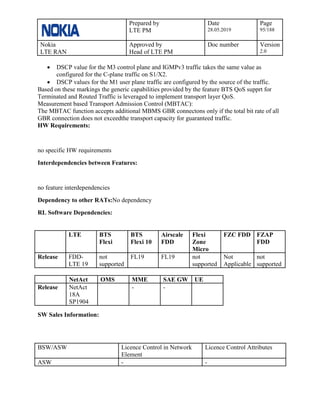
  • 175.
    Prepared by LTE PM Date 28.05.2019 Page 175/188 Nokia LTERAN Approved by Head of LTE PM Doc number Version 2.0 BSW/ASW Licence Control in Network Element Licence Control Attributes ASW NetAct - 6.3.1.2 Web Element Manager improvements - part 1 Unique ID: 5113 Short Description: This feature brings the support for WebEM functionality de-scoped form LTE 18A release. Benefits for the Customer: Operator will be able to use legacy BTSSM functions in WebEM. Functional Description: This feature introduces to TD LTE, FDD LTE and SRAN products following functionality that was descoped from SR001604/LTE3791: 1. General: • It shall be possible to check in WebEM the history of operations executed by user • GSM and WCDMA technology specific information shall not be visible WebEM dedicated for LTE product 3. Fault Management • It shall be possible to configure Fault Toggling via WebEM GUI 4. Test and Diagnostic: • It shall be possible to configure BTS Log levels via WebEM GUI • It shall be possible to configure Transport diagnostic (Ethernet mirroring, MTU path discovery, PDH loopback) via WebEM GUI • GSM Test Models Loop Test GUI shall be based on BTSSM instead of SRT Note: Following requirement from SR001604/LTE3791: • Maintenance and troubleshooting o Snapshot saving to external server is now covered by SR000936: SBTS Troubleshooting Symptom Data Automation HW Requirements: no specific HW requirements Interdependencies between Features:
  • 176.
    Prepared by LTE PM Date 28.05.2019 Page 176/188 Nokia LTERAN Approved by Head of LTE PM Doc number Version 2.0 no feature interdependencies Dependency to other RATs:No dependency RL Software Dependencies: LTE BTS Flexi BTS Flexi 10 Airscale FDD Flexi Zone Micro FZC FDD FZAP FDD Release FDD- LTE 19 not supported FL19 FL19 not supported not supported not supported NetAct OMS MME SAE GW UE Release - - - SW Sales Information: BSW/ASW Licence Control in Network Element Licence Control Attributes BSW - - 6.4 O&M Security 6.4.1.1 Continuous BTS product security improvements Part 4 Unique ID: 3103 Short Description: The feature provides enhancements to local BTS password rules and hardening improvements on Linux level Benefits for the Customer: Enhanced risk management by configurable password strength for local BTS passwords Functional Description: Configurable minimum password length (SecSoC_SEC.34.2):
  • 177.
    Prepared by LTE PM Date 28.05.2019 Page 177/188 Nokia LTERAN Approved by Head of LTE PM Doc number Version 2.0 (SecSoC_SEC.34.2 : “Minimum length and usage of non-alpha-numeric characters can be enforced”) The minimum length for local operator user accounts passwords and Nokia service user password is configurable between 8 and 128 characters (default setting is 8 characters) Configurable usage of non-alphanumeric characters in passwords (SecSoC_SEC.34.2): The mandatory usage of non-alphanumeric characters is configurable to to “none”, “1” or “2”. Default setting is “on”, i.e. at minimum 1 non-alphanumeric character must be part of the password. The configuration can be done by BTS Element Manager (by users with SystemAdmin or SecurityAdmin privileges) and with NetAct Configurator. Note: a new policy configuration becomes active with the next regular update of a user account password. The BTS doesn’t enforce the users to update their existing passwords at point in time when the configuration changes, i.e. not with the next login. Protected Stack Segments (SecSoC_SEC.9.7) (SecSoC_SEC.9.7 – sub-item 2.1.9: “Disable execute permission of stack segments “) Supported already for AirScale and is now as well applied to FSMv3 modules to block stack- overflow like attack scenarios HW Requirements: Interdependencies between Features:
  • 178.
    Prepared by LTE PM Date 28.05.2019 Page 178/188 Nokia LTERAN Approved by Head of LTE PM Doc number Version 2.0 Dependency to other RATs:No dependency RL Software Dependencies: LTE BTS Flexi BTS Flexi 10 Airscale FDD Flexi Zone Micro FZC FDD FZAP FDD Release FDD- LTE 19 not supported FL19 FL19 FL19 Not Applicable FL19 NetAct OMS MME SAE GW UE Release NetAct 18A SP1904 - - SW Sales Information: BSW/ASW Licence Control in Network Element Licence Control Attributes BSW - - 6.5 Supplementary O&M features 6.5.1.1 BTS Transport connection to BTS Mediator Service Unique ID: 3325 Short Description: Provides the external secured or unsecured m-plane transport link between the BTS local BTS OAM component in physical BTS and centralized BTS OAM components hosted remotely within the BTS Mediator which may be located in a remote data center together with NetAct or deployed as stand-alone node. Benefits for the Customer: Enables BTS secure transport connectivity between BTS and BTS Mediator Functional Description:
  • 179.
    Prepared by LTE PM Date 28.05.2019 Page 179/188 Nokia LTERAN Approved by Head of LTE PM Doc number Version 2.0 As part of the single OAM architecture a BTS is composed of a local OAM Info Model (IM) component located in each physical BTS and a centralized Info Model Plug-in component hosted remotely by the BTS. The Info Model in each of physical BTS is the main data repository and the BTS Mediator synchronizes its centralized Info Model data base with all the physical BTS connected to it via this new permanent Single OAM (SOAM) m-plane interface. BTS Mediator’s role is to mediate between the binary IM format on SOAM interface (Southbound I/F of BTS Mediator) and XML format used on NE3S interface of BTS Mediator (Northbound I/F of the Mediator). - The SOAM interface utilizes Google “protobuf” standard for OAM application payload encoding, accompanied by HTTP for file transfers. - TCP transport is used to carry the protobuf layer with its OAM application payload, secure transport by TLS can be activated on demand in case the operator has Public Key System in use. In case of secure m-plane communication is activated TLS1.2 is used to mutual authenticate the BTS & BTS Mediator peers by X.509 operator certificates and cipher the protobuf communication with according TLS ciphers and HTTPS is used for file transfers. Encapsulation of the encoded OAM application payload into IPsec tunnel is supported as well Operator configurable parameter on BTS side: BTS Mediator IP address:
  • 180.
    Prepared by LTE PM Date 28.05.2019 Page 180/188 Nokia LTERAN Approved by Head of LTE PM Doc number Version 2.0 Defines as static IP address the southbound IP address of the BTS Mediator Note: In case 2 BTS Mediators in resilience configuration are deployed the 2 IP addresses can be configured. OAM TLS mode: This parameter defines whether the TLS shall be used to secure the management connection to BTS Mediator. The following values are supported: "off" - The management connection is unsecure (TLS not in use, default setting) "forced" - The management connection is secured with TLS (TLS in use) The usage of the TLS requires that valid certificates are installed in the BTS The parameter can be configured with NetAct Configurator or with the BTS Element Manager.
  • 181.
    Prepared by LTE PM Date 28.05.2019 Page 181/188 Nokia LTERAN Approved by Head of LTE PM Doc number Version 2.0 HW Requirements: no specific HW requirements Interdependencies between Features: no feature interdependencies Dependency to other RATs:No dependency RL Software Dependencies:
  • 182.
    Prepared by LTE PM Date 28.05.2019 Page 182/188 Nokia LTERAN Approved by Head of LTE PM Doc number Version 2.0 LTE BTS Flexi BTS Flexi 10 Airscale FDD Flexi Zone Micro FZC FDD FZAP FDD Release FDD- LTE 19 not supported FL19 FL19 not supported Not Applicable not supported NetAct OMS MME SAE GW UE Release x - - SW Sales Information: BSW/ASW Licence Control in Network Element Licence Control Attributes BSW - - 6.6 LTE:Troubleshoot 6.6.1.1 GPS, time and synchronization management via WebEM Remote Tool Unique ID: 4129 Short Description: WebEM Remote Tool commands for GPS, Time and synchronization management provides the functionality to manage GPS, time and synchronization related data from the BTS. eNB GPS, Synchronization and Time details, which are currently available in BTS Element Manager (WebEM) shall be exposed via WebEM Remote Tool commands to the operator. The feature delivers ability: • to retrieve via WebEM Remote Tool following information: • GPS Inventory List • Synchronization and Time Information • Frequency History command
  • 183.
    Prepared by LTE PM Date 28.05.2019 Page 183/188 Nokia LTERAN Approved by Head of LTE PM Doc number Version 2.0 • to execute following procedure: • GPS Reset command Benefits for the Customer: • Automation • Automatic data collection in case of BTS abnormal situation • Automatic ticket creation • Quicker troubleshooting Functional Description: Feature gives possibility to make: • quicker troubleshooting • automation in case of ticket creation and data collection With respect to bullet information from short description field : This WebEM Remote Tool commands should just extract proper data and bring them available for end-user HW Requirements: no specific HW requirements Interdependencies between Features: no feature interdependencies Dependency to other RATs:No dependency RL Software Dependencies: LTE BTS Flexi BTS Flexi 10 Airscale FDD Flexi Zone Micro FZC FDD FZAP FDD Release FDD- LTE 19 not supported FL19 FL19 not supported not supported not supported NetAct OMS MME SAE GW UE
  • 184.
    Prepared by LTE PM Date 28.05.2019 Page 184/188 Nokia LTERAN Approved by Head of LTE PM Doc number Version 2.0 Release NetAct 18A SP1904 - - SW Sales Information: BSW/ASW Licence Control in Network Element Licence Control Attributes ASW - - 6.6.1.2 WebEM Remote Tool feature parity with BTS Site Manager Unique ID: 4622 Short Description: There is possibility to get the information by using Web Element Manager CLI as it was possible in BTS Site Manager CLI Benefits for the Customer: • Automation o automatic data collection in case of BTS abnormal situation o automatic ticket creation o automatic BTS management • Quicker troubleshooting Functional Description: BTS CLI commands must provide the following actions or informations: • block/unblock (cell, radio, BTS) • getalarmhistory • check NMS state • techrep and remote snapshot • generate scf • unit reset (RET, MHA, cell) • site reset
  • 185.
    Prepared by LTE PM Date 28.05.2019 Page 185/188 Nokia LTERAN Approved by Head of LTE PM Doc number Version 2.0 • reset to test dedicated state • get RF output power - the value equal to pMax • get/set backhaul parameters - this command will be supported only from xL19/SRAN19 onwards • commisioning/recommissioning • configuration reset • software update • software rollback • read DAC word, set DAC word • checklinkstatus • checkamplifier • checkantennas • checkclock • checkfans • checkhw • checkpower • checkvswr • getgpsstatus • radio reset at L1 layer Note: The RP001907/LTE3792 eNB selected data availability via BTS CLI introduces a feature activation parameter and associated feature license for the use of ADMIN CLI. By default, the ADMIN CLI is deactivated. Feature activation parameter must be enabled, to have the ADMIN CLI activated. This activation parameter is common for all CLI commands supported on the BTS i.e. once this parameter is enabled, any ADMIN CLI command(s) can be run. Similarly, a single CLI feature license is valid/sufficient to run any CLI command and any no. of CLI commands. HW Requirements: no specific HW requirements Interdependencies between Features: no feature interdependencies Dependency to other RATs:No dependency RL Software Dependencies:
  • 186.
    Prepared by LTE PM Date 28.05.2019 Page 186/188 Nokia LTERAN Approved by Head of LTE PM Doc number Version 2.0 LTE BTS Flexi BTS Flexi 10 Airscale FDD Flexi Zone Micro FZC FDD FZAP FDD Release FDD- LTE 19 not supported FL19 FL19 not supported not supported not supported NetAct OMS MME SAE GW UE Release NetAct 18A SP1904 - - SW Sales Information: BSW/ASW Licence Control in Network Element Licence Control Attributes ASW SW Asset Monitoring - 6.6.2 BTSMED for bare-metal Unique ID: 4831 Short Description: BTSMED support for bare-metal server HW. Benefits for the Customer: Every LTE customer has multiple LTE OMSs with their dedicated server blade. THese old LTE OMS servers can be re-used as such for BTSMEDs by this feature. This avoids OPEX costs for LTE customers and simplifies the transition to BTSMED based management solution. Functional Description: •Nokia AirFrame or HP (Gen8/9/10) servers can be used to BTSMED. •LTE OMS HW can be reused as such for BTSMED •HDD redundancy support for server HW Requirements: no specific HW requirements
  • 187.
    Prepared by LTE PM Date 28.05.2019 Page 187/188 Nokia LTERAN Approved by Head of LTE PM Doc number Version 2.0 Interdependencies between Features: no feature interdependencies Dependency to other RATs:No dependency RL Software Dependencies: LTE BTS Flexi BTS Flexi 10 Airscale FDD Flexi Zone Micro FZC FDD FZAP FDD Release FDD- LTE 19 not supported not supported not supported not supported not supported not supported NetAct OMS MME SAE GW UE Release - - - SW Sales Information: BSW/ASW Licence Control in Network Element Licence Control Attributes BSW - - 6.6.3 Multiple BTSMEDs Unique ID: 5022 Short Description: Support for multiple parallel BTSMEDs (1+1 pairs). Functional Description: NetAct to support multiple BTSMED (redundancy 1+1 pairs) to extend capacity of BTSMED layer Allows to use more but smaller BTSMEDs to make management connection to BTSs more robust against BTSMED failure by minimizing the impact.
  • 188.
    Prepared by LTE PM Date 28.05.2019 Page 188/188 Nokia LTERAN Approved by Head of LTE PM Doc number Version 2.0 Makes BTSMED redundancy pair switch over faster in NetAct. HW Requirements: no specific HW requirements Interdependencies between Features: no feature interdependencies Dependency to other RATs:No dependency RL Software Dependencies: LTE BTS Flexi BTS Flexi 10 Airscale FDD Flexi Zone Micro FZC FDD FZAP FDD Release FDD- LTE 19 not supported not supported not supported not supported not supported not supported NetAct OMS MME SAE GW UE Release - - - SW Sales Information: BSW/ASW Licence Control in Network Element Licence Control Attributes BSW - -