By
Jagtar Singh Dhaliwal
 RCS Global Limited is an emerging in software
business solution & IT infrastructure. With the motto
of “Provide Quality Solution at the Right Price at the
Right time”.
 The company is redefining the concepts of IT
services and consulting.
 RCS Global is the sister concern of ‘RAMA Group’
founded in 1992.
 Product Realization - Excellent team work & services.
 Business Process Consulting – Total satisfaction of client.
 IT Implementation – Focus on core business.
 Database Design – Store huge DB i.e. secure & robust.
 Business Intelligent – Expertise Troubleshoot.
 Offshore Development Centre – preparing efficient &
. reliable team.
 MEDI-SUITE
 EDU-SUITE
 SAP
 .NET
 RAMCO
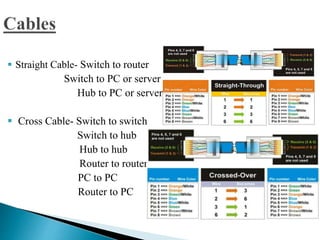
 Straight Cable- Switch to router
Switch to PC or server
Hub to PC or server
 Cross Cable- Switch to switch
Switch to hub
Hub to hub
Router to router
PC to PC
Router to PC
 IP is an address of a Computer on a network.
 task of delivering datagrams from the source host to the destination host
solely based on the addresses.
 Two IP version-IPv4 and IPv6
 IPv4(Internet Protocol version 4)for 32 bits
 IPv6(Internet Protocol version6)for 128 bits
 Type of IP Address
 Static IP Address (Automatically assign)
 Dynamic IP Address (Manually assign)
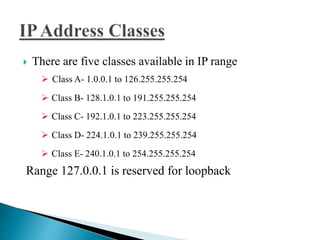
 There are five classes available in IP range
 Class A- 1.0.0.1 to 126.255.255.254
 Class B- 128.1.0.1 to 191.255.255.254
 Class C- 192.1.0.1 to 223.255.255.254
 Class D- 224.1.0.1 to 239.255.255.254
 Class E- 240.1.0.1 to 254.255.255.254
Range 127.0.0.1 is reserved for loopback
 Class A- assign large number of hosts
 Class B- assign large to medium network
 Class C- used in small LAN configuration
 Class D- reserved for multicasting purposes
 Class E- for research and developing centre
 With the rapid growth of the internet & the ever-
increasing demand for new addresses, the standard
address class structure has been expanded by
borrowing bits from the Host portion to allow for
more Networks.
 There are default standard subnet masks for Class A,
B and C addresses:
 The PING (Packet Internet Groper) command
verifies OSI Layer 3 (Network Layer) connectivity.
 The subnet mask is the same for all users on a
specific network.
 Internet routing devices traditionally have been called
gateways
A network gateway is an internetworking system capable of joining
together two networks that use different base protocols.
 A choke point of control and monitoring .
 Interconnects networks with differing trust.
 Imposes restrictions on network services.
 only authorized traffic is allowed
 Improve network security & reduce risks to hosts
Characterized by protocol level it controls in
 Packet filtering (filter incoming & outgoing data)
 Circuit gateways (large network filter)
 Application gateways (Need separate proxies for each service)
 Combination of above is dynamic packet filter
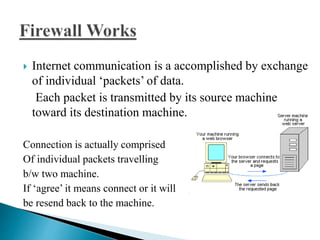
 Internet communication is a accomplished by exchange
of individual ‘packets’ of data.
Each packet is transmitted by its source machine
toward its destination machine.
Connection is actually comprised
Of individual packets travelling
b/w two machine.
If ‘agree’ it means connect or it will
be resend back to the machine.
 Firewall cannot prevent Virus and Trojans
from the accessing the internet.
 Mostly virus and trojan are received via e-mail
direct downloading ,etc
 Firewall not really protect the system from hackers
(or any ultra surf)
 Hard to upgrade
 Take up physical space
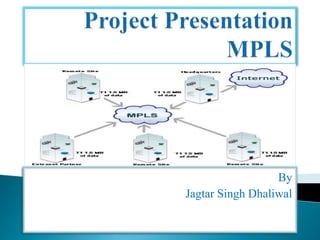
 Multi Protocol Label Switching is arranged between
Layer 2 and Layer 3
 Versatile solution:-speed ,QOS ,traffic management
Security management.
 Mechanisms to manage traffic flows of various
granularities (Flow Management)
 Is independent of Layer-2 and Layer-3 protocols
 Maps IP-addresses to fixed length labels
 Supports ATM, Frame-Relay and Ethernet
• Label
• Label Edge Router (LER)
• Forwarding Equivalence Router (FER)
• Label Switching Router (LSR)
• Label Distribution Protocol (LDP)
• Short fixed length entity
 20-bits label value
 Each label head contain four fields
Label Format
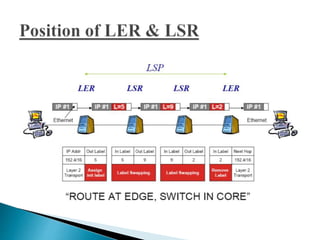
• Resides at the edge of an MPLS network and assigns and
removes the labels from the packets.
• Support multiple ports connected to dissimilar networks (such as
frame relay, ATM, and Ethernet).
• Is a high speed router in the core on an MPLS network.
• ATM switches can be used as LSRs without changing their
hardware. Label switching is equivalent to VP/VC switching.
• An application layer protocol for the distribution of label
binding information to LSRs.
• It is used to map FECs to labels, which, in turn, create LSPs.
• LDP sessions are established between LDP peers in the
MPLS network (not necessarily adjacent).
• In MPLS, traffic engineering is inherently provided using explicitly
routed paths.
• The LSPs are created independently, specifying different paths that
are based on user-defined policies. However, this may require
extensive operator intervention.
• RSVP-TE and CR-LDP are two possible approaches to supply
dynamic traffic engineering and QoS in MPLS.
• Improves packet-forwarding performance in the network
• Supports QoS and CoS for service differentiation
• Supports network scalability
• Integrates IP and ATM in the network
• Builds interoperable networks
 Unknown knowledge of the technology
 Miscommunication of networks still occur
 Near replacement of MPLS technology has to be put
in place of old technology
 Hardware problems
 Better security needs to be implemented so hackers
cannot get into technology
Jagtar Singh Dhaliwal
Roll No.-08588911806
Jagtar.singh@fiib.edu.com

MPLS ppt

  • 1.
  • 2.
     RCS GlobalLimited is an emerging in software business solution & IT infrastructure. With the motto of “Provide Quality Solution at the Right Price at the Right time”.  The company is redefining the concepts of IT services and consulting.  RCS Global is the sister concern of ‘RAMA Group’ founded in 1992.
  • 3.
     Product Realization- Excellent team work & services.  Business Process Consulting – Total satisfaction of client.  IT Implementation – Focus on core business.  Database Design – Store huge DB i.e. secure & robust.  Business Intelligent – Expertise Troubleshoot.  Offshore Development Centre – preparing efficient & . reliable team.
  • 4.
     MEDI-SUITE  EDU-SUITE SAP  .NET  RAMCO
  • 6.
     Straight Cable-Switch to router Switch to PC or server Hub to PC or server  Cross Cable- Switch to switch Switch to hub Hub to hub Router to router PC to PC Router to PC
  • 7.
     IP isan address of a Computer on a network.  task of delivering datagrams from the source host to the destination host solely based on the addresses.  Two IP version-IPv4 and IPv6  IPv4(Internet Protocol version 4)for 32 bits  IPv6(Internet Protocol version6)for 128 bits  Type of IP Address  Static IP Address (Automatically assign)  Dynamic IP Address (Manually assign)
  • 8.
     There arefive classes available in IP range  Class A- 1.0.0.1 to 126.255.255.254  Class B- 128.1.0.1 to 191.255.255.254  Class C- 192.1.0.1 to 223.255.255.254  Class D- 224.1.0.1 to 239.255.255.254  Class E- 240.1.0.1 to 254.255.255.254 Range 127.0.0.1 is reserved for loopback
  • 9.
     Class A-assign large number of hosts  Class B- assign large to medium network  Class C- used in small LAN configuration  Class D- reserved for multicasting purposes  Class E- for research and developing centre
  • 11.
     With therapid growth of the internet & the ever- increasing demand for new addresses, the standard address class structure has been expanded by borrowing bits from the Host portion to allow for more Networks.  There are default standard subnet masks for Class A, B and C addresses:
  • 12.
     The PING(Packet Internet Groper) command verifies OSI Layer 3 (Network Layer) connectivity.  The subnet mask is the same for all users on a specific network.  Internet routing devices traditionally have been called gateways A network gateway is an internetworking system capable of joining together two networks that use different base protocols.
  • 13.
     A chokepoint of control and monitoring .  Interconnects networks with differing trust.  Imposes restrictions on network services.  only authorized traffic is allowed  Improve network security & reduce risks to hosts
  • 14.
    Characterized by protocollevel it controls in  Packet filtering (filter incoming & outgoing data)  Circuit gateways (large network filter)  Application gateways (Need separate proxies for each service)  Combination of above is dynamic packet filter
  • 15.
     Internet communicationis a accomplished by exchange of individual ‘packets’ of data. Each packet is transmitted by its source machine toward its destination machine. Connection is actually comprised Of individual packets travelling b/w two machine. If ‘agree’ it means connect or it will be resend back to the machine.
  • 17.
     Firewall cannotprevent Virus and Trojans from the accessing the internet.  Mostly virus and trojan are received via e-mail direct downloading ,etc  Firewall not really protect the system from hackers (or any ultra surf)  Hard to upgrade  Take up physical space
  • 20.
     Multi ProtocolLabel Switching is arranged between Layer 2 and Layer 3  Versatile solution:-speed ,QOS ,traffic management Security management.
  • 21.
     Mechanisms tomanage traffic flows of various granularities (Flow Management)  Is independent of Layer-2 and Layer-3 protocols  Maps IP-addresses to fixed length labels  Supports ATM, Frame-Relay and Ethernet
  • 22.
    • Label • LabelEdge Router (LER) • Forwarding Equivalence Router (FER) • Label Switching Router (LSR) • Label Distribution Protocol (LDP)
  • 23.
    • Short fixedlength entity  20-bits label value  Each label head contain four fields Label Format
  • 24.
    • Resides atthe edge of an MPLS network and assigns and removes the labels from the packets. • Support multiple ports connected to dissimilar networks (such as frame relay, ATM, and Ethernet).
  • 25.
    • Is ahigh speed router in the core on an MPLS network. • ATM switches can be used as LSRs without changing their hardware. Label switching is equivalent to VP/VC switching.
  • 27.
    • An applicationlayer protocol for the distribution of label binding information to LSRs. • It is used to map FECs to labels, which, in turn, create LSPs. • LDP sessions are established between LDP peers in the MPLS network (not necessarily adjacent).
  • 28.
    • In MPLS,traffic engineering is inherently provided using explicitly routed paths. • The LSPs are created independently, specifying different paths that are based on user-defined policies. However, this may require extensive operator intervention. • RSVP-TE and CR-LDP are two possible approaches to supply dynamic traffic engineering and QoS in MPLS.
  • 29.
    • Improves packet-forwardingperformance in the network • Supports QoS and CoS for service differentiation • Supports network scalability • Integrates IP and ATM in the network • Builds interoperable networks
  • 30.
     Unknown knowledgeof the technology  Miscommunication of networks still occur  Near replacement of MPLS technology has to be put in place of old technology  Hardware problems  Better security needs to be implemented so hackers cannot get into technology
  • 31.
    Jagtar Singh Dhaliwal RollNo.-08588911806 Jagtar.singh@fiib.edu.com