HISTORY OF THE COMPUTER THE ELECTRONIC AGE 1941-PRESENT
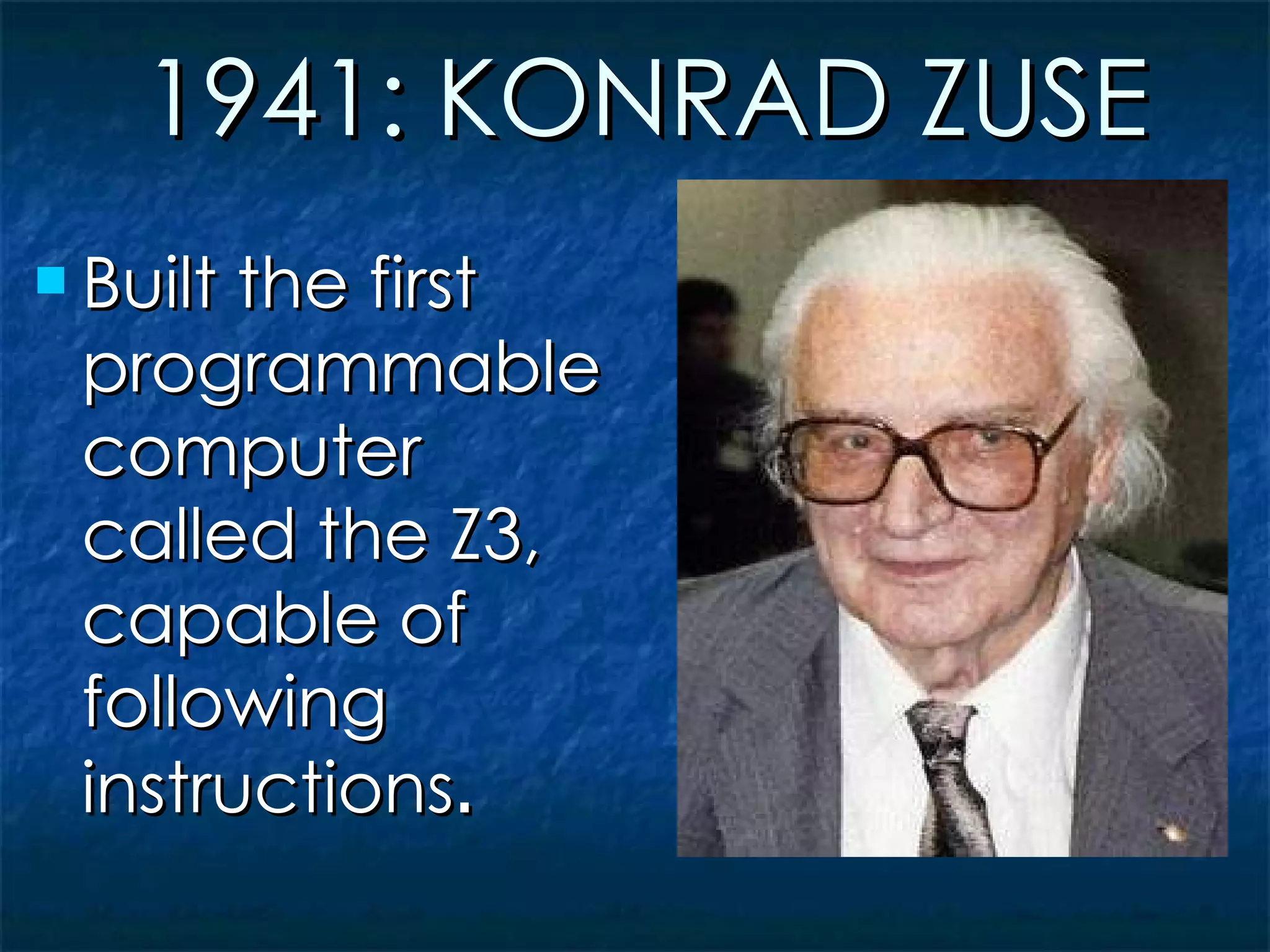
1941: KONRAD ZUSE Built the first programmable computer called the Z3, capable of following instructions .
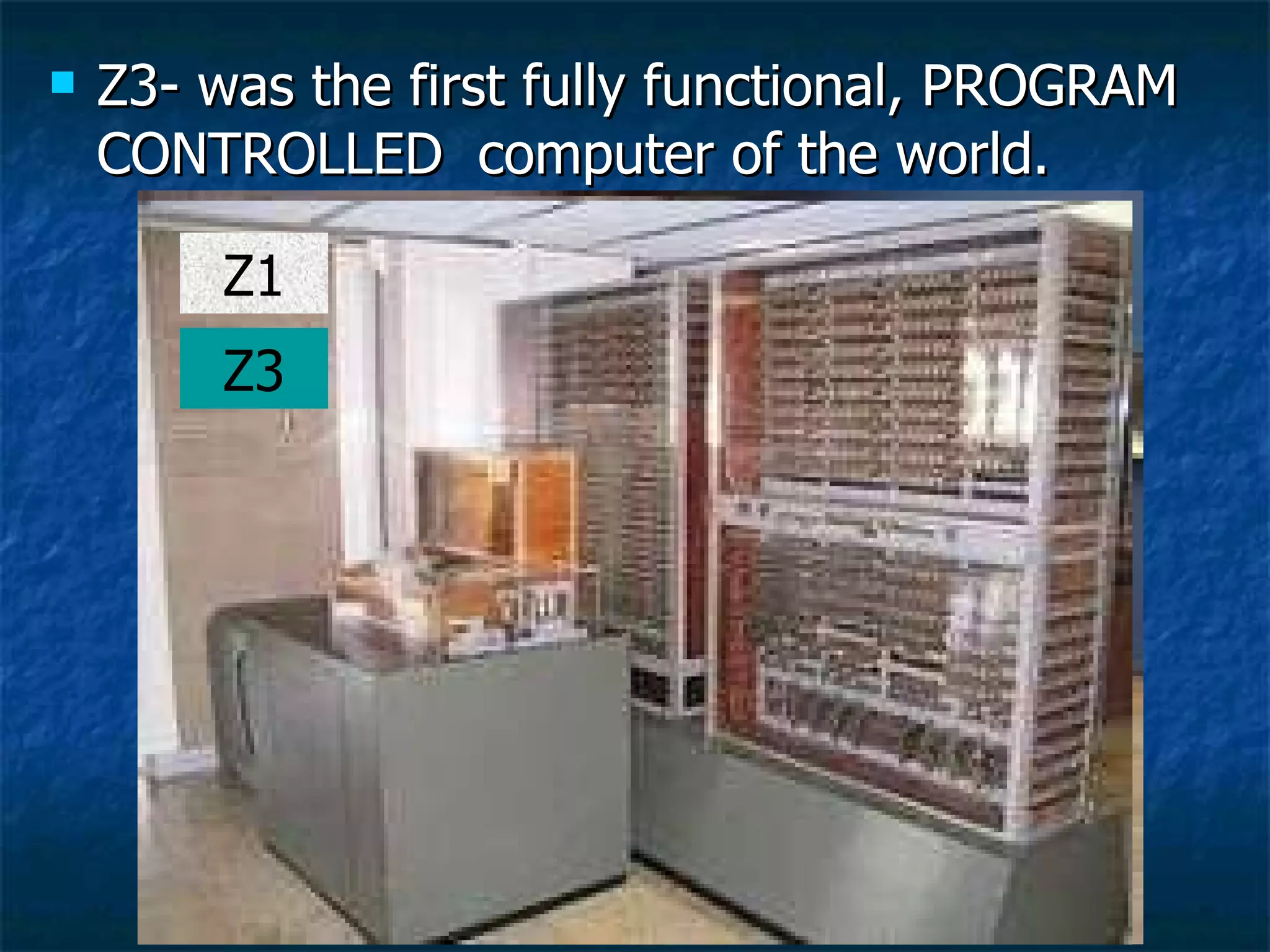
Z3- was the first fully functional, PROGRAM CONTROLLED  computer of the world. Z1 Z3
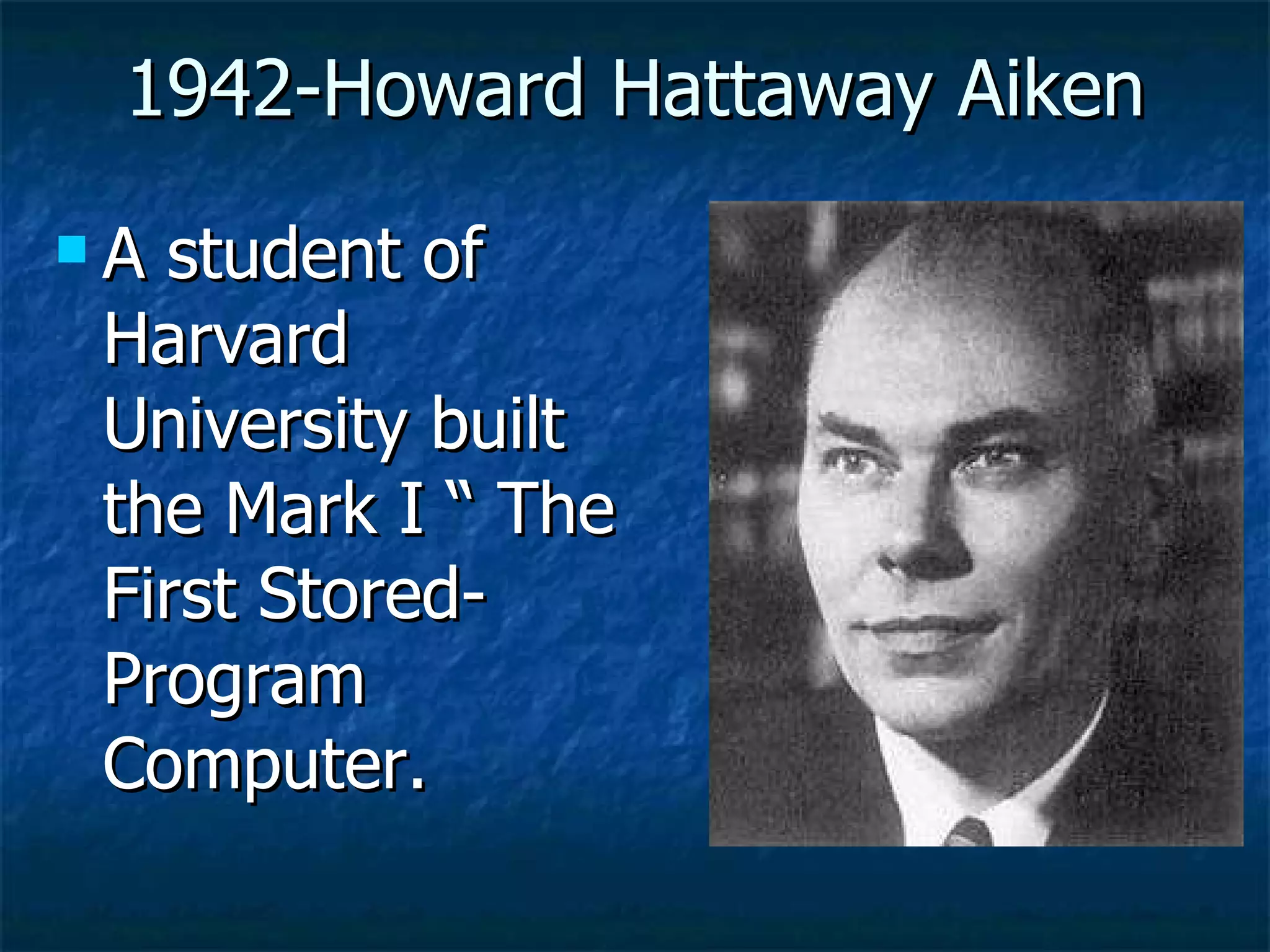
1942-Howard Hattaway Aiken A student of Harvard University built the Mark I “ The First Stored-Program Computer.
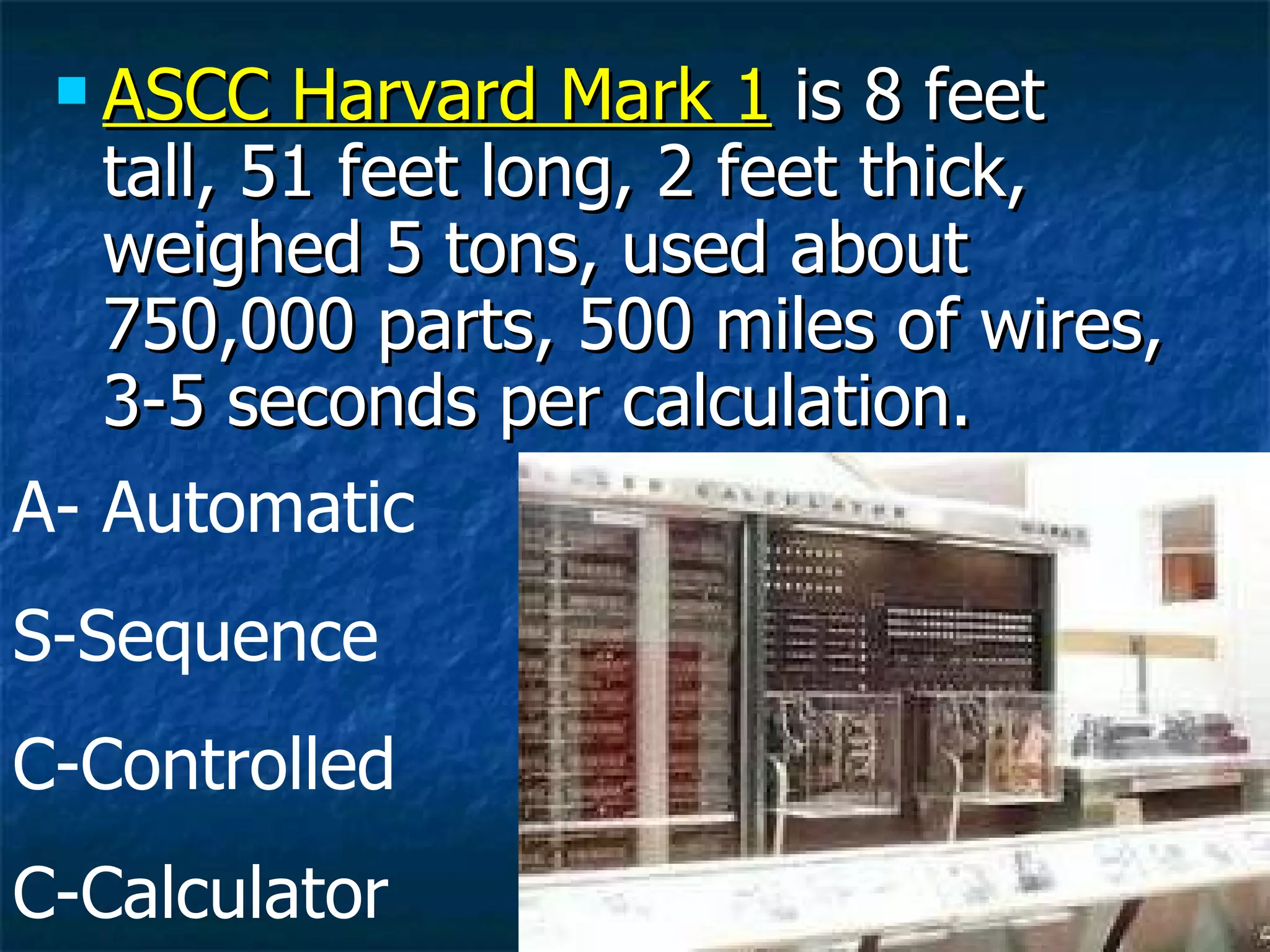
ASCC Harvard Mark 1  is 8 feet tall, 51 feet long, 2 feet thick, weighed 5 tons, used about 750,000 parts, 500 miles of wires, 3-5 seconds per calculation. A- Automatic S-Sequence C-Controlled C-Calculator
 
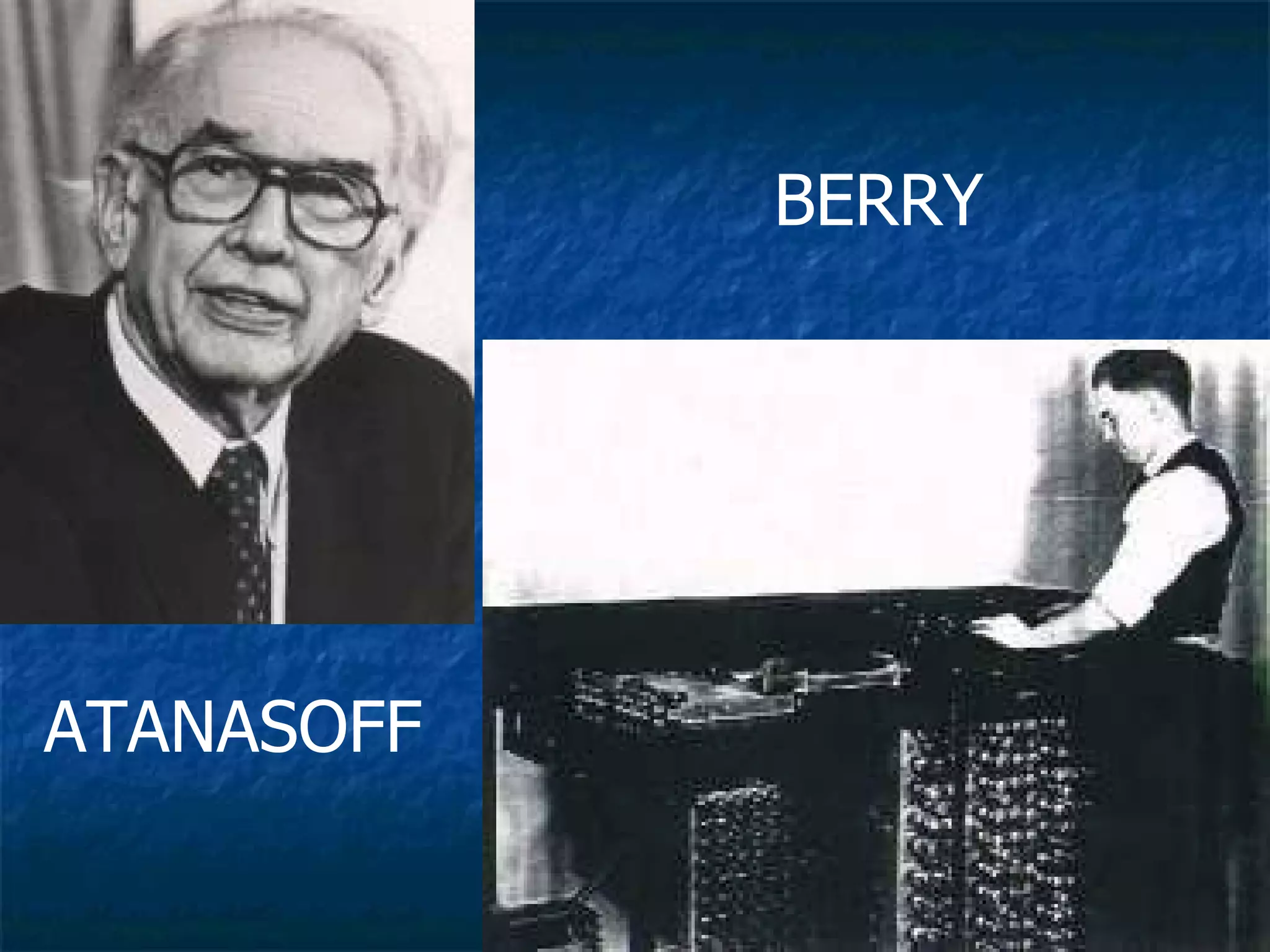
1942: John Atanasoff  and  Clifford Berry Completed the first all electronic computer, called the ABC Computer, it was the first computer to use electricity in the form of vacuum tubes to help make electric computation possible. This is used for solving complex system of equations.
ATANASOFF BERRY
 
THE  FOUR  GENERATIONS   OF  DIGITAL COMPUTING
THE FIRST  GENERATION COMPUTERS: 1951-1958 VACCUM TUBES AS THEIR MAIN LOGIC ELEMENTS. PUNCH CARDS TO INPUT and EXTENALLY STORE DATA. ROTATING MAGNETIC DRUMS FOR INTERNAL STORAGE OF DATA PROGRAMS.
First generation computer had vacuum tubes, resistors, and welded metal joints. They were large, slow, expensive, and produced a lot of heat. Often broke down because of burned-out vacuum tubes. Also needed many experts to operate them. When running these computer, people stood by shopping carts full of replacement of vacuum tubes.
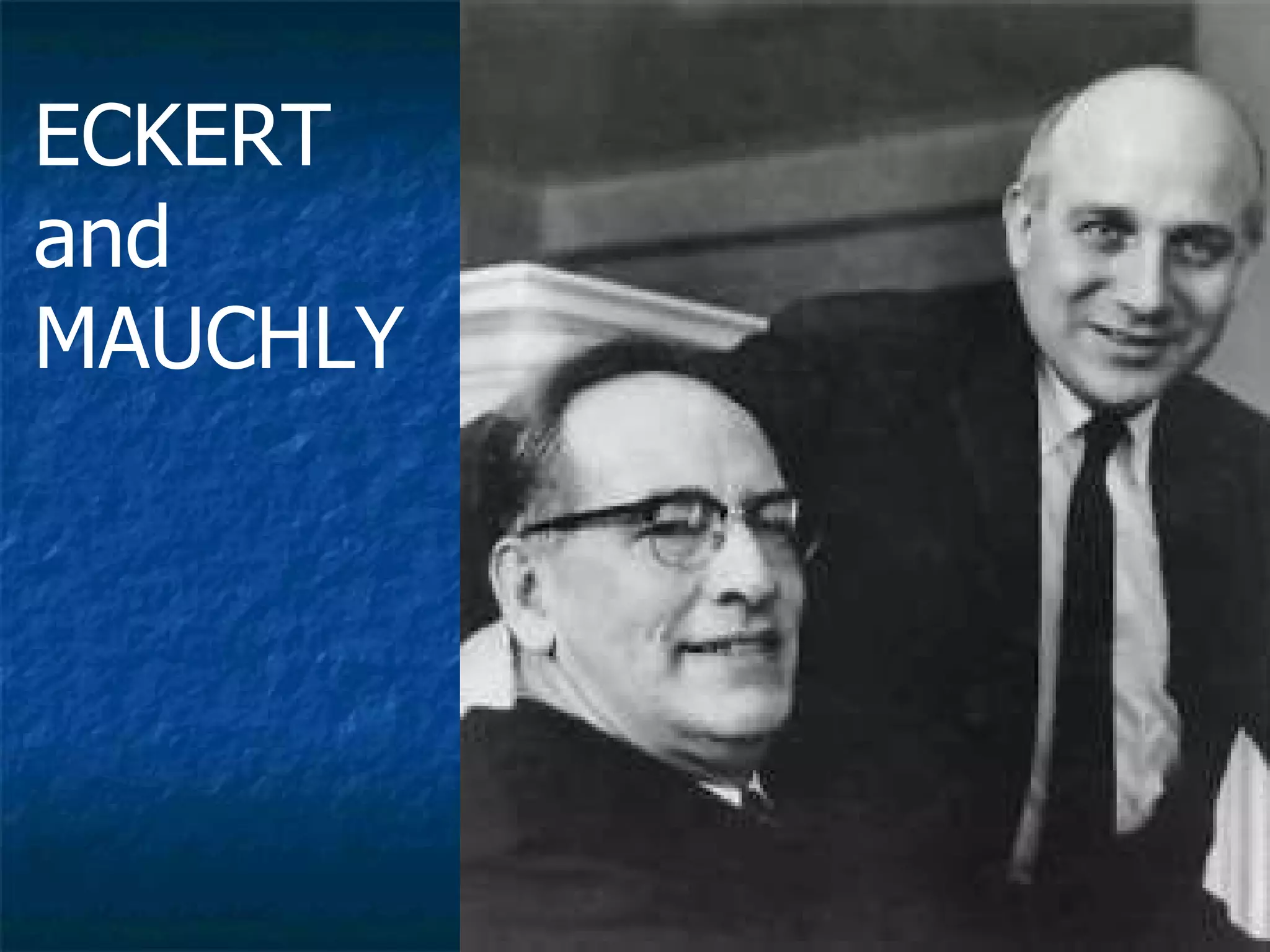
1945: PRESPER EKERT and JOHN MAUCHLY Developed the first operational electronic digital computer, called ENIAC, for the US Army. It is over 1000 times faster than Mark I, and could perform 5,000 additions per second. E- Electronic N-Numerical I-Integrator A-and C-Calculator
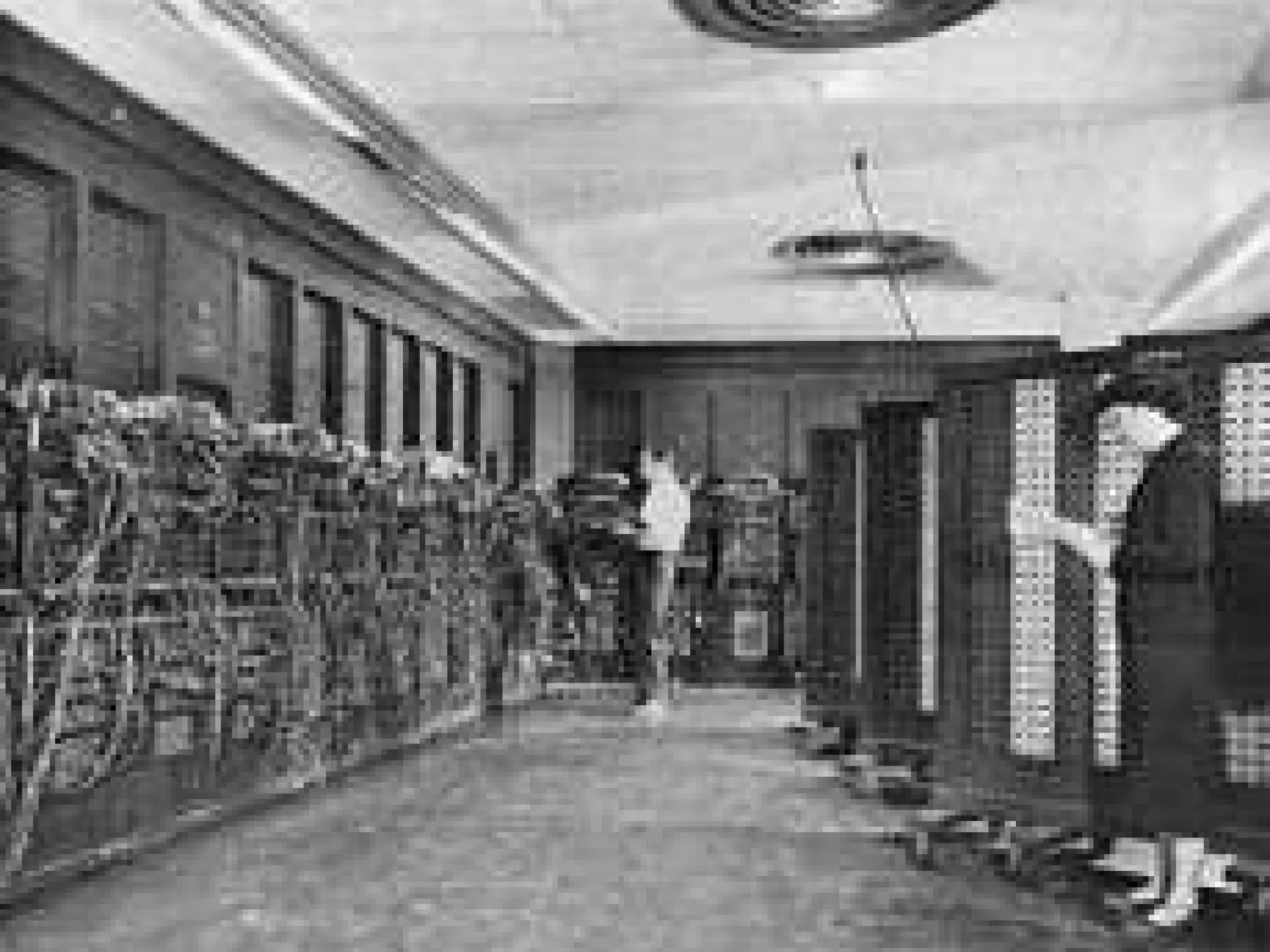
ENIAC had more than 18,000 vacuum tubes, and took up 1,800 square feet of space. In addition, the electrical current of ENIAC required could power more than a thousand modern computers. Today ENIAC’s technology could fit in a modern wristwatch.
 
ECKERT and MAUCHLY
1951: UNIVAC This computer was also designed by  Eckert and Mauchly , became the first commercially available electronic computer. One of this version the  UNIVAC 5  was used to predict result of the 1952 US presidential election.  It is used for business transactions and operations.
UNIVAC is 5 feet tall, 50 feet in length. Consist of 5,600 vacuum tubes and 18,000 crystal diodes. An internal storage of 1000 words or 12,000 characters. UNIV ersal  A utomatic  C alculator
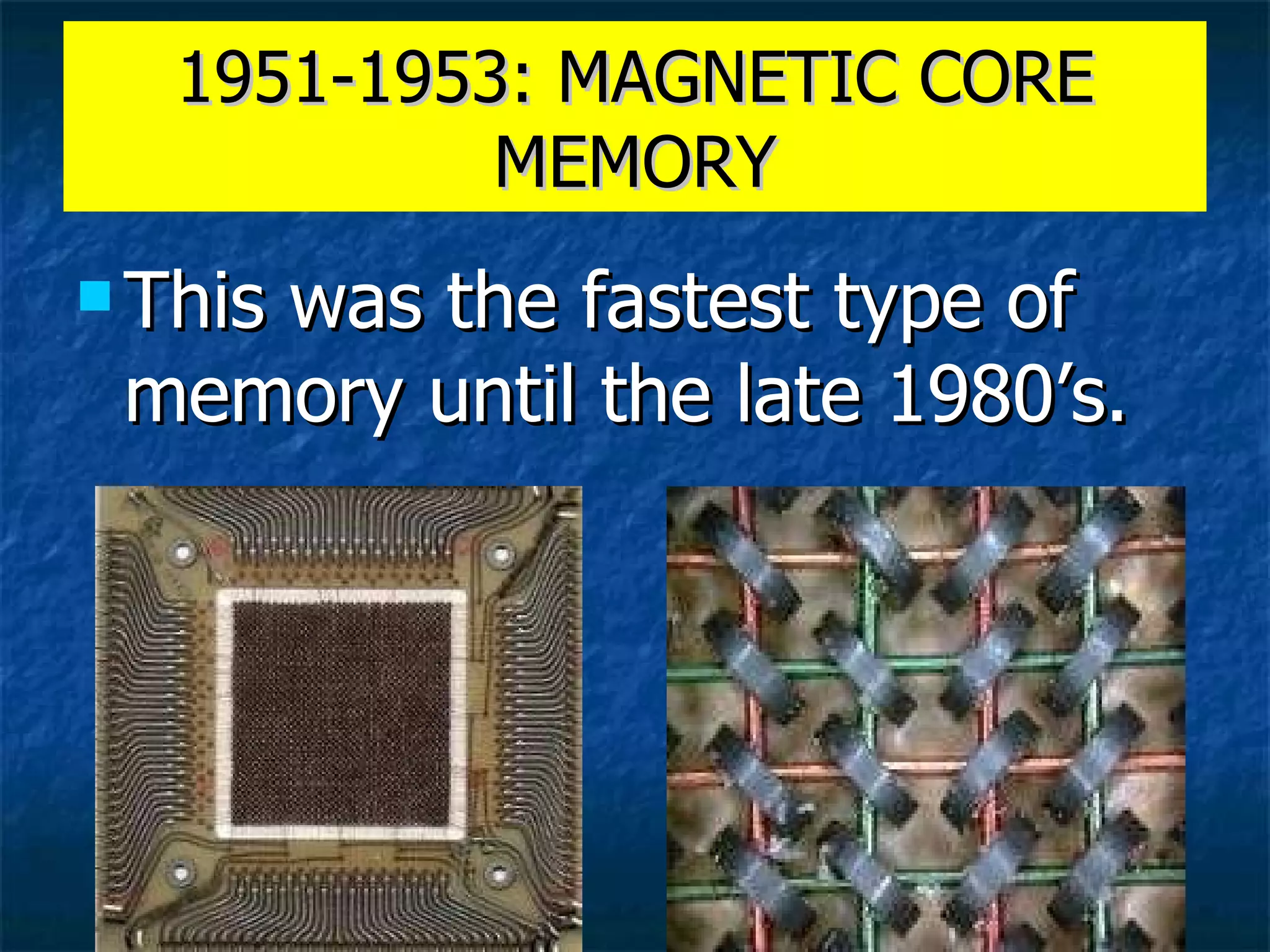
1951-1953: MAGNETIC CORE MEMORY This was the fastest type of memory until the late 1980’s.
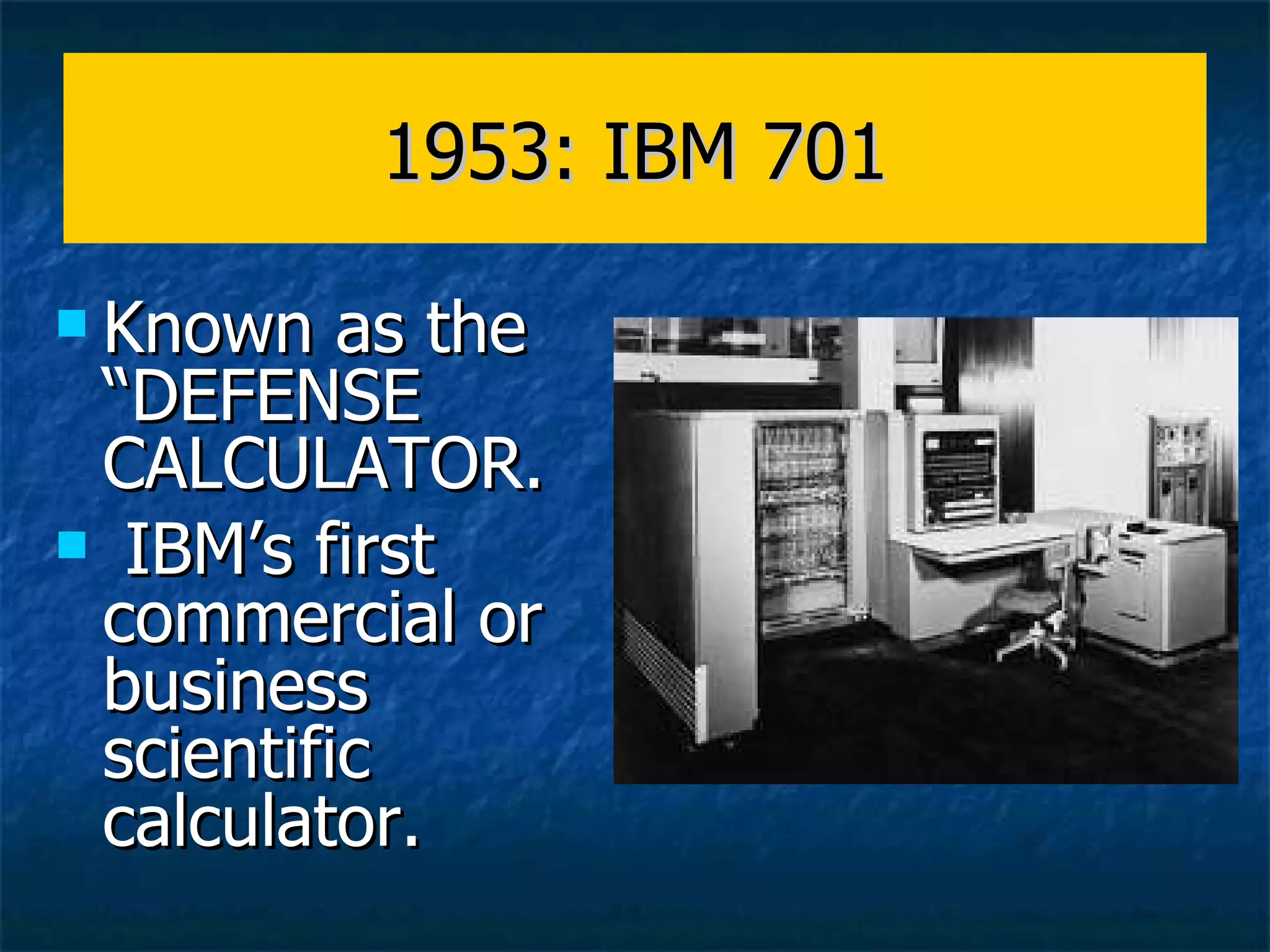
1953: IBM 701 Known as the “DEFENSE CALCULATOR. IBM’s first commercial or business scientific calculator.
END   OF THE  LESSON THANK YOU FOR WATCHING AND LISTENING

History of the computer electronic age

  • 1.
    HISTORY OF THECOMPUTER THE ELECTRONIC AGE 1941-PRESENT
  • 2.
    1941: KONRAD ZUSEBuilt the first programmable computer called the Z3, capable of following instructions .
  • 3.
    Z3- was thefirst fully functional, PROGRAM CONTROLLED computer of the world. Z1 Z3
  • 4.
    1942-Howard Hattaway AikenA student of Harvard University built the Mark I “ The First Stored-Program Computer.
  • 5.
    ASCC Harvard Mark1 is 8 feet tall, 51 feet long, 2 feet thick, weighed 5 tons, used about 750,000 parts, 500 miles of wires, 3-5 seconds per calculation. A- Automatic S-Sequence C-Controlled C-Calculator
  • 6.
  • 7.
    1942: John Atanasoff and Clifford Berry Completed the first all electronic computer, called the ABC Computer, it was the first computer to use electricity in the form of vacuum tubes to help make electric computation possible. This is used for solving complex system of equations.
  • 8.
  • 9.
  • 10.
    THE FOUR GENERATIONS OF DIGITAL COMPUTING
  • 11.
    THE FIRST GENERATION COMPUTERS: 1951-1958 VACCUM TUBES AS THEIR MAIN LOGIC ELEMENTS. PUNCH CARDS TO INPUT and EXTENALLY STORE DATA. ROTATING MAGNETIC DRUMS FOR INTERNAL STORAGE OF DATA PROGRAMS.
  • 12.
    First generation computerhad vacuum tubes, resistors, and welded metal joints. They were large, slow, expensive, and produced a lot of heat. Often broke down because of burned-out vacuum tubes. Also needed many experts to operate them. When running these computer, people stood by shopping carts full of replacement of vacuum tubes.
  • 13.
    1945: PRESPER EKERTand JOHN MAUCHLY Developed the first operational electronic digital computer, called ENIAC, for the US Army. It is over 1000 times faster than Mark I, and could perform 5,000 additions per second. E- Electronic N-Numerical I-Integrator A-and C-Calculator
  • 14.
    ENIAC had morethan 18,000 vacuum tubes, and took up 1,800 square feet of space. In addition, the electrical current of ENIAC required could power more than a thousand modern computers. Today ENIAC’s technology could fit in a modern wristwatch.
  • 15.
  • 16.
  • 17.
    1951: UNIVAC Thiscomputer was also designed by Eckert and Mauchly , became the first commercially available electronic computer. One of this version the UNIVAC 5 was used to predict result of the 1952 US presidential election. It is used for business transactions and operations.
  • 18.
    UNIVAC is 5feet tall, 50 feet in length. Consist of 5,600 vacuum tubes and 18,000 crystal diodes. An internal storage of 1000 words or 12,000 characters. UNIV ersal A utomatic C alculator
  • 19.
    1951-1953: MAGNETIC COREMEMORY This was the fastest type of memory until the late 1980’s.
  • 20.
    1953: IBM 701Known as the “DEFENSE CALCULATOR. IBM’s first commercial or business scientific calculator.
  • 21.
    END OF THE LESSON THANK YOU FOR WATCHING AND LISTENING