1st Generation Computer
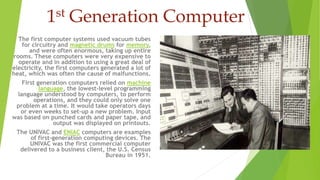
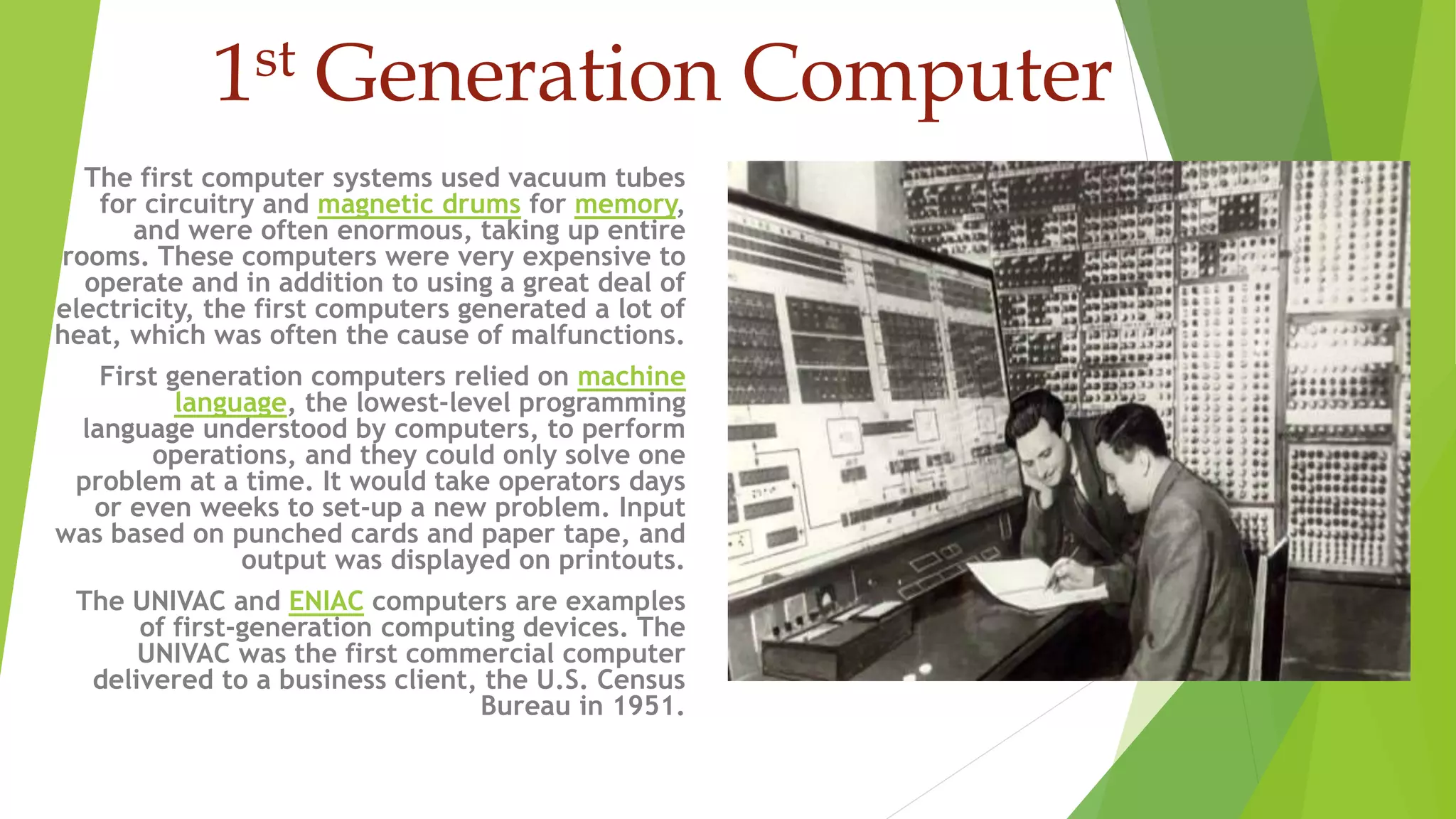
The first computer systems used vacuum tubes
for circuitry and magnetic drums for memory,
and were often enormous, taking up entire
rooms. These computers were very expensive to
operate and in addition to using a great deal of
electricity, the first computers generated a lot of
heat, which was often the cause of malfunctions.
First generation computers relied on machine
language, the lowest-level programming
language understood by computers, to perform
operations, and they could only solve one
problem at a time. It would take operators days
or even weeks to set-up a new problem. Input
was based on punched cards and paper tape, and
output was displayed on printouts.
The UNIVAC and ENIAC computers are examples
of first-generation computing devices. The
UNIVAC was the first commercial computer
delivered to a business client, the U.S. Census
Bureau in 1951.
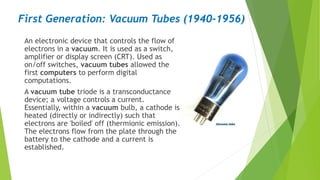
First Generation: Vacuum Tubes (1940-1956)
An electronic device that controls the flow of
electrons in a vacuum. It is used as a switch,
amplifier or display screen (CRT). Used as
on/off switches, vacuum tubes allowed the
first computers to perform digital
computations.
A vacuum tube triode is a transconductance
device; a voltage controls a current.
Essentially, within a vacuum bulb, a cathode is
heated (directly or indirectly) such that
electrons are 'boiled' off (thermionic emission).
The electrons flow from the plate through the
battery to the cathode and a current is
established.
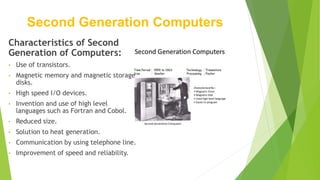
Second Generation Computers
Characteristics of Second
Generation of Computers:
• Use of transistors.
• Magnetic memory and magnetic storage
disks.
• High speed I/O devices.
• Invention and use of high level
languages such as Fortran and Cobol.
• Reduced size.
• Solution to heat generation.
• Communication by using telephone line.
• Improvement of speed and reliability.
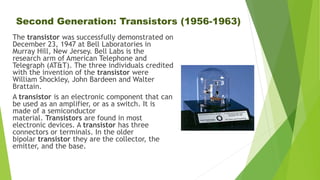
Second Generation: Transistors (1956-1963)
The transistor was successfully demonstrated on
December 23, 1947 at Bell Laboratories in
Murray Hill, New Jersey. Bell Labs is the
research arm of American Telephone and
Telegraph (AT&T). The three individuals credited
with the invention of the transistor were
William Shockley, John Bardeen and Walter
Brattain.
A transistor is an electronic component that can
be used as an amplifier, or as a switch. It is
made of a semiconductor
material. Transistors are found in most
electronic devices. A transistor has three
connectors or terminals. In the older
bipolar transistor they are the collector, the
emitter, and the base.
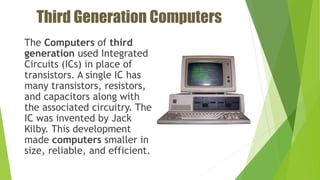
Third Generation Computers
The Computers of third
generation used Integrated
Circuits (ICs) in place of
transistors. A single IC has
many transistors, resistors,
and capacitors along with
the associated circuitry. The
IC was invented by Jack
Kilby. This development
made computers smaller in
size, reliable, and efficient.
Characteristics of Third
Generation computers:
• Integrated circuits instead of individual transistors
• Smaller, cheaper, more efficient and faster than second generation
computers
• High-level programming languages
• Magnetic storage
• Semiconductor Memories
• Introduction of Microprogramming
• Parallel Processing
• Multiprocessing
• OS allowed the Machine to run many Applications
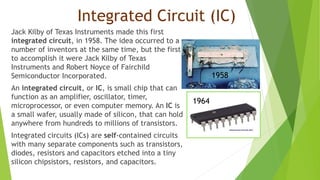
Integrated Circuit (IC)
Jack Kilby of Texas Instruments made this first
integrated circuit, in 1958. The idea occurred to a
number of inventors at the same time, but the first
to accomplish it were Jack Kilby of Texas
Instruments and Robert Noyce of Fairchild
Semiconductor Incorporated.
An integrated circuit, or IC, is small chip that can
function as an amplifier, oscillator, timer,
microprocessor, or even computer memory. An IC is
a small wafer, usually made of silicon, that can hold
anywhere from hundreds to millions of transistors.
Integrated circuits (ICs) are self-contained circuits
with many separate components such as transistors,
diodes, resistors and capacitors etched into a tiny
silicon chipsistors, resistors, and capacitors.
1958
1964
Microprocessors (1971)
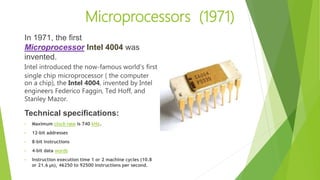
In 1971, the first
Microprocessor Intel 4004 was
invented.
Intel introduced the now-famous world's first
single chip microprocessor ( the computer
on a chip), the Intel 4004, invented by Intel
engineers Federico Faggin, Ted Hoff, and
Stanley Mazor.
Technical specifications:
• Maximum clock rate is 740 kHz.
• 12-bit addresses
• 8-bit instructions
• 4-bit data words
• Instruction execution time 1 or 2 machine cycles (10.8
or 21.6 µs), 46250 to 92500 instructions per second.
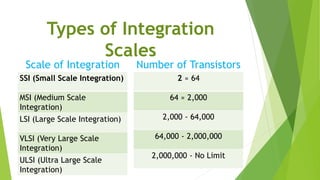
Types of Integration
Scales
Scale of Integration
SSI (Small Scale Integration)
MSI (Medium Scale
Integration)
LSI (Large Scale Integration)
VLSI (Very Large Scale
Integration)
ULSI (Ultra Large Scale
Integration)
Number of Transistors
2 ≈ 64
64 ≈ 2,000
2,000 - 64,000
64,000 - 2,000,000
2,000,000 - No Limit
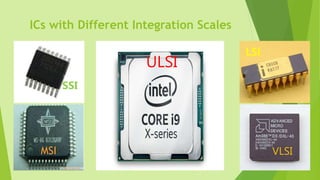
ICs with Different Integration Scales
ULSI
VLSI
LSI
MSI
SSI

Third Generation of Computers

  • 1.
    1st Generation Computer Thefirst computer systems used vacuum tubes for circuitry and magnetic drums for memory, and were often enormous, taking up entire rooms. These computers were very expensive to operate and in addition to using a great deal of electricity, the first computers generated a lot of heat, which was often the cause of malfunctions. First generation computers relied on machine language, the lowest-level programming language understood by computers, to perform operations, and they could only solve one problem at a time. It would take operators days or even weeks to set-up a new problem. Input was based on punched cards and paper tape, and output was displayed on printouts. The UNIVAC and ENIAC computers are examples of first-generation computing devices. The UNIVAC was the first commercial computer delivered to a business client, the U.S. Census Bureau in 1951.
  • 2.
    First Generation: VacuumTubes (1940-1956) An electronic device that controls the flow of electrons in a vacuum. It is used as a switch, amplifier or display screen (CRT). Used as on/off switches, vacuum tubes allowed the first computers to perform digital computations. A vacuum tube triode is a transconductance device; a voltage controls a current. Essentially, within a vacuum bulb, a cathode is heated (directly or indirectly) such that electrons are 'boiled' off (thermionic emission). The electrons flow from the plate through the battery to the cathode and a current is established.
  • 3.
    Second Generation Computers Characteristicsof Second Generation of Computers: • Use of transistors. • Magnetic memory and magnetic storage disks. • High speed I/O devices. • Invention and use of high level languages such as Fortran and Cobol. • Reduced size. • Solution to heat generation. • Communication by using telephone line. • Improvement of speed and reliability.
  • 4.
    Second Generation: Transistors(1956-1963) The transistor was successfully demonstrated on December 23, 1947 at Bell Laboratories in Murray Hill, New Jersey. Bell Labs is the research arm of American Telephone and Telegraph (AT&T). The three individuals credited with the invention of the transistor were William Shockley, John Bardeen and Walter Brattain. A transistor is an electronic component that can be used as an amplifier, or as a switch. It is made of a semiconductor material. Transistors are found in most electronic devices. A transistor has three connectors or terminals. In the older bipolar transistor they are the collector, the emitter, and the base.
  • 5.
    Third Generation Computers TheComputers of third generation used Integrated Circuits (ICs) in place of transistors. A single IC has many transistors, resistors, and capacitors along with the associated circuitry. The IC was invented by Jack Kilby. This development made computers smaller in size, reliable, and efficient.
  • 6.
    Characteristics of Third Generationcomputers: • Integrated circuits instead of individual transistors • Smaller, cheaper, more efficient and faster than second generation computers • High-level programming languages • Magnetic storage • Semiconductor Memories • Introduction of Microprogramming • Parallel Processing • Multiprocessing • OS allowed the Machine to run many Applications
  • 7.
    Integrated Circuit (IC) JackKilby of Texas Instruments made this first integrated circuit, in 1958. The idea occurred to a number of inventors at the same time, but the first to accomplish it were Jack Kilby of Texas Instruments and Robert Noyce of Fairchild Semiconductor Incorporated. An integrated circuit, or IC, is small chip that can function as an amplifier, oscillator, timer, microprocessor, or even computer memory. An IC is a small wafer, usually made of silicon, that can hold anywhere from hundreds to millions of transistors. Integrated circuits (ICs) are self-contained circuits with many separate components such as transistors, diodes, resistors and capacitors etched into a tiny silicon chipsistors, resistors, and capacitors. 1958 1964
  • 8.
    Microprocessors (1971) In 1971,the first Microprocessor Intel 4004 was invented. Intel introduced the now-famous world's first single chip microprocessor ( the computer on a chip), the Intel 4004, invented by Intel engineers Federico Faggin, Ted Hoff, and Stanley Mazor. Technical specifications: • Maximum clock rate is 740 kHz. • 12-bit addresses • 8-bit instructions • 4-bit data words • Instruction execution time 1 or 2 machine cycles (10.8 or 21.6 µs), 46250 to 92500 instructions per second.
  • 9.
    Types of Integration Scales Scaleof Integration SSI (Small Scale Integration) MSI (Medium Scale Integration) LSI (Large Scale Integration) VLSI (Very Large Scale Integration) ULSI (Ultra Large Scale Integration) Number of Transistors 2 ≈ 64 64 ≈ 2,000 2,000 - 64,000 64,000 - 2,000,000 2,000,000 - No Limit
  • 10.
    ICs with DifferentIntegration Scales ULSI VLSI LSI MSI SSI