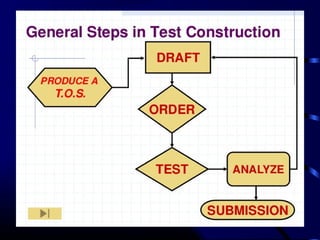
The Road
To
Test Construction
K toK to
1212Basic Education ProgramBasic Education Program
“The ultimate purpose of Test
Construction is to improve the
educational program of the school and
to make it more effective. Thus, it
should be considered as an essential
part of the complete learning process
for the improvement of teaching and
learning.”
FE S. J. HIDALGO
K toK to
1212Basic Education ProgramBasic Education Program
OBJECTIVES
• Identify the six cognitive domains of
learning.
• Discuss the features of the six domains of
learning.
• Construct test items that are congruent to
the objectives and learning outcomes.
K toK to
1212Basic Education ProgramBasic Education Program
PRIMING
“The evaluation of the 21st
century learners’
progress is a major aspect of the teacher’s job .”
- Evaluating Educational Outcomes.-
Oriondo & Antonio
To be able to prepare a good test, one has to
have
 a mastery of the subject
matter,
 knowledge of the students to
be tested,
skill in verbal expression and
the use of the different test
format.
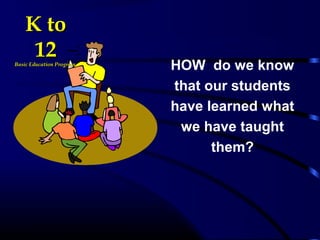
HOW do we know
that our students
have learned what
we have taught
them?
K toK to
1212Basic Education ProgramBasic Education Program
K toK to
1212Basic Education ProgramBasic Education Program
ACTIVITY 1
Act It Out
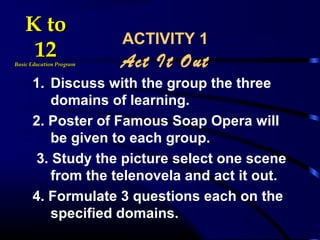
1. Discuss with the group the three
domains of learning.
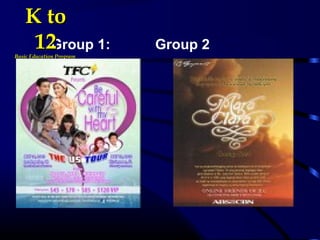
2. Poster of Famous Soap Opera will
be given to each group.
3. Study the picture select one scene
from the telenovela and act it out.
4. Formulate 3 questions each on the
specified domains.
K toK to
1212Basic Education ProgramBasic Education Program
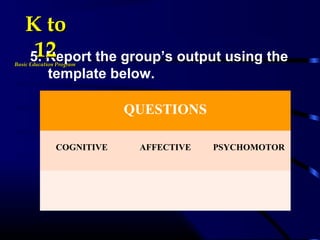
5. Report the group’s output using the
template below.
K toK to
1212Basic Education ProgramBasic Education Program
QUESTIONS
COGNITIVE AFFECTIVE PSYCHOMOTOR
Group 1: Group 2
K toK to
1212Basic Education ProgramBasic Education Program
Group 3: Group 4
K toK to
1212Basic Education ProgramBasic Education Program
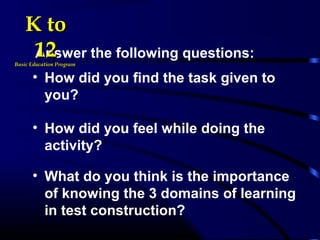
Answer the following questions:
• How did you find the task given to
you?
• How did you feel while doing the
activity?
• What do you think is the importance
of knowing the 3 domains of learning
in test construction?
K toK to
1212Basic Education ProgramBasic Education Program
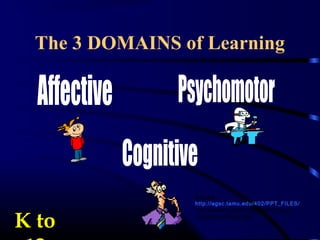
The 3 DOMAINS of Learning
Source :
http://agsc.tamu.edu/402/PPT_FILES/
TAXONOMY%20OF%20EDUCATIONAL
%20OBJECTIVES2.ppt
K toK to
• EMOTIONAL LEARNING: FEELING
Concerned with attitudes,
appreciations, interests, values and
adjustments.
AFFECTIVE DOMAIN
K toK to
• PHYSICAL LEARNING: DOING
Emphasizes speed, accuracy, dexterity, and
physical skills
PSYCHOMOTOR DOMAIN
K toK to
• Often referred to as Instructional or Behavioral
Objectives
• One of the major categories in the Taxonomy of
Educational Objectives
• Most used of the domains
COGNITIVE DOMAIN
K toK to
ACTIVITY 2
1. Examine the list of learning
competencies in all grading period.
2. Select five least mastered
competencies in each grading
period.
3. Construct 20 test items based on the
selected least mastered
competencies.
K toK to
1212Basic Education ProgramBasic Education Program
4. Categorized the questions into six
cognitive levels.
5. Post your work in the designated
corners.
6. Presentation of group output.
K toK to
1212Basic Education ProgramBasic Education Program
1. How do you find the task given to you?
2. How did you feel when you categorized the test
questions into 6 cognitive domains?
3. What helped you in classifying the test questions?
4. In cases where the classification/clustering of test items
was not the same as your team mates, how did you
resolve the situation?
5. Did you encounter difficulty in constructing test items
that reflects the 6 cognitive domains? Why?
6. What are the issues and concerns that you have in
constructing test items?
  K toK to
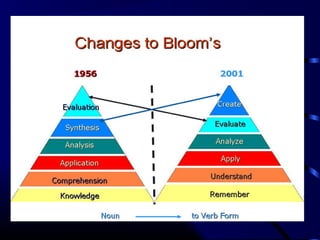
• Created hierarchy of cognitive skills that is
often used to categorize the levels of
cognitive involvement (thinking skills).
• Arranged in hierarchical form, moving from
the lowest level of cognition (thinking) to
the highest level of cognition (or from the
least complex to the most complex):
Bloom’s Taxonomy
K toK to
1212Basic Education ProgramBasic Education Program
• Provide structure to assist teachers in
writing objectives and assessments.
• Assist teachers in recognizing the various
levels of question asking.
• Serves as guide in constructing test
questions that will develop the learner’s
intellectual abilities and critical thinking.
K toK to
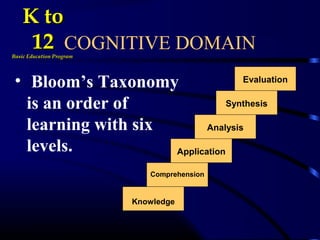
• Bloom’s Taxonomy
is an order of
learning with six
levels.
COGNITIVE DOMAIN
Knowledge
Evaluation
Synthesis
Analysis
Application
Comprehension
K toK to
1212Basic Education ProgramBasic Education Program
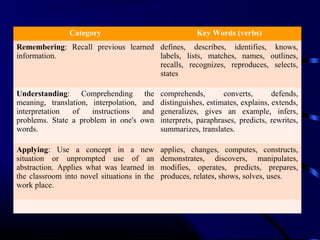
Category Key Words (verbs)
Remembering: Recall previous learned
information.
defines, describes, identifies, knows,
labels, lists, matches, names, outlines,
recalls, recognizes, reproduces, selects,
states
Understanding: Comprehending the
meaning, translation, interpolation, and
interpretation of instructions and
problems. State a problem in one's own
words.
comprehends, converts, defends,
distinguishes, estimates, explains, extends,
generalizes, gives an example, infers,
interprets, paraphrases, predicts, rewrites,
summarizes, translates.
Applying: Use a concept in a new
situation or unprompted use of an
abstraction. Applies what was learned in
the classroom into novel situations in the
work place.
applies, changes, computes, constructs,
demonstrates, discovers, manipulates,
modifies, operates, predicts, prepares,
produces, relates, shows, solves, uses.
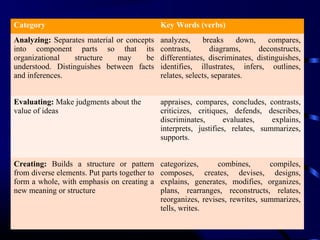
Category Key Words (verbs)
Analyzing: Separates material or concepts
into component parts so that its
organizational structure may be
understood. Distinguishes between facts
and inferences.
analyzes, breaks down, compares,
contrasts, diagrams, deconstructs,
differentiates, discriminates, distinguishes,
identifies, illustrates, infers, outlines,
relates, selects, separates.
Evaluating: Make judgments about the
value of ideas
appraises, compares, concludes, contrasts,
criticizes, critiques, defends, describes,
discriminates, evaluates, explains,
interprets, justifies, relates, summarizes,
supports.
Creating: Builds a structure or pattern
from diverse elements. Put parts together to
form a whole, with emphasis on creating a
new meaning or structure
categorizes, combines, compiles,
composes, creates, devises, designs,
explains, generates, modifies, organizes,
plans, rearranges, reconstructs, relates,
reorganizes, revises, rewrites, summarizes,
tells, writes.
TEST CONSTRUCTION
K toK to
1212Basic Education ProgramBasic Education Program
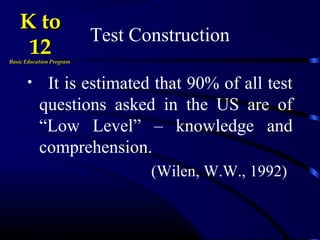
• It is estimated that 90% of all test
questions asked in the US are of
“Low Level” – knowledge and
comprehension.
(Wilen, W.W., 1992)
Test Construction
K toK to
1212Basic Education ProgramBasic Education Program
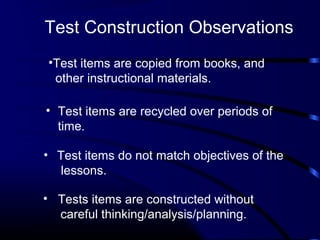
Test Construction Observations
• Test items are recycled over periods of
time.
•Test items are copied from books, and
other instructional materials.
• Test items do not match objectives of the
lessons.
• Tests items are constructed without
careful thinking/analysis/planning.
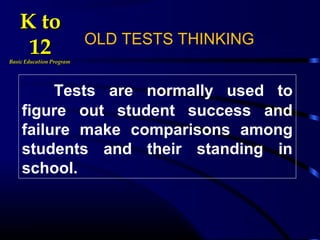
OLD TESTS THINKING
Tests are normally used to
figure out student success and
failure make comparisons among
students and their standing in
school.
K toK to
1212Basic Education ProgramBasic Education Program
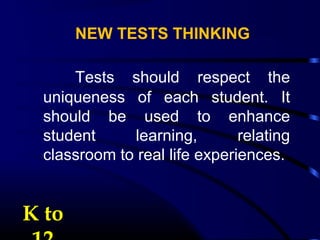
NEW TESTS THINKING
Tests should respect the
uniqueness of each student. It
should be used to enhance
student learning, relating
classroom to real life experiences.
K toK to
K toK to
K toK to
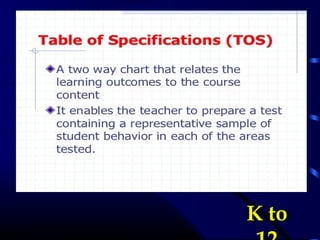
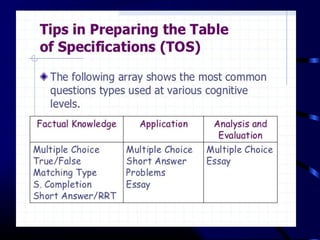
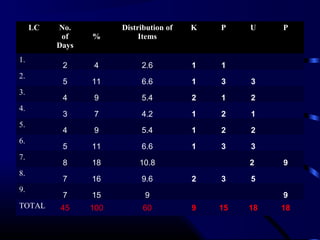
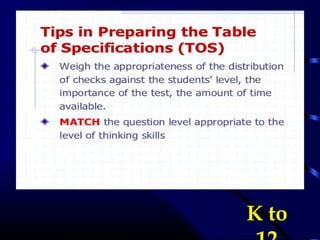
TABLE OF SPECIFICATIONS
K toK to
1212Basic Education ProgramBasic Education Program
K toK to
When to construct TOS?
• The TOS should be done before
constructing the test but it is ideal to
construct it before the instruction begins to
ensure that the test has instructional
validity.
K toK to
LC No.
of
Days
%
Distribution of
Items
K P U P
1.
2 4 2.6 1 1    
2.
5 11 6.6 1 3 3  
3.
4 9 5.4 2 1 2  
4.
3 7 4.2 1 2 1  
5.
4 9 5.4 1 2 2  
6.
5 11 6.6 1 3 3  
7.
8 18 10.8     2  9
8.
7 16 9.6 2 3 5  
9.
7 15 9       9
TOTAL 45 100 60 9 15 18 18
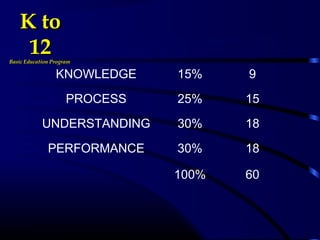
KNOWLEDGE 15% 9
PROCESS 25% 15
UNDERSTANDING 30% 18
PERFORMANCE 30% 18
  100% 60
K toK to
1212Basic Education ProgramBasic Education Program
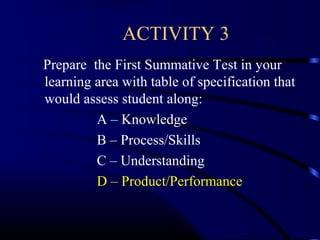
ACTIVITY 3
Prepare the First Summative Test in your
learning area with table of specification that
would assess student along:
A – Knowledge
B – Process/Skills
C – Understanding
D – Product/Performance
Reflection:
• How would your learning on constructing
effective test items help you as a Master
Teacher?
• How would it help your students and the
school?
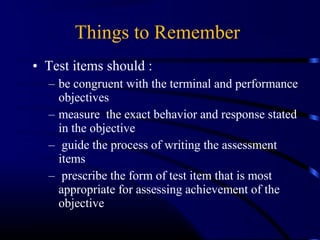
• Test items should :
– be congruent with the terminal and performance
objectives
– measure the exact behavior and response stated
in the objective
– guide the process of writing the assessment
items
– prescribe the form of test item that is most
appropriate for assessing achievement of the
objective
Things to Remember:
CLOSURE
1. Watch the  video presentation entitled, “Leader
2. How  will  you  show  your  concern  to  the 
teachers  in  addressing  their  needs  in 
terms  of  assessment  and  test 
construction? 
Teacher?
Thank You !

Session 2 test construction.mt's

  • 1.
    The Road To Test Construction KtoK to 1212Basic Education ProgramBasic Education Program
  • 2.
    “The ultimate purposeof Test Construction is to improve the educational program of the school and to make it more effective. Thus, it should be considered as an essential part of the complete learning process for the improvement of teaching and learning.” FE S. J. HIDALGO K toK to 1212Basic Education ProgramBasic Education Program
  • 3.
    OBJECTIVES • Identify thesix cognitive domains of learning. • Discuss the features of the six domains of learning. • Construct test items that are congruent to the objectives and learning outcomes. K toK to 1212Basic Education ProgramBasic Education Program
  • 4.
    PRIMING “The evaluation ofthe 21st century learners’ progress is a major aspect of the teacher’s job .” - Evaluating Educational Outcomes.- Oriondo & Antonio
  • 5.
    To be ableto prepare a good test, one has to have  a mastery of the subject matter,  knowledge of the students to be tested, skill in verbal expression and the use of the different test format.
  • 6.
    HOW do weknow that our students have learned what we have taught them? K toK to 1212Basic Education ProgramBasic Education Program
  • 7.
    K toK to 1212BasicEducation ProgramBasic Education Program
  • 8.
    ACTIVITY 1 Act ItOut 1. Discuss with the group the three domains of learning. 2. Poster of Famous Soap Opera will be given to each group. 3. Study the picture select one scene from the telenovela and act it out. 4. Formulate 3 questions each on the specified domains. K toK to 1212Basic Education ProgramBasic Education Program
  • 9.
    5. Report thegroup’s output using the template below. K toK to 1212Basic Education ProgramBasic Education Program QUESTIONS COGNITIVE AFFECTIVE PSYCHOMOTOR
  • 10.
    Group 1: Group2 K toK to 1212Basic Education ProgramBasic Education Program
  • 11.
    Group 3: Group4 K toK to 1212Basic Education ProgramBasic Education Program
  • 12.
    Answer the followingquestions: • How did you find the task given to you? • How did you feel while doing the activity? • What do you think is the importance of knowing the 3 domains of learning in test construction? K toK to 1212Basic Education ProgramBasic Education Program
  • 13.
    The 3 DOMAINSof Learning Source : http://agsc.tamu.edu/402/PPT_FILES/ TAXONOMY%20OF%20EDUCATIONAL %20OBJECTIVES2.ppt K toK to
  • 14.
    • EMOTIONAL LEARNING:FEELING Concerned with attitudes, appreciations, interests, values and adjustments. AFFECTIVE DOMAIN K toK to
  • 15.
    • PHYSICAL LEARNING:DOING Emphasizes speed, accuracy, dexterity, and physical skills PSYCHOMOTOR DOMAIN K toK to
  • 16.
    • Often referredto as Instructional or Behavioral Objectives • One of the major categories in the Taxonomy of Educational Objectives • Most used of the domains COGNITIVE DOMAIN K toK to
  • 17.
    ACTIVITY 2 1. Examinethe list of learning competencies in all grading period. 2. Select five least mastered competencies in each grading period. 3. Construct 20 test items based on the selected least mastered competencies. K toK to 1212Basic Education ProgramBasic Education Program
  • 18.
    4. Categorized thequestions into six cognitive levels. 5. Post your work in the designated corners. 6. Presentation of group output. K toK to 1212Basic Education ProgramBasic Education Program
  • 19.
    1. How doyou find the task given to you? 2. How did you feel when you categorized the test questions into 6 cognitive domains? 3. What helped you in classifying the test questions? 4. In cases where the classification/clustering of test items was not the same as your team mates, how did you resolve the situation? 5. Did you encounter difficulty in constructing test items that reflects the 6 cognitive domains? Why? 6. What are the issues and concerns that you have in constructing test items?   K toK to
  • 20.
    • Created hierarchyof cognitive skills that is often used to categorize the levels of cognitive involvement (thinking skills). • Arranged in hierarchical form, moving from the lowest level of cognition (thinking) to the highest level of cognition (or from the least complex to the most complex): Bloom’s Taxonomy K toK to 1212Basic Education ProgramBasic Education Program
  • 21.
    • Provide structureto assist teachers in writing objectives and assessments. • Assist teachers in recognizing the various levels of question asking. • Serves as guide in constructing test questions that will develop the learner’s intellectual abilities and critical thinking. K toK to
  • 22.
    • Bloom’s Taxonomy isan order of learning with six levels. COGNITIVE DOMAIN Knowledge Evaluation Synthesis Analysis Application Comprehension K toK to 1212Basic Education ProgramBasic Education Program
  • 24.
    Category Key Words(verbs) Remembering: Recall previous learned information. defines, describes, identifies, knows, labels, lists, matches, names, outlines, recalls, recognizes, reproduces, selects, states Understanding: Comprehending the meaning, translation, interpolation, and interpretation of instructions and problems. State a problem in one's own words. comprehends, converts, defends, distinguishes, estimates, explains, extends, generalizes, gives an example, infers, interprets, paraphrases, predicts, rewrites, summarizes, translates. Applying: Use a concept in a new situation or unprompted use of an abstraction. Applies what was learned in the classroom into novel situations in the work place. applies, changes, computes, constructs, demonstrates, discovers, manipulates, modifies, operates, predicts, prepares, produces, relates, shows, solves, uses.
  • 25.
    Category Key Words(verbs) Analyzing: Separates material or concepts into component parts so that its organizational structure may be understood. Distinguishes between facts and inferences. analyzes, breaks down, compares, contrasts, diagrams, deconstructs, differentiates, discriminates, distinguishes, identifies, illustrates, infers, outlines, relates, selects, separates. Evaluating: Make judgments about the value of ideas appraises, compares, concludes, contrasts, criticizes, critiques, defends, describes, discriminates, evaluates, explains, interprets, justifies, relates, summarizes, supports. Creating: Builds a structure or pattern from diverse elements. Put parts together to form a whole, with emphasis on creating a new meaning or structure categorizes, combines, compiles, composes, creates, devises, designs, explains, generates, modifies, organizes, plans, rearranges, reconstructs, relates, reorganizes, revises, rewrites, summarizes, tells, writes.
  • 26.
    TEST CONSTRUCTION K toKto 1212Basic Education ProgramBasic Education Program
  • 27.
    • It isestimated that 90% of all test questions asked in the US are of “Low Level” – knowledge and comprehension. (Wilen, W.W., 1992) Test Construction K toK to 1212Basic Education ProgramBasic Education Program
  • 28.
    Test Construction Observations •Test items are recycled over periods of time. •Test items are copied from books, and other instructional materials. • Test items do not match objectives of the lessons. • Tests items are constructed without careful thinking/analysis/planning.
  • 29.
    OLD TESTS THINKING Testsare normally used to figure out student success and failure make comparisons among students and their standing in school. K toK to 1212Basic Education ProgramBasic Education Program
  • 30.
    NEW TESTS THINKING Testsshould respect the uniqueness of each student. It should be used to enhance student learning, relating classroom to real life experiences. K toK to
  • 32.
  • 33.
  • 35.
    TABLE OF SPECIFICATIONS KtoK to 1212Basic Education ProgramBasic Education Program
  • 36.
  • 37.
    When to constructTOS? • The TOS should be done before constructing the test but it is ideal to construct it before the instruction begins to ensure that the test has instructional validity.
  • 38.
  • 40.
    LC No. of Days % Distribution of Items KP U P 1. 2 4 2.6 1 1     2. 5 11 6.6 1 3 3   3. 4 9 5.4 2 1 2   4. 3 7 4.2 1 2 1   5. 4 9 5.4 1 2 2   6. 5 11 6.6 1 3 3   7. 8 18 10.8     2  9 8. 7 16 9.6 2 3 5   9. 7 15 9       9 TOTAL 45 100 60 9 15 18 18
  • 41.
    KNOWLEDGE 15% 9 PROCESS25% 15 UNDERSTANDING 30% 18 PERFORMANCE 30% 18   100% 60 K toK to 1212Basic Education ProgramBasic Education Program
  • 42.
    ACTIVITY 3 Prepare theFirst Summative Test in your learning area with table of specification that would assess student along: A – Knowledge B – Process/Skills C – Understanding D – Product/Performance
  • 43.
    Reflection: • How wouldyour learning on constructing effective test items help you as a Master Teacher? • How would it help your students and the school?
  • 46.
    • Test itemsshould : – be congruent with the terminal and performance objectives – measure the exact behavior and response stated in the objective – guide the process of writing the assessment items – prescribe the form of test item that is most appropriate for assessing achievement of the objective Things to Remember:
  • 48.
    CLOSURE 1. Watch the  video presentation entitled, “Leader 2. How will  you  show  your  concern  to  the  teachers  in  addressing  their  needs  in  terms  of  assessment  and  test  construction?  Teacher?
  • 49.