March 13, 2017 1
INTRODUCTION TO COMPUTER
GENERATIONS OF COMPUTER
HISTORY OF COMPUTER
TYPES OF COMPUTER
BY MUKHTIAR & ROSHAN ALI
March 13, 2017 2
March 13, 2017 3
LOGO
GOVT:PG JAHANZEB COLLEGE SAIDU-SHARIF SWAT
PRESENTATION TOPIC:
COMPUTER GENERATIONS
HISTORY OF COMPUTER
TYPES OF COMPUTER
SCRIPTED BY: FROM GROUP A
MUKHTIAR CLASS NO:-20
ROSHAN ALI CLASS NO:-24
SUMBMITTED TO SIR: NAJIBULLAH SB
DEPARTMENT:ZOOLOGY 3RD SEMESTER
DATE:4/1/2016
C:UsersROSHANALIDesktopCOMPUTER
GENERATIONSSSSSSSSSSS.lnk
March 13, 2017 4
1
2
3
COMPUTER
NTS OF PRSENTAION TOPIC
•COMPUTER GENERATION
•TYPES OF COMPUTER
•HISTORY OF COMPUTER
March 13, 2017 5
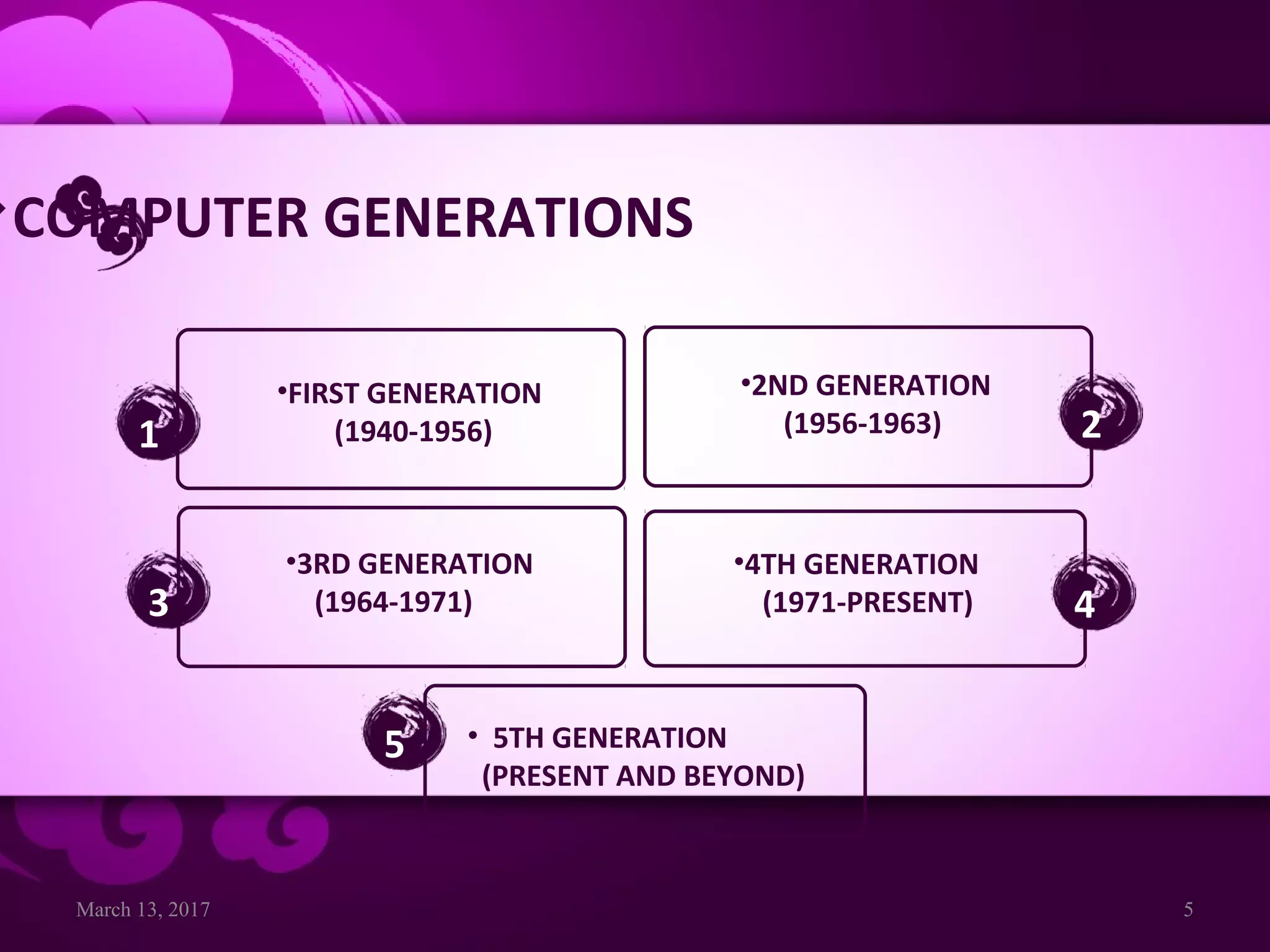
COMPUTER GENERATIONS
•2ND GENERATION
(1956-1963)
•FIRST GENERATION
(1940-1956)
•4TH GENERATION
(1971-PRESENT)
•3RD GENERATION
(1964-1971)
1 2
3 4
• 5TH GENERATION
(PRESENT AND BEYOND)
5
March 13, 2017 6
.
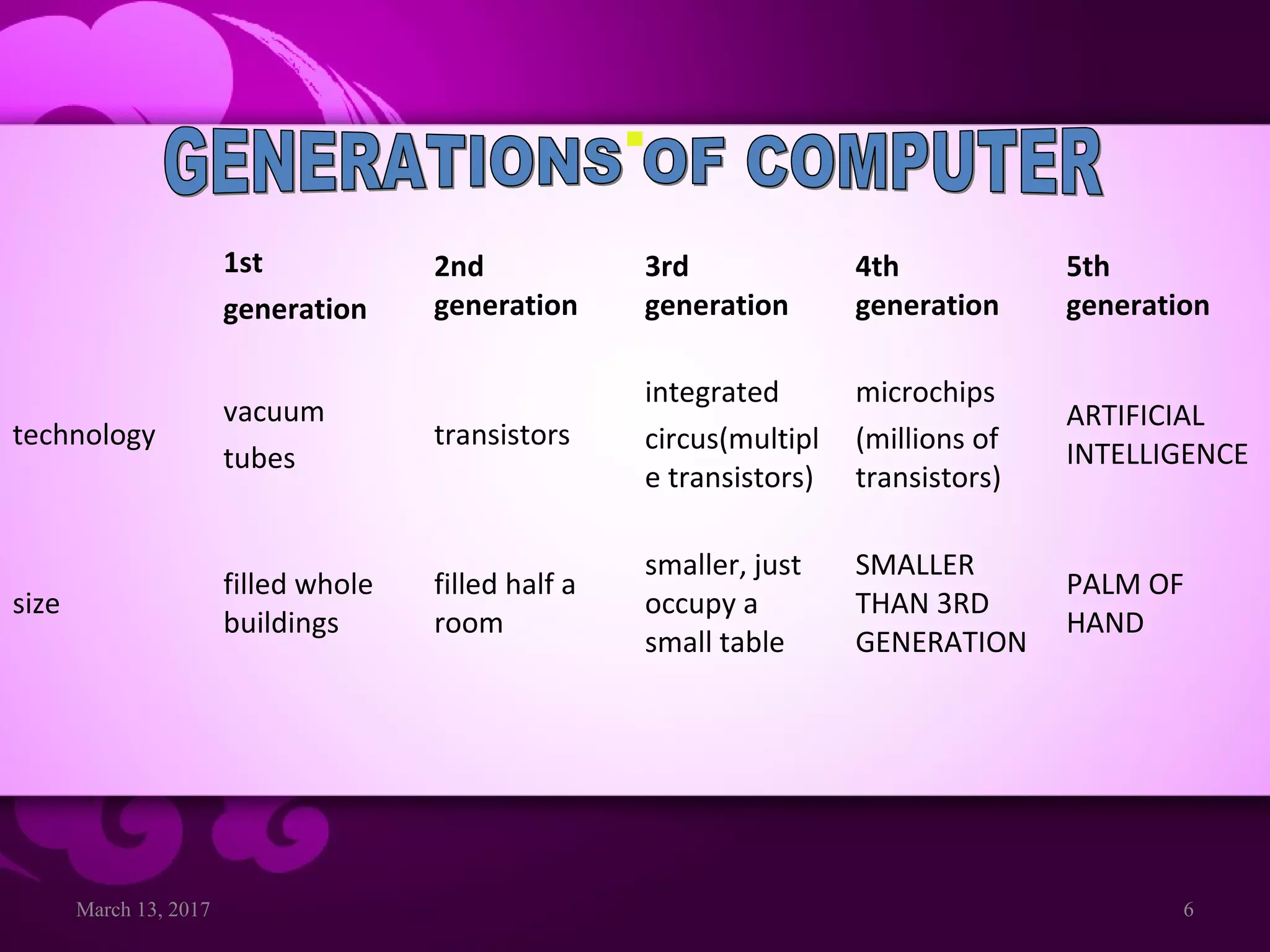
1st
generation
2nd
generation
3rd
generation
4th
generation
5th
generation
technology
vacuum
tubes
transistors
integrated
circus(multipl
e transistors)
microchips
(millions of
transistors)
ARTIFICIAL
INTELLIGENCE
size
filled whole
buildings
filled half a
room
smaller, just
occupy a
small table
SMALLER
THAN 3RD
GENERATION
PALM OF
HAND
March 13, 2017 7
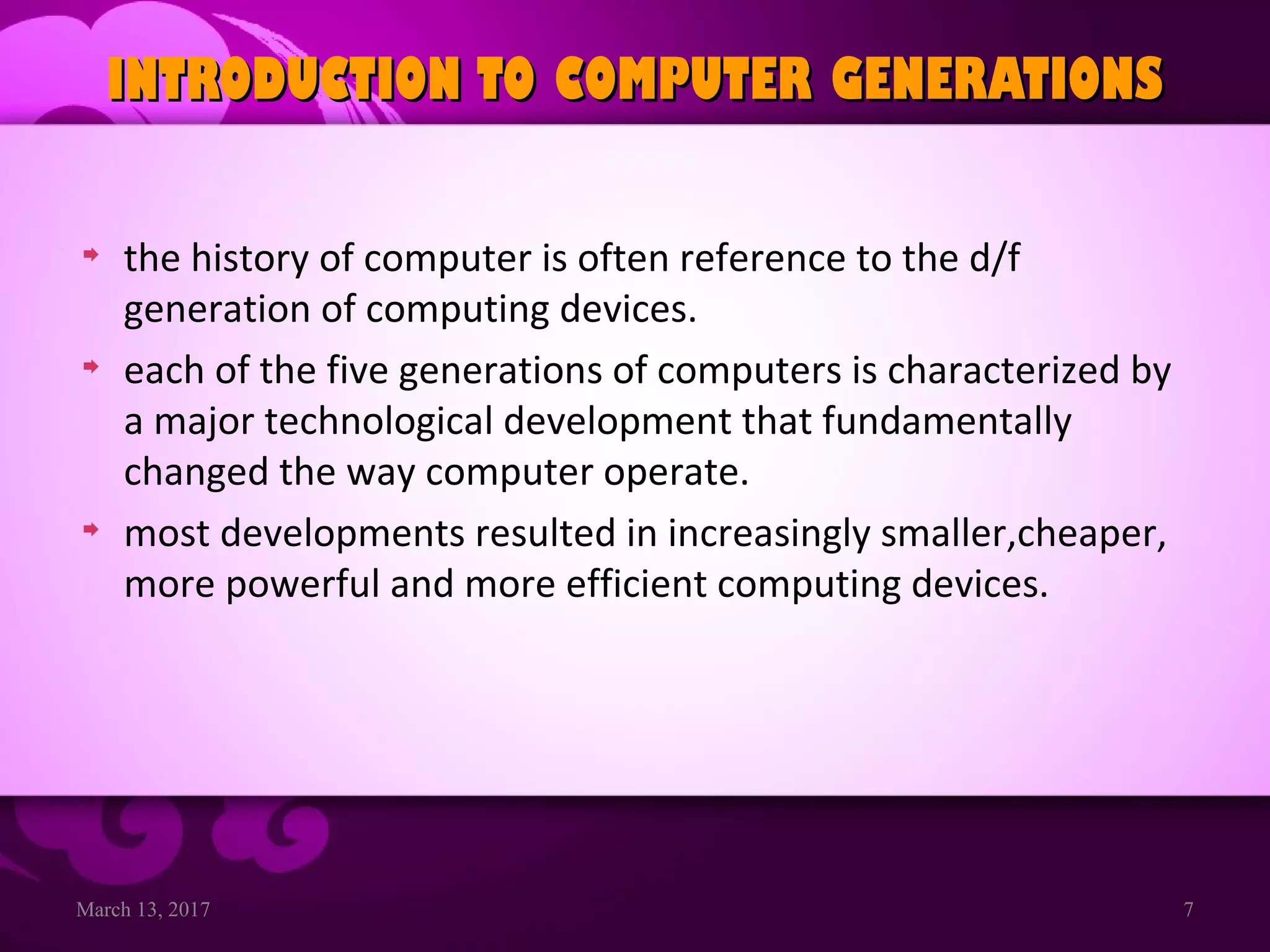
INTRODUCTION TO COMPUTER GENERATIONSINTRODUCTION TO COMPUTER GENERATIONS
the history of computer is often reference to the d/f
generation of computing devices.
each of the five generations of computers is characterized by
a major technological development that fundamentally
changed the way computer operate.
most developments resulted in increasingly smaller,cheaper,
more powerful and more efficient computing devices.
March 13, 2017 8
FIRST GENERATION COMPUTERSFIRST GENERATION COMPUTERS
(1940-1956)(1940-1956)
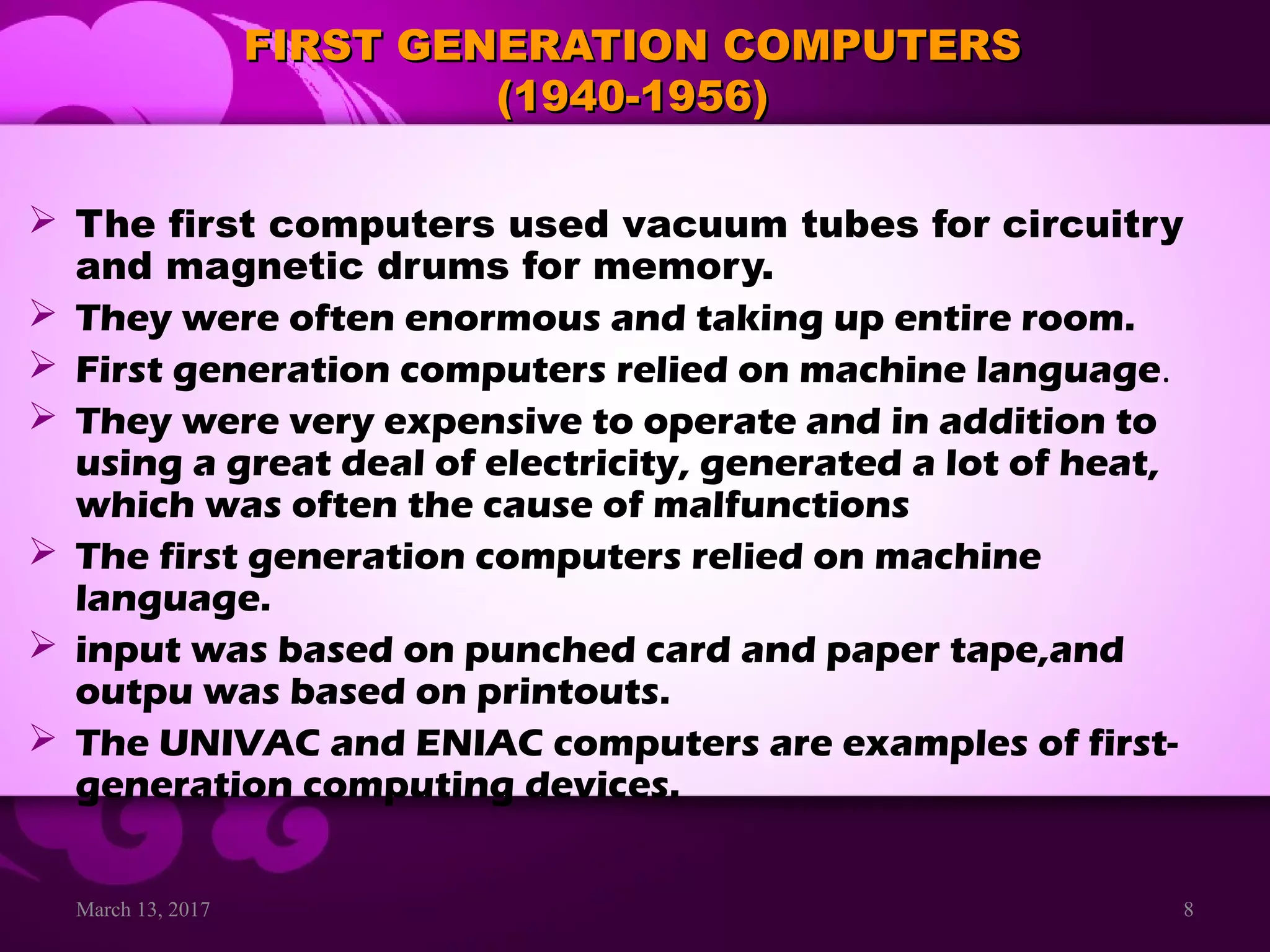
 The first computers used vacuum tubes for circuitry
and magnetic drums for memory.
 They were often enormous and taking up entire room.
 First generation computers relied on machine language.
 They were very expensive to operate and in addition to
using a great deal of electricity, generated a lot of heat,
which was often the cause of malfunctions
 The first generation computers relied on machine
language.
 input was based on punched card and paper tape,and
outpu was based on printouts.
 The UNIVAC and ENIAC computers are examples of first-
generation computing devices.
March 13, 2017 9
.
univac tube boardunivac tube board
individual vacuum tubeindividual vacuum tube
March 13, 2017 10
2ND GENERATION COMPUTERS
(1956-1963)
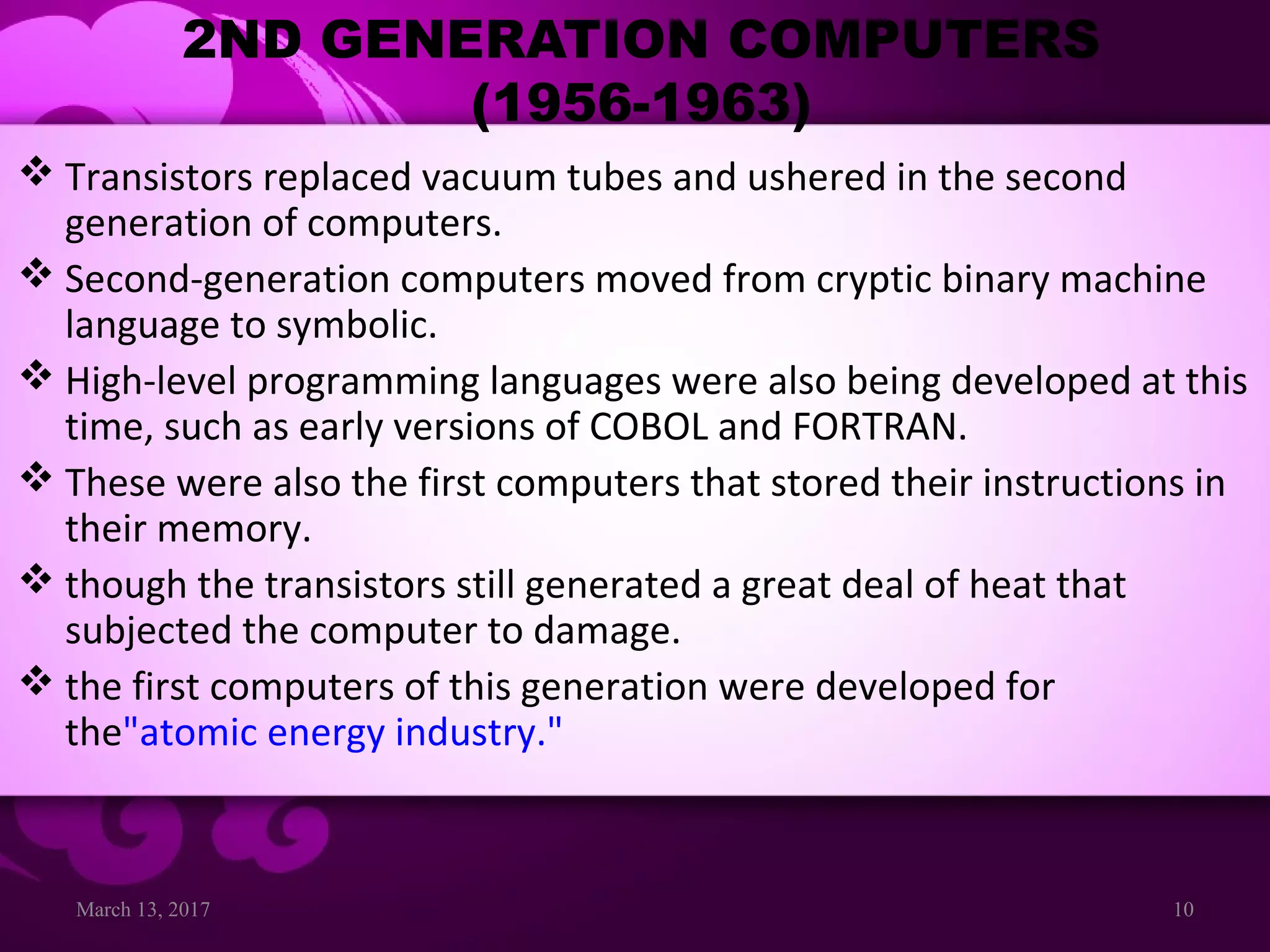
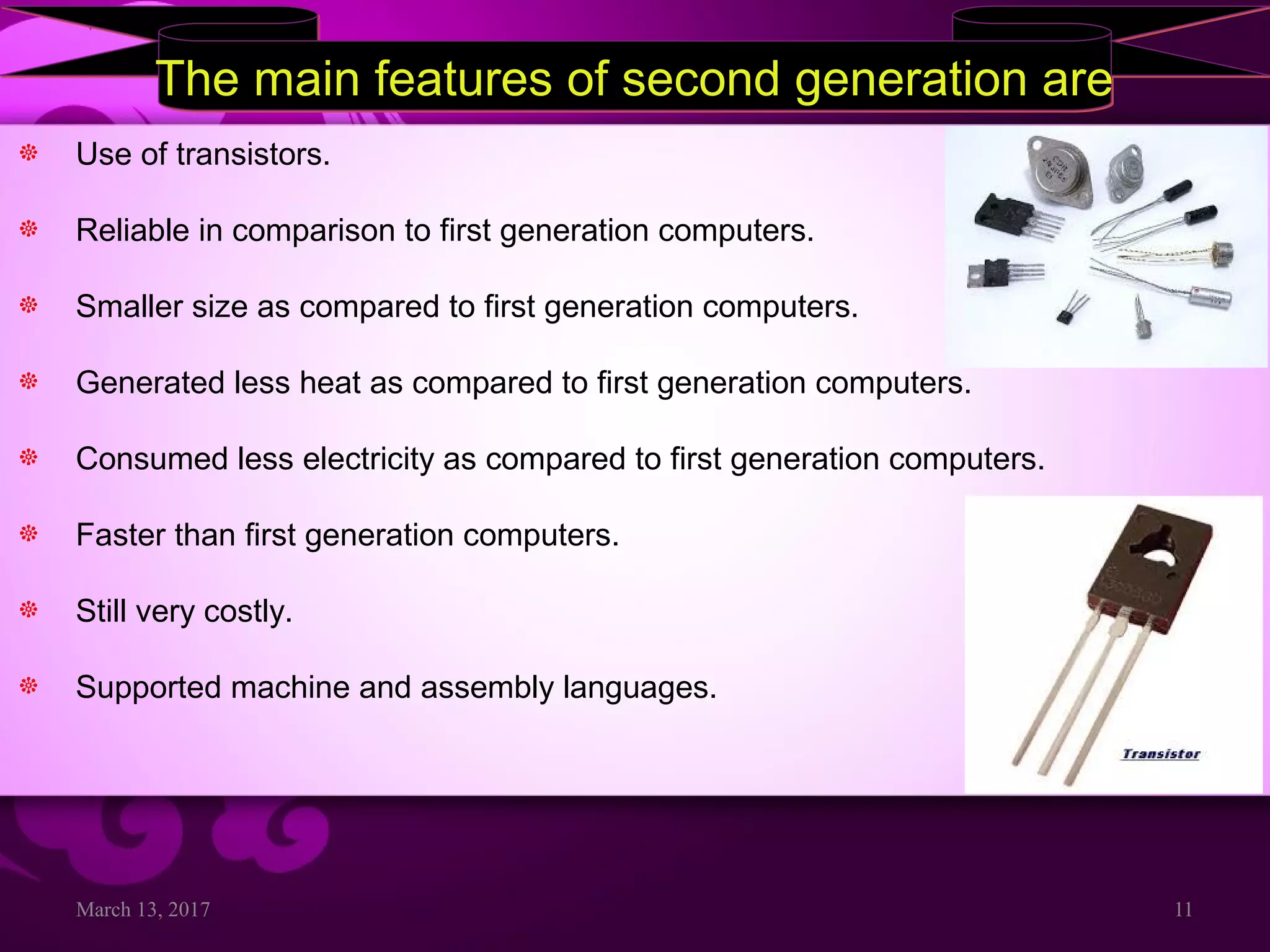
 Transistors replaced vacuum tubes and ushered in the second
generation of computers.
 Second-generation computers moved from cryptic binary machine
language to symbolic.
 High-level programming languages were also being developed at this
time, such as early versions of COBOL and FORTRAN.
 These were also the first computers that stored their instructions in
their memory.
 though the transistors still generated a great deal of heat that
subjected the computer to damage.
 the first computers of this generation were developed for
the"atomic energy industry."
March 13, 2017 11
The main features of second generation areThe main features of second generation are
Use of transistors.
Reliable in comparison to first generation computers.
Smaller size as compared to first generation computers.
Generated less heat as compared to first generation computers.
Consumed less electricity as compared to first generation computers.
Faster than first generation computers.
Still very costly.
Supported machine and assembly languages.
March 13, 2017 12
IBM 1620
IBM 7094
CDC 1604
CDC 3600
UNIVAC 1108
SOME COMPUTERS OF THIS GENERATION
WERE:-
March 13, 2017 13
THIRD GENERATION COMPUTERS
1965-1971
THIRD GENERATION COMPUTERS
1965-1971
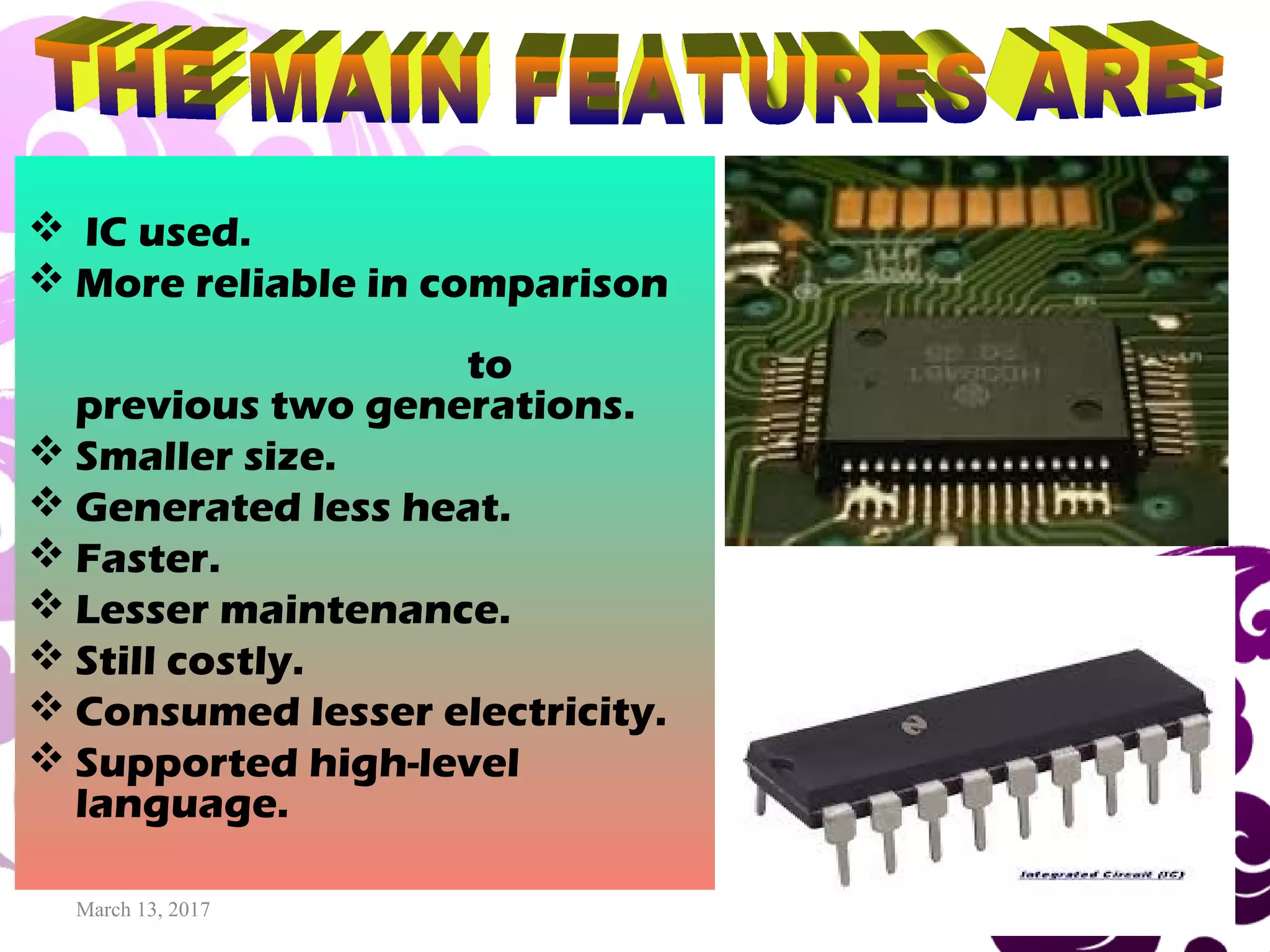
The computers of third generation used
integrated circuits (IC's) in place of
transistors. A single IC has many
transistors, resistors and capacitors
along with the associated circuitry. The
IC was invented by Jack Kilby. This
development made computers smaller
in size, reliable and efficient. In this
generation remote processing, time-
sharing, multi-programming operating
system were used. High-level
languages (FORTRAN-II TO IV, COBOL,
PASCAL PL/1, BASIC, ALGOL-68 etc.)
were used during this generation.
The computers of third generation used
integrated circuits (IC's) in place of
transistors. A single IC has many
transistors, resistors and capacitors
along with the associated circuitry. The
IC was invented by Jack Kilby. This
development made computers smaller
in size, reliable and efficient. In this
generation remote processing, time-
sharing, multi-programming operating
system were used. High-level
languages (FORTRAN-II TO IV, COBOL,
PASCAL PL/1, BASIC, ALGOL-68 etc.)
were used during this generation.
March 13, 2017 14
 IC used.
 More reliable in comparison
to
previous two generations.
 Smaller size.
 Generated less heat.
 Faster.
 Lesser maintenance.
 Still costly.
 Consumed lesser electricity.
 Supported high-level
language.
March 13, 2017 15
Some computers of this generation were:
 IBM-360 series
 Honeywell-6000 series
 PDP(Personal Data Processor)
 IBM-370/168
 TDC-316
March 13, 2017 16
4TH GENERATION COMPUTERS
1971-1980
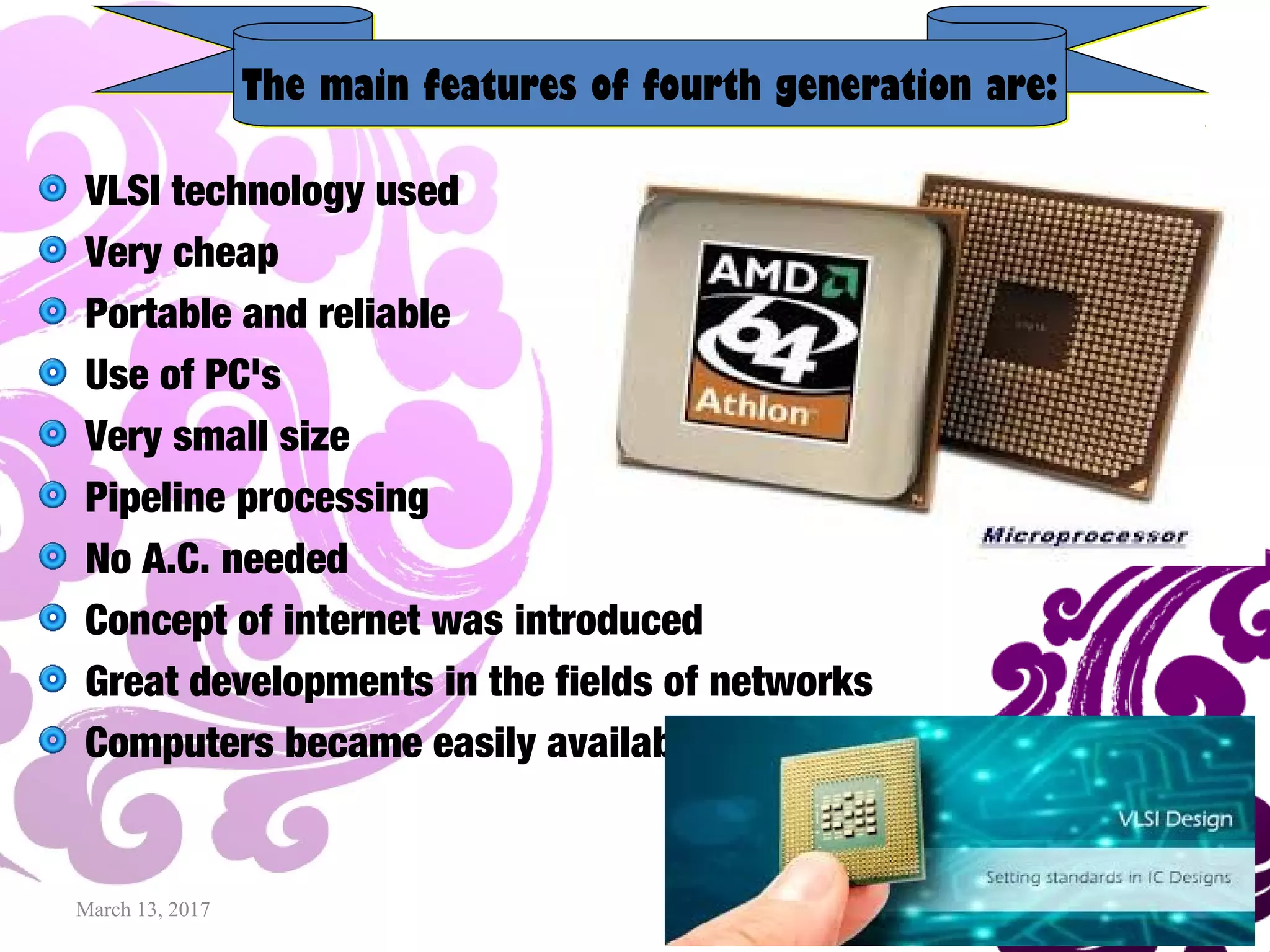
 The computers of fourth generation
used Very Large Scale Integrated (VLSI)
circuits. VLSI circuits having about 5000
transistors and other circuit elements
and their associated circuits on a single
chip made it possible to have
microcomputers of fourth generation.
 Fourth generation computers became
more powerful, compact, reliable, and
affordable. As a result, it gave rise to
personal computer (PC) revolution.
 IN this generation time sharing, real
time, networks, distributed operating
system were used. All the high-level
languages like C, C++, DBASE etc., were
used in this generation.
March 13, 2017 17
VLSI technology used
Very cheap
Portable and reliable
Use of PC's
Very small size
Pipeline processing
No A.C. needed
Concept of internet was introduced
Great developments in the fields of networks
Computers became easily available
The main features of fourth generation are:The main features of fourth generation are:
March 13, 2017 18
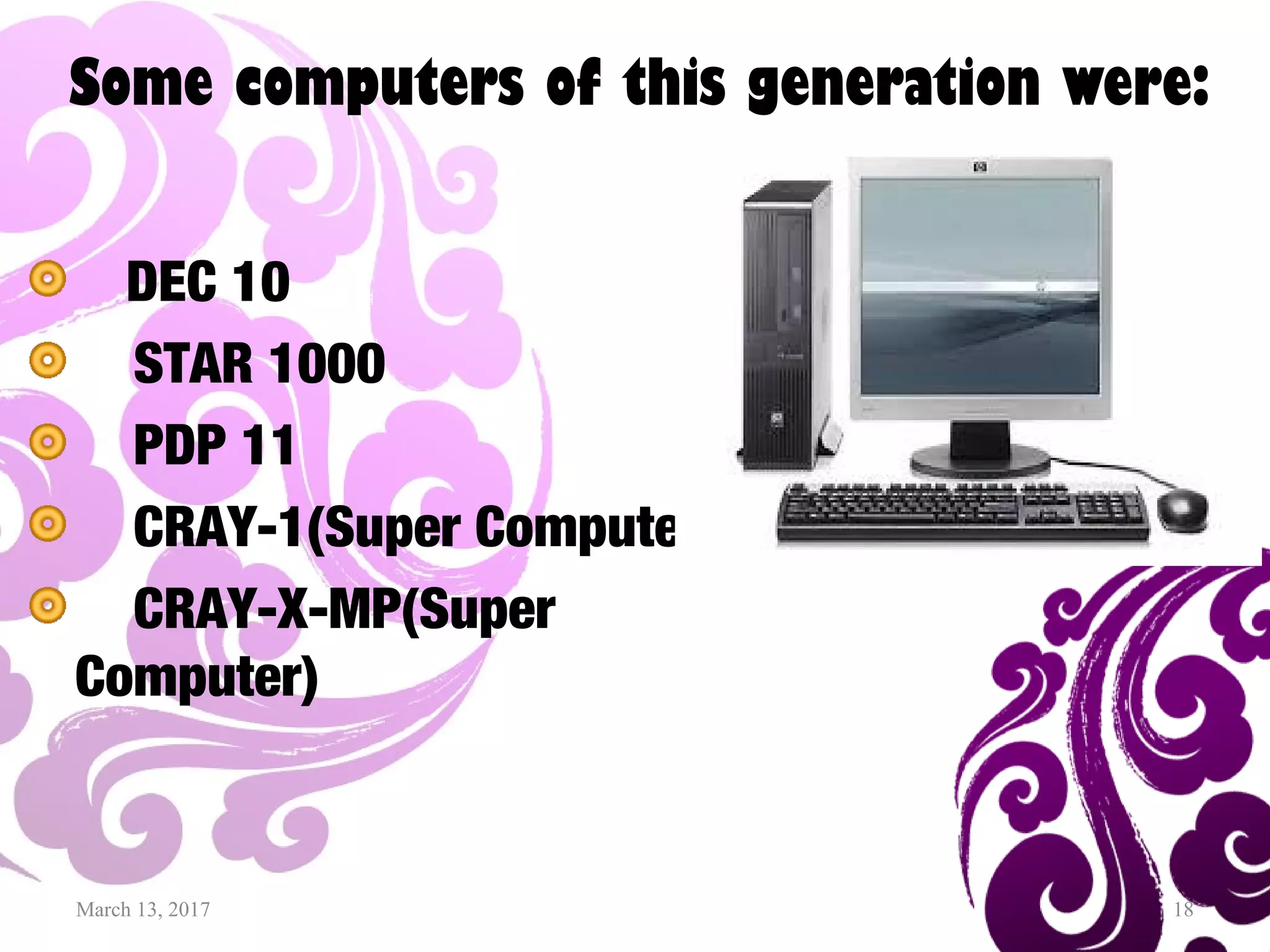
Some computers of this generation were:
DEC 10
STAR 1000
PDP 11
CRAY-1(Super Computer)
CRAY-X-MP(Super
Computer)
March 13, 2017 19
 In the fifth generation, the VLSI technology became
ULSIULSI (Ultra Large Scale Integration) technology,
resulting in the production of microprocessor chips
having ten million electronic components.
 This generation is based on parallel processing
hardware and AI (Artificial Intelligence) software.
 AI is an emerging branch in computer science,
which interprets means and method of making
computers think like human beings.
 All the high-level languages like C and C++, Java,
.Net etc., are used in this generation.
FIFTH GENERTION COMPUTERS
1980-TILL DATE
FIFTH GENERTION COMPUTERS
1980-TILL DATE
March 13, 2017 20
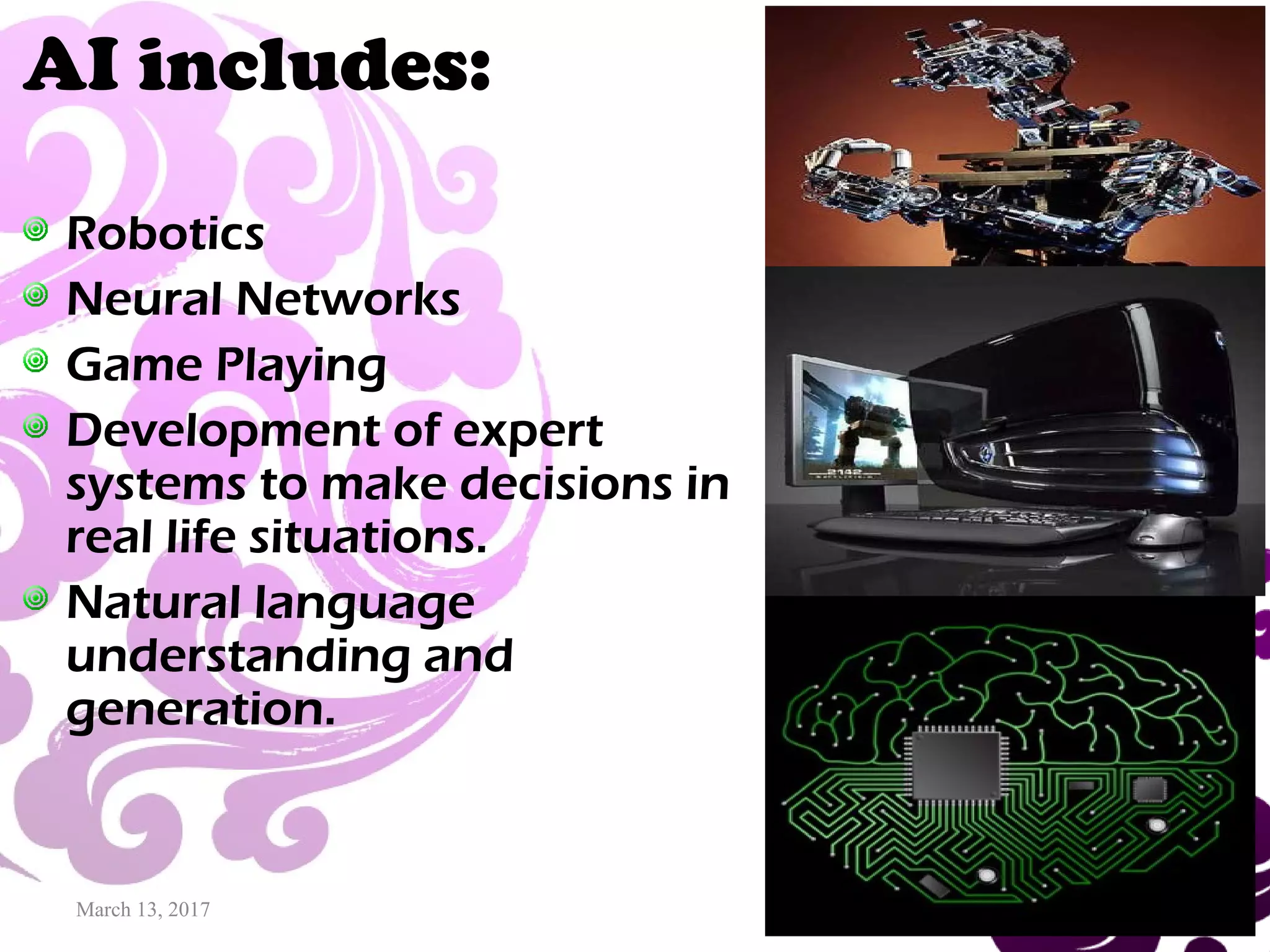
AI includes:
Robotics
Neural Networks
Game Playing
Development of expert
systems to make decisions in
real life situations.
Natural language
understanding and
generation.
March 13, 2017 21
ULSI technology
Development of true artificial
intelligence
Development of Natural language
processing
Advancement in Parallel
Processing
Advancement in Superconductor
technology
More user friendly interfaces with
multimedia features
Availability of very powerful and
compact computers at cheaper rate
.
The main features of fifth generation are:
TYPESTYPES
DESKTOP
LAPTOP
NOTEBOOK
ULTRABOOK
CHROMEBOOK
March 13, 2017 22
HISTORY OF COMPUTER
March 13, 2017 23
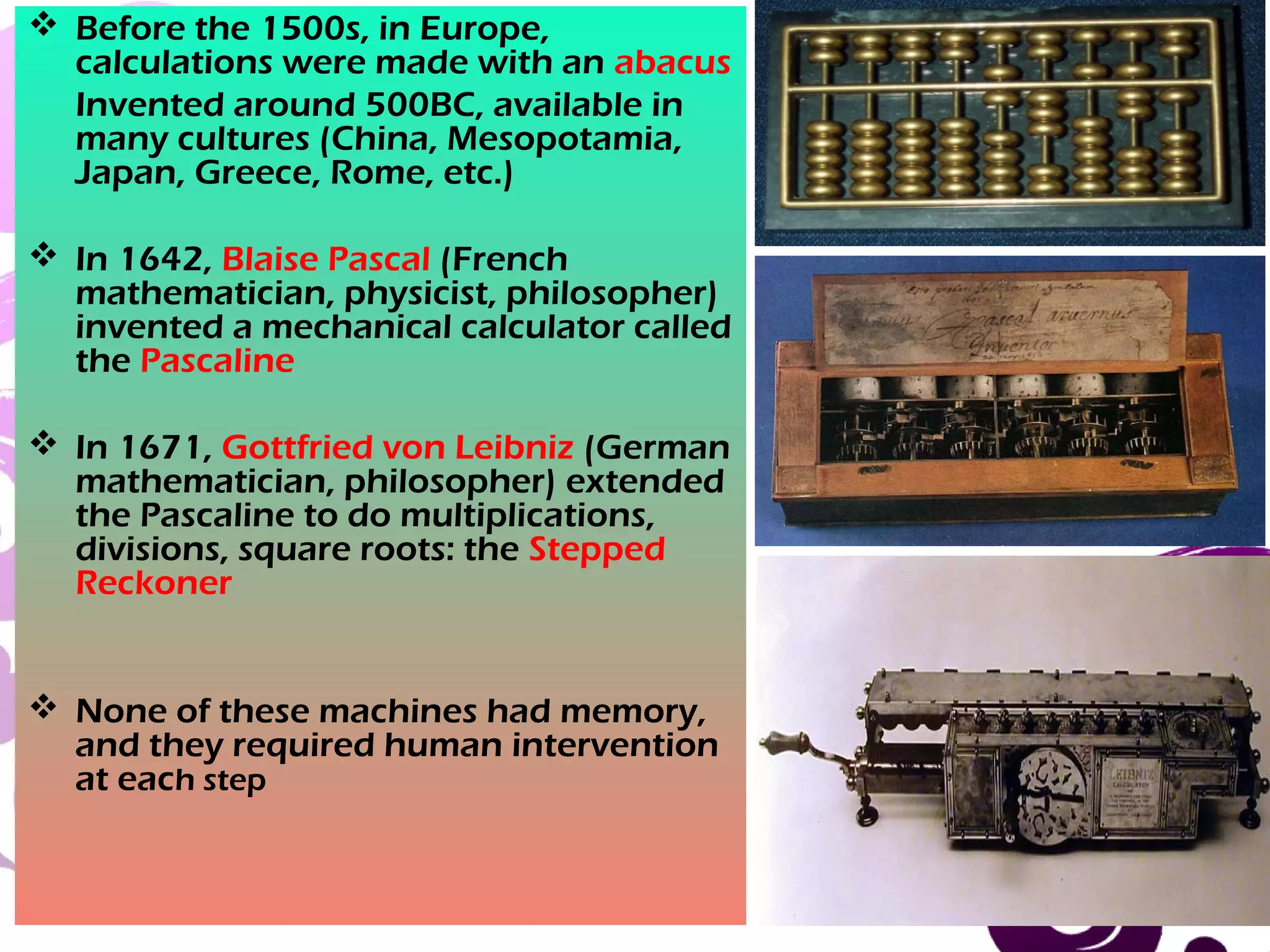
 Before the 1500s, in Europe,
calculations were made with an abacus
Invented around 500BC, available in
many cultures (China, Mesopotamia,
Japan, Greece, Rome, etc.)
 In 1642, Blaise Pascal (French
mathematician, physicist, philosopher)
invented a mechanical calculator called
the Pascaline
 In 1671, Gottfried von Leibniz (German
mathematician, philosopher) extended
the Pascaline to do multiplications,
divisions, square roots: the Stepped
Reckoner
 None of these machines had memory,
and they required human intervention
at each step
March 13, 2017 24
CHARLES BABBAGE
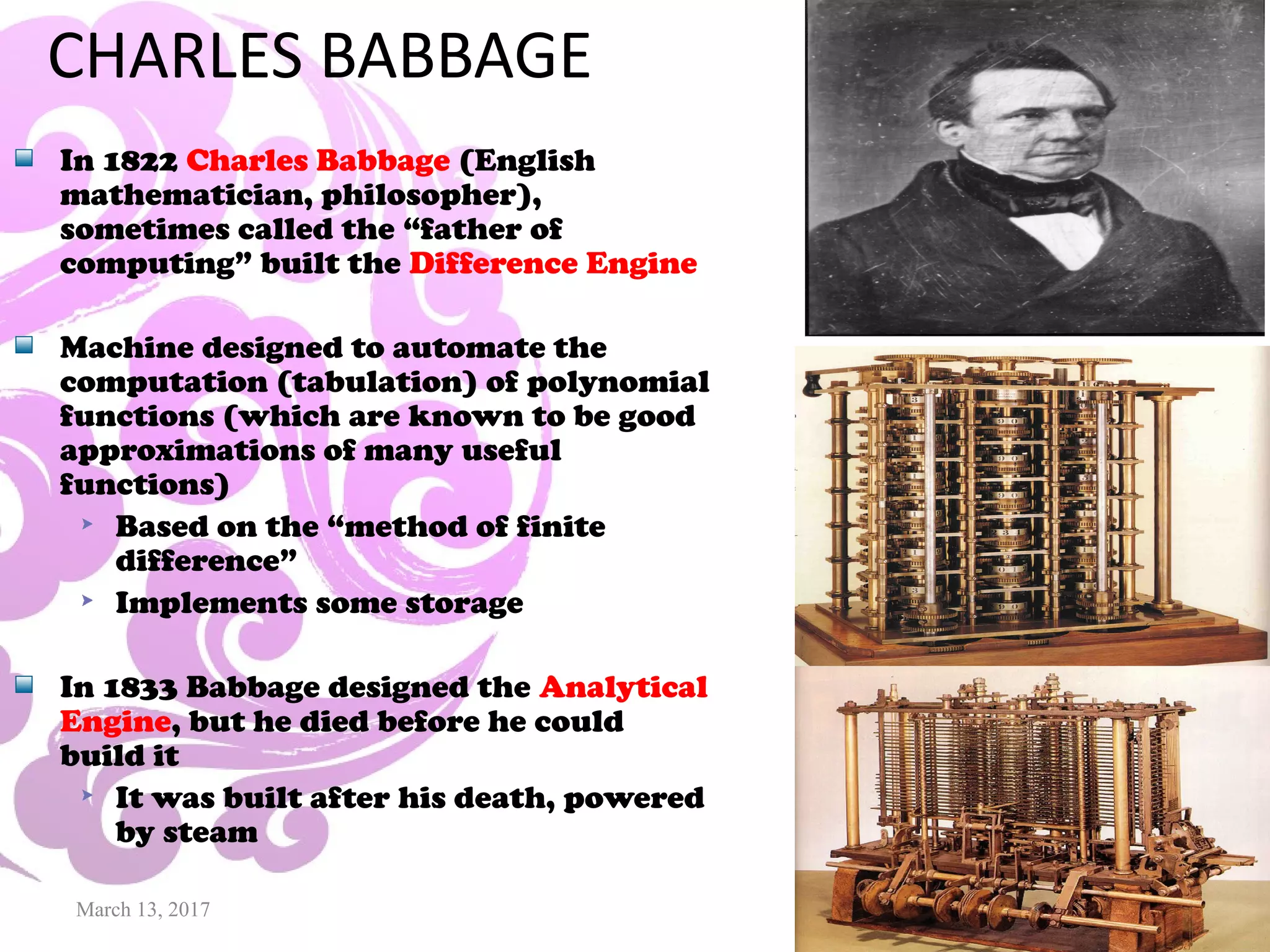
In 1822 Charles Babbage (English
mathematician, philosopher),
sometimes called the “father of
computing” built the Difference Engine
Machine designed to automate the
computation (tabulation) of polynomial
functions (which are known to be good
approximations of many useful
functions)
Based on the “method of finite
difference”
Implements some storage
In 1833 Babbage designed the Analytical
Engine, but he died before he could
build it
It was built after his death, powered
by steam
March 13, 2017 25
Lady Augusta AdaLady Augusta Ada
Countess of LovelaceCountess of Lovelace
1815-18521815-1852
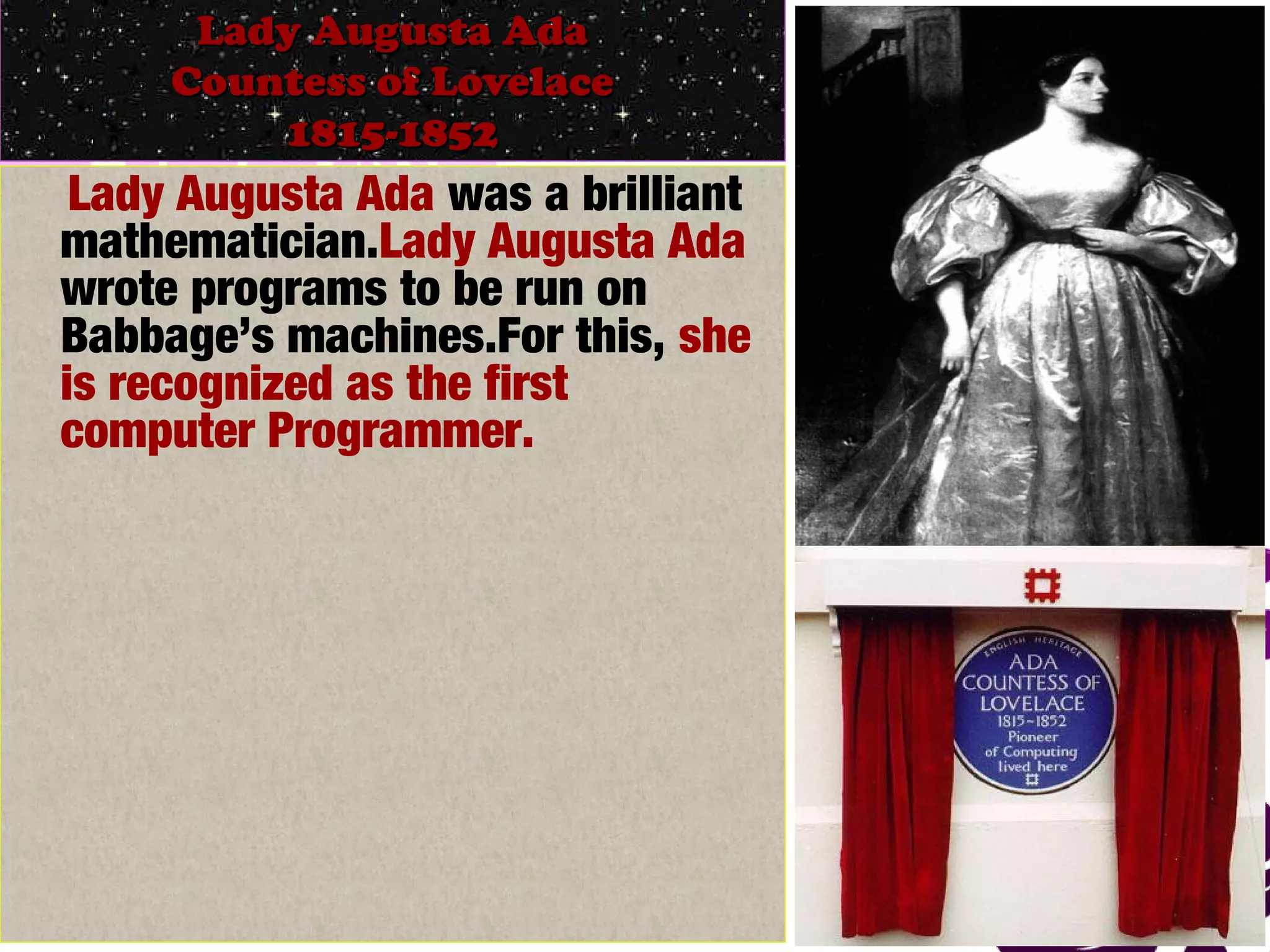
Lady Augusta Ada was a brilliant
mathematician.Lady Augusta Ada
wrote programs to be run on
Babbage’s machines.For this, she
is recognized as the first
computer Programmer.
March 13, 2017 26
Howard Aiken & Grace Hopper:-
Harvard Mark I Computer
The IBM Automatic Sequence Controlled Calculator (ASCC)
Computer was created by IBM for Harvard University,
which called it the Mark I. First universal calculator.
1944
March 13, 2017 27
The Colossus Mark I & II are widely acknowledged as the
first programmable electric computers, and were used at
Bletchley Park to decode German codes encrypted by the
Lorenz SZ40/42.
1943/1944
clossus mark-1 and mark-2
March 13, 2017 28
John Eckert & John W. Mauchly
ENIAC 1 Computer
1946
ENIAC was short for
Electronic Numerical
Integrator And Computer. It
was the first general
purpose (programmable to
solve any problem) electric
computer. It contained over
17,000 vacuum tubes,
weighed 27 tones and drew
150 kW of power to
operate.
March 13, 2017 29
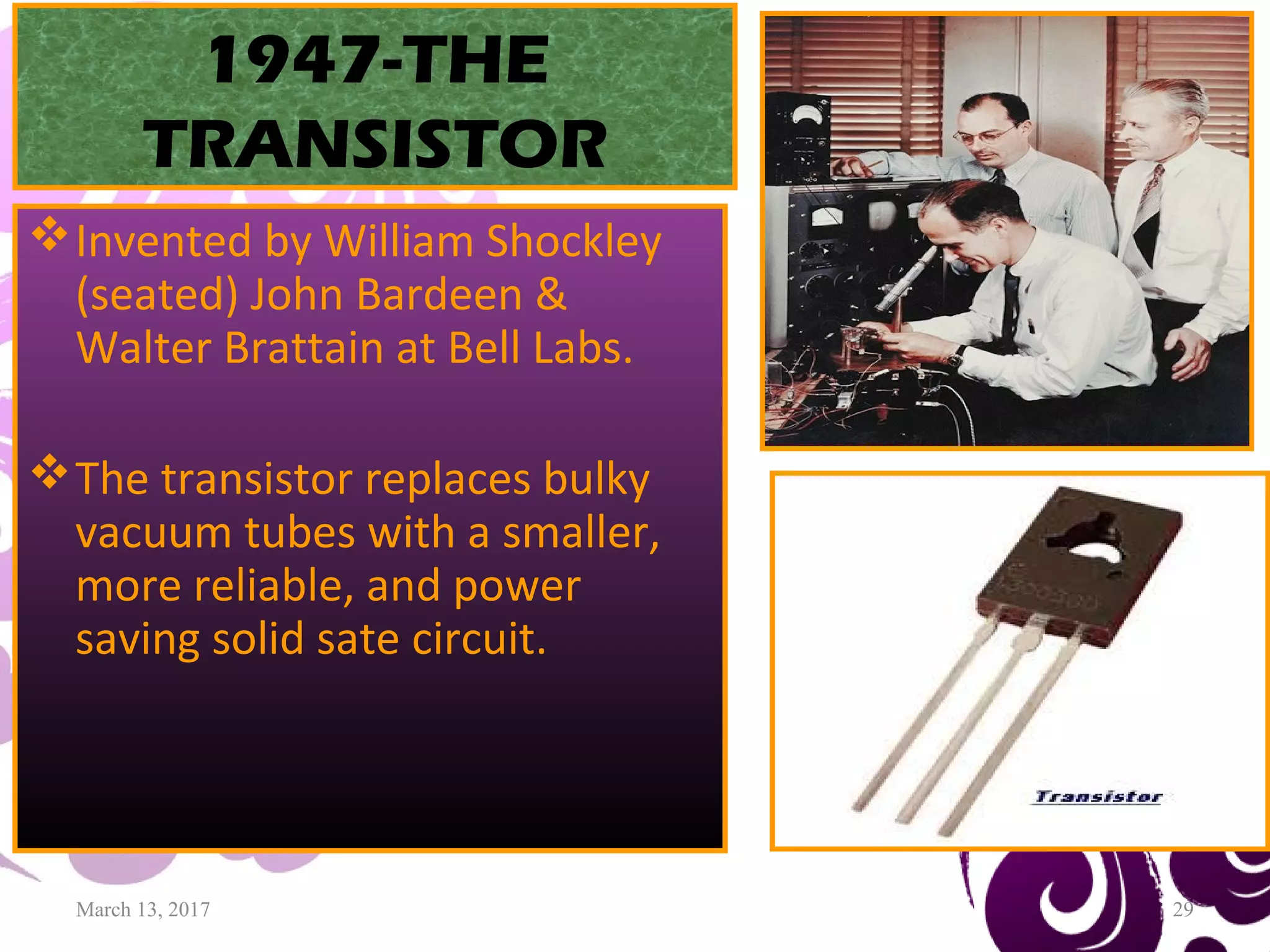
1947-THE
TRANSISTOR
Invented by William Shockley
(seated) John Bardeen &
Walter Brattain at Bell Labs.
The transistor replaces bulky
vacuum tubes with a smaller,
more reliable, and power
saving solid sate circuit.
March 13, 2017 30
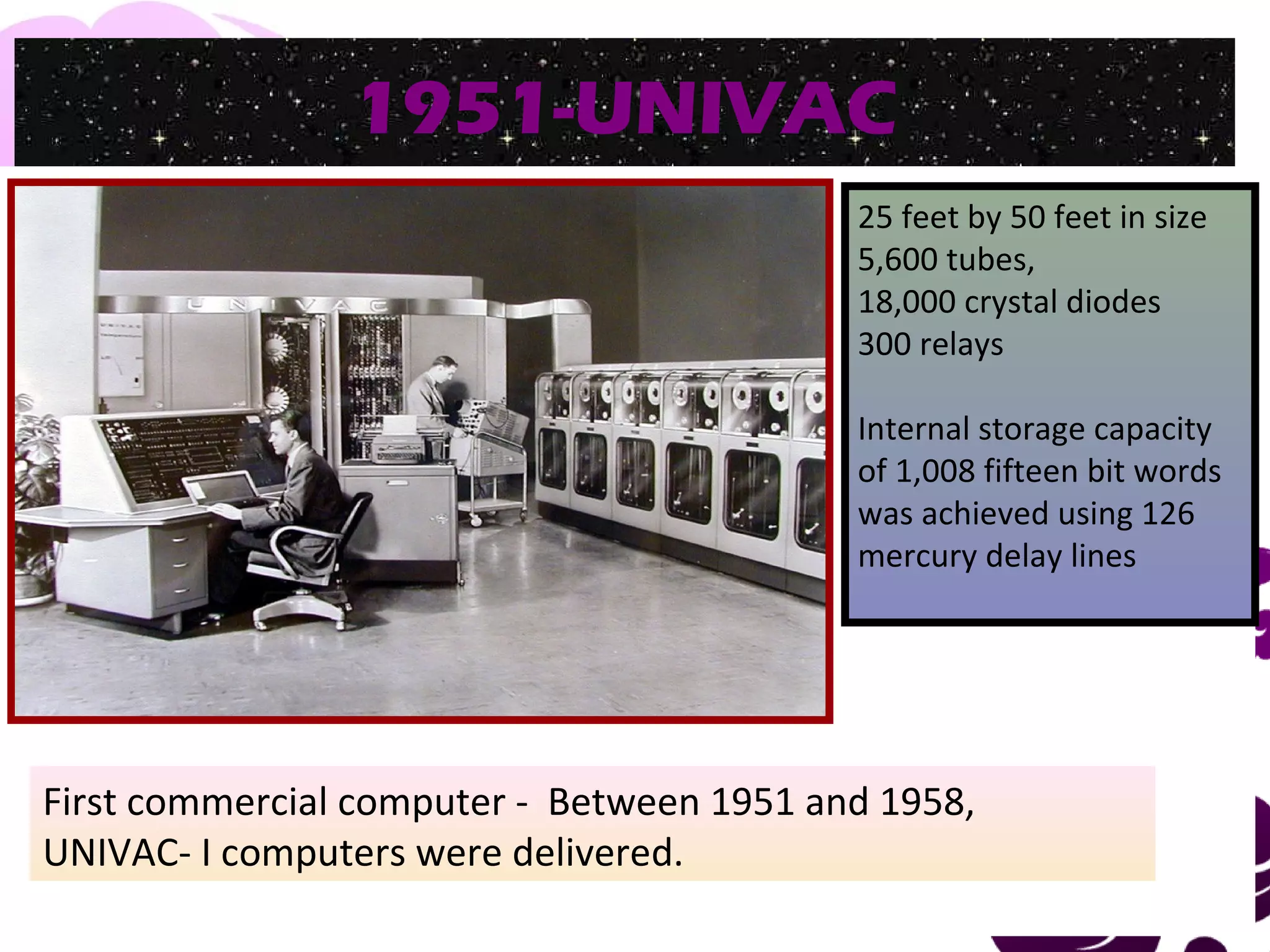
1951-UNIVAC
25 feet by 50 feet in size
5,600 tubes,
18,000 crystal diodes
300 relays
Internal storage capacity
of 1,008 fifteen bit words
was achieved using 126
mercury delay lines
First commercial computer - Between 1951 and 1958,
UNIVAC- I computers were delivered.
March 13, 2017 31
1953 IBM 701 EDPM COMPUTER
IBM enters the
market with its
first large scale
electronic
computer.
March 13, 2017 32
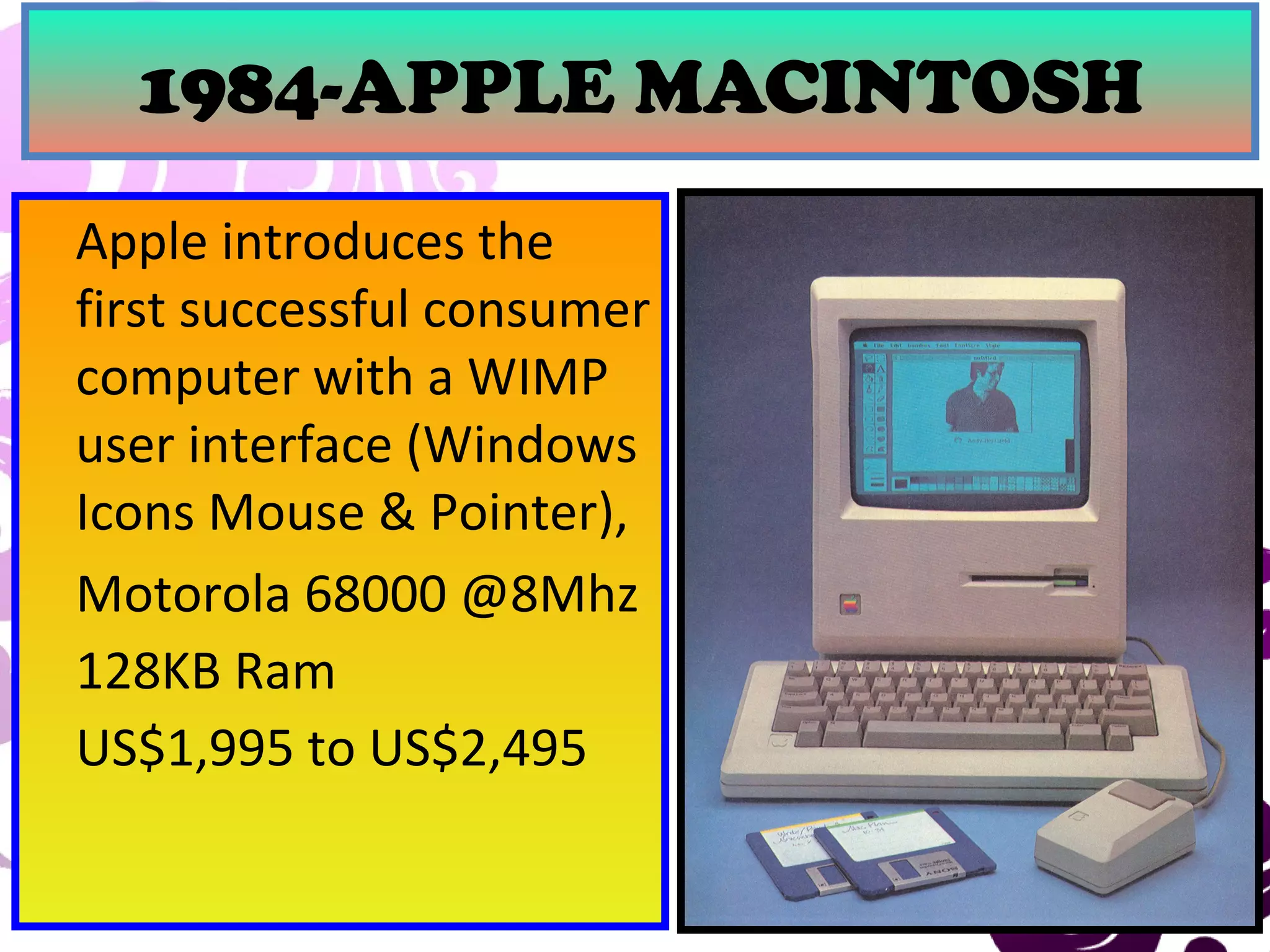
1984-APPLE MACINTOSH
Apple introduces the
first successful consumer
computer with a WIMP
user interface (Windows
Icons Mouse & Pointer),
Motorola 68000 @8Mhz
128KB Ram
US$1,995 to US$2,495
March 13, 2017 33
“a short summary''
(first telegraph message sent by Samuel Morse, 1844Samuel Morse, 1844)
Electronic and computing technology quickly progressed—at an
ever-accelerating pace—
from vacuum tubes (Lee de Forrest, the audion, 1907Lee de Forrest, the audion, 1907)
to transistors (William Shockley et al. 1947)William Shockley et al. 1947)
to semiconductors (Jack Kilby & Robert Noyce, 1958Jack Kilby & Robert Noyce, 1958)
to microprocessors (M.E. “Ted” Hoff, 1971M.E. “Ted” Hoff, 1971)
to networking and the Internet (Vinton Cerf & Robert Kahn,Vinton Cerf & Robert Kahn,
19821982]
to the World Wide Web (Tim Berners-Lee, 1991Tim Berners-Lee, 1991)
and beyond…
Whatever next?…Whatever next?…
March 13, 2017 34
THERE ARE THREE MAIN TYPES OF
COMPUTER:-
analog computer
digital computer
hybrid computer
TYPES OF COMPUTER
March 13, 2017 35
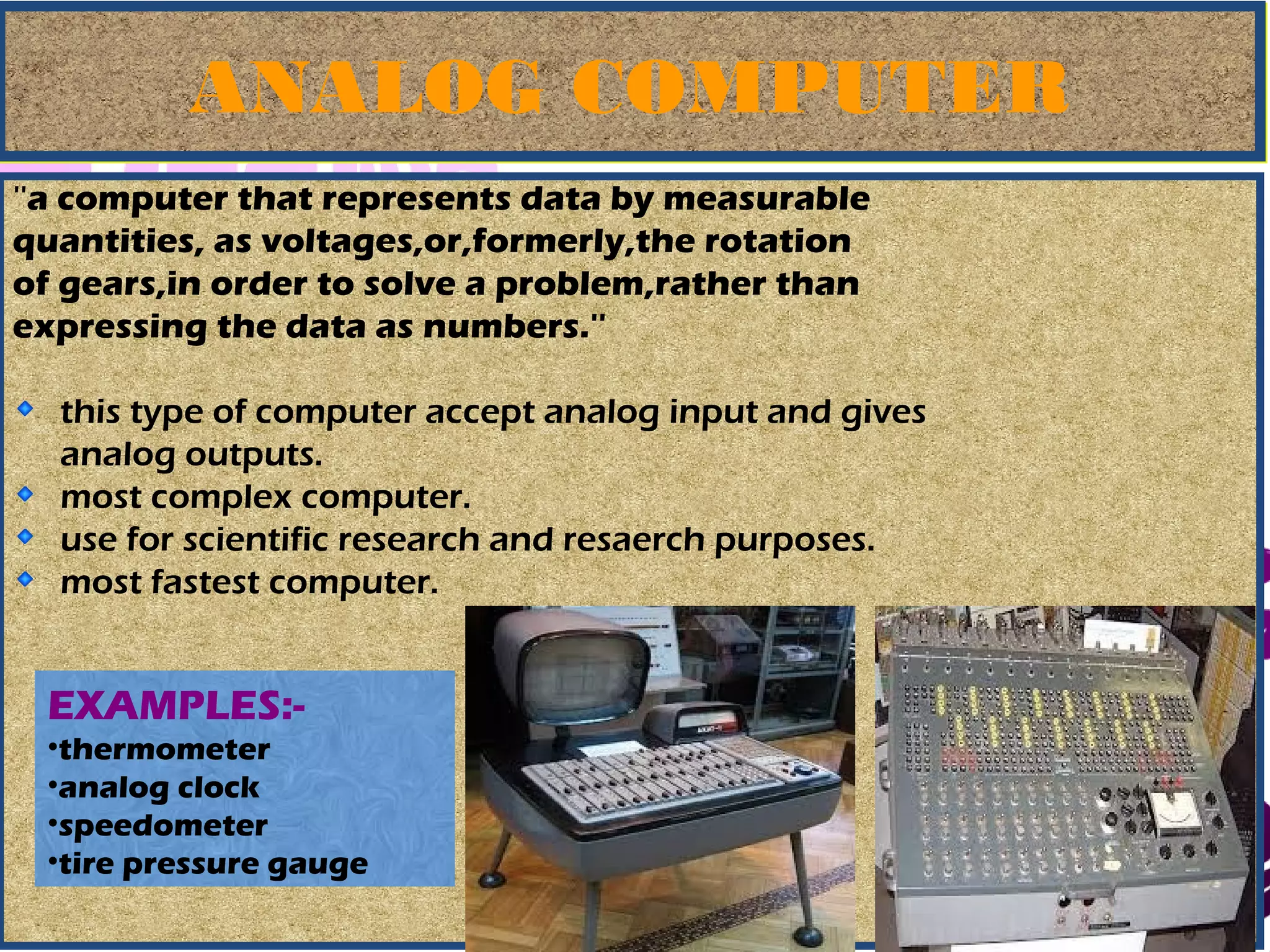
ANALOG COMPUTERANALOG COMPUTER
''a computer that represents data by measurable
quantities, as voltages,or,formerly,the rotation
of gears,in order to solve a problem,rather than
expressing the data as numbers.''
this type of computer accept analog input and gives
analog outputs.
most complex computer.
use for scientific research and resaerch purposes.
most fastest computer.
EXAMPLES:-
•thermometer
•analog clock
•speedometer
•tire pressure gauge
March 13, 2017 36
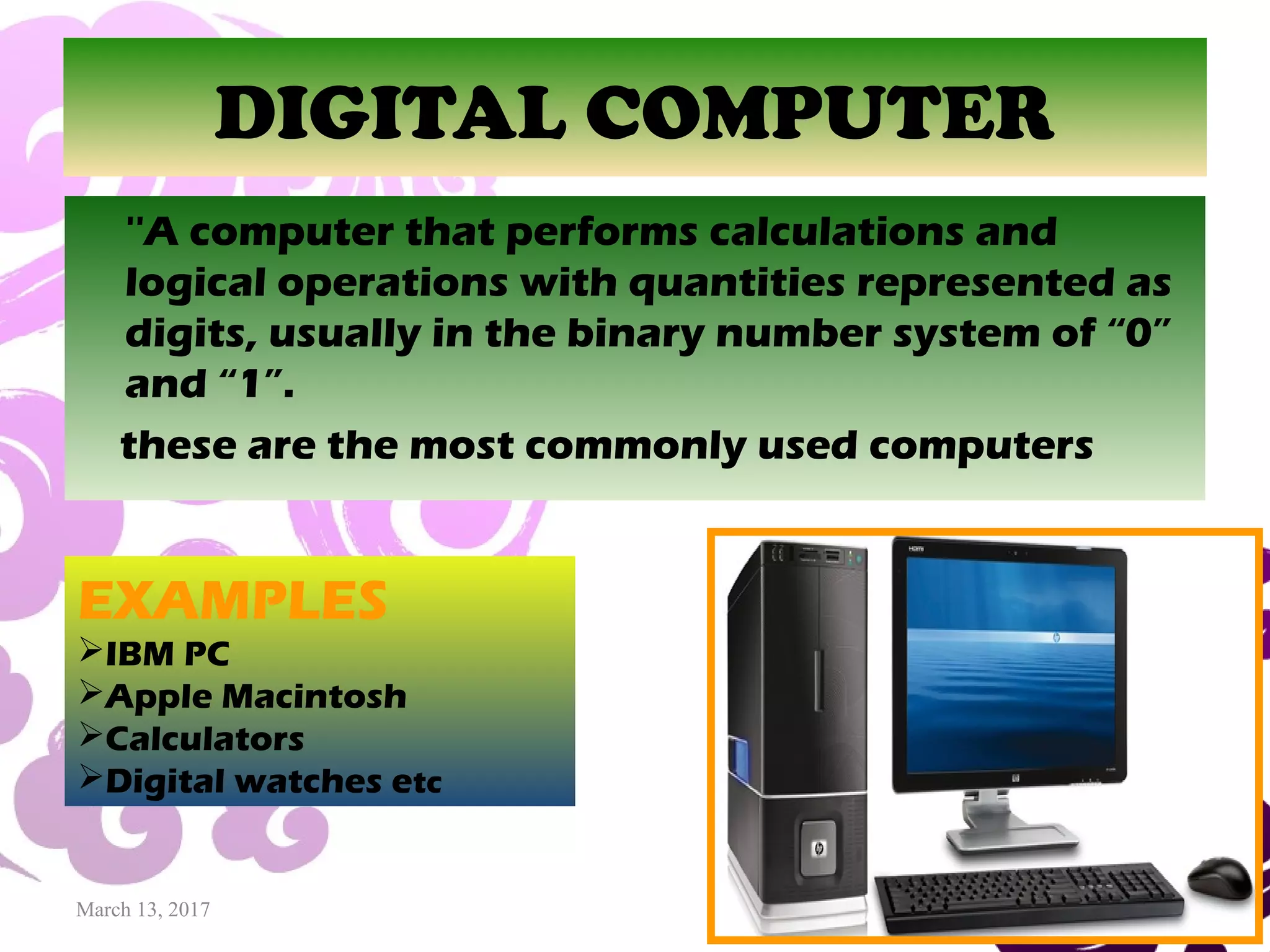
DIGITAL COMPUTER
''A computer that performs calculations and
logical operations with quantities represented as
digits, usually in the binary number system of “0”
and “1”.
these are the most commonly used computers
EXAMPLES
IBM PC
Apple Macintosh
Calculators
Digital watches etc
March 13, 2017 37
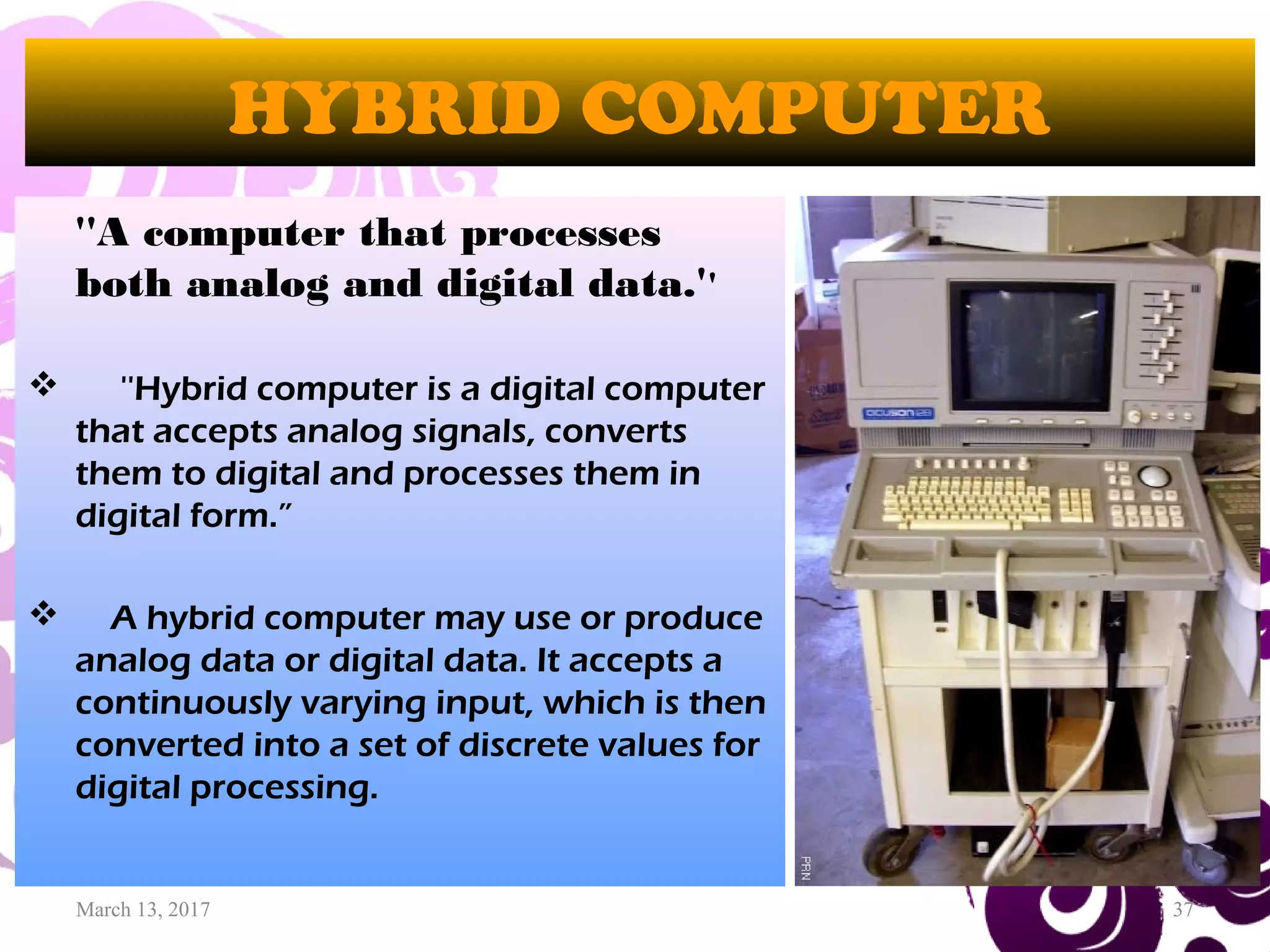
HYBRID COMPUTER
''A computer that processes
both analog and digital data.''
 ''Hybrid computer is a digital computer
that accepts analog signals, converts
them to digital and processes them in
digital form.”
 A hybrid computer may use or produce
analog data or digital data. It accepts a
continuously varying input, which is then
converted into a set of discrete values for
digital processing.
March 13, 2017 38
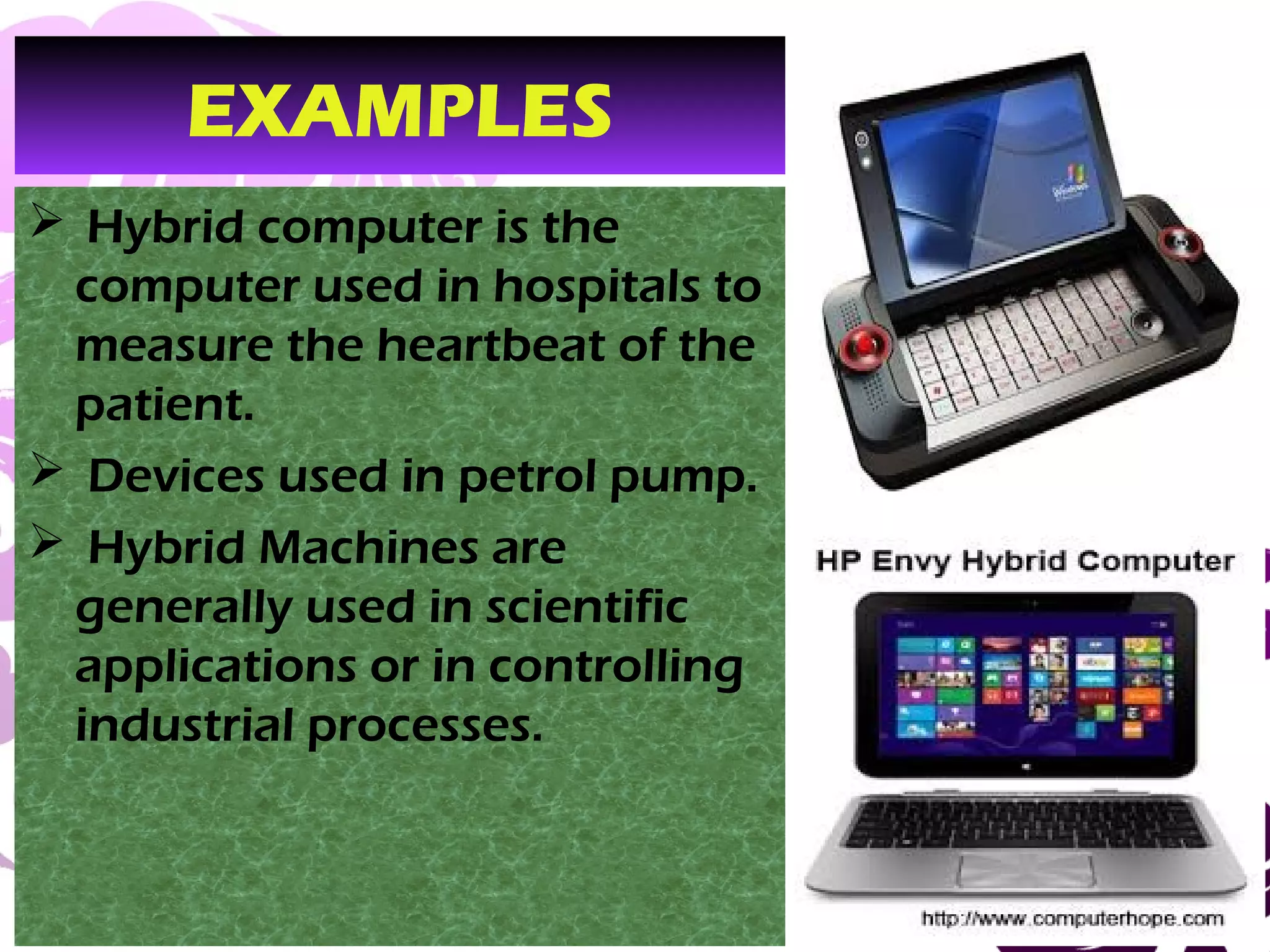
EXAMPLES
 Hybrid computer is the
computer used in hospitals to
measure the heartbeat of the
patient.
 Devices used in petrol pump.
 Hybrid Machines are
generally used in scientific
applications or in controlling
industrial processes.
March 13, 2017 39
1 2 3 4
REFERENCES
SLIDESHARE.COM
FROM MY
COMPUTER
COPY
http://edutry.blogsp
ot.com www.mhhe.co
m/peternorto
n
March 13, 2017 40
Thank You
March 13, 2017 41
Thank You
Kingsoft Office
Make Presentation much more fun

Computer,history,generations,and its types.

  • 1.
    March 13, 20171 INTRODUCTION TO COMPUTER GENERATIONS OF COMPUTER HISTORY OF COMPUTER TYPES OF COMPUTER BY MUKHTIAR & ROSHAN ALI
  • 2.
  • 3.
    March 13, 20173 LOGO GOVT:PG JAHANZEB COLLEGE SAIDU-SHARIF SWAT PRESENTATION TOPIC: COMPUTER GENERATIONS HISTORY OF COMPUTER TYPES OF COMPUTER SCRIPTED BY: FROM GROUP A MUKHTIAR CLASS NO:-20 ROSHAN ALI CLASS NO:-24 SUMBMITTED TO SIR: NAJIBULLAH SB DEPARTMENT:ZOOLOGY 3RD SEMESTER DATE:4/1/2016 C:UsersROSHANALIDesktopCOMPUTER GENERATIONSSSSSSSSSSS.lnk
  • 4.
    March 13, 20174 1 2 3 COMPUTER NTS OF PRSENTAION TOPIC •COMPUTER GENERATION •TYPES OF COMPUTER •HISTORY OF COMPUTER
  • 5.
    March 13, 20175 COMPUTER GENERATIONS •2ND GENERATION (1956-1963) •FIRST GENERATION (1940-1956) •4TH GENERATION (1971-PRESENT) •3RD GENERATION (1964-1971) 1 2 3 4 • 5TH GENERATION (PRESENT AND BEYOND) 5
  • 6.
    March 13, 20176 . 1st generation 2nd generation 3rd generation 4th generation 5th generation technology vacuum tubes transistors integrated circus(multipl e transistors) microchips (millions of transistors) ARTIFICIAL INTELLIGENCE size filled whole buildings filled half a room smaller, just occupy a small table SMALLER THAN 3RD GENERATION PALM OF HAND
  • 7.
    March 13, 20177 INTRODUCTION TO COMPUTER GENERATIONSINTRODUCTION TO COMPUTER GENERATIONS the history of computer is often reference to the d/f generation of computing devices. each of the five generations of computers is characterized by a major technological development that fundamentally changed the way computer operate. most developments resulted in increasingly smaller,cheaper, more powerful and more efficient computing devices.
  • 8.
    March 13, 20178 FIRST GENERATION COMPUTERSFIRST GENERATION COMPUTERS (1940-1956)(1940-1956)  The first computers used vacuum tubes for circuitry and magnetic drums for memory.  They were often enormous and taking up entire room.  First generation computers relied on machine language.  They were very expensive to operate and in addition to using a great deal of electricity, generated a lot of heat, which was often the cause of malfunctions  The first generation computers relied on machine language.  input was based on punched card and paper tape,and outpu was based on printouts.  The UNIVAC and ENIAC computers are examples of first- generation computing devices.
  • 9.
    March 13, 20179 . univac tube boardunivac tube board individual vacuum tubeindividual vacuum tube
  • 10.
    March 13, 201710 2ND GENERATION COMPUTERS (1956-1963)  Transistors replaced vacuum tubes and ushered in the second generation of computers.  Second-generation computers moved from cryptic binary machine language to symbolic.  High-level programming languages were also being developed at this time, such as early versions of COBOL and FORTRAN.  These were also the first computers that stored their instructions in their memory.  though the transistors still generated a great deal of heat that subjected the computer to damage.  the first computers of this generation were developed for the"atomic energy industry."
  • 11.
    March 13, 201711 The main features of second generation areThe main features of second generation are Use of transistors. Reliable in comparison to first generation computers. Smaller size as compared to first generation computers. Generated less heat as compared to first generation computers. Consumed less electricity as compared to first generation computers. Faster than first generation computers. Still very costly. Supported machine and assembly languages.
  • 12.
    March 13, 201712 IBM 1620 IBM 7094 CDC 1604 CDC 3600 UNIVAC 1108 SOME COMPUTERS OF THIS GENERATION WERE:-
  • 13.
    March 13, 201713 THIRD GENERATION COMPUTERS 1965-1971 THIRD GENERATION COMPUTERS 1965-1971 The computers of third generation used integrated circuits (IC's) in place of transistors. A single IC has many transistors, resistors and capacitors along with the associated circuitry. The IC was invented by Jack Kilby. This development made computers smaller in size, reliable and efficient. In this generation remote processing, time- sharing, multi-programming operating system were used. High-level languages (FORTRAN-II TO IV, COBOL, PASCAL PL/1, BASIC, ALGOL-68 etc.) were used during this generation. The computers of third generation used integrated circuits (IC's) in place of transistors. A single IC has many transistors, resistors and capacitors along with the associated circuitry. The IC was invented by Jack Kilby. This development made computers smaller in size, reliable and efficient. In this generation remote processing, time- sharing, multi-programming operating system were used. High-level languages (FORTRAN-II TO IV, COBOL, PASCAL PL/1, BASIC, ALGOL-68 etc.) were used during this generation.
  • 14.
    March 13, 201714  IC used.  More reliable in comparison to previous two generations.  Smaller size.  Generated less heat.  Faster.  Lesser maintenance.  Still costly.  Consumed lesser electricity.  Supported high-level language.
  • 15.
    March 13, 201715 Some computers of this generation were:  IBM-360 series  Honeywell-6000 series  PDP(Personal Data Processor)  IBM-370/168  TDC-316
  • 16.
    March 13, 201716 4TH GENERATION COMPUTERS 1971-1980  The computers of fourth generation used Very Large Scale Integrated (VLSI) circuits. VLSI circuits having about 5000 transistors and other circuit elements and their associated circuits on a single chip made it possible to have microcomputers of fourth generation.  Fourth generation computers became more powerful, compact, reliable, and affordable. As a result, it gave rise to personal computer (PC) revolution.  IN this generation time sharing, real time, networks, distributed operating system were used. All the high-level languages like C, C++, DBASE etc., were used in this generation.
  • 17.
    March 13, 201717 VLSI technology used Very cheap Portable and reliable Use of PC's Very small size Pipeline processing No A.C. needed Concept of internet was introduced Great developments in the fields of networks Computers became easily available The main features of fourth generation are:The main features of fourth generation are:
  • 18.
    March 13, 201718 Some computers of this generation were: DEC 10 STAR 1000 PDP 11 CRAY-1(Super Computer) CRAY-X-MP(Super Computer)
  • 19.
    March 13, 201719  In the fifth generation, the VLSI technology became ULSIULSI (Ultra Large Scale Integration) technology, resulting in the production of microprocessor chips having ten million electronic components.  This generation is based on parallel processing hardware and AI (Artificial Intelligence) software.  AI is an emerging branch in computer science, which interprets means and method of making computers think like human beings.  All the high-level languages like C and C++, Java, .Net etc., are used in this generation. FIFTH GENERTION COMPUTERS 1980-TILL DATE FIFTH GENERTION COMPUTERS 1980-TILL DATE
  • 20.
    March 13, 201720 AI includes: Robotics Neural Networks Game Playing Development of expert systems to make decisions in real life situations. Natural language understanding and generation.
  • 21.
    March 13, 201721 ULSI technology Development of true artificial intelligence Development of Natural language processing Advancement in Parallel Processing Advancement in Superconductor technology More user friendly interfaces with multimedia features Availability of very powerful and compact computers at cheaper rate . The main features of fifth generation are: TYPESTYPES DESKTOP LAPTOP NOTEBOOK ULTRABOOK CHROMEBOOK
  • 22.
    March 13, 201722 HISTORY OF COMPUTER
  • 23.
    March 13, 201723  Before the 1500s, in Europe, calculations were made with an abacus Invented around 500BC, available in many cultures (China, Mesopotamia, Japan, Greece, Rome, etc.)  In 1642, Blaise Pascal (French mathematician, physicist, philosopher) invented a mechanical calculator called the Pascaline  In 1671, Gottfried von Leibniz (German mathematician, philosopher) extended the Pascaline to do multiplications, divisions, square roots: the Stepped Reckoner  None of these machines had memory, and they required human intervention at each step
  • 24.
    March 13, 201724 CHARLES BABBAGE In 1822 Charles Babbage (English mathematician, philosopher), sometimes called the “father of computing” built the Difference Engine Machine designed to automate the computation (tabulation) of polynomial functions (which are known to be good approximations of many useful functions) Based on the “method of finite difference” Implements some storage In 1833 Babbage designed the Analytical Engine, but he died before he could build it It was built after his death, powered by steam
  • 25.
    March 13, 201725 Lady Augusta AdaLady Augusta Ada Countess of LovelaceCountess of Lovelace 1815-18521815-1852 Lady Augusta Ada was a brilliant mathematician.Lady Augusta Ada wrote programs to be run on Babbage’s machines.For this, she is recognized as the first computer Programmer.
  • 26.
    March 13, 201726 Howard Aiken & Grace Hopper:- Harvard Mark I Computer The IBM Automatic Sequence Controlled Calculator (ASCC) Computer was created by IBM for Harvard University, which called it the Mark I. First universal calculator. 1944
  • 27.
    March 13, 201727 The Colossus Mark I & II are widely acknowledged as the first programmable electric computers, and were used at Bletchley Park to decode German codes encrypted by the Lorenz SZ40/42. 1943/1944 clossus mark-1 and mark-2
  • 28.
    March 13, 201728 John Eckert & John W. Mauchly ENIAC 1 Computer 1946 ENIAC was short for Electronic Numerical Integrator And Computer. It was the first general purpose (programmable to solve any problem) electric computer. It contained over 17,000 vacuum tubes, weighed 27 tones and drew 150 kW of power to operate.
  • 29.
    March 13, 201729 1947-THE TRANSISTOR Invented by William Shockley (seated) John Bardeen & Walter Brattain at Bell Labs. The transistor replaces bulky vacuum tubes with a smaller, more reliable, and power saving solid sate circuit.
  • 30.
    March 13, 201730 1951-UNIVAC 25 feet by 50 feet in size 5,600 tubes, 18,000 crystal diodes 300 relays Internal storage capacity of 1,008 fifteen bit words was achieved using 126 mercury delay lines First commercial computer - Between 1951 and 1958, UNIVAC- I computers were delivered.
  • 31.
    March 13, 201731 1953 IBM 701 EDPM COMPUTER IBM enters the market with its first large scale electronic computer.
  • 32.
    March 13, 201732 1984-APPLE MACINTOSH Apple introduces the first successful consumer computer with a WIMP user interface (Windows Icons Mouse & Pointer), Motorola 68000 @8Mhz 128KB Ram US$1,995 to US$2,495
  • 33.
    March 13, 201733 “a short summary'' (first telegraph message sent by Samuel Morse, 1844Samuel Morse, 1844) Electronic and computing technology quickly progressed—at an ever-accelerating pace— from vacuum tubes (Lee de Forrest, the audion, 1907Lee de Forrest, the audion, 1907) to transistors (William Shockley et al. 1947)William Shockley et al. 1947) to semiconductors (Jack Kilby & Robert Noyce, 1958Jack Kilby & Robert Noyce, 1958) to microprocessors (M.E. “Ted” Hoff, 1971M.E. “Ted” Hoff, 1971) to networking and the Internet (Vinton Cerf & Robert Kahn,Vinton Cerf & Robert Kahn, 19821982] to the World Wide Web (Tim Berners-Lee, 1991Tim Berners-Lee, 1991) and beyond… Whatever next?…Whatever next?…
  • 34.
    March 13, 201734 THERE ARE THREE MAIN TYPES OF COMPUTER:- analog computer digital computer hybrid computer TYPES OF COMPUTER
  • 35.
    March 13, 201735 ANALOG COMPUTERANALOG COMPUTER ''a computer that represents data by measurable quantities, as voltages,or,formerly,the rotation of gears,in order to solve a problem,rather than expressing the data as numbers.'' this type of computer accept analog input and gives analog outputs. most complex computer. use for scientific research and resaerch purposes. most fastest computer. EXAMPLES:- •thermometer •analog clock •speedometer •tire pressure gauge
  • 36.
    March 13, 201736 DIGITAL COMPUTER ''A computer that performs calculations and logical operations with quantities represented as digits, usually in the binary number system of “0” and “1”. these are the most commonly used computers EXAMPLES IBM PC Apple Macintosh Calculators Digital watches etc
  • 37.
    March 13, 201737 HYBRID COMPUTER ''A computer that processes both analog and digital data.''  ''Hybrid computer is a digital computer that accepts analog signals, converts them to digital and processes them in digital form.”  A hybrid computer may use or produce analog data or digital data. It accepts a continuously varying input, which is then converted into a set of discrete values for digital processing.
  • 38.
    March 13, 201738 EXAMPLES  Hybrid computer is the computer used in hospitals to measure the heartbeat of the patient.  Devices used in petrol pump.  Hybrid Machines are generally used in scientific applications or in controlling industrial processes.
  • 39.
    March 13, 201739 1 2 3 4 REFERENCES SLIDESHARE.COM FROM MY COMPUTER COPY http://edutry.blogsp ot.com www.mhhe.co m/peternorto n
  • 40.
    March 13, 201740 Thank You
  • 41.
    March 13, 201741 Thank You Kingsoft Office Make Presentation much more fun