LESSON 1: Evolution of
Information Technology
CHAPTER I
Information technology
has been around for a
long, long time. Basically,
as long as people have
been around, information
technology has been
around because there were
always ways of
communicating through
technology available at
that point in time.
There are 4 main ages that
divide up the history of
information technology.
Only the latest age
(electronic) and some of
the electromechanical age
really affects us today, but
it is important to learn
about how we got to the
point we are at with
technology today.
The pre-mechanical age is
the earliest age of
information technology. It
can be defined as the
time between 3000B.C.
and 1450A.D.
PRE-MECHANICAL
AGE
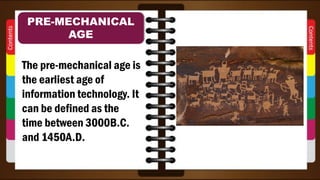
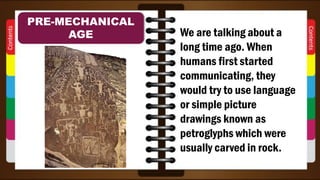
We are talking about a
long time ago. When
humans first started
communicating, they
would try to use language
or simple picture
drawings known as
petroglyphs which were
usually carved in rock.
PRE-MECHANICAL
AGE
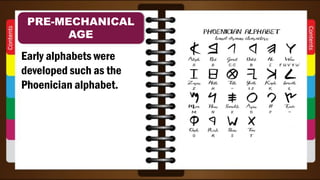
Early alphabets were
developed such as the
Phoenician alphabet.
PRE-MECHANICAL
AGE
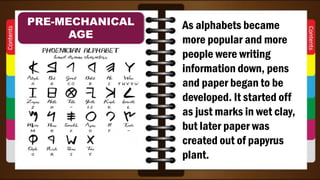
As alphabets became
more popular and more
people were writing
information down, pens
and paper began to be
developed. It started off
as just marks in wet clay,
but later paper was
created out of papyrus
plant.
PRE-MECHANICAL
AGE
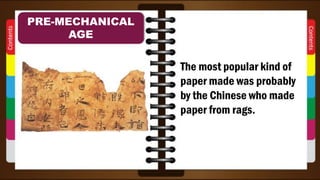
The most popular kind of
paper made was probably
by the Chinese who made
paper from rags.
PRE-MECHANICAL
AGE
Now that people were
writing a lot of
information down, they
needed ways to keep it all
in permanent storage.
This is where the first
books and libraries are
developed.
PRE-MECHANICAL
AGE
You’ve probably heard of
Egyptian scrolls which
were popular ways of
writing down information
to save. Some groups of
people were actually
binding paper together
into a book-like form.
PRE-MECHANICAL
AGE
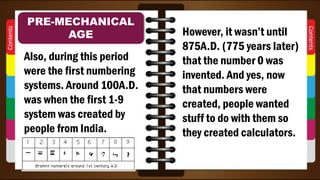
Also, during this period
were the first numbering
systems. Around 100A.D.
was when the first 1-9
system was created by
people from India.
PRE-MECHANICAL
AGE However, it wasn’t until
875A.D. (775 years later)
that the number 0 was
invented. And yes, now
that numbers were
created, people wanted
stuff to do with them so
they created calculators.
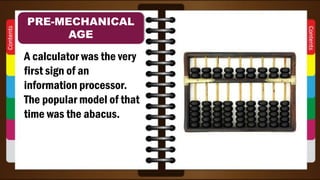
A calculator was the very
first sign of an
information processor.
The popular model of that
time was the abacus.
PRE-MECHANICAL
AGE
The age of mechanical, is
when we first start to see
connections between our
current technology and its
ancestors.
MECHANICAL
AGE The mechanical age can
be defined as the time
between 1450 and 1840.
A lot of new technologies
are developed in this era
as there is a large
explosion in interest with
this area.
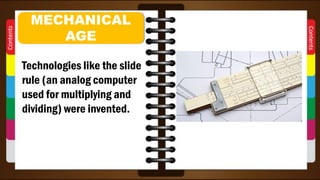
Technologies like the slide
rule (an analog computer
used for multiplying and
dividing) were invented.
MECHANICAL
AGE
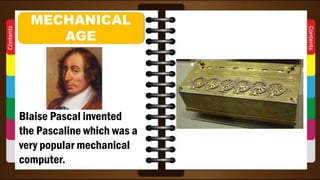
Blaise Pascal invented
the Pascaline which was a
very popular mechanical
computer.
MECHANICAL
AGE
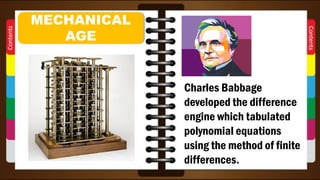
Charles Babbage
developed the difference
engine which tabulated
polynomial equations
using the method of finite
differences.
MECHANICAL
AGE
There were lots of
different machines
created during this era
and while we have not yet
gotten to a machine that
can do more than one type
of calculation in one, like
our modern-day started.
MECHANICAL
AGE
calculators, we are still
learning about how all of
our all-in-one machines
started.
Also, if you look at the size
of the machines invented
in this time compared to
the power behind them it
seems (to us) absolutely
ridiculous to understand
why anybody would want
MECHANICAL
AGE
to use them, but to the
people living in that time
ALL of these inventions
were HUGE.
ELECTRO
MECHANICAL AGE
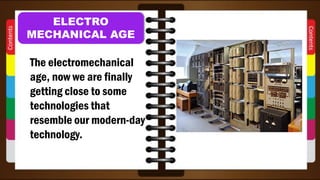
The electromechanical
age, now we are finally
getting close to some
technologies that
resemble our modern-day
technology.
ELECTRO
MECHANICAL AGE
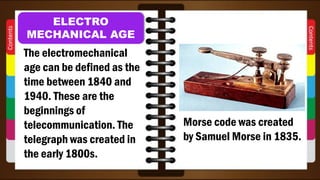
The electromechanical
age can be defined as the
time between 1840 and
1940. These are the
beginnings of
telecommunication. The
telegraph was created in
the early 1800s.
Morse code was created
by Samuel Morse in 1835.
ELECTRO
MECHANICAL AGE
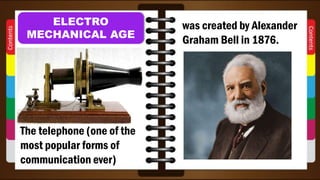
The telephone (one of the
most popular forms of
communication ever)
was created by Alexander
Graham Bell in 1876.
ELECTRO
MECHANICAL AGE
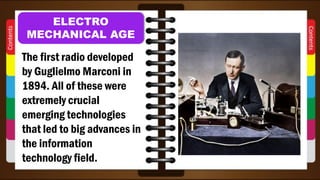
The first radio developed
by Guglielmo Marconi in
1894. All of these were
extremely crucial
emerging technologies
that led to big advances in
the information
technology field.
ELECTRO
MECHANICAL AGE
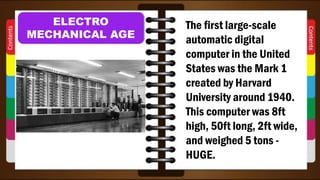
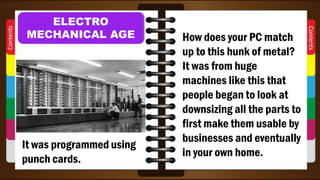
The first large-scale
automatic digital
computer in the United
States was the Mark 1
created by Harvard
University around 1940.
This computer was 8ft
high, 50ft long, 2ft wide,
and weighed 5 tons -
HUGE.
ELECTRO
MECHANICAL AGE How does your PC match
up to this hunk of metal?
It was from huge
machines like this that
people began to look at
downsizing all the parts to
first make them usable by
businesses and eventually
in your own home.
It was programmed using
punch cards.
ELECTRONIC
AGE
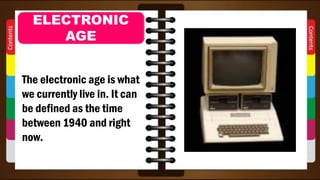
The electronic age is what
we currently live in. It can
be defined as the time
between 1940 and right
now.
ELECTRONIC
AGE
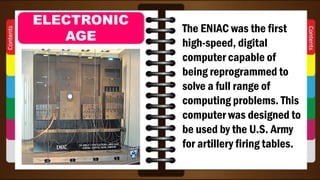
The ENIAC was the first
high-speed, digital
computer capable of
being reprogrammed to
solve a full range of
computing problems. This
computer was designed to
be used by the U.S. Army
for artillery firing tables.
ELECTRONIC
AGE
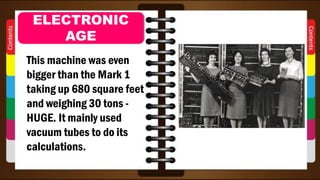
This machine was even
bigger than the Mark 1
taking up 680 square feet
and weighing 30 tons -
HUGE. It mainly used
vacuum tubes to do its
calculations.
ELECTRONIC
AGE
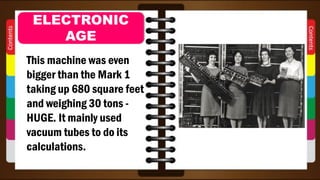
This machine was even
bigger than the Mark 1
taking up 680 square feet
and weighing 30 tons -
HUGE. It mainly used
vacuum tubes to do its
calculations.

Evolution-of-Information-Technology

  • 1.
    LESSON 1: Evolutionof Information Technology CHAPTER I
  • 2.
    Information technology has beenaround for a long, long time. Basically, as long as people have been around, information technology has been around because there were always ways of communicating through technology available at that point in time. There are 4 main ages that divide up the history of information technology. Only the latest age (electronic) and some of the electromechanical age really affects us today, but it is important to learn about how we got to the point we are at with technology today.
  • 3.
    The pre-mechanical ageis the earliest age of information technology. It can be defined as the time between 3000B.C. and 1450A.D. PRE-MECHANICAL AGE
  • 4.
    We are talkingabout a long time ago. When humans first started communicating, they would try to use language or simple picture drawings known as petroglyphs which were usually carved in rock. PRE-MECHANICAL AGE
  • 5.
    Early alphabets were developedsuch as the Phoenician alphabet. PRE-MECHANICAL AGE
  • 6.
    As alphabets became morepopular and more people were writing information down, pens and paper began to be developed. It started off as just marks in wet clay, but later paper was created out of papyrus plant. PRE-MECHANICAL AGE
  • 7.
    The most popularkind of paper made was probably by the Chinese who made paper from rags. PRE-MECHANICAL AGE
  • 8.
    Now that peoplewere writing a lot of information down, they needed ways to keep it all in permanent storage. This is where the first books and libraries are developed. PRE-MECHANICAL AGE
  • 9.
    You’ve probably heardof Egyptian scrolls which were popular ways of writing down information to save. Some groups of people were actually binding paper together into a book-like form. PRE-MECHANICAL AGE
  • 10.
    Also, during thisperiod were the first numbering systems. Around 100A.D. was when the first 1-9 system was created by people from India. PRE-MECHANICAL AGE However, it wasn’t until 875A.D. (775 years later) that the number 0 was invented. And yes, now that numbers were created, people wanted stuff to do with them so they created calculators.
  • 11.
    A calculator wasthe very first sign of an information processor. The popular model of that time was the abacus. PRE-MECHANICAL AGE
  • 12.
    The age ofmechanical, is when we first start to see connections between our current technology and its ancestors. MECHANICAL AGE The mechanical age can be defined as the time between 1450 and 1840. A lot of new technologies are developed in this era as there is a large explosion in interest with this area.
  • 13.
    Technologies like theslide rule (an analog computer used for multiplying and dividing) were invented. MECHANICAL AGE
  • 14.
    Blaise Pascal invented thePascaline which was a very popular mechanical computer. MECHANICAL AGE
  • 15.
    Charles Babbage developed thedifference engine which tabulated polynomial equations using the method of finite differences. MECHANICAL AGE
  • 16.
    There were lotsof different machines created during this era and while we have not yet gotten to a machine that can do more than one type of calculation in one, like our modern-day started. MECHANICAL AGE calculators, we are still learning about how all of our all-in-one machines started.
  • 17.
    Also, if youlook at the size of the machines invented in this time compared to the power behind them it seems (to us) absolutely ridiculous to understand why anybody would want MECHANICAL AGE to use them, but to the people living in that time ALL of these inventions were HUGE.
  • 18.
    ELECTRO MECHANICAL AGE The electromechanical age,now we are finally getting close to some technologies that resemble our modern-day technology.
  • 19.
    ELECTRO MECHANICAL AGE The electromechanical agecan be defined as the time between 1840 and 1940. These are the beginnings of telecommunication. The telegraph was created in the early 1800s. Morse code was created by Samuel Morse in 1835.
  • 20.
    ELECTRO MECHANICAL AGE The telephone(one of the most popular forms of communication ever) was created by Alexander Graham Bell in 1876.
  • 21.
    ELECTRO MECHANICAL AGE The firstradio developed by Guglielmo Marconi in 1894. All of these were extremely crucial emerging technologies that led to big advances in the information technology field.
  • 22.
    ELECTRO MECHANICAL AGE The firstlarge-scale automatic digital computer in the United States was the Mark 1 created by Harvard University around 1940. This computer was 8ft high, 50ft long, 2ft wide, and weighed 5 tons - HUGE.
  • 23.
    ELECTRO MECHANICAL AGE Howdoes your PC match up to this hunk of metal? It was from huge machines like this that people began to look at downsizing all the parts to first make them usable by businesses and eventually in your own home. It was programmed using punch cards.
  • 24.
    ELECTRONIC AGE The electronic ageis what we currently live in. It can be defined as the time between 1940 and right now.
  • 25.
    ELECTRONIC AGE The ENIAC wasthe first high-speed, digital computer capable of being reprogrammed to solve a full range of computing problems. This computer was designed to be used by the U.S. Army for artillery firing tables.
  • 26.
    ELECTRONIC AGE This machine waseven bigger than the Mark 1 taking up 680 square feet and weighing 30 tons - HUGE. It mainly used vacuum tubes to do its calculations.
  • 27.
    ELECTRONIC AGE This machine waseven bigger than the Mark 1 taking up 680 square feet and weighing 30 tons - HUGE. It mainly used vacuum tubes to do its calculations.