Administration and 
Staffing in Public Libraries 
Prepared by Roxanne Peña
Introduction 
• Library workers activate the mission of the public 
library. 
• The use of collections, community partnerships, 
and one-on-one service that supports lifelong 
learning to people of all ages are facilitated by a 
qualified and committed staff. 
• Many people—the library board, library workers, 
and volunteers—working together shape a 
library that functions as the heart of the 21st 
century community.
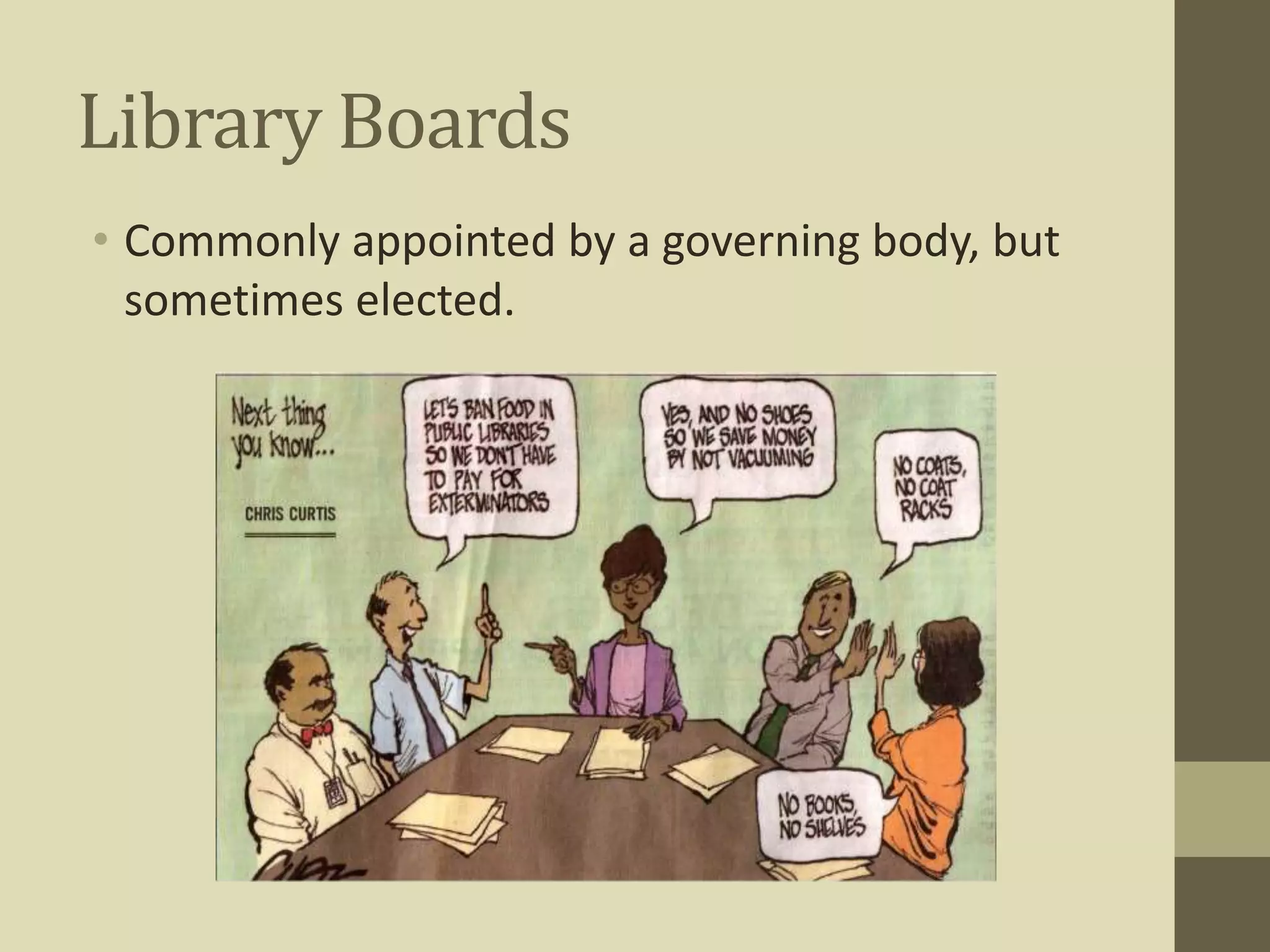
Library Boards 
• Commonly appointed by a governing body, but 
sometimes elected.
Library Boards 
• They have the responsibility for a range of functions: 
• Analysis of community needs 
• Hiring, recommending, and evaluating the public 
library director 
• Acting in an advocacy role to develop community 
support for bond issues and taxation 
• Budget review and approval 
• Policy review and approval 
• Commitment to freedom of inquiry and 
expression 
• Formulation of long range planning.
Library Director 
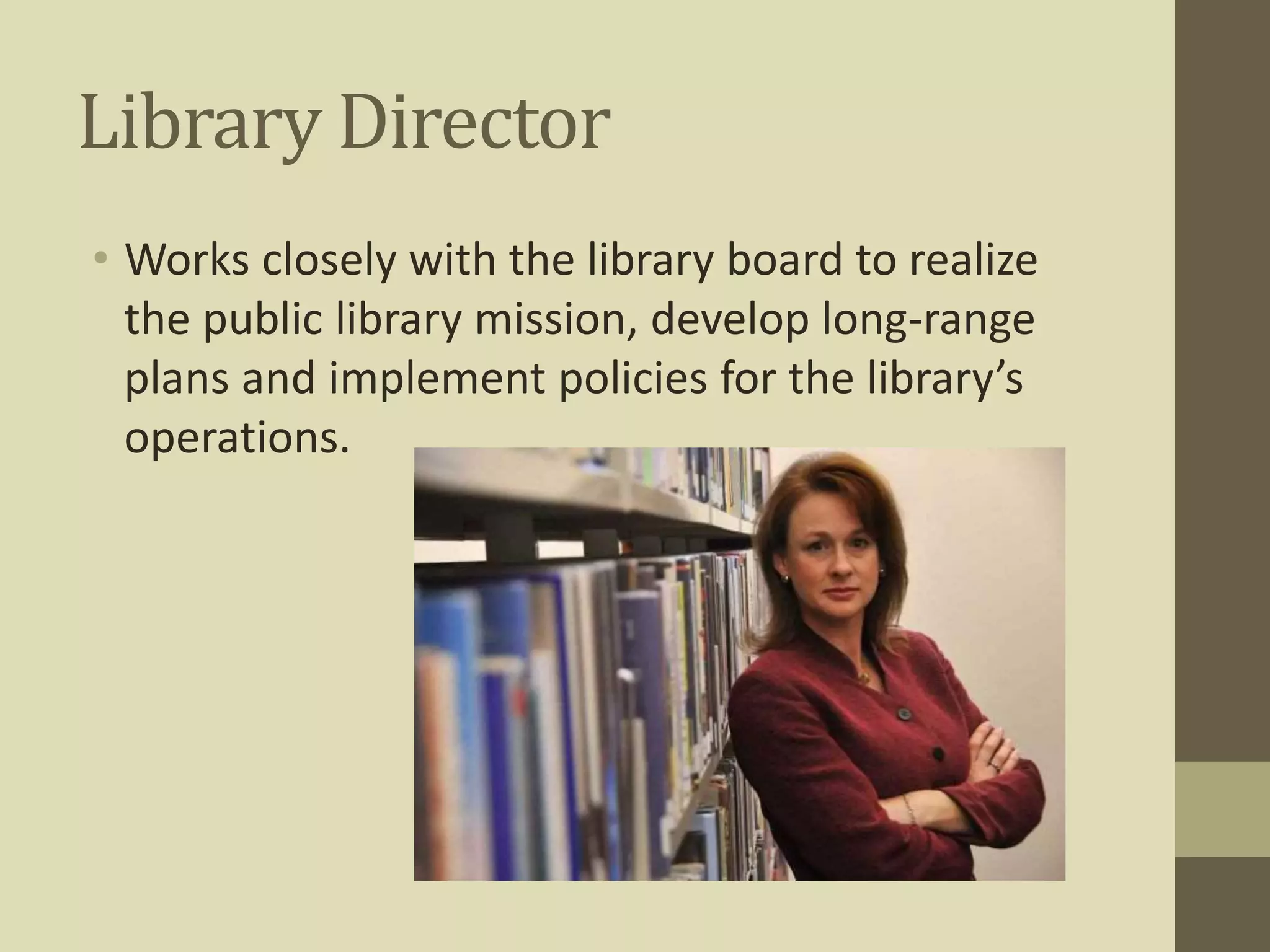
• Works closely with the library board to realize 
the public library mission, develop long-range 
plans and implement policies for the library’s 
operations.
Library Director 
• Directors are expected to handle numerous 
responsibilities, such as the following: 
• Lead the planning cycles 
• Organize human resources 
• Represent the library in the community 
• Oversee financial operations 
• Interact with local, state, and national library entities 
• Develop the library’s fiscal base through development 
and fundraising 
• Manage facilities and technology 
• Plan, design, and evaluate services
Library Director 
• Don Sager (2001), 
summarized the 
knowledge and skills 
required by public library 
directors: 
• People skills 
• Vision 
• Marketing ability 
• Communication 
• Collaborative skills 
• Technical Skills 
• Customer service skills 
• Problem-solving ability 
• Risk taking 
• Self-renewal
Organization of Public Library Staff 
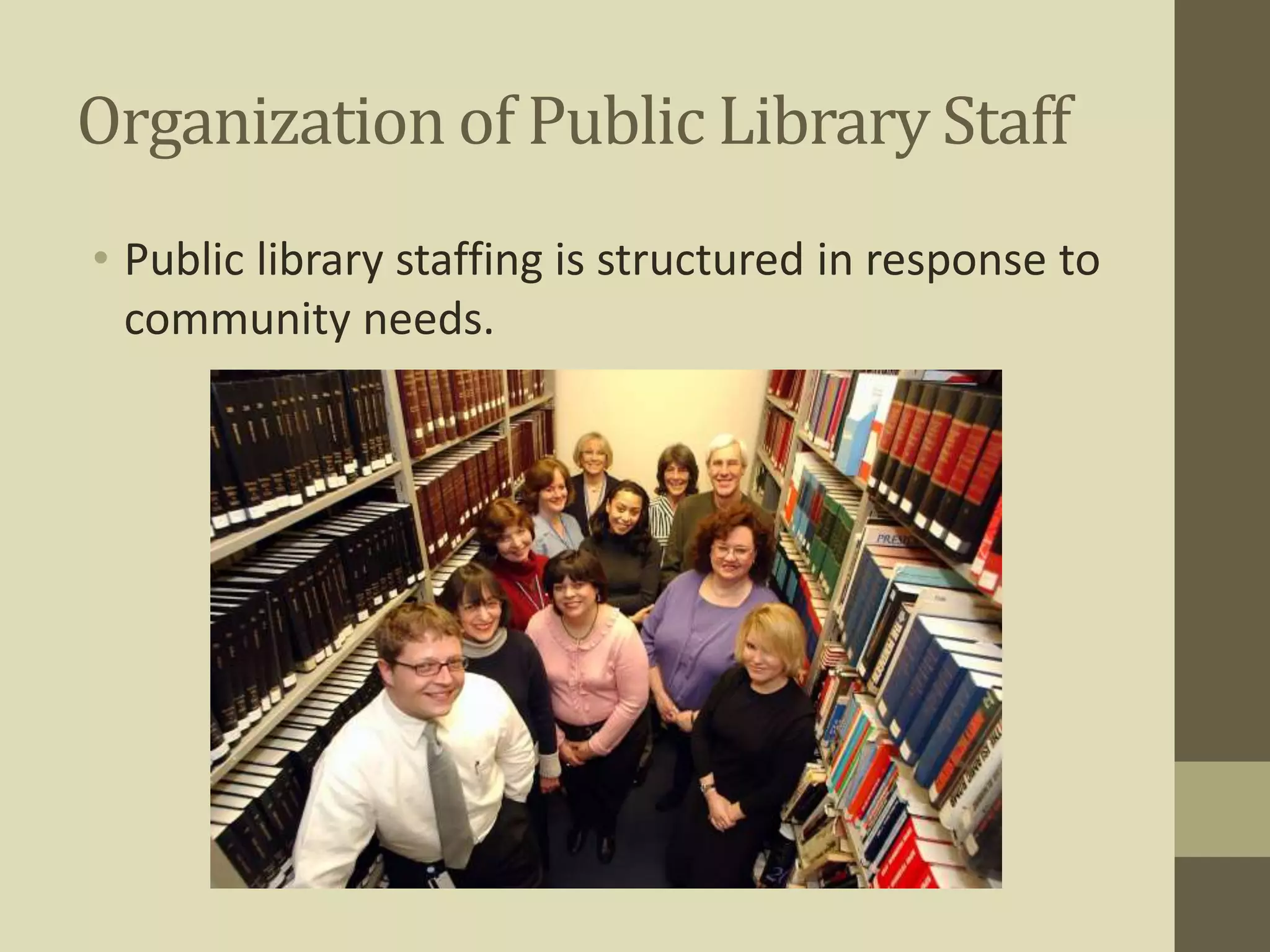
• Public library staffing is structured in response to 
community needs.
Organization of Public Library Staff 
• The Library Support Staff certification Program 
began in 2010—a national certification program 
that allows library support staff to demonstrate 
their competencies and be certified by the ALA. 
• There are no national standards that govern 
staffing patterns for public libraries. 
• Staff is viewed as a resource to be used as 
efficiently and effectively as possible and 
engaged in activities that are most important to 
a library’s mission, goals, and objectives.
Organization of Public Library Staff 
• Nelson, Altman and Mayo (2000), identified the 
aspects of staffing: 
• Identifying activities and when and where they 
will be performed 
• Identifying abilities needed to accomplish 
activities 
• Determining the number of staff in relation to 
patron use and staff workload 
• Understanding how staff currently use their time 
• Determining how to find staff to accomplish the 
library’s priorities
Unions 
• Unions contribute to a stable, productive 
workforce—where workers have a say in 
improving their jobs. 
• Library workers have organized in unions for 
better wages, working conditions and benefits. 
• Unions can help make libraries better by offering 
a collaborative model for employee relations 
that management might want to emulate.
Volunteers 
• Libraries actively solicit the support of volunteers 
for library operations serving in all the areas: 
• Shelving books 
• Checking materials in and out 
• Staffing reference and information desks 
• Providing behind-the-scenes support
Broad-Based Issues Relating to 
Staffing
Recruitment 
• Laura Bush 21st Century Librarian Program, 
funded by the Institute of Museum and Library 
Services (IMLS)—recognizes the key role of 
libraries and librarians in maintaining the flow of 
information critical to support formal education 
and to create a climate for democratic discourse.
Recruitment 
• Support to educate the next generation of 
librarians has focused on public librarians, 
certification of rural librarians, recruitment of 
people of color, and youth services librarians. 
• Public librarians and their associations continue 
to work to broaden the diversity of staff at all 
levels to reflect the diversity of the US 
population.
Staff Development and 
Continuing Education 
• Continuing education is critical to the 
development of excellent library service. 
• Public Library Association (PLA) provides 
ongoing staff development and continuing 
education for public librarians through national 
conferences, meetings and publications.
Staff Development and 
Continuing Education 
• Staff development and continuing education for 
library staff are central to positive performance. 
• Opportunities are made available in variety of 
formats, both internal and external to the 
employing library depending on the library’s size 
and structure. 
• Library-based staff development programs 
include curricula targeted to new knowledge or 
skills generally planned by a staff development 
committee.
ALA-APA and Certification 
• American Library Association-Allied 
Professional Association (ALA-APA) promote 
mutual professional interests of librarians and 
other library workers. This new organization 
focuses on certification of individuals in 
specializations.
ALA-APA and Certification 
• Library Support Staff Certification provides 
education for competency sets including 
foundations, technology, and teamwork.
ALA-APA and Certification 
• Certification can also take place at the state 
level. Many states have certification 
requirements for library directors and other staff. 
• State library agencies have different 
requirements regarding certification and, as one 
might expect each state is different.

Administration and Staffing in Public Libraries

  • 1.
    Administration and Staffingin Public Libraries Prepared by Roxanne Peña
  • 2.
    Introduction • Libraryworkers activate the mission of the public library. • The use of collections, community partnerships, and one-on-one service that supports lifelong learning to people of all ages are facilitated by a qualified and committed staff. • Many people—the library board, library workers, and volunteers—working together shape a library that functions as the heart of the 21st century community.
  • 3.
    Library Boards •Commonly appointed by a governing body, but sometimes elected.
  • 4.
    Library Boards •They have the responsibility for a range of functions: • Analysis of community needs • Hiring, recommending, and evaluating the public library director • Acting in an advocacy role to develop community support for bond issues and taxation • Budget review and approval • Policy review and approval • Commitment to freedom of inquiry and expression • Formulation of long range planning.
  • 5.
    Library Director •Works closely with the library board to realize the public library mission, develop long-range plans and implement policies for the library’s operations.
  • 6.
    Library Director •Directors are expected to handle numerous responsibilities, such as the following: • Lead the planning cycles • Organize human resources • Represent the library in the community • Oversee financial operations • Interact with local, state, and national library entities • Develop the library’s fiscal base through development and fundraising • Manage facilities and technology • Plan, design, and evaluate services
  • 7.
    Library Director •Don Sager (2001), summarized the knowledge and skills required by public library directors: • People skills • Vision • Marketing ability • Communication • Collaborative skills • Technical Skills • Customer service skills • Problem-solving ability • Risk taking • Self-renewal
  • 8.
    Organization of PublicLibrary Staff • Public library staffing is structured in response to community needs.
  • 9.
    Organization of PublicLibrary Staff • The Library Support Staff certification Program began in 2010—a national certification program that allows library support staff to demonstrate their competencies and be certified by the ALA. • There are no national standards that govern staffing patterns for public libraries. • Staff is viewed as a resource to be used as efficiently and effectively as possible and engaged in activities that are most important to a library’s mission, goals, and objectives.
  • 10.
    Organization of PublicLibrary Staff • Nelson, Altman and Mayo (2000), identified the aspects of staffing: • Identifying activities and when and where they will be performed • Identifying abilities needed to accomplish activities • Determining the number of staff in relation to patron use and staff workload • Understanding how staff currently use their time • Determining how to find staff to accomplish the library’s priorities
  • 11.
    Unions • Unionscontribute to a stable, productive workforce—where workers have a say in improving their jobs. • Library workers have organized in unions for better wages, working conditions and benefits. • Unions can help make libraries better by offering a collaborative model for employee relations that management might want to emulate.
  • 12.
    Volunteers • Librariesactively solicit the support of volunteers for library operations serving in all the areas: • Shelving books • Checking materials in and out • Staffing reference and information desks • Providing behind-the-scenes support
  • 13.
  • 14.
    Recruitment • LauraBush 21st Century Librarian Program, funded by the Institute of Museum and Library Services (IMLS)—recognizes the key role of libraries and librarians in maintaining the flow of information critical to support formal education and to create a climate for democratic discourse.
  • 15.
    Recruitment • Supportto educate the next generation of librarians has focused on public librarians, certification of rural librarians, recruitment of people of color, and youth services librarians. • Public librarians and their associations continue to work to broaden the diversity of staff at all levels to reflect the diversity of the US population.
  • 16.
    Staff Development and Continuing Education • Continuing education is critical to the development of excellent library service. • Public Library Association (PLA) provides ongoing staff development and continuing education for public librarians through national conferences, meetings and publications.
  • 17.
    Staff Development and Continuing Education • Staff development and continuing education for library staff are central to positive performance. • Opportunities are made available in variety of formats, both internal and external to the employing library depending on the library’s size and structure. • Library-based staff development programs include curricula targeted to new knowledge or skills generally planned by a staff development committee.
  • 18.
    ALA-APA and Certification • American Library Association-Allied Professional Association (ALA-APA) promote mutual professional interests of librarians and other library workers. This new organization focuses on certification of individuals in specializations.
  • 19.
    ALA-APA and Certification • Library Support Staff Certification provides education for competency sets including foundations, technology, and teamwork.
  • 20.
    ALA-APA and Certification • Certification can also take place at the state level. Many states have certification requirements for library directors and other staff. • State library agencies have different requirements regarding certification and, as one might expect each state is different.