MARC -21 (Machine
Readable Catalogue)
Dr.P.PADMA
Assistant Professor
DOLIS
Introduction
A MARC record is a Machine-Readable Cataloguing record. It is a
format standard for the storage and exchange of bibliographic records
and related information in machine. It is a standard for the description
of the digital format of any item. This is a computerized method of
recording the information for cataloguing purpose. These computer
readable cataloguing records will help the computer programs to
search for an display specified pieces of the information stored in a
cataloguing record.
Machine-readable
“Machine-readable” means
that one particular type of
machine, a computer, can
read and interpret the data in
the cataloguing record.
Catalogue
Record
“Cataloguing record” means a
bibliographic record, or the
information traditionally shown on a
catalogue card. The record includes
(not necessarily in this order):
 a description of the item,
 main entry and added entries,
subject headings, and
the classification or call number.
MARC 21
 MARC (MAchine-Readable Cataloging) standards are a set of digital formats for the
description of items catalogued by libraries, such as books. Working with the Library of
Congress, American computer scientist Henriette Avram developed MARC in the 1960s to
create records that could be read by computers and shared among libraries. By 1971, MARC
formats had become the US national standard for dissemination of bibliographic data. Two
years later, they became the international standard. There are several versions of MARC in
use around the world, the most predominant being MARC 21, created in 1999 as a result of
the harmonization of U.S. and Canadian MARC formats, and UNIMARC, widely used in
Europe. The MARC 21 family of standards now includes formats for authority records,
holdings records, classification schedules, and community information, in addition to the
format for bibliographic records.
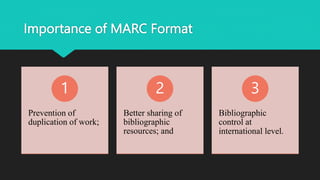
Importance of MARC Format
Prevention of
duplication of work;
1
Better sharing of
bibliographic
resources; and
2
Bibliographic
control at
international level.
3
MARC 21 Record System
 Record structure
 Content designation
 Data content
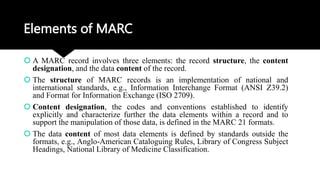
Elements of MARC
 A MARC record involves three elements: the record structure, the content
designation, and the data content of the record.
 The structure of MARC records is an implementation of national and
international standards, e.g., Information Interchange Format (ANSI Z39.2)
and Format for Information Exchange (ISO 2709).
 Content designation, the codes and conventions established to identify
explicitly and characterize further the data elements within a record and to
support the manipulation of those data, is defined in the MARC 21 formats.
 The data content of most data elements is defined by standards outside the
formats, e.g., Anglo-American Cataloguing Rules, Library of Congress Subject
Headings, National Library of Medicine Classification.
MARC Record
Strucutre
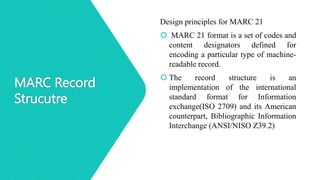
Design principles for MARC 21
 MARC 21 format is a set of codes and
content designators defined for
encoding a particular type of machine-
readable record.
 The record structure is an
implementation of the international
standard format for Information
exchange(ISO 2709) and its American
counterpart, Bibliographic Information
Interchange (ANSI/NISO Z39.2)
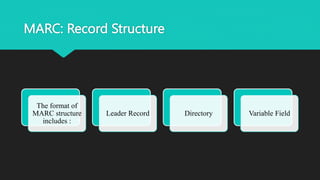
MARC: Record Structure
The format of
MARC structure
includes :
Leader Record Directory Variable Field
Leader
 The leader is the first 24 characters of the records. Each position has an
assigned meaning, but much of information in the leader is for computer use.
Leader provides information about the ensuing record such as the total length
of the record, type of the record code and the bibliographic level.
Record
Directory
 Immediately following the leader, the
directory begins. Directory tells what
variable fields are in the record and
where they are placed. There is a 12
characters record directory for each
variable field. The record directory
helps in the retrieval of select fields
from the record. The directory ends
with a field terminator character
Variable Fields
 The variable fields follow the leader and the
directory in the record and consist of control fields
and data fields. Control fields preceded data fields in
the record and are arranged in the same sequence as
the corresponding entries in the directory.
Content
Designation
Fixed fields
The variable fields
Tags
Indicators
Delimiters
Subfield Codes
Fixed Field
 Each bibliographic record is divided logically into fields.
 There is a field for the author, a field for title information and so on.
 These fields are subdivided into one or more “subfields”. They are represented by
3-digit tags. Many tag field has equip the possibility and responsibility to use
subfield to encode additional information
 The subfield data designated and interpreted by man.
Variable data fields
 The remaining variable fields
defined in the format. In addition to
being identified by a field tag in the
Directory, variable data fields
contain two indicator
positions stored at the beginning of
each field and a two-
character subfield code preceding
each data element within the field.
Tags
 Each field is associated with 3-digit number called a “tag”.
 A tag identifies the field --the kind of data-- That follows.
 MARC 21 formats use only numeric tags.
 The tag stored in the directory entry for the field, not in the field itself.
 Here the number 100 is the tag 100 1# Sa Pirsig, Robert M.  Variable field tags are defined in
blocks according to the first character of the tag, which with some exceptions, identifies the
general function of the field’s data within a record.
 The type of information in the field is identified by the remainder of the tag.
 The meaning of these blocks depends upon the type of record
Indicators
 Digits or blanks that give the computer instructions or information about the data contained in the
field.
 Two character positions follow each tag(with the exception of fields 001 through 009).
 One or both of these character positions may be used for indicators.
 When an indicators position is not used, that indicator is referred to as “undefined” and the
position is left blank
 It is the convention to represent a blank, or undefined, indicator position by the character “
Subfield Codes
 Single letters or digits indicate what type of information is in a subfield .
 Subfield are smaller piece of information
 You can have more than one subfield
Data
Content
Description
Subject headings
Classification numbers
Main and added entries
Advantages of MARC -21
 Easily duplicated and standardized.
 Can carry data formulated by different cataloguing rules and conventions
 Transmits data from one system to another
 Alllow libraries to share authority data that is predictable and reliable
 Can be formatted for any types of library
 Improves ease, efficiency and cooperation
Problems with MARC 21
 Not enough focus on electronic resources
 Too complex • Redundant data (fixed Vs. Variable fields)
 Lack of explicit hierarchical levels
 Controlled values embedded in the standard
 Limitation of available fields, subfields, indicator values, etc.
 English language and western oriented
Conclusion
 MARC 21 is not a cataloguing standard, it is a Communication standard and
a framework for exchanging catalogue records .MARC 21 = USMARC +
CAN/MARC . MARC 21 developed in 1997-98 & 1st published in 1999 as
named MARC 21 .MARC 21 record acts as a uniform record structure for
the representation of disparate information types .MARC 21 may appear
difficult at first, but with knowledge and use, it will begin to make sense. As
you become more familiar with MARC, the simpler it will become.

MARC -21.pptx

  • 1.
    MARC -21 (Machine ReadableCatalogue) Dr.P.PADMA Assistant Professor DOLIS
  • 2.
    Introduction A MARC recordis a Machine-Readable Cataloguing record. It is a format standard for the storage and exchange of bibliographic records and related information in machine. It is a standard for the description of the digital format of any item. This is a computerized method of recording the information for cataloguing purpose. These computer readable cataloguing records will help the computer programs to search for an display specified pieces of the information stored in a cataloguing record.
  • 3.
    Machine-readable “Machine-readable” means that oneparticular type of machine, a computer, can read and interpret the data in the cataloguing record.
  • 4.
    Catalogue Record “Cataloguing record” meansa bibliographic record, or the information traditionally shown on a catalogue card. The record includes (not necessarily in this order):  a description of the item,  main entry and added entries, subject headings, and the classification or call number.
  • 5.
    MARC 21  MARC(MAchine-Readable Cataloging) standards are a set of digital formats for the description of items catalogued by libraries, such as books. Working with the Library of Congress, American computer scientist Henriette Avram developed MARC in the 1960s to create records that could be read by computers and shared among libraries. By 1971, MARC formats had become the US national standard for dissemination of bibliographic data. Two years later, they became the international standard. There are several versions of MARC in use around the world, the most predominant being MARC 21, created in 1999 as a result of the harmonization of U.S. and Canadian MARC formats, and UNIMARC, widely used in Europe. The MARC 21 family of standards now includes formats for authority records, holdings records, classification schedules, and community information, in addition to the format for bibliographic records.
  • 6.
    Importance of MARCFormat Prevention of duplication of work; 1 Better sharing of bibliographic resources; and 2 Bibliographic control at international level. 3
  • 7.
    MARC 21 RecordSystem MARC 21 Record System  Record structure  Content designation  Data content
  • 8.
    Elements of MARC A MARC record involves three elements: the record structure, the content designation, and the data content of the record.  The structure of MARC records is an implementation of national and international standards, e.g., Information Interchange Format (ANSI Z39.2) and Format for Information Exchange (ISO 2709).  Content designation, the codes and conventions established to identify explicitly and characterize further the data elements within a record and to support the manipulation of those data, is defined in the MARC 21 formats.  The data content of most data elements is defined by standards outside the formats, e.g., Anglo-American Cataloguing Rules, Library of Congress Subject Headings, National Library of Medicine Classification.
  • 9.
    MARC Record Strucutre Design principlesfor MARC 21  MARC 21 format is a set of codes and content designators defined for encoding a particular type of machine- readable record.  The record structure is an implementation of the international standard format for Information exchange(ISO 2709) and its American counterpart, Bibliographic Information Interchange (ANSI/NISO Z39.2)
  • 10.
    MARC: Record Structure Theformat of MARC structure includes : Leader Record Directory Variable Field
  • 11.
    Leader  The leaderis the first 24 characters of the records. Each position has an assigned meaning, but much of information in the leader is for computer use. Leader provides information about the ensuing record such as the total length of the record, type of the record code and the bibliographic level.
  • 12.
    Record Directory  Immediately followingthe leader, the directory begins. Directory tells what variable fields are in the record and where they are placed. There is a 12 characters record directory for each variable field. The record directory helps in the retrieval of select fields from the record. The directory ends with a field terminator character
  • 13.
    Variable Fields  Thevariable fields follow the leader and the directory in the record and consist of control fields and data fields. Control fields preceded data fields in the record and are arranged in the same sequence as the corresponding entries in the directory.
  • 14.
    Content Designation Fixed fields The variablefields Tags Indicators Delimiters Subfield Codes
  • 15.
    Fixed Field  Eachbibliographic record is divided logically into fields.  There is a field for the author, a field for title information and so on.  These fields are subdivided into one or more “subfields”. They are represented by 3-digit tags. Many tag field has equip the possibility and responsibility to use subfield to encode additional information  The subfield data designated and interpreted by man.
  • 16.
    Variable data fields The remaining variable fields defined in the format. In addition to being identified by a field tag in the Directory, variable data fields contain two indicator positions stored at the beginning of each field and a two- character subfield code preceding each data element within the field.
  • 17.
    Tags  Each fieldis associated with 3-digit number called a “tag”.  A tag identifies the field --the kind of data-- That follows.  MARC 21 formats use only numeric tags.  The tag stored in the directory entry for the field, not in the field itself.  Here the number 100 is the tag 100 1# Sa Pirsig, Robert M.  Variable field tags are defined in blocks according to the first character of the tag, which with some exceptions, identifies the general function of the field’s data within a record.  The type of information in the field is identified by the remainder of the tag.  The meaning of these blocks depends upon the type of record
  • 18.
    Indicators  Digits orblanks that give the computer instructions or information about the data contained in the field.  Two character positions follow each tag(with the exception of fields 001 through 009).  One or both of these character positions may be used for indicators.  When an indicators position is not used, that indicator is referred to as “undefined” and the position is left blank  It is the convention to represent a blank, or undefined, indicator position by the character “
  • 19.
    Subfield Codes  Singleletters or digits indicate what type of information is in a subfield .  Subfield are smaller piece of information  You can have more than one subfield
  • 20.
  • 21.
    Advantages of MARC-21  Easily duplicated and standardized.  Can carry data formulated by different cataloguing rules and conventions  Transmits data from one system to another  Alllow libraries to share authority data that is predictable and reliable  Can be formatted for any types of library  Improves ease, efficiency and cooperation
  • 22.
    Problems with MARC21  Not enough focus on electronic resources  Too complex • Redundant data (fixed Vs. Variable fields)  Lack of explicit hierarchical levels  Controlled values embedded in the standard  Limitation of available fields, subfields, indicator values, etc.  English language and western oriented
  • 23.
    Conclusion  MARC 21is not a cataloguing standard, it is a Communication standard and a framework for exchanging catalogue records .MARC 21 = USMARC + CAN/MARC . MARC 21 developed in 1997-98 & 1st published in 1999 as named MARC 21 .MARC 21 record acts as a uniform record structure for the representation of disparate information types .MARC 21 may appear difficult at first, but with knowledge and use, it will begin to make sense. As you become more familiar with MARC, the simpler it will become.