A good name is better than riches.
Arbeit gibt Brot, Faulheit bringt Not.
Audi multa, loquere pauca.
 The Middle English period saw the breakdown of
the inflectional system of Old English and the expansion
of vocabulary with many borrowings from French and Latin.
 1150 Approximate date of the earliest surviving texts in Middl
English.
 1171 Henry II declares himself overlord of Ireland, introducing
Norman French and English to the country. About this time the
University of Oxford is founded.
 1204 King John loses control of the Duchy of Normandy and
other French lands; England is now the only home of the
Norman French/English.
 1209 The University of Cambridge is formed by scholars from
Oxford.
 1215 King John signs the Magna Carta ("Great Charter"), a
critical document in the long historical process leading to the
rule of constitutional law in the English-speaking world.
Henry II
The University of Cambridge
 1215 King John signs the Magna Carta ("Great
Charter"), a critical document in the long historical
process leading to the rule of constitutional law in
the English-speaking world.
 1258 King Henry III is forced to accept the
Provisions of Oxford, which establish a Privy
Council to oversee the administration of the
government. These documents, though annulled a
few years later, are generally regarded as England's
first written constitution.
 Late 13th century Under Edward I, royal authority
is consolidated in England and Wales. English
becomes the dominant language of all classes.
King John
King Henry III
Edward I
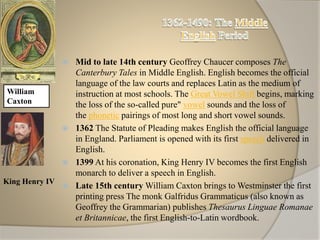
 Mid to late 14th century Geoffrey Chaucer composes The
Canterbury Tales in Middle English. English becomes the official
language of the law courts and replaces Latin as the medium of
instruction at most schools. The Great Vowel Shift begins, marking
the loss of the so-called pure" vowel sounds and the loss of
the phonetic pairings of most long and short vowel sounds.
 1362 The Statute of Pleading makes English the official language
in England. Parliament is opened with its first speech delivered in
English.
 1399 At his coronation, King Henry IV becomes the first English
monarch to deliver a speech in English.
 Late 15th century William Caxton brings to Westminster the first
printing press The monk Galfridus Grammaticus (also known as
Geoffrey the Grammarian) publishes Thesaurus Linguae Romanae
et Britannicae, the first English-to-Latin wordbook.
William
Caxton
King Henry IV
MIDDLE ENGLISH PHONETICS
The stress is dynamic and fixed in the
native words. But in the borrowed
French words the stress was on the
last syllable: licour [li’ku:r],
nature [na’nr.r],
Otto Jespersen
The Great Vowel Shift was a massive sound change
affecting the long vowels of English during
the fifteenth to eighteenth centuries
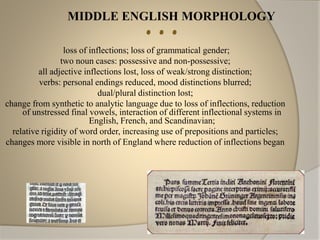
…loss of inflections; loss of grammatical gender;
two noun cases: possessive and non-possessive;
all adjective inflections lost, loss of weak/strong distinction;
verbs: personal endings reduced, mood distinctions blurred;
dual/plural distinction lost;
change from synthetic to analytic language due to loss of inflections, reduction
of unstressed final vowels, interaction of different inflectional systems in
English, French, and Scandinavian;
relative rigidity of word order, increasing use of prepositions and particles;
changes more visible in north of England where reduction of inflections began
MIDDLE ENGLISH MORPHOLOGY
MIDDLE ENGLISH
Adjective before noun (erthely servaunt); articles: indefinite article
(a/an) derived from numeral “one”;
isolated possessive marker (the raven is neste);
analytic possessive (of); group possessive (the Duke’s place of
Lancastre); double possessive (obligacion of myn); noun adjuncts
(perselly rotes, fenell rotes);
negative ne before verb (I nolde fange); double negatives freely used;
prepositions before objects; sometimes followed if object was
pronoun (he seyde him to);
verb phrases: origin of compound verb phrases; perfect tense became
common, use of auxiliaries (be & have);
progressive tense came into being; passive constructions (with ‘be’ as
auxiliary);
future tense (with shall and will auxiliaries); modal auxiliaries instead of
subjunctive (may, might, be going to, be about to); do in periphrastic
constructions indicating tense (doth serve);
impersonal verbs and dummy subjects (me thristed, hit me likede);
clauses: trend toward modern word order,
 1. Scandinavian (those who came in the end of the
Old English period) — over 500 words (take, give,
sky, wrong, etc.);
 2. French (the language of the Norman conquerors)
— over 3500 words (government, army, battle, etc.).
Though the number of the French words is greater,
all the Scandinavian words — common, colloquial,
everyday, indispensable — entered the very core of
the language, and their influence is very great. The
French words are generally terms indispensable only
in certain official spheres, but not colloquial.
I
S
H
V
O
C
A
B
U
L
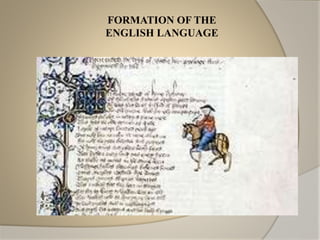
FORMATION OF THE
ENGLISH LANGUAGE
FORMATION OF THE
ENGLISH LANGUAGE
 The English national language was
formed on the basis of the London
dialect, which was uppermost among
Middle English dialects due to the
political, geographical, economic and
“linguistic” position of London which
became the capital of England already in
the 11th century
MIDDLE ENGLISH LANGUAGE �

MIDDLE ENGLISH LANGUAGE

  • 1.
    A good nameis better than riches. Arbeit gibt Brot, Faulheit bringt Not. Audi multa, loquere pauca.
  • 2.
     The MiddleEnglish period saw the breakdown of the inflectional system of Old English and the expansion of vocabulary with many borrowings from French and Latin.  1150 Approximate date of the earliest surviving texts in Middl English.  1171 Henry II declares himself overlord of Ireland, introducing Norman French and English to the country. About this time the University of Oxford is founded.  1204 King John loses control of the Duchy of Normandy and other French lands; England is now the only home of the Norman French/English.  1209 The University of Cambridge is formed by scholars from Oxford.  1215 King John signs the Magna Carta ("Great Charter"), a critical document in the long historical process leading to the rule of constitutional law in the English-speaking world. Henry II The University of Cambridge
  • 3.
     1215 KingJohn signs the Magna Carta ("Great Charter"), a critical document in the long historical process leading to the rule of constitutional law in the English-speaking world.  1258 King Henry III is forced to accept the Provisions of Oxford, which establish a Privy Council to oversee the administration of the government. These documents, though annulled a few years later, are generally regarded as England's first written constitution.  Late 13th century Under Edward I, royal authority is consolidated in England and Wales. English becomes the dominant language of all classes. King John King Henry III Edward I
  • 4.
     Mid tolate 14th century Geoffrey Chaucer composes The Canterbury Tales in Middle English. English becomes the official language of the law courts and replaces Latin as the medium of instruction at most schools. The Great Vowel Shift begins, marking the loss of the so-called pure" vowel sounds and the loss of the phonetic pairings of most long and short vowel sounds.  1362 The Statute of Pleading makes English the official language in England. Parliament is opened with its first speech delivered in English.  1399 At his coronation, King Henry IV becomes the first English monarch to deliver a speech in English.  Late 15th century William Caxton brings to Westminster the first printing press The monk Galfridus Grammaticus (also known as Geoffrey the Grammarian) publishes Thesaurus Linguae Romanae et Britannicae, the first English-to-Latin wordbook. William Caxton King Henry IV
  • 5.
    MIDDLE ENGLISH PHONETICS Thestress is dynamic and fixed in the native words. But in the borrowed French words the stress was on the last syllable: licour [li’ku:r], nature [na’nr.r], Otto Jespersen The Great Vowel Shift was a massive sound change affecting the long vowels of English during the fifteenth to eighteenth centuries
  • 6.
    …loss of inflections;loss of grammatical gender; two noun cases: possessive and non-possessive; all adjective inflections lost, loss of weak/strong distinction; verbs: personal endings reduced, mood distinctions blurred; dual/plural distinction lost; change from synthetic to analytic language due to loss of inflections, reduction of unstressed final vowels, interaction of different inflectional systems in English, French, and Scandinavian; relative rigidity of word order, increasing use of prepositions and particles; changes more visible in north of England where reduction of inflections began MIDDLE ENGLISH MORPHOLOGY
  • 7.
    MIDDLE ENGLISH Adjective beforenoun (erthely servaunt); articles: indefinite article (a/an) derived from numeral “one”; isolated possessive marker (the raven is neste); analytic possessive (of); group possessive (the Duke’s place of Lancastre); double possessive (obligacion of myn); noun adjuncts (perselly rotes, fenell rotes); negative ne before verb (I nolde fange); double negatives freely used; prepositions before objects; sometimes followed if object was pronoun (he seyde him to); verb phrases: origin of compound verb phrases; perfect tense became common, use of auxiliaries (be & have); progressive tense came into being; passive constructions (with ‘be’ as auxiliary); future tense (with shall and will auxiliaries); modal auxiliaries instead of subjunctive (may, might, be going to, be about to); do in periphrastic constructions indicating tense (doth serve); impersonal verbs and dummy subjects (me thristed, hit me likede); clauses: trend toward modern word order,
  • 8.
     1. Scandinavian(those who came in the end of the Old English period) — over 500 words (take, give, sky, wrong, etc.);  2. French (the language of the Norman conquerors) — over 3500 words (government, army, battle, etc.). Though the number of the French words is greater, all the Scandinavian words — common, colloquial, everyday, indispensable — entered the very core of the language, and their influence is very great. The French words are generally terms indispensable only in certain official spheres, but not colloquial. I S H V O C A B U L
  • 9.
  • 10.
    FORMATION OF THE ENGLISHLANGUAGE  The English national language was formed on the basis of the London dialect, which was uppermost among Middle English dialects due to the political, geographical, economic and “linguistic” position of London which became the capital of England already in the 11th century