
A Brief History
of the
English Language
Prepared by
ZIA UR REHMAN
Lecturer in English
Cadet College Kohat
Pakistan
ENGLISH
ENGLISH
ENGLISH
ENGLISH
ENGLISH
ENGLISH
A Brief History
of the
English Language
( Why English is Hard to Spell! )
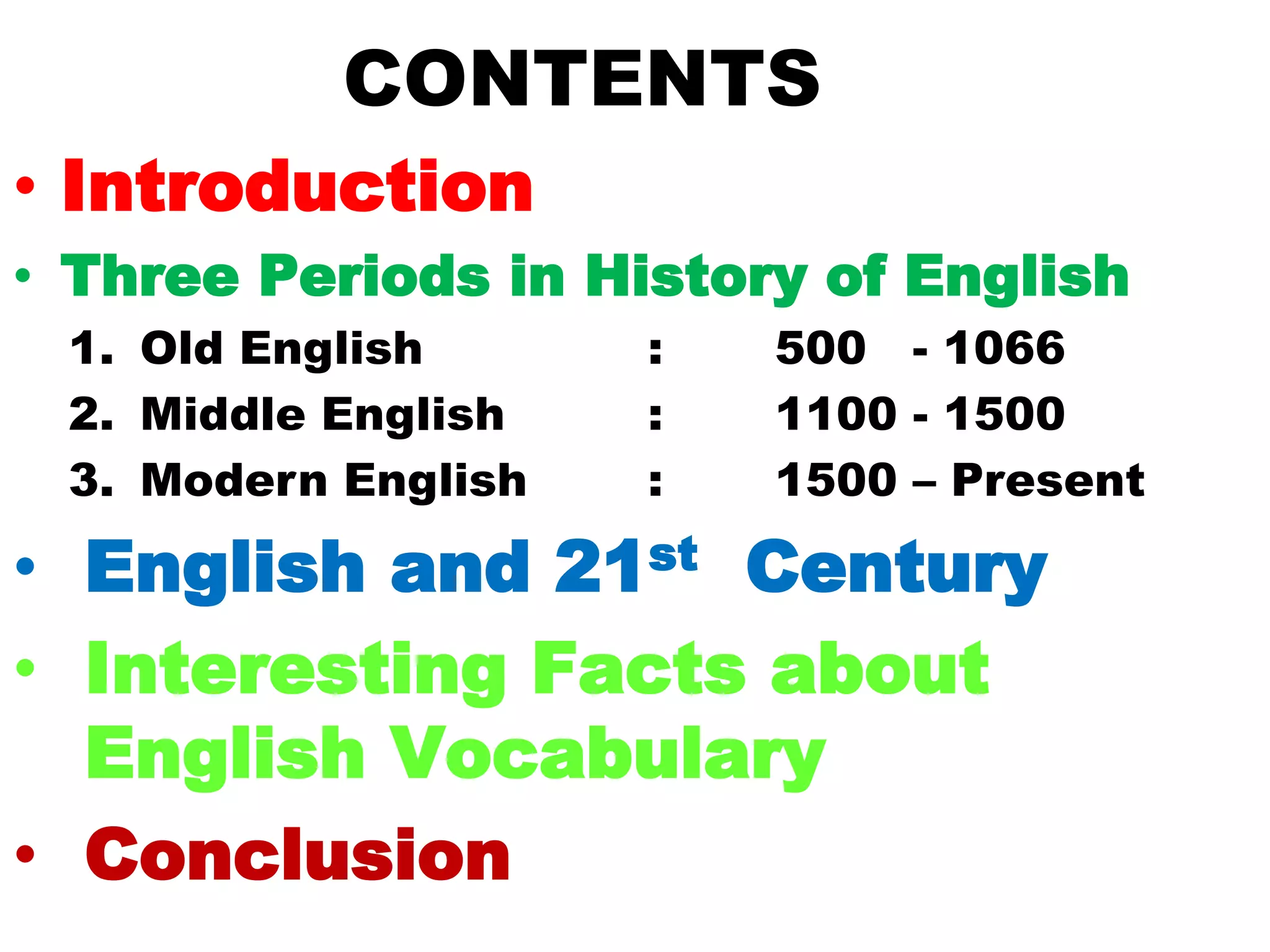
CONTENTS
• Introduction
• Three Periods in History of English
1. Old English : 500 - 1066
2. Middle English : 1100 - 1500
3. Modern English : 1500 – Present
• English and 21st Century
• Interesting Facts about
English Vocabulary
• Conclusion
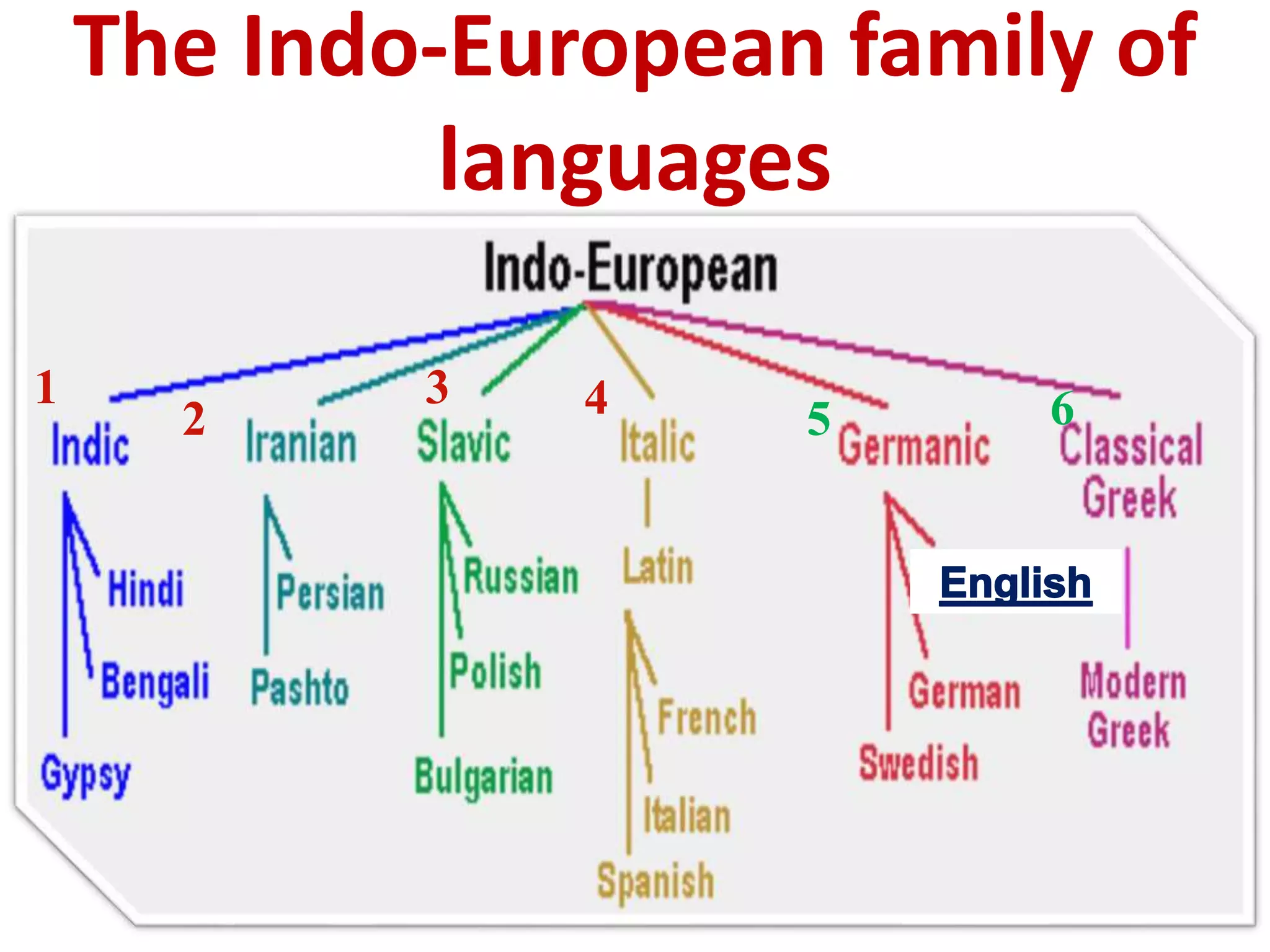
The Indo-European family of
languages
1
2
3 4 5 6
English is the official language
of How many nations.
about
45Countries
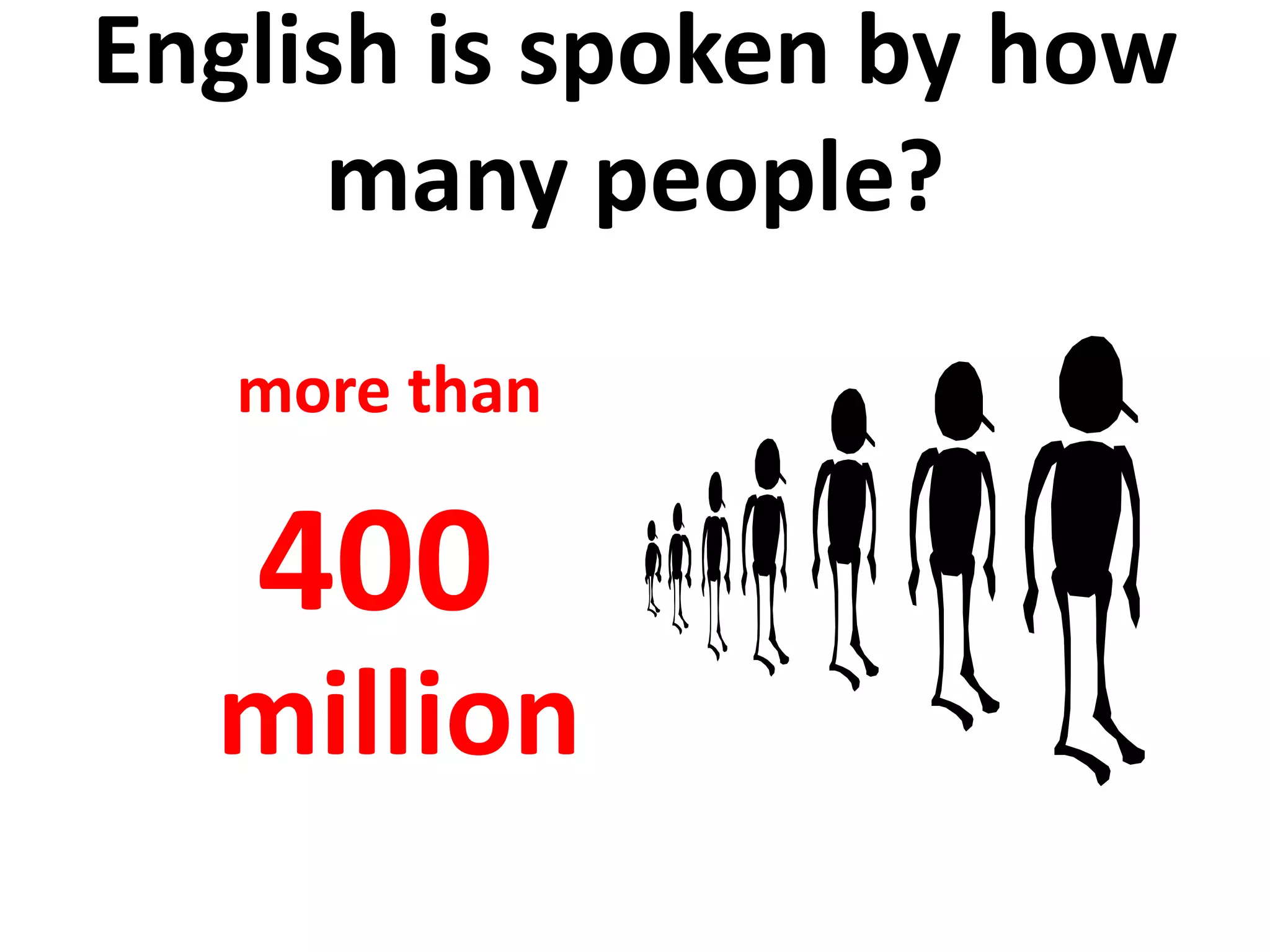
English is spoken by how
many people?
more than
400
million
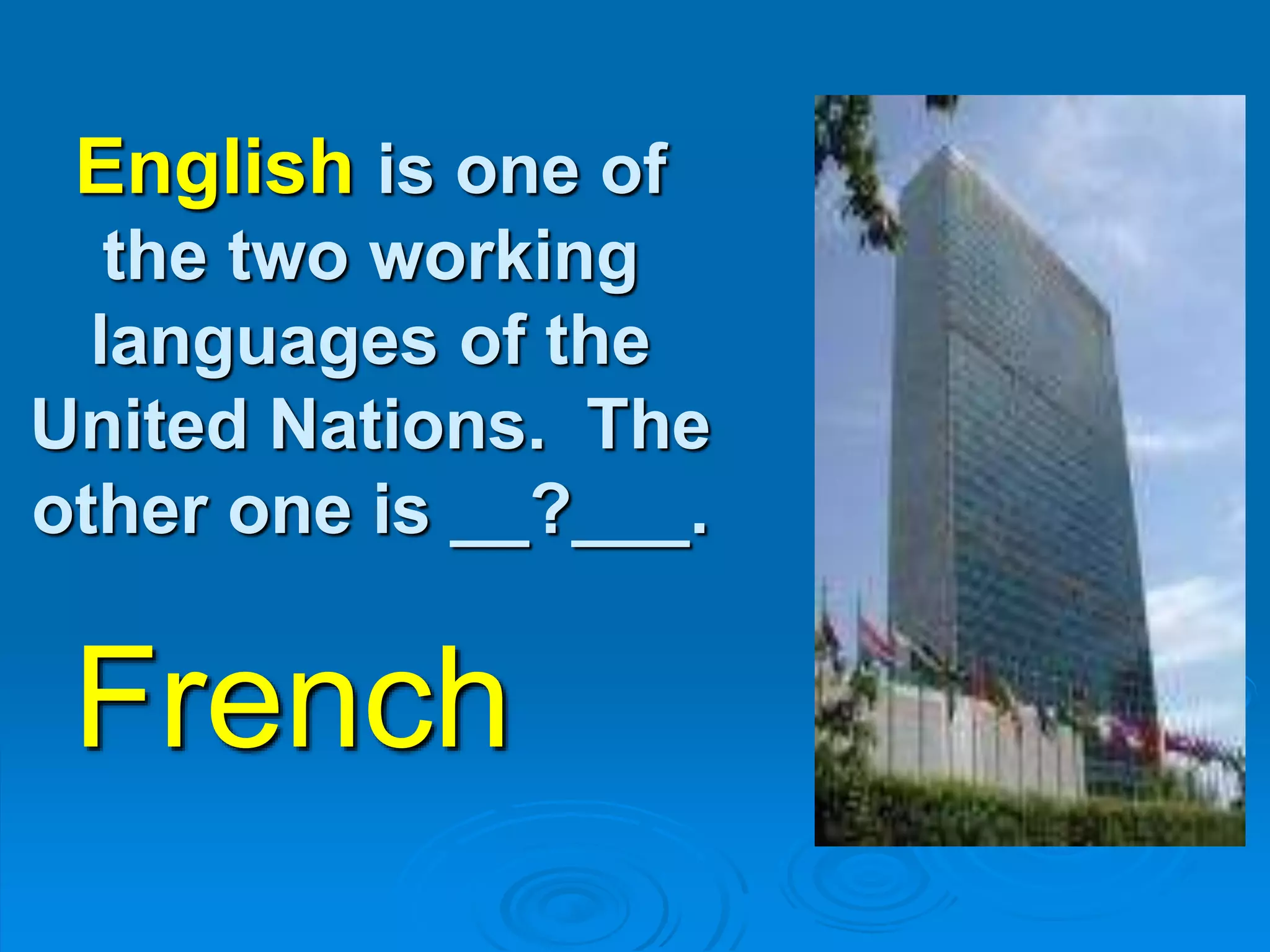
English is one of
the two working
languages of the
United Nations. The
other one is __?___.
French
English is the mother tongue
of the people in the British
Isles, USA, Australia, New
Zealand.
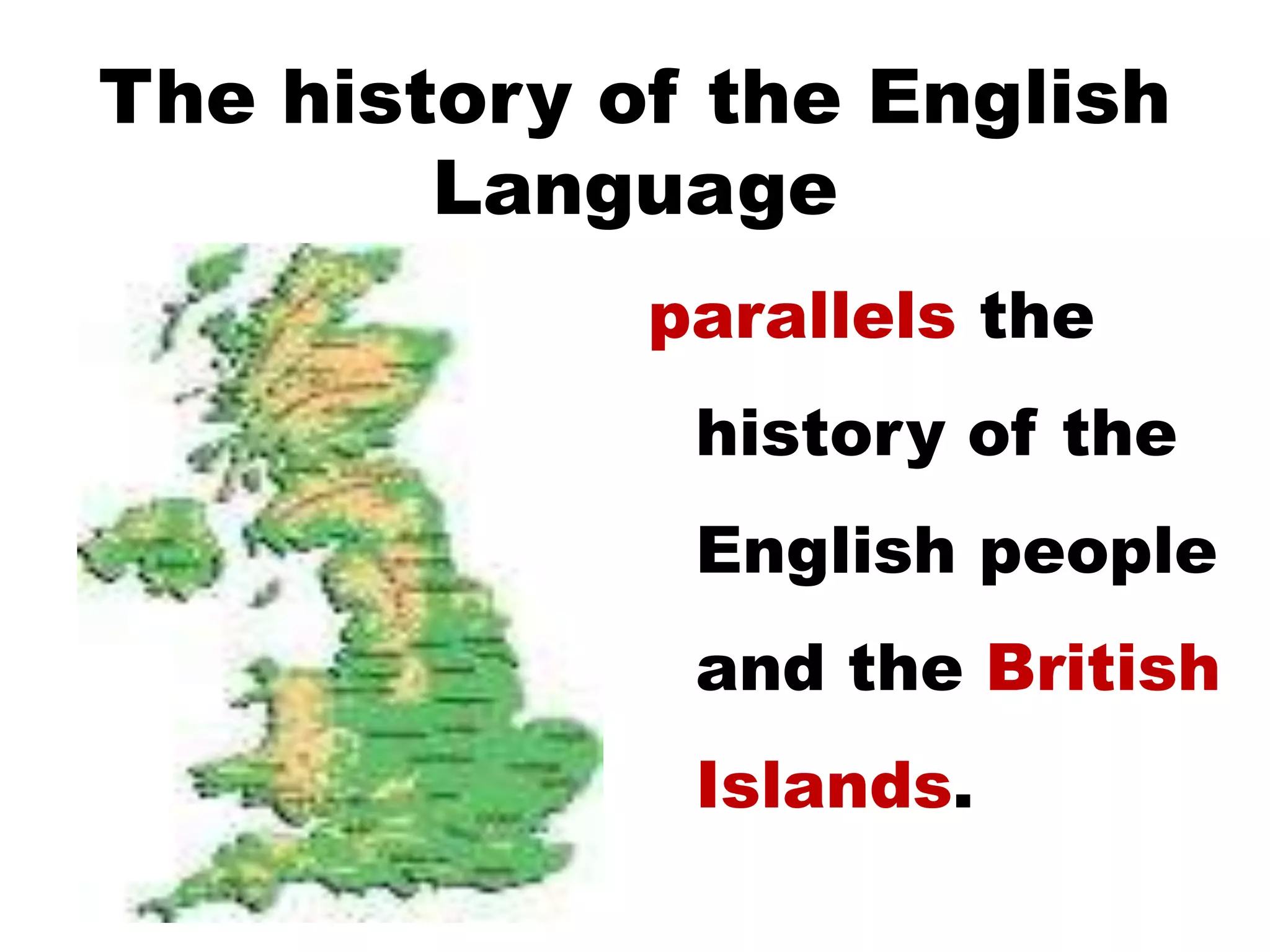
The history of the English
Language
parallels the
history of the
English people
and the British
Islands.
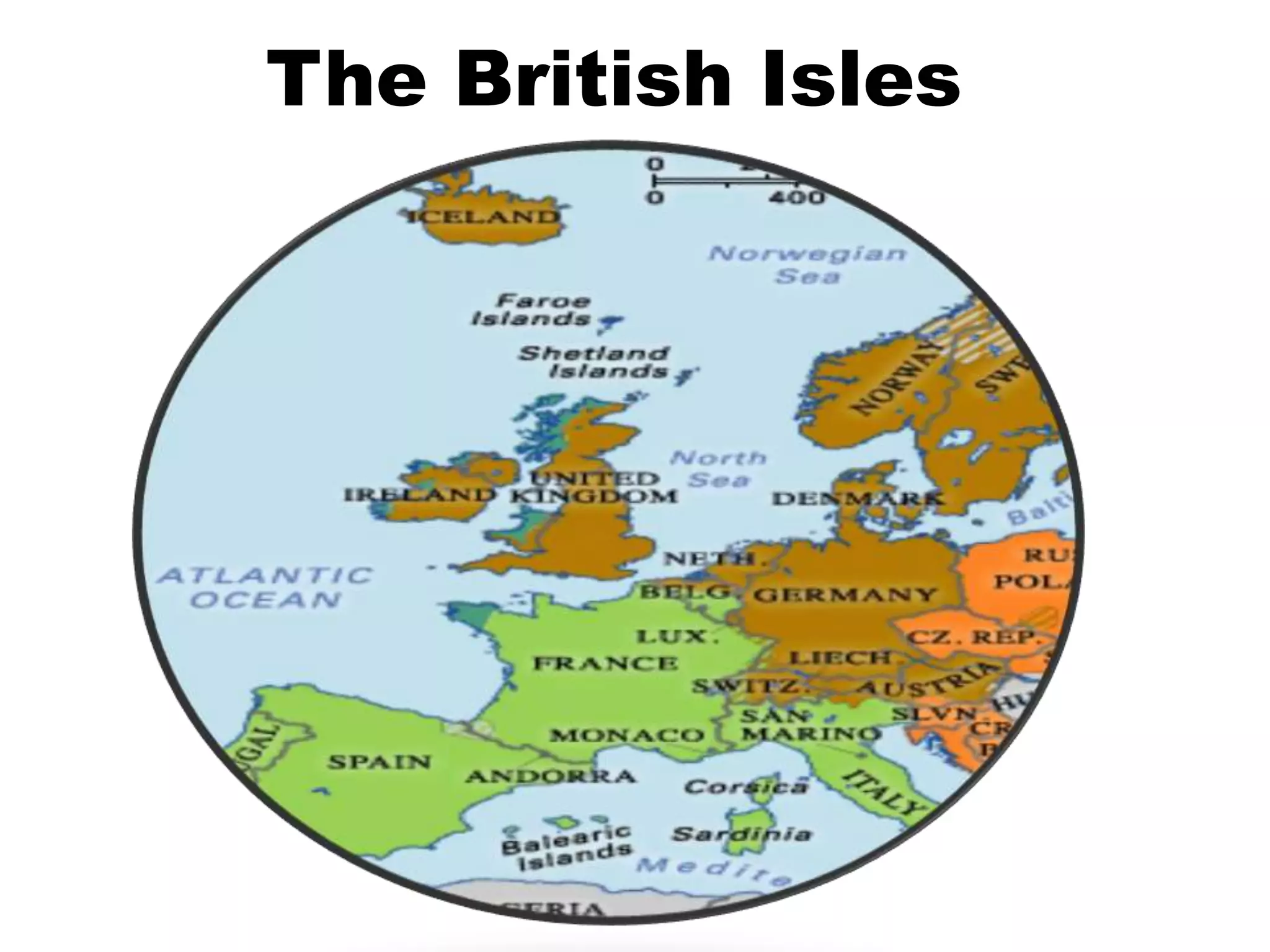
The British Isles
English spread because
of
British exploration, colonization,
and empire building during the
 17th
 18th
 And 19th centuries
Periods in History of English
1. Old English : 500-1066
2. Middle English :1100-1500
3. Modern English : 1500 – Present
An Englishman of 1300 AD wouldn’t
have understood the English of 500
AD; nor would he understand the
English we speak today.
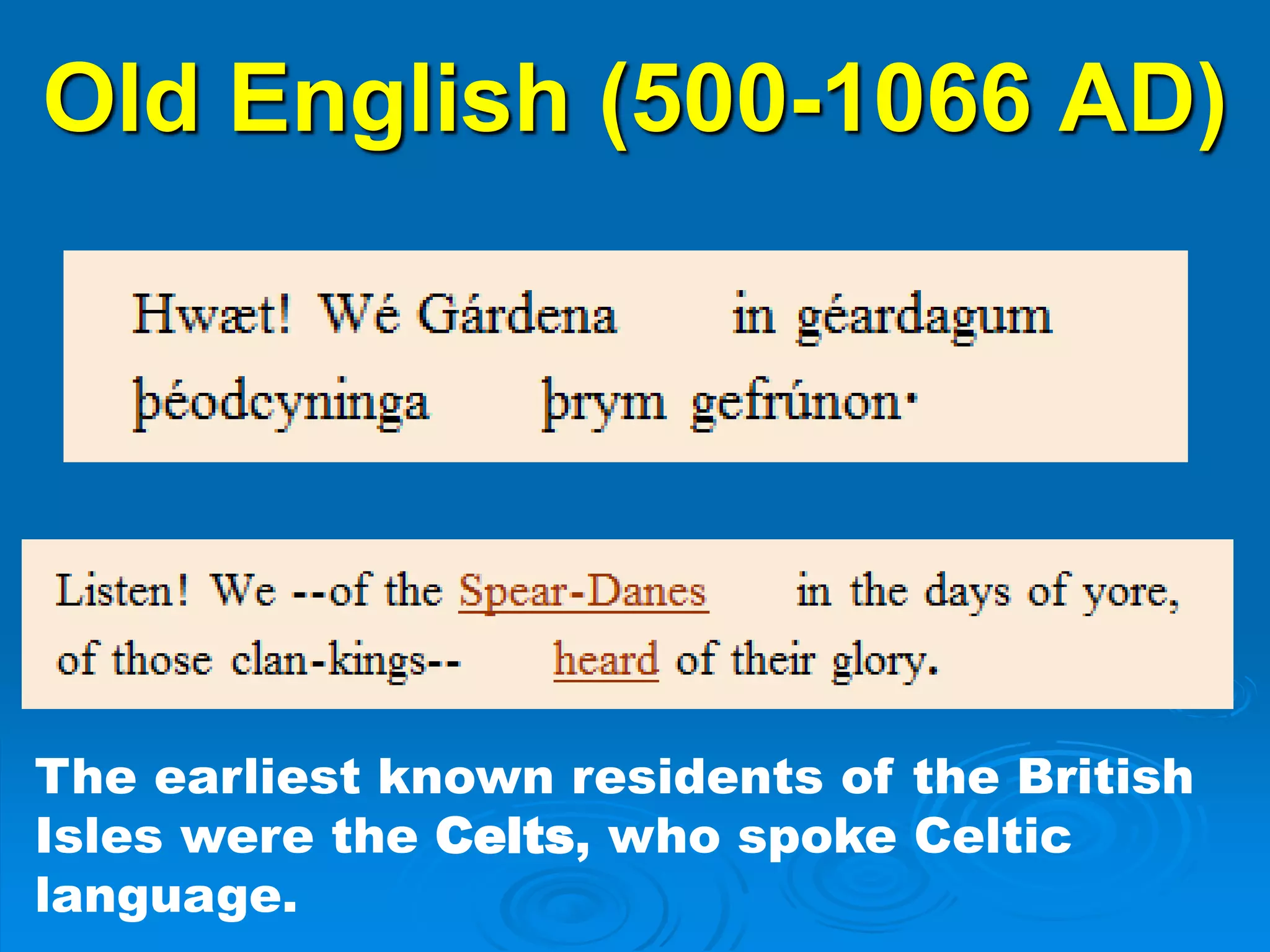
Old English (500-1066 AD)
The earliest known residents of the British
Isles were the Celts, who spoke Celtic
language.
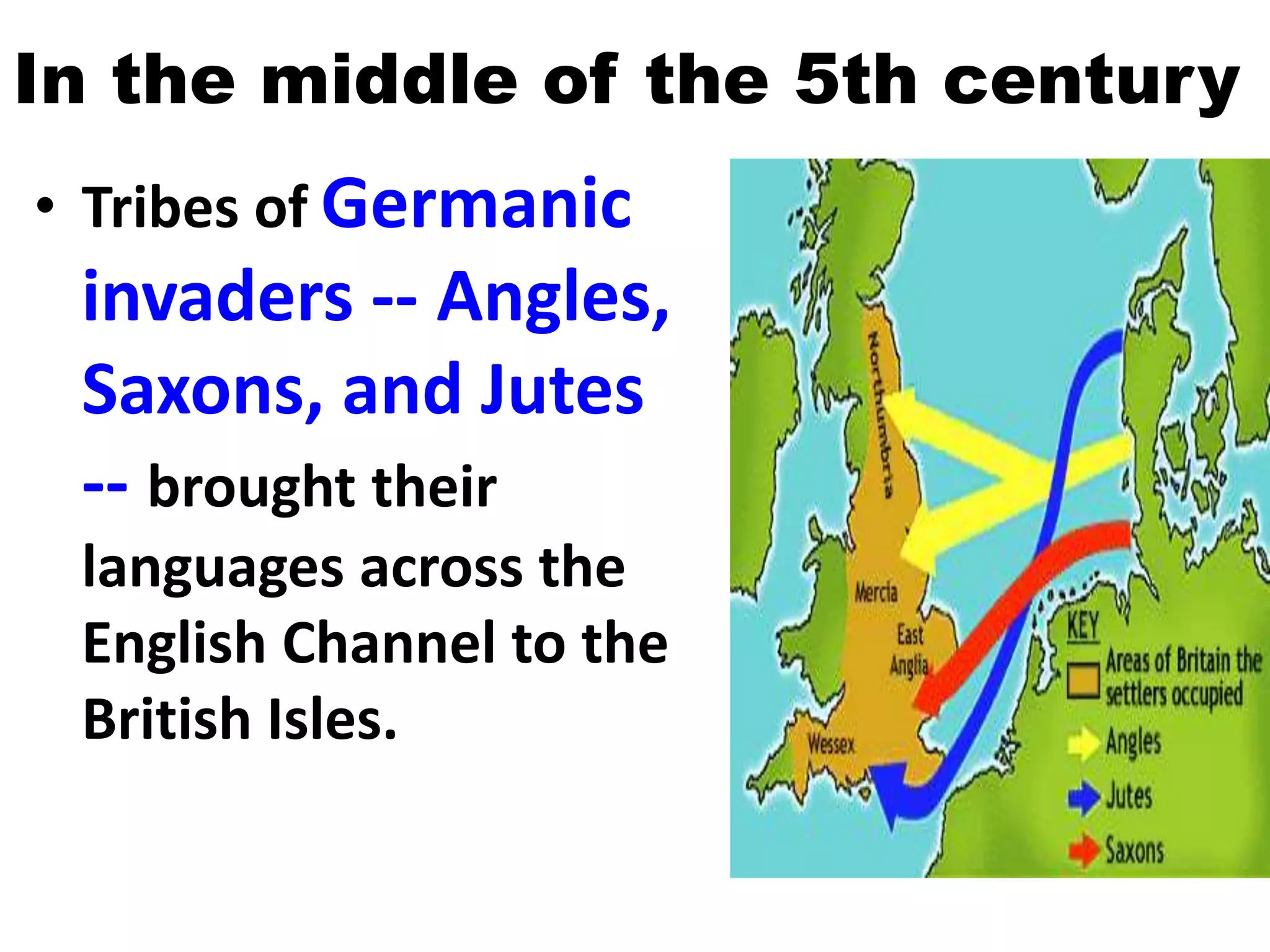
In the middle of the 5th century
• Tribes of Germanic
invaders -- Angles,
Saxons, and Jutes
-- brought their
languages across the
English Channel to the
British Isles.
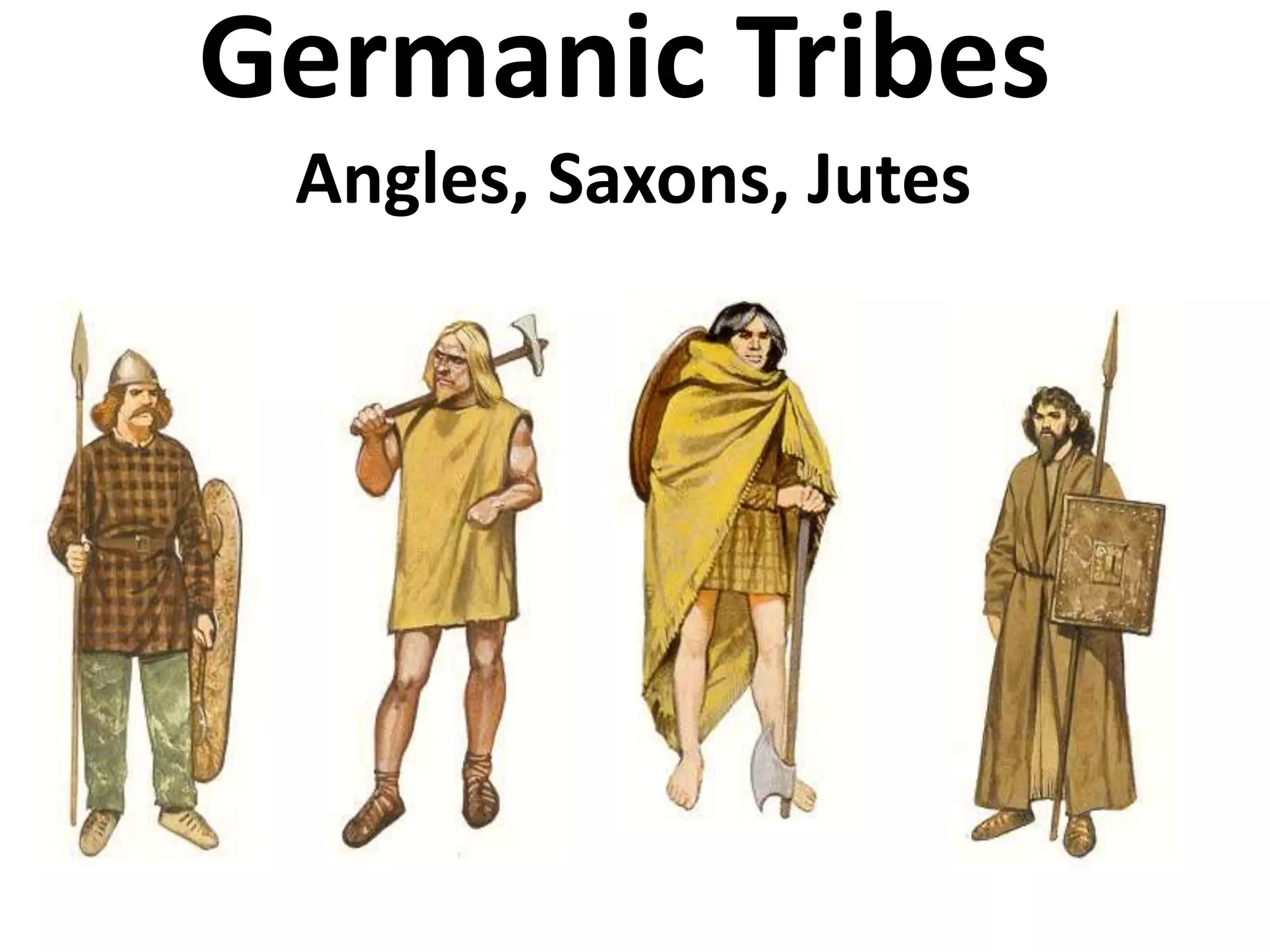
Germanic Tribes
Angles, Saxons, Jutes
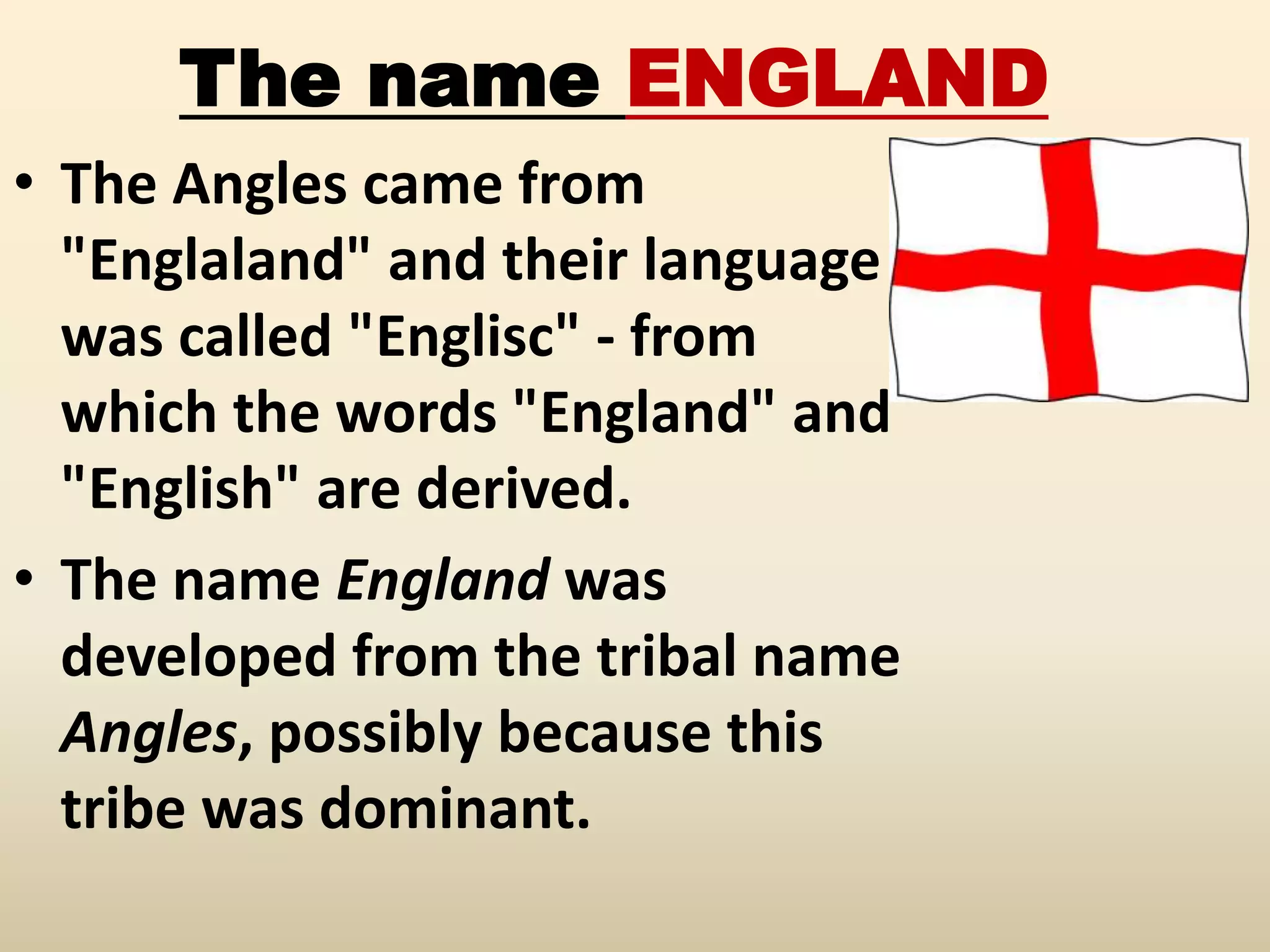
The name ENGLAND
• The Angles came from
"Englaland" and their language
was called "Englisc" - from
which the words "England" and
"English" are derived.
• The name England was
developed from the tribal name
Angles, possibly because this
tribe was dominant.
Vocabulary
From Anglo-Saxon English
Fox, bread, good, shower,
home, stones
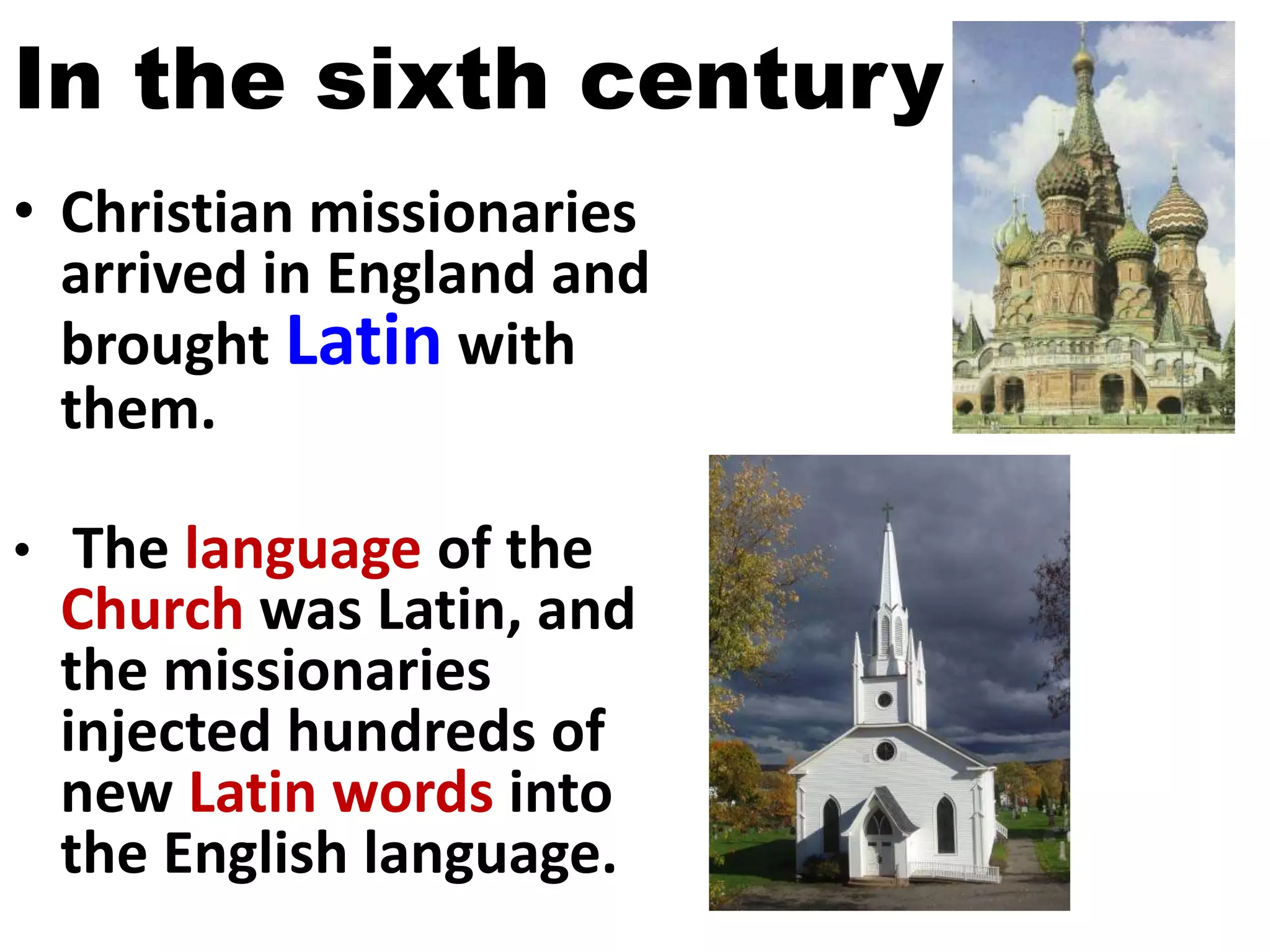
In the sixth century
• Christian missionaries
arrived in England and
brought Latin with
them.
• The language of the
Church was Latin, and
the missionaries
injected hundreds of
new Latin words into
the English language.
From Latin Christianity
priest, bishop, anthem,
candle, epistle, hymn
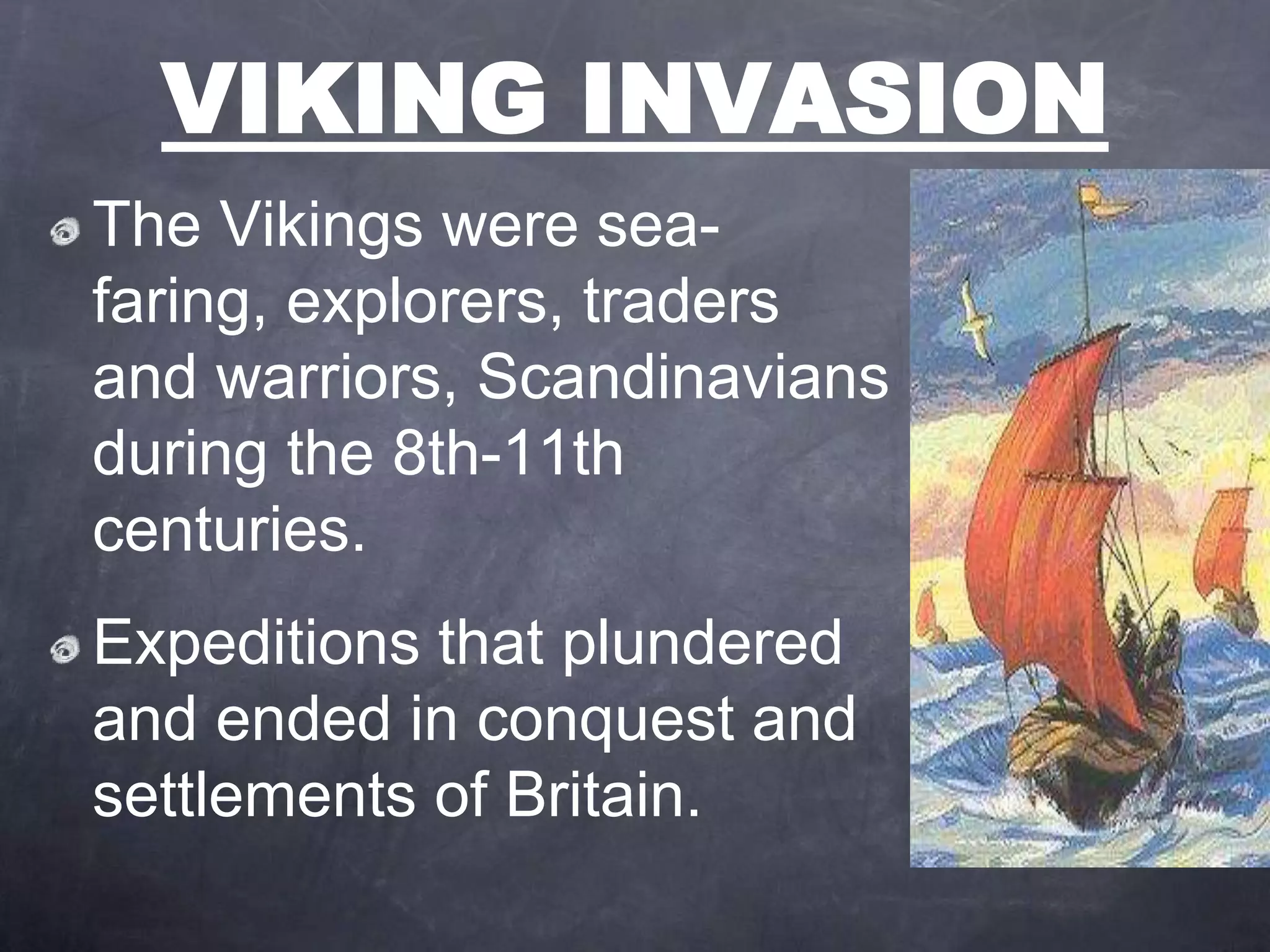
VIKING INVASION
The Vikings were sea-
faring, explorers, traders
and warriors, Scandinavians
during the 8th-11th
centuries.
Expeditions that plundered
and ended in conquest and
settlements of Britain.
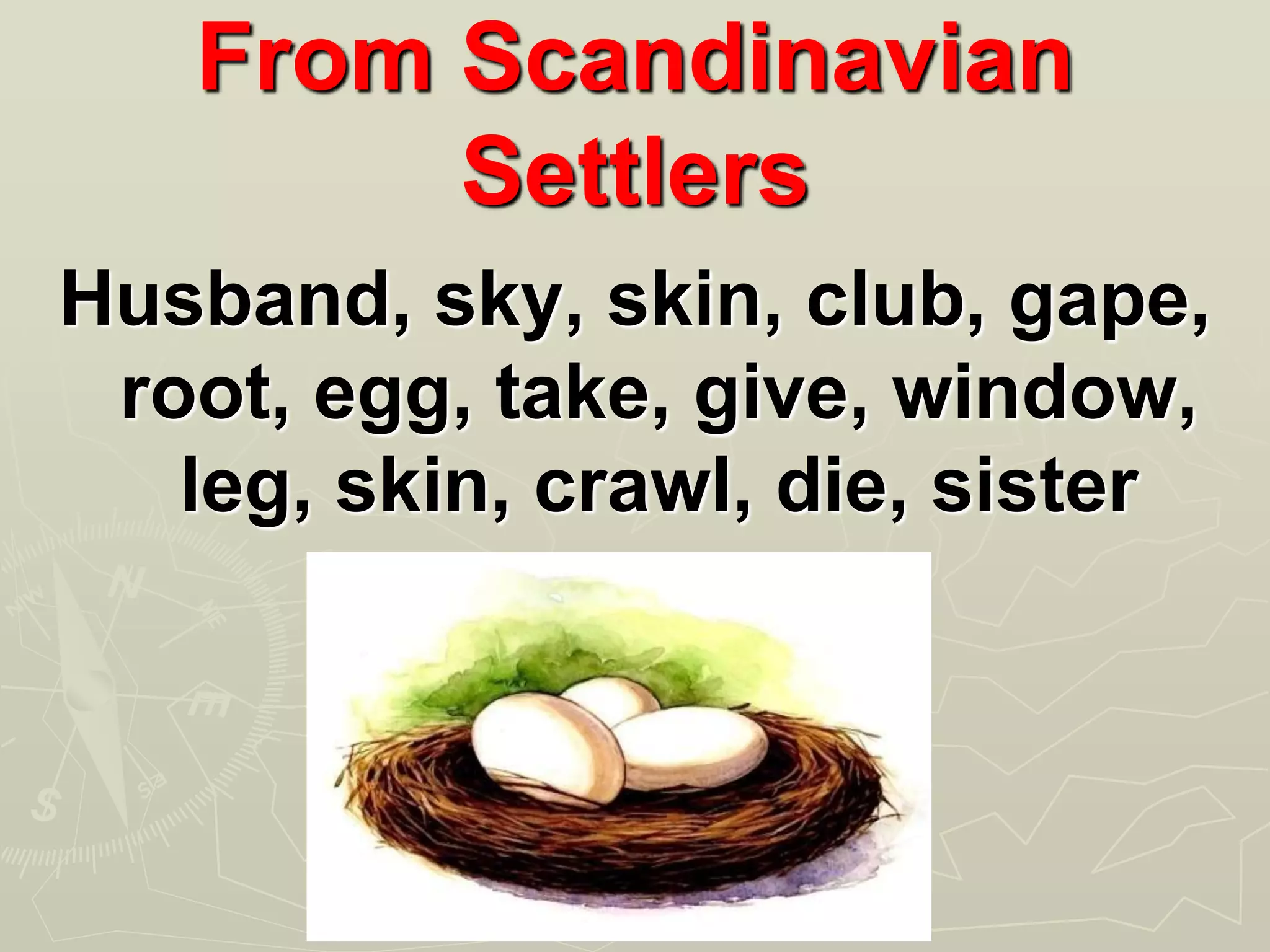
From Scandinavian
Settlers
Husband, sky, skin, club, gape,
root, egg, take, give, window,
leg, skin, crawl, die, sister
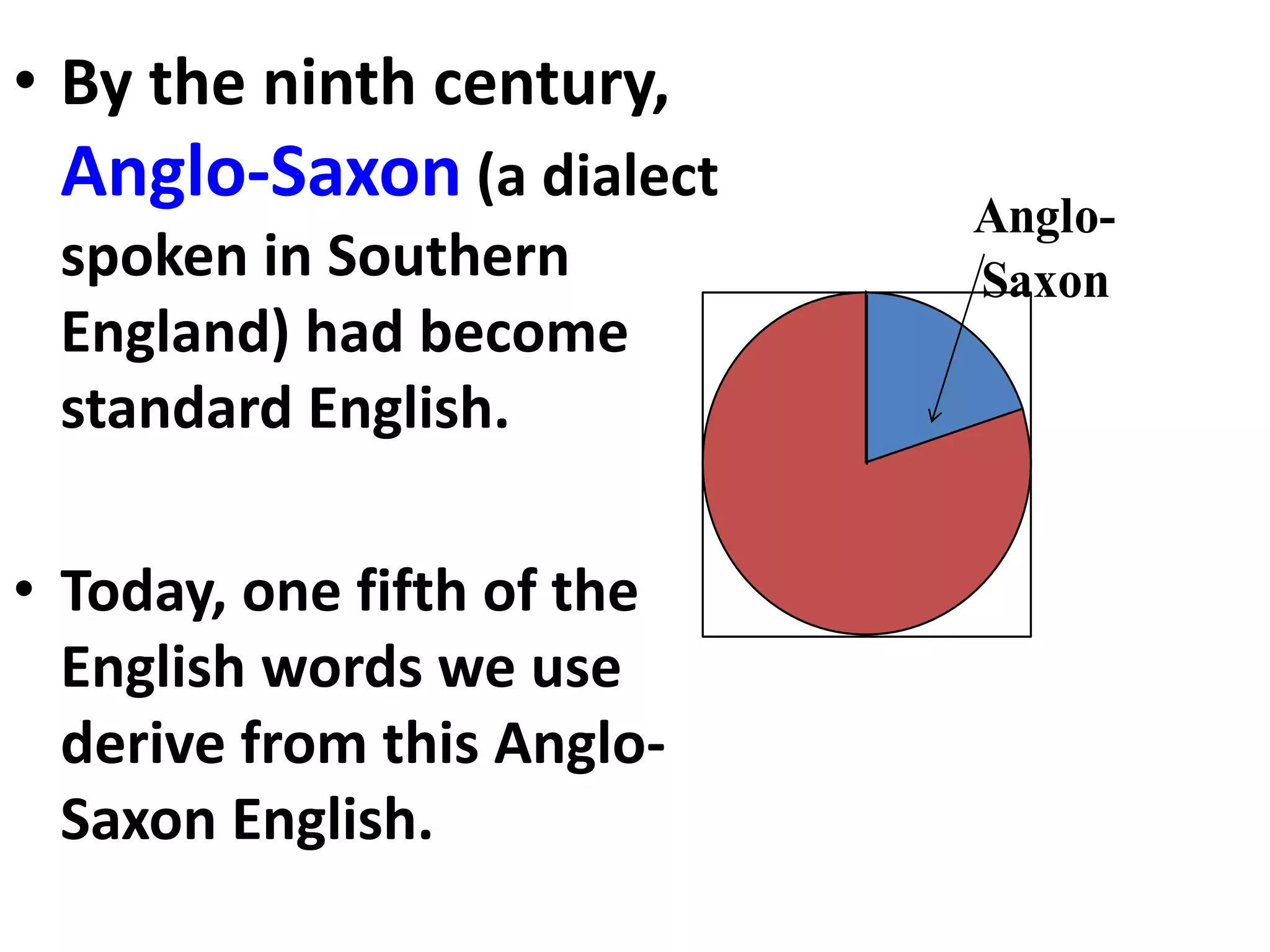
• By the ninth century,
Anglo-Saxon (a dialect
spoken in Southern
England) had become
standard English.
• Today, one fifth of the
English words we use
derive from this Anglo-
Saxon English.
Anglo-
Saxon
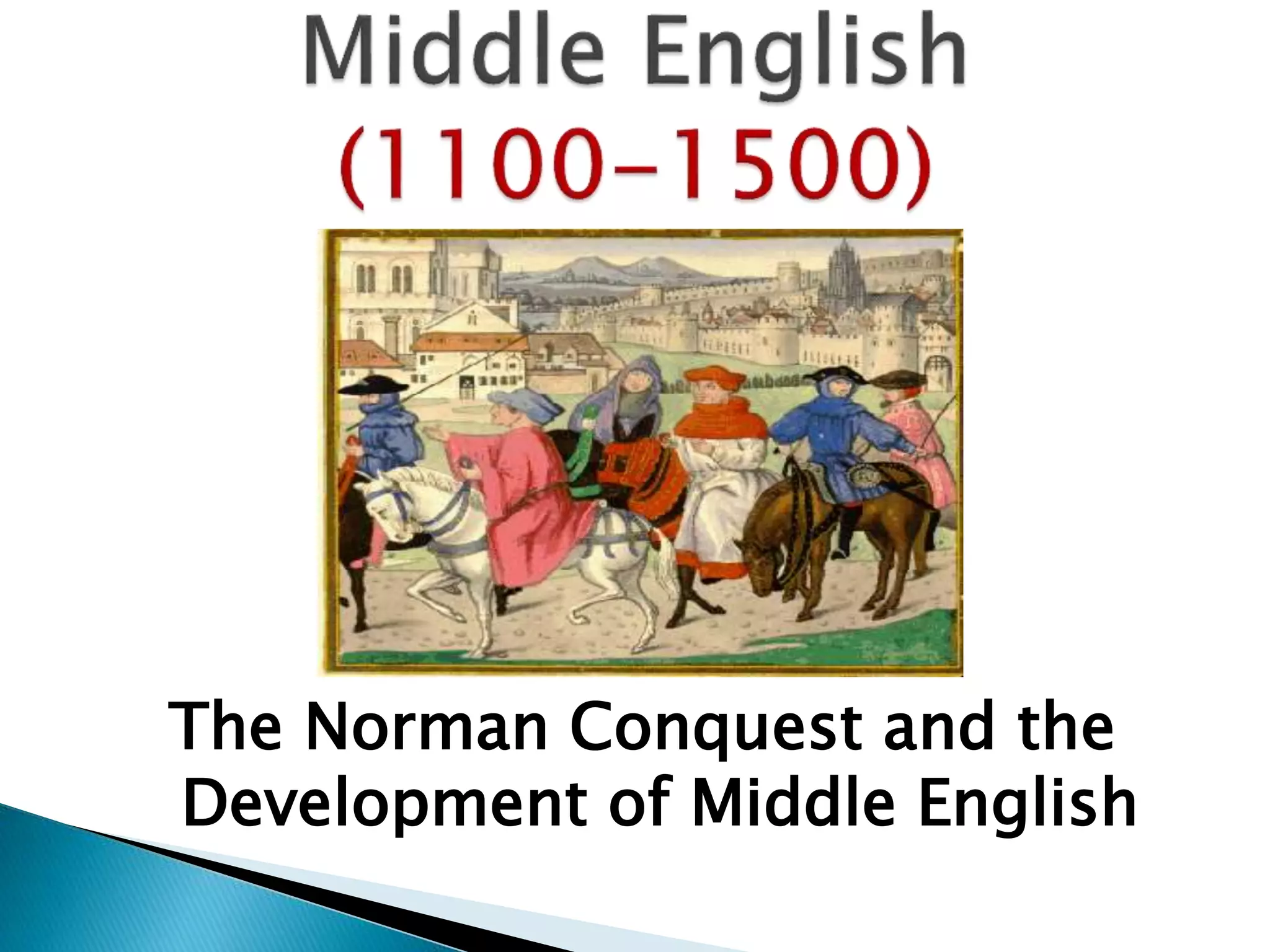
The Norman Conquest and the
Development of Middle English
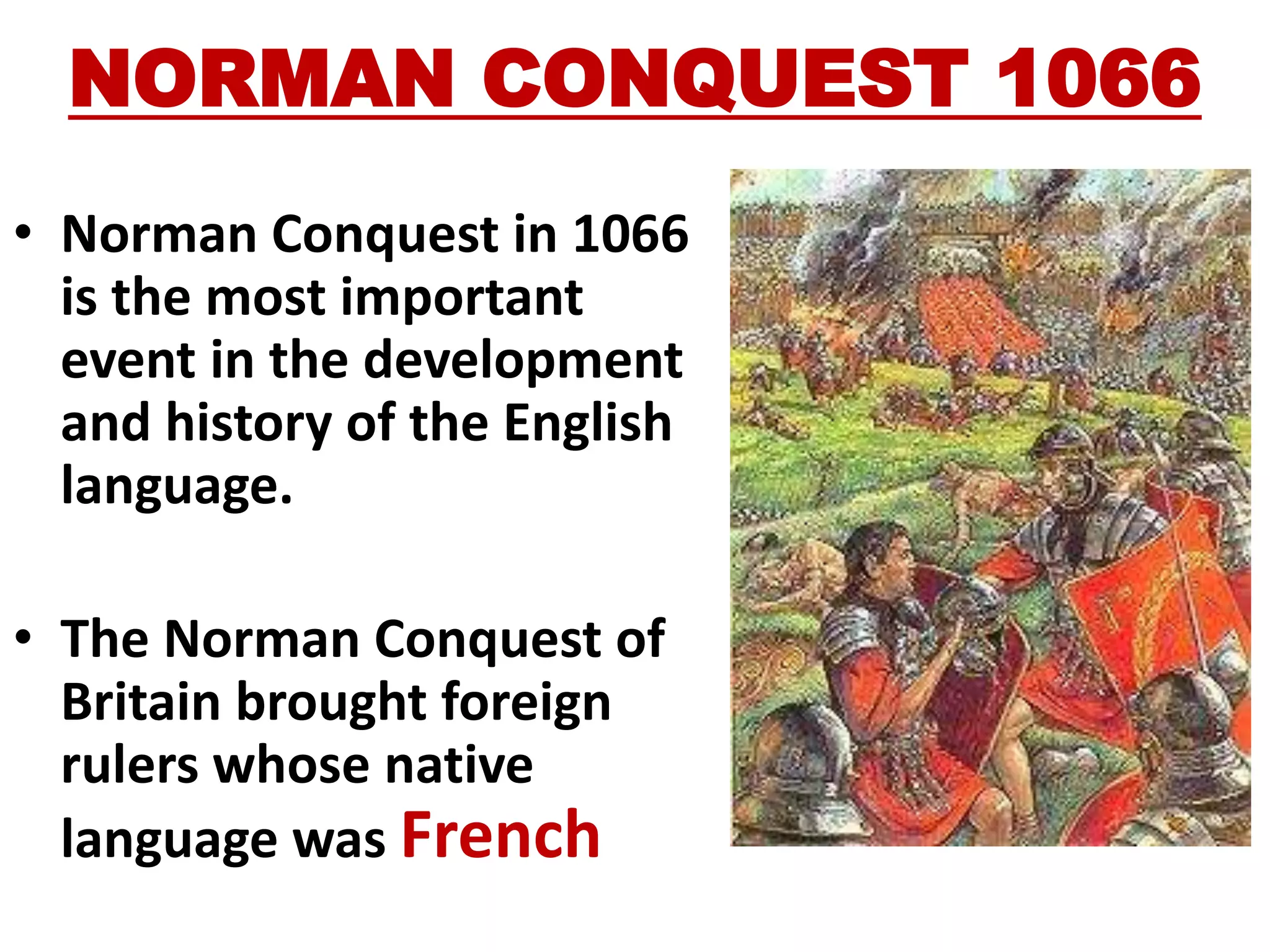
NORMAN CONQUEST 1066
• Norman Conquest in 1066
is the most important
event in the development
and history of the English
language.
• The Norman Conquest of
Britain brought foreign
rulers whose native
language was French
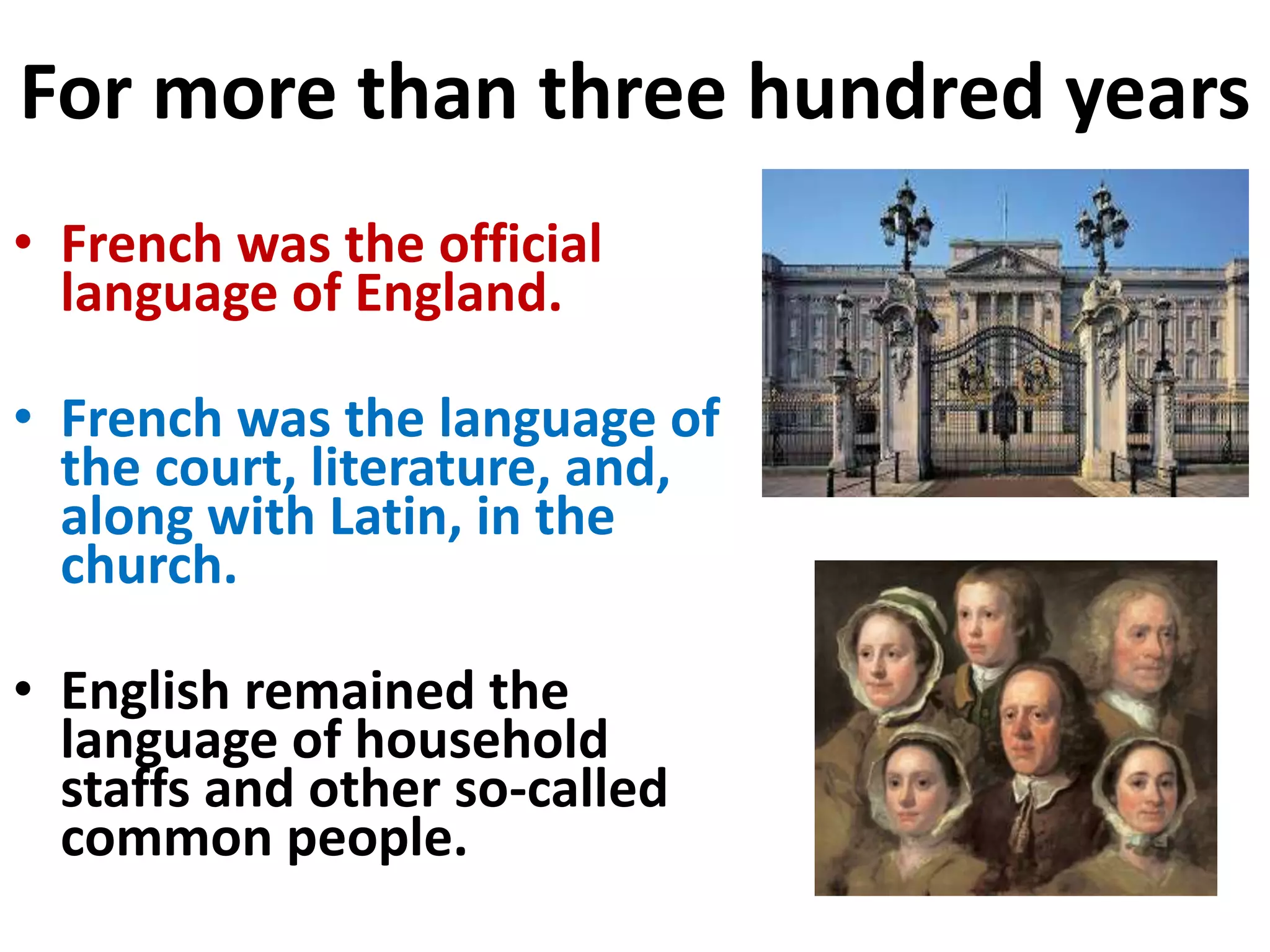
For more than three hundred years
• French was the official
language of England.
• French was the language of
the court, literature, and,
along with Latin, in the
church.
• English remained the
language of household
staffs and other so-called
common people.
RISE OF THE MIDDLE ENGLISH
•It was not until the14th century—300 years later—
that English became dominant in Britain again.
•In 1399, King Henry IV became the first king of
England since the Norman Conquest whose mother
tongue was English.
•By the end of the 14th Century, the dialect of
London had emerged as the standard dialect of
what we now call Middle English.
27
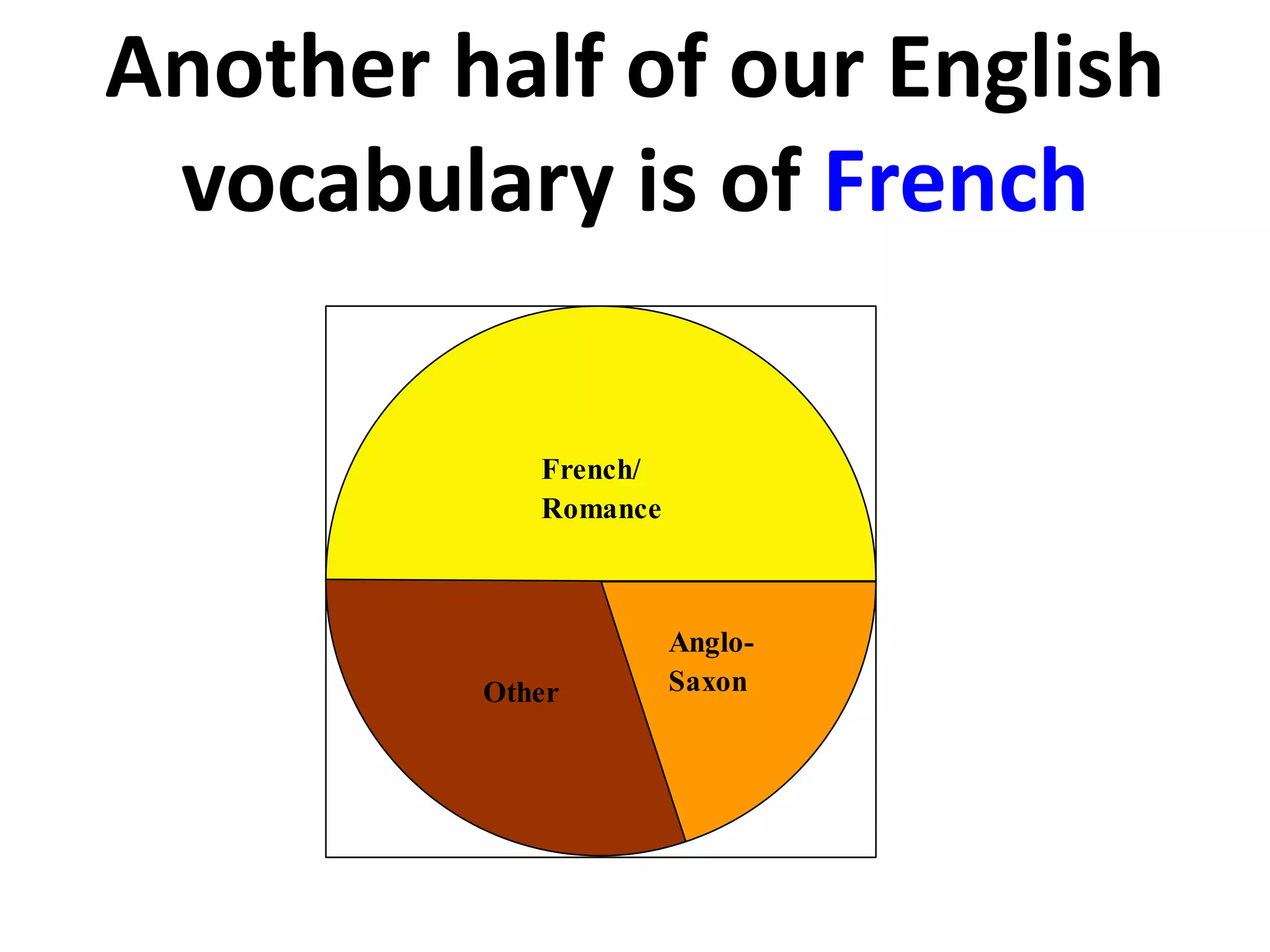
Another half of our English
vocabulary is of French
Anglo-
SaxonOther
French/
Romance
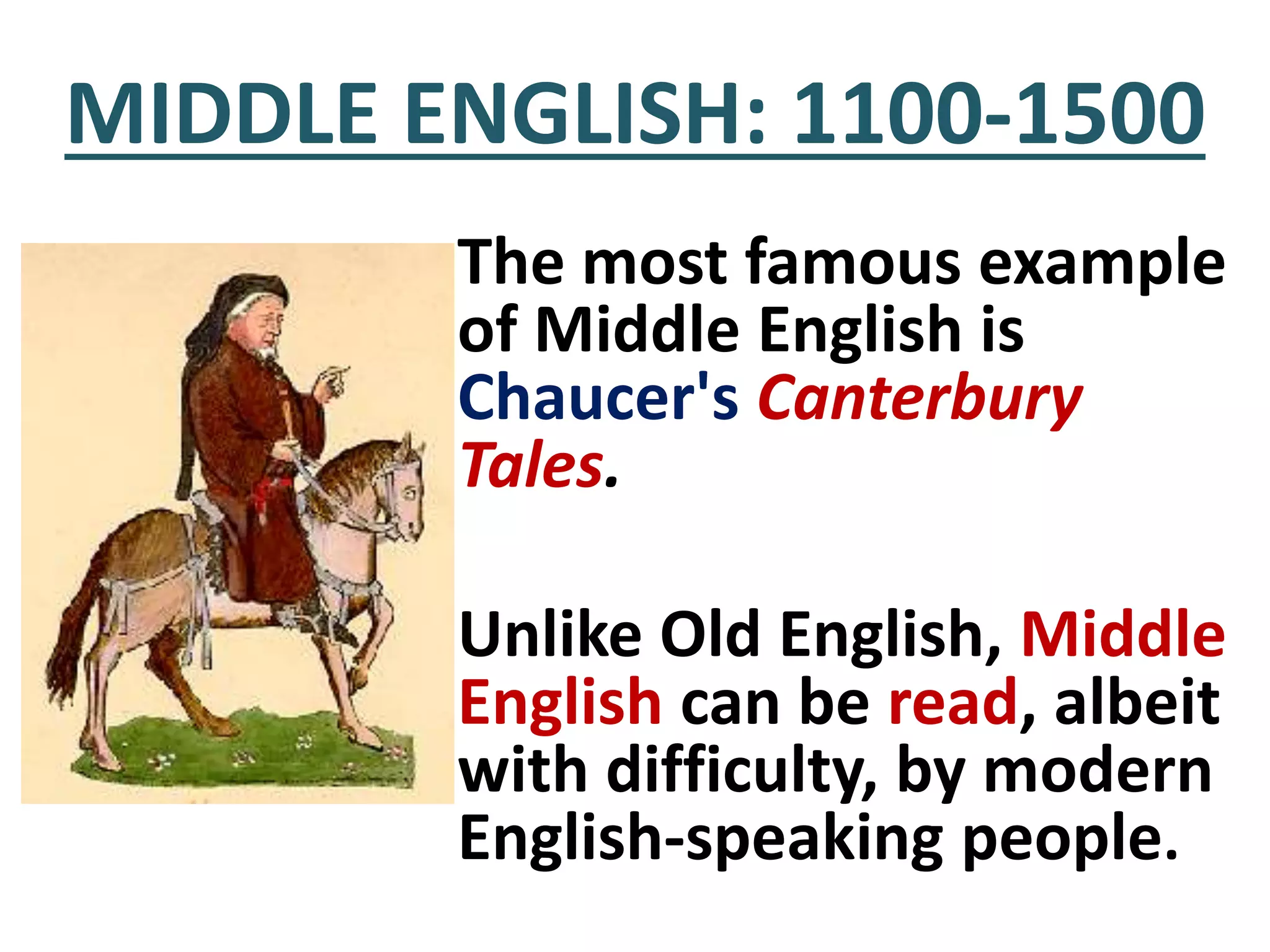
MIDDLE ENGLISH: 1100-1500
The most famous example
of Middle English is
Chaucer's Canterbury
Tales.
Unlike Old English, Middle
English can be read, albeit
with difficulty, by modern
English-speaking people.
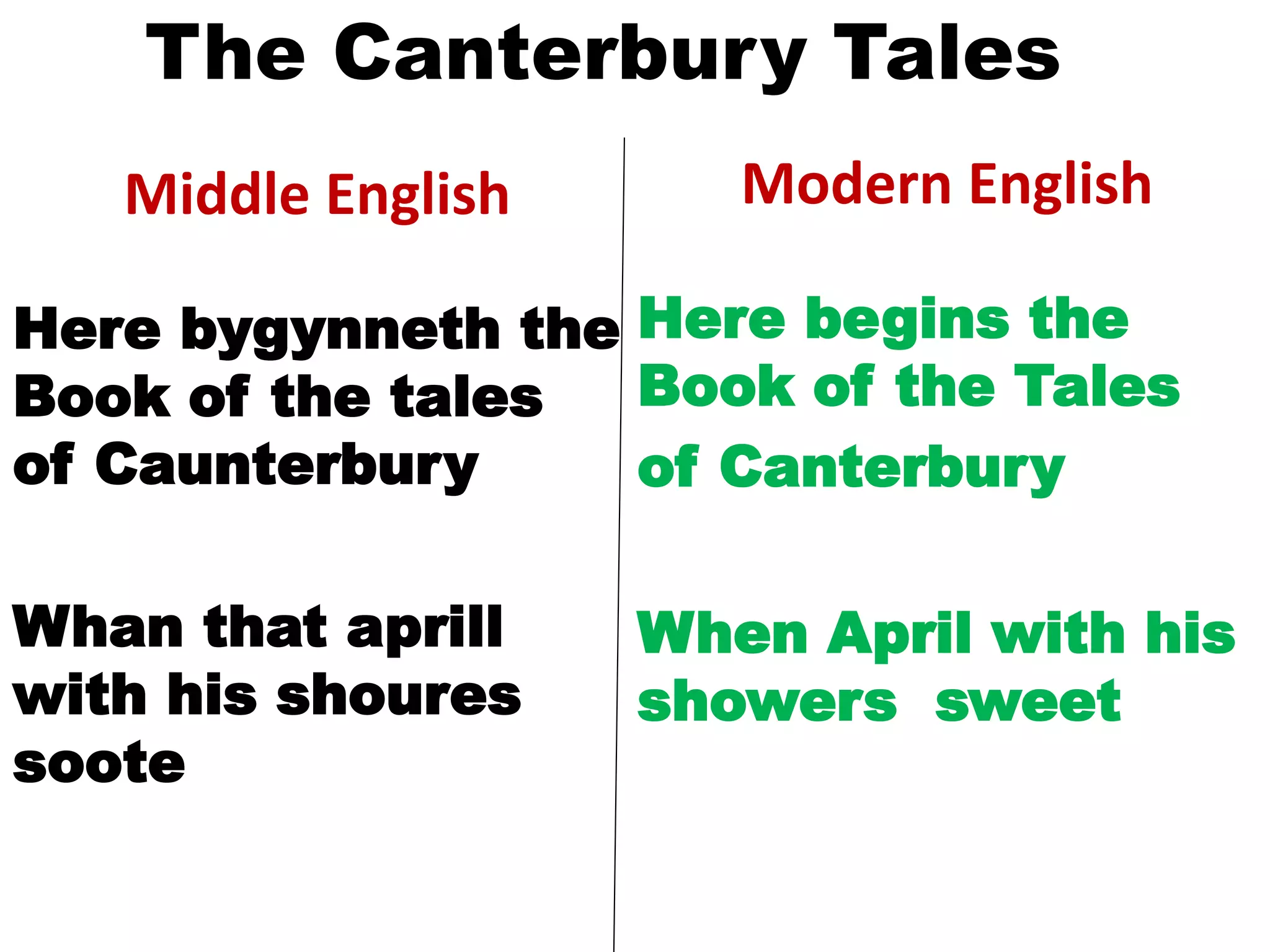
The Canterbury Tales
Middle English
Here bygynneth the
Book of the tales
of Caunterbury
Whan that aprill
with his shoures
soote
Modern English
Here begins the
Book of the Tales
of Canterbury
When April with his
showers sweet
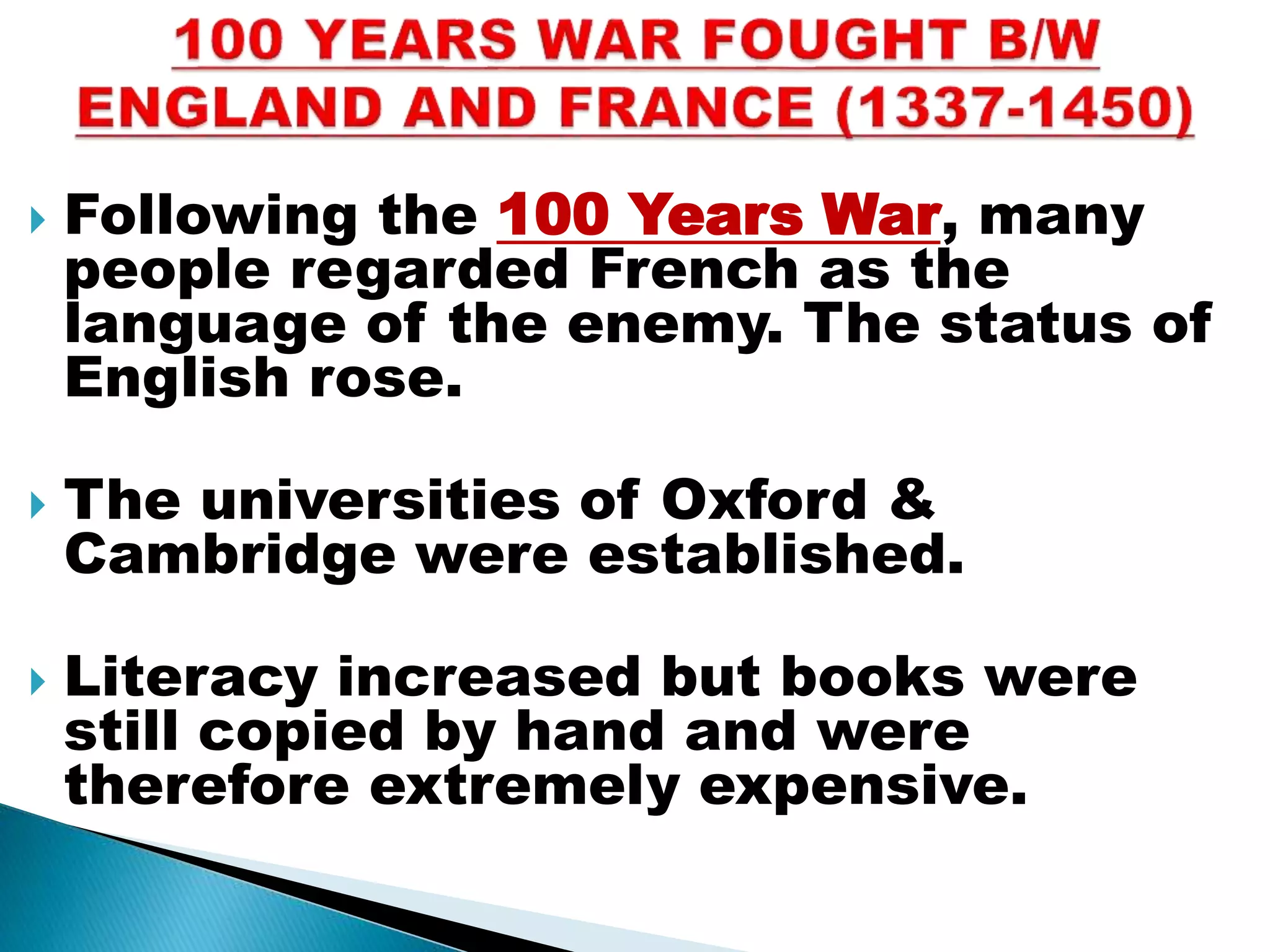
 Following the 100 Years War, many
people regarded French as the
language of the enemy. The status of
English rose.
 The universities of Oxford &
Cambridge were established.
 Literacy increased but books were
still copied by hand and were
therefore extremely expensive.
Legal terms:
Judge, jury, attorney, crime,
assault
Terms of rank:
prince, duke, baron,
parliament, countess
Others:
courage, season, manner,
study, castle.
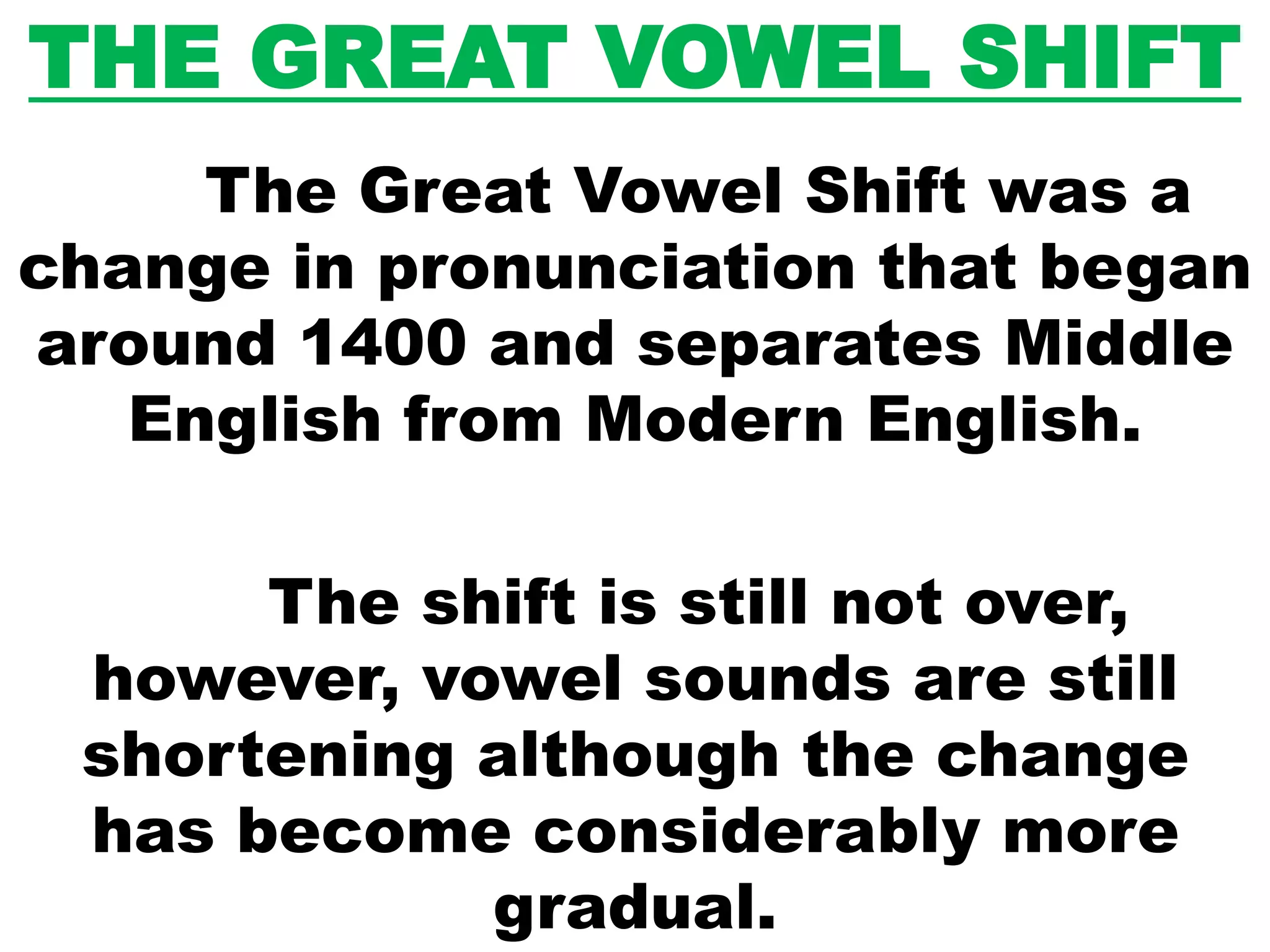
THE GREAT VOWEL SHIFT
The Great Vowel Shift was a
change in pronunciation that began
around 1400 and separates Middle
English from Modern English.
The shift is still not over,
however, vowel sounds are still
shortening although the change
has become considerably more
gradual.
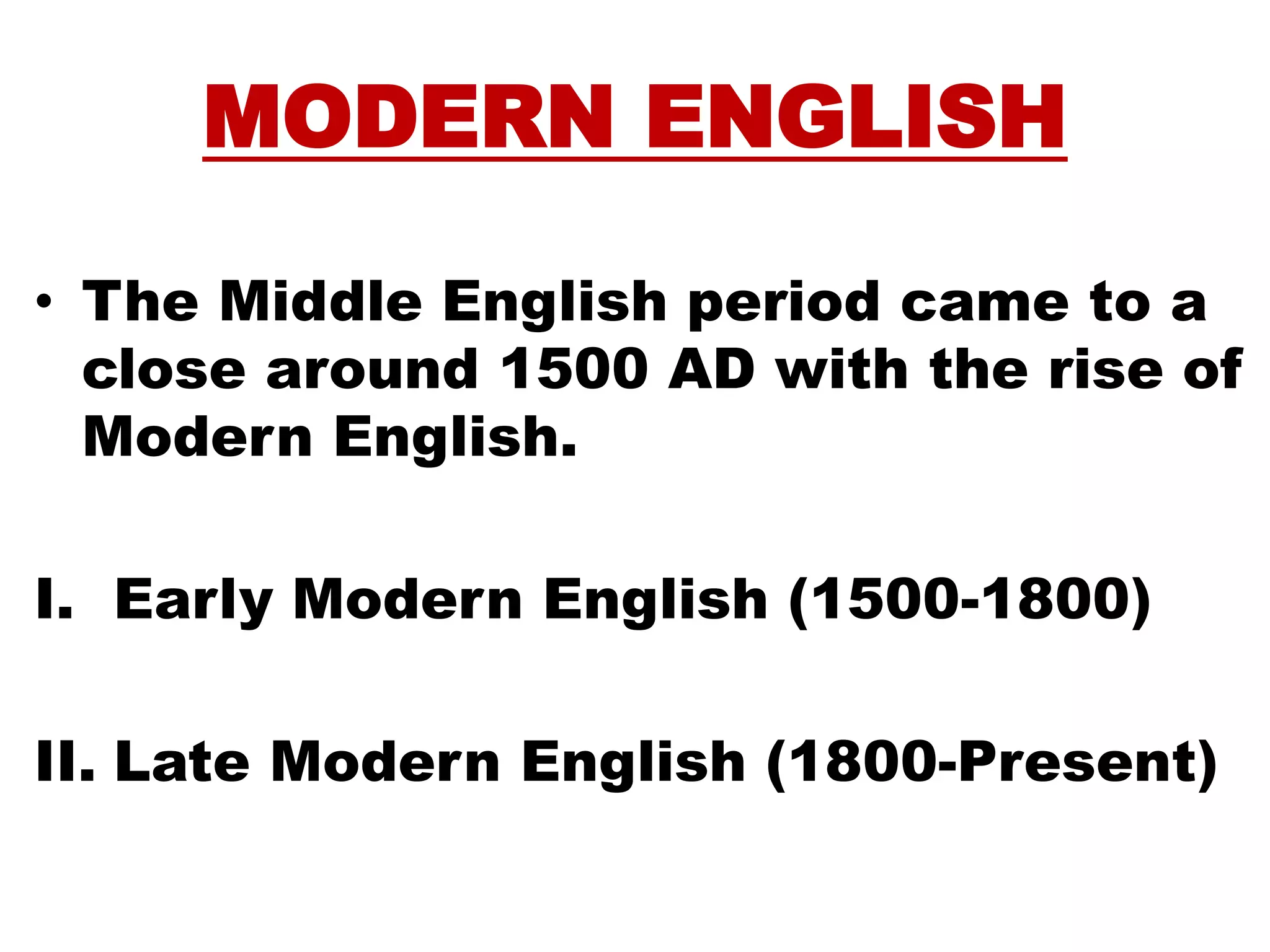
MODERN ENGLISH
• The Middle English period came to a
close around 1500 AD with the rise of
Modern English.
I. Early Modern English (1500-1800)
II. Late Modern English (1800-Present)
EARLY MODERN ENGLISH
(1500-1800)
 The Renaissance brought the
revival of classical scholarship and
brought many classical Latin and Greek
words into the Language.
“The age of Shakespeare" or "the
Elizabethan era“ --early 16th century to
the early 17th century.
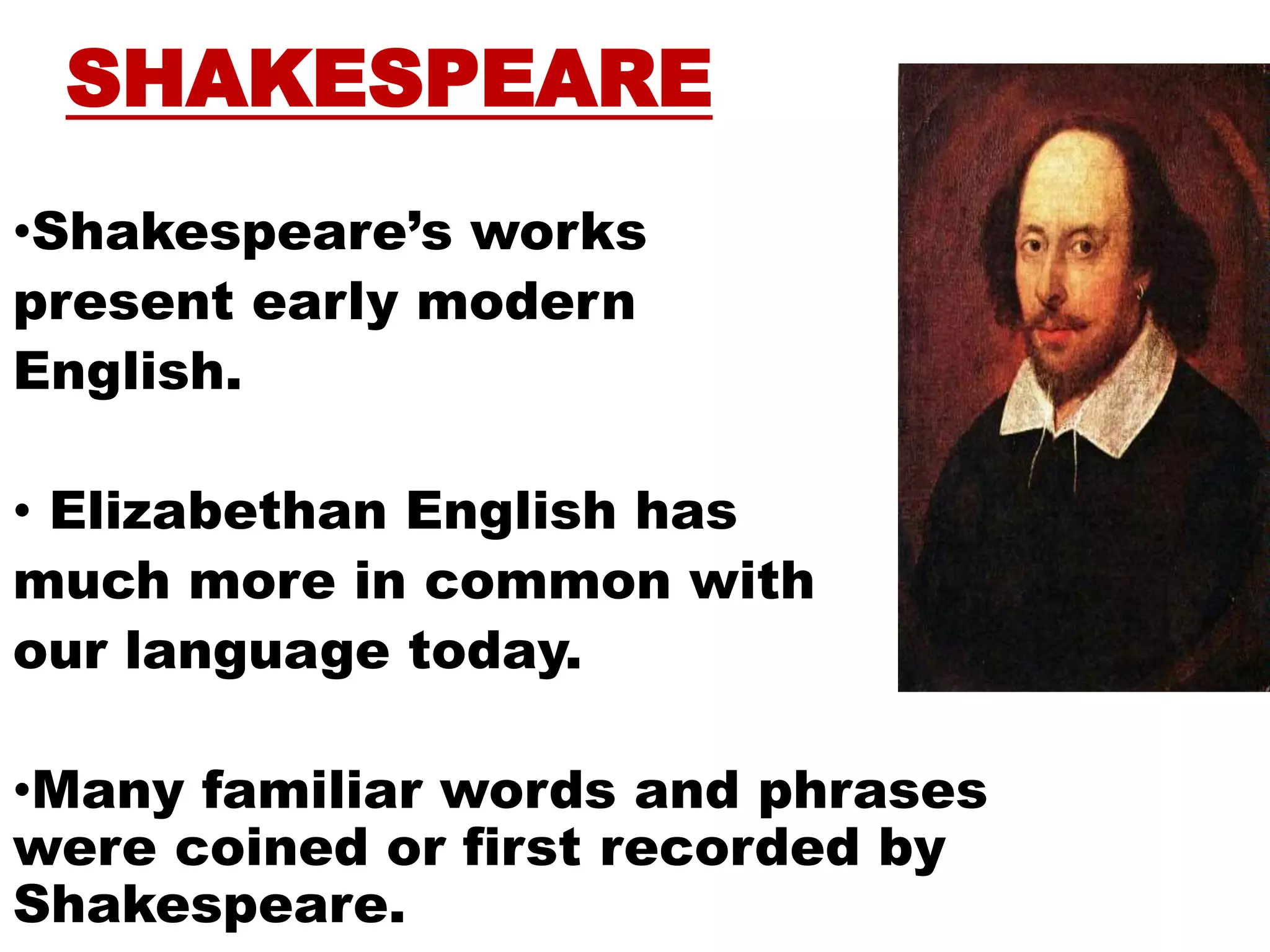
SHAKESPEARE
•Shakespeare’s works
present early modern
English.
• Elizabethan English has
much more in common with
our language today.
•Many familiar words and phrases
were coined or first recorded by
Shakespeare.
Words for science,
invention, and
technology:
isotope, metronome,
polymer, telephone,
helium, halogen,
intravenous,
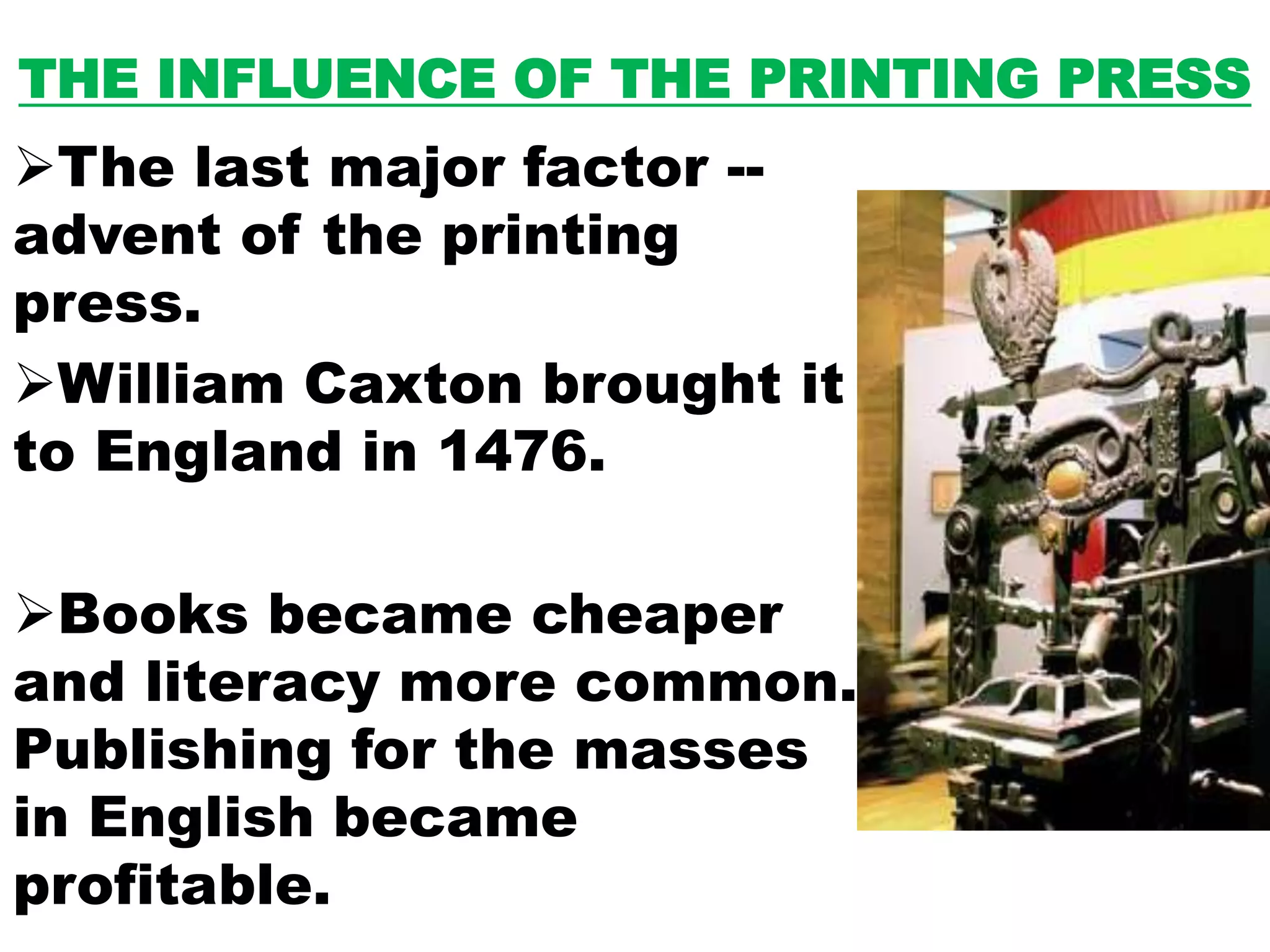
THE INFLUENCE OF THE PRINTING PRESS
The last major factor --
advent of the printing
press.
William Caxton brought it
to England in 1476.
Books became cheaper
and literacy more common.
Publishing for the masses
in English became
profitable.
LATE MODERN ENGLISH (1800-PRESENT)
 The principal distinction between
early and late-modern English is
vocabulary.
 Pronunciation, grammar, and spelling
are largely the same.
 New words are the result of two
historical factors:
 the Industrial Revolution
 the British Empire Expansion
INDUSTRIAL REVOLUTION
 England began the Industrial
Revolution in18th century
 New technical words were added to
the vocabulary as inventors designed
various products and machinery.
 trains, engine, combustion,
electricity, telephone, telegraph,
camera etc
BRITISH EMPIRE.
• ‘The Dictionary of the English
Language’ was published in 1755 by
Samuel Johnson.
• English language across the world -
to the USA, Australia, New Zealand,
India, Malaysia and Africa.
• 'kangaroo' is native Australian
words, 'juggernaut' and 'turban'
came from India.
ENGLISH & 21ST CENTURY
• It is in this century that we get
doodlebugs, gasmasks, mods and
rockers;
• we enjoy eating dim sum,
cappuccino, chicken tikka masala
and pizza;
• we talk of chavs, mingers and
weirdos; and
• we are addicted to tellies, websites,
cybercafes and compact discs.
RAPID SPREAD OF ENGLISH &
THE 21ST CENTURY.
• Many other varieties of English around the
world
• American English is particularly influential,
due to the USA's dominance
• Australian English, New Zealand English,
Canadian English, South African English,
Indian English and Caribbean English
• According to some linguists, English
contains some 500,000 words.
• Generally, speakers with well-
developed vocabularies employ 30,000
words.
• That leaves the most articulate among
us about 470,000 words short.
• Nearly 60% of all he or she says is
said with just 100 different words.
CONCLUSION
 English language has become the
lingua franca of the Modern World
 One quarter of the world’s
population, or b/w 1.2 and 1.5
billion people, are already fluent
or competent in English.
 About 750 million more people
speak English as a foreign
language.
• English is hard to spell, but it
is a wonderful, versatile,
expanding language!
Expand your English vocabulary
By
Reading, Writing, Listening &
Speaking English
CONCLUSION
Zia eng

Zia eng

  • 1.
    A Brief History ofthe English Language Prepared by ZIA UR REHMAN Lecturer in English Cadet College Kohat Pakistan
  • 2.
  • 3.
    A Brief History ofthe English Language ( Why English is Hard to Spell! )
  • 4.
    CONTENTS • Introduction • ThreePeriods in History of English 1. Old English : 500 - 1066 2. Middle English : 1100 - 1500 3. Modern English : 1500 – Present • English and 21st Century • Interesting Facts about English Vocabulary • Conclusion
  • 5.
    The Indo-European familyof languages 1 2 3 4 5 6
  • 6.
    English is theofficial language of How many nations. about 45Countries
  • 7.
    English is spokenby how many people? more than 400 million
  • 8.
    English is oneof the two working languages of the United Nations. The other one is __?___. French
  • 9.
    English is themother tongue of the people in the British Isles, USA, Australia, New Zealand.
  • 10.
    The history ofthe English Language parallels the history of the English people and the British Islands.
  • 11.
  • 12.
    English spread because of Britishexploration, colonization, and empire building during the  17th  18th  And 19th centuries
  • 13.
    Periods in Historyof English 1. Old English : 500-1066 2. Middle English :1100-1500 3. Modern English : 1500 – Present An Englishman of 1300 AD wouldn’t have understood the English of 500 AD; nor would he understand the English we speak today.
  • 14.
    Old English (500-1066AD) The earliest known residents of the British Isles were the Celts, who spoke Celtic language.
  • 15.
    In the middleof the 5th century • Tribes of Germanic invaders -- Angles, Saxons, and Jutes -- brought their languages across the English Channel to the British Isles.
  • 16.
  • 17.
    The name ENGLAND •The Angles came from "Englaland" and their language was called "Englisc" - from which the words "England" and "English" are derived. • The name England was developed from the tribal name Angles, possibly because this tribe was dominant.
  • 18.
    Vocabulary From Anglo-Saxon English Fox,bread, good, shower, home, stones
  • 19.
    In the sixthcentury • Christian missionaries arrived in England and brought Latin with them. • The language of the Church was Latin, and the missionaries injected hundreds of new Latin words into the English language.
  • 20.
    From Latin Christianity priest,bishop, anthem, candle, epistle, hymn
  • 21.
    VIKING INVASION The Vikingswere sea- faring, explorers, traders and warriors, Scandinavians during the 8th-11th centuries. Expeditions that plundered and ended in conquest and settlements of Britain.
  • 22.
    From Scandinavian Settlers Husband, sky,skin, club, gape, root, egg, take, give, window, leg, skin, crawl, die, sister
  • 23.
    • By theninth century, Anglo-Saxon (a dialect spoken in Southern England) had become standard English. • Today, one fifth of the English words we use derive from this Anglo- Saxon English. Anglo- Saxon
  • 24.
    The Norman Conquestand the Development of Middle English
  • 25.
    NORMAN CONQUEST 1066 •Norman Conquest in 1066 is the most important event in the development and history of the English language. • The Norman Conquest of Britain brought foreign rulers whose native language was French
  • 26.
    For more thanthree hundred years • French was the official language of England. • French was the language of the court, literature, and, along with Latin, in the church. • English remained the language of household staffs and other so-called common people.
  • 27.
    RISE OF THEMIDDLE ENGLISH •It was not until the14th century—300 years later— that English became dominant in Britain again. •In 1399, King Henry IV became the first king of England since the Norman Conquest whose mother tongue was English. •By the end of the 14th Century, the dialect of London had emerged as the standard dialect of what we now call Middle English. 27
  • 28.
    Another half ofour English vocabulary is of French Anglo- SaxonOther French/ Romance
  • 29.
    MIDDLE ENGLISH: 1100-1500 Themost famous example of Middle English is Chaucer's Canterbury Tales. Unlike Old English, Middle English can be read, albeit with difficulty, by modern English-speaking people.
  • 30.
    The Canterbury Tales MiddleEnglish Here bygynneth the Book of the tales of Caunterbury Whan that aprill with his shoures soote Modern English Here begins the Book of the Tales of Canterbury When April with his showers sweet
  • 31.
     Following the100 Years War, many people regarded French as the language of the enemy. The status of English rose.  The universities of Oxford & Cambridge were established.  Literacy increased but books were still copied by hand and were therefore extremely expensive.
  • 32.
    Legal terms: Judge, jury,attorney, crime, assault Terms of rank: prince, duke, baron, parliament, countess Others: courage, season, manner, study, castle.
  • 33.
    THE GREAT VOWELSHIFT The Great Vowel Shift was a change in pronunciation that began around 1400 and separates Middle English from Modern English. The shift is still not over, however, vowel sounds are still shortening although the change has become considerably more gradual.
  • 34.
    MODERN ENGLISH • TheMiddle English period came to a close around 1500 AD with the rise of Modern English. I. Early Modern English (1500-1800) II. Late Modern English (1800-Present)
  • 35.
    EARLY MODERN ENGLISH (1500-1800) The Renaissance brought the revival of classical scholarship and brought many classical Latin and Greek words into the Language. “The age of Shakespeare" or "the Elizabethan era“ --early 16th century to the early 17th century.
  • 36.
    SHAKESPEARE •Shakespeare’s works present earlymodern English. • Elizabethan English has much more in common with our language today. •Many familiar words and phrases were coined or first recorded by Shakespeare.
  • 37.
    Words for science, invention,and technology: isotope, metronome, polymer, telephone, helium, halogen, intravenous,
  • 38.
    THE INFLUENCE OFTHE PRINTING PRESS The last major factor -- advent of the printing press. William Caxton brought it to England in 1476. Books became cheaper and literacy more common. Publishing for the masses in English became profitable.
  • 39.
    LATE MODERN ENGLISH(1800-PRESENT)  The principal distinction between early and late-modern English is vocabulary.  Pronunciation, grammar, and spelling are largely the same.  New words are the result of two historical factors:  the Industrial Revolution  the British Empire Expansion
  • 40.
    INDUSTRIAL REVOLUTION  Englandbegan the Industrial Revolution in18th century  New technical words were added to the vocabulary as inventors designed various products and machinery.  trains, engine, combustion, electricity, telephone, telegraph, camera etc
  • 41.
    BRITISH EMPIRE. • ‘TheDictionary of the English Language’ was published in 1755 by Samuel Johnson. • English language across the world - to the USA, Australia, New Zealand, India, Malaysia and Africa. • 'kangaroo' is native Australian words, 'juggernaut' and 'turban' came from India.
  • 42.
    ENGLISH & 21STCENTURY • It is in this century that we get doodlebugs, gasmasks, mods and rockers; • we enjoy eating dim sum, cappuccino, chicken tikka masala and pizza; • we talk of chavs, mingers and weirdos; and • we are addicted to tellies, websites, cybercafes and compact discs.
  • 43.
    RAPID SPREAD OFENGLISH & THE 21ST CENTURY. • Many other varieties of English around the world • American English is particularly influential, due to the USA's dominance • Australian English, New Zealand English, Canadian English, South African English, Indian English and Caribbean English
  • 44.
    • According tosome linguists, English contains some 500,000 words. • Generally, speakers with well- developed vocabularies employ 30,000 words. • That leaves the most articulate among us about 470,000 words short. • Nearly 60% of all he or she says is said with just 100 different words.
  • 45.
    CONCLUSION  English languagehas become the lingua franca of the Modern World  One quarter of the world’s population, or b/w 1.2 and 1.5 billion people, are already fluent or competent in English.  About 750 million more people speak English as a foreign language.
  • 46.
    • English ishard to spell, but it is a wonderful, versatile, expanding language! Expand your English vocabulary By Reading, Writing, Listening & Speaking English CONCLUSION