Embed presentation
Downloaded 245 times


The document provides a history of the English language from its origins with the Celts in 500BC through its development and changes over time due to influences from the Romans, Anglo-Saxons, Vikings, and Normans. It discusses the impact of significant events like the Norman invasion of 1066 and the introduction of the printing press in the late 15th century. Key periods that shaped the language include the Renaissance, the Industrial Revolution, and the 20th century. The document also touches on theories of language change and the development of spelling rules and standards over the centuries.
Discusses the history of English, text analysis, theories behind language change, and attitudes.
English history divided into Old, Middle, Early Modern, Modern, and Contemporary English.
Celtic origins affecting place names but few words survive in English.
Latin loanwords from the Roman period; around 200 words, like wine and wall, introduced.
Germanic tribes form Old English, contributing one-third of everyday vocabulary, e.g., food and night.
Danish invasion introduces nearly 2000 Norse words, enriching English vocabulary.
Challenges in writing due to varying sounds in Latin and Old English, leading to inconsistent rules.
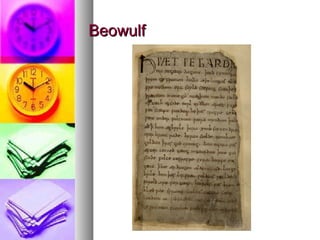
Referenced classic text 'Beowulf', significant in Old English literature.
Normans' cultural transformation of English, embedding thousands of French words like court and beauty.
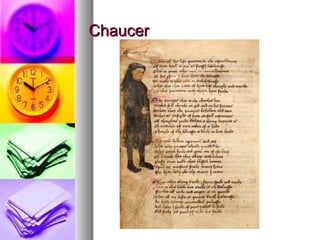
Reference to Chaucer, significant figure in Middle English literature.
Integration of French spelling rules; confusion leads to inconsistencies in English spelling.
Rules created by scribes for vowel sounds and consonant doubling established during writing.
Major phonetic shift affecting pronunciation and spelling of English from 1350 to 1700.
Post-war view of French as the enemy language; rise of English; introduction of many Latin terms.
Cultural advancement and impact of printing resulting in new words and standard language formation.
Growth of dictionaries and grammar rules in the 1700s; Samuel Johnson's influential dictionary.
Rise of new vocab related to science, industry; reflects societal transformations during the era.
Modern English expands with new slang and terms from global influences, reflecting recent history.