modernenglish
By Juan Montes, Vicky Guo, Lorna, Barb Sawyers,
Dan Mason and Rena Lu
For Linguistics, CCLCS, TESL Ontario
May 1, 2015
modernenglish
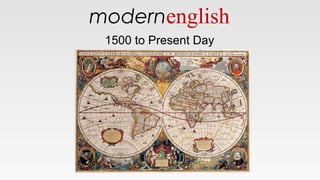
1500 to Present Day
modernenglish
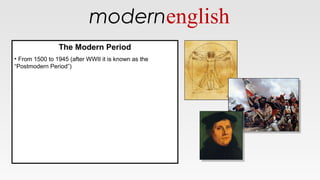
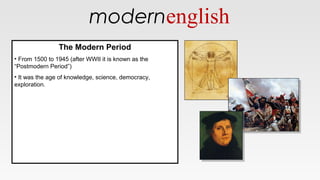
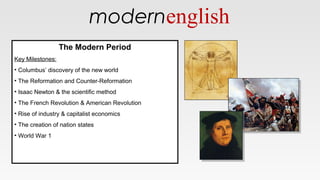
The Modern Period
• From 1500 to 1945 (after WWII it is known as the
“Postmodern Period”)
The Modern Period
• From 1500 to 1945 (after WWII it is known as the
“Postmodern Period”)
modernenglish
The Modern Period
• From 1500 to 1945 (after WWII it is known as the
“Postmodern Period”)
• It was the age of knowledge, science, democracy,
exploration.
The Modern Period
• From 1500 to 1945 (after WWII it is known as the
“Postmodern Period”)
• It was the age of knowledge, science, democracy,
exploration.
modernenglish
The Modern Period
Key Milestones:
• Columbus’ discovery of the new world
• The Reformation and Counter-Reformation
• Isaac Newton & the scientific method
• The French Revolution & American Revolution
• Rise of industry & capitalist economics
• The creation of nation states
• World War 1
The Modern Period
Key Milestones:
• Columbus’ discovery of the new world
• The Reformation and Counter-Reformation
• Isaac Newton & the scientific method
• The French Revolution & American Revolution
• Rise of industry & capitalist economics
• The creation of nation states
• World War 1
modernenglish
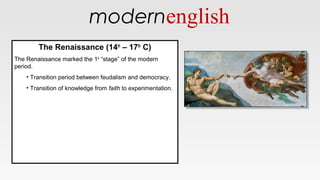
The Renaissance (14th
– 17th
C)
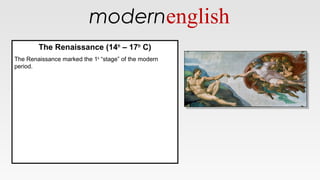
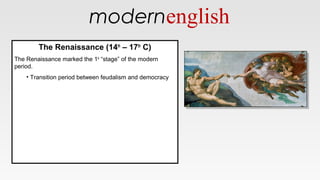
The Renaissance marked the 1st
“stage” of the modern
period.
The Renaissance (14th
– 17th
C)
The Renaissance marked the 1st
“stage” of the modern
period.
modernenglish
The Renaissance (14th
– 17th
C)
The Renaissance marked the 1st
“stage” of the modern
period.
• Transition period between feudalism and democracy
The Renaissance (14th
– 17th
C)
The Renaissance marked the 1st
“stage” of the modern
period.
• Transition period between feudalism and democracy
modernenglish
The Renaissance (14th
– 17th
C)
The Renaissance marked the 1st
“stage” of the modern
period.
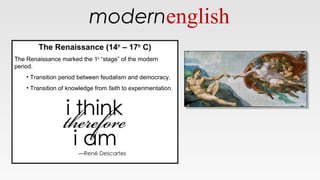
• Transition period between feudalism and democracy.
• Transition of knowledge from faith to experimentation.
The Renaissance (14th
– 17th
C)
The Renaissance marked the 1st
“stage” of the modern
period.
• Transition period between feudalism and democracy.
• Transition of knowledge from faith to experimentation.
modernenglish
The Renaissance (14th
– 17th
C)
The Renaissance marked the 1st
“stage” of the modern
period.
• Transition period between feudalism and democracy.
• Transition of knowledge from faith to experimentation.
The Renaissance (14th
– 17th
C)
The Renaissance marked the 1st
“stage” of the modern
period.
• Transition period between feudalism and democracy.
• Transition of knowledge from faith to experimentation.
modernenglish
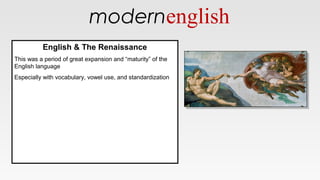
English & The Renaissance
This was a period of great expansion and “maturity” of the
English language
Especially with vocabulary, vowel use, and standardization
English & The Renaissance
This was a period of great expansion and “maturity” of the
English language
Especially with vocabulary, vowel use, and standardization
modernenglish
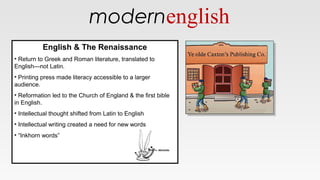
English & The Renaissance
• Return to Greek and Roman literature, translated to
English—not Latin.
• Printing press made literacy accessible to a larger
audience.
• Reformation led to the Church of England & the first bible
in English.
• Intellectual thought shifted from Latin to English
• Intellectual writing created a need for new words
• “Inkhorn words”
English & The Renaissance
• Return to Greek and Roman literature, translated to
English—not Latin.
• Printing press made literacy accessible to a larger
audience.
• Reformation led to the Church of England & the first bible
in English.
• Intellectual thought shifted from Latin to English
• Intellectual writing created a need for new words
• “Inkhorn words”
modernenglish
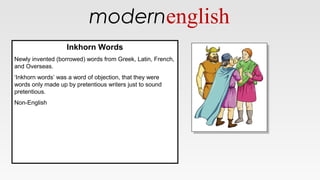
Inkhorn Words
Newly invented (borrowed) words from Greek, Latin, French,
and Overseas.
‘Inkhorn words’ was a word of objection, that they were
words only made up by pretentious writers just to sound
pretentious.
Non-English
Inkhorn Words
Newly invented (borrowed) words from Greek, Latin, French,
and Overseas.
‘Inkhorn words’ was a word of objection, that they were
words only made up by pretentious writers just to sound
pretentious.
Non-English
modernenglish
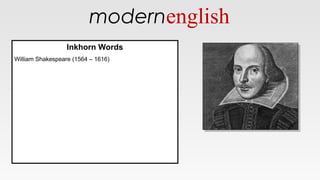
Inkhorn Words
William Shakespeare (1564 – 1616)
Inkhorn Words
William Shakespeare (1564 – 1616)
modernenglish
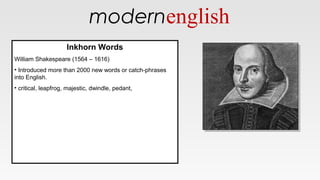
Inkhorn Words
William Shakespeare (1564 – 1616)
• Introduced more than 2000 new words or catch-phrases
into English.
• critical, leapfrog, majestic, dwindle, pedant,
Inkhorn Words
William Shakespeare (1564 – 1616)
• Introduced more than 2000 new words or catch-phrases
into English.
• critical, leapfrog, majestic, dwindle, pedant,
modernenglish
Inkhorn Words
accommodation addiction anticipate compatible democracy
education encyclopedia excellent pretext
profitable anonymous antique catastrophe
enthusiasm tenacious splendidious
contemplate pathetique tranquil complexion
Inkhorn Words
accommodation addiction anticipate compatible democracy
education encyclopedia excellent pretext
profitable anonymous antique catastrophe
enthusiasm tenacious splendidious
contemplate pathetique tranquil complexion
modernenglish
Linguistics of Inkhorn Words
• polysyllabic
• consistent prefixes and suffixes [ex~, ab~, ante~, com~]
[~able, ~ous, ~ation, ~ence]
• Noticeable Greek, Latin, and French patterns in affixes
Another dramatic trend
was…
Linguistics of Inkhorn Words
• polysyllabic
• consistent prefixes and suffixes [ex~, ab~, ante~, com~]
[~able, ~ous, ~ation, ~ence]
• Noticeable Greek, Latin, and French patterns in affixes
Another dramatic trend
was…
The Great Vowel Shift
english
The Great Vowel Shift
1400 to 1800
Regional, not universal
Listen to present-day regional accents
Sounds produced in a different
part of the mouth
Affected pronunciation of long vowels
english
Theories
Push
Pull
Mixed
english
The Great Vowel Shift
Results
Inconsistent spelling
Regional dialects
Pronunciation and spelling don’t match
english
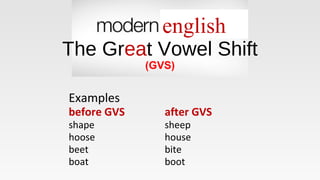
The Great Vowel Shift
Examples
before GVS after GVS
shape sheep
hoose house
beet bite
boat boot
english
The Great Vowel Shift
(GVS)
What else happened?
english
The Great Vowel Shift
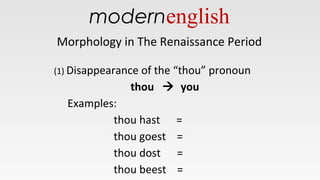
Morphology in The Renaissance Period
(1) Disappearance of the “thou” pronoun
thou  you
Examples:
thou hast =
thou goest =
thou dost =
thou beest =
modernenglish
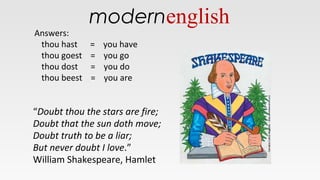
Answers:
thou hast = you have
thou goest = you go
thou dost = you do
thou beest = you are
“Doubt thou the stars are fire;
Doubt that the sun doth move;
Doubt truth to be a liar;
But never doubt I love.”
William Shakespeare, Hamlet
modernenglish
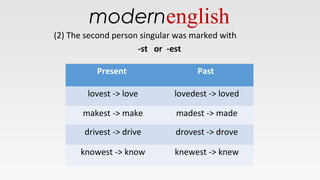
(2) The second person singular was marked with
-st or -est
Present Past
lovest -> love lovedest -> loved
makest -> make madest -> made
drivest -> drive drovest -> drove
knowest -> know knewest -> knew
modernenglish
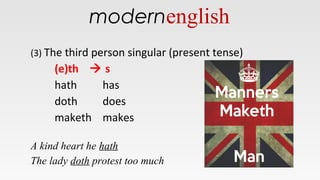
(3) The third person singular (present tense)
(e)th  s
hath has
doth does
maketh makes
A kind heart he hath
The lady doth protest too much
modernenglish
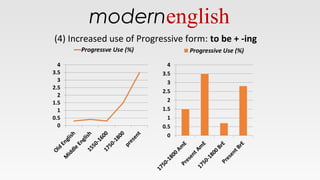
(4) Increased use of Progressive form: to be + -ing
modernenglish
modernenglish
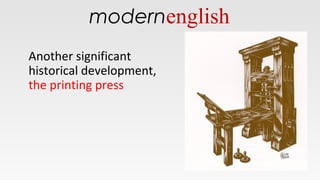
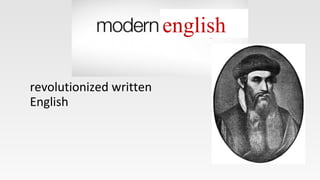
Another significant
historical development,
the printing press
revolutionized written
English
english
english
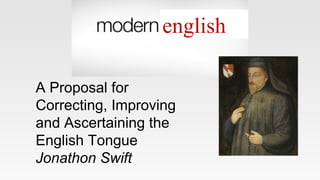
A Proposal for
Correcting, Improving
and Ascertaining the
English Tongue
Jonathon Swift
english
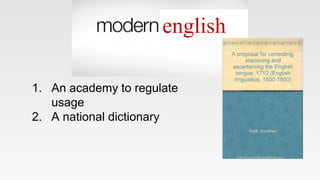
1. An academy to regulate
usage
2. A national dictionary
english
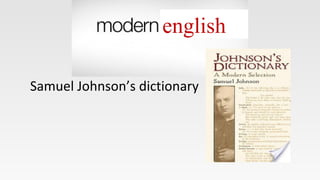
Samuel Johnson’s dictionary
english
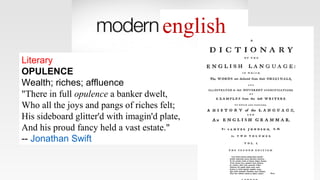
Literary
OPULENCE
Wealth; riches; affluence
"There in full opulence a banker dwelt,
Who all the joys and pangs of riches felt;
His sideboard glitter'd with imagin'd plate,
And his proud fancy held a vast estate."
-- Jonathan Swift
english
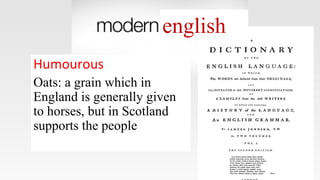
Humourous
Oats: a grain which in
England is generally given
to horses, but in Scotland
supports the people
english
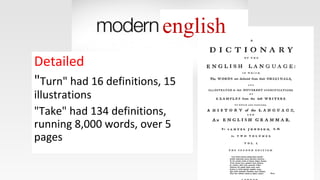
Detailed
"Turn" had 16 definitions, 15
illustrations
"Take" had 134 definitions,
running 8,000 words, over 5
pages
english
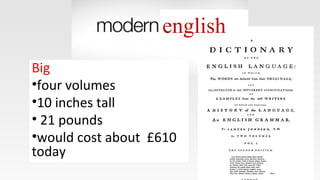
Big
•four volumes
•10 inches tall
• 21 pounds
•would cost about £610
today
english
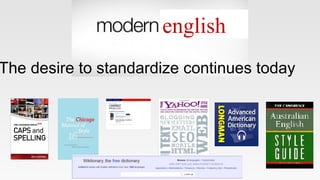
The desire to standardize continues today
english
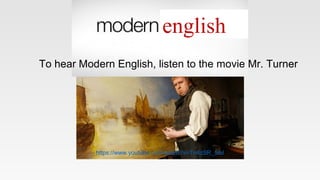
https://www.youtube.com/watch?v=Tn4zSR_5ioI
To hear Modern English, listen to the movie Mr. Turner
english
Recent
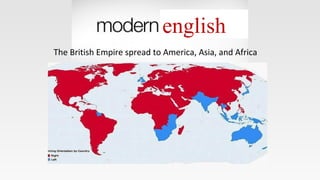
The British Empire spread to America, Asia, and Africa
english
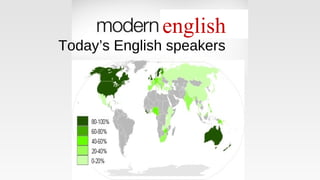
Today’s English speakers
english
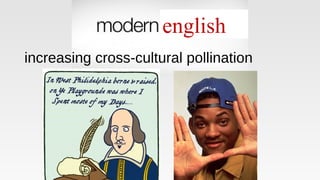
increasing cross-cultural pollination
english
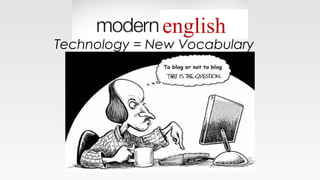
Technology = New Vocabulary
english
english
english
Examples
back button
bandwidth
defrag
english
Changes
subjunctive form is
rare, except in old
expressions “Be that as
it may.”
english
Changes
More phrasal verbs
english
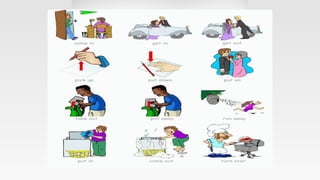
Changes
More phrasal verbs
english
English as a World
Language
english
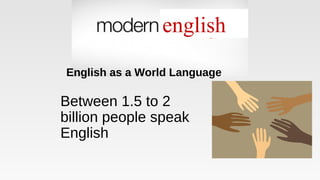
Between 1.5 to 2
billion people speak
English
english
English as a World Language
English is the symbol of
globalization.
The number of speakers is less
important than its economic,
technological, and culture power.
David Crystal
english
Translation has to be
recognized.
David Crystal
english
english
english
english
english
english
english
english
english
english
Thank you
GRAMERCY
Þancung

Modern english master

  • 1.
    modernenglish By Juan Montes,Vicky Guo, Lorna, Barb Sawyers, Dan Mason and Rena Lu For Linguistics, CCLCS, TESL Ontario May 1, 2015
  • 2.
  • 3.
    modernenglish The Modern Period •From 1500 to 1945 (after WWII it is known as the “Postmodern Period”) The Modern Period • From 1500 to 1945 (after WWII it is known as the “Postmodern Period”)
  • 4.
    modernenglish The Modern Period •From 1500 to 1945 (after WWII it is known as the “Postmodern Period”) • It was the age of knowledge, science, democracy, exploration. The Modern Period • From 1500 to 1945 (after WWII it is known as the “Postmodern Period”) • It was the age of knowledge, science, democracy, exploration.
  • 5.
    modernenglish The Modern Period KeyMilestones: • Columbus’ discovery of the new world • The Reformation and Counter-Reformation • Isaac Newton & the scientific method • The French Revolution & American Revolution • Rise of industry & capitalist economics • The creation of nation states • World War 1 The Modern Period Key Milestones: • Columbus’ discovery of the new world • The Reformation and Counter-Reformation • Isaac Newton & the scientific method • The French Revolution & American Revolution • Rise of industry & capitalist economics • The creation of nation states • World War 1
  • 6.
    modernenglish The Renaissance (14th –17th C) The Renaissance marked the 1st “stage” of the modern period. The Renaissance (14th – 17th C) The Renaissance marked the 1st “stage” of the modern period.
  • 7.
    modernenglish The Renaissance (14th –17th C) The Renaissance marked the 1st “stage” of the modern period. • Transition period between feudalism and democracy The Renaissance (14th – 17th C) The Renaissance marked the 1st “stage” of the modern period. • Transition period between feudalism and democracy
  • 8.
    modernenglish The Renaissance (14th –17th C) The Renaissance marked the 1st “stage” of the modern period. • Transition period between feudalism and democracy. • Transition of knowledge from faith to experimentation. The Renaissance (14th – 17th C) The Renaissance marked the 1st “stage” of the modern period. • Transition period between feudalism and democracy. • Transition of knowledge from faith to experimentation.
  • 9.
    modernenglish The Renaissance (14th –17th C) The Renaissance marked the 1st “stage” of the modern period. • Transition period between feudalism and democracy. • Transition of knowledge from faith to experimentation. The Renaissance (14th – 17th C) The Renaissance marked the 1st “stage” of the modern period. • Transition period between feudalism and democracy. • Transition of knowledge from faith to experimentation.
  • 10.
    modernenglish English & TheRenaissance This was a period of great expansion and “maturity” of the English language Especially with vocabulary, vowel use, and standardization English & The Renaissance This was a period of great expansion and “maturity” of the English language Especially with vocabulary, vowel use, and standardization
  • 11.
    modernenglish English & TheRenaissance • Return to Greek and Roman literature, translated to English—not Latin. • Printing press made literacy accessible to a larger audience. • Reformation led to the Church of England & the first bible in English. • Intellectual thought shifted from Latin to English • Intellectual writing created a need for new words • “Inkhorn words” English & The Renaissance • Return to Greek and Roman literature, translated to English—not Latin. • Printing press made literacy accessible to a larger audience. • Reformation led to the Church of England & the first bible in English. • Intellectual thought shifted from Latin to English • Intellectual writing created a need for new words • “Inkhorn words”
  • 12.
    modernenglish Inkhorn Words Newly invented(borrowed) words from Greek, Latin, French, and Overseas. ‘Inkhorn words’ was a word of objection, that they were words only made up by pretentious writers just to sound pretentious. Non-English Inkhorn Words Newly invented (borrowed) words from Greek, Latin, French, and Overseas. ‘Inkhorn words’ was a word of objection, that they were words only made up by pretentious writers just to sound pretentious. Non-English
  • 13.
    modernenglish Inkhorn Words William Shakespeare(1564 – 1616) Inkhorn Words William Shakespeare (1564 – 1616)
  • 14.
    modernenglish Inkhorn Words William Shakespeare(1564 – 1616) • Introduced more than 2000 new words or catch-phrases into English. • critical, leapfrog, majestic, dwindle, pedant, Inkhorn Words William Shakespeare (1564 – 1616) • Introduced more than 2000 new words or catch-phrases into English. • critical, leapfrog, majestic, dwindle, pedant,
  • 15.
    modernenglish Inkhorn Words accommodation addictionanticipate compatible democracy education encyclopedia excellent pretext profitable anonymous antique catastrophe enthusiasm tenacious splendidious contemplate pathetique tranquil complexion Inkhorn Words accommodation addiction anticipate compatible democracy education encyclopedia excellent pretext profitable anonymous antique catastrophe enthusiasm tenacious splendidious contemplate pathetique tranquil complexion
  • 16.
    modernenglish Linguistics of InkhornWords • polysyllabic • consistent prefixes and suffixes [ex~, ab~, ante~, com~] [~able, ~ous, ~ation, ~ence] • Noticeable Greek, Latin, and French patterns in affixes Another dramatic trend was… Linguistics of Inkhorn Words • polysyllabic • consistent prefixes and suffixes [ex~, ab~, ante~, com~] [~able, ~ous, ~ation, ~ence] • Noticeable Greek, Latin, and French patterns in affixes Another dramatic trend was…
  • 17.
    The Great VowelShift english
  • 18.
    The Great VowelShift 1400 to 1800 Regional, not universal Listen to present-day regional accents Sounds produced in a different part of the mouth Affected pronunciation of long vowels english
  • 19.
  • 20.
    Results Inconsistent spelling Regional dialects Pronunciationand spelling don’t match english The Great Vowel Shift
  • 21.
    Examples before GVS afterGVS shape sheep hoose house beet bite boat boot english The Great Vowel Shift (GVS)
  • 22.
  • 23.
    Morphology in TheRenaissance Period (1) Disappearance of the “thou” pronoun thou  you Examples: thou hast = thou goest = thou dost = thou beest = modernenglish
  • 24.
    Answers: thou hast =you have thou goest = you go thou dost = you do thou beest = you are “Doubt thou the stars are fire; Doubt that the sun doth move; Doubt truth to be a liar; But never doubt I love.” William Shakespeare, Hamlet modernenglish
  • 25.
    (2) The secondperson singular was marked with -st or -est Present Past lovest -> love lovedest -> loved makest -> make madest -> made drivest -> drive drovest -> drove knowest -> know knewest -> knew modernenglish
  • 26.
    (3) The thirdperson singular (present tense) (e)th  s hath has doth does maketh makes A kind heart he hath The lady doth protest too much modernenglish
  • 27.
    (4) Increased useof Progressive form: to be + -ing modernenglish
  • 28.
  • 29.
  • 30.
    english A Proposal for Correcting,Improving and Ascertaining the English Tongue Jonathon Swift
  • 31.
    english 1. An academyto regulate usage 2. A national dictionary
  • 32.
  • 33.
    english Literary OPULENCE Wealth; riches; affluence "Therein full opulence a banker dwelt, Who all the joys and pangs of riches felt; His sideboard glitter'd with imagin'd plate, And his proud fancy held a vast estate." -- Jonathan Swift
  • 34.
    english Humourous Oats: a grainwhich in England is generally given to horses, but in Scotland supports the people
  • 35.
    english Detailed "Turn" had 16definitions, 15 illustrations "Take" had 134 definitions, running 8,000 words, over 5 pages
  • 36.
    english Big •four volumes •10 inchestall • 21 pounds •would cost about £610 today
  • 37.
    english The desire tostandardize continues today
  • 38.
  • 39.
  • 40.
    The British Empirespread to America, Asia, and Africa english
  • 41.
  • 42.
  • 43.
    Technology = NewVocabulary english
  • 44.
  • 45.
  • 46.
    english Changes subjunctive form is rare,except in old expressions “Be that as it may.”
  • 47.
  • 48.
  • 49.
    english English as aWorld Language english
  • 50.
    Between 1.5 to2 billion people speak English english English as a World Language
  • 51.
    English is thesymbol of globalization. The number of speakers is less important than its economic, technological, and culture power. David Crystal english
  • 52.
    Translation has tobe recognized. David Crystal english
  • 53.
  • 54.
  • 55.
  • 56.
  • 57.
  • 58.
  • 59.
  • 60.
  • 61.