TISSUES
JaniceV. Ng, MSc
Department of Biology
CAS, UP Manila
Tissues
 “weave”
 group of cells with a common structure
and function
 held together by intracellular substances
Types
 EpithelialTissues
 ConnectiveTissues
 MuscularTissues
 NervousTissues
Epithelial Tissues
 composed of closely packed cells with very little intercellular
substance
 surface epithelia – exposed to air or fluid; continuous with
one or more layer of cells
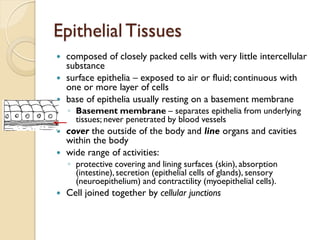
 base of epithelia usually resting on a basement membrane
◦ Basement membrane – separates epithelia from underlying
tissues; never penetrated by blood vessels
 cover the outside of the body and line organs and cavities
within the body
 wide range of activities:
◦ protective covering and lining surfaces (skin), absorption
(intestine), secretion (epithelial cells of glands), sensory
(neuroepithelium) and contractility (myoepithelial cells).
 Cell joined together by cellular junctions
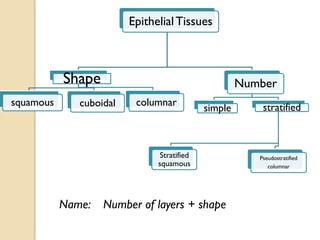
EpithelialTissues
Shape
squamous cuboidal columnar
Number
simple stratified
Stratified
squamous
Pseudostratified
columnar
Name: Number of layers + shape
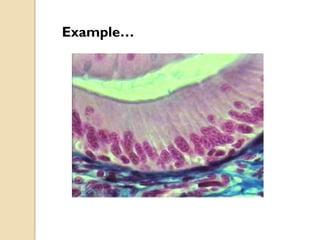
Example…
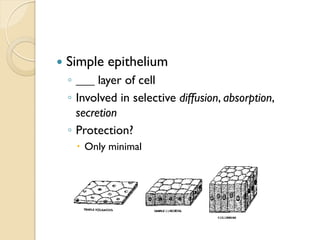
 Simple epithelium
◦ ___ layer of cell
◦ Involved in selective diffusion, absorption,
secretion
◦ Protection?
 Only minimal
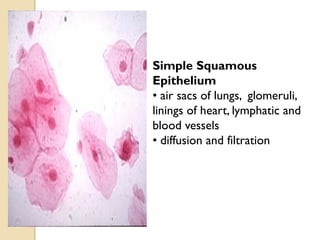
Simple Squamous
Epithelium
• air sacs of lungs, glomeruli,
linings of heart, lymphatic and
blood vessels
• diffusion and filtration
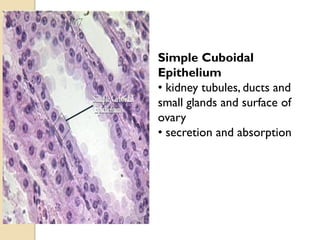
Simple Cuboidal
Epithelium
• kidney tubules, ducts and
small glands and surface of
ovary
• secretion and absorption
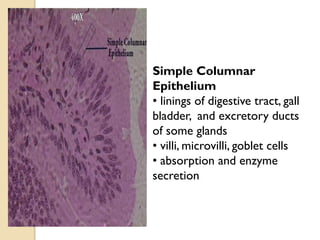
Simple Columnar
Epithelium
• linings of digestive tract, gall
bladder, and excretory ducts
of some glands
• villi, microvilli, goblet cells
• absorption and enzyme
secretion
 Stratified epithelium
◦ ____ layer of cells
◦ Mainly for protection
◦ Degree of stratification related to the kind of
physical stresses to which the surface is
exposed
◦ Name is based on the structure of the ____
cells
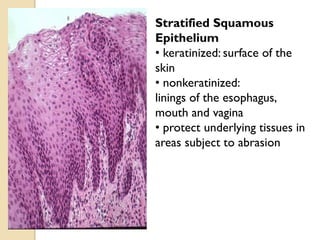
Stratified Squamous
Epithelium
• keratinized: surface of the
skin
• nonkeratinized:
linings of the esophagus,
mouth and vagina
• protect underlying tissues in
areas subject to abrasion
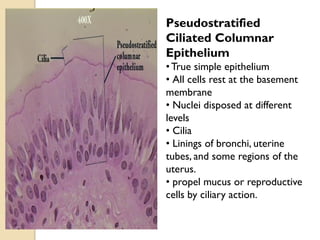
Pseudostratified
Ciliated Columnar
Epithelium
•True simple epithelium
• All cells rest at the basement
membrane
• Nuclei disposed at different
levels
• Cilia
• Linings of bronchi, uterine
tubes, and some regions of the
uterus.
• propel mucus or reproductive
cells by ciliary action.
Connective Tissues
 Provide structural and metabolic support
for other tissues and organs
 Usually contain blood vessels
 Mediate exchange of nutrients,
metabolites, waste products between
tissues and circulatory system
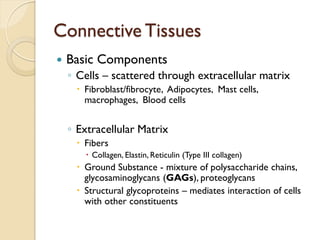
Connective Tissues
 Basic Components
◦ Cells – scattered through extracellular matrix
 Fibroblast/fibrocyte, Adipocytes, Mast cells,
macrophages, Blood cells
◦ Extracellular Matrix
 Fibers
 Collagen, Elastin, Reticulin (Type III collagen)
 Ground Substance - mixture of polysaccharide chains,
glycosaminoglycans (GAGs), proteoglycans
 Structural glycoproteins – mediates interaction of cells
with other constituents
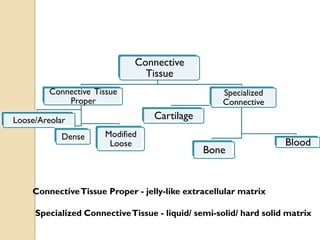
Connective
Tissue
Connective Tissue
Proper
Loose/Areolar
Dense Modified
Loose
Specialized
Connective
Cartilage
Bone
Blood
ConnectiveTissue Proper - jelly-like extracellular matrix
Specialized ConnectiveTissue - liquid/ semi-solid/ hard solid matrix
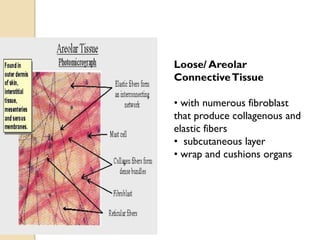
Loose/ Areolar
ConnectiveTissue
• with numerous fibroblast
that produce collagenous and
elastic fibers
• subcutaneous layer
• wrap and cushions organs
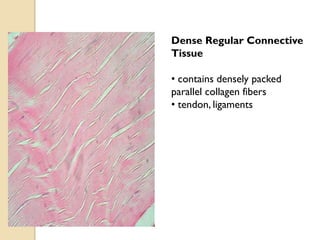
Dense Regular Connective
Tissue
• contains densely packed
parallel collagen fibers
• tendon, ligaments
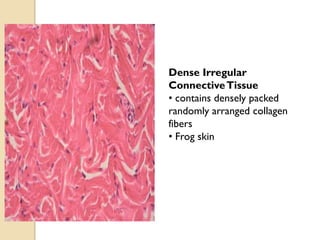
Dense Irregular
ConnectiveTissue
• contains densely packed
randomly arranged collagen
fibers
• Frog skin
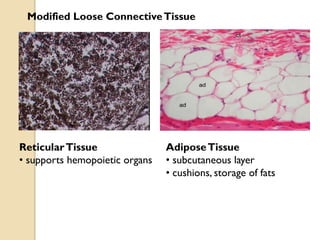
Modified Loose ConnectiveTissue
AdiposeTissue
• subcutaneous layer
• cushions, storage of fats
ReticularTissue
• supports hemopoietic organs
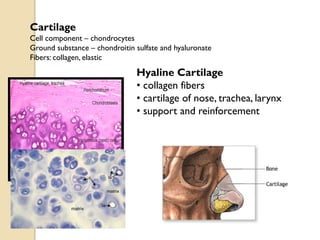
Cartilage
Cell component – chondrocytes
Ground substance – chondroitin sulfate and hyaluronate
Fibers: collagen, elastic
Hyaline Cartilage
• collagen fibers
• cartilage of nose, trachea, larynx
• support and reinforcement
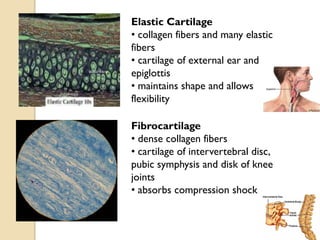
Elastic Cartilage
• collagen fibers and many elastic
fibers
• cartilage of external ear and
epiglottis
• maintains shape and allows
flexibility
Fibrocartilage
• dense collagen fibers
• cartilage of intervertebral disc,
pubic symphysis and disk of knee
joints
• absorbs compression shock
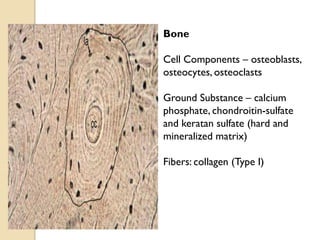
Bone
Cell Components – osteoblasts,
osteocytes, osteoclasts
Ground Substance – calcium
phosphate, chondroitin-sulfate
and keratan sulfate (hard and
mineralized matrix)
Fibers: collagen (Type I)
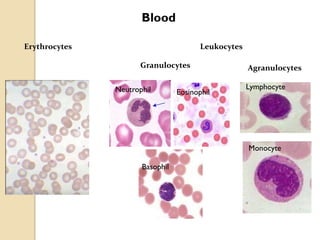
Blood
Granulocytes Agranulocytes
Neutrophil Eosinophil
Basophil
Lymphocyte
Monocyte
Erythrocytes Leukocytes
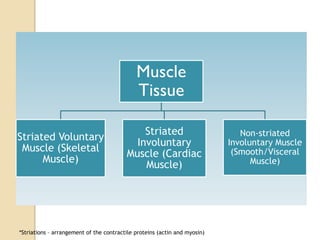
Muscle
Tissue
Striated Voluntary
Muscle (Skeletal
Muscle)
Striated
Involuntary
Muscle (Cardiac
Muscle)
Non-striated
Involuntary Muscle
(Smooth/Visceral
Muscle)
*Striations – arrangement of the contractile proteins (actin and myosin)
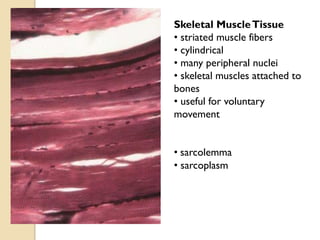
Skeletal MuscleTissue
• striated muscle fibers
• cylindrical
• many peripheral nuclei
• skeletal muscles attached to
bones
• useful for voluntary
movement
• sarcolemma
• sarcoplasm
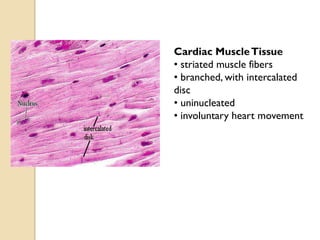
Cardiac MuscleTissue
• striated muscle fibers
• branched, with intercalated
disc
• uninucleated
• involuntary heart movement
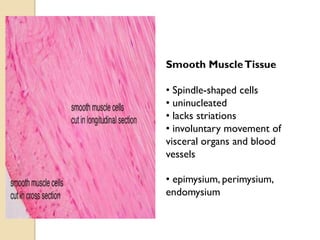
Smooth MuscleTissue
• Spindle-shaped cells
• uninucleated
• lacks striations
• involuntary movement of
visceral organs and blood
vessels
• epimysium, perimysium,
endomysium
Nervous Tissues
 Sense stimuli and transmit signals from one
part of the animal to another
 Functional unit  neuron/nerve cell
 Smear, Cross section, Longitudinal section
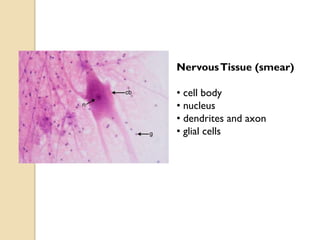
NervousTissue (smear)
• cell body
• nucleus
• dendrites and axon
• glial cells
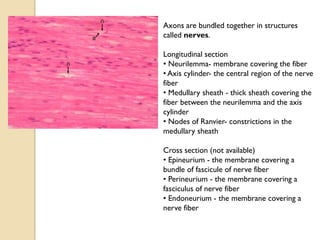
Axons are bundled together in structures
called nerves.
Longitudinal section
• Neurilemma- membrane covering the fiber
• Axis cylinder- the central region of the nerve
fiber
• Medullary sheath - thick sheath covering the
fiber between the neurilemma and the axis
cylinder
• Nodes of Ranvier- constrictions in the
medullary sheath
Cross section (not available)
• Epineurium - the membrane covering a
bundle of fascicule of nerve fiber
• Perineurium - the membrane covering a
fasciculus of nerve fiber
• Endoneurium - the membrane covering a
nerve fiber
END

Histology