Hirschsprung Disease
Introduction
Hirschsprung disease is also known as Congenital Aganglionic Megacolon. Hirschsprung
disease is a congenital anomaly that results in mechanical obstruction from inadequate
motility of part of the intestine. It accounts for about one fourth of all cases of neonatal
intestinal obstruction. Hirschsprung disease (HSCR) is a birth defect which is characterized
by the absence of particular nerve cells (ganglions) in a segment of the bowel in an infant.
Definition
Hirschsprung disease is a congenital disorder which is characterized by absence of the
parasympathetic ganglionic nerve cells within the muscle wall of the intestinal tract, usually
at the distal ends of the colon, resulting in functional obstruction with dilation and
hypertrophy of proximal colon.
The level of hirschsprung's disease include:-
1. Short-segment: Missing ganglion cells in the rectum and sigmoid colon (the last segment
of the colon).
2. Long-segment: Also missing ganglion cells in the first third of the colon (proximal
colon).
Incidence
The incidence of HSCR is estimated to be approximately 1 in 5000 live births. Over 80% of
patients produce clinical symptoms and are diagnosed in the neonatal period. The majority of
patients with HSCR are male, with a male-to-female ratio of 4:1
Source:-
https://www.researchgate.net/publication/333313815_Epidemiology_and_Clinical_Character
istics_of_Hirschsprung's_Disease
Kanti children's hospital has served a total of 103 patients in the Surgical ICU of Kanti
Children’s Hospital, from October to December 2018 from which hirschsprung's disease
patients was 2 (October), 4 (November ), 6 (December ).
Source:- https://realmedicinefoundation.org/wp-
content/uploads/2019/09/RMF_Nepal___Kanti_Children_s_Hospital___Q4_2018.pdf
Etiology
 Exact cause is unknown
 In some cases may be hereditary due to RET gene abnormalities.
 Congenital defects (an arrest in embryonic development affecting the migration of
parasympathetic nerve of the intestine, occurring prior to the 12 weeks of gestation)
 Common among child with Down syndrome, congenital heart disease.
Pathophysiology
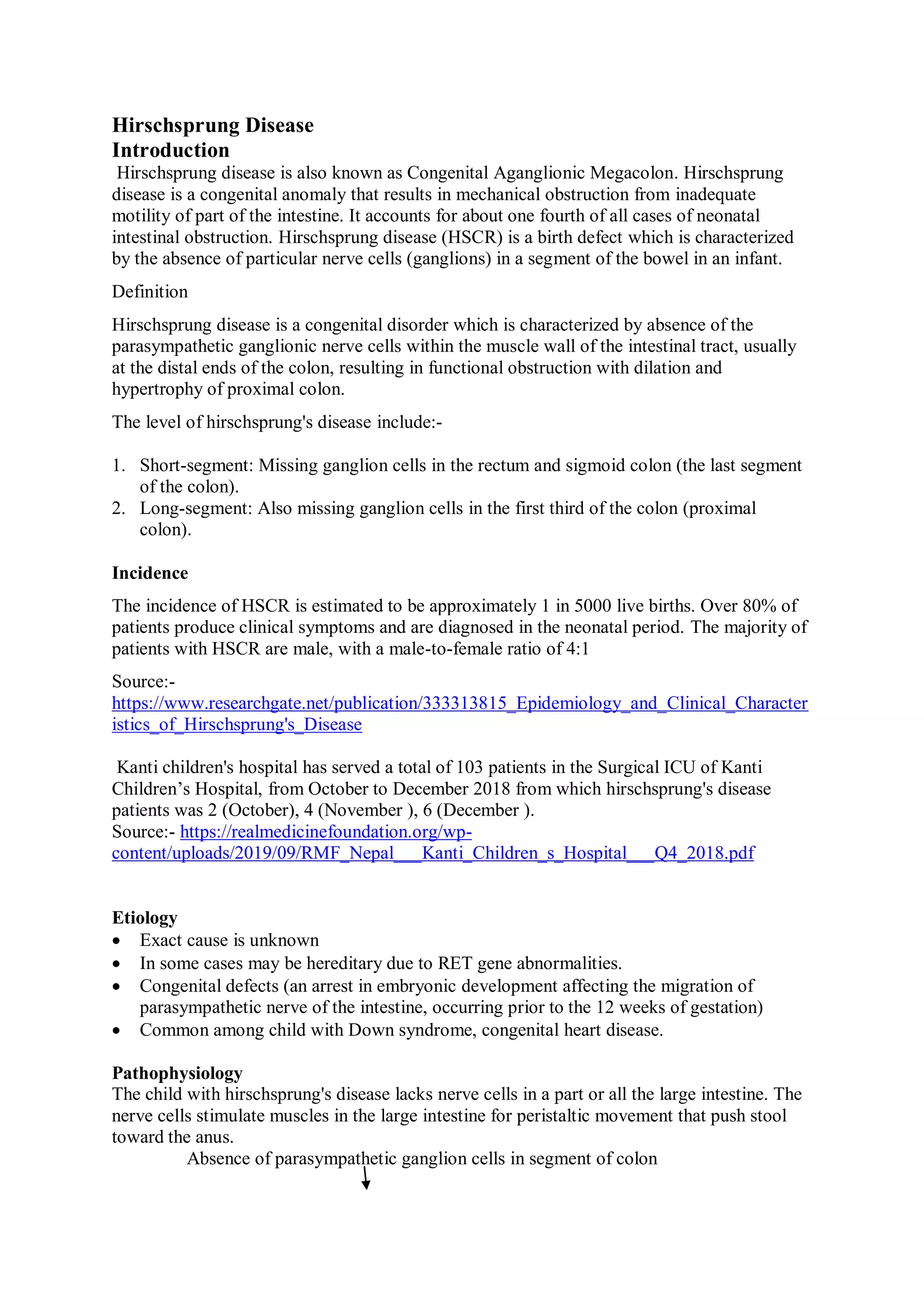
The child with hirschsprung's disease lacks nerve cells in a part or all the large intestine. The
nerve cells stimulate muscles in the large intestine for peristaltic movement that push stool
toward the anus.
Absence of parasympathetic ganglion cells in segment of colon
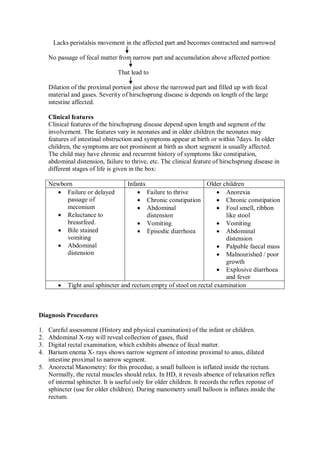
Lacks peristalsis movement in the affected part and becomes contracted and narrowed
No passage of fecal matter from narrow part and accumulation above affected portion
That lead to
Dilation of the proximal portion just above the narrowed part and filled up with fecal
material and gases. Severity of hirschsprung disease is depends on length of the large
intestine affected.
Clinical features
Clinical features of the hirschsprung disease depend upon length and segment of the
involvement. The features vary in neonates and in older children the neonates may
features of intestinal obstruction and symptoms appear at birth or within 7days. In older
children, the symptoms are not prominent at birth as short segment is usually affected.
The child may have chronic and recurrent history of symptoms like constipation,
abdominal distension, failure to thrive, etc. The clinical feature of hirschsprung disease in
different stages of life is given in the box:
Newborn Infants Older children
 Failure or delayed
passage of
meconium
 Reluctance to
breastfeed.
 Bile stained
vomiting
 Abdominal
distension
 Failure to thrive
 Chronic constipation
 Abdominal
distension
 Vomiting
 Episodic diarrhoea
 Anorexia
 Chronic constipation
 Foul smell, ribbon
like stool
 Vomiting
 Abdominal
distension
 Palpable faecal mass
 Malnourished / poor
growth
 Explosive diarrhoea
and fever
 Tight anal sphincter and rectum empty of stool on rectal examination
Diagnosis Procedures
1. Careful assessment (History and physical examination) of the infant or children.
2. Abdominal X-ray will reveal collection of gases, fluid
3. Digital rectal examination, which exhibits absence of fecal matter.
4. Barium enema X- rays shows narrow segment of intestine proximal to anus, dilated
intestine proximal to narrow segment.
5. Anorectal Manometry: for this procedue, a small balloon is inflated inside the rectum.
Normally, the rectal muscles should relax. In HD, it reveals absence of relaxation reflex
of internal sphincter. It is useful only for older children. It records the reflex reponse of
sphincter (use for older children). During manometry small balloon is inflates inside the
rectum.
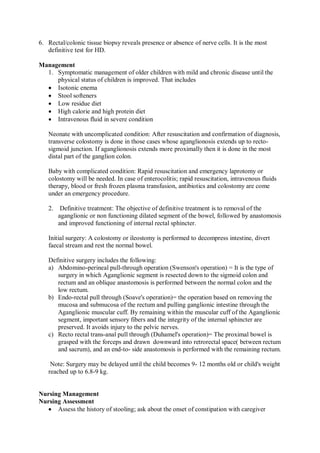
6. Rectal/colonic tissue biopsy reveals presence or absence of nerve cells. It is the most
definitive test for HD.
Management
1. Symptomatic management of older children with mild and chronic disease until the
physical status of children is improved. That includes
 Isotonic enema
 Stool softeners
 Low residue diet
 High calorie and high protein diet
 Intravenous fluid in severe condition
Neonate with uncomplicated condition: After resuscitation and confirmation of diagnosis,
transverse colostomy is done in those cases whose aganglionosis extends up to recto-
sigmoid junction. If aganglionosis extends more proximally then it is done in the most
distal part of the ganglion colon.
Baby with complicated condition: Rapid resuscitation and emergency laprotomy or
colostomy will be needed. In case of enterocolitis; rapid resuscitation, intravenous fluids
therapy, blood or fresh frozen plasma transfusion, antibiotics and colostomy are come
under an emergency procedure.
2. Definitive treatment: The objective of definitive treatment is to removal of the
aganglionic or non functioning dilated segment of the bowel, followed by anastomosis
and improved functioning of internal rectal sphincter.
Initial surgery: A colostomy or ileostomy is performed to decompress intestine, divert
faecal stream and rest the normal bowel.
Definitive surgery includes the following:
a) Abdomino-perineal pull-through operation (Swenson's operation) = It is the type of
surgery in which Aganglionic segment is resected down to the sigmoid colon and
rectum and an oblique anastomosis is performed between the normal colon and the
low rectum.
b) Endo-rectal pull through (Soave's operation)= the operation based on removing the
mucosa and submucosa of the rectum and pulling ganglionic intestine through the
Aganglionic muscular cuff. By remaining within the muscular cuff of the Aganglionic
segment, important sensory fibers and the integrity of the internal sphincter are
preserved. It avoids injury to the pelvic nerves.
c) Recto rectal trans-anal pull through (Duhamel's operation)= The proximal bowel is
grasped with the forceps and drawn downward into retrorectal space( between rectum
and sacrum), and an end-to- side anastomosis is performed with the remaining rectum.
Note: Surgery may be delayed until the child becomes 9- 12 months old or child's weight
reached up to 6.8-9 kg.
Nursing Management
Nursing Assessment
 Assess the history of stooling; ask about the onset of constipation with caregiver
 Assess the character and odor of stools
 Assess the frequency of bowel movements
 Assess the presence of poor feeding habits, anorexia, and irritability.
 Observe for distended abdomen and signs of poor nutrition; record weight and vital
signs during the physical exam.
Nursing Diagnosis
 Constipation related to decreased bowel motility.
 Imbalanced nutrition: less than body requirements related to anorexia.
 Fear (in the older child) related to impending surgery.
 Risk for impaired skin integrity related to irritation from the colostomy.
 Acute pain related to the surgical procedure.
 Deficient fluid volume related to postoperative condition.
 Impaired oral and nasal mucous membranes related to NPO status and irritation
from NG tube.
 Deficient knowledge of caregivers related to understanding of postoperative care
of the colostomy.
Nursing Interventions
Promote skin integrity.
 When performing routine colostomy care, give careful attention to the area around
the colostomy;
 Record and report redness, irritation, and rashy appearances of the skin around the
stoma;
 Prepare the skin with skin-toughening preparations that strengthen it and provide
better adhesion of the appliance.
Promote comfort.
 Observe for signs of pain, such as crying, pulse and respiration rate increases,
restlessness, guarding of the abdomen, or drawing up the legs;
 Changing the child’s position,
 Holding the child when possible, stroking, cuddling, and engaging in age-appropriate
activities.
 Administer analgesics as ordered
Maintain fluid balance.
 Determine accurate intake and output
 Reporting the character, amount, and consistency of stools help determine
 When the child may have oral feedings; to monitor fluid loss,
 Record and report the drainage from the NG tube every 8 hours;
 Immediately report any unusual drainage, such as bright-red bleeding.
Provide oral and nasal care.
 Perform good mouth care at least every 4 hours; at the same time
 Rinse the oral cavity time to time
 Gently clean the nares to relieve any irritation from the NG tube.
Provide family teaching.
 Show the family caregiver how to care for the colostomy at home;
 Discuss topics such as devices and their use, and skin care;
 The caregivers should demonstrate their understanding by caring for the colostomy
under the supervision of nursing personnel several days before discharge.
Constipation
 Assess the frequency and characteristics of stools in infants/children
 Avoid taking temperature temperature of infant/ child rectally.
 Encourage for ambulation
 Administer stool softener according to prescribed
Preoperative management
 Assessment of child's health condition.
 Written consent from parents.
 Physical preparations: Emptying the with repeated saline enemas and use systemic
antibiotic and colon irrigations.
 Insertion of nasogastric tube to abdominal distension.
 Instilled antibiotic solution through nasogastric tube to minimize infection.
 Vitals monitoring.
 Maintain intake output record.
 Regular measurement of abdominal girth
 Provide preoperative medications.
 Ensure adequate nutrition and hydration level of the infant/child before and after
surgery
 Prepare the child and the parents for different procedures and treatment
 Preoperative care like collection of lab report consent
 Keep the child NPO during the initial post-operative period.
 Monitor I/O chart including nasogastric drainage
Post operative management
 Assessment of child's general condition.
 Monitor vital sign and record properly.
 Maintain airway patency
 Prevent from aspiration
 Assess wound site and drainage tube if present for bleeding, leakage
 Change dressing using sterile technique
 Prevent contamination from diaper; change diaper below dressing frequently
 Prevent perineal and anal excoriation thorough cleaning and using ointment after the
infant soils
 Follow careful hand washing technique
 Report sign of wound infection
 Encourage frequent coughing and deep breathing exercise to maintain respiratory
status as well as to minimize respiratory complication in older children
 Allow the baby to cry for short period to prevent atelectasis
 Change baby's position frequently to increase circulation and allow for aeration of all
lung areas
 Maintain patency of nasogastric tube postoperatively
 Assess bowel sound regularly with measurement of abdominal girth
 Maintain nil per orally until bowel sound return and the bowel is ready for feeding
Complication
Before surgery:
 Enterocolitis (main cause of death),
 Hydroureter or Hydronephrosis,
 Water intoxication from tap water enema,
 Cecal perforation.
After surgery:
 Enterocolitis,
 Leaking of anastomosis and pelvic abscess,
 Temporary sudden inability to evacuation of colon,
 Volvulus
 Intussusceptions,
 Abdominal distension,
 Respiratory distress,
 Infection,
 Bleeding,
 Shock.
Reference of Hirschsprung disease
 Uprety K, Child Health Nursing, fourth Edition (2071 Bhadra), Tara Books and
Stationery, Chhetrapati, Kathmandu, pg 163- 166
 Shrestha T. Essential Child Health Nursing. first Edition 2015,August. Medhavi
Publication; Jamal, Kathmandu Page no.281-286
 WilsonD, Rodgers CC, Hockenberry M, Wongs Essential of pediatric Nursing 10 th
edition, ELSEVIER, page no 1371-1373
 Adhikari T, Essential of Pediatric Nursing, first 2014 edition, vidyarthi pustak
bhadar, bhotahity, Kathmandu, page no163-166
 https://www.cincinnatichildrens.org/health/h/hirschsprung

Hirschsprung Disease.pdf

  • 1.
    Hirschsprung Disease Introduction Hirschsprung diseaseis also known as Congenital Aganglionic Megacolon. Hirschsprung disease is a congenital anomaly that results in mechanical obstruction from inadequate motility of part of the intestine. It accounts for about one fourth of all cases of neonatal intestinal obstruction. Hirschsprung disease (HSCR) is a birth defect which is characterized by the absence of particular nerve cells (ganglions) in a segment of the bowel in an infant. Definition Hirschsprung disease is a congenital disorder which is characterized by absence of the parasympathetic ganglionic nerve cells within the muscle wall of the intestinal tract, usually at the distal ends of the colon, resulting in functional obstruction with dilation and hypertrophy of proximal colon. The level of hirschsprung's disease include:- 1. Short-segment: Missing ganglion cells in the rectum and sigmoid colon (the last segment of the colon). 2. Long-segment: Also missing ganglion cells in the first third of the colon (proximal colon). Incidence The incidence of HSCR is estimated to be approximately 1 in 5000 live births. Over 80% of patients produce clinical symptoms and are diagnosed in the neonatal period. The majority of patients with HSCR are male, with a male-to-female ratio of 4:1 Source:- https://www.researchgate.net/publication/333313815_Epidemiology_and_Clinical_Character istics_of_Hirschsprung's_Disease Kanti children's hospital has served a total of 103 patients in the Surgical ICU of Kanti Children’s Hospital, from October to December 2018 from which hirschsprung's disease patients was 2 (October), 4 (November ), 6 (December ). Source:- https://realmedicinefoundation.org/wp- content/uploads/2019/09/RMF_Nepal___Kanti_Children_s_Hospital___Q4_2018.pdf Etiology  Exact cause is unknown  In some cases may be hereditary due to RET gene abnormalities.  Congenital defects (an arrest in embryonic development affecting the migration of parasympathetic nerve of the intestine, occurring prior to the 12 weeks of gestation)  Common among child with Down syndrome, congenital heart disease. Pathophysiology The child with hirschsprung's disease lacks nerve cells in a part or all the large intestine. The nerve cells stimulate muscles in the large intestine for peristaltic movement that push stool toward the anus. Absence of parasympathetic ganglion cells in segment of colon
  • 2.
    Lacks peristalsis movementin the affected part and becomes contracted and narrowed No passage of fecal matter from narrow part and accumulation above affected portion That lead to Dilation of the proximal portion just above the narrowed part and filled up with fecal material and gases. Severity of hirschsprung disease is depends on length of the large intestine affected. Clinical features Clinical features of the hirschsprung disease depend upon length and segment of the involvement. The features vary in neonates and in older children the neonates may features of intestinal obstruction and symptoms appear at birth or within 7days. In older children, the symptoms are not prominent at birth as short segment is usually affected. The child may have chronic and recurrent history of symptoms like constipation, abdominal distension, failure to thrive, etc. The clinical feature of hirschsprung disease in different stages of life is given in the box: Newborn Infants Older children  Failure or delayed passage of meconium  Reluctance to breastfeed.  Bile stained vomiting  Abdominal distension  Failure to thrive  Chronic constipation  Abdominal distension  Vomiting  Episodic diarrhoea  Anorexia  Chronic constipation  Foul smell, ribbon like stool  Vomiting  Abdominal distension  Palpable faecal mass  Malnourished / poor growth  Explosive diarrhoea and fever  Tight anal sphincter and rectum empty of stool on rectal examination Diagnosis Procedures 1. Careful assessment (History and physical examination) of the infant or children. 2. Abdominal X-ray will reveal collection of gases, fluid 3. Digital rectal examination, which exhibits absence of fecal matter. 4. Barium enema X- rays shows narrow segment of intestine proximal to anus, dilated intestine proximal to narrow segment. 5. Anorectal Manometry: for this procedue, a small balloon is inflated inside the rectum. Normally, the rectal muscles should relax. In HD, it reveals absence of relaxation reflex of internal sphincter. It is useful only for older children. It records the reflex reponse of sphincter (use for older children). During manometry small balloon is inflates inside the rectum.
  • 3.
    6. Rectal/colonic tissuebiopsy reveals presence or absence of nerve cells. It is the most definitive test for HD. Management 1. Symptomatic management of older children with mild and chronic disease until the physical status of children is improved. That includes  Isotonic enema  Stool softeners  Low residue diet  High calorie and high protein diet  Intravenous fluid in severe condition Neonate with uncomplicated condition: After resuscitation and confirmation of diagnosis, transverse colostomy is done in those cases whose aganglionosis extends up to recto- sigmoid junction. If aganglionosis extends more proximally then it is done in the most distal part of the ganglion colon. Baby with complicated condition: Rapid resuscitation and emergency laprotomy or colostomy will be needed. In case of enterocolitis; rapid resuscitation, intravenous fluids therapy, blood or fresh frozen plasma transfusion, antibiotics and colostomy are come under an emergency procedure. 2. Definitive treatment: The objective of definitive treatment is to removal of the aganglionic or non functioning dilated segment of the bowel, followed by anastomosis and improved functioning of internal rectal sphincter. Initial surgery: A colostomy or ileostomy is performed to decompress intestine, divert faecal stream and rest the normal bowel. Definitive surgery includes the following: a) Abdomino-perineal pull-through operation (Swenson's operation) = It is the type of surgery in which Aganglionic segment is resected down to the sigmoid colon and rectum and an oblique anastomosis is performed between the normal colon and the low rectum. b) Endo-rectal pull through (Soave's operation)= the operation based on removing the mucosa and submucosa of the rectum and pulling ganglionic intestine through the Aganglionic muscular cuff. By remaining within the muscular cuff of the Aganglionic segment, important sensory fibers and the integrity of the internal sphincter are preserved. It avoids injury to the pelvic nerves. c) Recto rectal trans-anal pull through (Duhamel's operation)= The proximal bowel is grasped with the forceps and drawn downward into retrorectal space( between rectum and sacrum), and an end-to- side anastomosis is performed with the remaining rectum. Note: Surgery may be delayed until the child becomes 9- 12 months old or child's weight reached up to 6.8-9 kg. Nursing Management Nursing Assessment  Assess the history of stooling; ask about the onset of constipation with caregiver
  • 4.
     Assess thecharacter and odor of stools  Assess the frequency of bowel movements  Assess the presence of poor feeding habits, anorexia, and irritability.  Observe for distended abdomen and signs of poor nutrition; record weight and vital signs during the physical exam. Nursing Diagnosis  Constipation related to decreased bowel motility.  Imbalanced nutrition: less than body requirements related to anorexia.  Fear (in the older child) related to impending surgery.  Risk for impaired skin integrity related to irritation from the colostomy.  Acute pain related to the surgical procedure.  Deficient fluid volume related to postoperative condition.  Impaired oral and nasal mucous membranes related to NPO status and irritation from NG tube.  Deficient knowledge of caregivers related to understanding of postoperative care of the colostomy. Nursing Interventions Promote skin integrity.  When performing routine colostomy care, give careful attention to the area around the colostomy;  Record and report redness, irritation, and rashy appearances of the skin around the stoma;  Prepare the skin with skin-toughening preparations that strengthen it and provide better adhesion of the appliance. Promote comfort.  Observe for signs of pain, such as crying, pulse and respiration rate increases, restlessness, guarding of the abdomen, or drawing up the legs;  Changing the child’s position,  Holding the child when possible, stroking, cuddling, and engaging in age-appropriate activities.  Administer analgesics as ordered Maintain fluid balance.  Determine accurate intake and output  Reporting the character, amount, and consistency of stools help determine  When the child may have oral feedings; to monitor fluid loss,  Record and report the drainage from the NG tube every 8 hours;  Immediately report any unusual drainage, such as bright-red bleeding. Provide oral and nasal care.  Perform good mouth care at least every 4 hours; at the same time
  • 5.
     Rinse theoral cavity time to time  Gently clean the nares to relieve any irritation from the NG tube. Provide family teaching.  Show the family caregiver how to care for the colostomy at home;  Discuss topics such as devices and their use, and skin care;  The caregivers should demonstrate their understanding by caring for the colostomy under the supervision of nursing personnel several days before discharge. Constipation  Assess the frequency and characteristics of stools in infants/children  Avoid taking temperature temperature of infant/ child rectally.  Encourage for ambulation  Administer stool softener according to prescribed Preoperative management  Assessment of child's health condition.  Written consent from parents.  Physical preparations: Emptying the with repeated saline enemas and use systemic antibiotic and colon irrigations.  Insertion of nasogastric tube to abdominal distension.  Instilled antibiotic solution through nasogastric tube to minimize infection.  Vitals monitoring.  Maintain intake output record.  Regular measurement of abdominal girth  Provide preoperative medications.  Ensure adequate nutrition and hydration level of the infant/child before and after surgery  Prepare the child and the parents for different procedures and treatment  Preoperative care like collection of lab report consent  Keep the child NPO during the initial post-operative period.  Monitor I/O chart including nasogastric drainage Post operative management  Assessment of child's general condition.  Monitor vital sign and record properly.  Maintain airway patency  Prevent from aspiration  Assess wound site and drainage tube if present for bleeding, leakage  Change dressing using sterile technique  Prevent contamination from diaper; change diaper below dressing frequently  Prevent perineal and anal excoriation thorough cleaning and using ointment after the infant soils  Follow careful hand washing technique  Report sign of wound infection  Encourage frequent coughing and deep breathing exercise to maintain respiratory status as well as to minimize respiratory complication in older children  Allow the baby to cry for short period to prevent atelectasis  Change baby's position frequently to increase circulation and allow for aeration of all lung areas
  • 6.
     Maintain patencyof nasogastric tube postoperatively  Assess bowel sound regularly with measurement of abdominal girth  Maintain nil per orally until bowel sound return and the bowel is ready for feeding Complication Before surgery:  Enterocolitis (main cause of death),  Hydroureter or Hydronephrosis,  Water intoxication from tap water enema,  Cecal perforation. After surgery:  Enterocolitis,  Leaking of anastomosis and pelvic abscess,  Temporary sudden inability to evacuation of colon,  Volvulus  Intussusceptions,  Abdominal distension,  Respiratory distress,  Infection,  Bleeding,  Shock. Reference of Hirschsprung disease  Uprety K, Child Health Nursing, fourth Edition (2071 Bhadra), Tara Books and Stationery, Chhetrapati, Kathmandu, pg 163- 166  Shrestha T. Essential Child Health Nursing. first Edition 2015,August. Medhavi Publication; Jamal, Kathmandu Page no.281-286  WilsonD, Rodgers CC, Hockenberry M, Wongs Essential of pediatric Nursing 10 th edition, ELSEVIER, page no 1371-1373  Adhikari T, Essential of Pediatric Nursing, first 2014 edition, vidyarthi pustak bhadar, bhotahity, Kathmandu, page no163-166  https://www.cincinnatichildrens.org/health/h/hirschsprung