PRESENTED BY : MS. PREETI M. BAGUL
NURSING LECTURER
INTRODUCTION
Hirschsprung disease is an intestinal disorder
characterized by the absence of nerves in parts of
the intestine. This condition occurs when the nerves
in the intestine (enteric nerves) do not form
properly during development before birth
(embryonic development).
DEFINITION
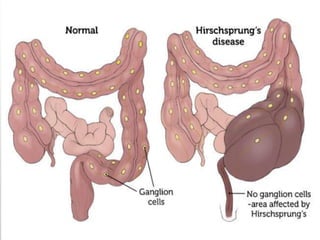
Hirschsprung disease is a congenital
malformation of large intestine caused due to
congenital absence of ganglion cells in the
submucosal and myentric plexus of intestine.
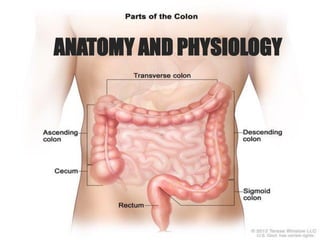
ANATOMY AND PHYSIOLOGY
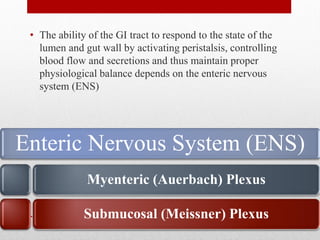
• The ability of the GI tract to respond to the state of the
lumen and gut wall by activating peristalsis, controlling
blood flow and secretions and thus maintain proper
physiological balance depends on the enteric nervous
system (ENS)
Enteric Nervous System (ENS)
Myenteric (Auerbach) Plexus
Submucosal (Meissner) Plexus
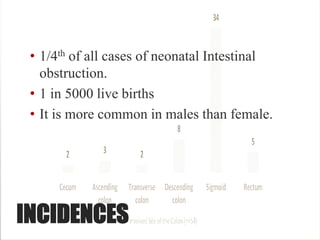
INCIDENCES
• 1/4th of all cases of neonatal Intestinal
obstruction.
• 1 in 5000 live births
• It is more common in males than female.
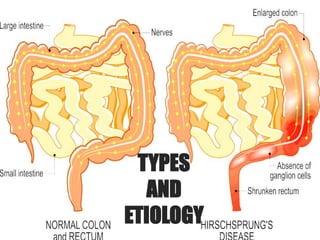
TYPES
AND
ETIOLOGY
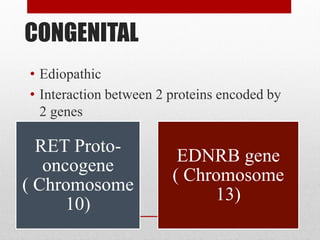
CONGENITAL
• Ediopathic
• Interaction between 2 proteins encoded by
2 genes
RET Proto-
oncogene
( Chromosome
10)
EDNRB gene
( Chromosome
13)
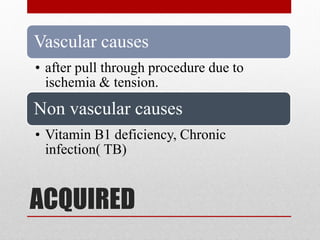
ACQUIRED
Vascular causes
• after pull through procedure due to
ischemia & tension.
Non vascular causes
• Vitamin B1 deficiency, Chronic
infection( TB)
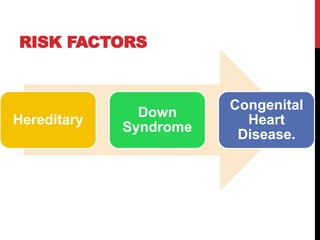
RISK FACTORS
Hereditary
Down
Syndrome
Congenital
Heart
Disease.
PATHOPHYSIOLOGY
CLINICAL
MANIFESTATIONS
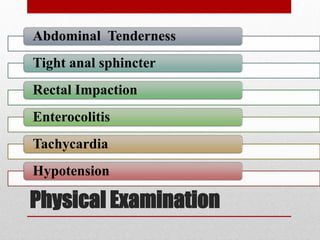
Physical Examination
Abdominal Tenderness
Tight anal sphincter
Rectal Impaction
Enterocolitis
Tachycardia
Hypotension
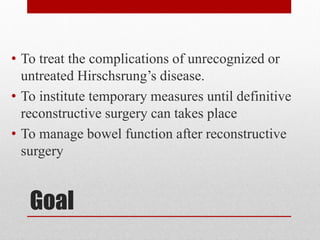
Goal
• To treat the complications of unrecognized or
untreated Hirschsrung’s disease.
• To institute temporary measures until definitive
reconstructive surgery can takes place
• To manage bowel function after reconstructive
surgery
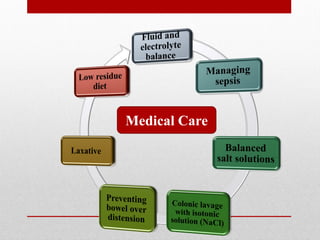
Medical Care
Pharmacological
Management
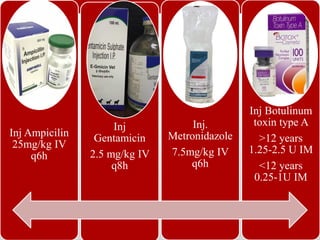
Inj Ampicilin
25mg/kg IV
q6h
Inj
Gentamicin
2.5 mg/kg IV
q8h
Inj.
Metronidazole
7.5mg/kg IV
q6h
Inj Botulinum
toxin type A
>12 years
1.25-2.5 U IM
<12 years
0.25-1U IM
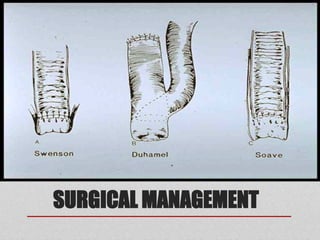
SURGICAL MANAGEMENT
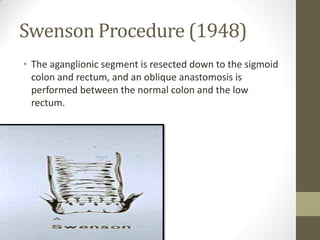
Swenson Procedure (1948)
• The aganglionic segment is resected down to the sigmoid
colon and rectum, and an oblique anastomosis is
performed between the normal colon and the low
rectum.
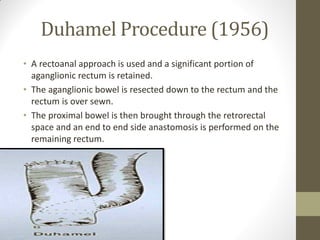
Duhamel Procedure (1956)
• A rectoanal approach is used and a significant portion of
aganglionic rectum is retained.
• The aganglionic bowel is resected down to the rectum and the
rectum is over sewn.
• The proximal bowel is then brought through the retrorectal
space and an end to end side anastomosis is performed on the
remaining rectum.
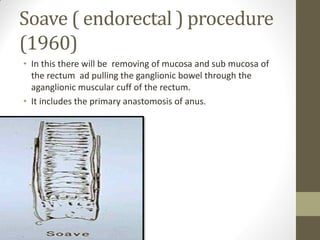
Soave ( endorectal ) procedure
(1960)
• In this there will be removing of mucosa and sub mucosa of
the rectum ad pulling the ganglionic bowel through the
aganglionic muscular cuff of the rectum.
• It includes the primary anastomosis of anus.
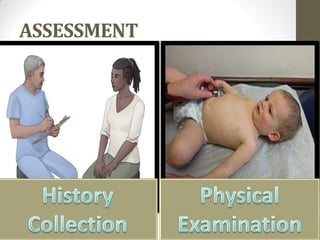
ASSESSMENT
ASSESSMENT
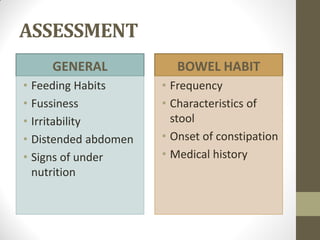
GENERAL
• Feeding Habits
• Fussiness
• Irritability
• Distended abdomen
• Signs of under
nutrition
BOWEL HABIT
• Frequency
• Characteristics of
stool
• Onset of constipation
• Medical history
NURSING DIAGNOSIS
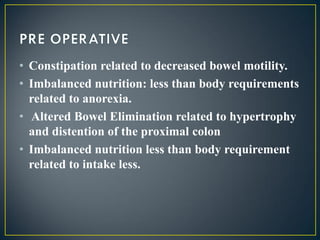
• Constipation related to decreased bowel motility.
• Imbalanced nutrition: less than body requirements
related to anorexia.
• Altered Bowel Elimination related to hypertrophy
and distention of the proximal colon
• Imbalanced nutrition less than body requirement
related to intake less.
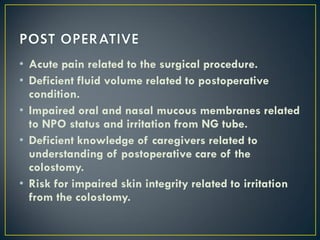
• Acute pain related to the surgical procedure.
• Deficient fluid volume related to postoperative
condition.
• Impaired oral and nasal mucous membranes related
to NPO status and irritation from NG tube.
• Deficient knowledge of caregivers related to
understanding of postoperative care of the
colostomy.
• Risk for impaired skin integrity related to irritation
from the colostomy.
ASSESSMENT
NURSING
DIAGNOSIS
EXPEXTED
OUTCOME
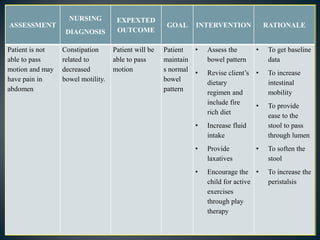
GOAL INTERVENTION RATIONALE
Patient is not
able to pass
motion and may
have pain in
abdomen
Constipation
related to
decreased
bowel motility.
Patient will be
able to pass
motion
Patient
maintain
s normal
bowel
pattern
• Assess the
bowel pattern
• Revise client’s
dietary
regimen and
include fire
rich diet
• Increase fluid
intake
• Provide
laxatives
• Encourage the
child for active
exercises
through play
therapy
• To get baseline
data
• To increase
intestinal
mobility
• To provide
ease to the
stool to pass
through lumen
• To soften the
stool
• To increase the
peristalsis
ASSESSMENT NURSING
DIAGNOSIS
EXPEXTED
OUTCOME
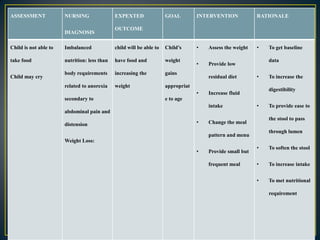
GOAL INTERVENTION RATIONALE
Child is not able to
take food
Child may cry
Imbalanced
nutrition: less than
body requirements
related to anorexia
secondary to
abdominal pain and
distension
Weight Loss:
child will be able to
have food and
increasing the
weight
Child’s
weight
gains
appropriat
e to age
• Assess the weight
• Provide low
residual diet
• Increase fluid
intake
• Change the meal
pattern and menu
• Provide small but
frequent meal
• To get baseline
data
• To increase the
digestibility
• To provide ease to
the stool to pass
through lumen
• To soften the stool
• To increase intake
• To met nutritional
requirement
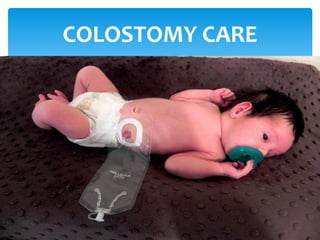
COLOSTOMY CARE
 To maintain integrity of stoma and peristomal skin
 To prevent infection
 To promote general comfort
 To provide clean ostomy pouch for fecal evacuation
 To reduce odor from over used pouch
OBJECTIVES OF COLOSTOMY
CARE
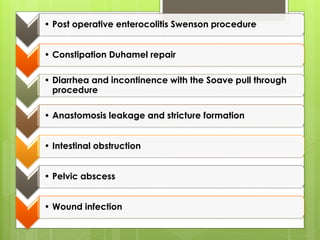
COMPLICATIONS
• Post operative enterocolitis Swenson procedure
• Constipation Duhamel repair
• Diarrhea and incontinence with the Soave pull through
procedure
• Anastomosis leakage and stricture formation
• Intestinal obstruction
• Pelvic abscess
• Wound infection
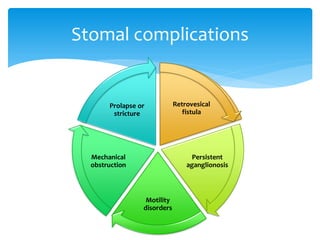
Retrovesical
fistula
Persistent
aganglionosis
Motility
disorders
Mechanical
obstruction
Prolapse or
stricture
Stomal complications
PROGNOSIS
• As expected patients with associated trisomy 21 tend to
have poorer clinical outcome.
• In general more than 90% of patient with Hirschsprung
disease have satisfactory outcomes
• Although many patients many have disturbances of bowel
function for several years before developing normal
continence.
CONCLUSION
Hirschsprung disease is an congenital abnormality which is
constructive and non life threatening
SUMMARY
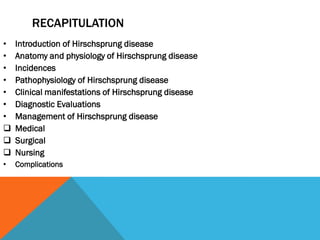
RECAPITULATION
• Introduction of Hirschsprung disease
• Anatomy and physiology of Hirschsprung disease
• Incidences
• Pathophysiology of Hirschsprung disease
• Clinical manifestations of Hirschsprung disease
• Diagnostic Evaluations
• Management of Hirschsprung disease
 Medical
 Surgical
 Nursing
• Complications
ASSIGNMENT
As per the nursing assessment enlist the nursing diagnosis and write
down the nursing care-plan (any 2)
BIBLIOGRAPHY
Wong D.L etal. Essentials of Paediatric Nursing. 6th edition.
Missouri: Mosby; 2001
Marlow D.R. Redding B. Textbook of Paediatric nursing. 1st
edition.Singapore: Harwourt Brace & company; 1998
Dr.Chaudari KC. Indian Journa of Paediatrics. Nov22 2007
Parthasarathy IAP textbook of Paediatrics. 2nd edition.
jaypee: New Delhi; 2002
Hirschsprung's Disease .pdf

Hirschsprung's Disease .pdf

  • 1.
    PRESENTED BY :MS. PREETI M. BAGUL NURSING LECTURER
  • 3.
    INTRODUCTION Hirschsprung disease isan intestinal disorder characterized by the absence of nerves in parts of the intestine. This condition occurs when the nerves in the intestine (enteric nerves) do not form properly during development before birth (embryonic development).
  • 4.
    DEFINITION Hirschsprung disease isa congenital malformation of large intestine caused due to congenital absence of ganglion cells in the submucosal and myentric plexus of intestine.
  • 5.
  • 6.
    • The abilityof the GI tract to respond to the state of the lumen and gut wall by activating peristalsis, controlling blood flow and secretions and thus maintain proper physiological balance depends on the enteric nervous system (ENS) Enteric Nervous System (ENS) Myenteric (Auerbach) Plexus Submucosal (Meissner) Plexus
  • 8.
    INCIDENCES • 1/4th ofall cases of neonatal Intestinal obstruction. • 1 in 5000 live births • It is more common in males than female.
  • 9.
  • 10.
    CONGENITAL • Ediopathic • Interactionbetween 2 proteins encoded by 2 genes RET Proto- oncogene ( Chromosome 10) EDNRB gene ( Chromosome 13)
  • 11.
    ACQUIRED Vascular causes • afterpull through procedure due to ischemia & tension. Non vascular causes • Vitamin B1 deficiency, Chronic infection( TB)
  • 12.
  • 13.
  • 14.
  • 15.
    Physical Examination Abdominal Tenderness Tightanal sphincter Rectal Impaction Enterocolitis Tachycardia Hypotension
  • 18.
    Goal • To treatthe complications of unrecognized or untreated Hirschsrung’s disease. • To institute temporary measures until definitive reconstructive surgery can takes place • To manage bowel function after reconstructive surgery
  • 19.
  • 20.
  • 21.
    Inj Ampicilin 25mg/kg IV q6h Inj Gentamicin 2.5mg/kg IV q8h Inj. Metronidazole 7.5mg/kg IV q6h Inj Botulinum toxin type A >12 years 1.25-2.5 U IM <12 years 0.25-1U IM
  • 22.
  • 23.
    Swenson Procedure (1948) •The aganglionic segment is resected down to the sigmoid colon and rectum, and an oblique anastomosis is performed between the normal colon and the low rectum.
  • 24.
    Duhamel Procedure (1956) •A rectoanal approach is used and a significant portion of aganglionic rectum is retained. • The aganglionic bowel is resected down to the rectum and the rectum is over sewn. • The proximal bowel is then brought through the retrorectal space and an end to end side anastomosis is performed on the remaining rectum.
  • 25.
    Soave ( endorectal) procedure (1960) • In this there will be removing of mucosa and sub mucosa of the rectum ad pulling the ganglionic bowel through the aganglionic muscular cuff of the rectum. • It includes the primary anastomosis of anus.
  • 26.
  • 27.
    ASSESSMENT GENERAL • Feeding Habits •Fussiness • Irritability • Distended abdomen • Signs of under nutrition BOWEL HABIT • Frequency • Characteristics of stool • Onset of constipation • Medical history
  • 28.
  • 29.
    • Constipation relatedto decreased bowel motility. • Imbalanced nutrition: less than body requirements related to anorexia. • Altered Bowel Elimination related to hypertrophy and distention of the proximal colon • Imbalanced nutrition less than body requirement related to intake less.
  • 30.
    • Acute painrelated to the surgical procedure. • Deficient fluid volume related to postoperative condition. • Impaired oral and nasal mucous membranes related to NPO status and irritation from NG tube. • Deficient knowledge of caregivers related to understanding of postoperative care of the colostomy. • Risk for impaired skin integrity related to irritation from the colostomy.
  • 31.
    ASSESSMENT NURSING DIAGNOSIS EXPEXTED OUTCOME GOAL INTERVENTION RATIONALE Patientis not able to pass motion and may have pain in abdomen Constipation related to decreased bowel motility. Patient will be able to pass motion Patient maintain s normal bowel pattern • Assess the bowel pattern • Revise client’s dietary regimen and include fire rich diet • Increase fluid intake • Provide laxatives • Encourage the child for active exercises through play therapy • To get baseline data • To increase intestinal mobility • To provide ease to the stool to pass through lumen • To soften the stool • To increase the peristalsis
  • 32.
    ASSESSMENT NURSING DIAGNOSIS EXPEXTED OUTCOME GOAL INTERVENTIONRATIONALE Child is not able to take food Child may cry Imbalanced nutrition: less than body requirements related to anorexia secondary to abdominal pain and distension Weight Loss: child will be able to have food and increasing the weight Child’s weight gains appropriat e to age • Assess the weight • Provide low residual diet • Increase fluid intake • Change the meal pattern and menu • Provide small but frequent meal • To get baseline data • To increase the digestibility • To provide ease to the stool to pass through lumen • To soften the stool • To increase intake • To met nutritional requirement
  • 33.
  • 34.
     To maintainintegrity of stoma and peristomal skin  To prevent infection  To promote general comfort  To provide clean ostomy pouch for fecal evacuation  To reduce odor from over used pouch OBJECTIVES OF COLOSTOMY CARE
  • 35.
  • 36.
    • Post operativeenterocolitis Swenson procedure • Constipation Duhamel repair • Diarrhea and incontinence with the Soave pull through procedure • Anastomosis leakage and stricture formation • Intestinal obstruction • Pelvic abscess • Wound infection
  • 37.
  • 38.
    PROGNOSIS • As expectedpatients with associated trisomy 21 tend to have poorer clinical outcome. • In general more than 90% of patient with Hirschsprung disease have satisfactory outcomes • Although many patients many have disturbances of bowel function for several years before developing normal continence.
  • 39.
    CONCLUSION Hirschsprung disease isan congenital abnormality which is constructive and non life threatening
  • 40.
  • 41.
    RECAPITULATION • Introduction ofHirschsprung disease • Anatomy and physiology of Hirschsprung disease • Incidences • Pathophysiology of Hirschsprung disease • Clinical manifestations of Hirschsprung disease • Diagnostic Evaluations • Management of Hirschsprung disease  Medical  Surgical  Nursing • Complications
  • 42.
    ASSIGNMENT As per thenursing assessment enlist the nursing diagnosis and write down the nursing care-plan (any 2)
  • 43.
    BIBLIOGRAPHY Wong D.L etal.Essentials of Paediatric Nursing. 6th edition. Missouri: Mosby; 2001 Marlow D.R. Redding B. Textbook of Paediatric nursing. 1st edition.Singapore: Harwourt Brace & company; 1998 Dr.Chaudari KC. Indian Journa of Paediatrics. Nov22 2007 Parthasarathy IAP textbook of Paediatrics. 2nd edition. jaypee: New Delhi; 2002