DIARRHEA
It is common in children, especially those between 6 months and 2 years of age. It is more
common in babies under 6 months who are drinking cow’s milk or infant formulas. Frequent
passing of normal stools is not diarrhoea. The number of stools normally passed in a day
varies with the diet and age of the child.
Definition
Diarrhea is defined as the passage of loose liquid or watery stool more than 3times in 24
hours. There is change in amount of stool >200gram per day.
INCIDENCE
According to international journal of environmental research and public health article
(diarrhea in under five year old children in Nepal) published on 23 march 2020 .However, the
mortality rate of children under five years old was still high (i.e., 32 deaths per 1000 live
births in 2018), which was around five times higher than that in high-income countries such
as the United States of America (i.e., 6 deaths per 1000 live births in 2018). Diarrhoea
remains the leading cause of morbidity and mortality of children under five years old. The
prevalence of diarrhoea within two weeks varied geographically across the country, ranging
from 3.7% to 9.0% in different provinces according to the recent Nepal Demographic and
Health Survey (NDHS) in 2016, According to the WHO, there were 1193 deaths under five
caused by diarrhoea in Nepal in 2017.
Source ( file:///C:/Users/HP/Downloads/ijerph-17-02140-v2.pdf )
TYPES OF DIARRHEA
1). Acute Diarrhea:
An attack of sudden onset which usually lasts 3-7 days and may last up to 10-14 days. It is a
leading cause of illness in children younger than 5 years of age. Acute diarrhea is defined as a
sudden increase in frequency and a change in consistency of stools, often caused by an
infectious agent in the GI tract. It is caused by infection of large bowel but may be associated
with infection of gastric mucosa and small intestine. It causes rapid loss of fluid and
electrolyte resulting severe dehydration to death. The term “Acute Gastroenteritis” is mostly
frequently used to describe acute diarrhea.
2). Chronic Diarrhea:
It is defined as an increase in stool frequency and increased water content with duration of
more than fourteen days. It is also known as persistent diarrhea. It is often caused by chronic
conditions such as malabsorption syndrome, inflammatory bowel disease, immune
deficiency, lactose intolerance, food allergies or as a result of inadequate management of
acute diarrhea. Chronic diarrhea causes about 35% of all diarrhea-associated death.
CAUSES
1) Viral causes
Virus is the common cause of diarrhea among children. It accounts approximately 30-50% of
childhood diarrhoea age between 6month to 2 years of children. Rota virus is the commonest
virus. Other Adeno virus, Entero virus, Astro virus etc.
2) Bacterial causes: Escherichia coli, Shigella, Salmonella, Vibrio cholera, etc.
3) Protozoal causes: Entamoeba hystolytica, Giardia lamblia (common).
4) Worm infestation.
5) Allergic diarrhea(due to milk protein)
6) Metabolic diarrhea(metabolic disorder such as galactosaemia, lactase deficiency)
7) Emotional stress
PREDISPOSING FACTOR
Factors responsible to increase the risk of diarrhea in children;
1) Inappropriate supplementary foods :
(i) Poor environmental sanitation such as unsafe drinking water, unsafe excreta disposal,
unhygienic environment, etc.
(ii) Solid foods introduced too early
(iii)Unhygienic food
(iv)Nutritional status: Malnourished children are at greater risk to have diarrhoea than well
nourished children due to low immunity, Vitamin A deficiency.
(v) Poor personal hygiene
(vi)Raw, unripe food or adult type food is given without preparing it.
2) Feeding pattern(bottle feeding)
3) Lack of awareness.
4) Incomplete immunization.
5) Low socio-economic status.
6) Age: more common in child between 6months to 2years,it is also common among child
below 6months with formula feeding.
7) Season (more common in pre-monsoon and monsoon.
8) Worm infestation.
9) Low immunity.
Mode of transmission: Faecal-oral route.
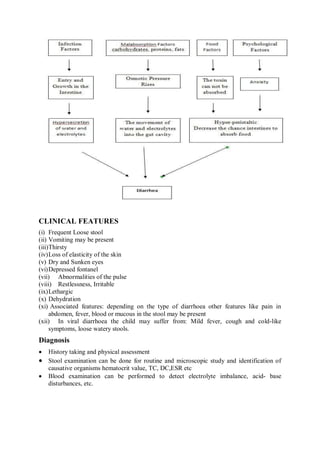
PATHOPHYSIOLOGY
CLINICAL FEATURES
(i) Frequent Loose stool
(ii) Vomiting may be present
(iii)Thirsty
(iv)Loss of elasticity of the skin
(v) Dry and Sunken eyes
(vi)Depressed fontanel
(vii) Abnormalities of the pulse
(viii) Restlessness, Irritable
(ix)Lethargic
(x) Dehydration
(xi) Associated features: depending on the type of diarrhoea other features like pain in
abdomen, fever, blood or mucous in the stool may be present
(xii) In viral diarrhoea the child may suffer from: Mild fever, cough and cold-like
symptoms, loose watery stools.
Diagnosis
 History taking and physical assessment
 Stool examination can be done for routine and microscopic study and identification of
causative organisms hematocrit value, TC, DC,ESR etc
 Blood examination can be performed to detect electrolyte imbalance, acid- base
disturbances, etc.
Prevention of diarrhea
 Exclusive breast feeding for the first 6 months of life and continue breast feeding up
to 2 years of age.
 Timely weaning.
 Giving freshly prepared foods and clean safe drinking water to child.
 Discourage bottle feeding.
 Follow proper hand washing technique and teach child accordingly.
 Proper disposal of human excreta and use of toilet.
 Having your child immunized against preventable communicable diseases.
 Public awareness regarding government policies.
 Health education on environmental and personal hygiene.
Principle of diarrhea management
a) Assessment of the children’s condition.
b) Identify the level of dehydration
c) Correction of dehydration
d) Proper nutritional care
e) Treatment of underlying causes and associated problems
f) Treatment of complications
g) Prevention of diarrhea.
Nursing management for diarrhea
 Elicit the complete health history to identify the character and pattern of diarrhea.
 Perform a complete physical assessment.
 Inspect mucous membrane and skin to determine hydration status and perineal area.
 Prevention of spread of infection by good hand washing practices, hygienic disposal
of stools, care of diapers, general cleanliness and universal precaution.
 Restoring fluid and electrolyte balance by ORS and IV therapy.
 Encourage rest, liquids and foods low in bulk until acute period subsides.
 Advice patient to restrict intake of milk products, whole grains products, fresh fruits
and vegetables for several days.
 Administer anti diarrheal drugs as prescribed.
 Monitor serum electrolyte levels closely.
 Encourage patient to follow a perianal care routinely.
Complication of diarrhea
(i) Dehydration
(ii) Electrolyte imbalance
(iii)Kidney failure
(iv)Organ damage
DEHYDRATION
Definition:
Loss of abnormal amount of water and salts from the body is called dehydration. It occurs
when the output of water and salt is is greater than the input in the body.
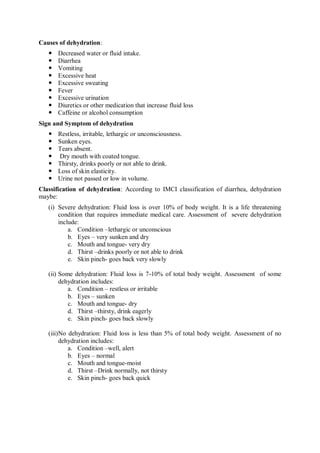
Causes of dehydration:
 Decreased water or fluid intake.
 Diarrhea
 Vomiting
 Excessive heat
 Excessive sweating
 Fever
 Excessive urination
 Diuretics or other medication that increase fluid loss
 Caffeine or alcohol consumption
Sign and Symptom of dehydration
 Restless, irritable, lethargic or unconsciousness.
 Sunken eyes.
 Tears absent.
 Dry mouth with coated tongue.
 Thirsty, drinks poorly or not able to drink.
 Loss of skin elasticity.
 Urine not passed or low in volume.
Classification of dehydration: According to IMCI classification of diarrhea, dehydration
maybe:
(i) Severe dehydration: Fluid loss is over 10% of body weight. It is a life threatening
condition that requires immediate medical care. Assessment of severe dehydration
include:
a. Condition –lethargic or unconscious
b. Eyes – very sunken and dry
c. Mouth and tongue- very dry
d. Thirst –drinks poorly or not able to drink
e. Skin pinch- goes back very slowly
(ii) Some dehydration: Fluid loss is 7-10% of total body weight. Assessment of some
dehydration includes:
a. Condition – restless or irritable
b. Eyes – sunken
c. Mouth and tongue- dry
d. Thirst –thirsty, drink eagerly
e. Skin pinch- goes back slowly
(iii)No dehydration: Fluid loss is less than 5% of total body weight. Assessment of no
dehydration includes:
a. Condition –well, alert
b. Eyes – normal
c. Mouth and tongue-moist
d. Thirst –Drink normally, not thirsty
e. Skin pinch- goes back quick
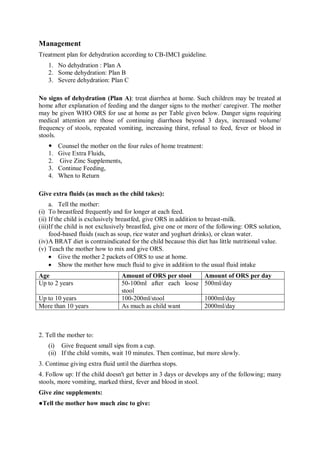
Management
Treatment plan for dehydration according to CB-IMCI guideline.
1. No dehydration : Plan A
2. Some dehydration: Plan B
3. Severe dehydration: Plan C
No signs of dehydration (Plan A): treat diarrhea at home. Such children may be treated at
home after explanation of feeding and the danger signs to the mother/ caregiver. The mother
may be given WHO ORS for use at home as per Table given below. Danger signs requiring
medical attention are those of continuing diarrhoea beyond 3 days, increased volume/
frequency of stools, repeated vomiting, increasing thirst, refusal to feed, fever or blood in
stools.
 Counsel the mother on the four rules of home treatment:
1. Give Extra Fluids,
2. Give Zinc Supplements,
3. Continue Feeding,
4. When to Return
Give extra fluids (as much as the child takes):
a. Tell the mother:
(i) To breastfeed frequently and for longer at each feed.
(ii) If the child is exclusively breastfed, give ORS in addition to breast-milk.
(iii)If the child is not exclusively breastfed, give one or more of the following: ORS solution,
food-based fluids (such as soup, rice water and yoghurt drinks), or clean water.
(iv)A BRAT diet is contraindicated for the child because this diet has little nutritional value.
(v) Teach the mother how to mix and give ORS.
 Give the mother 2 packets of ORS to use at home.
 Show the mother how much fluid to give in addition to the usual fluid intake
Age Amount of ORS per stool Amount of ORS per day
Up to 2 years 50-100ml after each loose
stool
500ml/day
Up to 10 years 100-200ml/stool 1000ml/day
More than 10 years As much as child want 2000ml/day
2. Tell the mother to:
(i) Give frequent small sips from a cup.
(ii) If the child vomits, wait 10 minutes. Then continue, but more slowly.
3. Continue giving extra fluid until the diarrhea stops.
4. Follow up: If the child doesn't get better in 3 days or develops any of the following; many
stools, more vomiting, marked thirst, fever and blood in stool.
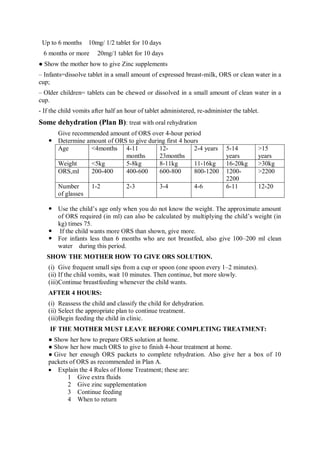
Give zinc supplements:
●Tell the mother how much zinc to give:
Up to 6 months 10mg/ 1/2 tablet for 10 days
6 months or more 20mg/1 tablet for 10 days
● Show the mother how to give Zinc supplements
– Infants=dissolve tablet in a small amount of expressed breast-milk, ORS or clean water in a
cup;
– Older children= tablets can be chewed or dissolved in a small amount of clean water in a
cup.
- If the child vomits after half an hour of tablet administered, re-administer the tablet.
Some dehydration (Plan B): treat with oral rehydration
Give recommended amount of ORS over 4-hour period
 Determine amount of ORS to give during first 4 hours
Age <4months 4-11
months
12-
23months
2-4 years 5-14
years
>15
years
Weight <5kg 5-8kg 8-11kg 11-16kg 16-20kg >30kg
ORS,ml 200-400 400-600 600-800 800-1200 1200-
2200
>2200
Number
of glasses
1-2 2-3 3-4 4-6 6-11 12-20
 Use the child’s age only when you do not know the weight. The approximate amount
of ORS required (in ml) can also be calculated by multiplying the child’s weight (in
kg) times 75.
 If the child wants more ORS than shown, give more.
 For infants less than 6 months who are not breastfed, also give 100–200 ml clean
water during this period.
SHOW THE MOTHER HOW TO GIVE ORS SOLUTION.
(i) Give frequent small sips from a cup or spoon (one spoon every 1–2 minutes).
(ii) If the child vomits, wait 10 minutes. Then continue, but more slowly.
(iii)Continue breastfeeding whenever the child wants.
AFTER 4 HOURS:
(i) Reassess the child and classify the child for dehydration.
(ii) Select the appropriate plan to continue treatment.
(iii)Begin feeding the child in clinic.
IF THE MOTHER MUST LEAVE BEFORE COMPLETING TREATMENT:
● Show her how to prepare ORS solution at home.
● Show her how much ORS to give to finish 4-hour treatment at home.
● Give her enough ORS packets to complete rehydration. Also give her a box of 10
packets of ORS as recommended in Plan A.
 Explain the 4 Rules of Home Treatment; these are:
1 Give extra fluids
2 Give zinc supplementation
3 Continue feeding
4 When to return
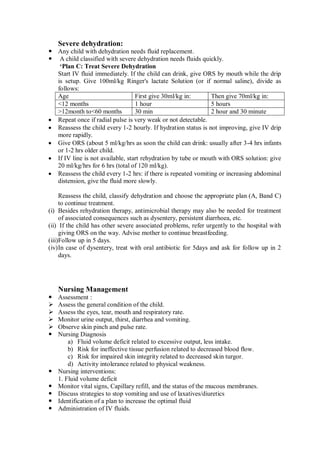
Severe dehydration:
 Any child with dehydration needs fluid replacement.
 A child classified with severe dehydration needs fluids quickly.
‘Plan C: Treat Severe Dehydration
Start IV fluid immediately. If the child can drink, give ORS by mouth while the drip
is setup. Give 100ml/kg Ringer's lactate Solution (or if normal saline), divide as
follows:
Age First give 30ml/kg in: Then give 70ml/kg in:
<12 months 1 hour 5 hours
>12month to<60 months 30 min 2 hour and 30 minute
 Repeat once if radial pulse is very weak or not detectable.
 Reassess the child every 1-2 hourly. If hydration status is not improving, give IV drip
more rapidly.
 Give ORS (about 5 ml/kg/hrs as soon the child can drink: usually after 3-4 hrs infants
or 1-2 hrs older child.
 If IV line is not available, start rehydration by tube or mouth with ORS solution: give
20 ml/kg/hrs for 6 hrs (total of 120 ml/kg).
 Reassess the child every 1-2 hrs: if there is repeated vomiting or increasing abdominal
distension, give the fluid more slowly.
Reassess the child, classify dehydration and choose the appropriate plan (A, Band C)
to continue treatment.
(i) Besides rehydration therapy, antimicrobial therapy may also be needed for treatment
of associated consequences such as dysentery, persistent diarrhoea, etc.
(ii) If the child has other severe associated problems, refer urgently to the hospital with
giving ORS on the way. Advise mother to continue breastfeeding.
(iii)Follow up in 5 days.
(iv)In case of dysentery, treat with oral antibiotic for 5days and ask for follow up in 2
days.
Nursing Management
 Assessment :
 Assess the general condition of the child.
 Assess the eyes, tear, mouth and respiratory rate.
 Monitor urine output, thirst, diarrhea and vomiting.
 Observe skin pinch and pulse rate.
 Nursing Diagnosis
a) Fluid volume deficit related to excessive output, less intake.
b) Risk for ineffective tissue perfusion related to decreased blood flow.
c) Risk for impaired skin integrity related to decreased skin turgor.
d) Activity intolerance related to physical weakness.
 Nursing interventions:
1. Fluid volume deficit
 Monitor vital signs, Capillary refill, and the status of the mucous membranes.
 Discuss strategies to stop vomiting and use of laxatives/diuretics
 Identification of a plan to increase the optimal fluid
 Administration of IV fluids.
2. Risk for ineffective tissue perfusion
 Assess change in the level of consciousness
 Auscultation apical pulse , watch HR
 Assess , the skin against the cold , pale , sweating
 Record output and urine specific gravity
 Observation pale skin , redness , Change positions frequently
 Keep an eye on pulse oximetry
 Give IV fluids as indicated
3. Risk for impaired skin integrity related to decreased skin turgor
 Observation reddish , pale
 Use skin cream
 Discuss the importance of changes in position it is necessary to maintain the activity
 Emphasize the importance of nutrient input/adequate fluid.
4. Activity intolerance related to physical weakness
 Assess the patient’s nutritional status
 Observe and monitor the patient’s sleep pattern and the amount of sleep achieved over
the past few days
 Determine the patient’s daily routine and over the counter medication
 Assess the need for ambulation aids for ADLS
 Observe and document response to activity
References of diarrhea and dysentery
 Uprety K, Child Health Nursing, fourth Edition (2071 Bhadra), Tara Books and
Stationery, Chhetrapati, Kathmandu, pg 324- 329
 Shrestha T. Essential Child Health Nursing. first Edition 2015,August. Medhavi
Publication; Jamal, Kathmandu Page no.193-203
 Dahal K, Community Health Nursing –II. 5th
edition Makalu Publication House
Dillibajar, Kathmandu, Page no 80-90
 Paul VK, Bagga A, Ghai Essential Pediatrics, eight edition, CBS Publisher and
Distributors Pvt Ltd page 293 to 296
 file:///C:/Users/HP/Downloads/ijerph-17-02140-v2.pdf
 http://dohs.gov.np/wp-content/uploads/2020/11/DoHS-Annual-Report-FY-075-76-
.pdf

DIARRHEA.pdf

  • 1.
    DIARRHEA It is commonin children, especially those between 6 months and 2 years of age. It is more common in babies under 6 months who are drinking cow’s milk or infant formulas. Frequent passing of normal stools is not diarrhoea. The number of stools normally passed in a day varies with the diet and age of the child. Definition Diarrhea is defined as the passage of loose liquid or watery stool more than 3times in 24 hours. There is change in amount of stool >200gram per day. INCIDENCE According to international journal of environmental research and public health article (diarrhea in under five year old children in Nepal) published on 23 march 2020 .However, the mortality rate of children under five years old was still high (i.e., 32 deaths per 1000 live births in 2018), which was around five times higher than that in high-income countries such as the United States of America (i.e., 6 deaths per 1000 live births in 2018). Diarrhoea remains the leading cause of morbidity and mortality of children under five years old. The prevalence of diarrhoea within two weeks varied geographically across the country, ranging from 3.7% to 9.0% in different provinces according to the recent Nepal Demographic and Health Survey (NDHS) in 2016, According to the WHO, there were 1193 deaths under five caused by diarrhoea in Nepal in 2017. Source ( file:///C:/Users/HP/Downloads/ijerph-17-02140-v2.pdf ) TYPES OF DIARRHEA 1). Acute Diarrhea: An attack of sudden onset which usually lasts 3-7 days and may last up to 10-14 days. It is a leading cause of illness in children younger than 5 years of age. Acute diarrhea is defined as a sudden increase in frequency and a change in consistency of stools, often caused by an infectious agent in the GI tract. It is caused by infection of large bowel but may be associated with infection of gastric mucosa and small intestine. It causes rapid loss of fluid and electrolyte resulting severe dehydration to death. The term “Acute Gastroenteritis” is mostly frequently used to describe acute diarrhea. 2). Chronic Diarrhea: It is defined as an increase in stool frequency and increased water content with duration of more than fourteen days. It is also known as persistent diarrhea. It is often caused by chronic conditions such as malabsorption syndrome, inflammatory bowel disease, immune deficiency, lactose intolerance, food allergies or as a result of inadequate management of acute diarrhea. Chronic diarrhea causes about 35% of all diarrhea-associated death. CAUSES 1) Viral causes
  • 2.
    Virus is thecommon cause of diarrhea among children. It accounts approximately 30-50% of childhood diarrhoea age between 6month to 2 years of children. Rota virus is the commonest virus. Other Adeno virus, Entero virus, Astro virus etc. 2) Bacterial causes: Escherichia coli, Shigella, Salmonella, Vibrio cholera, etc. 3) Protozoal causes: Entamoeba hystolytica, Giardia lamblia (common). 4) Worm infestation. 5) Allergic diarrhea(due to milk protein) 6) Metabolic diarrhea(metabolic disorder such as galactosaemia, lactase deficiency) 7) Emotional stress PREDISPOSING FACTOR Factors responsible to increase the risk of diarrhea in children; 1) Inappropriate supplementary foods : (i) Poor environmental sanitation such as unsafe drinking water, unsafe excreta disposal, unhygienic environment, etc. (ii) Solid foods introduced too early (iii)Unhygienic food (iv)Nutritional status: Malnourished children are at greater risk to have diarrhoea than well nourished children due to low immunity, Vitamin A deficiency. (v) Poor personal hygiene (vi)Raw, unripe food or adult type food is given without preparing it. 2) Feeding pattern(bottle feeding) 3) Lack of awareness. 4) Incomplete immunization. 5) Low socio-economic status. 6) Age: more common in child between 6months to 2years,it is also common among child below 6months with formula feeding. 7) Season (more common in pre-monsoon and monsoon. 8) Worm infestation. 9) Low immunity. Mode of transmission: Faecal-oral route. PATHOPHYSIOLOGY
  • 3.
    CLINICAL FEATURES (i) FrequentLoose stool (ii) Vomiting may be present (iii)Thirsty (iv)Loss of elasticity of the skin (v) Dry and Sunken eyes (vi)Depressed fontanel (vii) Abnormalities of the pulse (viii) Restlessness, Irritable (ix)Lethargic (x) Dehydration (xi) Associated features: depending on the type of diarrhoea other features like pain in abdomen, fever, blood or mucous in the stool may be present (xii) In viral diarrhoea the child may suffer from: Mild fever, cough and cold-like symptoms, loose watery stools. Diagnosis  History taking and physical assessment  Stool examination can be done for routine and microscopic study and identification of causative organisms hematocrit value, TC, DC,ESR etc  Blood examination can be performed to detect electrolyte imbalance, acid- base disturbances, etc.
  • 4.
    Prevention of diarrhea Exclusive breast feeding for the first 6 months of life and continue breast feeding up to 2 years of age.  Timely weaning.  Giving freshly prepared foods and clean safe drinking water to child.  Discourage bottle feeding.  Follow proper hand washing technique and teach child accordingly.  Proper disposal of human excreta and use of toilet.  Having your child immunized against preventable communicable diseases.  Public awareness regarding government policies.  Health education on environmental and personal hygiene. Principle of diarrhea management a) Assessment of the children’s condition. b) Identify the level of dehydration c) Correction of dehydration d) Proper nutritional care e) Treatment of underlying causes and associated problems f) Treatment of complications g) Prevention of diarrhea. Nursing management for diarrhea  Elicit the complete health history to identify the character and pattern of diarrhea.  Perform a complete physical assessment.  Inspect mucous membrane and skin to determine hydration status and perineal area.  Prevention of spread of infection by good hand washing practices, hygienic disposal of stools, care of diapers, general cleanliness and universal precaution.  Restoring fluid and electrolyte balance by ORS and IV therapy.  Encourage rest, liquids and foods low in bulk until acute period subsides.  Advice patient to restrict intake of milk products, whole grains products, fresh fruits and vegetables for several days.  Administer anti diarrheal drugs as prescribed.  Monitor serum electrolyte levels closely.  Encourage patient to follow a perianal care routinely. Complication of diarrhea (i) Dehydration (ii) Electrolyte imbalance (iii)Kidney failure (iv)Organ damage DEHYDRATION Definition: Loss of abnormal amount of water and salts from the body is called dehydration. It occurs when the output of water and salt is is greater than the input in the body.
  • 5.
    Causes of dehydration: Decreased water or fluid intake.  Diarrhea  Vomiting  Excessive heat  Excessive sweating  Fever  Excessive urination  Diuretics or other medication that increase fluid loss  Caffeine or alcohol consumption Sign and Symptom of dehydration  Restless, irritable, lethargic or unconsciousness.  Sunken eyes.  Tears absent.  Dry mouth with coated tongue.  Thirsty, drinks poorly or not able to drink.  Loss of skin elasticity.  Urine not passed or low in volume. Classification of dehydration: According to IMCI classification of diarrhea, dehydration maybe: (i) Severe dehydration: Fluid loss is over 10% of body weight. It is a life threatening condition that requires immediate medical care. Assessment of severe dehydration include: a. Condition –lethargic or unconscious b. Eyes – very sunken and dry c. Mouth and tongue- very dry d. Thirst –drinks poorly or not able to drink e. Skin pinch- goes back very slowly (ii) Some dehydration: Fluid loss is 7-10% of total body weight. Assessment of some dehydration includes: a. Condition – restless or irritable b. Eyes – sunken c. Mouth and tongue- dry d. Thirst –thirsty, drink eagerly e. Skin pinch- goes back slowly (iii)No dehydration: Fluid loss is less than 5% of total body weight. Assessment of no dehydration includes: a. Condition –well, alert b. Eyes – normal c. Mouth and tongue-moist d. Thirst –Drink normally, not thirsty e. Skin pinch- goes back quick
  • 6.
    Management Treatment plan fordehydration according to CB-IMCI guideline. 1. No dehydration : Plan A 2. Some dehydration: Plan B 3. Severe dehydration: Plan C No signs of dehydration (Plan A): treat diarrhea at home. Such children may be treated at home after explanation of feeding and the danger signs to the mother/ caregiver. The mother may be given WHO ORS for use at home as per Table given below. Danger signs requiring medical attention are those of continuing diarrhoea beyond 3 days, increased volume/ frequency of stools, repeated vomiting, increasing thirst, refusal to feed, fever or blood in stools.  Counsel the mother on the four rules of home treatment: 1. Give Extra Fluids, 2. Give Zinc Supplements, 3. Continue Feeding, 4. When to Return Give extra fluids (as much as the child takes): a. Tell the mother: (i) To breastfeed frequently and for longer at each feed. (ii) If the child is exclusively breastfed, give ORS in addition to breast-milk. (iii)If the child is not exclusively breastfed, give one or more of the following: ORS solution, food-based fluids (such as soup, rice water and yoghurt drinks), or clean water. (iv)A BRAT diet is contraindicated for the child because this diet has little nutritional value. (v) Teach the mother how to mix and give ORS.  Give the mother 2 packets of ORS to use at home.  Show the mother how much fluid to give in addition to the usual fluid intake Age Amount of ORS per stool Amount of ORS per day Up to 2 years 50-100ml after each loose stool 500ml/day Up to 10 years 100-200ml/stool 1000ml/day More than 10 years As much as child want 2000ml/day 2. Tell the mother to: (i) Give frequent small sips from a cup. (ii) If the child vomits, wait 10 minutes. Then continue, but more slowly. 3. Continue giving extra fluid until the diarrhea stops. 4. Follow up: If the child doesn't get better in 3 days or develops any of the following; many stools, more vomiting, marked thirst, fever and blood in stool. Give zinc supplements: ●Tell the mother how much zinc to give:
  • 7.
    Up to 6months 10mg/ 1/2 tablet for 10 days 6 months or more 20mg/1 tablet for 10 days ● Show the mother how to give Zinc supplements – Infants=dissolve tablet in a small amount of expressed breast-milk, ORS or clean water in a cup; – Older children= tablets can be chewed or dissolved in a small amount of clean water in a cup. - If the child vomits after half an hour of tablet administered, re-administer the tablet. Some dehydration (Plan B): treat with oral rehydration Give recommended amount of ORS over 4-hour period  Determine amount of ORS to give during first 4 hours Age <4months 4-11 months 12- 23months 2-4 years 5-14 years >15 years Weight <5kg 5-8kg 8-11kg 11-16kg 16-20kg >30kg ORS,ml 200-400 400-600 600-800 800-1200 1200- 2200 >2200 Number of glasses 1-2 2-3 3-4 4-6 6-11 12-20  Use the child’s age only when you do not know the weight. The approximate amount of ORS required (in ml) can also be calculated by multiplying the child’s weight (in kg) times 75.  If the child wants more ORS than shown, give more.  For infants less than 6 months who are not breastfed, also give 100–200 ml clean water during this period. SHOW THE MOTHER HOW TO GIVE ORS SOLUTION. (i) Give frequent small sips from a cup or spoon (one spoon every 1–2 minutes). (ii) If the child vomits, wait 10 minutes. Then continue, but more slowly. (iii)Continue breastfeeding whenever the child wants. AFTER 4 HOURS: (i) Reassess the child and classify the child for dehydration. (ii) Select the appropriate plan to continue treatment. (iii)Begin feeding the child in clinic. IF THE MOTHER MUST LEAVE BEFORE COMPLETING TREATMENT: ● Show her how to prepare ORS solution at home. ● Show her how much ORS to give to finish 4-hour treatment at home. ● Give her enough ORS packets to complete rehydration. Also give her a box of 10 packets of ORS as recommended in Plan A.  Explain the 4 Rules of Home Treatment; these are: 1 Give extra fluids 2 Give zinc supplementation 3 Continue feeding 4 When to return
  • 8.
    Severe dehydration:  Anychild with dehydration needs fluid replacement.  A child classified with severe dehydration needs fluids quickly. ‘Plan C: Treat Severe Dehydration Start IV fluid immediately. If the child can drink, give ORS by mouth while the drip is setup. Give 100ml/kg Ringer's lactate Solution (or if normal saline), divide as follows: Age First give 30ml/kg in: Then give 70ml/kg in: <12 months 1 hour 5 hours >12month to<60 months 30 min 2 hour and 30 minute  Repeat once if radial pulse is very weak or not detectable.  Reassess the child every 1-2 hourly. If hydration status is not improving, give IV drip more rapidly.  Give ORS (about 5 ml/kg/hrs as soon the child can drink: usually after 3-4 hrs infants or 1-2 hrs older child.  If IV line is not available, start rehydration by tube or mouth with ORS solution: give 20 ml/kg/hrs for 6 hrs (total of 120 ml/kg).  Reassess the child every 1-2 hrs: if there is repeated vomiting or increasing abdominal distension, give the fluid more slowly. Reassess the child, classify dehydration and choose the appropriate plan (A, Band C) to continue treatment. (i) Besides rehydration therapy, antimicrobial therapy may also be needed for treatment of associated consequences such as dysentery, persistent diarrhoea, etc. (ii) If the child has other severe associated problems, refer urgently to the hospital with giving ORS on the way. Advise mother to continue breastfeeding. (iii)Follow up in 5 days. (iv)In case of dysentery, treat with oral antibiotic for 5days and ask for follow up in 2 days. Nursing Management  Assessment :  Assess the general condition of the child.  Assess the eyes, tear, mouth and respiratory rate.  Monitor urine output, thirst, diarrhea and vomiting.  Observe skin pinch and pulse rate.  Nursing Diagnosis a) Fluid volume deficit related to excessive output, less intake. b) Risk for ineffective tissue perfusion related to decreased blood flow. c) Risk for impaired skin integrity related to decreased skin turgor. d) Activity intolerance related to physical weakness.  Nursing interventions: 1. Fluid volume deficit  Monitor vital signs, Capillary refill, and the status of the mucous membranes.  Discuss strategies to stop vomiting and use of laxatives/diuretics  Identification of a plan to increase the optimal fluid  Administration of IV fluids.
  • 9.
    2. Risk forineffective tissue perfusion  Assess change in the level of consciousness  Auscultation apical pulse , watch HR  Assess , the skin against the cold , pale , sweating  Record output and urine specific gravity  Observation pale skin , redness , Change positions frequently  Keep an eye on pulse oximetry  Give IV fluids as indicated 3. Risk for impaired skin integrity related to decreased skin turgor  Observation reddish , pale  Use skin cream  Discuss the importance of changes in position it is necessary to maintain the activity  Emphasize the importance of nutrient input/adequate fluid. 4. Activity intolerance related to physical weakness  Assess the patient’s nutritional status  Observe and monitor the patient’s sleep pattern and the amount of sleep achieved over the past few days  Determine the patient’s daily routine and over the counter medication  Assess the need for ambulation aids for ADLS  Observe and document response to activity References of diarrhea and dysentery  Uprety K, Child Health Nursing, fourth Edition (2071 Bhadra), Tara Books and Stationery, Chhetrapati, Kathmandu, pg 324- 329  Shrestha T. Essential Child Health Nursing. first Edition 2015,August. Medhavi Publication; Jamal, Kathmandu Page no.193-203  Dahal K, Community Health Nursing –II. 5th edition Makalu Publication House Dillibajar, Kathmandu, Page no 80-90  Paul VK, Bagga A, Ghai Essential Pediatrics, eight edition, CBS Publisher and Distributors Pvt Ltd page 293 to 296  file:///C:/Users/HP/Downloads/ijerph-17-02140-v2.pdf  http://dohs.gov.np/wp-content/uploads/2020/11/DoHS-Annual-Report-FY-075-76- .pdf