HIRARC
Hazard Identification; Risk Assessment;
& Risk Control
Content
• Definition
• What is HIRARC ?
• Purpose of HIRARC
• OSH Acts and
Regulation
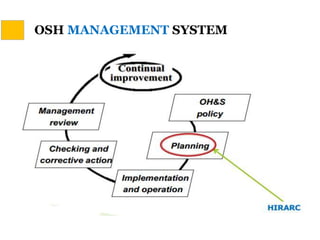
• OSH Management
System
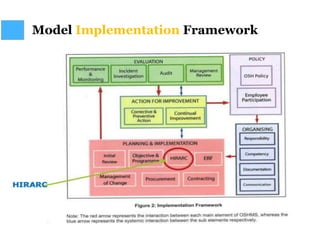
• Model Implementation
Framework
• Process of HIRARC
• Classify Work Activities
• Tips For Classify Work
Activities
• Hazard Identification
(HI)
• Hazard Identification
Technique
• Risk Assessment (RA)
• Risk Control (RC)
• Hierarchy of Control
• Job Safety Analysis
(JSA)
• HIRARC Example
General Process Implementation
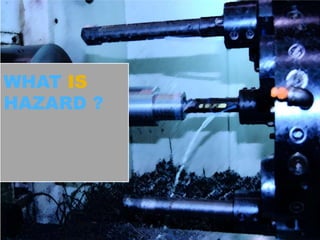
WHAT IS
HAZARD ?
DEFINITION
‘…In risk management, the term “hazard” is used to mean an
event that could cause harm…’
(British Standards Institution (2004), BS8800: Occupational Health and Safety
Management Systems – Guide, British Standards Institution, London).
‘….Hazards are sources of potential harm to human health,
property or environment, which may, under certain conditions,
lead to accidents…’
(Lind et al., 2008, “Safety risk assessment in industrial maintenance”, Journal of
Quality in Maintenance Engineering, Vol. 14 No. 2, pp. 205-217)
A source or a situation with a potential for harm in terms of human injury or
ill health, damage to property, damage to the environment or a combination
of these.
DEFINITION
Risk…
‘…expose a business to potential advantage or disadvantage, the
likelihood of occurrence and censequence of which can be
measured and manage…..’
Sonia Bharwani David Mathews, (2012),"Risk identification and analysis in the hospitality industry",
Worldwide Hospitality and Tourism Themes
A combination of the likelihood of an occurrence of a hazardous
event with specified period or in specified circumstances the
severity of injury or damage to the health of people, property,
environment or any combination of these caused by the event.
Hazard
Identification
Risk
Assessment
estimate level of risk and
determine tolerability
What Is HIRARC ?
‘…..In general, risk assessment should consist of hazard
identification, evaluation of preventive safety measures and
their functionality, estimation of exposure to the hazards, and
the evaluation of consequences and tolerability of the risk’
(Booty, F. (2006), Facilities Management Handbook, 3rd ed., Elsevier, Oxford).
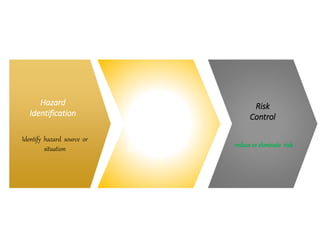
Identify hazard source or
situation
Hazard
Identification
Risk
Assessment
Risk
Control
estimate level of risk and
determine tolerability
reduce or eliminate risk
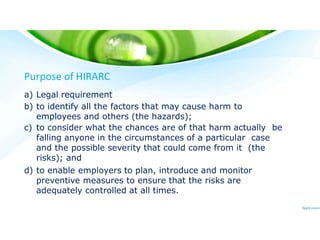
Purpose of HIRARC
a) Legal requirement
b) to identify all the factors that may cause harm to
employees and others (the hazards);
c) to consider what the chances are of that harm actually be
falling anyone in the circumstances of a particular case
and the possible severity that could come from it (the
risks); and
d) to enable employers to plan, introduce and monitor
preventive measures to ensure that the risks are
adequately controlled at all times.
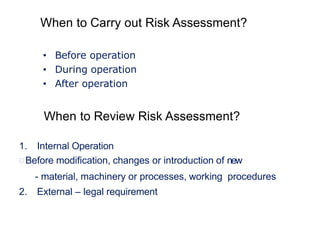
When to Carry out Risk Assessment?
• Before operation
• During operation
• After operation
1. Internal Operation
Before modification, changes or introduction of new
- material, machinery or processes, working procedures
2. External – legal requirement
When to Review Risk Assessment?
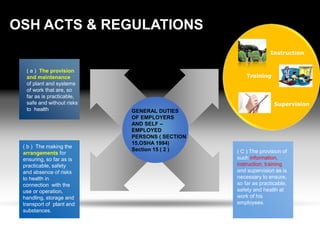
OSH ACTS & REGULATIONS
( b ) The making the
arrangements for
ensuring, so far as is
practicable, safety
and absence of risks
to health in
connection with the
use or operation,
handling, storage and
transport of plant and
substances.
( C ) The provision of
such information,
instruction, training
and supervision as is
necessary to ensure,
so far as practicable,
safety and health at
work of his
employees.
( a ) The provision
and maintenance
of plant and systems
of work that are, so
far as is practicable,
safe and without risks
to health GENERAL DUTIES
OF EMPLOYERS
AND SELF –
EMPLOYED
PERSONS ( SECTION
15,OSHA 1994)
Section 15 ( 2 )
Training
Instruction
Supervision
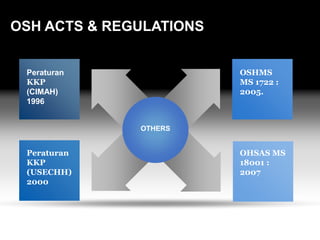
OSH ACTS & REGULATIONS
Peraturan
KKP
(USECHH)
2000
Peraturan
KKP
(CIMAH)
1996
OHSAS MS
18001 :
2007
OSHMS
MS 1722 :
2005.
OTHERS
OSH MANAGEMENT SYSTEM
Model Implementation Framework
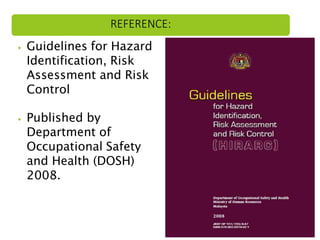
⦁ Guidelines for Hazard
Identification, Risk
Assessment and Risk
Control
⦁ Published by
Department of
Occupational Safety
and Health (DOSH)
2008.
REFERENCE:
• SHO
• SHC MEMBERS
• PROCESS ENGINEER
• PRODUCTION MANAGER/
• SUPERVISOR
• EMPLOYEES
• SUPPLIES / CONTRACTOR
Who are involve-HIRARC
‘As recent studies have shown, there are various risk
assessment tools and methodologies available to help an
organisation to assess risk.
However, prevention of accidents is based on risk
analysis, which involves the identification of the hazards and
the consequences and the likelihood of occurrence of each
hazard
• (Lind et al., 2008, “Safety risk assessment in industrial maintenance”, Journal of Quality in Maintenance
Engineering, Vol. 14 No. 2, pp. 205-217)
Methodology For HIRARC
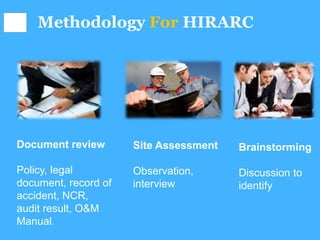
Document review
Policy, legal
document, record of
accident, NCR,
audit result, O&M
Manual.
Site Assessment
Observation,
interview
Brainstorming
Discussion to
identify
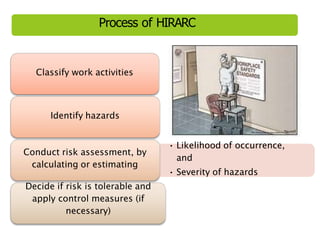
Classify work activities
Identify hazards
• Likelihood of occurrence,
and
• Severity of hazards
Conduct risk assessment, by
calculating or estimating
Decide if risk is tolerable and
apply control measures (if
necessary)
Process of HIRARC
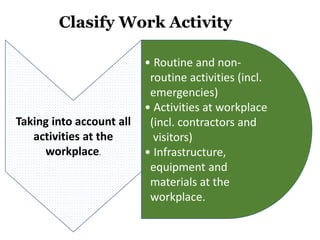
• Routine and non-
routine activities (incl.
emergencies)
• Activities at workplace
(incl. contractors and
visitors)
• Infrastructure,
equipment and
materials at the
workplace.
Taking into account all
activities at the
workplace.
Clasify Work Activity
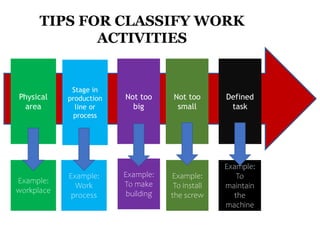
TIPS FOR CLASSIFY WORK
ACTIVITIES
Physical
area
Stage in
production
line or
process
Not too
big
Not too
small
Defined
task
Example:
workplace
Example:
Work
process
Example:
To make
building
Example:
To install
the screw
Example:
To
maintain
the
machine
HAZARD IDENTIFICATION
Means the identification of undesired events/conditions
that lead to the materialization of the hazard mechanism
by which those undesired events could occur.
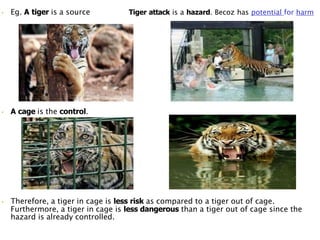
• Eg. A tiger is a source Tiger attack is a hazard. Becoz has potential for harm
• A cage is the control.
• Therefore, a tiger in cage is less risk as compared to a tiger out of cage.
Furthermore, a tiger in cage is less dangerous than a tiger out of cage since the
hazard is already controlled.
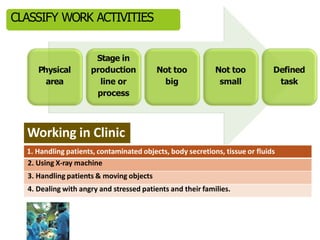
Physical
area
Stage in
production
line or
process
Not too
big
Not too
small
Defined
task
CLASSIFY WORK ACTIVITIES
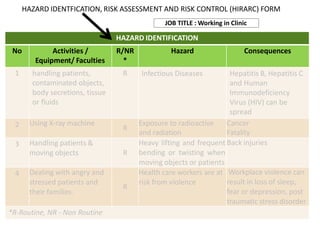
1. Handling patients, contaminated objects, body secretions, tissue or fluids
2. Using X-ray machine
3. Handling patients & moving objects
4. Dealing with angry and stressed patients and their families.
Working in Clinic
HAZARD IDENTIFICATION
No Activities /
Equipment/ Faculties
R/NR
*
Hazard Consequences
1 handling patients,
contaminated objects,
body secretions, tissue
or fluids
R Infectious Diseases Hepatitis B, Hepatitis C
and Human
Immunodeficiency
Virus (HIV) can be
spread
2 Using X-ray machine
R
Exposure to radioactive
and radiation
Cancer
Fatality
3 Handling patients &
moving objects R
Heavy lifting and frequent
bending or twisting when
moving objects or patients
Back injuries
4 Dealing with angry and
stressed patients and
their families.
R
Health care workers are at
risk from violence
Workplace violence can
result in loss of sleep,
fear or depression, post
traumatic stress disorder
*R-Routine, NR - Non Routine
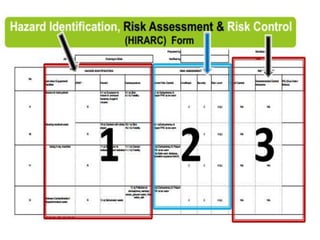
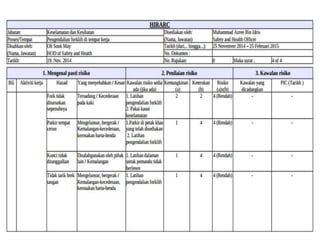
HAZARD IDENTFICATION, RISK ASSESSMENT AND RISK CONTROL (HIRARC) FORM
JOB TITLE : Working in Clinic
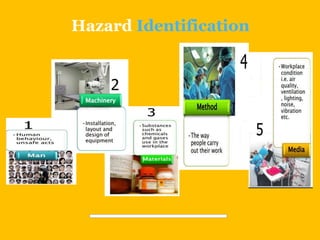
Hazard Identification
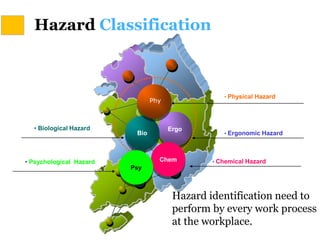
Ergo
Bio • Ergonomic Hazard
• Biological Hazard
• Physical Hazard
Hazard Classification
Phy
Hazard identification need to
perform by every work process
at the workplace.
Chem • Chemical Hazard
Psy
• Psychological Hazard
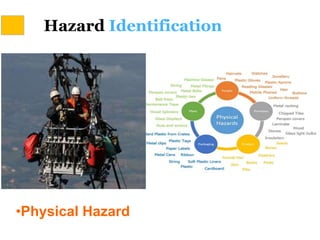
Hazard Identification
•Physical Hazard
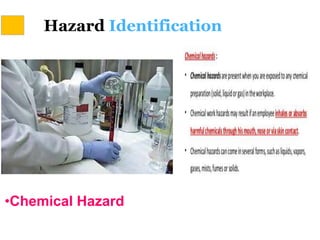
Hazard Identification
•Chemical Hazard
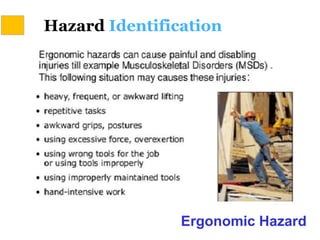
Hazard Identification
Ergonomic Hazard
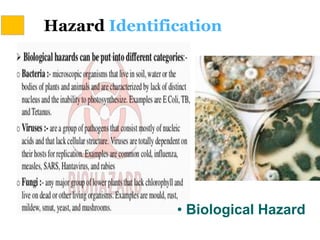
Hazard Identification
• Biological Hazard
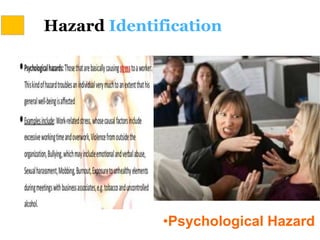
Hazard Identification
•Psychological Hazard
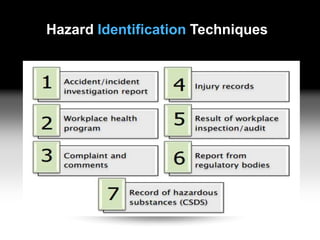
Hazard Identification Techniques
Risk Assessment
Risk Asessment
‘Risk assessment provides the foundation for successful health
and safety management and is key to reducing work-related
accidents and occupational diseases, which in turn helps
improve work place health and safety as well as business
performance’
(Payne, 2000; European Agency for Safety and Health at Work,
2009).
Risk Assessment
Risk Asessment
Two semi-quantitative risk assessment methods for occupational
risk assessment identified in the literature:
 Papadakis and Chalkidou (2008)
Based on risk matrices with two dimensions, namely, the frequency
of occurrence of an accident and the severity of its consequences.
 Marhavilas and Koulouriotis (2008)
The proportional risk assessment technique called the “RSPE”
method based on the function R1 4 SPE, where “R” is the risk,
“S” is the severity of the accident consequences, “P” the
frequency of the accident and “E” the frequency of employee
exposure factor.
Risk Assessment
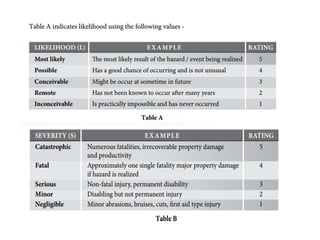
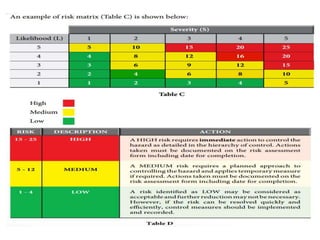
Risk Asessment
The risk analysis tool British Standards Institution (2004)
‘….A risk rating matrix where the likelihood of harm is expressed
broadly as very unlikely, unlikely, likely and very likely together
with the severity of harm…’
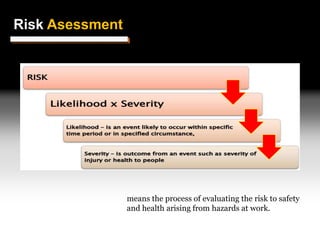
Risk Assessment
means the process of evaluating the risk to safety
and health arising from hazards at work.
Risk Asessment
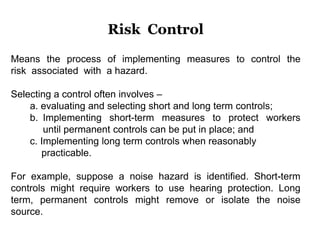
Means the process of implementing measures to control the
risk associated with a hazard.
Selecting a control often involves –
a. evaluating and selecting short and long term controls;
b. Implementing short-term measures to protect workers
until permanent controls can be put in place; and
c. Implementing long term controls when reasonably
practicable.
For example, suppose a noise hazard is identified. Short-term
controls might require workers to use hearing protection. Long
term, permanent controls might remove or isolate the noise
source.
Risk Control
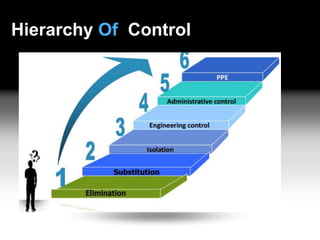
Hierarchy Of Control
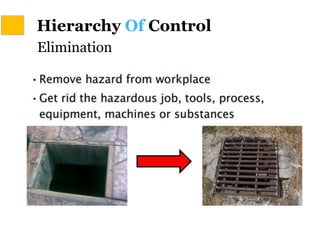
Elimination
Hierarchy Of Control
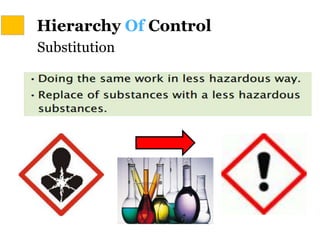
Substitution
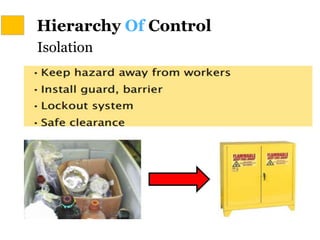
Hierarchy Of Control
Isolation
Company name
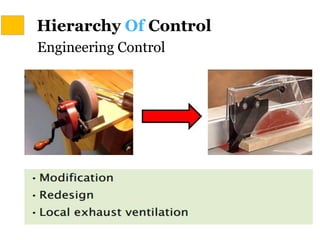
Hierarchy Of Control
Engineering Control
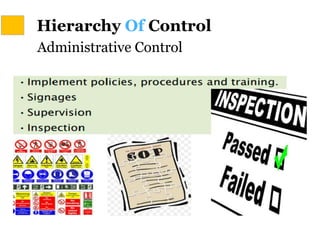
Hierarchy Of Control
Administrative Control
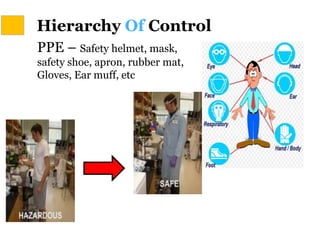
Hierarchy Of Control
PPE – Safety helmet, mask,
safety shoe, apron, rubber mat,
Gloves, Ear muff, etc
• Enforcement is to ensure that proposed risk control is
done to minimize or eliminate the danger.
• Normally, the enforced and monitored by the PIC
appointed.
ENFORCEMENT
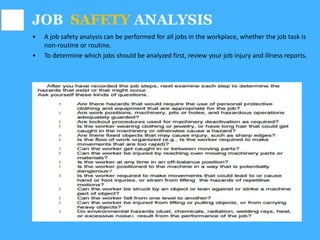
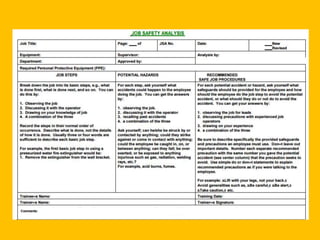
JOB SAFETY ANALYSIS
• A job safety analysis can be performed for all jobs in the workplace, whether the job task is
non-routine or routine.
• To determine which jobs should be analyzed first, review your job injury and illness reports.
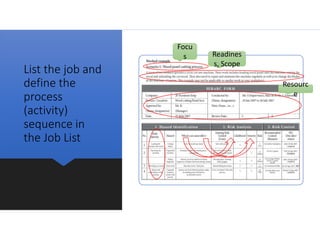
List the job and
define the
process
(activity)
sequence in
the Job List
Focu
s Readines
s, Scope
Resourc
e
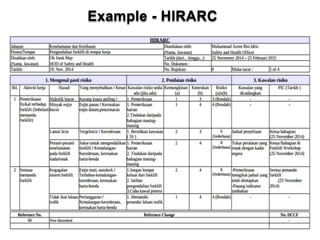
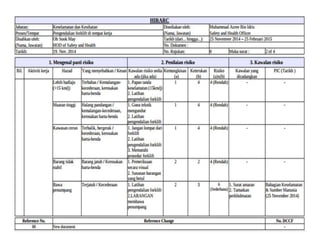
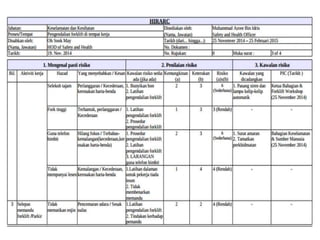
Example - HIRARC
• Set a Process to review OHS Hazards & Risk
• Output/ results can be used to review :
* Standard Operating Procedures (SOP)
* Training Materials
* Internal Audit
* Management Review/ Continuous
Improvement
* Justification for Budget allocations
SUMMARY
CONCLUSIONS
 Basic for OSH Management Is Hazard
Identification, Risk Assessment & Risk Control
 Various Risk Assessment Tools And Methodologies
Available To Help An Organisation To Assess Risk
 Basic for Hazard Management is Risk Assessment
 Selecting Of Control Should Follow Hierarchy Of
Control
Thank You

HIRARC Dealan.pptx

  • 1.
    HIRARC Hazard Identification; RiskAssessment; & Risk Control
  • 2.
    Content • Definition • Whatis HIRARC ? • Purpose of HIRARC • OSH Acts and Regulation • OSH Management System • Model Implementation Framework • Process of HIRARC • Classify Work Activities • Tips For Classify Work Activities • Hazard Identification (HI) • Hazard Identification Technique • Risk Assessment (RA) • Risk Control (RC) • Hierarchy of Control • Job Safety Analysis (JSA) • HIRARC Example General Process Implementation
  • 3.
  • 4.
    DEFINITION ‘…In risk management,the term “hazard” is used to mean an event that could cause harm…’ (British Standards Institution (2004), BS8800: Occupational Health and Safety Management Systems – Guide, British Standards Institution, London). ‘….Hazards are sources of potential harm to human health, property or environment, which may, under certain conditions, lead to accidents…’ (Lind et al., 2008, “Safety risk assessment in industrial maintenance”, Journal of Quality in Maintenance Engineering, Vol. 14 No. 2, pp. 205-217) A source or a situation with a potential for harm in terms of human injury or ill health, damage to property, damage to the environment or a combination of these.
  • 5.
    DEFINITION Risk… ‘…expose a businessto potential advantage or disadvantage, the likelihood of occurrence and censequence of which can be measured and manage…..’ Sonia Bharwani David Mathews, (2012),"Risk identification and analysis in the hospitality industry", Worldwide Hospitality and Tourism Themes A combination of the likelihood of an occurrence of a hazardous event with specified period or in specified circumstances the severity of injury or damage to the health of people, property, environment or any combination of these caused by the event.
  • 6.
    Hazard Identification Risk Assessment estimate level ofrisk and determine tolerability What Is HIRARC ? ‘…..In general, risk assessment should consist of hazard identification, evaluation of preventive safety measures and their functionality, estimation of exposure to the hazards, and the evaluation of consequences and tolerability of the risk’ (Booty, F. (2006), Facilities Management Handbook, 3rd ed., Elsevier, Oxford).
  • 7.
    Identify hazard sourceor situation Hazard Identification Risk Assessment Risk Control estimate level of risk and determine tolerability reduce or eliminate risk
  • 8.
    Purpose of HIRARC a)Legal requirement b) to identify all the factors that may cause harm to employees and others (the hazards); c) to consider what the chances are of that harm actually be falling anyone in the circumstances of a particular case and the possible severity that could come from it (the risks); and d) to enable employers to plan, introduce and monitor preventive measures to ensure that the risks are adequately controlled at all times.
  • 9.
    When to Carryout Risk Assessment? • Before operation • During operation • After operation 1. Internal Operation Before modification, changes or introduction of new - material, machinery or processes, working procedures 2. External – legal requirement When to Review Risk Assessment?
  • 10.
    OSH ACTS &REGULATIONS ( b ) The making the arrangements for ensuring, so far as is practicable, safety and absence of risks to health in connection with the use or operation, handling, storage and transport of plant and substances. ( C ) The provision of such information, instruction, training and supervision as is necessary to ensure, so far as practicable, safety and health at work of his employees. ( a ) The provision and maintenance of plant and systems of work that are, so far as is practicable, safe and without risks to health GENERAL DUTIES OF EMPLOYERS AND SELF – EMPLOYED PERSONS ( SECTION 15,OSHA 1994) Section 15 ( 2 ) Training Instruction Supervision
  • 11.
    OSH ACTS &REGULATIONS Peraturan KKP (USECHH) 2000 Peraturan KKP (CIMAH) 1996 OHSAS MS 18001 : 2007 OSHMS MS 1722 : 2005. OTHERS
  • 12.
  • 13.
  • 14.
    ⦁ Guidelines forHazard Identification, Risk Assessment and Risk Control ⦁ Published by Department of Occupational Safety and Health (DOSH) 2008. REFERENCE:
  • 15.
    • SHO • SHCMEMBERS • PROCESS ENGINEER • PRODUCTION MANAGER/ • SUPERVISOR • EMPLOYEES • SUPPLIES / CONTRACTOR Who are involve-HIRARC
  • 16.
    ‘As recent studieshave shown, there are various risk assessment tools and methodologies available to help an organisation to assess risk. However, prevention of accidents is based on risk analysis, which involves the identification of the hazards and the consequences and the likelihood of occurrence of each hazard • (Lind et al., 2008, “Safety risk assessment in industrial maintenance”, Journal of Quality in Maintenance Engineering, Vol. 14 No. 2, pp. 205-217) Methodology For HIRARC
  • 17.
    Methodology For HIRARC Documentreview Policy, legal document, record of accident, NCR, audit result, O&M Manual. Site Assessment Observation, interview Brainstorming Discussion to identify
  • 18.
    Classify work activities Identifyhazards • Likelihood of occurrence, and • Severity of hazards Conduct risk assessment, by calculating or estimating Decide if risk is tolerable and apply control measures (if necessary) Process of HIRARC
  • 19.
    • Routine andnon- routine activities (incl. emergencies) • Activities at workplace (incl. contractors and visitors) • Infrastructure, equipment and materials at the workplace. Taking into account all activities at the workplace. Clasify Work Activity
  • 20.
    TIPS FOR CLASSIFYWORK ACTIVITIES Physical area Stage in production line or process Not too big Not too small Defined task Example: workplace Example: Work process Example: To make building Example: To install the screw Example: To maintain the machine
  • 21.
    HAZARD IDENTIFICATION Means theidentification of undesired events/conditions that lead to the materialization of the hazard mechanism by which those undesired events could occur.
  • 22.
    • Eg. Atiger is a source Tiger attack is a hazard. Becoz has potential for harm • A cage is the control. • Therefore, a tiger in cage is less risk as compared to a tiger out of cage. Furthermore, a tiger in cage is less dangerous than a tiger out of cage since the hazard is already controlled.
  • 23.
    Physical area Stage in production line or process Nottoo big Not too small Defined task CLASSIFY WORK ACTIVITIES 1. Handling patients, contaminated objects, body secretions, tissue or fluids 2. Using X-ray machine 3. Handling patients & moving objects 4. Dealing with angry and stressed patients and their families. Working in Clinic
  • 24.
    HAZARD IDENTIFICATION No Activities/ Equipment/ Faculties R/NR * Hazard Consequences 1 handling patients, contaminated objects, body secretions, tissue or fluids R Infectious Diseases Hepatitis B, Hepatitis C and Human Immunodeficiency Virus (HIV) can be spread 2 Using X-ray machine R Exposure to radioactive and radiation Cancer Fatality 3 Handling patients & moving objects R Heavy lifting and frequent bending or twisting when moving objects or patients Back injuries 4 Dealing with angry and stressed patients and their families. R Health care workers are at risk from violence Workplace violence can result in loss of sleep, fear or depression, post traumatic stress disorder *R-Routine, NR - Non Routine HAZARD IDENTFICATION, RISK ASSESSMENT AND RISK CONTROL (HIRARC) FORM JOB TITLE : Working in Clinic
  • 25.
  • 26.
    Ergo Bio • ErgonomicHazard • Biological Hazard • Physical Hazard Hazard Classification Phy Hazard identification need to perform by every work process at the workplace. Chem • Chemical Hazard Psy • Psychological Hazard
  • 27.
  • 28.
  • 29.
  • 30.
  • 31.
  • 32.
  • 33.
    Risk Assessment Risk Asessment ‘Riskassessment provides the foundation for successful health and safety management and is key to reducing work-related accidents and occupational diseases, which in turn helps improve work place health and safety as well as business performance’ (Payne, 2000; European Agency for Safety and Health at Work, 2009).
  • 34.
    Risk Assessment Risk Asessment Twosemi-quantitative risk assessment methods for occupational risk assessment identified in the literature:  Papadakis and Chalkidou (2008) Based on risk matrices with two dimensions, namely, the frequency of occurrence of an accident and the severity of its consequences.  Marhavilas and Koulouriotis (2008) The proportional risk assessment technique called the “RSPE” method based on the function R1 4 SPE, where “R” is the risk, “S” is the severity of the accident consequences, “P” the frequency of the accident and “E” the frequency of employee exposure factor.
  • 35.
    Risk Assessment Risk Asessment Therisk analysis tool British Standards Institution (2004) ‘….A risk rating matrix where the likelihood of harm is expressed broadly as very unlikely, unlikely, likely and very likely together with the severity of harm…’
  • 36.
    Risk Assessment means theprocess of evaluating the risk to safety and health arising from hazards at work. Risk Asessment
  • 39.
    Means the processof implementing measures to control the risk associated with a hazard. Selecting a control often involves – a. evaluating and selecting short and long term controls; b. Implementing short-term measures to protect workers until permanent controls can be put in place; and c. Implementing long term controls when reasonably practicable. For example, suppose a noise hazard is identified. Short-term controls might require workers to use hearing protection. Long term, permanent controls might remove or isolate the noise source. Risk Control
  • 40.
  • 41.
  • 42.
  • 43.
  • 44.
    Company name Hierarchy OfControl Engineering Control
  • 45.
  • 46.
    Hierarchy Of Control PPE– Safety helmet, mask, safety shoe, apron, rubber mat, Gloves, Ear muff, etc
  • 47.
    • Enforcement isto ensure that proposed risk control is done to minimize or eliminate the danger. • Normally, the enforced and monitored by the PIC appointed. ENFORCEMENT
  • 48.
    JOB SAFETY ANALYSIS •A job safety analysis can be performed for all jobs in the workplace, whether the job task is non-routine or routine. • To determine which jobs should be analyzed first, review your job injury and illness reports.
  • 49.
    List the joband define the process (activity) sequence in the Job List Focu s Readines s, Scope Resourc e
  • 52.
  • 56.
    • Set aProcess to review OHS Hazards & Risk • Output/ results can be used to review : * Standard Operating Procedures (SOP) * Training Materials * Internal Audit * Management Review/ Continuous Improvement * Justification for Budget allocations SUMMARY
  • 57.
    CONCLUSIONS  Basic forOSH Management Is Hazard Identification, Risk Assessment & Risk Control  Various Risk Assessment Tools And Methodologies Available To Help An Organisation To Assess Risk  Basic for Hazard Management is Risk Assessment  Selecting Of Control Should Follow Hierarchy Of Control
  • 58.