Hazards Identification and Risk
Assessment
This training module covers the key steps in hazard identification and risk assessment, a crucial process for
ensuring workplace safety. It provides a comprehensive overview of best practices for recognizing, evaluating, and
mitigating risks.
by sanjeev kumar
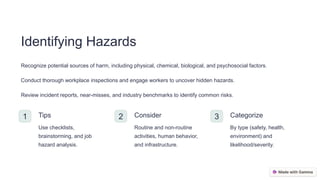
Identifying Hazards
Recognize potential sources of harm, including physical, chemical, biological, and psychosocial factors.
Conduct thorough workplace inspections and engage workers to uncover hidden hazards.
Review incident reports, near-misses, and industry benchmarks to identify common risks.
1 Tips
Use checklists,
brainstorming, and job
hazard analysis.
2 Consider
Routine and non-routine
activities, human behavior,
and infrastructure.
3 Categorize
By type (safety, health,
environment) and
likelihood/severity.
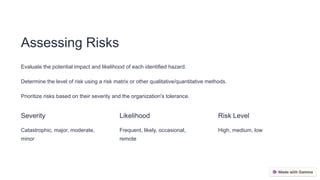
Assessing Risks
Evaluate the potential impact and likelihood of each identified hazard.
Determine the level of risk using a risk matrix or other qualitative/quantitative methods.
Prioritize risks based on their severity and the organization's tolerance.
Severity
Catastrophic, major, moderate,
minor
Likelihood
Frequent, likely, occasional,
remote
Risk Level
High, medium, low
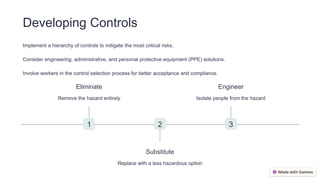
Developing Controls
Implement a hierarchy of controls to mitigate the most critical risks.
Consider engineering, administrative, and personal protective equipment (PPE) solutions.
Involve workers in the control selection process for better acceptance and compliance.
1
Eliminate
Remove the hazard entirely
2
Substitute
Replace with a less hazardous option
3
Engineer
Isolate people from the hazard
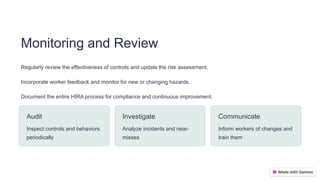
Monitoring and Review
Regularly review the effectiveness of controls and update the risk assessment.
Incorporate worker feedback and monitor for new or changing hazards.
Document the entire HIRA process for compliance and continuous improvement.
Audit
Inspect controls and behaviors
periodically
Investigate
Analyze incidents and near-
misses
Communicate
Inform workers of changes and
train them
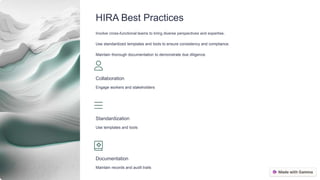
HIRA Best Practices
Involve cross-functional teams to bring diverse perspectives and expertise.
Use standardized templates and tools to ensure consistency and compliance.
Maintain thorough documentation to demonstrate due diligence.
Collaboration
Engage workers and stakeholders
Standardization
Use templates and tools
Documentation
Maintain records and audit trails
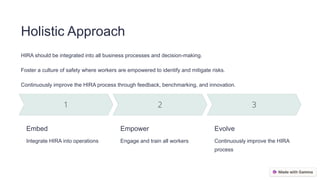
Holistic Approach
HIRA should be integrated into all business processes and decision-making.
Foster a culture of safety where workers are empowered to identify and mitigate risks.
Continuously improve the HIRA process through feedback, benchmarking, and innovation.
Embed
Integrate HIRA into operations
Empower
Engage and train all workers
Evolve
Continuously improve the HIRA
process
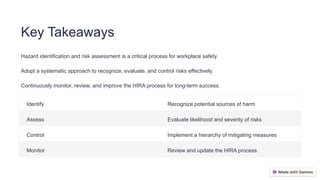
Key Takeaways
Hazard identification and risk assessment is a critical process for workplace safety.
Adopt a systematic approach to recognize, evaluate, and control risks effectively.
Continuously monitor, review, and improve the HIRA process for long-term success.
Identify Recognize potential sources of harm
Assess Evaluate likelihood and severity of risks
Control Implement a hierarchy of mitigating measures
Monitor Review and update the HIRA process

Hazards-Identification-and-Risk-Assessment.pptx

  • 1.
    Hazards Identification andRisk Assessment This training module covers the key steps in hazard identification and risk assessment, a crucial process for ensuring workplace safety. It provides a comprehensive overview of best practices for recognizing, evaluating, and mitigating risks. by sanjeev kumar
  • 2.
    Identifying Hazards Recognize potentialsources of harm, including physical, chemical, biological, and psychosocial factors. Conduct thorough workplace inspections and engage workers to uncover hidden hazards. Review incident reports, near-misses, and industry benchmarks to identify common risks. 1 Tips Use checklists, brainstorming, and job hazard analysis. 2 Consider Routine and non-routine activities, human behavior, and infrastructure. 3 Categorize By type (safety, health, environment) and likelihood/severity.
  • 3.
    Assessing Risks Evaluate thepotential impact and likelihood of each identified hazard. Determine the level of risk using a risk matrix or other qualitative/quantitative methods. Prioritize risks based on their severity and the organization's tolerance. Severity Catastrophic, major, moderate, minor Likelihood Frequent, likely, occasional, remote Risk Level High, medium, low
  • 4.
    Developing Controls Implement ahierarchy of controls to mitigate the most critical risks. Consider engineering, administrative, and personal protective equipment (PPE) solutions. Involve workers in the control selection process for better acceptance and compliance. 1 Eliminate Remove the hazard entirely 2 Substitute Replace with a less hazardous option 3 Engineer Isolate people from the hazard
  • 5.
    Monitoring and Review Regularlyreview the effectiveness of controls and update the risk assessment. Incorporate worker feedback and monitor for new or changing hazards. Document the entire HIRA process for compliance and continuous improvement. Audit Inspect controls and behaviors periodically Investigate Analyze incidents and near- misses Communicate Inform workers of changes and train them
  • 6.
    HIRA Best Practices Involvecross-functional teams to bring diverse perspectives and expertise. Use standardized templates and tools to ensure consistency and compliance. Maintain thorough documentation to demonstrate due diligence. Collaboration Engage workers and stakeholders Standardization Use templates and tools Documentation Maintain records and audit trails
  • 7.
    Holistic Approach HIRA shouldbe integrated into all business processes and decision-making. Foster a culture of safety where workers are empowered to identify and mitigate risks. Continuously improve the HIRA process through feedback, benchmarking, and innovation. Embed Integrate HIRA into operations Empower Engage and train all workers Evolve Continuously improve the HIRA process
  • 8.
    Key Takeaways Hazard identificationand risk assessment is a critical process for workplace safety. Adopt a systematic approach to recognize, evaluate, and control risks effectively. Continuously monitor, review, and improve the HIRA process for long-term success. Identify Recognize potential sources of harm Assess Evaluate likelihood and severity of risks Control Implement a hierarchy of mitigating measures Monitor Review and update the HIRA process