WELCOME TO
Environmental Quality Act 1974
(EQA 1974)
TRAINING
RAZAK BIN MAJID
Health, Safety and Environment Trainer
2
NAME : Razak Bin Majid
POSITION : Trainer
EDUCATION : Executive Master SHE from UNISEL
H/P : 019-4944324
Competency:
SHO Registered Person (8408)
Train The Trainer (HRDF)
Train The Trainer (BOFA)
Train The Trainer (Forklift)
Train The Trainer (Fire Fighting)
ISO 45001-2018 Lead Auditor
ISO 14001- 2015 Auditor
Authorize Gas Tester (DOSH)
Scaffolder (DOSH)
Traffic Management Supervisor
Lifting Supervisor
Ergonomic Trained Person
Trainer Profile
In
case
of
EMERGENCY
Please use nearest exit to the
assembly area
Please do not run
Please do not use the elevator
Use the nearest staircase
Safety Briefing
3
Facilities
Washroom (Every floor)
Surau (First Floor)
Cafeteria
Smoking (Ground Floor)
Reminder
Silence hand-phone during training session
Important Things
4
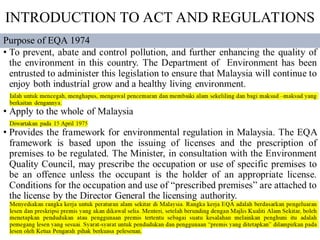
Purpose of EQA 1974
INTRODUCTION TO ACT AND REGULATIONS
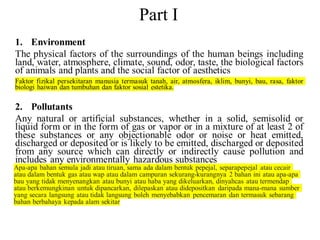
Part I
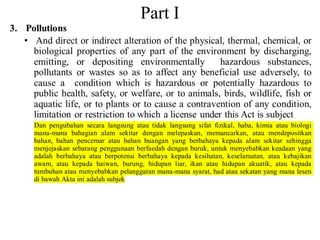
Part I
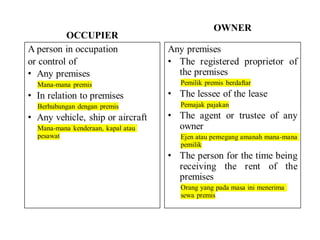
OCCUPIER
OWNER
How Many Regulations, Rules and Order Stated In
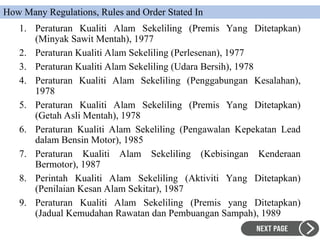
1. Peraturan Kualiti Alam Sekeliling (Premis Yang Ditetapkan)
(Minyak Sawit Mentah), 1977
2. Peraturan Kualiti Alam Sekeliling (Perlesenan), 1977
3. Peraturan Kualiti Alam Sekeliling (Udara Bersih), 1978
4. Peraturan Kualiti Alam Sekeliling (Penggabungan Kesalahan),
1978
5. Peraturan Kualiti Alam Sekeliling (Premis Yang Ditetapkan)
(Getah Asli Mentah), 1978
6. Peraturan Kualiti Alam Sekeliling (Pengawalan Kepekatan Lead
dalam Bensin Motor), 1985
7. Peraturan Kualiti Alam Sekeliling (Kebisingan Kenderaan
Bermotor), 1987
8. Perintah Kualiti Alam Sekeliling (Aktiviti Yang Ditetapkan)
(Penilaian Kesan Alam Sekitar), 1987
9. Peraturan Kualiti Alam Sekeliling (Premis yang Ditetapkan)
(Jadual Kemudahan Rawatan dan Pembuangan Sampah), 1989
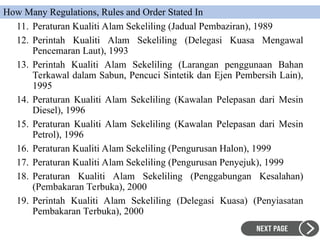
11. Peraturan Kualiti Alam Sekeliling (Jadual Pembaziran), 1989
12. Perintah Kualiti Alam Sekeliling (Delegasi Kuasa Mengawal
Pencemaran Laut), 1993
13. Perintah Kualiti Alam Sekeliling (Larangan penggunaan Bahan
Terkawal dalam Sabun, Pencuci Sintetik dan Ejen Pembersih Lain),
1995
14. Peraturan Kualiti Alam Sekeliling (Kawalan Pelepasan dari Mesin
Diesel), 1996
15. Peraturan Kualiti Alam Sekeliling (Kawalan Pelepasan dari Mesin
Petrol), 1996
16. Peraturan Kualiti Alam Sekeliling (Pengurusan Halon), 1999
17. Peraturan Kualiti Alam Sekeliling (Pengurusan Penyejuk), 1999
18. Peraturan Kualiti Alam Sekeliling (Penggabungan Kesalahan)
(Pembakaran Terbuka), 2000
19. Perintah Kualiti Alam Sekeliling (Delegasi Kuasa) (Penyiasatan
Pembakaran Terbuka), 2000
How Many Regulations, Rules and Order Stated In
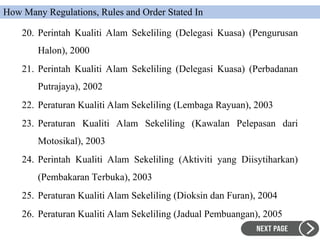
20. Perintah Kualiti Alam Sekeliling (Delegasi Kuasa) (Pengurusan
Halon), 2000
21. Perintah Kualiti Alam Sekeliling (Delegasi Kuasa) (Perbadanan
Putrajaya), 2002
22. Peraturan Kualiti Alam Sekeliling (Lembaga Rayuan), 2003
23. Peraturan Kualiti Alam Sekeliling (Kawalan Pelepasan dari
Motosikal), 2003
24. Perintah Kualiti Alam Sekeliling (Aktiviti yang Diisytiharkan)
(Pembakaran Terbuka), 2003
25. Peraturan Kualiti Alam Sekeliling (Dioksin dan Furan), 2004
26. Peraturan Kualiti Alam Sekeliling (Jadual Pembuangan), 2005
How Many Regulations, Rules and Order Stated In
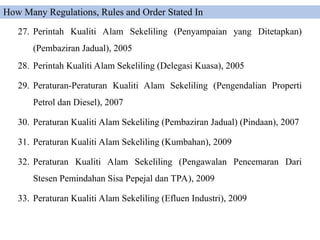
27. Perintah Kualiti Alam Sekeliling (Penyampaian yang Ditetapkan)
(Pembaziran Jadual), 2005
28. Perintah Kualiti Alam Sekeliling (Delegasi Kuasa), 2005
29. Peraturan-Peraturan Kualiti Alam Sekeliling (Pengendalian Properti
Petrol dan Diesel), 2007
30. Peraturan Kualiti Alam Sekeliling (Pembaziran Jadual) (Pindaan), 2007
31. Peraturan Kualiti Alam Sekeliling (Kumbahan), 2009
32. Peraturan Kualiti Alam Sekeliling (Pengawalan Pencemaran Dari
Stesen Pemindahan Sisa Pepejal dan TPA), 2009
33. Peraturan Kualiti Alam Sekeliling (Efluen Industri), 2009
How Many Regulations, Rules and Order Stated In
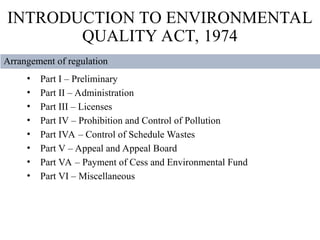
• Part I – Preliminary
• Part II – Administration
• Part III – Licenses
• Part IV – Prohibition and Control of Pollution
• Part IVA – Control of Schedule Wastes
• Part V – Appeal and Appeal Board
• Part VA – Payment of Cess and Environmental Fund
• Part VI – Miscellaneous
INTRODUCTION TO ENVIRONMENTAL
QUALITY ACT, 1974
Arrangement of regulation
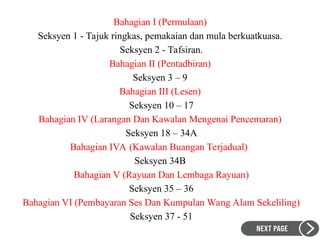
Bahagian I (Permulaan)
Seksyen 1 - Tajuk ringkas, pemakaian dan mula berkuatkuasa.
Seksyen 2 - Tafsiran.
Bahagian II (Pentadbiran)
Seksyen 3 – 9
Bahagian III (Lesen)
Seksyen 10 – 17
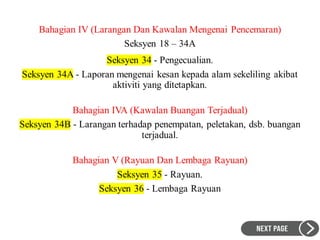
Bahagian IV (Larangan Dan Kawalan Mengenai Pencemaran)
Seksyen 18 – 34A
Bahagian IVA (Kawalan Buangan Terjadual)
Seksyen 34B
Bahagian V (Rayuan Dan Lembaga Rayuan)
Seksyen 35 – 36
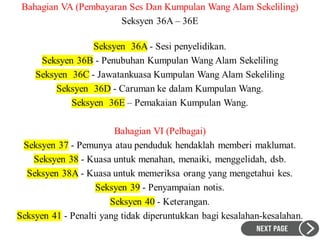
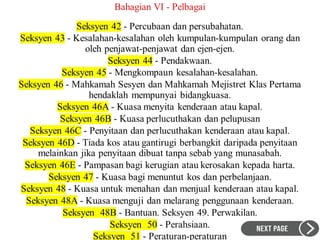
Bahagian VI (Pembayaran Ses Dan Kumpulan Wang Alam Sekeliling)
Seksyen 37 - 51
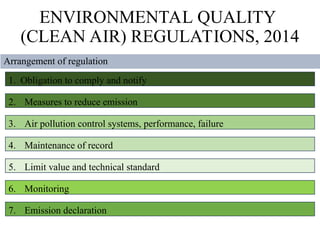
ENVIRONMENTAL QUALITY
(CLEAN AIR) REGULATIONS, 2014
Arrangement of regulation
1. Obligation to comply and notify
2. Measures to reduce emission
3. Air pollution control systems, performance, failure
4. Maintenance of record
5. Limit value and technical standard
6. Monitoring
7. Emission declaration
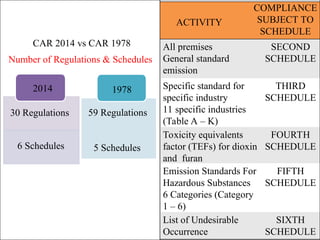
CAR 2014 vs CAR 1978
30 Regulations
6 Schedules
2014
21
Number of Regulations & Schedules
1978
59 Regulations
5 Schedules
All premises
General standard
emission
SECOND
SCHEDULE
Specific standard for
specific industry
11 specific industries
(Table A – K)
THIRD
SCHEDULE
Toxicity equivalents
factor (TEFs) for dioxin
and furan
FOURTH
SCHEDULE
Emission Standards For
Hazardous Substances
6 Categories (Category
1 – 6)
FIFTH
SCHEDULE
List of Undesirable
Occurrence
SIXTH
SCHEDULE
ACTIVITY
COMPLIANCE
SUBJECT TO
SCHEDULE
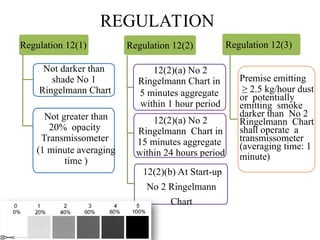
Regulation 12(1)
Not darker than
shade No 1
Ringelmann Chart
Not greater than
20% opacity
Transmissometer
(1 minute averaging
time )
Regulation 12(2)
12(2)(a) No 2
Ringelmann Chart in
5 minutes aggregate
within 1 hour period
12(2)(a) No 2
Ringelmann Chart in
15 minutes aggregate
within 24 hours period
12(2)(b) At Start-up
No 2 Ringelmann
Chart
Regulation 12(3)
Premise emitting
≥ 2.5 kg/hour dust
or potentially
emitting smoke
darker than No 2
Ringelmann Chart
shall operate a
transmissometer
(averaging time: 1
minute)
REGULATION
23
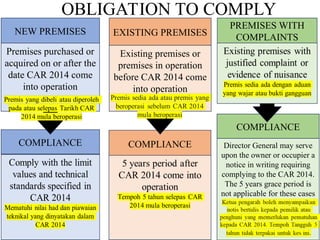
OBLIGATION TO COMPLY
EXISTING PREMISES
COMPLIANCE
NEW PREMISES
Premises purchased or
acquired on or after the
date CAR 2014 come
into operation
COMPLIANCE
EXISTING PREMISES
Existing premises or
premises in operation
before CAR 2014 come
into operation
COMPLIANCE
PREMISES WITH
COMPLAINTS
Director General may serve
upon the owner or occupier a
notice in writing requiring
complying to the CAR 2014.
The 5 years grace period is
not applicable for these cases
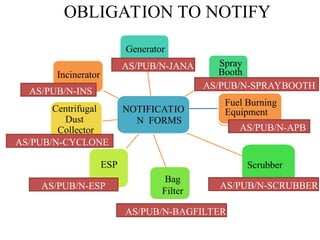
OBLIGATION TO NOTIFY
Generator
Spray
Booth
Scrubber
Bag
Filter
ESP
Centrifugal
Dust
Collector
Incinerator
Fuel Burning
Equipment
AS/PUB/N-APB
AS/PUB/N-SCRUBBER
AS/PUB/N-BAGFILTER
AS/PUB/N-INS
AS/PUB/N-JANA
AS/PUB/N-CYCLONE
AS/PUB/N-ESP
AS/PUB/N-SPRAYBOOTH
NOTIFICATIO
N FORMS
OBLIGATION TO NOTIFY
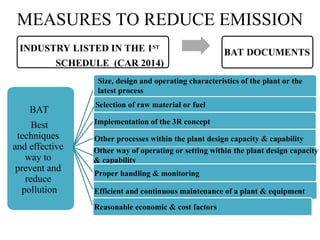
BAT
Best
techniques
and effective
way to
prevent and
reduce
pollution
Size, design and operating characteristics of the plant or the
latest process
Selection of raw material or fuel
Implementation of the 3R concept
Other processes within the plant design capacity & capability
Other way of operating or setting within the plant design capacity
& capability
Proper handling & monitoring
Efficient and continuous maintenance of a plant & equipment
Reasonable economic & cost factors
INDUSTRY LISTED IN THE 1ST
SCHEDULE (CAR 2014)
BAT DOCUMENTS
MEASURES TO REDUCE EMISSION
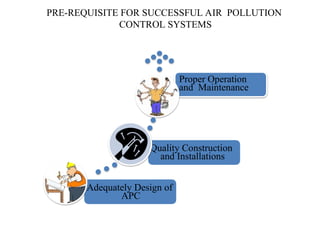
PRE-REQUISITE FOR SUCCESSFUL AIR POLLUTION
CONTROL SYSTEMS
Quality Construction
and Installations
Proper Operation
and Maintenance
Adequately Design of
APC
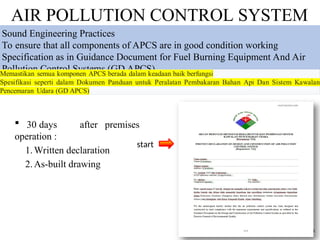
AIR POLLUTION CONTROL SYSTEM
 30 days after premises
operation :
1.Written declaration
2.As-built drawing
start
28
Sound Engineering Practices
To ensure that all components of APCS are in good condition working
Specification as in Guidance Document for Fuel Burning Equipment And Air
Pollution Control Systems (GD APCS)
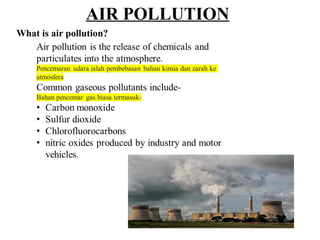
AIR POLLUTION
What is air pollution?
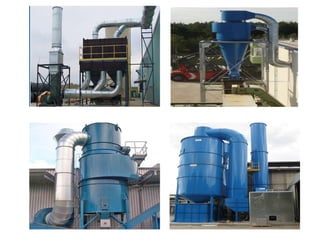
CONTROL OF AIR POLLUTION
To control particulate emissions following equipments are
employed:-
Settling chambers
Cyclone separators
Fabric filters
Electrostatic precipitators
Wet collector
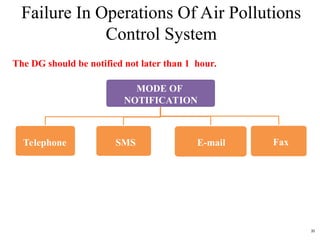
Telephone SMS E-mail Fax
35
MODE OF
NOTIFICATION
Failure In Operations Of Air Pollutions
Control System
The DG should be notified not later than 1 hour.
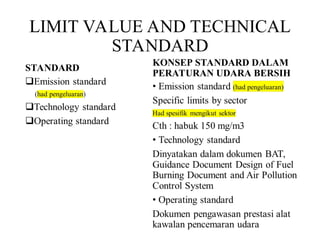
LIMIT VALUE AND TECHNICAL
STANDARD
STANDARD
KONSEP STANDARD DALAM
PERATURAN UDARA BERSIH
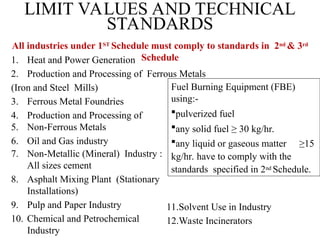
All industries under 1ST Schedule must comply to standards in 2nd & 3rd
Schedule
LIMIT VALUES AND TECHNICAL
STANDARDS
Fuel Burning Equipment (FBE)
using:-
pulverized fuel
any solid fuel ≥ 30 kg/hr.
any liquid or gaseous matter ≥15
kg/hr. have to comply with the
standards specified in 2nd Schedule.
1. Heat and Power Generation
2. Production and Processing of Ferrous Metals
(Iron and Steel Mills)
3. Ferrous Metal Foundries
4. Production and Processing of
5. Non-Ferrous Metals
6. Oil and Gas industry
7. Non-Metallic (Mineral) Industry :
All sizes cement
8. Asphalt Mixing Plant (Stationary
Installations)
9. Pulp and Paper Industry
10. Chemical and Petrochemical
Industry
11.Solvent Use in Industry
12.Waste Incinerators
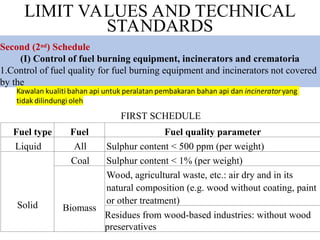
Fuel type Fuel Fuel quality parameter
Liquid All Sulphur content < 500 ppm (per weight)
Solid
Coal Sulphur content < 1% (per weight)
Biomass
Wood, agricultural waste, etc.: air dry and in its
natural composition (e.g. wood without coating, paint
or other treatment)
Residues from wood-based industries: without wood
preservatives
Second (2nd) Schedule
(I) Control of fuel burning equipment, incinerators and crematoria
1.Control of fuel quality for fuel burning equipment and incinerators not covered
by the
LIMIT VALUES AND TECHNICAL
STANDARDS
FIRST SCHEDULE
Second (2nd) Schedule
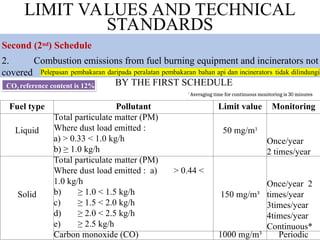
2. Combustion emissions from fuel burning equipment and incinerators not
covered
Fuel type Pollutant Limit value Monitoring
Liquid
Total particulate matter (PM)
Where dust load emitted :
a) > 0.33 < 1.0 kg/h
b) ≥ 1.0 kg/h
50 mg/m3
Once/year
2 times/year
Solid
Total particulate matter (PM)
Where dust load emitted : a) > 0.44 <
1.0 kg/h
b) ≥ 1.0 < 1.5 kg/h
c) ≥ 1.5 < 2.0 kg/h
d) ≥ 2.0 < 2.5 kg/h
e) ≥ 2.5 kg/h
150 mg/m³
Once/year 2
times/year
3times/year
4times/year
Continuous*
Carbon monoxide (CO) 1000 mg/m³ Periodic
CO2 reference content is 12%
* Averaging time for continuous monitoring is 30 minutes
LIMIT VALUES AND TECHNICAL
STANDARDS
BY THE FIRST SCHEDULE
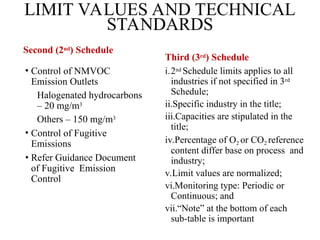
• Control of NMVOC
Emission Outlets
Halogenated hydrocarbons
– 20 mg/m3
Others – 150 mg/m3
• Control of Fugitive
Emissions
• Refer Guidance Document
of Fugitive Emission
Control
Third (3rd) Schedule
i.2nd Schedule limits applies to all
industries if not specified in 3rd
Schedule;
ii.Specific industry in the title;
iii.Capacities are stipulated in the
title;
iv.Percentage of O2 or CO2 reference
content differ base on process and
industry;
v.Limit values are normalized;
vi.Monitoring type: Periodic or
Continuous; and
vii.“Note” at the bottom of each
sub-table is important
LIMIT VALUES AND TECHNICAL
STANDARDS
Second (2nd) Schedule
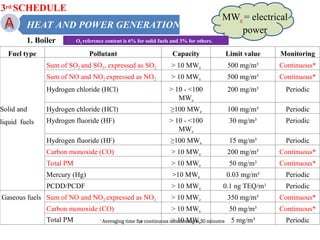
1. Boiler O2 reference content is 6% for solid fuels and 3% for others.
HEAT AND POWER GENERATION
MWe = electrical
power
3rd SCHEDULE
* Averaging time for continuous monitoring is 30 minutes
Fuel type Pollutant Capacity Limit value Monitoring
Solid and
liquid fuels
Sum of SO2 and SO3, expressed as SO2 > 10 MWe 500 mg/m³ Continuous*
Sum of NO and NO2 expressed as NO2 > 10 MWe 500 mg/m³ Continuous*
Hydrogen chloride (HCl) > 10 - <100
MWe
200 mg/m³ Periodic
Hydrogen chloride (HCl) ≥100 MWe 100 mg/m³ Periodic
Hydrogen fluoride (HF) > 10 - <100
MWe
30 mg/m³ Periodic
Hydrogen fluoride (HF) ≥100 MWe 15 mg/m³ Periodic
Carbon monoxide (CO) > 10 MWe 200 mg/m³ Continuous*
Total PM > 10 MWe 50 mg/m³ Continuous*
Mercury (Hg) >10 MWe 0.03 mg/m³ Periodic
PCDD/PCDF > 10 MWe 0.1 ng TEQ/m3 Periodic
Gaseous fuels Sum of NO and NO2 expressed as NO2 > 10 MWe 350 mg/m³ Continuous*
Carbon monoxide (CO) > 10 MWe 50 mg/m³ Continuous*
Total PM 29 > 10 MWe 5 mg/m³ Periodic
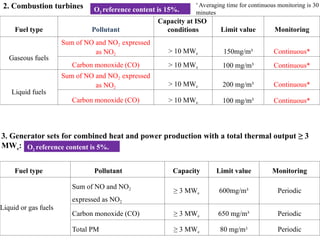
Fuel type Pollutant
Capacity at ISO
conditions Limit value Monitoring
Gaseous fuels
Sum of NO and NO2 expressed
as NO2
> 10 MWe 150mg/m³ Continuous*
Carbon monoxide (CO) > 10 MWe 100 mg/m³ Continuous*
Liquid fuels
Sum of NO and NO2 expressed
as NO2
> 10 MWe 200 mg/m³ Continuous*
Carbon monoxide (CO) > 10 MWe 100 mg/m³ Continuous*
2. Combustion turbines O2 reference content is 15%.
* Averaging time for continuous monitoring is 30
minutes
3. Generator sets for combined heat and power production with a total thermal output ≥ 3
MWe:
Fuel type Pollutant Capacity Limit value Monitoring
Liquid or gas fuels
Sum of NO and NO2
expressed as NO2
≥ 3 MWe 600mg/m³ Periodic
Carbon monoxide (CO) ≥ 3 MWe 650 mg/m³ Periodic
Total PM ≥ 3 MWe 80 mg/m3 Periodic
O2 reference content is 5%.
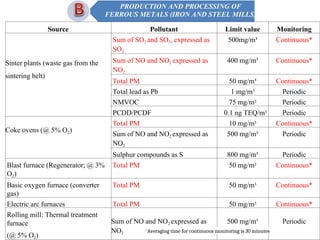
PRODUCTION AND PROCESSING OF
FERROUS METALS (IRON AND STEEL MILLS)
Source Pollutant Limit value Monitoring
Sinter plants (waste gas from the
sintering belt)
Sum of SO2 and SO3, expressed as
SO2
500mg/m³ Continuous*
Sum of NO and NO2 expressed as
NO2
400 mg/m³ Continuous*
Total PM 50 mg/m³ Continuous*
Total lead as Pb 1 mg/m3 Periodic
NMVOC 75 mg/m3 Periodic
PCDD/PCDF 0.1 ng TEQ/m3 Periodic
Coke ovens (@ 5% O2)
Total PM 10 mg/m3 Continuous*
Sum of NO and NO2 expressed as
NO2
500 mg/m³ Periodic
Sulphur compounds as S 800 mg/m³ Periodic
Blast furnace (Regenerator; @ 3%
O2)
Total PM 50 mg/m3 Continuous*
Basic oxygen furnace (converter
gas)
Total PM 50 mg/m3 Continuous*
Electric arc furnaces Total PM 50 mg/m3 Continuous*
Rolling mill: Thermal treatment
furnace
(@ 5% O2)
Sum of NO and NO2 expressed as
NO2
500 mg/m³ Periodic
* Averaging time for continuous monitoring is 30 minutes
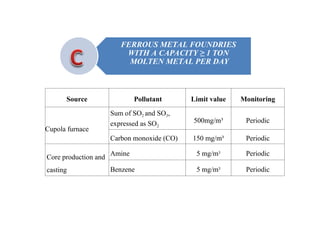
Source Pollutant Limit value Monitoring
Cupola furnace
Sum of SO2 and SO3,
expressed as SO2
500mg/m³ Periodic
Carbon monoxide (CO) 150 mg/m³ Periodic
Core production and
casting
Amine 5 mg/m3 Periodic
Benzene 5 mg/m3 Periodic
FERROUS METAL FOUNDRIES
WITH A CAPACITY ≥ 1 TON
MOLTEN METAL PER DAY
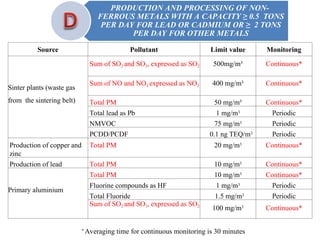
PRODUCTION AND PROCESSING OF NON-
FERROUS METALS WITH A CAPACITY ≥ 0.5 TONS
PER DAY FOR LEAD OR CADMIUM OR ≥ 2 TONS
PER DAY FOR OTHER METALS
* Averaging time for continuous monitoring is 30 minutes
Source Pollutant Limit value Monitoring
Sinter plants (waste gas
from the sintering belt)
Sum of SO2 and SO3, expressed as SO2 500mg/m³ Continuous*
Sum of NO and NO2 expressed as NO2 400 mg/m³ Continuous*
Total PM 50 mg/m³ Continuous*
Total lead as Pb 1 mg/m3 Periodic
NMVOC 75 mg/m3 Periodic
PCDD/PCDF 0.1 ng TEQ/m3 Periodic
Production of copper and
zinc
Total PM 20 mg/m3 Continuous*
Production of lead Total PM 10 mg/m3 Continuous*
Primary aluminium
Total PM 10 mg/m3 Continuous*
Fluorine compounds as HF 1 mg/m3 Periodic
Total Fluoride 1.5 mg/m3 Periodic
Sum of SO2 and SO3, expressed as SO2
100 mg/m3 Continuous*
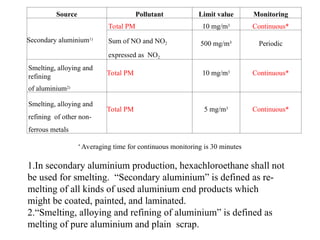
Source Pollutant Limit value Monitoring
Secondary aluminium1)
Total PM 10 mg/m3 Continuous*
Sum of NO and NO2
expressed as NO2
500 mg/m³ Periodic
Smelting, alloying and
refining
of aluminium2)
Total PM 10 mg/m3 Continuous*
Smelting, alloying and
refining of other non-
ferrous metals
Total PM 5 mg/m3 Continuous*
* Averaging time for continuous monitoring is 30 minutes
1.In secondary aluminium production, hexachloroethane shall not
be used for smelting. “Secondary aluminium” is defined as re-
melting of all kinds of used aluminium end products which
might be coated, painted, and laminated.
2.“Smelting, alloying and refining of aluminium” is defined as
melting of pure aluminium and plain scrap.
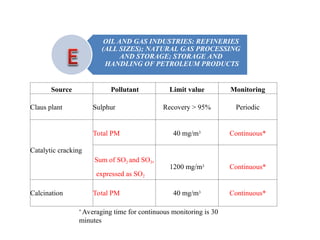
Source Pollutant Limit value Monitoring
Claus plant Sulphur Recovery > 95% Periodic
Catalytic cracking
Total PM 40 mg/m3 Continuous*
Sum of SO2 and SO3,
expressed as SO2
1200 mg/m3 Continuous*
Calcination Total PM 40 mg/m3 Continuous*
OIL AND GAS INDUSTRIES: REFINERIES
(ALL SIZES); NATURAL GAS PROCESSING
AND STORAGE; STORAGE AND
HANDLING OF PETROLEUM PRODUCTS
* Averaging time for continuous monitoring is 30
minutes
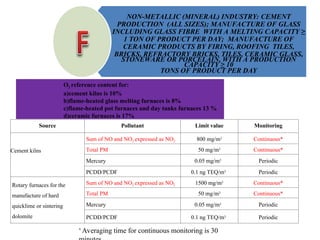
Source Pollutant Limit value Monitoring
Cement kilns
Sum of NO and NO2 expressed as NO2 800 mg/m3 Continuous*
Total PM 50 mg/m3 Continuous*
Mercury 0.05 mg/m3 Periodic
PCDD/PCDF 0.1 ng TEQ/m3 Periodic
Rotary furnaces for the
manufacture of hard
quicklime or sintering
dolomite
Sum of NO and NO2 expressed as NO2 1500 mg/m3 Continuous*
Total PM 50 mg/m3 Continuous*
Mercury 0.05 mg/m3 Periodic
PCDD/PCDF 0.1 ng TEQ/m3 Periodic
O2 reference content for:
a)cement kilns is 10%
b)flame-heated glass melting furnaces is 8%
c)flame-heated pot furnaces and day tanks furnaces 13 %
d)ceramic furnaces is 17%
NON-METALLIC (MINERAL) INDUSTRY: CEMENT
PRODUCTION (ALL SIZES); MANUFACTURE OF GLASS
INCLUDING GLASS FIBRE WITH A MELTING CAPACITY ≥
1 TON OF PRODUCT PER DAY; MANUFACTURE OF
CERAMIC PRODUCTS BY FIRING, ROOFING TILES,
BRICKS, REFRACTORY BRICKS, TILES, CERAMIC GLASS,
STONEWARE OR PORCELAIN, WITH A PRODUCTION
CAPACITY ≥ 10
TONS OF PRODUCT PER DAY
* Averaging time for continuous monitoring is 30
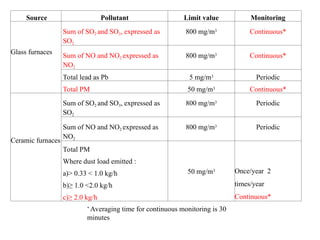
Source Pollutant Limit value Monitoring
Glass furnaces
Sum of SO2 and SO3, expressed as
SO2
800 mg/m3 Continuous*
Sum of NO and NO2 expressed as
NO2
800 mg/m3 Continuous*
Total lead as Pb 5 mg/m3 Periodic
Total PM 50 mg/m3 Continuous*
Ceramic furnaces
Sum of SO2 and SO3, expressed as
SO2
800 mg/m3 Periodic
Sum of NO and NO2 expressed as
NO2
800 mg/m3 Periodic
Total PM
Where dust load emitted :
a)> 0.33 < 1.0 kg/h
b)≥ 1.0 <2.0 kg/h
c)≥ 2.0 kg/h
50 mg/m3 Once/year 2
times/year
Continuous*
* Averaging time for continuous monitoring is 30
minutes
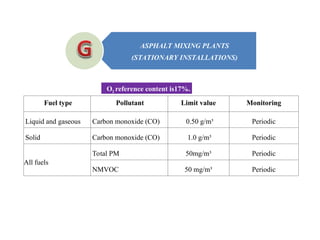
Fuel type Pollutant Limit value Monitoring
Liquid and gaseous Carbon monoxide (CO) 0.50 g/m³ Periodic
Solid Carbon monoxide (CO) 1.0 g/m³ Periodic
All fuels
Total PM 50mg/m³ Periodic
NMVOC 50 mg/m³ Periodic
O2 reference content is17%.
ASPHALT MIXING PLANTS
(STATIONARY INSTALLATIONS)
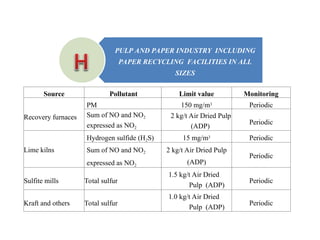
Source Pollutant Limit value Monitoring
Recovery furnaces
PM 150 mg/m3 Periodic
Sum of NO and NO2
expressed as NO2
2 kg/t Air Dried Pulp
(ADP)
Periodic
Lime kilns
Hydrogen sulfide (H2S) 15 mg/m3 Periodic
Sum of NO and NO2
expressed as NO2
2 kg/t Air Dried Pulp
(ADP)
Periodic
Sulfite mills Total sulfur
1.5 kg/t Air Dried
Pulp (ADP)
Periodic
Kraft and others Total sulfur
1.0 kg/t Air Dried
Pulp (ADP)
Periodic
PULP AND PAPER INDUSTRY INCLUDING
PAPER RECYCLING FACILITIES IN ALL
SIZES
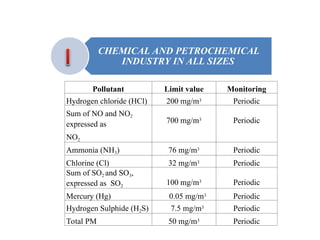
Pollutant Limit value Monitoring
Hydrogen chloride (HCl) 200 mg/m3 Periodic
Sum of NO and NO2
expressed as
NO2
700 mg/m3 Periodic
Ammonia (NH3) 76 mg/m3 Periodic
Chlorine (Cl) 32 mg/m3 Periodic
Sum of SO2 and SO3,
expressed as SO2
100 mg/m3 Periodic
Mercury (Hg) 0.05 mg/m3 Periodic
Hydrogen Sulphide (H2S) 7.5 mg/m3 Periodic
Total PM 50 mg/m3 Periodic
CHEMICAL AND PETROCHEMICAL
INDUSTRY IN ALL SIZES
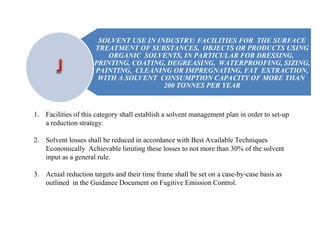
1. Facilities of this category shall establish a solvent management plan in order to set-up
a reduction strategy.
2. Solvent losses shall be reduced in accordance with Best Available Techniques
Economically Achievable limiting these losses to not more than 30% of the solvent
input as a general rule.
3. Actual reduction targets and their time frame shall be set on a case-by-case basis as
outlined in the Guidance Document on Fugitive Emission Control.
SOLVENT USE IN INDUSTRY: FACILITIES FOR THE SURFACE
TREATMENT OF SUBSTANCES, OBJECTS OR PRODUCTS USING
ORGANIC SOLVENTS, IN PARTICULAR FOR DRESSING,
PRINTING, COATING, DEGREASING, WATERPROOFING, SIZING,
PAINTING, CLEANING OR IMPREGNATING, FAT EXTRACTION,
WITH A SOLVENT CONSUMPTION CAPACITY OF MORE THAN
200 TONNES PER YEAR
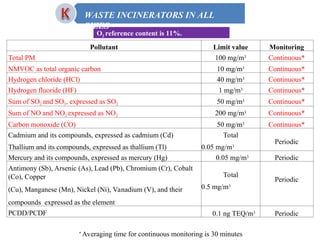
Pollutant Limit value Monitoring
Total PM 100 mg/m3 Continuous*
NMVOC as total organic carbon 10 mg/m3 Continuous*
Hydrogen chloride (HCl) 40 mg/m3 Continuous*
Hydrogen fluoride (HF) 1 mg/m3 Continuous*
Sum of SO2 and SO3, expressed as SO2 50 mg/m3 Continuous*
Sum of NO and NO2 expressed as NO2 200 mg/m3 Continuous*
Carbon monoxide (CO) 50 mg/m3 Continuous*
Cadmium and its compounds, expressed as cadmium (Cd)
Thallium and its compounds, expressed as thallium (Tl)
Total
0.05 mg/m3
Periodic
Mercury and its compounds, expressed as mercury (Hg) 0.05 mg/m3 Periodic
Antimony (Sb), Arsenic (As), Lead (Pb), Chromium (Cr), Cobalt
(Co), Copper
(Cu), Manganese (Mn), Nickel (Ni), Vanadium (V), and their
compounds expressed as the element
Total
0.5 mg/m3
Periodic
PCDD/PCDF 0.1 ng TEQ/m3 Periodic
O2 reference content is 11%.
WASTE INCINERATORS IN ALL
SIZES
* Averaging time for continuous monitoring is 30 minutes
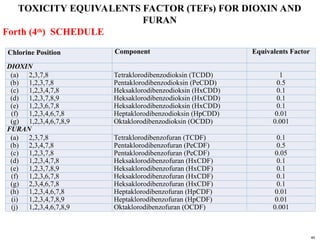
Chlorine Position Component Equivalents Factor
DIOXIN
(a) 2,3,7,8 Tetraklorodibenzodioksin (TCDD) 1
(b) 1,2,3,7,8 Pentaklorodibenzodioksin (PeCDD) 0.5
(c) 1,2,3,4,7,8 Heksaklorodibenzodioksin (HxCDD) 0.1
(d) 1,2,3,7,8,9 Heksaklorodibenzodioksin (HxCDD) 0.1
(e) 1,2,3,6,7,8 Heksaklorodibenzodioksin (HxCDD) 0.1
(f) 1,2,3,4,6,7,8 Heptaklorodibenzodioksin (HpCDD) 0.01
(g) 1,2,3,4,6,7,8,9 Oktaklorodibenzodioksin (OCDD) 0.001
FURAN
(a) 2,3,7,8 Tetraklorodibenzofuran (TCDF) 0.1
(b) 2,3,4,7,8 Pentaklorodibenzofuran (PeCDF) 0.5
(c) 1,2,3,7,8 Pentaklorodibenzofuran (PeCDF) 0.05
(d) 1,2,3,4,7,8 Heksaklorodibenzofuran (HxCDF) 0.1
(e) 1,2,3,7,8,9 Heksaklorodibenzofuran (HxCDF) 0.1
(f) 1,2,3,6,7,8 Heksaklorodibenzofuran (HxCDF) 0.1
(g) 2,3,4,6,7,8 Heksaklorodibenzofuran (HxCDF) 0.1
(h) 1,2,3,4,6,7,8 Heptaklorodibenzofuran (HpCDF) 0.01
(i) 1,2,3,4,7,8,9 Heptaklorodibenzofuran (HpCDF) 0.01
(j) 1,2,3,4,6,7,8,9 Oktaklorodibenzofuran (OCDF) 0.001
44
TOXICITY EQUIVALENTS FACTOR (TEFs) FOR DIOXIN AND
FURAN
Forth (4th) SCHEDULE
Bacaan
normalized
pada STP
(273K,
101.3
kPa)
Tentukan
rujukan O2
yang
ditetapkan
Contoh :
Bagi loji janakuasa menggunakan bahanapi
pepejal, rujukan oksigen adalah 6% dan nilai
had pengeluaran NO2 adalah 500 mg/m3. Jika
bacaan yang diukur adalah 490 mg/m3 pada
bacaan oksigen 8%, maka bacaan yang diukur
perlu normalized dengan menggunakan formula
berikut:
O2, ref
[GN] 20.9
O2,
measured
= O2 reading, % vol
= reference oxygen content, % vol
[G] = measured gas concentration
= normalized gas concentration
= percentage of oxygen in ambient
air

2,measured
2,ref
20.9  O

GN G
20.9 
O
3
m
G N
 566 mg
20.9  8
490
20.9  6
Bacaan
normalized
pada STP
(273K,
101.3
kPa)
Tentukan
rujukan
CO2
adalah
12%
Contoh :
Bagi pelepasan daripada peralatan pembakaran bahanapi yang menggunakan bahanapi
pepejal, rujukan karbon dioksida adalah 12% dan nilai had pengeluaran jirim zarahan
(PM) adalah 150 mg/m3. Jika bacaan yang diukur adalah 140 mg/m3 pada bacaan karbon
dioksida 8%, maka:
CO2, ref
N
CO
CO2,ref
2,measured
G
G
12
 210 mg
m3
GN  140
8
PELEPASAN KARBON
MONOKSIDA
CO2, measured = CO2 measured, % vol
= reference carbon dioxide content, %
vol
[G] = measured gas
concentrDatitioentapkan mengikut
keperluan
[GN] = normalized gas
concent(rcaatiosen to case basis) bagi
proses
yang memerlukan pembakaran
tidak lengkap seperti kilang
penghasilan kayu arang (kiln)
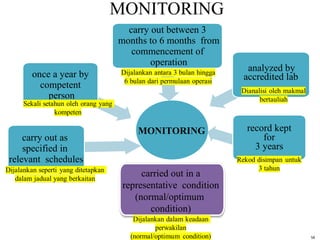
MONITORING
MONITORING
carry out as
specified in
relevant schedules
carry out between 3
months to 6 months from
commencement of
operation
record kept
for
3 years
analyzed by
accredited lab
once a year by
competent
person
carried out in a
representative condition
(normal/optimum
condition)
58
59
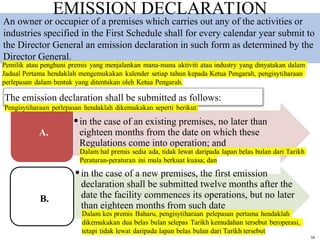
•in the case of an existing premises, no later than
eighteen months from the date on which these
Regulations come into operation; and
•in the case of a new premises, the first emission
declaration shall be submitted twelve months after the
date the facility commences its operations, but no later
than eighteen months from such date
The emission declaration shall be submitted as follows:
A.
B.
An owner or occupier of a premises which carries out any of the activities or
industries specified in the First Schedule shall for every calendar year submit to
the Director General an emission declaration in such form as determined by the
Director General.
EMISSION DECLARATION
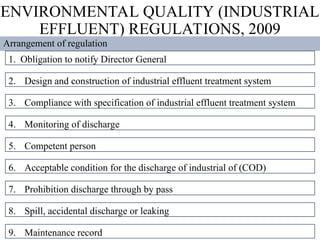
ENVIRONMENTAL QUALITY (INDUSTRIAL
EFFLUENT) REGULATIONS, 2009
Arrangement of regulation
1. Obligation to notify Director General
2. Design and construction of industrial effluent treatment system
3. Compliance with specification of industrial effluent treatment system
4. Monitoring of discharge
5. Competent person
6. Acceptable condition for the discharge of industrial of (COD)
7. Prohibition discharge through by pass
8. Spill, accidental discharge or leaking
9. Maintenance record
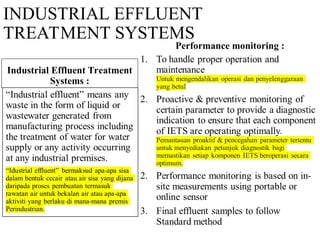
INDUSTRIAL EFFLUENT
TREATMENT SYSTEMS
Industrial Effluent Treatment
Systems :
Performance monitoring :
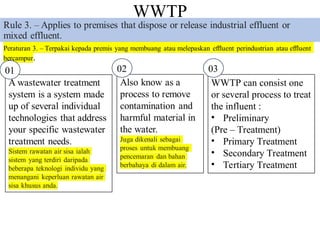
WWTP
WWTP can consist one
or several process to treat
the influent :
• Preliminary
(Pre – Treatment)
• Primary Treatment
• Secondary Treatment
• Tertiary Treatment
01 02 03
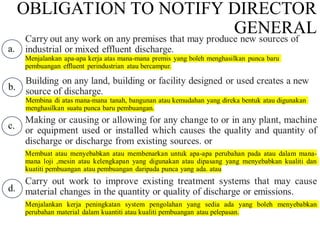
OBLIGATION TO NOTIFY DIRECTOR
GENERAL
a.
b.
c.
d.
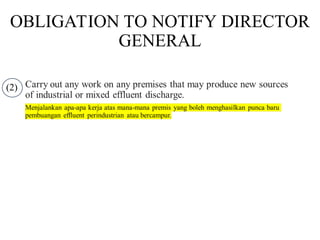
OBLIGATION TO NOTIFY DIRECTOR
GENERAL
(2)
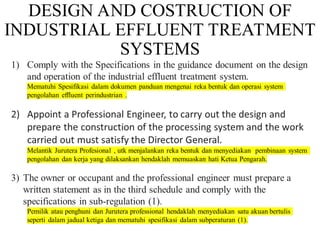
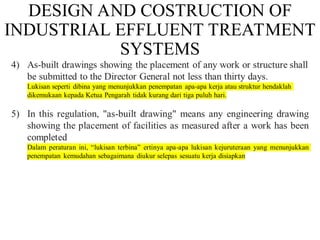
DESIGN AND COSTRUCTION OF
INDUSTRIAL EFFLUENT TREATMENT
SYSTEMS
DESIGN AND COSTRUCTION OF
INDUSTRIAL EFFLUENT TREATMENT
SYSTEMS
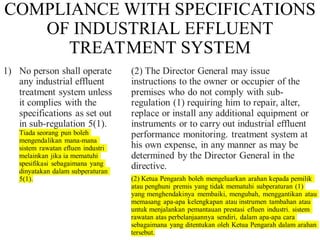
COMPLIANCE WITH SPECIFICATIONS
OF INDUSTRIAL EFFLUENT
TREATMENT SYSTEM
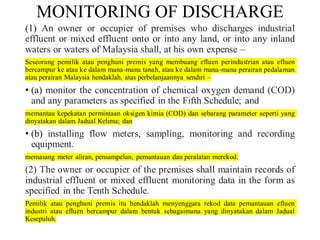
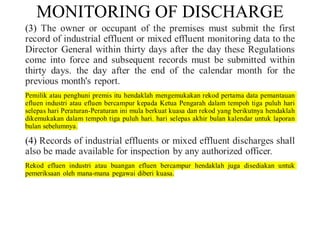
MONITORING OF DISCHARGE
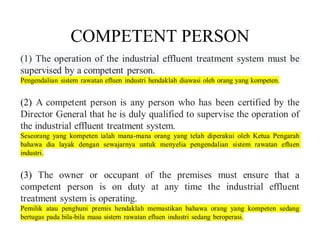
COMPETENT PERSON
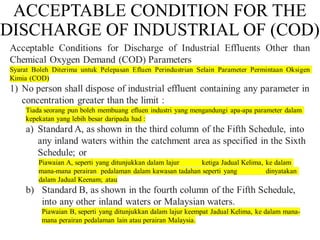
ACCEPTABLE CONDITION FOR THE
DISCHARGE OF INDUSTRIAL OF (COD)
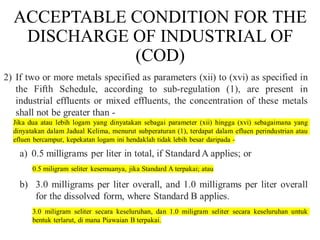
ACCEPTABLE CONDITION FOR THE
DISCHARGE OF INDUSTRIAL OF
(COD)
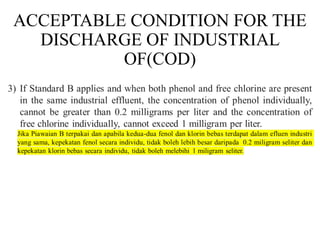
ACCEPTABLE CONDITION FOR THE
DISCHARGE OF INDUSTRIAL
OF(COD)
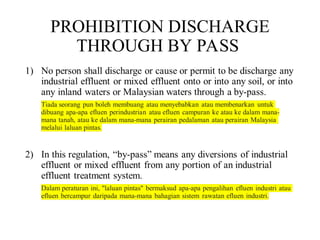
PROHIBITION DISCHARGE
THROUGH BY PASS
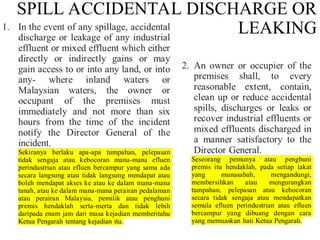
SPILL ACCIDENTAL DISCHARGE OR
LEAKING
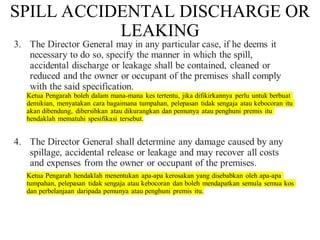
SPILL ACCIDENTAL DISCHARGE OR
LEAKING
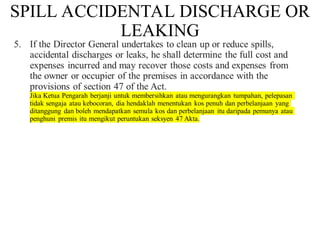
SPILL ACCIDENTAL DISCHARGE OR
LEAKING
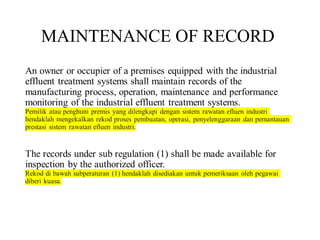
MAINTENANCE OF RECORD
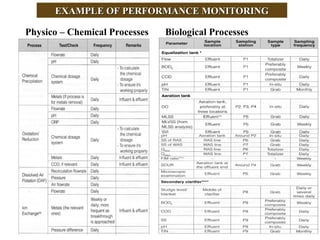
Physico – Chemical Processes Biological Processes
EXAMPLE OF PERFORMANCE MONITORING
Waste Water Treatment Plant
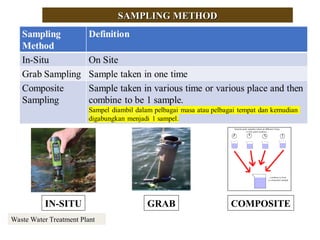
SAMPLING METHOD
SAMPLING METHOD
IN-SITU COMPOSITE
GRAB
Waste Water Treatment Plant
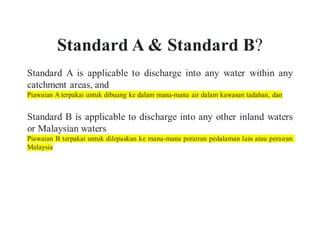
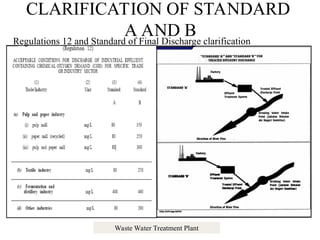
CLARIFICATION OF STANDARD
A AND B
Regulations 12 and Standard of Final Discharge clarification
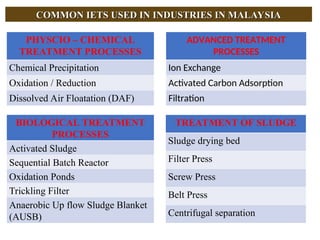
COMMON IETS USED IN INDUSTRIES IN MALAYSIA
PHYSCIO – CHEMICAL
TREATMENT PROCESSES
Chemical Precipitation
Oxidation / Reduction
Dissolved Air Floatation (DAF)
BIOLOGICAL TREATMENT
PROCESSES
Activated Sludge
Sequential Batch Reactor
Oxidation Ponds
Trickling Filter
Anaerobic Up flow Sludge Blanket
(AUSB)
ADVANCED TREATMENT
PROCESSES
Ion Exchange
Activated Carbon Adsorption
Filtration
TREATMENT OF SLUDGE
Sludge drying bed
Filter Press
Screw Press
Belt Press
Centrifugal separation
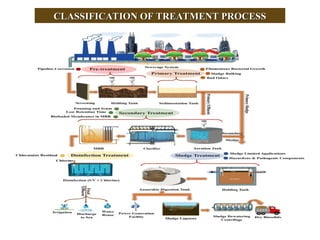
CLASSIFICATION OF TREATMENT PROCESS
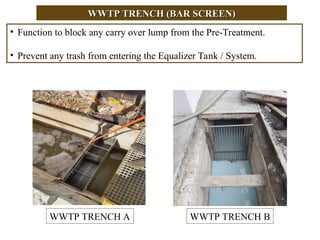
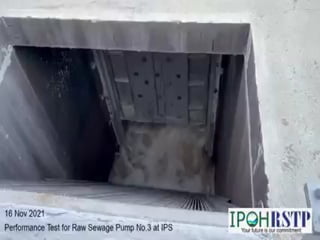
WWTP TRENCH (BAR SCREEN)
• Function to block any carry over lump from the Pre-Treatment.
• Prevent any trash from entering the Equalizer Tank / System.
WWTP TRENCH A WWTP TRENCH B
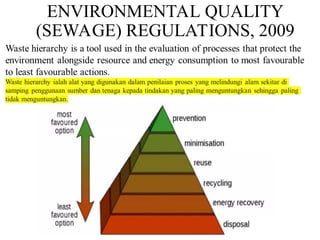
ENVIRONMENTAL QUALITY
(SEWAGE) REGULATIONS, 2009
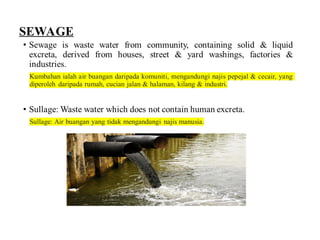
SEWAGE
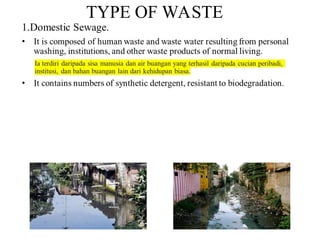
TYPE OF WASTE
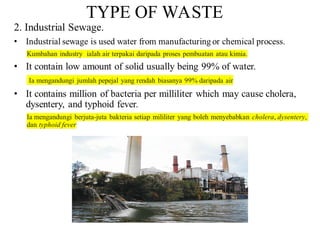
TYPE OF WASTE
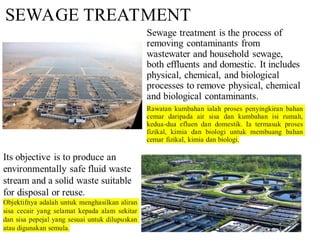
SEWAGE TREATMENT
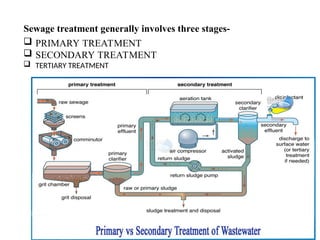
Sewage treatment generally involves three stages-
 PRIMARY TREATMENT
 SECONDARY TREATMENT
 TERTIARY TREATMENT
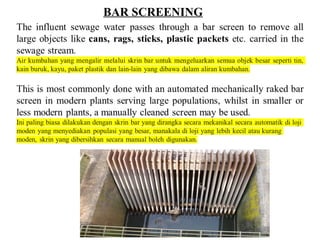
PRIMARY
TREATMENT
BAR SCREENING
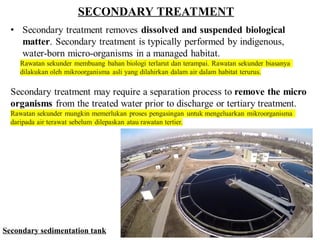
SECONDARY TREATMENT
Secondary sedimentation tank
Methods of tertiary treatment-
Filtration
Sludge drying beds
Chlorination
TERTIARY TREATMENT
Why Implement Waste Acceptance Criteria?
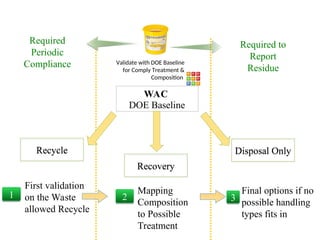
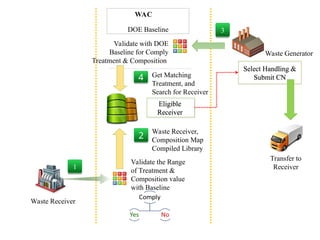
DOE Baseline
WAC
Validate with DOE Baseline
for Comply Treatment &
Composition
Disposal Only
Recovery
Recycle
1
First validation
on the Waste
allowed Recycle
2
Mapping
Composition
to Possible
Treatment
3
Final options if no
possible handling
types fits in
Required
Periodic
Compliance
Required to
Report
Residue
DOE Baseline
WAC
1
Validate the Range
of Treatment &
Composition value
with Baseline
Waste Receiver
Validate with DOE
Baseline for Comply
Treatment & Composition
3
Waste Generator
2
Waste Receiver,
Composition Map
Compiled Library
4 Get Matching
Treatment, and
Search for Receiver
Eligible
Receiver
Select Handling &
Submit CN
Transfer to
Receiver
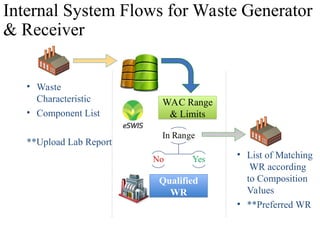
Internal System Flows for Waste Generator
& Receiver
• Waste
Characteristic
• Component List
**Upload Lab Report
Qualified
WR
• List of Matching
WR according
to Composition
Values
• **Preferred WR
WAC Range
& Limits
103 103
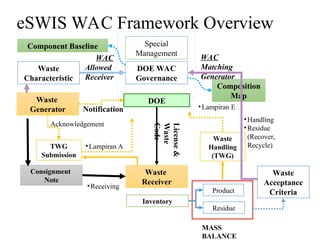
Waste
Generator
Waste
Receiver
License
&
Waste
Code
Notification
Waste
Handling
(TWG)
Consignment
Note
Product
Residue
MASS
BALANCE
•Lampiran E
Inventory
•Handling
•Residue
(Recover,
Recycle)
•Receiving
eSWIS WAC Framework Overview
TWG
Submission
•Lampiran A
Acknowledgement
Special
Management
Composition
Map
Component Baseline
DOE WAC
Governance
Waste
Acceptance
Criteria
Waste
Characteristic
WAC
Matching
Generator
WAC
Allowed
Receiver
DOE
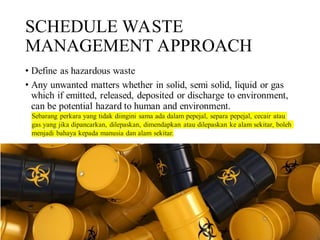
SCHEDULE WASTE
MANAGEMENT APPROACH
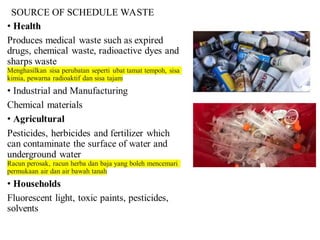
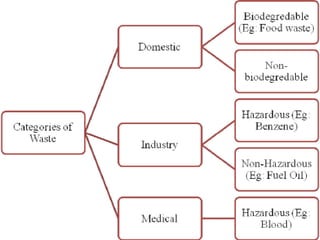
SOURCE OF SCHEDULE WASTE
Hazardous waste
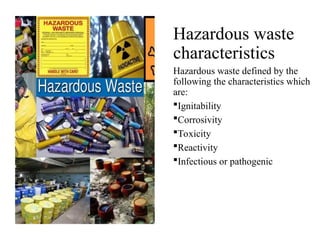
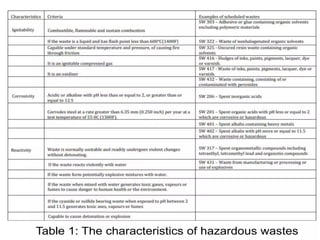
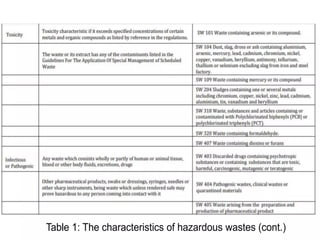
characteristics
Hazardous waste defined by the
following the characteristics which
are:
Ignitability
Corrosivity
Toxicity
Reactivity
Infectious or pathogenic
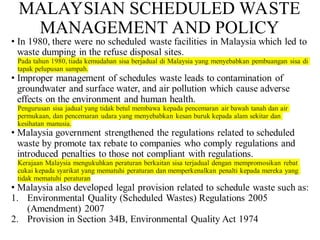
MALAYSIAN SCHEDULED WASTE
MANAGEMENT AND POLICY
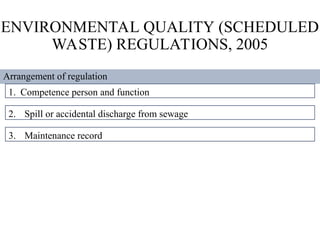
ENVIRONMENTAL QUALITY (SCHEDULED
WASTE) REGULATIONS, 2005
Arrangement of regulation
1. Competence person and function
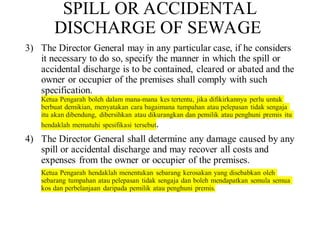
2. Spill or accidental discharge from sewage
3. Maintenance record
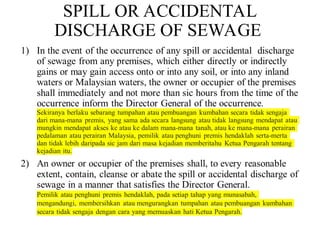
SPILL OR ACCIDENTAL
DISCHARGE OF SEWAGE
SPILL OR ACCIDENTAL
DISCHARGE OF SEWAGE
SPILL OR ACCIDENTAL
DISCHARGE OF SEWAGE
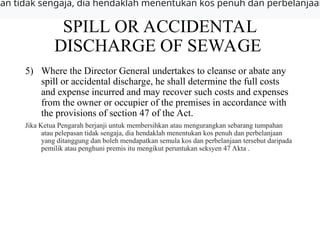
5) Where the Director General undertakes to cleanse or abate any
spill or accidental discharge, he shall determine the full costs
and expense incurred and may recover such costs and expenses
from the owner or occupier of the premises in accordance with
the provisions of section 47 of the Act.
Jika Ketua Pengarah berjanji untuk membersihkan atau mengurangkan sebarang tumpahan
atau pelepasan tidak sengaja, dia hendaklah menentukan kos penuh dan perbelanjaan
yang ditanggung dan boleh mendapatkan semula kos dan perbelanjaan tersebut daripada
pemilik atau penghuni premis itu mengikut peruntukan seksyen 47 Akta .
san tidak sengaja, dia hendaklah menentukan kos penuh dan perbelanjaan
LANGKAH-LANGKAH
KAWALAN RISIKO BAHAN
KIMIA BERBAHAYA KEPADA
KESIHATAN
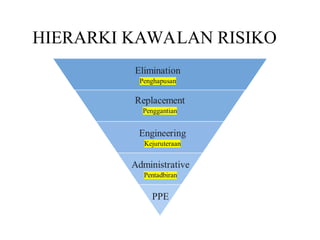
HIERARKI KAWALAN RISIKO
PPE
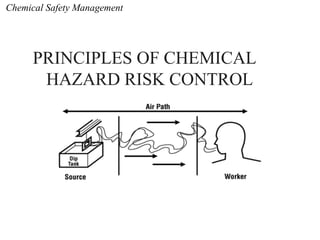
PRINCIPLES OF CHEMICAL
HAZARD RISK CONTROL
Chemical Safety Management
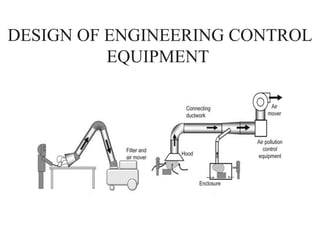
DESIGN OF ENGINEERING CONTROL
EQUIPMENT
DESIGN OF ENGINEERING CONTROL
EQUIPMENT
ENGINEERING CONTROL
EQUIPMENT
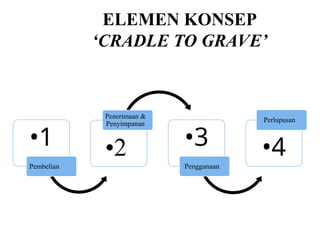
ELEMEN KONSEP
‘CRADLE TO GRAVE’
•1
Pembelian
Penerimaan &
Penyimpanan
•2 •3
Penggunaan
•4
Perlupusan
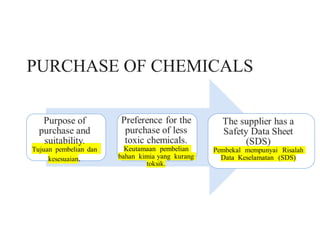
PURCHASE OF CHEMICALS
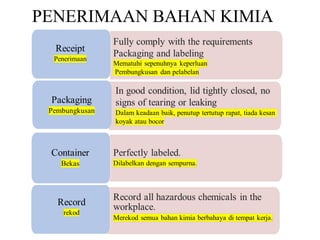
PENERIMAAN BAHAN KIMIA
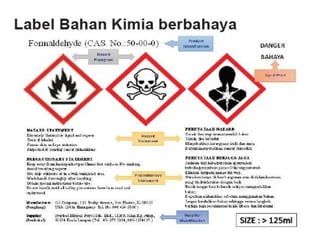
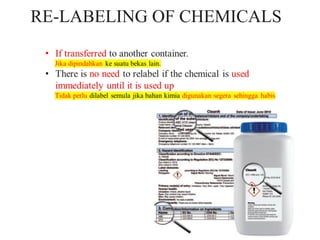
RE-LABELING OF CHEMICALS
•
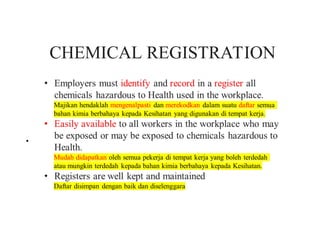
CHEMICAL REGISTRATION
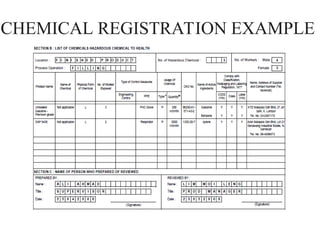
CHEMICAL REGISTRATION EXAMPLE
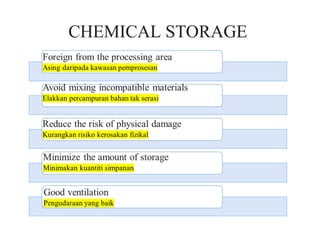
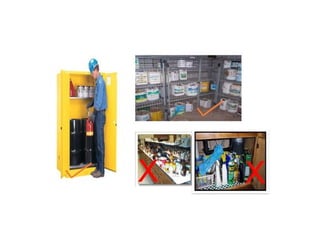
CHEMICAL STORAGE
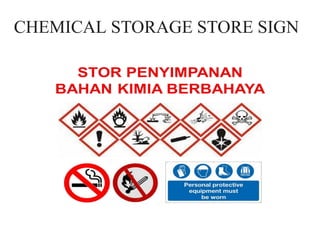
PAPAN TANDA STOR
PENYIMPANAN
BAHAN KIMIA
CHEMICAL STORAGE STORE SIGN
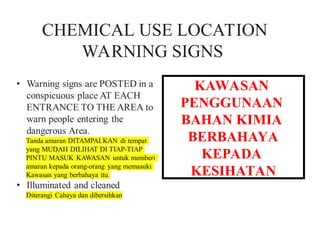
CHEMICAL USE LOCATION
WARNING SIGNS
KAWASAN
PENGGUNAAN
BAHAN KIMIA
BERBAHAYA
KEPADA
KESIHATAN
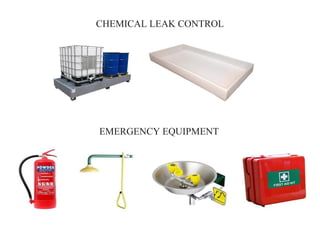
CHEMICAL LEAK CONTROL
EMERGENCY EQUIPMENT
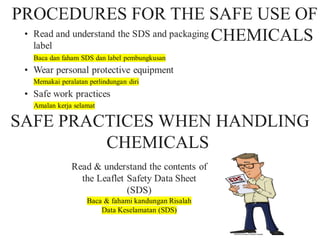
PROCEDURES FOR THE SAFE USE OF
CHEMICALS
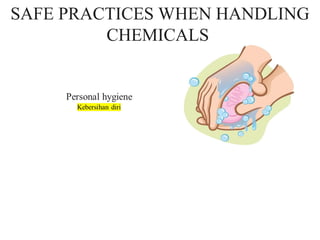
SAFE PRACTICES WHEN HANDLING
CHEMICALS
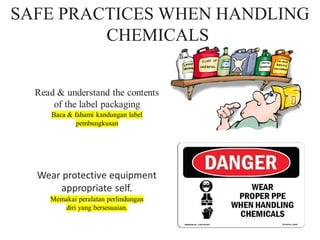
SAFE PRACTICES WHEN HANDLING
CHEMICALS
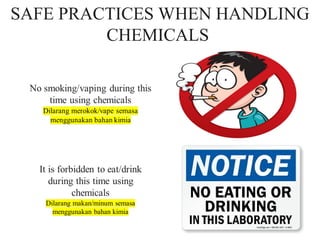
SAFE PRACTICES WHEN HANDLING
CHEMICALS
SAFE PRACTICES WHEN HANDLING
CHEMICALS
PERSONAL PROTECTION EQUIPMENT
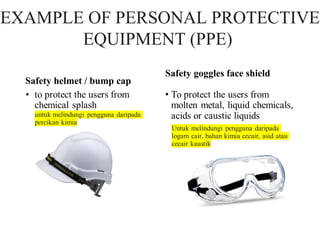
Safety helmet / bump cap
Safety goggles face shield
EXAMPLE OF PERSONAL PROTECTIVE
EQUIPMENT (PPE)
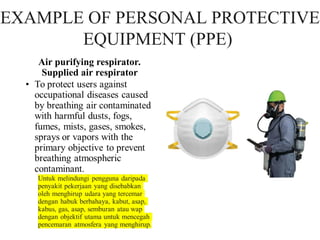
Air purifying respirator.
Supplied air respirator
EXAMPLE OF PERSONAL PROTECTIVE
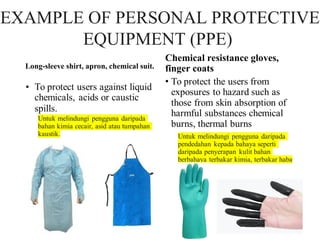
EQUIPMENT (PPE)
Long-sleeve shirt, apron, chemical suit.
Chemical resistance gloves,
finger coats
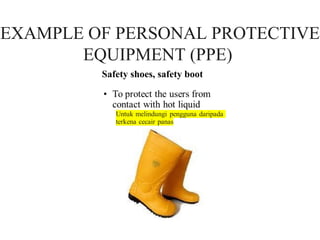
EXAMPLE OF PERSONAL PROTECTIVE
EQUIPMENT (PPE)
Safety shoes, safety boot
EXAMPLE OF PERSONAL PROTECTIVE
EQUIPMENT (PPE)
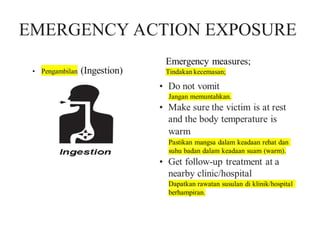
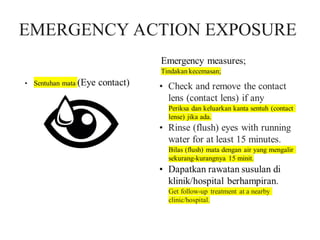
EMERGENCY ACTION EXPOSURE
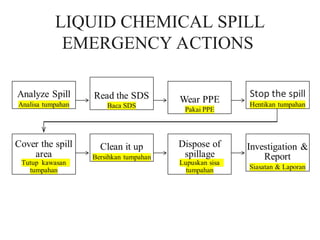
LIQUID CHEMICAL SPILL
EMERGENCY ACTIONS
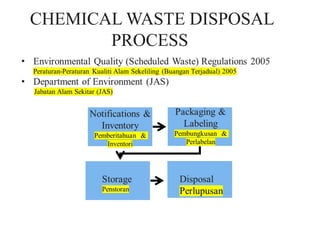
CHEMICAL WASTE DISPOSAL
PROCESS
PENALTI MAJIKAN
Denda RM 10,000
atau
Penjara 1 tahun
atau
Kedua-duanya
Environment Quality Act slide  in power point ppt

Environment Quality Act slide in power point ppt

  • 1.
    WELCOME TO Environmental QualityAct 1974 (EQA 1974) TRAINING RAZAK BIN MAJID Health, Safety and Environment Trainer
  • 2.
    2 NAME : RazakBin Majid POSITION : Trainer EDUCATION : Executive Master SHE from UNISEL H/P : 019-4944324 Competency: SHO Registered Person (8408) Train The Trainer (HRDF) Train The Trainer (BOFA) Train The Trainer (Forklift) Train The Trainer (Fire Fighting) ISO 45001-2018 Lead Auditor ISO 14001- 2015 Auditor Authorize Gas Tester (DOSH) Scaffolder (DOSH) Traffic Management Supervisor Lifting Supervisor Ergonomic Trained Person Trainer Profile
  • 3.
    In case of EMERGENCY Please use nearestexit to the assembly area Please do not run Please do not use the elevator Use the nearest staircase Safety Briefing 3
  • 4.
    Facilities Washroom (Every floor) Surau(First Floor) Cafeteria Smoking (Ground Floor) Reminder Silence hand-phone during training session Important Things 4
  • 5.
    Purpose of EQA1974 INTRODUCTION TO ACT AND REGULATIONS
  • 6.
  • 7.
  • 8.
  • 9.
    How Many Regulations,Rules and Order Stated In 1. Peraturan Kualiti Alam Sekeliling (Premis Yang Ditetapkan) (Minyak Sawit Mentah), 1977 2. Peraturan Kualiti Alam Sekeliling (Perlesenan), 1977 3. Peraturan Kualiti Alam Sekeliling (Udara Bersih), 1978 4. Peraturan Kualiti Alam Sekeliling (Penggabungan Kesalahan), 1978 5. Peraturan Kualiti Alam Sekeliling (Premis Yang Ditetapkan) (Getah Asli Mentah), 1978 6. Peraturan Kualiti Alam Sekeliling (Pengawalan Kepekatan Lead dalam Bensin Motor), 1985 7. Peraturan Kualiti Alam Sekeliling (Kebisingan Kenderaan Bermotor), 1987 8. Perintah Kualiti Alam Sekeliling (Aktiviti Yang Ditetapkan) (Penilaian Kesan Alam Sekitar), 1987 9. Peraturan Kualiti Alam Sekeliling (Premis yang Ditetapkan) (Jadual Kemudahan Rawatan dan Pembuangan Sampah), 1989
  • 10.
    11. Peraturan KualitiAlam Sekeliling (Jadual Pembaziran), 1989 12. Perintah Kualiti Alam Sekeliling (Delegasi Kuasa Mengawal Pencemaran Laut), 1993 13. Perintah Kualiti Alam Sekeliling (Larangan penggunaan Bahan Terkawal dalam Sabun, Pencuci Sintetik dan Ejen Pembersih Lain), 1995 14. Peraturan Kualiti Alam Sekeliling (Kawalan Pelepasan dari Mesin Diesel), 1996 15. Peraturan Kualiti Alam Sekeliling (Kawalan Pelepasan dari Mesin Petrol), 1996 16. Peraturan Kualiti Alam Sekeliling (Pengurusan Halon), 1999 17. Peraturan Kualiti Alam Sekeliling (Pengurusan Penyejuk), 1999 18. Peraturan Kualiti Alam Sekeliling (Penggabungan Kesalahan) (Pembakaran Terbuka), 2000 19. Perintah Kualiti Alam Sekeliling (Delegasi Kuasa) (Penyiasatan Pembakaran Terbuka), 2000 How Many Regulations, Rules and Order Stated In
  • 11.
    20. Perintah KualitiAlam Sekeliling (Delegasi Kuasa) (Pengurusan Halon), 2000 21. Perintah Kualiti Alam Sekeliling (Delegasi Kuasa) (Perbadanan Putrajaya), 2002 22. Peraturan Kualiti Alam Sekeliling (Lembaga Rayuan), 2003 23. Peraturan Kualiti Alam Sekeliling (Kawalan Pelepasan dari Motosikal), 2003 24. Perintah Kualiti Alam Sekeliling (Aktiviti yang Diisytiharkan) (Pembakaran Terbuka), 2003 25. Peraturan Kualiti Alam Sekeliling (Dioksin dan Furan), 2004 26. Peraturan Kualiti Alam Sekeliling (Jadual Pembuangan), 2005 How Many Regulations, Rules and Order Stated In
  • 12.
    27. Perintah KualitiAlam Sekeliling (Penyampaian yang Ditetapkan) (Pembaziran Jadual), 2005 28. Perintah Kualiti Alam Sekeliling (Delegasi Kuasa), 2005 29. Peraturan-Peraturan Kualiti Alam Sekeliling (Pengendalian Properti Petrol dan Diesel), 2007 30. Peraturan Kualiti Alam Sekeliling (Pembaziran Jadual) (Pindaan), 2007 31. Peraturan Kualiti Alam Sekeliling (Kumbahan), 2009 32. Peraturan Kualiti Alam Sekeliling (Pengawalan Pencemaran Dari Stesen Pemindahan Sisa Pepejal dan TPA), 2009 33. Peraturan Kualiti Alam Sekeliling (Efluen Industri), 2009 How Many Regulations, Rules and Order Stated In
  • 13.
    • Part I– Preliminary • Part II – Administration • Part III – Licenses • Part IV – Prohibition and Control of Pollution • Part IVA – Control of Schedule Wastes • Part V – Appeal and Appeal Board • Part VA – Payment of Cess and Environmental Fund • Part VI – Miscellaneous INTRODUCTION TO ENVIRONMENTAL QUALITY ACT, 1974 Arrangement of regulation
  • 14.
    Bahagian I (Permulaan) Seksyen1 - Tajuk ringkas, pemakaian dan mula berkuatkuasa. Seksyen 2 - Tafsiran. Bahagian II (Pentadbiran) Seksyen 3 – 9 Bahagian III (Lesen) Seksyen 10 – 17 Bahagian IV (Larangan Dan Kawalan Mengenai Pencemaran) Seksyen 18 – 34A Bahagian IVA (Kawalan Buangan Terjadual) Seksyen 34B Bahagian V (Rayuan Dan Lembaga Rayuan) Seksyen 35 – 36 Bahagian VI (Pembayaran Ses Dan Kumpulan Wang Alam Sekeliling) Seksyen 37 - 51
  • 20.
    ENVIRONMENTAL QUALITY (CLEAN AIR)REGULATIONS, 2014 Arrangement of regulation 1. Obligation to comply and notify 2. Measures to reduce emission 3. Air pollution control systems, performance, failure 4. Maintenance of record 5. Limit value and technical standard 6. Monitoring 7. Emission declaration
  • 21.
    CAR 2014 vsCAR 1978 30 Regulations 6 Schedules 2014 21 Number of Regulations & Schedules 1978 59 Regulations 5 Schedules All premises General standard emission SECOND SCHEDULE Specific standard for specific industry 11 specific industries (Table A – K) THIRD SCHEDULE Toxicity equivalents factor (TEFs) for dioxin and furan FOURTH SCHEDULE Emission Standards For Hazardous Substances 6 Categories (Category 1 – 6) FIFTH SCHEDULE List of Undesirable Occurrence SIXTH SCHEDULE ACTIVITY COMPLIANCE SUBJECT TO SCHEDULE
  • 22.
    Regulation 12(1) Not darkerthan shade No 1 Ringelmann Chart Not greater than 20% opacity Transmissometer (1 minute averaging time ) Regulation 12(2) 12(2)(a) No 2 Ringelmann Chart in 5 minutes aggregate within 1 hour period 12(2)(a) No 2 Ringelmann Chart in 15 minutes aggregate within 24 hours period 12(2)(b) At Start-up No 2 Ringelmann Chart Regulation 12(3) Premise emitting ≥ 2.5 kg/hour dust or potentially emitting smoke darker than No 2 Ringelmann Chart shall operate a transmissometer (averaging time: 1 minute) REGULATION
  • 23.
    23 OBLIGATION TO COMPLY EXISTINGPREMISES COMPLIANCE NEW PREMISES Premises purchased or acquired on or after the date CAR 2014 come into operation COMPLIANCE EXISTING PREMISES Existing premises or premises in operation before CAR 2014 come into operation COMPLIANCE PREMISES WITH COMPLAINTS Director General may serve upon the owner or occupier a notice in writing requiring complying to the CAR 2014. The 5 years grace period is not applicable for these cases
  • 24.
  • 25.
  • 26.
    BAT Best techniques and effective way to preventand reduce pollution Size, design and operating characteristics of the plant or the latest process Selection of raw material or fuel Implementation of the 3R concept Other processes within the plant design capacity & capability Other way of operating or setting within the plant design capacity & capability Proper handling & monitoring Efficient and continuous maintenance of a plant & equipment Reasonable economic & cost factors INDUSTRY LISTED IN THE 1ST SCHEDULE (CAR 2014) BAT DOCUMENTS MEASURES TO REDUCE EMISSION
  • 27.
    PRE-REQUISITE FOR SUCCESSFULAIR POLLUTION CONTROL SYSTEMS Quality Construction and Installations Proper Operation and Maintenance Adequately Design of APC
  • 28.
    AIR POLLUTION CONTROLSYSTEM  30 days after premises operation : 1.Written declaration 2.As-built drawing start 28 Sound Engineering Practices To ensure that all components of APCS are in good condition working Specification as in Guidance Document for Fuel Burning Equipment And Air Pollution Control Systems (GD APCS)
  • 29.
    AIR POLLUTION What isair pollution?
  • 32.
    CONTROL OF AIRPOLLUTION To control particulate emissions following equipments are employed:- Settling chambers Cyclone separators Fabric filters Electrostatic precipitators Wet collector
  • 35.
    Telephone SMS E-mailFax 35 MODE OF NOTIFICATION Failure In Operations Of Air Pollutions Control System The DG should be notified not later than 1 hour.
  • 36.
    LIMIT VALUE ANDTECHNICAL STANDARD STANDARD KONSEP STANDARD DALAM PERATURAN UDARA BERSIH
  • 37.
    All industries under1ST Schedule must comply to standards in 2nd & 3rd Schedule LIMIT VALUES AND TECHNICAL STANDARDS Fuel Burning Equipment (FBE) using:- pulverized fuel any solid fuel ≥ 30 kg/hr. any liquid or gaseous matter ≥15 kg/hr. have to comply with the standards specified in 2nd Schedule. 1. Heat and Power Generation 2. Production and Processing of Ferrous Metals (Iron and Steel Mills) 3. Ferrous Metal Foundries 4. Production and Processing of 5. Non-Ferrous Metals 6. Oil and Gas industry 7. Non-Metallic (Mineral) Industry : All sizes cement 8. Asphalt Mixing Plant (Stationary Installations) 9. Pulp and Paper Industry 10. Chemical and Petrochemical Industry 11.Solvent Use in Industry 12.Waste Incinerators
  • 38.
    Fuel type FuelFuel quality parameter Liquid All Sulphur content < 500 ppm (per weight) Solid Coal Sulphur content < 1% (per weight) Biomass Wood, agricultural waste, etc.: air dry and in its natural composition (e.g. wood without coating, paint or other treatment) Residues from wood-based industries: without wood preservatives Second (2nd) Schedule (I) Control of fuel burning equipment, incinerators and crematoria 1.Control of fuel quality for fuel burning equipment and incinerators not covered by the LIMIT VALUES AND TECHNICAL STANDARDS FIRST SCHEDULE
  • 39.
    Second (2nd) Schedule 2.Combustion emissions from fuel burning equipment and incinerators not covered Fuel type Pollutant Limit value Monitoring Liquid Total particulate matter (PM) Where dust load emitted : a) > 0.33 < 1.0 kg/h b) ≥ 1.0 kg/h 50 mg/m3 Once/year 2 times/year Solid Total particulate matter (PM) Where dust load emitted : a) > 0.44 < 1.0 kg/h b) ≥ 1.0 < 1.5 kg/h c) ≥ 1.5 < 2.0 kg/h d) ≥ 2.0 < 2.5 kg/h e) ≥ 2.5 kg/h 150 mg/m³ Once/year 2 times/year 3times/year 4times/year Continuous* Carbon monoxide (CO) 1000 mg/m³ Periodic CO2 reference content is 12% * Averaging time for continuous monitoring is 30 minutes LIMIT VALUES AND TECHNICAL STANDARDS BY THE FIRST SCHEDULE
  • 40.
    • Control ofNMVOC Emission Outlets Halogenated hydrocarbons – 20 mg/m3 Others – 150 mg/m3 • Control of Fugitive Emissions • Refer Guidance Document of Fugitive Emission Control Third (3rd) Schedule i.2nd Schedule limits applies to all industries if not specified in 3rd Schedule; ii.Specific industry in the title; iii.Capacities are stipulated in the title; iv.Percentage of O2 or CO2 reference content differ base on process and industry; v.Limit values are normalized; vi.Monitoring type: Periodic or Continuous; and vii.“Note” at the bottom of each sub-table is important LIMIT VALUES AND TECHNICAL STANDARDS Second (2nd) Schedule
  • 41.
    1. Boiler O2reference content is 6% for solid fuels and 3% for others. HEAT AND POWER GENERATION MWe = electrical power 3rd SCHEDULE * Averaging time for continuous monitoring is 30 minutes Fuel type Pollutant Capacity Limit value Monitoring Solid and liquid fuels Sum of SO2 and SO3, expressed as SO2 > 10 MWe 500 mg/m³ Continuous* Sum of NO and NO2 expressed as NO2 > 10 MWe 500 mg/m³ Continuous* Hydrogen chloride (HCl) > 10 - <100 MWe 200 mg/m³ Periodic Hydrogen chloride (HCl) ≥100 MWe 100 mg/m³ Periodic Hydrogen fluoride (HF) > 10 - <100 MWe 30 mg/m³ Periodic Hydrogen fluoride (HF) ≥100 MWe 15 mg/m³ Periodic Carbon monoxide (CO) > 10 MWe 200 mg/m³ Continuous* Total PM > 10 MWe 50 mg/m³ Continuous* Mercury (Hg) >10 MWe 0.03 mg/m³ Periodic PCDD/PCDF > 10 MWe 0.1 ng TEQ/m3 Periodic Gaseous fuels Sum of NO and NO2 expressed as NO2 > 10 MWe 350 mg/m³ Continuous* Carbon monoxide (CO) > 10 MWe 50 mg/m³ Continuous* Total PM 29 > 10 MWe 5 mg/m³ Periodic
  • 42.
    Fuel type Pollutant Capacityat ISO conditions Limit value Monitoring Gaseous fuels Sum of NO and NO2 expressed as NO2 > 10 MWe 150mg/m³ Continuous* Carbon monoxide (CO) > 10 MWe 100 mg/m³ Continuous* Liquid fuels Sum of NO and NO2 expressed as NO2 > 10 MWe 200 mg/m³ Continuous* Carbon monoxide (CO) > 10 MWe 100 mg/m³ Continuous* 2. Combustion turbines O2 reference content is 15%. * Averaging time for continuous monitoring is 30 minutes 3. Generator sets for combined heat and power production with a total thermal output ≥ 3 MWe: Fuel type Pollutant Capacity Limit value Monitoring Liquid or gas fuels Sum of NO and NO2 expressed as NO2 ≥ 3 MWe 600mg/m³ Periodic Carbon monoxide (CO) ≥ 3 MWe 650 mg/m³ Periodic Total PM ≥ 3 MWe 80 mg/m3 Periodic O2 reference content is 5%.
  • 43.
    PRODUCTION AND PROCESSINGOF FERROUS METALS (IRON AND STEEL MILLS) Source Pollutant Limit value Monitoring Sinter plants (waste gas from the sintering belt) Sum of SO2 and SO3, expressed as SO2 500mg/m³ Continuous* Sum of NO and NO2 expressed as NO2 400 mg/m³ Continuous* Total PM 50 mg/m³ Continuous* Total lead as Pb 1 mg/m3 Periodic NMVOC 75 mg/m3 Periodic PCDD/PCDF 0.1 ng TEQ/m3 Periodic Coke ovens (@ 5% O2) Total PM 10 mg/m3 Continuous* Sum of NO and NO2 expressed as NO2 500 mg/m³ Periodic Sulphur compounds as S 800 mg/m³ Periodic Blast furnace (Regenerator; @ 3% O2) Total PM 50 mg/m3 Continuous* Basic oxygen furnace (converter gas) Total PM 50 mg/m3 Continuous* Electric arc furnaces Total PM 50 mg/m3 Continuous* Rolling mill: Thermal treatment furnace (@ 5% O2) Sum of NO and NO2 expressed as NO2 500 mg/m³ Periodic * Averaging time for continuous monitoring is 30 minutes
  • 44.
    Source Pollutant Limitvalue Monitoring Cupola furnace Sum of SO2 and SO3, expressed as SO2 500mg/m³ Periodic Carbon monoxide (CO) 150 mg/m³ Periodic Core production and casting Amine 5 mg/m3 Periodic Benzene 5 mg/m3 Periodic FERROUS METAL FOUNDRIES WITH A CAPACITY ≥ 1 TON MOLTEN METAL PER DAY
  • 45.
    PRODUCTION AND PROCESSINGOF NON- FERROUS METALS WITH A CAPACITY ≥ 0.5 TONS PER DAY FOR LEAD OR CADMIUM OR ≥ 2 TONS PER DAY FOR OTHER METALS * Averaging time for continuous monitoring is 30 minutes Source Pollutant Limit value Monitoring Sinter plants (waste gas from the sintering belt) Sum of SO2 and SO3, expressed as SO2 500mg/m³ Continuous* Sum of NO and NO2 expressed as NO2 400 mg/m³ Continuous* Total PM 50 mg/m³ Continuous* Total lead as Pb 1 mg/m3 Periodic NMVOC 75 mg/m3 Periodic PCDD/PCDF 0.1 ng TEQ/m3 Periodic Production of copper and zinc Total PM 20 mg/m3 Continuous* Production of lead Total PM 10 mg/m3 Continuous* Primary aluminium Total PM 10 mg/m3 Continuous* Fluorine compounds as HF 1 mg/m3 Periodic Total Fluoride 1.5 mg/m3 Periodic Sum of SO2 and SO3, expressed as SO2 100 mg/m3 Continuous*
  • 46.
    Source Pollutant Limitvalue Monitoring Secondary aluminium1) Total PM 10 mg/m3 Continuous* Sum of NO and NO2 expressed as NO2 500 mg/m³ Periodic Smelting, alloying and refining of aluminium2) Total PM 10 mg/m3 Continuous* Smelting, alloying and refining of other non- ferrous metals Total PM 5 mg/m3 Continuous* * Averaging time for continuous monitoring is 30 minutes 1.In secondary aluminium production, hexachloroethane shall not be used for smelting. “Secondary aluminium” is defined as re- melting of all kinds of used aluminium end products which might be coated, painted, and laminated. 2.“Smelting, alloying and refining of aluminium” is defined as melting of pure aluminium and plain scrap.
  • 47.
    Source Pollutant Limitvalue Monitoring Claus plant Sulphur Recovery > 95% Periodic Catalytic cracking Total PM 40 mg/m3 Continuous* Sum of SO2 and SO3, expressed as SO2 1200 mg/m3 Continuous* Calcination Total PM 40 mg/m3 Continuous* OIL AND GAS INDUSTRIES: REFINERIES (ALL SIZES); NATURAL GAS PROCESSING AND STORAGE; STORAGE AND HANDLING OF PETROLEUM PRODUCTS * Averaging time for continuous monitoring is 30 minutes
  • 48.
    Source Pollutant Limitvalue Monitoring Cement kilns Sum of NO and NO2 expressed as NO2 800 mg/m3 Continuous* Total PM 50 mg/m3 Continuous* Mercury 0.05 mg/m3 Periodic PCDD/PCDF 0.1 ng TEQ/m3 Periodic Rotary furnaces for the manufacture of hard quicklime or sintering dolomite Sum of NO and NO2 expressed as NO2 1500 mg/m3 Continuous* Total PM 50 mg/m3 Continuous* Mercury 0.05 mg/m3 Periodic PCDD/PCDF 0.1 ng TEQ/m3 Periodic O2 reference content for: a)cement kilns is 10% b)flame-heated glass melting furnaces is 8% c)flame-heated pot furnaces and day tanks furnaces 13 % d)ceramic furnaces is 17% NON-METALLIC (MINERAL) INDUSTRY: CEMENT PRODUCTION (ALL SIZES); MANUFACTURE OF GLASS INCLUDING GLASS FIBRE WITH A MELTING CAPACITY ≥ 1 TON OF PRODUCT PER DAY; MANUFACTURE OF CERAMIC PRODUCTS BY FIRING, ROOFING TILES, BRICKS, REFRACTORY BRICKS, TILES, CERAMIC GLASS, STONEWARE OR PORCELAIN, WITH A PRODUCTION CAPACITY ≥ 10 TONS OF PRODUCT PER DAY * Averaging time for continuous monitoring is 30
  • 49.
    Source Pollutant Limitvalue Monitoring Glass furnaces Sum of SO2 and SO3, expressed as SO2 800 mg/m3 Continuous* Sum of NO and NO2 expressed as NO2 800 mg/m3 Continuous* Total lead as Pb 5 mg/m3 Periodic Total PM 50 mg/m3 Continuous* Ceramic furnaces Sum of SO2 and SO3, expressed as SO2 800 mg/m3 Periodic Sum of NO and NO2 expressed as NO2 800 mg/m3 Periodic Total PM Where dust load emitted : a)> 0.33 < 1.0 kg/h b)≥ 1.0 <2.0 kg/h c)≥ 2.0 kg/h 50 mg/m3 Once/year 2 times/year Continuous* * Averaging time for continuous monitoring is 30 minutes
  • 50.
    Fuel type PollutantLimit value Monitoring Liquid and gaseous Carbon monoxide (CO) 0.50 g/m³ Periodic Solid Carbon monoxide (CO) 1.0 g/m³ Periodic All fuels Total PM 50mg/m³ Periodic NMVOC 50 mg/m³ Periodic O2 reference content is17%. ASPHALT MIXING PLANTS (STATIONARY INSTALLATIONS)
  • 51.
    Source Pollutant Limitvalue Monitoring Recovery furnaces PM 150 mg/m3 Periodic Sum of NO and NO2 expressed as NO2 2 kg/t Air Dried Pulp (ADP) Periodic Lime kilns Hydrogen sulfide (H2S) 15 mg/m3 Periodic Sum of NO and NO2 expressed as NO2 2 kg/t Air Dried Pulp (ADP) Periodic Sulfite mills Total sulfur 1.5 kg/t Air Dried Pulp (ADP) Periodic Kraft and others Total sulfur 1.0 kg/t Air Dried Pulp (ADP) Periodic PULP AND PAPER INDUSTRY INCLUDING PAPER RECYCLING FACILITIES IN ALL SIZES
  • 52.
    Pollutant Limit valueMonitoring Hydrogen chloride (HCl) 200 mg/m3 Periodic Sum of NO and NO2 expressed as NO2 700 mg/m3 Periodic Ammonia (NH3) 76 mg/m3 Periodic Chlorine (Cl) 32 mg/m3 Periodic Sum of SO2 and SO3, expressed as SO2 100 mg/m3 Periodic Mercury (Hg) 0.05 mg/m3 Periodic Hydrogen Sulphide (H2S) 7.5 mg/m3 Periodic Total PM 50 mg/m3 Periodic CHEMICAL AND PETROCHEMICAL INDUSTRY IN ALL SIZES
  • 53.
    1. Facilities ofthis category shall establish a solvent management plan in order to set-up a reduction strategy. 2. Solvent losses shall be reduced in accordance with Best Available Techniques Economically Achievable limiting these losses to not more than 30% of the solvent input as a general rule. 3. Actual reduction targets and their time frame shall be set on a case-by-case basis as outlined in the Guidance Document on Fugitive Emission Control. SOLVENT USE IN INDUSTRY: FACILITIES FOR THE SURFACE TREATMENT OF SUBSTANCES, OBJECTS OR PRODUCTS USING ORGANIC SOLVENTS, IN PARTICULAR FOR DRESSING, PRINTING, COATING, DEGREASING, WATERPROOFING, SIZING, PAINTING, CLEANING OR IMPREGNATING, FAT EXTRACTION, WITH A SOLVENT CONSUMPTION CAPACITY OF MORE THAN 200 TONNES PER YEAR
  • 54.
    Pollutant Limit valueMonitoring Total PM 100 mg/m3 Continuous* NMVOC as total organic carbon 10 mg/m3 Continuous* Hydrogen chloride (HCl) 40 mg/m3 Continuous* Hydrogen fluoride (HF) 1 mg/m3 Continuous* Sum of SO2 and SO3, expressed as SO2 50 mg/m3 Continuous* Sum of NO and NO2 expressed as NO2 200 mg/m3 Continuous* Carbon monoxide (CO) 50 mg/m3 Continuous* Cadmium and its compounds, expressed as cadmium (Cd) Thallium and its compounds, expressed as thallium (Tl) Total 0.05 mg/m3 Periodic Mercury and its compounds, expressed as mercury (Hg) 0.05 mg/m3 Periodic Antimony (Sb), Arsenic (As), Lead (Pb), Chromium (Cr), Cobalt (Co), Copper (Cu), Manganese (Mn), Nickel (Ni), Vanadium (V), and their compounds expressed as the element Total 0.5 mg/m3 Periodic PCDD/PCDF 0.1 ng TEQ/m3 Periodic O2 reference content is 11%. WASTE INCINERATORS IN ALL SIZES * Averaging time for continuous monitoring is 30 minutes
  • 55.
    Chlorine Position ComponentEquivalents Factor DIOXIN (a) 2,3,7,8 Tetraklorodibenzodioksin (TCDD) 1 (b) 1,2,3,7,8 Pentaklorodibenzodioksin (PeCDD) 0.5 (c) 1,2,3,4,7,8 Heksaklorodibenzodioksin (HxCDD) 0.1 (d) 1,2,3,7,8,9 Heksaklorodibenzodioksin (HxCDD) 0.1 (e) 1,2,3,6,7,8 Heksaklorodibenzodioksin (HxCDD) 0.1 (f) 1,2,3,4,6,7,8 Heptaklorodibenzodioksin (HpCDD) 0.01 (g) 1,2,3,4,6,7,8,9 Oktaklorodibenzodioksin (OCDD) 0.001 FURAN (a) 2,3,7,8 Tetraklorodibenzofuran (TCDF) 0.1 (b) 2,3,4,7,8 Pentaklorodibenzofuran (PeCDF) 0.5 (c) 1,2,3,7,8 Pentaklorodibenzofuran (PeCDF) 0.05 (d) 1,2,3,4,7,8 Heksaklorodibenzofuran (HxCDF) 0.1 (e) 1,2,3,7,8,9 Heksaklorodibenzofuran (HxCDF) 0.1 (f) 1,2,3,6,7,8 Heksaklorodibenzofuran (HxCDF) 0.1 (g) 2,3,4,6,7,8 Heksaklorodibenzofuran (HxCDF) 0.1 (h) 1,2,3,4,6,7,8 Heptaklorodibenzofuran (HpCDF) 0.01 (i) 1,2,3,4,7,8,9 Heptaklorodibenzofuran (HpCDF) 0.01 (j) 1,2,3,4,6,7,8,9 Oktaklorodibenzofuran (OCDF) 0.001 44 TOXICITY EQUIVALENTS FACTOR (TEFs) FOR DIOXIN AND FURAN Forth (4th) SCHEDULE
  • 56.
    Bacaan normalized pada STP (273K, 101.3 kPa) Tentukan rujukan O2 yang ditetapkan Contoh: Bagi loji janakuasa menggunakan bahanapi pepejal, rujukan oksigen adalah 6% dan nilai had pengeluaran NO2 adalah 500 mg/m3. Jika bacaan yang diukur adalah 490 mg/m3 pada bacaan oksigen 8%, maka bacaan yang diukur perlu normalized dengan menggunakan formula berikut: O2, ref [GN] 20.9 O2, measured = O2 reading, % vol = reference oxygen content, % vol [G] = measured gas concentration = normalized gas concentration = percentage of oxygen in ambient air  2,measured 2,ref 20.9  O  GN G 20.9  O 3 m G N  566 mg 20.9  8 490 20.9  6
  • 57.
    Bacaan normalized pada STP (273K, 101.3 kPa) Tentukan rujukan CO2 adalah 12% Contoh : Bagipelepasan daripada peralatan pembakaran bahanapi yang menggunakan bahanapi pepejal, rujukan karbon dioksida adalah 12% dan nilai had pengeluaran jirim zarahan (PM) adalah 150 mg/m3. Jika bacaan yang diukur adalah 140 mg/m3 pada bacaan karbon dioksida 8%, maka: CO2, ref N CO CO2,ref 2,measured G G 12  210 mg m3 GN  140 8 PELEPASAN KARBON MONOKSIDA CO2, measured = CO2 measured, % vol = reference carbon dioxide content, % vol [G] = measured gas concentrDatitioentapkan mengikut keperluan [GN] = normalized gas concent(rcaatiosen to case basis) bagi proses yang memerlukan pembakaran tidak lengkap seperti kilang penghasilan kayu arang (kiln)
  • 58.
    MONITORING MONITORING carry out as specifiedin relevant schedules carry out between 3 months to 6 months from commencement of operation record kept for 3 years analyzed by accredited lab once a year by competent person carried out in a representative condition (normal/optimum condition) 58
  • 59.
    59 •in the caseof an existing premises, no later than eighteen months from the date on which these Regulations come into operation; and •in the case of a new premises, the first emission declaration shall be submitted twelve months after the date the facility commences its operations, but no later than eighteen months from such date The emission declaration shall be submitted as follows: A. B. An owner or occupier of a premises which carries out any of the activities or industries specified in the First Schedule shall for every calendar year submit to the Director General an emission declaration in such form as determined by the Director General. EMISSION DECLARATION
  • 60.
    ENVIRONMENTAL QUALITY (INDUSTRIAL EFFLUENT)REGULATIONS, 2009 Arrangement of regulation 1. Obligation to notify Director General 2. Design and construction of industrial effluent treatment system 3. Compliance with specification of industrial effluent treatment system 4. Monitoring of discharge 5. Competent person 6. Acceptable condition for the discharge of industrial of (COD) 7. Prohibition discharge through by pass 8. Spill, accidental discharge or leaking 9. Maintenance record
  • 61.
    INDUSTRIAL EFFLUENT TREATMENT SYSTEMS IndustrialEffluent Treatment Systems : Performance monitoring :
  • 63.
    WWTP WWTP can consistone or several process to treat the influent : • Preliminary (Pre – Treatment) • Primary Treatment • Secondary Treatment • Tertiary Treatment 01 02 03
  • 64.
    OBLIGATION TO NOTIFYDIRECTOR GENERAL a. b. c. d.
  • 65.
    OBLIGATION TO NOTIFYDIRECTOR GENERAL (2)
  • 66.
    DESIGN AND COSTRUCTIONOF INDUSTRIAL EFFLUENT TREATMENT SYSTEMS
  • 67.
    DESIGN AND COSTRUCTIONOF INDUSTRIAL EFFLUENT TREATMENT SYSTEMS
  • 68.
    COMPLIANCE WITH SPECIFICATIONS OFINDUSTRIAL EFFLUENT TREATMENT SYSTEM
  • 69.
  • 70.
  • 71.
  • 72.
    ACCEPTABLE CONDITION FORTHE DISCHARGE OF INDUSTRIAL OF (COD)
  • 73.
    ACCEPTABLE CONDITION FORTHE DISCHARGE OF INDUSTRIAL OF (COD)
  • 74.
    ACCEPTABLE CONDITION FORTHE DISCHARGE OF INDUSTRIAL OF(COD)
  • 75.
  • 76.
  • 77.
  • 78.
  • 79.
  • 80.
    Physico – ChemicalProcesses Biological Processes EXAMPLE OF PERFORMANCE MONITORING EXAMPLE OF PERFORMANCE MONITORING
  • 81.
    Waste Water TreatmentPlant SAMPLING METHOD SAMPLING METHOD IN-SITU COMPOSITE GRAB
  • 83.
    Waste Water TreatmentPlant CLARIFICATION OF STANDARD A AND B Regulations 12 and Standard of Final Discharge clarification
  • 84.
    COMMON IETS USEDIN INDUSTRIES IN MALAYSIA COMMON IETS USED IN INDUSTRIES IN MALAYSIA PHYSCIO – CHEMICAL TREATMENT PROCESSES Chemical Precipitation Oxidation / Reduction Dissolved Air Floatation (DAF) BIOLOGICAL TREATMENT PROCESSES Activated Sludge Sequential Batch Reactor Oxidation Ponds Trickling Filter Anaerobic Up flow Sludge Blanket (AUSB) ADVANCED TREATMENT PROCESSES Ion Exchange Activated Carbon Adsorption Filtration TREATMENT OF SLUDGE Sludge drying bed Filter Press Screw Press Belt Press Centrifugal separation
  • 85.
    CLASSIFICATION OF TREATMENTPROCESS CLASSIFICATION OF TREATMENT PROCESS
  • 86.
    WWTP TRENCH (BARSCREEN) WWTP TRENCH (BAR SCREEN) • Function to block any carry over lump from the Pre-Treatment. • Prevent any trash from entering the Equalizer Tank / System. WWTP TRENCH A WWTP TRENCH B
  • 88.
  • 90.
  • 91.
  • 92.
  • 93.
  • 94.
    Sewage treatment generallyinvolves three stages-  PRIMARY TREATMENT  SECONDARY TREATMENT  TERTIARY TREATMENT
  • 95.
  • 96.
  • 97.
  • 98.
    Methods of tertiarytreatment- Filtration Sludge drying beds Chlorination TERTIARY TREATMENT
  • 99.
    Why Implement WasteAcceptance Criteria?
  • 100.
    DOE Baseline WAC Validate withDOE Baseline for Comply Treatment & Composition Disposal Only Recovery Recycle 1 First validation on the Waste allowed Recycle 2 Mapping Composition to Possible Treatment 3 Final options if no possible handling types fits in Required Periodic Compliance Required to Report Residue
  • 101.
    DOE Baseline WAC 1 Validate theRange of Treatment & Composition value with Baseline Waste Receiver Validate with DOE Baseline for Comply Treatment & Composition 3 Waste Generator 2 Waste Receiver, Composition Map Compiled Library 4 Get Matching Treatment, and Search for Receiver Eligible Receiver Select Handling & Submit CN Transfer to Receiver
  • 102.
    Internal System Flowsfor Waste Generator & Receiver • Waste Characteristic • Component List **Upload Lab Report Qualified WR • List of Matching WR according to Composition Values • **Preferred WR WAC Range & Limits
  • 103.
    103 103 Waste Generator Waste Receiver License & Waste Code Notification Waste Handling (TWG) Consignment Note Product Residue MASS BALANCE •Lampiran E Inventory •Handling •Residue (Recover, Recycle) •Receiving eSWISWAC Framework Overview TWG Submission •Lampiran A Acknowledgement Special Management Composition Map Component Baseline DOE WAC Governance Waste Acceptance Criteria Waste Characteristic WAC Matching Generator WAC Allowed Receiver DOE
  • 104.
  • 105.
  • 106.
    Hazardous waste characteristics Hazardous wastedefined by the following the characteristics which are: Ignitability Corrosivity Toxicity Reactivity Infectious or pathogenic
  • 109.
  • 111.
    ENVIRONMENTAL QUALITY (SCHEDULED WASTE)REGULATIONS, 2005 Arrangement of regulation 1. Competence person and function 2. Spill or accidental discharge from sewage 3. Maintenance record
  • 112.
  • 113.
  • 114.
    SPILL OR ACCIDENTAL DISCHARGEOF SEWAGE 5) Where the Director General undertakes to cleanse or abate any spill or accidental discharge, he shall determine the full costs and expense incurred and may recover such costs and expenses from the owner or occupier of the premises in accordance with the provisions of section 47 of the Act. Jika Ketua Pengarah berjanji untuk membersihkan atau mengurangkan sebarang tumpahan atau pelepasan tidak sengaja, dia hendaklah menentukan kos penuh dan perbelanjaan yang ditanggung dan boleh mendapatkan semula kos dan perbelanjaan tersebut daripada pemilik atau penghuni premis itu mengikut peruntukan seksyen 47 Akta . san tidak sengaja, dia hendaklah menentukan kos penuh dan perbelanjaan
  • 115.
  • 116.
  • 117.
    PRINCIPLES OF CHEMICAL HAZARDRISK CONTROL Chemical Safety Management
  • 118.
    DESIGN OF ENGINEERINGCONTROL EQUIPMENT
  • 119.
    DESIGN OF ENGINEERINGCONTROL EQUIPMENT
  • 120.
  • 121.
    ELEMEN KONSEP ‘CRADLE TOGRAVE’ •1 Pembelian Penerimaan & Penyimpanan •2 •3 Penggunaan •4 Perlupusan
  • 122.
  • 123.
  • 125.
  • 126.
  • 127.
  • 128.
  • 129.
  • 130.
  • 132.
    CHEMICAL USE LOCATION WARNINGSIGNS KAWASAN PENGGUNAAN BAHAN KIMIA BERBAHAYA KEPADA KESIHATAN
  • 133.
  • 134.
    PROCEDURES FOR THESAFE USE OF CHEMICALS SAFE PRACTICES WHEN HANDLING CHEMICALS
  • 135.
    SAFE PRACTICES WHENHANDLING CHEMICALS
  • 136.
    SAFE PRACTICES WHENHANDLING CHEMICALS
  • 137.
    SAFE PRACTICES WHENHANDLING CHEMICALS
  • 138.
  • 139.
  • 140.
    Safety helmet /bump cap Safety goggles face shield EXAMPLE OF PERSONAL PROTECTIVE EQUIPMENT (PPE)
  • 141.
    Air purifying respirator. Suppliedair respirator EXAMPLE OF PERSONAL PROTECTIVE EQUIPMENT (PPE)
  • 142.
    Long-sleeve shirt, apron,chemical suit. Chemical resistance gloves, finger coats EXAMPLE OF PERSONAL PROTECTIVE EQUIPMENT (PPE)
  • 143.
    Safety shoes, safetyboot EXAMPLE OF PERSONAL PROTECTIVE EQUIPMENT (PPE)
  • 144.
  • 145.
  • 146.
  • 147.
  • 148.
  • 149.
    PENALTI MAJIKAN Denda RM10,000 atau Penjara 1 tahun atau Kedua-duanya

Editor's Notes