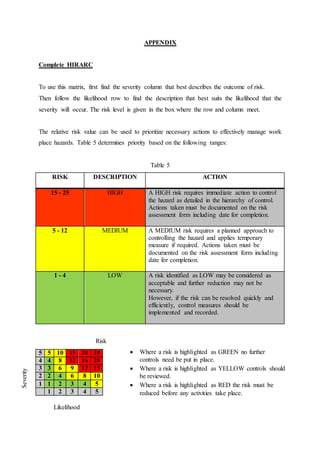
 Where a risk is highlighted as GREEN no further
controls need be put in place.
 Where a risk is highlighted as YELLOW controls should
be reviewed.
 Where a risk is highlighted as RED the risk must be
reduced before any activities take place.
APPENDIX
Complete HIRARC
To use this matrix, first find the severity column that best describes the outcome of risk.
Then follow the likelihood row to find the description that best suits the likelihood that the
severity will occur. The risk level is given in the box where the row and column meet.
The relative risk value can be used to prioritize necessary actions to effectively manage work
place hazards. Table 5 determines priority based on the following ranges:
Table 5
RISK DESCRIPTION ACTION
15 - 25 HIGH A HIGH risk requires immediate action to control
the hazard as detailed in the hierarchy of control.
Actions taken must be documented on the risk
assessment form including date for completion.
5 - 12 MEDIUM A MEDIUM risk requires a planned approach to
controlling the hazard and applies temporary
measure if required. Actions taken must be
documented on the risk assessment form including
date for completion.
1 - 4 LOW A risk identified as LOW may be considered as
acceptable and further reduction may not be
necessary.
However, if the risk can be resolved quickly and
efficiently, control measures should be
implemented and recorded.
5 5 10 15 20 25
4 4 8 12 16 20
3 3 6 9 12 15
2 2 4 6 8 10
1 1 2 3 4 5
1 2 3 4 5
Likelihood
Risk
Severity
Severity
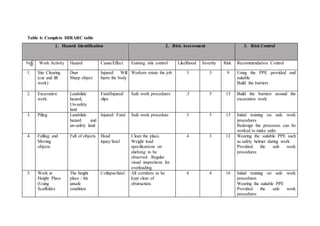
Table 6: Complete HIRARC table
1. Hazard Identification 2. Risk Assessment 3. Risk Control
No Work Activity Hazard Cause/Effect Existing risk control Likelihood Severity Risk Recommendation Control
1. Site Clearing
(cut and fill
work)
Dust
Sharp object
Injured/ Will
harm the body
Workers rotate the job 3 3 9 Using the PPE provided and
suitable
Build the barriers
2. Excavation
work.
Landslide
hazard,
Un-safety
land
Fatal/Injured/
slips
Safe work procedures .3 5 15 Build the barriers around the
excavation work
3. Piling Landslide
hazard and
un-safety land
Injured/ Fatal Safe work procedure 3 5 15 Initial training on safe work
procedures
Redesign the processes can be
worked to make safer
4. Falling and
Moving
objects
Fall of objects Head
injury/fatal
Clean the place.
Weight load
specifications on
shelving to be
observed. Regular
visual inspections for
overloading.
4 3 12 Wearing the suitable PPE such
as safety helmet during work
Provided the safe work
procedures
5. Work at
Height Place
(Using
Scaffolds)
The height
place / the
unsafe
condition
Collapse/fatal All corridors to be
kept clear of
obstruction.
4 4 16 Initial training on safe work
procedures
Wearing the suitable PPE
Provided the safe work
procedures
6. Manual
Handling of
Tools
(Electricity)
Electric
current/sharp
object
Electric
shock/injured
All hirers / users of the
building are to be
responsible for
ensuring those tasked
with manual handling
are correctly trained
.3 3 9 Wearing the suitable PPE such
as glove when handling
Housekeeping to make sure the
place is safe to work
7. Chipping,
grinding,
sawing,
hammering
Fall of objects Injured No heavy objects to be
stored above head
height. Weight load
specifications on
shelving to be
observed. Regular
visual inspections for
overloading.
3 2 6 Wearing the suitable PPE
during work
Provided the safe work
procedure such as rules and
sign board
Hirarc table

Hirarc table

  • 1.
     Where arisk is highlighted as GREEN no further controls need be put in place.  Where a risk is highlighted as YELLOW controls should be reviewed.  Where a risk is highlighted as RED the risk must be reduced before any activities take place. APPENDIX Complete HIRARC To use this matrix, first find the severity column that best describes the outcome of risk. Then follow the likelihood row to find the description that best suits the likelihood that the severity will occur. The risk level is given in the box where the row and column meet. The relative risk value can be used to prioritize necessary actions to effectively manage work place hazards. Table 5 determines priority based on the following ranges: Table 5 RISK DESCRIPTION ACTION 15 - 25 HIGH A HIGH risk requires immediate action to control the hazard as detailed in the hierarchy of control. Actions taken must be documented on the risk assessment form including date for completion. 5 - 12 MEDIUM A MEDIUM risk requires a planned approach to controlling the hazard and applies temporary measure if required. Actions taken must be documented on the risk assessment form including date for completion. 1 - 4 LOW A risk identified as LOW may be considered as acceptable and further reduction may not be necessary. However, if the risk can be resolved quickly and efficiently, control measures should be implemented and recorded. 5 5 10 15 20 25 4 4 8 12 16 20 3 3 6 9 12 15 2 2 4 6 8 10 1 1 2 3 4 5 1 2 3 4 5 Likelihood Risk Severity
  • 2.
    Severity Table 6: CompleteHIRARC table 1. Hazard Identification 2. Risk Assessment 3. Risk Control No Work Activity Hazard Cause/Effect Existing risk control Likelihood Severity Risk Recommendation Control 1. Site Clearing (cut and fill work) Dust Sharp object Injured/ Will harm the body Workers rotate the job 3 3 9 Using the PPE provided and suitable Build the barriers 2. Excavation work. Landslide hazard, Un-safety land Fatal/Injured/ slips Safe work procedures .3 5 15 Build the barriers around the excavation work 3. Piling Landslide hazard and un-safety land Injured/ Fatal Safe work procedure 3 5 15 Initial training on safe work procedures Redesign the processes can be worked to make safer 4. Falling and Moving objects Fall of objects Head injury/fatal Clean the place. Weight load specifications on shelving to be observed. Regular visual inspections for overloading. 4 3 12 Wearing the suitable PPE such as safety helmet during work Provided the safe work procedures 5. Work at Height Place (Using Scaffolds) The height place / the unsafe condition Collapse/fatal All corridors to be kept clear of obstruction. 4 4 16 Initial training on safe work procedures Wearing the suitable PPE Provided the safe work procedures
  • 3.
    6. Manual Handling of Tools (Electricity) Electric current/sharp object Electric shock/injured Allhirers / users of the building are to be responsible for ensuring those tasked with manual handling are correctly trained .3 3 9 Wearing the suitable PPE such as glove when handling Housekeeping to make sure the place is safe to work 7. Chipping, grinding, sawing, hammering Fall of objects Injured No heavy objects to be stored above head height. Weight load specifications on shelving to be observed. Regular visual inspections for overloading. 3 2 6 Wearing the suitable PPE during work Provided the safe work procedure such as rules and sign board