Personal Protective Equipment
(PPE)
2
NAME : Razak Bin Majid
POSITION : Trainer
EDUCATION : Executive Master SHE from UNISEL
H/P : 019-4944324
EMAIL : razak813426@gmail.com.my
Competency:
SHO Registered Person (8408)
Train The Trainer (NIOSH & HRDF)
Train The Trainer (BOFA)
Authorize Gas Tester (DOSH)
Scaffolder (DOSH)
Lifting Supervisor
Ergonomic
Trainer Profile
In
case
of
EMERGENCY
Please use nearest exit to
the assembly area
Please do not run
Please do not use the elevator
Use the nearest staircase
Safety
Briefing
3
FACILITIES
WASHROOM (EVERY FLOOR)
SURAU (FIRST FLOOR)
CAFETERIA
SMOKING (GROUND FLOOR)
REMINDER
SILENCE HAND-PHONE DURING TRAINING
SES
SION
Important Things
4
Peruntukan Perundangan
AK
TA
Akta Keselamatan & Kesihatan
Pekerjaan 1994
Akta Kilang &
Jentera
(Pindaan)
2006
Akta Alam
Sekeliling 1974
Akta Kilang &
Jentera 1967
(Disemak
Semula 1974)
AKTA KESELAMATAN DAN KESIHATAN PEKERJAAN
1994
 Sec 15:General duties of employers and self-employed persons to their
employees./ Seksyen 15 Akta Keselamatan & Kesihatan Pekerjaan 1994.
(1) It shall be the duty of every employer and every self-employed person to
ensure, so far as is practicable, the safety, health and welfare at work of all his
employees/Memastikan keselamatan, kesihatan dan kebajikan semua pekerjanya.
Question
1) What means so far as is practicable / Apakah yang dimaksud setakat yang
pratik?
AKTA KESELAMATAN DAN KESIHATAN PEKERJAAN 1994
“practicable” means practicable having regard to/ "boleh dipraktikkan" ertinya boleh
dipraktikkan dengan mengambil kira
(a) the severity of the hazard or risk in question/teruknya bahaya atau risiko yang
terlibat
(b) the state of knowledge about the hazard or risk and any way of removing or
mitigating the hazard or risk/keadaan pengetahuan mengenai bahaya atau risiko itu
dan apa-apa cara untuk menghapuskan atau mengurangkan bahaya atau risiko itu.
(c) the availability and suitability of ways to remove or mitigate the hazard or
risk/ada tidaknya dan kesesuaian cara untuk menghapuskan atau mengurangkan
bahaya dan risiko tersebut.
(d) the cost of removing or mitigating the hazard or risk/kos untuk menghapuskan
atau mengurangkan bahaya atau risiko itu
AKTA KESELAMATAN DAN KESIHATAN PEKERJAAN 1994
 Sec 24 General duties of employees at work./ Sek 24:Kewajipan am pekerja yang sedang bekerja.
(1) It shall be the duty of every employee while at work/Adalah menjadi kewajipan tiap-tiap pekerja
yang sedang bekerja:
(a) to take reasonable care for the safety and health of himself and of other persons who may be
affected by his acts or omissions at work/untuk memberikan perhatian yang munasabah bagi
keselamatan dan kesihatan dirinya dan orang lain yang mungkin terjejas oleh tindakan atau
peninggalannya semasa bekerja
- Not blocking emergency door
- Not parking forklift at prohibited area
- Make a modification without get approval
- Create risk to other
AKTA KESELAMATAN DAN KESIHATAN PEKERJAAN 1994
 Sec 24 General duties of employees at work./ Sek 24:Kewajipan am pekerja yang sedang bekerja.
(1) It shall be the duty of every employee while at work/Adalah menjadi kewajipan tiap-tiap pekerja
yang sedang bekerja:
(b) to co-operate with his employer or any other person in the discharge of any duty or requirement
imposed on the employer or that other person by this Act or any regulation made there
under/untuk bekerjasama dengan majikannya atau mana-mana orang lain dalam menunaikan apa-apa
kewajipan atau kehendak yang dikenakan ke atas majikan atau orang lain itu melalui Akta ini atau
mana-mana peraturan yang dibuat di bawahnya
- Attend program
- Give cooperation during audit and inspection
- Give feedback when ask by employer
AKTA KESELAMATAN DAN KESIHATAN PEKERJAAN
1994
 Sec 24 General duties of employees at work./ Sek 24:Kewajipan am pekerja yang sedang
bekerja.
(1) It shall be the duty of every employee while at work/Adalah menjadi kewajipan tiap-tiap
pekerja yang sedang bekerja:
(c) to wear or use at all times any protective equipment or clothing provided by the employer
for the purpose of preventing risks to his safety and health./untuk memakai atau
menggunakan pada sepanjang masa apa-apa kelengkapan atau pakaian perlindungan
yang diadakan oleh majikan bagi maksud mengegah apa-apa risiko kepada keselamatan
dan kesihatannya.
- Comply on PPE requirement
- Change if not in good condition
- Ask if not sure
- For forklift minimum safety helmet and safety shoe required .
AKTA KESELAMATAN DAN KESIHATAN PEKERJAAN 1994
 Sec 24 General duties of employees at work./ Sek 24:Kewajipan am pekerja yang sedang bekerja.
(1) It shall be the duty of every employee while at work/Adalah menjadi kewajipan tiap-tiap pekerja
yang sedang bekerja:
(d) to comply with any instruction or measure on occupational safety and health instituted by his
employer or any other person by or under thisAct or any regulation made there under/untuk
mematuhi apa-apa arahan atau langkah tentang keselamatan dan kesihatan pekerjaan yang
diperkenalkan oleh majikannya atau mana-mana orang lain melalui atau di bawah Akta ini atau
mana-mana peraturan yang dibuat di bawahnya.
- Guideline
- ICOP
- Order
AKTA KESELAMATAN DAN KESIHATAN PEKERJAAN 1994
 Sec 24 General duties of employees at work./ Sek 24:Kewajipan am pekerja
yang sedang bekerja
(2) A person who contravenes the provisions of this section shall be guilty of an
offence and shall, on conviction, be liable to a fine not-exceeding one thousand
ringgit or to imprisonment for a term not exceeding three months or to both./
Seseorang yang melanggar peruntukan seksyen ini adalah melakukan suatu
kesalahan dan, apabila disabitkan, boleh didenda tidak melebihi satu ribu ringgit
atau dipenjarakan selama tempoh tidak melebihi tiga bulan atau kedua-duanya
Learning Outcomes
Learning Objective:
Upon completion of this unit the participants will be able
to identify the need for Personal Protective Equipment
(PPE).
Learner Outcomes:
You will be able to:
Identify the requirements for PPE.
Develop a hazard assessment program as it pertains to
PPE.
Evaluate a variety of PPE devices and determine the types
of equipment necessary for your workplace.
Understand the training requirements for your workers
on proper usage of PPE
Introduction:
 Hazards exist in every work place and in many
different forms:
 sharp edges
 falling objects
 flying sparks
 chemicals
 noise
 other potentially dangerous situations
 OSHA requires employers to protect their
employees from workplace hazards that can cause
injury or illness.
What is PPE?
 Is the equipment worn to minimize exposure to
hazards that cause serious workplace injuries and
illnesses.
 These injuries and illnesses may result from
contact with chemical, radiological, physical,
electrical, mechanical, or other workplace
hazards.
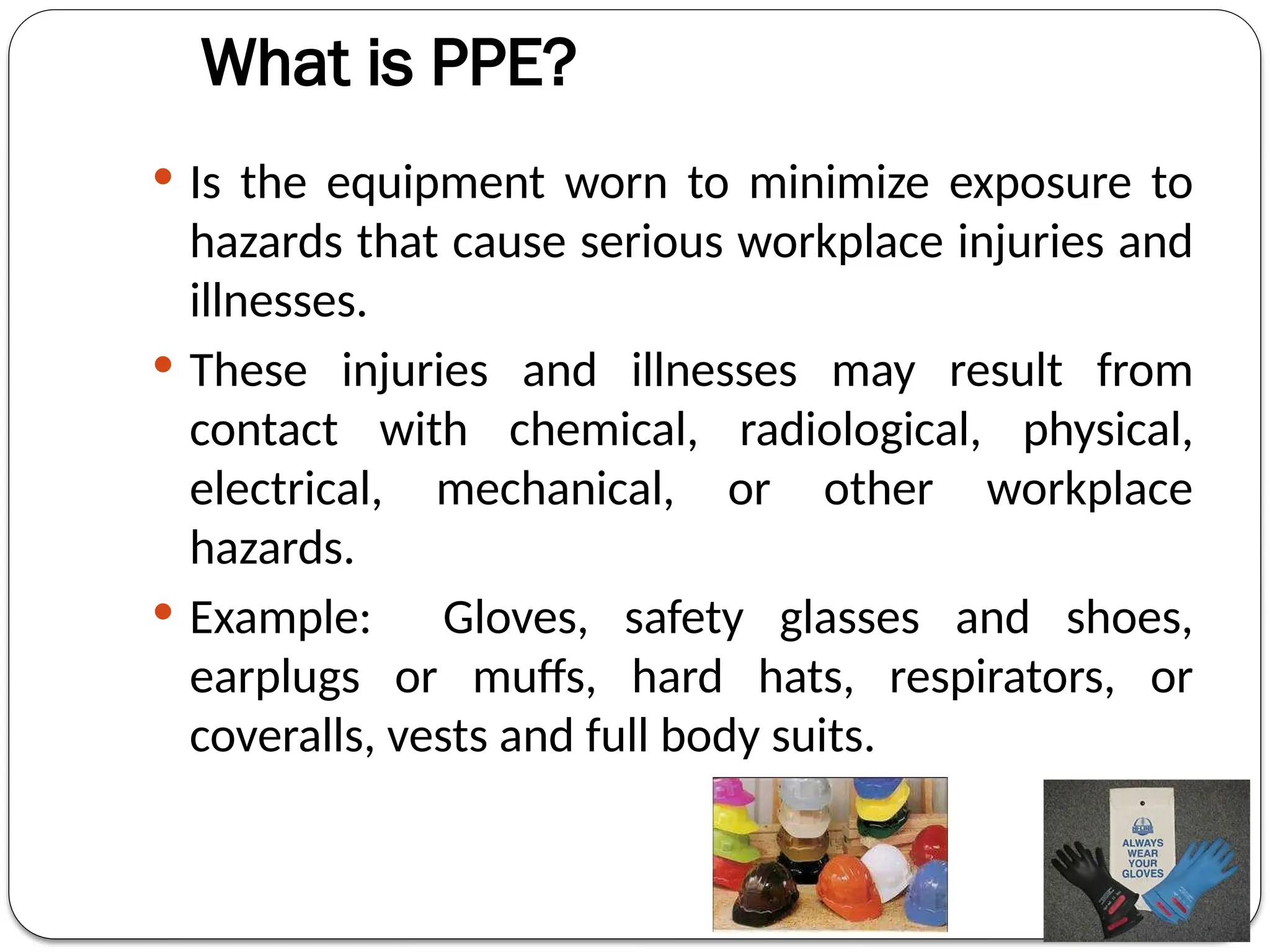
 Example: Gloves, safety glasses and shoes,
earplugs or muffs, hard hats, respirators, or
coveralls, vests and full body suits.
HAZARD CONTROL HIERARCHY
 ELIMINATION
 SUBSTITUTION/ ISOLATION
 ENGINEERING CONTROL
 ADMINISTRATIVE
CONTROL
 PPE’S
Protecting Employees from
Workplace Hazards
Employers must protect employees from workplace
hazards and dangerous work procedures that can
cause injury, illness and fatalities.
Employers must:
Use all feasible engineering and work practice
controls to eliminate and reduce hazards
Then use appropriate PPE if these controls do
not
eliminate hazards.
Remember: PPE is the last control --
Hazard Assessment:
 Developing a comprehensive safety and health
program
 Identify physical and health hazards in the
workplace.
 Conduct a walk-through survey of the facility to
assess the potential hazards.
 Organize and analyze the data so that it may be
efficiently used in determining the proper types
of PPE required at the worksite.
What is a risk assessment?
A risk assessment process aims to remove fall
hazards or reduce the level of their risk by adding
precautions to keep you and others safe.
The process is:
•Identify fall hazards.
•Evaluate the risk associated with any hazards.
•Determine appropriate ways to eliminate or control
the hazard.
By controlling the risks, you have created a safer
work environment for you and others.
The workplace should be periodically
reassessed when:
 Conditions change
 Equipment or operating procedures change
 Injury and illness records are reviewed to identify any
trends influencing suitability of existing PPE
 Monitoring PPE for condition and age
 Required documentation of the hazard assessment
includes the following information:
 Identification of the workplace evaluated
 Name of the person conducting the assessment
 Date of the assessment
 Identification of the document certifying completion of
the hazard assessment
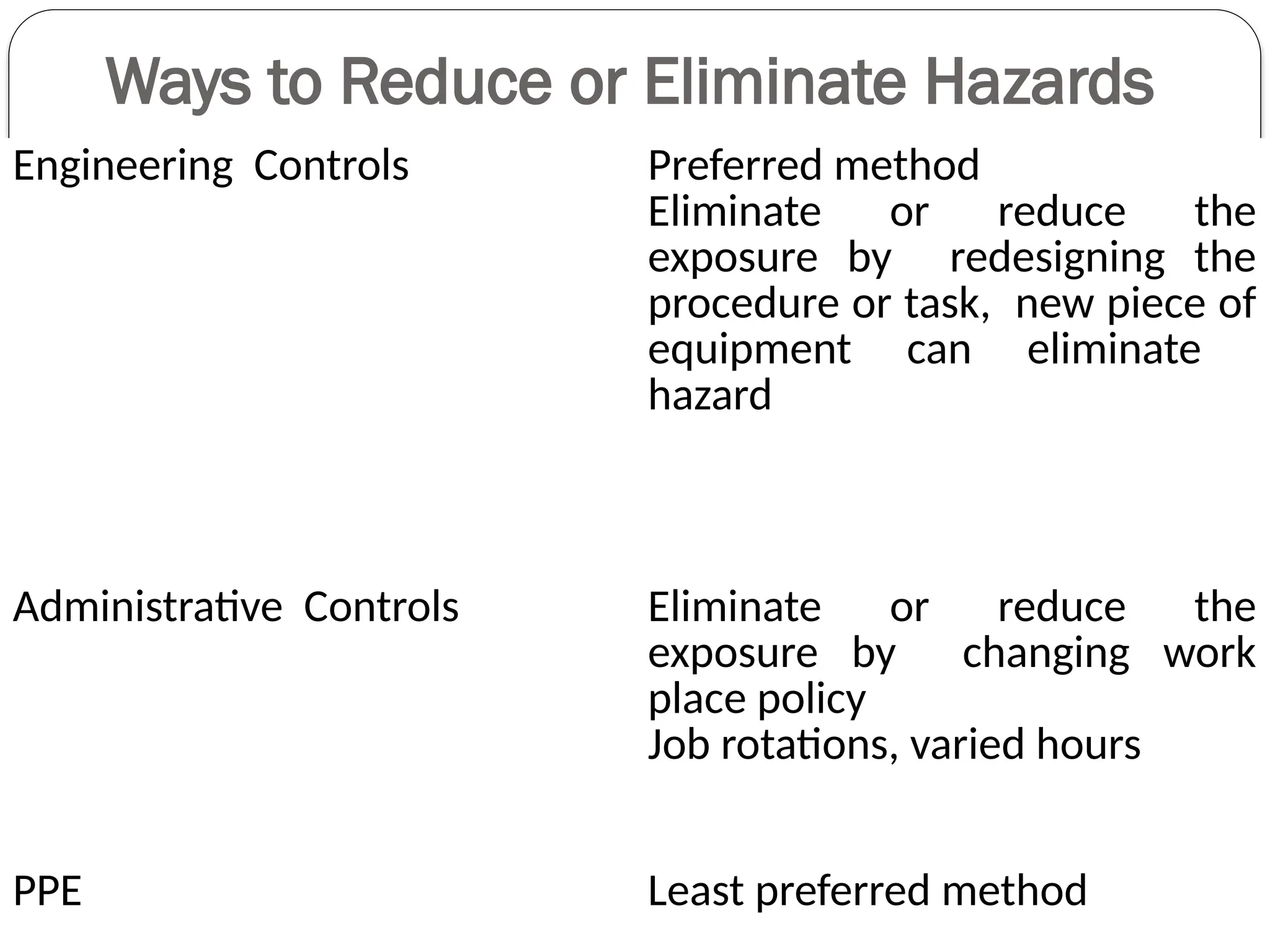
Ways to Reduce or Eliminate Hazards
Engineering Controls Preferred method
Eliminate or reduce the
exposure by redesigning the
procedure or task, new piece of
equipment can eliminate
hazard
Administrative Controls Eliminate or reduce the
exposure by changing work
place policy
Job rotations, varied hours
PPE Least preferred method
Engineering Controls
 If . . .
 The machine or work environment can
be physically changed to prevent
employee exposure to the potential
hazard,
 Then . . .
 The hazard can be eliminated with an
engineering control.
WHY PERSONAL PROTECTIVE
EQUIPMENT NEED TO PROVIDED
Personal Protective Equipment (PPE) must
be provided when necessary by reason of
hazards encountered that are capable of
causing injury or impairment
PPE is not a substitute for engineering,
work practice, and/or administrative
controls
PPE creates barrier between hazard and
route of entry
Use of PPE does not eliminate the hazard
so if the equipment fails then exposure
occurs
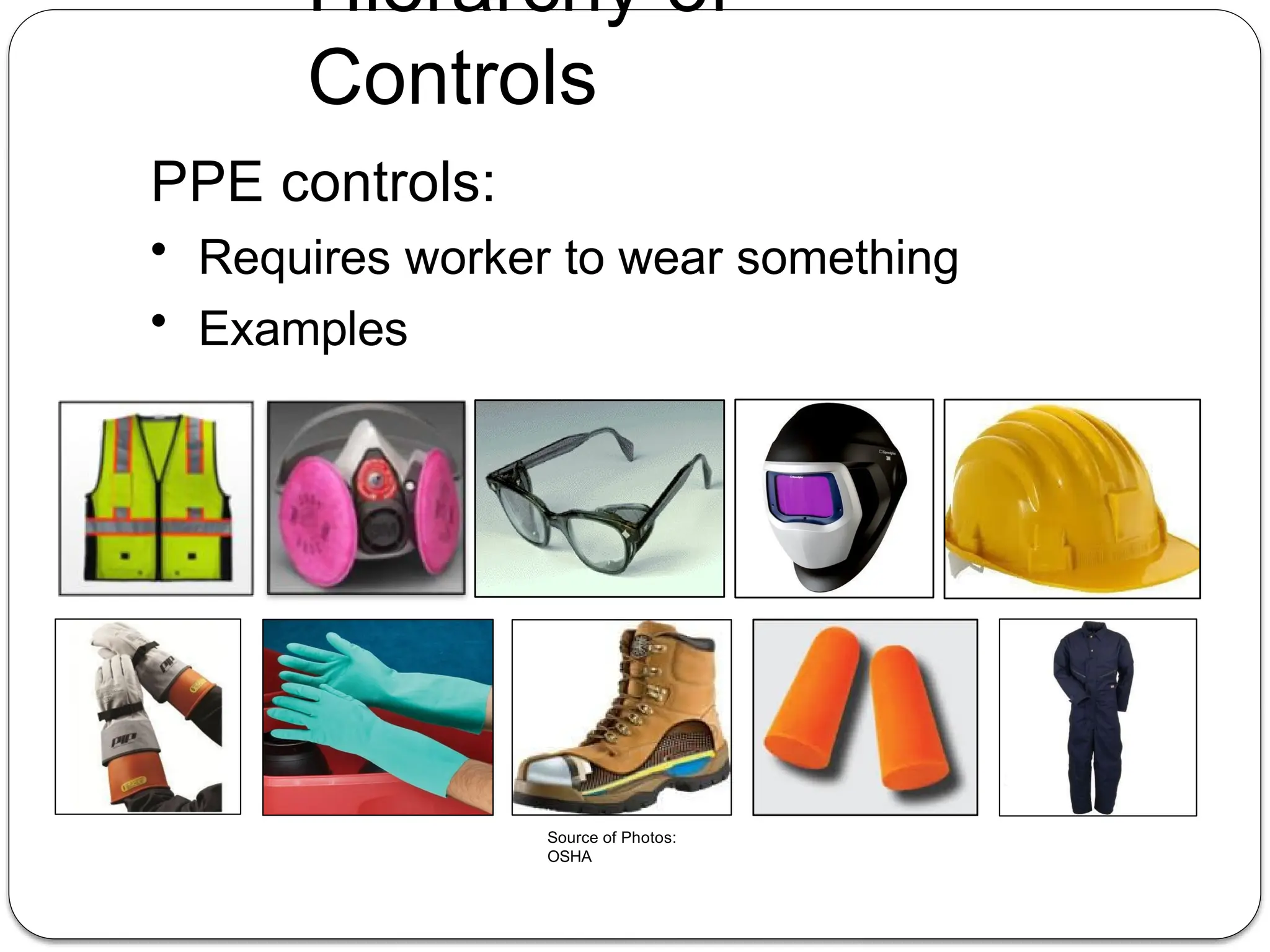
Source of Photos:
OSHA
Hierarchy of
Controls
PPE controls:
• Requires worker to wear something
• Examples
Occupational Safety and Health (OSHA 1994), Section 15
GENERAL DUTIES OF EMPLOYERS AND SELF-EMPLOYED PERSONS
15. General duties of employers and self-employed persons to their
employees.
(1) It shall be the duty of every employer and every self-employed
person to ensure, so far as is practicable, the safety, health and welfare
at work of all his employees.
(2) Without prejudice to the generality of subsection (1), the matters
to which the duty extends include in particular-
(a) the provision and maintenance of plant and systems of work that are,
so far as is practicable, safe and without risks to health;
(b) the making of arrangements for ensuring, so far as is practicable,
safety and absence of risks to health in connection with the use or
operation, handling, storage and transport of plant and substances;
Occupational Safety and Health
(OSHA 1994), Section 15
(c) the provision of such information, instruction training and
supervision as is necessary to ensure, so far as is practicable,
the safety and health at work of his employees;
(d) so far as is practicable, as regards any place of work under
the control of the employer or self-employed person, the
maintenance of it in a condition that is safe and without risks
to health and the provision and maintenance of the means of
access to and egress from it that are safe and without such
risks;
(e) the provision and maintenance of a working environment
for his employees that is, so far as is practicable, safe, without
risks to health, and adequate as regards facilities for their
welfare at work.
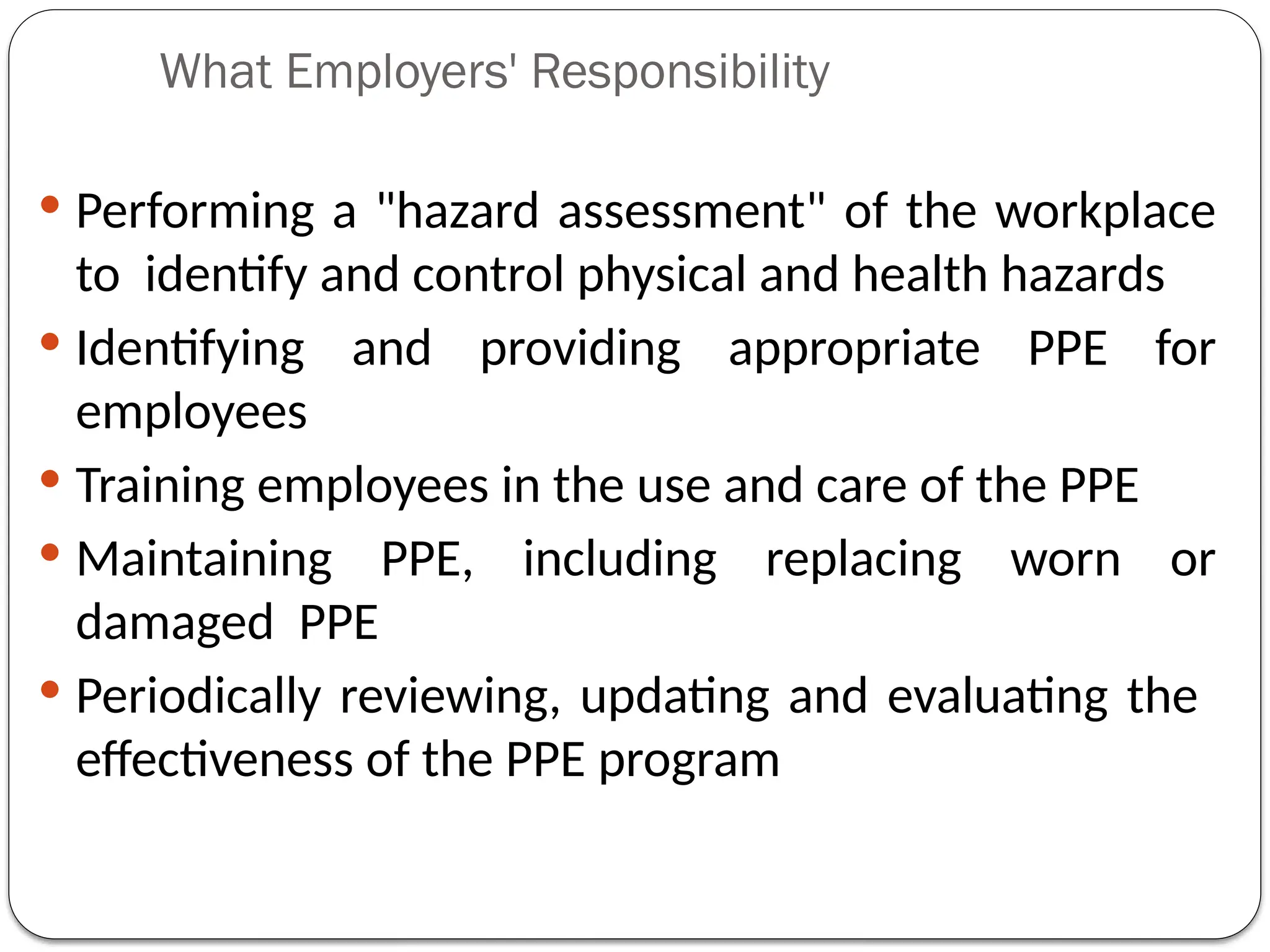
What Employers' Responsibility
 Performing a "hazard assessment" of the workplace
to identify and control physical and health hazards
 Identifying and providing appropriate PPE for
employees
 Training employees in the use and care of the PPE
 Maintaining PPE, including replacing worn or
damaged PPE
 Periodically reviewing, updating and evaluating the
effectiveness of the PPE program
Occupational Safety and Health
(OSHA 1994), Section 24
GENERAL DUTIES OF EMPLOYEES
24. General duties of employees at work.
(1) It shall be the duty of every employee while at work-
(a) to take reasonable care for the safety and health of himself and of other
persons who may be affected by his acts or omissions at work;
(b) to co-operate with his employer or any other person in the discharge of any
duty or requirement imposed on the employer or that other person by this Act
or any regulation made there under;
(c) to wear or use at all times any protective equipment or clothing provided by
the employer for the purpose of preventing risks to his safety and health; and
(d) to comply with any instruction or measure on occupational safety and
health instituted by his employer or any other person by or under this Act or
any regulation made thereunder.
(2) A person who contravenes the provisions of this section shall be guilty of
an offence and shall, on conviction, be liable to a fine not-exceeding one
thousand ringgit or to imprisonment for a term not exceeding three months or
to both.
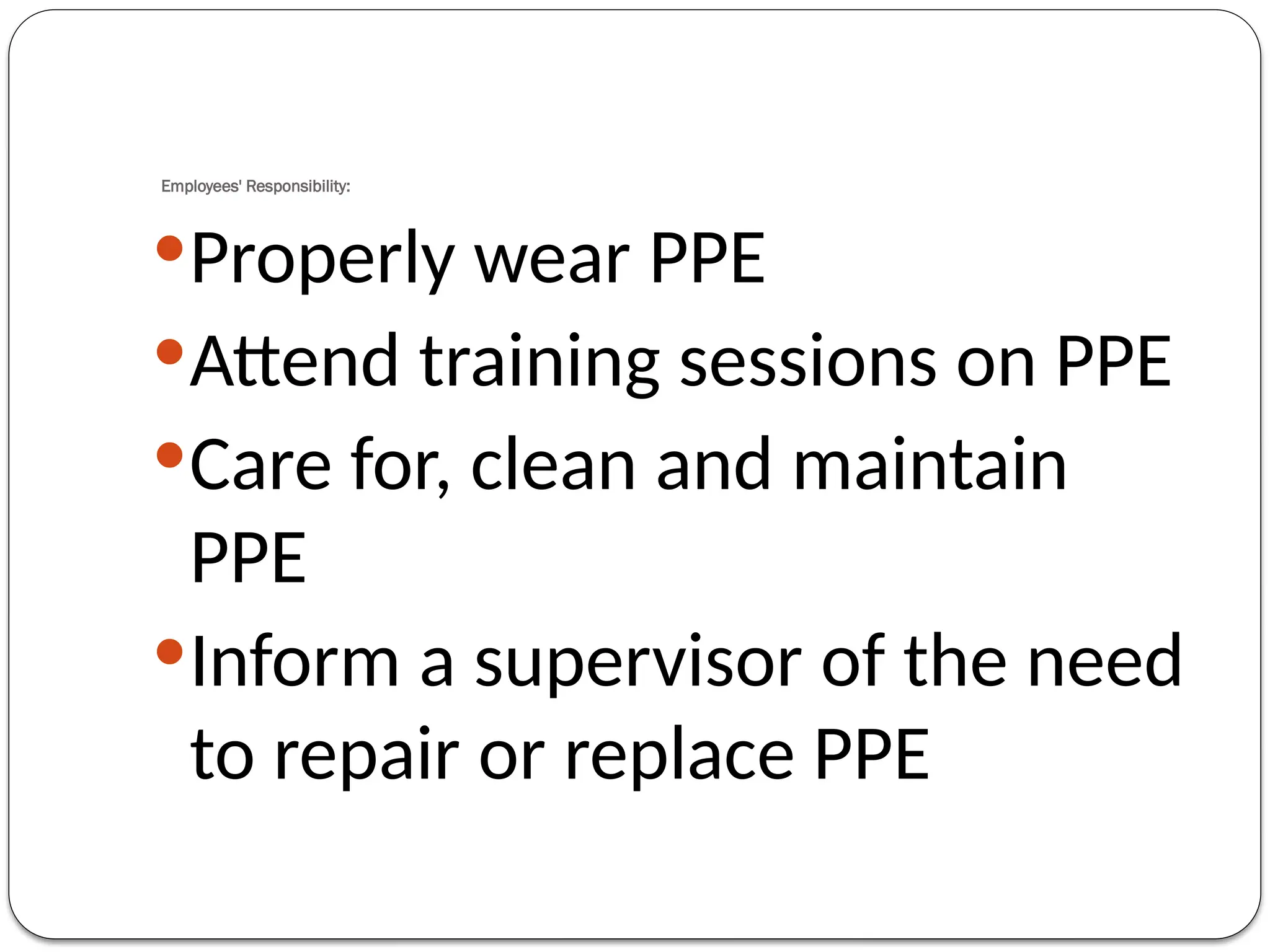
Employees' Responsibility:
Properly wear PPE
Attend training sessions on PPE
Care for, clean and maintain
PPE
Inform a supervisor of the need
to repair or replace PPE
Factories and Machineries Act (FMA 1967),
Section 24
24. Personal protective clothing and appliances.
Where in any factory persons are exposed to a
wet or dusty process, to noise, to heat or to any
poisonous, corrosive or other injurious substance
which is liable to cause bodily injury to those
persons the Minister may prescribe the provision and
maintenance for use of those persons suitable and
adequate personal protective clothing and
appliances including where necessary goggles,
gloves, leggings, caps, foot-wear and protective
ointment or lotion
Employer Responsibilities
Assessment
Employers are required to conduct an
assessment to determine the various hazards
that may be present at the workplace -
Different types of hazards include:
 Physical
 Chemical
 Electrical
 Mechanical
 Biological
 Health Hazards
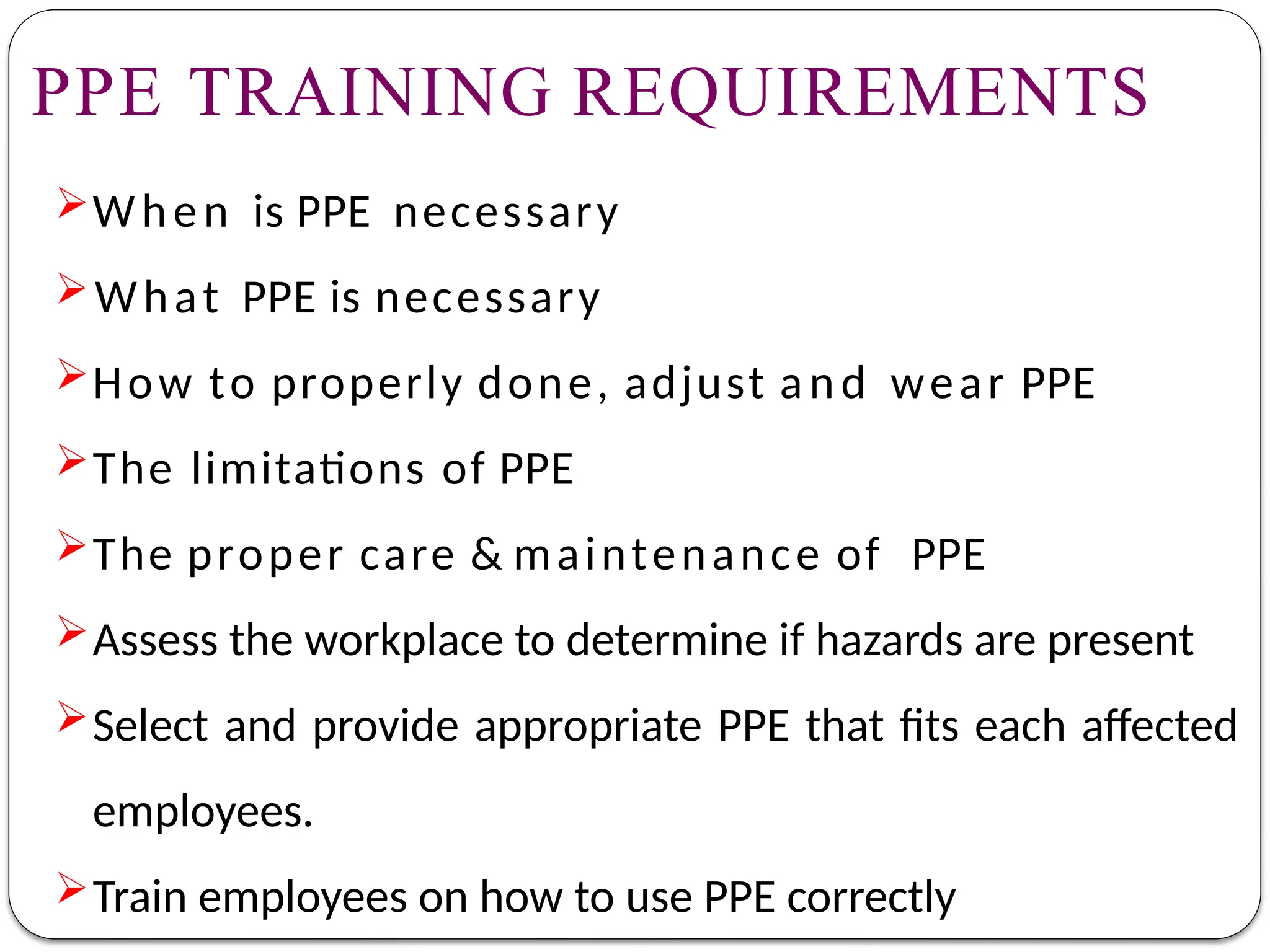
PPE TRAINING REQUIREMENTS
When is PPE necessary
What PPE is necessary
How to properly done, adjust and wear PPE
The limitations of PPE
The proper care & maintenance of PPE
Assess the workplace to determine if hazards are present
Select and provide appropriate PPE that fits each affected
employees.
Train employees on how to use PPE correctly
Employee Responsibilities
To attend all PPE training sessions
To use appropriate PPE on the job
Follow ALL Warnings and Precautions
Listen and Follow Directions
Maintain asigned PPE in healthy condition
 Report any and ALL unsafe conditions you may
find in your work area.
Is This An Appropriate Hard
Hat?
Is This An Appropriate
Respirator?
Is This an Appropriate Welder’s
Mask?
Is This an Appropriate
Scaffolding?
TYPES OF PERSONAL PROTECTIVE
EQUIPMENTS
HEAD PROTECTION
EYE PROTECTION
EAR PROTECTION
RESPIRATORY PROTECTION
FACE PROTECTION
HAND PROTECTION
BODY PROTECTION
LEG PROTECTION
PPE Selection
Should be of safe design and construction
Should be maintained in a clean and reliable
fashion
Fit and comfort should be taken into consideration
when selecting
Make sure PPE types are compatible if worn
together
Must meet standards developed by American
National Standards Institute (ANSI)
It is a good idea to select PPE that will provide a
level of protection greater than the minimum
required to protect employees from hazards.
Evaluation and documentation:
• The employee must demonstrate an understanding
of the PPE training and the ability to properly wear
and use the PPE before they are allowed to
perform work requiring the use of the PPE.
• Employers must document the training of each
employee that is required to wear PPE with the
following information
• Name of employee
• Date trained
• Subject of the training
Types of PPE:
Head
Eye and face
Ears
Lungs
Hand and arm
Foot and leg
Flying particles
Liquid chemicals
Acids or caustic liquids
Chemical gases or vapors
Potentially infected
material
Potentially harmful light
radiation
HEAD PROTECTION
Injuries to the head
could involve your:
-brain
-eyes
-nose
-mouth
For this reason, head
protection and safety are
very important
POTENTIAL HAZARDS
-accidents result
in shocks a n d
burns
- falling or flying
objects cause
sprains, fractures,
a n d concussions
-materials can
irritate a n d burn
eyes a n d skin
Electrical Shocks Head Impact Splashes, Spills
& Drips
Head Protection
Types of Head PPE
Hard hats
A rigid shell that resists and deflects
blows to the head
 A suspension system inside the hat
that acts as a shock absorber
 Some hats serve as an insulator
against electrical shocks
 Some hard hats can be modified so
you can add face shields, goggles,
hoods, or hearing protection to them
Source of graphics: OSHA
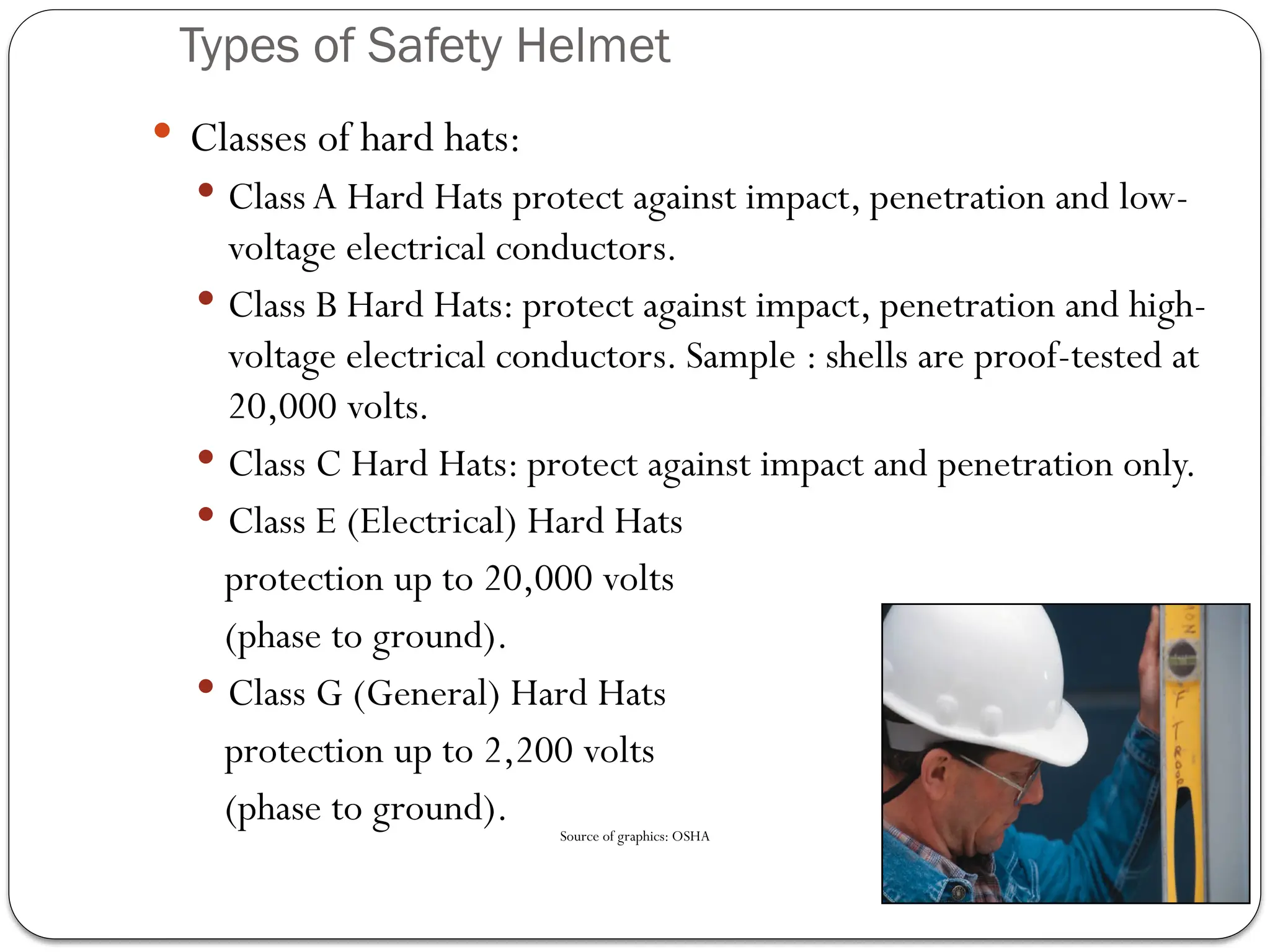
Types of Safety Helmet
 Classes of hard hats:
 Class A Hard Hats protect against impact, penetration and low-
voltage electrical conductors.
 Class B Hard Hats: protect against impact, penetration and high-
voltage electrical conductors. Sample : shells are proof-tested at
20,000 volts.
 Class C Hard Hats: protect against impact and penetration only.
 Class E (Electrical) Hard Hats
protection up to 20,000 volts
(phase to ground).
 Class G (General) Hard Hats
protection up to 2,200 volts
(phase to ground).
Head
Protection
 Hard hats must be worn in areas
around or where there is a
potential for falling objects.
 Hard hats must also be worn
where there are low-hanging
obstructions.
 Helmets designed to reduce
electrical shock hazards must
be worn when your head is
exposed to electricity
 Some tasks require both head &
face protection.
Periodic cleaning and inspection will extend the useful life of protective headgear
 A daily inspection of the hard hat shell, suspension system
and other accessories for holes, cracks, tears or other
damage that might compromise the protective value of the
hat is essential
 Paints, paint thinners and some cleaning agents can weaken
the shells of hard hats and may eliminate electrical
resistance
 Consult the helmet manufacturer for information on the
effects of paint and cleaning materials on their hard hats
Con’t
 Never drill holes, paint or apply labels to protective headgear as
this may reduce the integrity of the protection
 Do not store protective headgear in direct sunlight, such as on
the rear window shelf of a car, since sunlight and extreme heat
can damage them
 Stickers are not typically allowed on hats as they prohibit a
thorough inspection for cracks and defects.
Hard hats with any of the following defects should
be removed from service and replaced:
 Perforation, cracking, or deformity of the brim or shell
 Indication of exposure of the brim or shell to heat,
chemicals or ultraviolet light and other radiation
 Always replace a hard hat if it sustains an impact, even if
damage is not noticeable
 Suspension systems are offered as replacement parts and
should be replaced when damaged or when excessive wear
is noticed. It is not necessary to replace the entire hard hat.
Eye and Face
Protection
Why Eye and Face
Protection is
Important??
Thousands of people are
blinded each year from
work related eye injuries.
Injuries that could have
been prevented, if only
people would have used
eye or face protection.
Types of PPE
Eye and face
protection:
Source of images:
OSHA
Eye and Face Protection
Types of eye/face hazards
 Impact
 Heat
 Chemicals
- Liquid chemicals
- Chemical gases or vapors
 Potentially infected material
 Dust
 Light and/or Radiation
 Flying particles
Eye and Face
Protection
Potential Incidences of Eye/Face Hazards
Object Striking Eyes
 Dusts, Powders, Fumes, and Mists
 Operations such as grinding, chiseling, sanding,
hammering, and spraying can create small
airborne particles
Contact with Chemicals
 Toxic Gases, Vapors, and Liquids
 Toxic chemicals in the form of gases, vapors, and
liquids can damage your eyes. Always read the
appropriate MSDS before working with any hazardous
material.
Eye and Face
Protection
Potential Incidences of Eye/Face Hazards
Swinging Objects
 Large objects such as:
1.swinging chains, cables and ropes;
2.tools that are thrown or fall;
Thermal and Radiation Hazards
 Operations such as welding, metal cutting,
and working around furnaces can expose
your eyes to heat, glare, ultraviolet, and
infrared radiation
Protection
 Safety Glasses
 much stronger and more resistant to impact and
heat than regular glasses
 Equipped with side shields that give you
protection from hazards that may not be directly in
front of you
 Safety glasses should be approved to meet standards
 Should fit comfortable on face through all job tasks.
 Ensure that glasses are not too big or too tight
 Limitation
 Does not seal around eyes, could allow small
droplets to come in contact with eyes
Types of Eye and Face Personal Protective Equipment
Eye and Face Protection
 Goggles
 surround the eye area, they give you more protection
in situations where you might encounter splashing
liquids, fumes, vapors, powders, dusts, and mists
 must indicate that they are chemical splash goggles to
be worn for that purpose
 Limitation
 Uncomfortable to wear with other head gear like
helmet, ear muffs or respirator
Types of PPE
Goggle types
Direct-ventilated
Source: OSHA.gov
Indirect-ventilated Non-ventilated
• Does not allow the
passage of air into
the goggle
• Prevents splash entry
• May fog and require
frequent lens
cleaning
• Prevents
fogging by
allowing air
circulation
• Protects
against liquid
or chemical
splash entry
• Resist direct
passage of large
particles into the
goggle
• Prevents fogging
by allowing air
circulation
Safety goggles are used as primary protection to shield the eyes from
heat hazards. Goggles form a protective seal around the eyes, preventing objects
or liquids from entering under or around the goggles. This is especially
important when working with or around molten metals that may splash.
When employees are exposed to high temperatures, additional protection
beyond that offered by primary protectors may be required. Use safety goggles
in combination with a heat-reflective face shield for severe temperatures
exposure. Consider specific lens, frame, and ventilation options when
selecting safety goggles.
Ventilated goggles allow air circulation while providing protection against
airborne particles, dust, liquids, or light
Goggel keselamatan digunakan sebagai perlindungan utama untuk melindungi
mata dari bahaya panas. Goggle membentuk meterai perlindungan di sekeliling
mata, menghalang objek atau cecair daripada memasuki di bawah atau di sekitar
gogal. Ini amat penting apabila bekerja dengan atau di sekitar logam cair yang
boleh memercik.
Goggle ventilasi membolehkan peredaran udara memberi perlindungan terhadap
zarah, debu, cecair, atau cahaya udara
Eye and Face Protection
 Face Shields
 full face protection
 used around operations which expose
you to molten metal, chemical splashes,
or flying particles
 Can be used simultaneously as a hard
hat
 Limitations
 Are not considered eye protection, will
need to wear goggles or glasses
underneath
 Can fog up if working in poorly ventilated
Source of photos:
OSHA
• Welding shields
– Protect eyes from
burns caused by:
• Infared light
• Intense radiant light
– Protect eyes and face
from flying sparks,
metal spatter, and slag
chips
Types of PPE
Eye and Face Protection
 Face shield used by an
employee working with
molten metal
 The molten metal bubbled
and burst onto the face
shield of the employee
 The employee did not
receive any injuries from
the incident
Source: OSHA
• Common causes of eye
injuries
– Chemical splashes
– Blood or OPIM splashes or
sprays
– Intense light
– Dust and other flying
particles
– Molten metal splashes
Types of PPE
Eye and Face Protection
Welding Helmets
Provide both face and eye
protection use special
absorptive lenses that
filter the intense light and
radiant energy that is
produced during welding
operations
Prescription lenses
 Regular prescription corrective lenses do not
provide adequate protection against workplace
hazards.
 PPE may incorporate the prescription into the
design
 Employees may wear additional eye protection
over prescription lenses
 Protective eyewear should not disturb the proper
positioning of the prescription lenses or interfere
with the employee's vision
 Individuals with contact lenses must wear eye or
face PPE when working in hazardous conditions
HEARING PROTECTION
Damage t o t h e delicate structures in your ear can
cause o n e of t w o types of hearing loss:
• CONDUCTIVE - blocks
transmission of sound to
inner ear - medical/surgical
treatment available for most
• SENSORINEURAL - involves
organ of Corti a n d auditory
nerve - almost always
irreversible
Most hearing loss in the workplace is
sensorineural.
Exposure Hours per Day Sound Level in dBA
8 82
6 92
4 95
3 97
2 100
1 1/2 102
1 105
1/2 110
¼ or less 115
47
• Exposure to noise
levels over 82 dB can
cause hearing loss
• Hearing
protection
required at 90
dB
• Implement
effective Hearing
Conservation
Source: OSHA
Types of PPE
Hearing protectors
Hearing protectors reduce the ambient noise that gets
through to the ears.
Hearing protectors worn by employees must reduce an
employee's noise exposure to within the acceptable limits.
Manufacturers of hearing protection devices must display
the device's noise reduction rating (NRR) on the product
packaging.
If exposed to occupational noise at or above 82 dB averaged
over an eight-hour period, the employer is required to have a
hearing conservation program that includes regular testing of
employees' hearing by qualified professionals.
TYPE OF HEARING
PROTECTION
• Required when employees are in
areas where there is exposure to
excessive noise levels (8 hour TWA >
85 dbA)
• Recommended for use in high noise
areas and for use with high noise
operations
• Must have appropriate NR (muffs do
not always provide more
protection)
Hearing Protection
 Determining the need to provide hearing
protection for employees can be challenging.
Employee exposure to excessive noise depends
upon a number of factors, including:
 The loudness of the noise as measured in decibels
(dB)
 The duration of each employee's exposure to the
noise
 Whether employees move between work areas
with different noise levels
 Whether noise is generated from one or multiple
sources
Hand
Protection
Why is Hand
Protection
Important?
It has been
estimated that
almost 20% of all
disabling accidents
on the job involve
the hands
Without your fingers
o
rhands, your ability
to work would be
greatly reduced
Hand and Arm Protection
 Potential hazards include skin absorption of harmful
substances
 chemical or thermal burns
 electrical dangers
 bruises
 abrasions
 cuts
 punctures
 fractures
 amputations
 Protective equipment includes gloves, finger guards
and arm coverings or elbow-length gloves.
POTENTIAL HAZARDS
Traumatic Injuries Contact Injuries Repetitive Motion
- cuts, punctures,
sprains or
crushing from
equipment
- contact with toxic
chemicals, biological
substances,
electrical sources,
extreme
- same h a n d
movement over
ext end ed time
periods
Source of photos:
OSHA
Anti-
vibration
Heat-
resistant
Leather
Palm
Cut-
resistant
Permeation-
resistant
Chemical-
resistant
• Types of gloves
Types of PPE
TypeOfHand Protection
 Gloves
 Metal mesh gloves
 resist sharp edges and prevent cuts
 Leather gloves
 shield your hands from rough
surfaces
 Vinyl and neoprene gloves
 protect your hands against
toxic chemicals
 Rubber gloves
 protect you when working
around electricity
Types of protective gloves
 There are many types of gloves available that
protect against a wide variety of hazards.
 The nature of the hazard and the operation
involved will affect the selection of gloves.
 It is essential to use gloves specifically designed
for the hazards and tasks in the work place.
 For chemical handling refer to the SDSs under
PPE.
 The following are examples of some factors that
may influence the selection of protective gloves
for a workplace:
Cont.
 Type of chemicals handled
 Nature of contact (total immersion, splash, etc.)
 Duration of contact
 Area requiring protection (hand only, forearm, arm)
 Grip requirements (dry, wet, oily)
 Thermal protection
 Size and comfort
 Abrasion/resistance requirements
Care of protective gloves
 Inspect before each use to ensure that they are not
torn, punctured or made ineffective in any way.
 Fill the gloves with water and tightly rolling the cuff
towards the fingers will help reveal any pinhole
leaks.
 Gloves that are discolored or stiff may also indicate
deficiencies caused by excessive use or degradation
from chemical exposure.
Foot Protection
Why is Foot Protection
Important?
 The human foot is rigid enough
to support the weight of your
entire body, and yet flexible
enough to allow you to run,
dance, play sports, and to take
you anywhere you want to go.
Without your feet and toes, your
ability to work at your job would
be greatly reduced.
Foot and leg protection:
• Causes of foot injuries:
– Falling or rolling of heavy objects
– Crushing or penetrating materials
– Sharp objects that can penetrate
the sole
– Exposure to molten metal
– Working on, or around, hot, wet,
or
slippery surfaces
– Working when electrical
hazards are present.
Source: OSHA
Types of PPE
Foot Protection
 Workers at risk of possible foot or leg injuries from
falling, rolling objects, crushing or penetrating
materials should wear protective footwear.
 Examples of situations in which an employee
should wear foot and/or leg protection include:
 When heavy objects such as barrels or tools might
roll onto or fall on the employee's feet
 Working with sharp objects such as nails or spikes
that could pierce the soles or uppers of ordinary
shoes
 Working on or around hot, wet or slippery surfaces
 Working when electrical hazards are present
Impact Injuries Spills & Splashes Compression Injuries
Electrical Shocks Slipping Heat/Cold
Foot
Protection
Types of Foot PPE
 Safety Shoes and Boots
 Steel toe footwear
 protects your toes from falling objects
and from being crushed
 Metatarsal footwear
 special guards that run from your
ankle to your toes and protect your
entire foot
 Reinforced sole footwear
 metal reinforcement that protects
your foot from punctures
 Latex/Rubber footwear
 resists chemicals and provides
extra traction on slippery surfaces
Foot
Protection
 Type of Foot PPE
 Safety Shoes and Boots
 PVC footwear
 protects your feet against moisture and
improves traction
 Butyl footwear
 protects against most ketones, aldehydes,
alcohols, acids, salts, and alkalies
 Vinyl footwear
 resists solvents, acids, alkalies, salts,
water, grease, and blood
 Nitrile footwear
 resists animal fats, oils, and chemicals
Foot
Protection
Types of Foot PPE
 Safety Shoes and Boots
 Electrostatic dissipating
footwear
 conducts static electricity
to floors
that are grounded
 Electrical hazard
footwear
 insulated with tough rubber to
prevent shocks and burns
from electricity
Leggings:
 Protect the lower legs and feet from heat
hazards like welding sparks. Safety snaps
allow leggings to be removed quickly.
 Metatarsal Guards:
 Protect the instep area from impact and
compression. Made of aluminum, steel,
fiber or plastic, these guards may be
strapped to the outside of shoes.
Toe Guards:
 Fit over the toes of regular shoes to
protect the toes from impact and
compression hazards. They may be
made of steel, aluminum or plastic.
 Boots:
 To be worn in areas where the floors
may be wet or slippery, provide
protection for the toes if the
employee is stepped on.
 Safety footwear should be inspected prior to each use.
 Checked for wear and tear at reasonable intervals,
looking for cracks or holes, separation of materials,
broken buckles or laces.
 The soles of shoes should be checked for pieces of
metal or other embedded items that could present
electrical or tripping hazards.
Care of protective footwear
RESPIRATORY PROTECTION
Required when employees are in areas where
effective engineering controls are not feasible to
protect the health of the employee from
harmful dusts, fogs, fumes, mists, gases, smokes,
sprays or vapors
Must comply with Standards
HOW RESPIRATORY PROTECT
Exposure levels exceed the PEL
During installation of engineering or work
practice controls
Maintenance and repair activities that may
result in exceeding the PEL
Emergency Response where type and/or
concentration of contaminant is unknown
Voluntary Usage
Types of PPE
Respiratory protection:
Source of photos:
OSHA
Source of photos:
OSHA
• Types of respirators
– Air-Purifying (APR) –
remove contaminants
from air
• Particulate
respirators
• Chemical
cartridge/ gas
mask respirator
• Powered Air-
Purifying
Respirator (PAPR)
Types of PPE
LUNG DAMAGE
Inhalation of hazardous
materials damages
delicate structures of
the lung
Damaged lungs are more
susceptible to
respiratory disease
Most direct route to the
bloodstream
TYPES OF RESPIRATORS
Supplied-air
Air-purifying
Mechanical Filter Respirators
 Not to be worn when situation may include an
immediate danger to life or health (IDLH)
 Protects from particulate contaminants: dusts,
mists, or metal fumes
 Both disposable and reusable masks are available
 Filters and disposable masks should be replaced
when breathing becomes too labored, when the
mask loses its shape and no longer seals well to
face, or if substance can be smelled or tasted
 Approved models have two elastic straps that are
placed across the crown and neck for a better seal.
Look for a "TC" number to be sure it is approved.
Chemical Cartridge Respirators
 Filters out low concentrations of toxic gases and vapors
 Activated charcoal absorbs contaminants from inhaled air
 Can also be equipped with particulate filters, (should be
worn if exposed to gases, vapors, dusts, or mists)
 Some cartridges specifically made for use with pesticides.
 Cartridges should be replaced according to manufacturer's
guidelines or when "breakthrough" occurs -- that is, when
you begin to smell or taste the contaminant or when
dizziness or irritation occurs. Some cartridges last for hours
while others last for days.
 Chemical cartridge respirators should not be worn in areas
considered immediately dangerous to life or health (IDLH).
Body
Protection
Why is Body Protection Important?
 The skin acts as a natural barrier to the elements
 Chemicals can break down the skin barrier and
allow secondary infections to manifest
Types of PPE
Body protection –
protective
clothing:
Source of photos:
OSHA
• Provide protective clothing
for those parts of the body
exposed to possible
injuries
• Types of body protection
– Laboratory coats
– Coveralls
– Vests
– Jackets
– Aprons
– Surgical gowns
– Full-body suits
Source of photos:
OSHA
Types of PPE
• Selection of body
protection – variety of
materials effective against
particular hazard
– Paper-like fiber – dust and
splashes
– Treated wool and cotton – fire-
resistant; dust, abrasions,
rough/irritating surfaces
– Duck – cuts, bruises
– Leather – dry heat, flames
– Rubber, rubberized fabrics,
neoprene, and plastics – certain
chemicals and physical hazards
Source of photos:
OSHA
Types of PPE
Body
Protection
Potential Incidences of Body Hazards
 Temperature stress
 Exposure to heat (hot metals) or cold (dry ice)
which results in burns
 Chemical Contact
 Chemical splash
 Contact with potentially infectious materials
 Radiation
 Thunderous blood
Body
Protection
Types of Body PPE
 Insulated Coats and Pants
 Fire resistant
 Heat resistant
 Cold resistant
 Sleeves and Aprons
 Work well when pouring or
manipulating chemical to reduce splash
 Make sure the sleeves and aprons are
appropriate for the chemical
Fire Suits
Features :
Designed to protect those who work in high heat industrial
situations or in direct contact with fires.
Designed to protect pipeline workers, off shore oilrig
crews, plant operators, industrial workers, fireman, etc.
Fire Action Suit
Chemical Suits
Features:
Designed to provide complete protection to the respiratory,
sight or skin from hazardous vapors, gases, particulates,
sudden splash. Totally encapsulated, vapor tight
•Chemical Suits (Provision for a SCBA set) with hood, face
shield, boots & gloves
Safety Body Harness
What is fall protection?
• Fall protection is the backup system
planned for a worker who could lose
his or her balance at a height, in
order to control or eliminate injury
potential.
• Fall protection must be provided
when workers are at:
–10 feet
COMMON FALL HAZARDS
• Retrieving items from the roofs (e.g. balls, shoes)
• Cleaning roof gutters
• Cleaning high windows, fans
• Changing light bulbs
• Opening/closing out of reach windows
• Hanging classroom displays
• Accessing items on high shelving
• Easy access to roofs (poor design)
• Working on roofs
• Using ladders
• Working on fragile, slippery or sloping surfaces.
Fall Hazard Controls
Know the A, B, Cs
of Personal Fall
Arrest Systems
• Anchorages
• Body harness
• Components
(connectors like snap hooks or Dee-
rings, connection points, lanyards,
deceleration devices, lifelines, etc.)
Installed, used, and maintained according to the
manufacturer
Source: Honeywell/Miller; used with
permission.
Full Body Harness Inspecting
When inspecting a harness, look for:
• Cuts, frayed edges or broken stitches
in
webbing
• Discoloration, melted fibers or
brittleness
due to heat or chemicals
• Excessive oil or grease contamination
• Cracks, distortions, sharp or rough
edges on
the harness’ buckles
• Rusting on grommets *
Equipment Do’s and Don’ts
Do inspect for wear and damage before
use.
Do remove from service after a fall for
inspection.
Don’t use to lift materials.
Don’t attach to guardrails or hoists.
Lanyard
The lanyard attaches the harness to the anchor. When
inspecting lanyards, look for the following:
 Worn, broken or cut fibers
 Free of knots
 Evidence of stretching or loading
 Excessive oil or grease contamination
 Cracks, distortion, corrosion or signs of stress on connecting
hardware
 Shock absorber intact
 Shock absorber is installed at man end, no anchor end
 Correct length to ensure a fall of no more than one metre *
Personal items and apparel that can be a hazard during PPE use:
Jewelry, rings
Loose clothing
Hood strings - hanging items
Long hair - not tied back
Ear buds for MP3 devices
Contact lenses
Transition lenses or sun glasses
Summary
 PPE is the last result after the elimination, substitute,
engineering and administration.
 Make sure that employees are using required PPE
properly and are following the policies and
procedures regarding PPE established at your work
place.
 Have supervisors or lead workers regularly monitor,
supervise, reinforce, and enforce the correct use and
care of PPE by employees.
 Provide follow- up training if necessary to ensure that
each employee has the adequate skill, knowledge,
and ability to use his/her personal protective
equipment.
Training personal protective equipment PPE in power point.pptx

Training personal protective equipment PPE in power point.pptx

  • 1.
  • 2.
    2 NAME : RazakBin Majid POSITION : Trainer EDUCATION : Executive Master SHE from UNISEL H/P : 019-4944324 EMAIL : razak813426@gmail.com.my Competency: SHO Registered Person (8408) Train The Trainer (NIOSH & HRDF) Train The Trainer (BOFA) Authorize Gas Tester (DOSH) Scaffolder (DOSH) Lifting Supervisor Ergonomic Trainer Profile
  • 3.
    In case of EMERGENCY Please use nearestexit to the assembly area Please do not run Please do not use the elevator Use the nearest staircase Safety Briefing 3
  • 4.
    FACILITIES WASHROOM (EVERY FLOOR) SURAU(FIRST FLOOR) CAFETERIA SMOKING (GROUND FLOOR) REMINDER SILENCE HAND-PHONE DURING TRAINING SES SION Important Things 4
  • 5.
    Peruntukan Perundangan AK TA Akta Keselamatan& Kesihatan Pekerjaan 1994 Akta Kilang & Jentera (Pindaan) 2006 Akta Alam Sekeliling 1974 Akta Kilang & Jentera 1967 (Disemak Semula 1974)
  • 6.
    AKTA KESELAMATAN DANKESIHATAN PEKERJAAN 1994  Sec 15:General duties of employers and self-employed persons to their employees./ Seksyen 15 Akta Keselamatan & Kesihatan Pekerjaan 1994. (1) It shall be the duty of every employer and every self-employed person to ensure, so far as is practicable, the safety, health and welfare at work of all his employees/Memastikan keselamatan, kesihatan dan kebajikan semua pekerjanya. Question 1) What means so far as is practicable / Apakah yang dimaksud setakat yang pratik?
  • 7.
    AKTA KESELAMATAN DANKESIHATAN PEKERJAAN 1994 “practicable” means practicable having regard to/ "boleh dipraktikkan" ertinya boleh dipraktikkan dengan mengambil kira (a) the severity of the hazard or risk in question/teruknya bahaya atau risiko yang terlibat (b) the state of knowledge about the hazard or risk and any way of removing or mitigating the hazard or risk/keadaan pengetahuan mengenai bahaya atau risiko itu dan apa-apa cara untuk menghapuskan atau mengurangkan bahaya atau risiko itu. (c) the availability and suitability of ways to remove or mitigate the hazard or risk/ada tidaknya dan kesesuaian cara untuk menghapuskan atau mengurangkan bahaya dan risiko tersebut. (d) the cost of removing or mitigating the hazard or risk/kos untuk menghapuskan atau mengurangkan bahaya atau risiko itu
  • 8.
    AKTA KESELAMATAN DANKESIHATAN PEKERJAAN 1994  Sec 24 General duties of employees at work./ Sek 24:Kewajipan am pekerja yang sedang bekerja. (1) It shall be the duty of every employee while at work/Adalah menjadi kewajipan tiap-tiap pekerja yang sedang bekerja: (a) to take reasonable care for the safety and health of himself and of other persons who may be affected by his acts or omissions at work/untuk memberikan perhatian yang munasabah bagi keselamatan dan kesihatan dirinya dan orang lain yang mungkin terjejas oleh tindakan atau peninggalannya semasa bekerja - Not blocking emergency door - Not parking forklift at prohibited area - Make a modification without get approval - Create risk to other
  • 9.
    AKTA KESELAMATAN DANKESIHATAN PEKERJAAN 1994  Sec 24 General duties of employees at work./ Sek 24:Kewajipan am pekerja yang sedang bekerja. (1) It shall be the duty of every employee while at work/Adalah menjadi kewajipan tiap-tiap pekerja yang sedang bekerja: (b) to co-operate with his employer or any other person in the discharge of any duty or requirement imposed on the employer or that other person by this Act or any regulation made there under/untuk bekerjasama dengan majikannya atau mana-mana orang lain dalam menunaikan apa-apa kewajipan atau kehendak yang dikenakan ke atas majikan atau orang lain itu melalui Akta ini atau mana-mana peraturan yang dibuat di bawahnya - Attend program - Give cooperation during audit and inspection - Give feedback when ask by employer
  • 10.
    AKTA KESELAMATAN DANKESIHATAN PEKERJAAN 1994  Sec 24 General duties of employees at work./ Sek 24:Kewajipan am pekerja yang sedang bekerja. (1) It shall be the duty of every employee while at work/Adalah menjadi kewajipan tiap-tiap pekerja yang sedang bekerja: (c) to wear or use at all times any protective equipment or clothing provided by the employer for the purpose of preventing risks to his safety and health./untuk memakai atau menggunakan pada sepanjang masa apa-apa kelengkapan atau pakaian perlindungan yang diadakan oleh majikan bagi maksud mengegah apa-apa risiko kepada keselamatan dan kesihatannya. - Comply on PPE requirement - Change if not in good condition - Ask if not sure - For forklift minimum safety helmet and safety shoe required .
  • 11.
    AKTA KESELAMATAN DANKESIHATAN PEKERJAAN 1994  Sec 24 General duties of employees at work./ Sek 24:Kewajipan am pekerja yang sedang bekerja. (1) It shall be the duty of every employee while at work/Adalah menjadi kewajipan tiap-tiap pekerja yang sedang bekerja: (d) to comply with any instruction or measure on occupational safety and health instituted by his employer or any other person by or under thisAct or any regulation made there under/untuk mematuhi apa-apa arahan atau langkah tentang keselamatan dan kesihatan pekerjaan yang diperkenalkan oleh majikannya atau mana-mana orang lain melalui atau di bawah Akta ini atau mana-mana peraturan yang dibuat di bawahnya. - Guideline - ICOP - Order
  • 12.
    AKTA KESELAMATAN DANKESIHATAN PEKERJAAN 1994  Sec 24 General duties of employees at work./ Sek 24:Kewajipan am pekerja yang sedang bekerja (2) A person who contravenes the provisions of this section shall be guilty of an offence and shall, on conviction, be liable to a fine not-exceeding one thousand ringgit or to imprisonment for a term not exceeding three months or to both./ Seseorang yang melanggar peruntukan seksyen ini adalah melakukan suatu kesalahan dan, apabila disabitkan, boleh didenda tidak melebihi satu ribu ringgit atau dipenjarakan selama tempoh tidak melebihi tiga bulan atau kedua-duanya
  • 13.
    Learning Outcomes Learning Objective: Uponcompletion of this unit the participants will be able to identify the need for Personal Protective Equipment (PPE). Learner Outcomes: You will be able to: Identify the requirements for PPE. Develop a hazard assessment program as it pertains to PPE. Evaluate a variety of PPE devices and determine the types of equipment necessary for your workplace. Understand the training requirements for your workers on proper usage of PPE
  • 14.
    Introduction:  Hazards existin every work place and in many different forms:  sharp edges  falling objects  flying sparks  chemicals  noise  other potentially dangerous situations  OSHA requires employers to protect their employees from workplace hazards that can cause injury or illness.
  • 15.
    What is PPE? Is the equipment worn to minimize exposure to hazards that cause serious workplace injuries and illnesses.  These injuries and illnesses may result from contact with chemical, radiological, physical, electrical, mechanical, or other workplace hazards.  Example: Gloves, safety glasses and shoes, earplugs or muffs, hard hats, respirators, or coveralls, vests and full body suits.
  • 16.
    HAZARD CONTROL HIERARCHY ELIMINATION  SUBSTITUTION/ ISOLATION  ENGINEERING CONTROL  ADMINISTRATIVE CONTROL  PPE’S
  • 17.
    Protecting Employees from WorkplaceHazards Employers must protect employees from workplace hazards and dangerous work procedures that can cause injury, illness and fatalities. Employers must: Use all feasible engineering and work practice controls to eliminate and reduce hazards Then use appropriate PPE if these controls do not eliminate hazards. Remember: PPE is the last control --
  • 18.
    Hazard Assessment:  Developinga comprehensive safety and health program  Identify physical and health hazards in the workplace.  Conduct a walk-through survey of the facility to assess the potential hazards.  Organize and analyze the data so that it may be efficiently used in determining the proper types of PPE required at the worksite.
  • 19.
    What is arisk assessment? A risk assessment process aims to remove fall hazards or reduce the level of their risk by adding precautions to keep you and others safe. The process is: •Identify fall hazards. •Evaluate the risk associated with any hazards. •Determine appropriate ways to eliminate or control the hazard. By controlling the risks, you have created a safer work environment for you and others.
  • 20.
    The workplace shouldbe periodically reassessed when:  Conditions change  Equipment or operating procedures change  Injury and illness records are reviewed to identify any trends influencing suitability of existing PPE  Monitoring PPE for condition and age  Required documentation of the hazard assessment includes the following information:  Identification of the workplace evaluated  Name of the person conducting the assessment  Date of the assessment  Identification of the document certifying completion of the hazard assessment
  • 21.
    Ways to Reduceor Eliminate Hazards Engineering Controls Preferred method Eliminate or reduce the exposure by redesigning the procedure or task, new piece of equipment can eliminate hazard Administrative Controls Eliminate or reduce the exposure by changing work place policy Job rotations, varied hours PPE Least preferred method
  • 22.
    Engineering Controls  If. . .  The machine or work environment can be physically changed to prevent employee exposure to the potential hazard,  Then . . .  The hazard can be eliminated with an engineering control.
  • 23.
    WHY PERSONAL PROTECTIVE EQUIPMENTNEED TO PROVIDED Personal Protective Equipment (PPE) must be provided when necessary by reason of hazards encountered that are capable of causing injury or impairment PPE is not a substitute for engineering, work practice, and/or administrative controls PPE creates barrier between hazard and route of entry Use of PPE does not eliminate the hazard so if the equipment fails then exposure occurs
  • 24.
    Source of Photos: OSHA Hierarchyof Controls PPE controls: • Requires worker to wear something • Examples
  • 25.
    Occupational Safety andHealth (OSHA 1994), Section 15 GENERAL DUTIES OF EMPLOYERS AND SELF-EMPLOYED PERSONS 15. General duties of employers and self-employed persons to their employees. (1) It shall be the duty of every employer and every self-employed person to ensure, so far as is practicable, the safety, health and welfare at work of all his employees. (2) Without prejudice to the generality of subsection (1), the matters to which the duty extends include in particular- (a) the provision and maintenance of plant and systems of work that are, so far as is practicable, safe and without risks to health; (b) the making of arrangements for ensuring, so far as is practicable, safety and absence of risks to health in connection with the use or operation, handling, storage and transport of plant and substances;
  • 26.
    Occupational Safety andHealth (OSHA 1994), Section 15 (c) the provision of such information, instruction training and supervision as is necessary to ensure, so far as is practicable, the safety and health at work of his employees; (d) so far as is practicable, as regards any place of work under the control of the employer or self-employed person, the maintenance of it in a condition that is safe and without risks to health and the provision and maintenance of the means of access to and egress from it that are safe and without such risks; (e) the provision and maintenance of a working environment for his employees that is, so far as is practicable, safe, without risks to health, and adequate as regards facilities for their welfare at work.
  • 27.
    What Employers' Responsibility Performing a "hazard assessment" of the workplace to identify and control physical and health hazards  Identifying and providing appropriate PPE for employees  Training employees in the use and care of the PPE  Maintaining PPE, including replacing worn or damaged PPE  Periodically reviewing, updating and evaluating the effectiveness of the PPE program
  • 28.
    Occupational Safety andHealth (OSHA 1994), Section 24 GENERAL DUTIES OF EMPLOYEES 24. General duties of employees at work. (1) It shall be the duty of every employee while at work- (a) to take reasonable care for the safety and health of himself and of other persons who may be affected by his acts or omissions at work; (b) to co-operate with his employer or any other person in the discharge of any duty or requirement imposed on the employer or that other person by this Act or any regulation made there under; (c) to wear or use at all times any protective equipment or clothing provided by the employer for the purpose of preventing risks to his safety and health; and (d) to comply with any instruction or measure on occupational safety and health instituted by his employer or any other person by or under this Act or any regulation made thereunder. (2) A person who contravenes the provisions of this section shall be guilty of an offence and shall, on conviction, be liable to a fine not-exceeding one thousand ringgit or to imprisonment for a term not exceeding three months or to both.
  • 29.
    Employees' Responsibility: Properly wearPPE Attend training sessions on PPE Care for, clean and maintain PPE Inform a supervisor of the need to repair or replace PPE
  • 30.
    Factories and MachineriesAct (FMA 1967), Section 24 24. Personal protective clothing and appliances. Where in any factory persons are exposed to a wet or dusty process, to noise, to heat or to any poisonous, corrosive or other injurious substance which is liable to cause bodily injury to those persons the Minister may prescribe the provision and maintenance for use of those persons suitable and adequate personal protective clothing and appliances including where necessary goggles, gloves, leggings, caps, foot-wear and protective ointment or lotion
  • 31.
    Employer Responsibilities Assessment Employers arerequired to conduct an assessment to determine the various hazards that may be present at the workplace - Different types of hazards include:  Physical  Chemical  Electrical  Mechanical  Biological  Health Hazards
  • 32.
    PPE TRAINING REQUIREMENTS Whenis PPE necessary What PPE is necessary How to properly done, adjust and wear PPE The limitations of PPE The proper care & maintenance of PPE Assess the workplace to determine if hazards are present Select and provide appropriate PPE that fits each affected employees. Train employees on how to use PPE correctly
  • 33.
    Employee Responsibilities To attendall PPE training sessions To use appropriate PPE on the job Follow ALL Warnings and Precautions Listen and Follow Directions Maintain asigned PPE in healthy condition  Report any and ALL unsafe conditions you may find in your work area.
  • 34.
    Is This AnAppropriate Hard Hat?
  • 35.
    Is This AnAppropriate Respirator?
  • 36.
    Is This anAppropriate Welder’s Mask?
  • 37.
    Is This anAppropriate Scaffolding?
  • 38.
    TYPES OF PERSONALPROTECTIVE EQUIPMENTS HEAD PROTECTION EYE PROTECTION EAR PROTECTION RESPIRATORY PROTECTION FACE PROTECTION HAND PROTECTION BODY PROTECTION LEG PROTECTION
  • 39.
    PPE Selection Should beof safe design and construction Should be maintained in a clean and reliable fashion Fit and comfort should be taken into consideration when selecting Make sure PPE types are compatible if worn together Must meet standards developed by American National Standards Institute (ANSI) It is a good idea to select PPE that will provide a level of protection greater than the minimum required to protect employees from hazards.
  • 40.
    Evaluation and documentation: •The employee must demonstrate an understanding of the PPE training and the ability to properly wear and use the PPE before they are allowed to perform work requiring the use of the PPE. • Employers must document the training of each employee that is required to wear PPE with the following information • Name of employee • Date trained • Subject of the training
  • 42.
    Types of PPE: Head Eyeand face Ears Lungs Hand and arm Foot and leg Flying particles Liquid chemicals Acids or caustic liquids Chemical gases or vapors Potentially infected material Potentially harmful light radiation
  • 44.
    HEAD PROTECTION Injuries tothe head could involve your: -brain -eyes -nose -mouth For this reason, head protection and safety are very important
  • 45.
    POTENTIAL HAZARDS -accidents result inshocks a n d burns - falling or flying objects cause sprains, fractures, a n d concussions -materials can irritate a n d burn eyes a n d skin Electrical Shocks Head Impact Splashes, Spills & Drips
  • 46.
    Head Protection Types ofHead PPE Hard hats A rigid shell that resists and deflects blows to the head  A suspension system inside the hat that acts as a shock absorber  Some hats serve as an insulator against electrical shocks  Some hard hats can be modified so you can add face shields, goggles, hoods, or hearing protection to them
  • 47.
    Source of graphics:OSHA Types of Safety Helmet  Classes of hard hats:  Class A Hard Hats protect against impact, penetration and low- voltage electrical conductors.  Class B Hard Hats: protect against impact, penetration and high- voltage electrical conductors. Sample : shells are proof-tested at 20,000 volts.  Class C Hard Hats: protect against impact and penetration only.  Class E (Electrical) Hard Hats protection up to 20,000 volts (phase to ground).  Class G (General) Hard Hats protection up to 2,200 volts (phase to ground).
  • 49.
    Head Protection  Hard hatsmust be worn in areas around or where there is a potential for falling objects.  Hard hats must also be worn where there are low-hanging obstructions.  Helmets designed to reduce electrical shock hazards must be worn when your head is exposed to electricity  Some tasks require both head & face protection.
  • 50.
    Periodic cleaning andinspection will extend the useful life of protective headgear  A daily inspection of the hard hat shell, suspension system and other accessories for holes, cracks, tears or other damage that might compromise the protective value of the hat is essential  Paints, paint thinners and some cleaning agents can weaken the shells of hard hats and may eliminate electrical resistance  Consult the helmet manufacturer for information on the effects of paint and cleaning materials on their hard hats
  • 51.
    Con’t  Never drillholes, paint or apply labels to protective headgear as this may reduce the integrity of the protection  Do not store protective headgear in direct sunlight, such as on the rear window shelf of a car, since sunlight and extreme heat can damage them  Stickers are not typically allowed on hats as they prohibit a thorough inspection for cracks and defects.
  • 52.
    Hard hats withany of the following defects should be removed from service and replaced:  Perforation, cracking, or deformity of the brim or shell  Indication of exposure of the brim or shell to heat, chemicals or ultraviolet light and other radiation  Always replace a hard hat if it sustains an impact, even if damage is not noticeable  Suspension systems are offered as replacement parts and should be replaced when damaged or when excessive wear is noticed. It is not necessary to replace the entire hard hat.
  • 53.
    Eye and Face Protection WhyEye and Face Protection is Important?? Thousands of people are blinded each year from work related eye injuries. Injuries that could have been prevented, if only people would have used eye or face protection.
  • 54.
    Types of PPE Eyeand face protection: Source of images: OSHA
  • 55.
    Eye and FaceProtection Types of eye/face hazards  Impact  Heat  Chemicals - Liquid chemicals - Chemical gases or vapors  Potentially infected material  Dust  Light and/or Radiation  Flying particles
  • 56.
    Eye and Face Protection PotentialIncidences of Eye/Face Hazards Object Striking Eyes  Dusts, Powders, Fumes, and Mists  Operations such as grinding, chiseling, sanding, hammering, and spraying can create small airborne particles Contact with Chemicals  Toxic Gases, Vapors, and Liquids  Toxic chemicals in the form of gases, vapors, and liquids can damage your eyes. Always read the appropriate MSDS before working with any hazardous material.
  • 57.
    Eye and Face Protection PotentialIncidences of Eye/Face Hazards Swinging Objects  Large objects such as: 1.swinging chains, cables and ropes; 2.tools that are thrown or fall; Thermal and Radiation Hazards  Operations such as welding, metal cutting, and working around furnaces can expose your eyes to heat, glare, ultraviolet, and infrared radiation
  • 58.
    Protection  Safety Glasses much stronger and more resistant to impact and heat than regular glasses  Equipped with side shields that give you protection from hazards that may not be directly in front of you  Safety glasses should be approved to meet standards  Should fit comfortable on face through all job tasks.  Ensure that glasses are not too big or too tight  Limitation  Does not seal around eyes, could allow small droplets to come in contact with eyes Types of Eye and Face Personal Protective Equipment
  • 59.
    Eye and FaceProtection  Goggles  surround the eye area, they give you more protection in situations where you might encounter splashing liquids, fumes, vapors, powders, dusts, and mists  must indicate that they are chemical splash goggles to be worn for that purpose  Limitation  Uncomfortable to wear with other head gear like helmet, ear muffs or respirator
  • 60.
    Types of PPE Goggletypes Direct-ventilated Source: OSHA.gov Indirect-ventilated Non-ventilated • Does not allow the passage of air into the goggle • Prevents splash entry • May fog and require frequent lens cleaning • Prevents fogging by allowing air circulation • Protects against liquid or chemical splash entry • Resist direct passage of large particles into the goggle • Prevents fogging by allowing air circulation
  • 61.
    Safety goggles areused as primary protection to shield the eyes from heat hazards. Goggles form a protective seal around the eyes, preventing objects or liquids from entering under or around the goggles. This is especially important when working with or around molten metals that may splash. When employees are exposed to high temperatures, additional protection beyond that offered by primary protectors may be required. Use safety goggles in combination with a heat-reflective face shield for severe temperatures exposure. Consider specific lens, frame, and ventilation options when selecting safety goggles. Ventilated goggles allow air circulation while providing protection against airborne particles, dust, liquids, or light Goggel keselamatan digunakan sebagai perlindungan utama untuk melindungi mata dari bahaya panas. Goggle membentuk meterai perlindungan di sekeliling mata, menghalang objek atau cecair daripada memasuki di bawah atau di sekitar gogal. Ini amat penting apabila bekerja dengan atau di sekitar logam cair yang boleh memercik. Goggle ventilasi membolehkan peredaran udara memberi perlindungan terhadap zarah, debu, cecair, atau cahaya udara
  • 62.
    Eye and FaceProtection  Face Shields  full face protection  used around operations which expose you to molten metal, chemical splashes, or flying particles  Can be used simultaneously as a hard hat  Limitations  Are not considered eye protection, will need to wear goggles or glasses underneath  Can fog up if working in poorly ventilated
  • 63.
    Source of photos: OSHA •Welding shields – Protect eyes from burns caused by: • Infared light • Intense radiant light – Protect eyes and face from flying sparks, metal spatter, and slag chips Types of PPE
  • 64.
    Eye and FaceProtection  Face shield used by an employee working with molten metal  The molten metal bubbled and burst onto the face shield of the employee  The employee did not receive any injuries from the incident
  • 65.
    Source: OSHA • Commoncauses of eye injuries – Chemical splashes – Blood or OPIM splashes or sprays – Intense light – Dust and other flying particles – Molten metal splashes Types of PPE
  • 66.
    Eye and FaceProtection Welding Helmets Provide both face and eye protection use special absorptive lenses that filter the intense light and radiant energy that is produced during welding operations
  • 67.
    Prescription lenses  Regularprescription corrective lenses do not provide adequate protection against workplace hazards.  PPE may incorporate the prescription into the design  Employees may wear additional eye protection over prescription lenses  Protective eyewear should not disturb the proper positioning of the prescription lenses or interfere with the employee's vision  Individuals with contact lenses must wear eye or face PPE when working in hazardous conditions
  • 68.
    HEARING PROTECTION Damage to t h e delicate structures in your ear can cause o n e of t w o types of hearing loss: • CONDUCTIVE - blocks transmission of sound to inner ear - medical/surgical treatment available for most • SENSORINEURAL - involves organ of Corti a n d auditory nerve - almost always irreversible Most hearing loss in the workplace is sensorineural.
  • 69.
    Exposure Hours perDay Sound Level in dBA 8 82 6 92 4 95 3 97 2 100 1 1/2 102 1 105 1/2 110 ¼ or less 115 47
  • 71.
    • Exposure tonoise levels over 82 dB can cause hearing loss • Hearing protection required at 90 dB • Implement effective Hearing Conservation Source: OSHA Types of PPE
  • 72.
    Hearing protectors Hearing protectorsreduce the ambient noise that gets through to the ears. Hearing protectors worn by employees must reduce an employee's noise exposure to within the acceptable limits. Manufacturers of hearing protection devices must display the device's noise reduction rating (NRR) on the product packaging. If exposed to occupational noise at or above 82 dB averaged over an eight-hour period, the employer is required to have a hearing conservation program that includes regular testing of employees' hearing by qualified professionals.
  • 73.
    TYPE OF HEARING PROTECTION •Required when employees are in areas where there is exposure to excessive noise levels (8 hour TWA > 85 dbA) • Recommended for use in high noise areas and for use with high noise operations • Must have appropriate NR (muffs do not always provide more protection)
  • 74.
    Hearing Protection  Determiningthe need to provide hearing protection for employees can be challenging. Employee exposure to excessive noise depends upon a number of factors, including:  The loudness of the noise as measured in decibels (dB)  The duration of each employee's exposure to the noise  Whether employees move between work areas with different noise levels  Whether noise is generated from one or multiple sources
  • 75.
    Hand Protection Why is Hand Protection Important? Ithas been estimated that almost 20% of all disabling accidents on the job involve the hands Without your fingers o rhands, your ability to work would be greatly reduced
  • 76.
    Hand and ArmProtection  Potential hazards include skin absorption of harmful substances  chemical or thermal burns  electrical dangers  bruises  abrasions  cuts  punctures  fractures  amputations  Protective equipment includes gloves, finger guards and arm coverings or elbow-length gloves.
  • 77.
    POTENTIAL HAZARDS Traumatic InjuriesContact Injuries Repetitive Motion - cuts, punctures, sprains or crushing from equipment - contact with toxic chemicals, biological substances, electrical sources, extreme - same h a n d movement over ext end ed time periods
  • 78.
  • 79.
    TypeOfHand Protection  Gloves Metal mesh gloves  resist sharp edges and prevent cuts  Leather gloves  shield your hands from rough surfaces  Vinyl and neoprene gloves  protect your hands against toxic chemicals  Rubber gloves  protect you when working around electricity
  • 80.
    Types of protectivegloves  There are many types of gloves available that protect against a wide variety of hazards.  The nature of the hazard and the operation involved will affect the selection of gloves.  It is essential to use gloves specifically designed for the hazards and tasks in the work place.  For chemical handling refer to the SDSs under PPE.  The following are examples of some factors that may influence the selection of protective gloves for a workplace:
  • 81.
    Cont.  Type ofchemicals handled  Nature of contact (total immersion, splash, etc.)  Duration of contact  Area requiring protection (hand only, forearm, arm)  Grip requirements (dry, wet, oily)  Thermal protection  Size and comfort  Abrasion/resistance requirements
  • 82.
    Care of protectivegloves  Inspect before each use to ensure that they are not torn, punctured or made ineffective in any way.  Fill the gloves with water and tightly rolling the cuff towards the fingers will help reveal any pinhole leaks.  Gloves that are discolored or stiff may also indicate deficiencies caused by excessive use or degradation from chemical exposure.
  • 83.
    Foot Protection Why isFoot Protection Important?  The human foot is rigid enough to support the weight of your entire body, and yet flexible enough to allow you to run, dance, play sports, and to take you anywhere you want to go. Without your feet and toes, your ability to work at your job would be greatly reduced.
  • 84.
    Foot and legprotection: • Causes of foot injuries: – Falling or rolling of heavy objects – Crushing or penetrating materials – Sharp objects that can penetrate the sole – Exposure to molten metal – Working on, or around, hot, wet, or slippery surfaces – Working when electrical hazards are present. Source: OSHA Types of PPE
  • 85.
    Foot Protection  Workersat risk of possible foot or leg injuries from falling, rolling objects, crushing or penetrating materials should wear protective footwear.  Examples of situations in which an employee should wear foot and/or leg protection include:  When heavy objects such as barrels or tools might roll onto or fall on the employee's feet  Working with sharp objects such as nails or spikes that could pierce the soles or uppers of ordinary shoes  Working on or around hot, wet or slippery surfaces  Working when electrical hazards are present
  • 86.
    Impact Injuries Spills& Splashes Compression Injuries Electrical Shocks Slipping Heat/Cold
  • 87.
    Foot Protection Types of FootPPE  Safety Shoes and Boots  Steel toe footwear  protects your toes from falling objects and from being crushed  Metatarsal footwear  special guards that run from your ankle to your toes and protect your entire foot  Reinforced sole footwear  metal reinforcement that protects your foot from punctures  Latex/Rubber footwear  resists chemicals and provides extra traction on slippery surfaces
  • 88.
    Foot Protection  Type ofFoot PPE  Safety Shoes and Boots  PVC footwear  protects your feet against moisture and improves traction  Butyl footwear  protects against most ketones, aldehydes, alcohols, acids, salts, and alkalies  Vinyl footwear  resists solvents, acids, alkalies, salts, water, grease, and blood  Nitrile footwear  resists animal fats, oils, and chemicals
  • 89.
    Foot Protection Types of FootPPE  Safety Shoes and Boots  Electrostatic dissipating footwear  conducts static electricity to floors that are grounded  Electrical hazard footwear  insulated with tough rubber to prevent shocks and burns from electricity
  • 90.
    Leggings:  Protect thelower legs and feet from heat hazards like welding sparks. Safety snaps allow leggings to be removed quickly.  Metatarsal Guards:  Protect the instep area from impact and compression. Made of aluminum, steel, fiber or plastic, these guards may be strapped to the outside of shoes.
  • 91.
    Toe Guards:  Fitover the toes of regular shoes to protect the toes from impact and compression hazards. They may be made of steel, aluminum or plastic.  Boots:  To be worn in areas where the floors may be wet or slippery, provide protection for the toes if the employee is stepped on.
  • 92.
     Safety footwearshould be inspected prior to each use.  Checked for wear and tear at reasonable intervals, looking for cracks or holes, separation of materials, broken buckles or laces.  The soles of shoes should be checked for pieces of metal or other embedded items that could present electrical or tripping hazards. Care of protective footwear
  • 93.
    RESPIRATORY PROTECTION Required whenemployees are in areas where effective engineering controls are not feasible to protect the health of the employee from harmful dusts, fogs, fumes, mists, gases, smokes, sprays or vapors Must comply with Standards
  • 94.
    HOW RESPIRATORY PROTECT Exposurelevels exceed the PEL During installation of engineering or work practice controls Maintenance and repair activities that may result in exceeding the PEL Emergency Response where type and/or concentration of contaminant is unknown Voluntary Usage
  • 95.
    Types of PPE Respiratoryprotection: Source of photos: OSHA
  • 96.
    Source of photos: OSHA •Types of respirators – Air-Purifying (APR) – remove contaminants from air • Particulate respirators • Chemical cartridge/ gas mask respirator • Powered Air- Purifying Respirator (PAPR) Types of PPE
  • 97.
    LUNG DAMAGE Inhalation ofhazardous materials damages delicate structures of the lung Damaged lungs are more susceptible to respiratory disease Most direct route to the bloodstream
  • 98.
  • 99.
    Mechanical Filter Respirators Not to be worn when situation may include an immediate danger to life or health (IDLH)  Protects from particulate contaminants: dusts, mists, or metal fumes  Both disposable and reusable masks are available  Filters and disposable masks should be replaced when breathing becomes too labored, when the mask loses its shape and no longer seals well to face, or if substance can be smelled or tasted  Approved models have two elastic straps that are placed across the crown and neck for a better seal. Look for a "TC" number to be sure it is approved.
  • 100.
    Chemical Cartridge Respirators Filters out low concentrations of toxic gases and vapors  Activated charcoal absorbs contaminants from inhaled air  Can also be equipped with particulate filters, (should be worn if exposed to gases, vapors, dusts, or mists)  Some cartridges specifically made for use with pesticides.  Cartridges should be replaced according to manufacturer's guidelines or when "breakthrough" occurs -- that is, when you begin to smell or taste the contaminant or when dizziness or irritation occurs. Some cartridges last for hours while others last for days.  Chemical cartridge respirators should not be worn in areas considered immediately dangerous to life or health (IDLH).
  • 101.
    Body Protection Why is BodyProtection Important?  The skin acts as a natural barrier to the elements  Chemicals can break down the skin barrier and allow secondary infections to manifest
  • 102.
    Types of PPE Bodyprotection – protective clothing: Source of photos: OSHA
  • 103.
    • Provide protectiveclothing for those parts of the body exposed to possible injuries • Types of body protection – Laboratory coats – Coveralls – Vests – Jackets – Aprons – Surgical gowns – Full-body suits Source of photos: OSHA Types of PPE
  • 104.
    • Selection ofbody protection – variety of materials effective against particular hazard – Paper-like fiber – dust and splashes – Treated wool and cotton – fire- resistant; dust, abrasions, rough/irritating surfaces – Duck – cuts, bruises – Leather – dry heat, flames – Rubber, rubberized fabrics, neoprene, and plastics – certain chemicals and physical hazards Source of photos: OSHA Types of PPE
  • 105.
    Body Protection Potential Incidences ofBody Hazards  Temperature stress  Exposure to heat (hot metals) or cold (dry ice) which results in burns  Chemical Contact  Chemical splash  Contact with potentially infectious materials  Radiation  Thunderous blood
  • 106.
    Body Protection Types of BodyPPE  Insulated Coats and Pants  Fire resistant  Heat resistant  Cold resistant  Sleeves and Aprons  Work well when pouring or manipulating chemical to reduce splash  Make sure the sleeves and aprons are appropriate for the chemical
  • 107.
    Fire Suits Features : Designedto protect those who work in high heat industrial situations or in direct contact with fires. Designed to protect pipeline workers, off shore oilrig crews, plant operators, industrial workers, fireman, etc.
  • 108.
    Fire Action Suit ChemicalSuits Features: Designed to provide complete protection to the respiratory, sight or skin from hazardous vapors, gases, particulates, sudden splash. Totally encapsulated, vapor tight •Chemical Suits (Provision for a SCBA set) with hood, face shield, boots & gloves
  • 109.
  • 110.
    What is fallprotection? • Fall protection is the backup system planned for a worker who could lose his or her balance at a height, in order to control or eliminate injury potential. • Fall protection must be provided when workers are at: –10 feet
  • 111.
    COMMON FALL HAZARDS •Retrieving items from the roofs (e.g. balls, shoes) • Cleaning roof gutters • Cleaning high windows, fans • Changing light bulbs • Opening/closing out of reach windows • Hanging classroom displays • Accessing items on high shelving • Easy access to roofs (poor design) • Working on roofs • Using ladders • Working on fragile, slippery or sloping surfaces.
  • 112.
    Fall Hazard Controls Knowthe A, B, Cs of Personal Fall Arrest Systems • Anchorages • Body harness • Components (connectors like snap hooks or Dee- rings, connection points, lanyards, deceleration devices, lifelines, etc.) Installed, used, and maintained according to the manufacturer Source: Honeywell/Miller; used with permission.
  • 113.
    Full Body HarnessInspecting When inspecting a harness, look for: • Cuts, frayed edges or broken stitches in webbing • Discoloration, melted fibers or brittleness due to heat or chemicals • Excessive oil or grease contamination • Cracks, distortions, sharp or rough edges on the harness’ buckles • Rusting on grommets *
  • 114.
    Equipment Do’s andDon’ts Do inspect for wear and damage before use. Do remove from service after a fall for inspection. Don’t use to lift materials. Don’t attach to guardrails or hoists.
  • 115.
    Lanyard The lanyard attachesthe harness to the anchor. When inspecting lanyards, look for the following:  Worn, broken or cut fibers  Free of knots  Evidence of stretching or loading  Excessive oil or grease contamination  Cracks, distortion, corrosion or signs of stress on connecting hardware  Shock absorber intact  Shock absorber is installed at man end, no anchor end  Correct length to ensure a fall of no more than one metre *
  • 116.
    Personal items andapparel that can be a hazard during PPE use: Jewelry, rings Loose clothing Hood strings - hanging items Long hair - not tied back Ear buds for MP3 devices Contact lenses Transition lenses or sun glasses
  • 117.
    Summary  PPE isthe last result after the elimination, substitute, engineering and administration.  Make sure that employees are using required PPE properly and are following the policies and procedures regarding PPE established at your work place.  Have supervisors or lead workers regularly monitor, supervise, reinforce, and enforce the correct use and care of PPE by employees.  Provide follow- up training if necessary to ensure that each employee has the adequate skill, knowledge, and ability to use his/her personal protective equipment.

Editor's Notes

  • #15 Notes:
  • #47 https://www.osha.gov/Publications/osha3151.html “There are many types of hard hats available in the marketplace today. In addition to selecting protective headgear that meets ANSI standard requirements, employers should ensure that employees wear hard hats that provide appropriate protection against potential workplace hazards. It is important for employers to understand all potential hazards when making this selection, including electrical hazards. This can be done through a comprehensive hazard analysis and an awareness of the different types of protective headgear available.” (OSHA Publication 3151-12R, 2003) Class G hard hats are intended for general service use, such as building construction, shipbuilding, lumbering, and manufacturing. Class G hard hats provide good impact protection, but limited voltage protection (proof-tested at 2,200 volts).
  • #60 Safety goggles are used as primary protection to shield the eyes from heat hazards. Goggles form a protective seal around the eyes, preventing objects or liquids from entering under or around the goggles. This is especially important when working with or around molten metals that may splash. When employees are exposed to high temperatures, additional protection beyond that offered by primary protectors may be required. Use safety goggles in combination with a heat-reflective face shield for severe temperatures exposure. Consider specific lens, frame, and ventilation options when selecting safety goggles. Ventilated goggles allow air circulation while providing protection against airborne particles, dust, liquids, or light.