What is aRisk Assessment?
Why Is Risk Assessment
Important?
02
When Do You Perform a Risk
Assessment?
03
3 Types of Risk Assessment
04
5 Steps
05
01
TODAY'S
TODAY'S
TOPİCS
TOPİCS
06
Tools and Techniques
3.
What is aRisk Assessment?
What is a Risk Assessment?
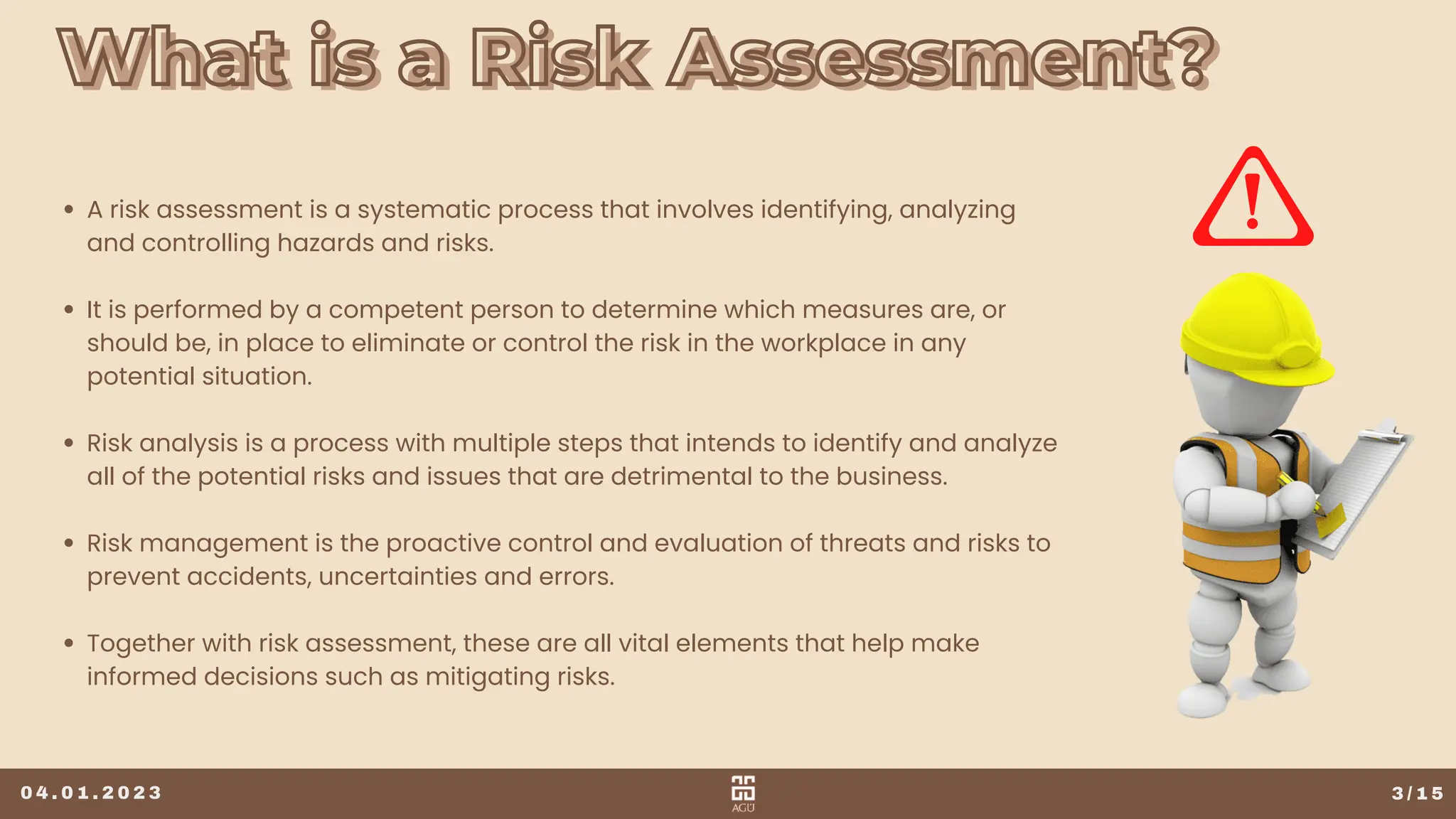
A risk assessment is a systematic process that involves identifying, analyzing
and controlling hazards and risks.
It is performed by a competent person to determine which measures are, or
should be, in place to eliminate or control the risk in the workplace in any
potential situation.
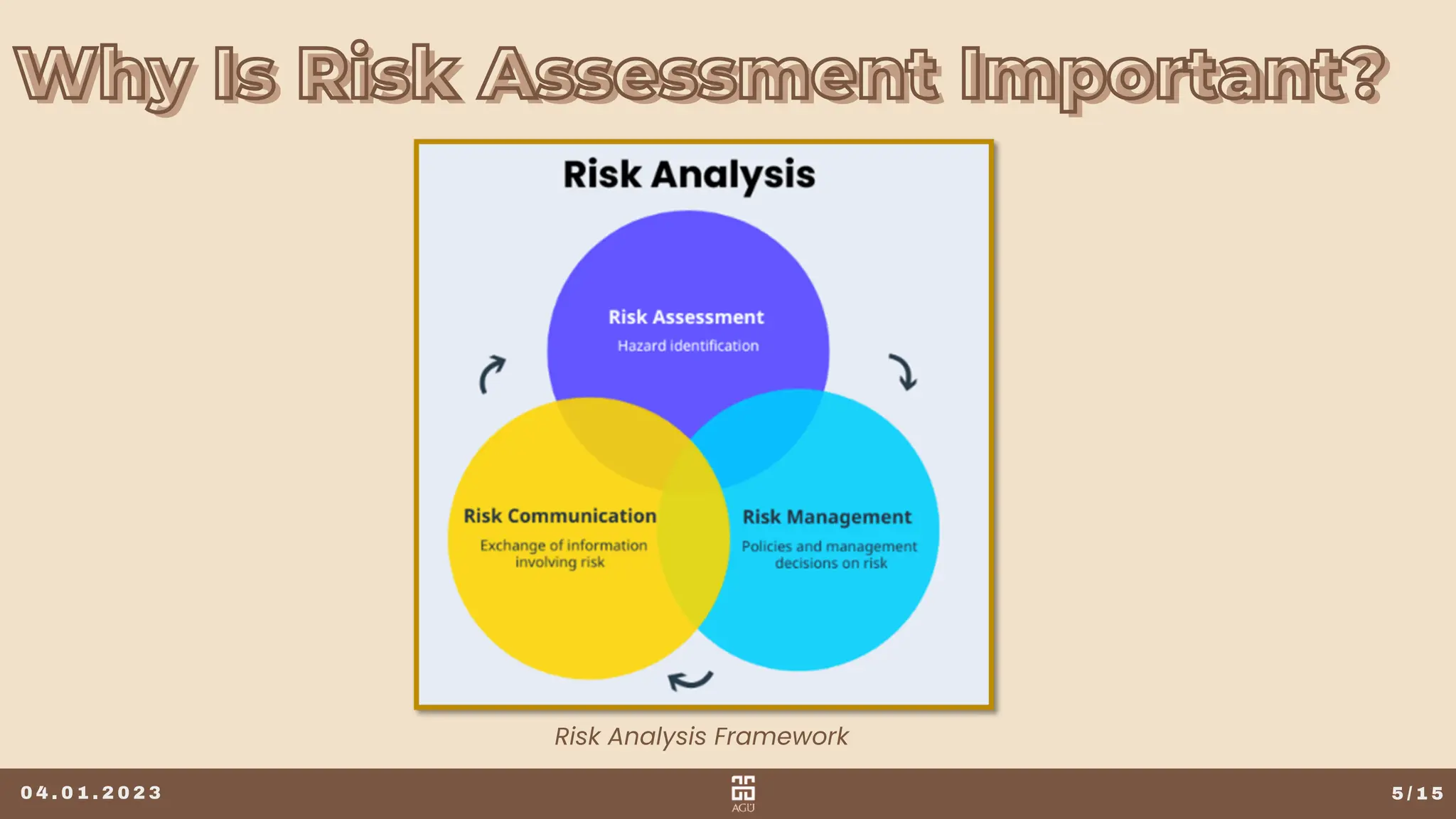
Risk analysis is a process with multiple steps that intends to identify and analyze
all of the potential risks and issues that are detrimental to the business.
Risk management is the proactive control and evaluation of threats and risks to
prevent accidents, uncertainties and errors.
Together with risk assessment, these are all vital elements that help make
informed decisions such as mitigating risks.
3 / 1 5
0 4 . 0 1 . 2 0 2 3
4.
Why Is RiskAssessment Important?
Why Is Risk Assessment Important?
Identifying hazards by using the risk assessment process is a key element when
ensuring the health and safety of your employees and customers.
There are guidelines available for different industries since present types of
possible risks may vary, an example of this is agribusinesses.
The gravity of hazard identifications is clear with all these organizations and
governments requiring risk assessments at work.
Prevent and reduce risks to save lives and to ensure that the workplace stays as
a safe space.
4 / 1 5
0 4 . 0 1 . 2 0 2 3
When Do YouPerform a Risk
When Do You Perform a Risk
Assessment?
Assessment?
Beyond complying with legislative requirements, the purpose of risk assessments are to eliminate operational
risks and improve the overall safety of the workplace.
6 / 1 5
It is employers responsibility to perform risk assessments when:
new processes or steps are introduced in the workflow;
changes are made to the existing processes,
equipment, and tools; or new hazards arise
Risk assessments are also performed by auditors when planning
an audit procedure for a company.
0 4 . 0 1 . 2 0 2 3
7.
3 Types ofRisk Assessment
3 Types of Risk Assessment
Large Scale Assessments
A Quantitative Risk Assessment (QRA) is used to evaluate the risks
associated with large-scale, complex hazard sites in industries such as
nuclear power and oil and gas.
Required Specific Assessments
This refers to assessments that are required under specific legislation or
regulations, such as the handling of hazardous substances
General assessments
This type of assessment manages general workplace risks and is
required under the management of legal health and safety
administrations.
7 / 1 5
0 4 . 0 1 . 2 0 2 3
8.
Tools and Techniques
Toolsand Techniques
8 / 1 5
There are options on the tools and techniques that
can be seamlessly incorporated into a business
process. The four common risk assessment tools are:
risk matrix, decision tree, failure modes and effects
analysis (FMEA), and bowtie model. Other risk
assessment techniques include what-if analysis,
failure tree analysis, and hazard operability analysis.
0 4 . 0 1 . 2 0 2 3
9.
Tools and Techniques
Toolsand Techniques
9 / 1 5
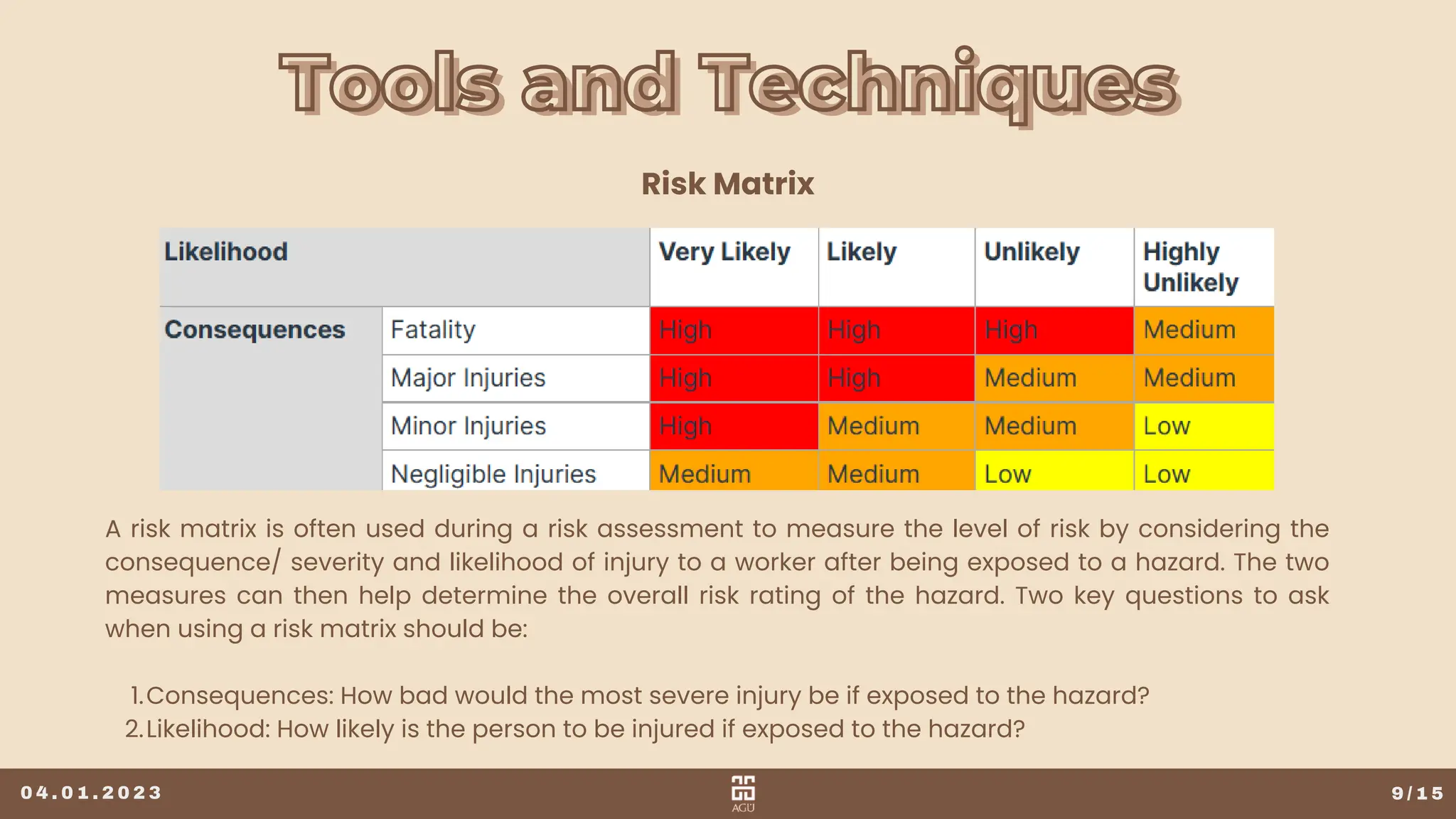
Risk Matrix
A risk matrix is often used during a risk assessment to measure the level of risk by considering the
consequence/ severity and likelihood of injury to a worker after being exposed to a hazard. The two
measures can then help determine the overall risk rating of the hazard. Two key questions to ask
when using a risk matrix should be:
1.Consequences: How bad would the most severe injury be if exposed to the hazard?
2.Likelihood: How likely is the person to be injured if exposed to the hazard?
0 4 . 0 1 . 2 0 2 3
10.
Research the workplaceand see what harm could
reasonably be expected.
Identify common workplace hazards.
Check manufacturers or suppliers' instructions or data
sheets for obvious hazards.
Review previous crash and near miss reports. Identify
hazards efficiently using a hazard identification
checklist.
5 STEPS
5 STEPS
1 0 / 1 5
0 4 . 0 1 . 2 0 2 3
1. IDENTIFY HAZARDS
1. IDENTIFY HAZARDS
11.
5 STEPS
5 STEPS
11 / 1 5
To assess the risk of a hazard, you must consider how, where, how much
and for how long individuals are exposed to a potential hazard.
Assign a risk rating to your hazards with the help of a risk matrix.
Using a risk matrix can help quantify the level of risk per hazard, taking into
account factors such as probability of occurrence and severity of potential
injury.
0 4 . 0 1 . 2 0 2 3
2. EVALUATE THE RISKS
2. EVALUATE THE RISKS
12.
5 STEPS
5 STEPS
12 / 1 5
After assigning a risk rating to an identified hazard, it’s time to come up with
effective controls to protect workers, properties, civilians, and/or the
environment. Follow the hierarchy of controls in prioritizing the implementation
of controls.
0 4 . 0 1 . 2 0 2 3
3. DECIDE ON CONTROL MEASURE TO
3. DECIDE ON CONTROL MEASURE TO
IMPLEMENT
IMPLEMENT
13.
5 STEPS
5 STEPS
13 / 1 5
It is important to keep a formal record of risk assessments. This can help your
organization keep track of hazards, risk, and control measures. Documentation
may include a detailed description of the process in assessing the risk, an
outline of evaluations, and detailed explanations on how conclusions were
made.
0 4 . 0 1 . 2 0 2 3
4. DOCUMENT YOUR FINDINGS
4. DOCUMENT YOUR FINDINGS
14.
5 STEPS
5 STEPS
14 / 1 5
Follow up with your assessments and see if your recommended controls have
been put in place. If the conditions in which your risk assessment was based on
change significantly, use your best judgment to determine if a new risk
assessment is necessary.
0 4 . 0 1 . 2 0 2 3
5. REVIEW YOUR ASSESSMENT AND
5. REVIEW YOUR ASSESSMENT AND
UPDATE IF NECESSARY
UPDATE IF NECESSARY