High pressure injection
injuries
Sean Nicklin
Hand Surgeon
Sydney Hospital, Prince of Wales & Sydney Children's Hospitals
High pressure injection injuries
• High pressure injection into hand
• Paint, paint stripper, grease, oil, water, air
• First cases described by Hesse in 1925 (German)
• Rees 1937
• Jet fuel R MF 4000psi
• Infection and necrosis
• Surgical emergency
• Timely I&D, debridement and washout
• Severity of injury often underestimated
Epidemiology
• 1 in 600 hand traumas
• 1-4 / year large centres
• Patient:
• Male
• 35 yo
• Labourer
• Industrial cleaning, fueling, painting
• Site:
• Non dominant hand
• Index finger (>50%) > palm > rest of hand
• Mechanism:
• Cleaning nozzle with hand or cloth
• Grasping pressurised tubing with leak
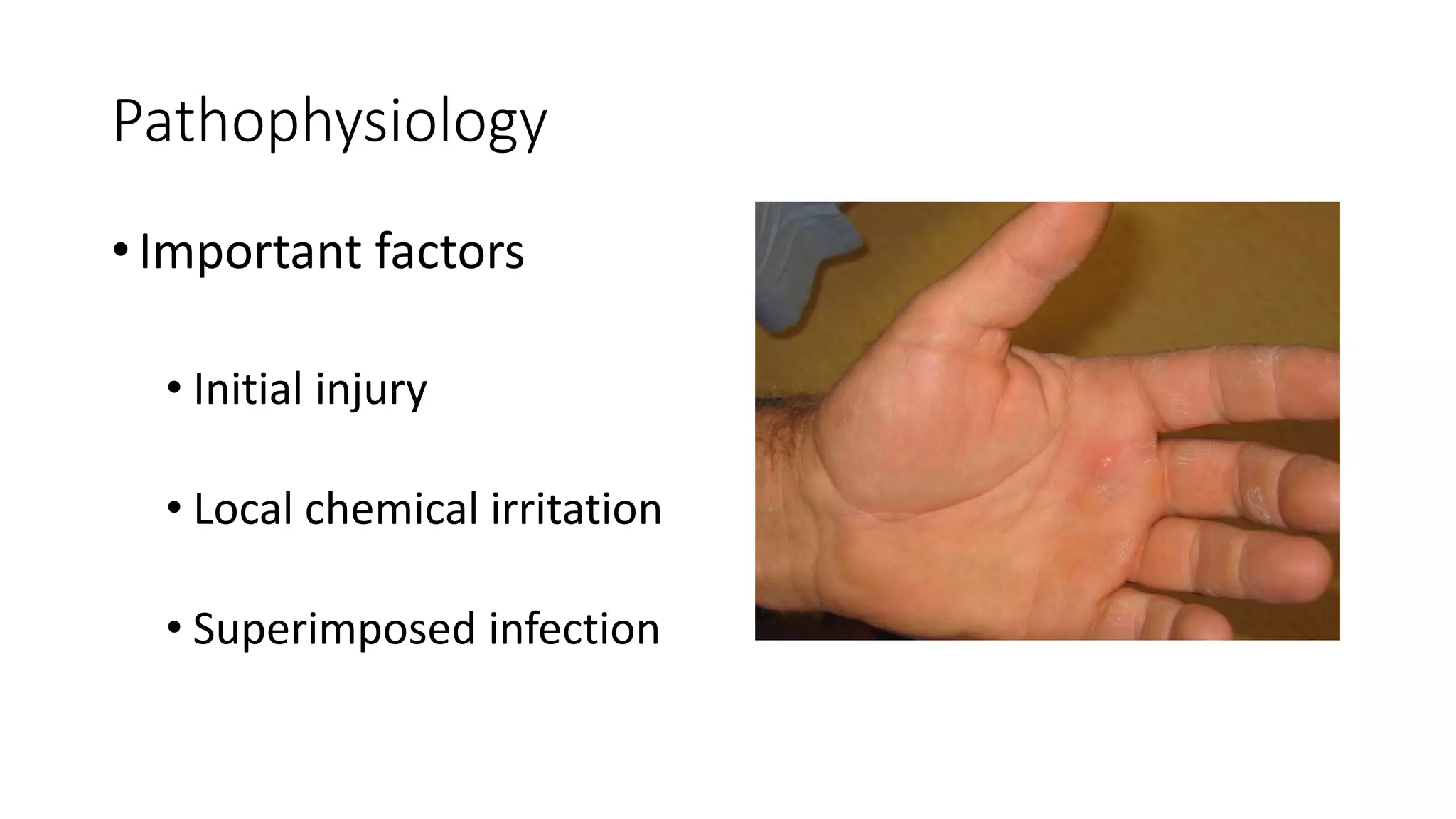
Pathophysiology
•Important factors
• Initial injury
• Local chemical irritation
• Superimposed infection
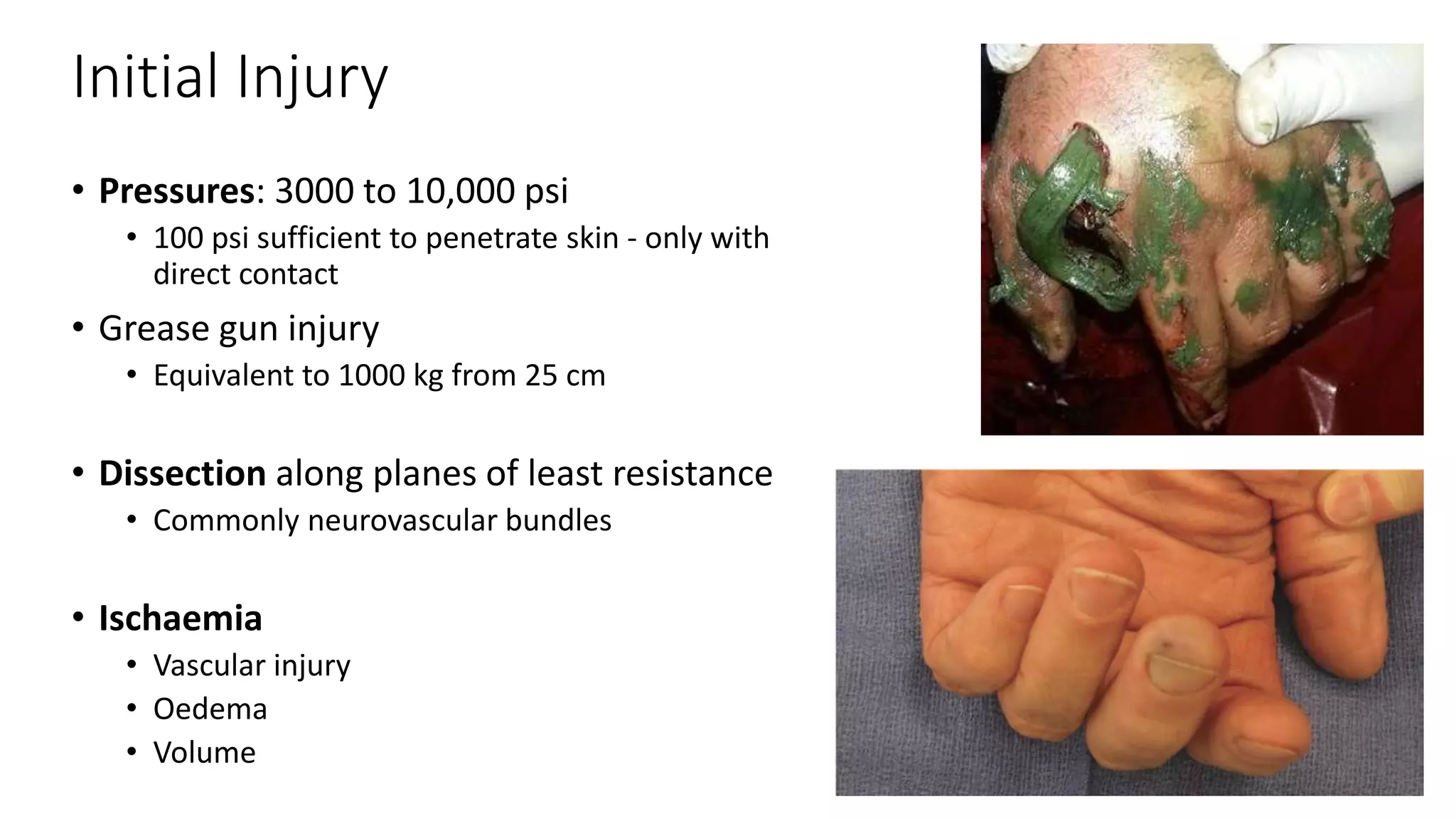
Initial Injury
• Pressures: 3000 to 10,000 psi
• 100 psi sufficient to penetrate skin - only with
direct contact
• Grease gun injury
• Equivalent to 1000 kg from 25 cm
• Dissection along planes of least resistance
• Commonly neurovascular bundles
• Ischaemia
• Vascular injury
• Oedema
• Volume
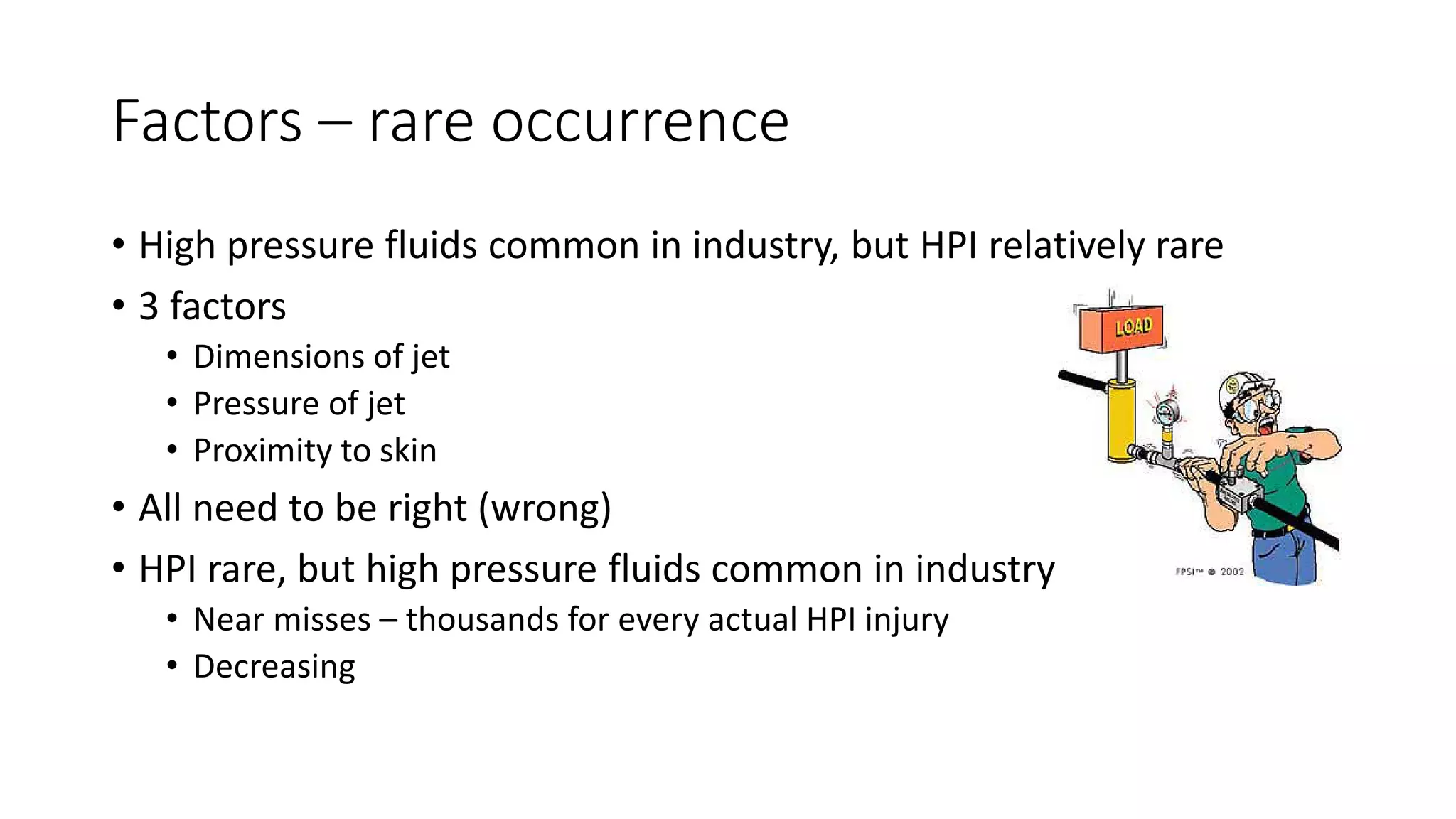
Factors – rare occurrence
• High pressure fluids common in industry, but HPI relatively rare
• 3 factors
• Dimensions of jet
• Pressure of jet
• Proximity to skin
• All need to be right (wrong)
• HPI rare, but high pressure fluids common in industry
• Near misses – thousands for every actual HPI injury
• Decreasing
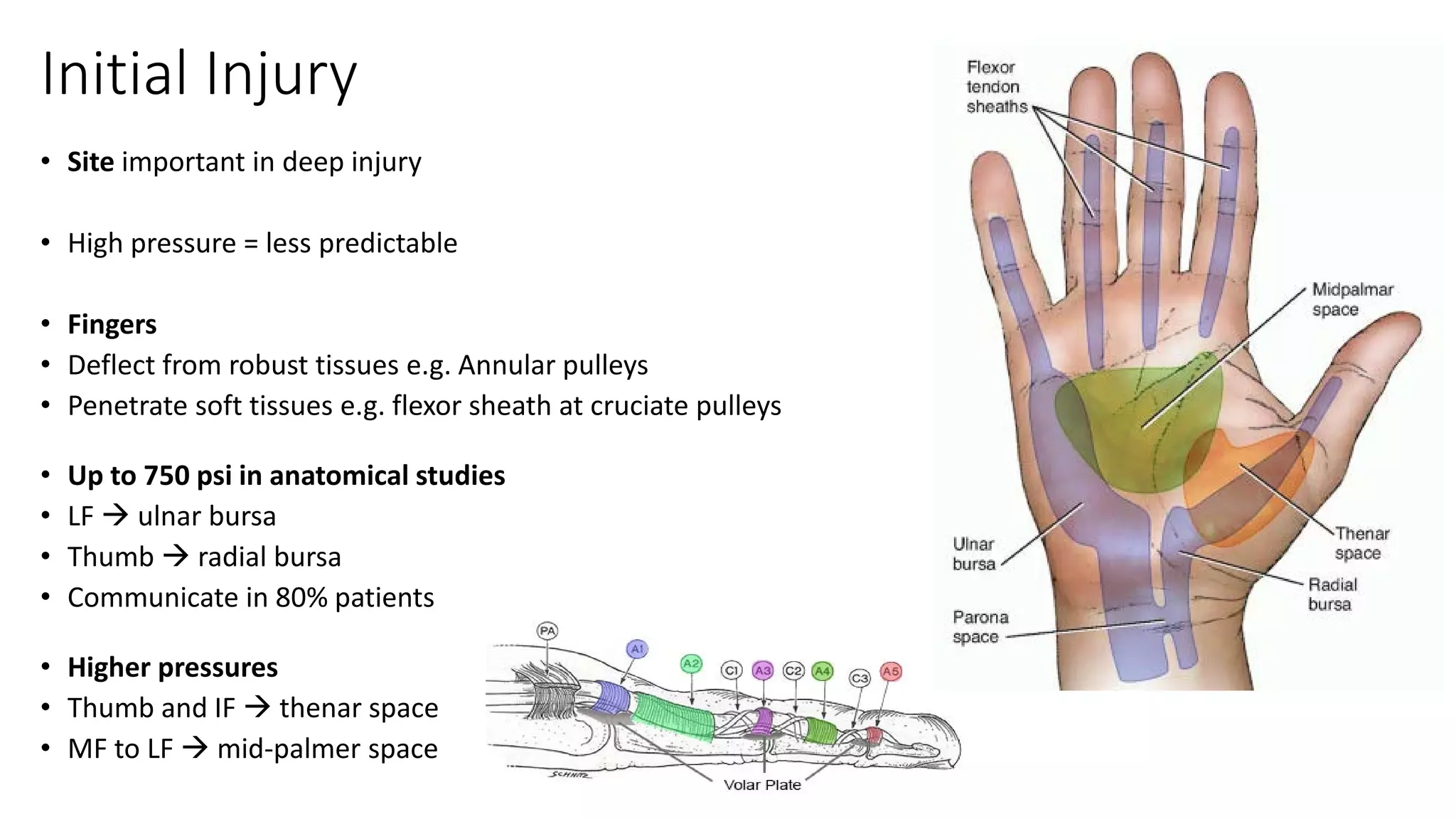
Initial Injury
• Site important in deep injury
• High pressure = less predictable
• Fingers
• Deflect from robust tissues e.g. Annular pulleys
• Penetrate soft tissues e.g. flexor sheath at cruciate pulleys
• Up to 750 psi in anatomical studies
• LF  ulnar bursa
• Thumb  radial bursa
• Communicate in 80% patients
• Higher pressures
• Thumb and IF  thenar space
• MF to LF  mid-palmer space
Initial Injury
• Mid palm
• Deposition of material deep to palmar
aponeurosis
• Occasional through and through injuries
Local chemical irritation
• Common:
• Paint, grease, hydraulic fluid, diesel, paint
thinner
• Features:
• Intrinsically cytotoxic
• Induce large inflammatory response
• Dissolve fats/nerve sheaths e.g. turpentine
• Viscosity can determine extent of injury
• Prognosis:
• Oil based paints - 58% amputation
• Grease – 6% amputation
• Air or water – rare amputation
Poorer prognosis Better prognosis
Paint (oil based)
Grease
Water
Air
Water based paint
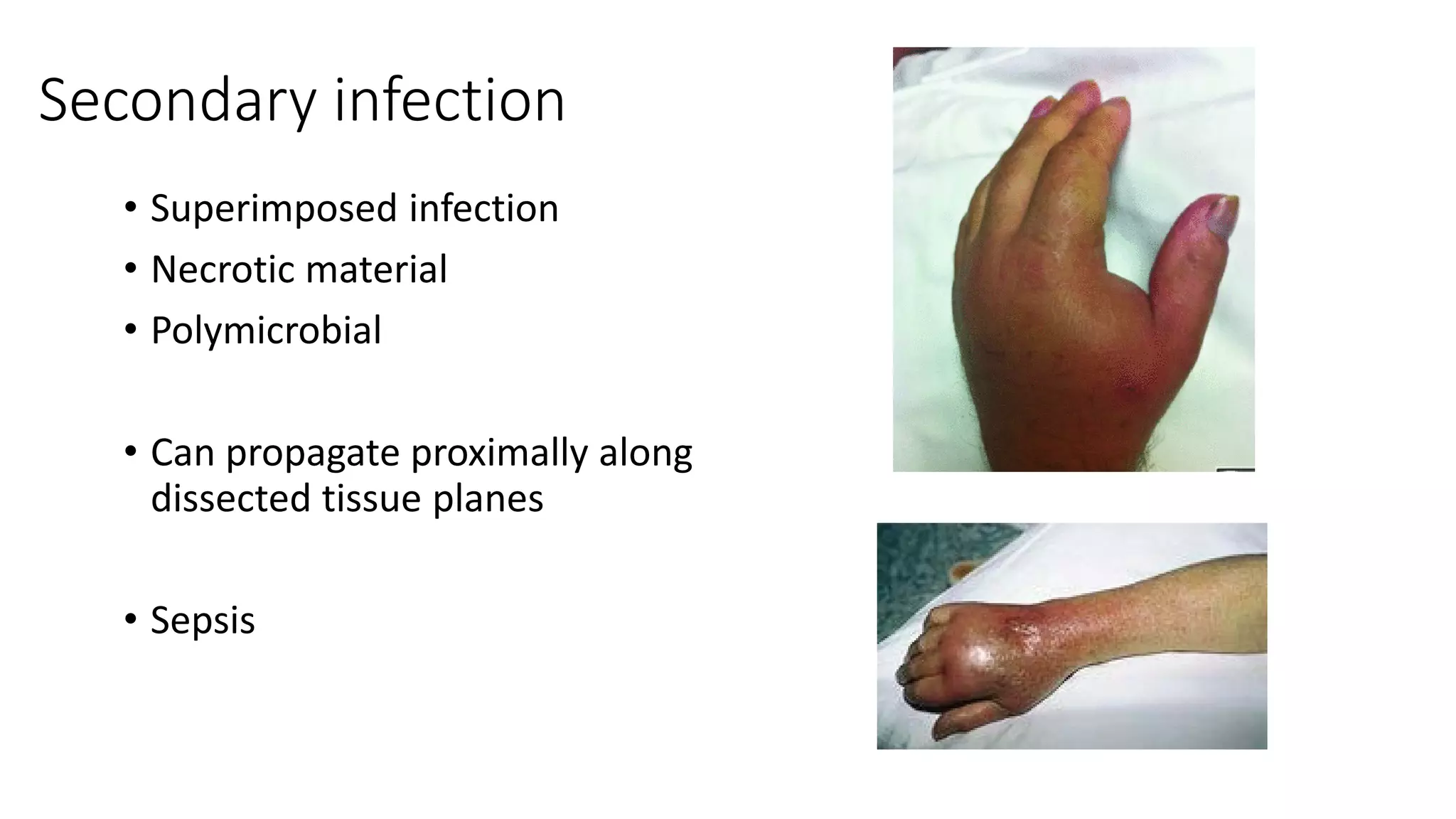
Secondary infection
• Superimposed infection
• Necrotic material
• Polymicrobial
• Can propagate proximally along
dissected tissue planes
• Sepsis
Natural history
• Clinical stages (Mason and Queen, 1941)
• Acute
• Immediate
• Spasm, compression, damage to neurovascular bundles
• Ischaemia
• Intermediate
• Foreign body reaction
• Severe fibrosis
• Formation of granulomas
• Stiffness and loss of function
• Late
• Remodeling phase
• Breakdown of granulomas
• Widespread cutaneous lesions and sinuses
• Malignancies reported
Clinical presentation
• Symptoms
• Early
• Initially pain-free
• Delay presentation
• Late
• Progressive pain and parasthaesia
• Signs
• Early
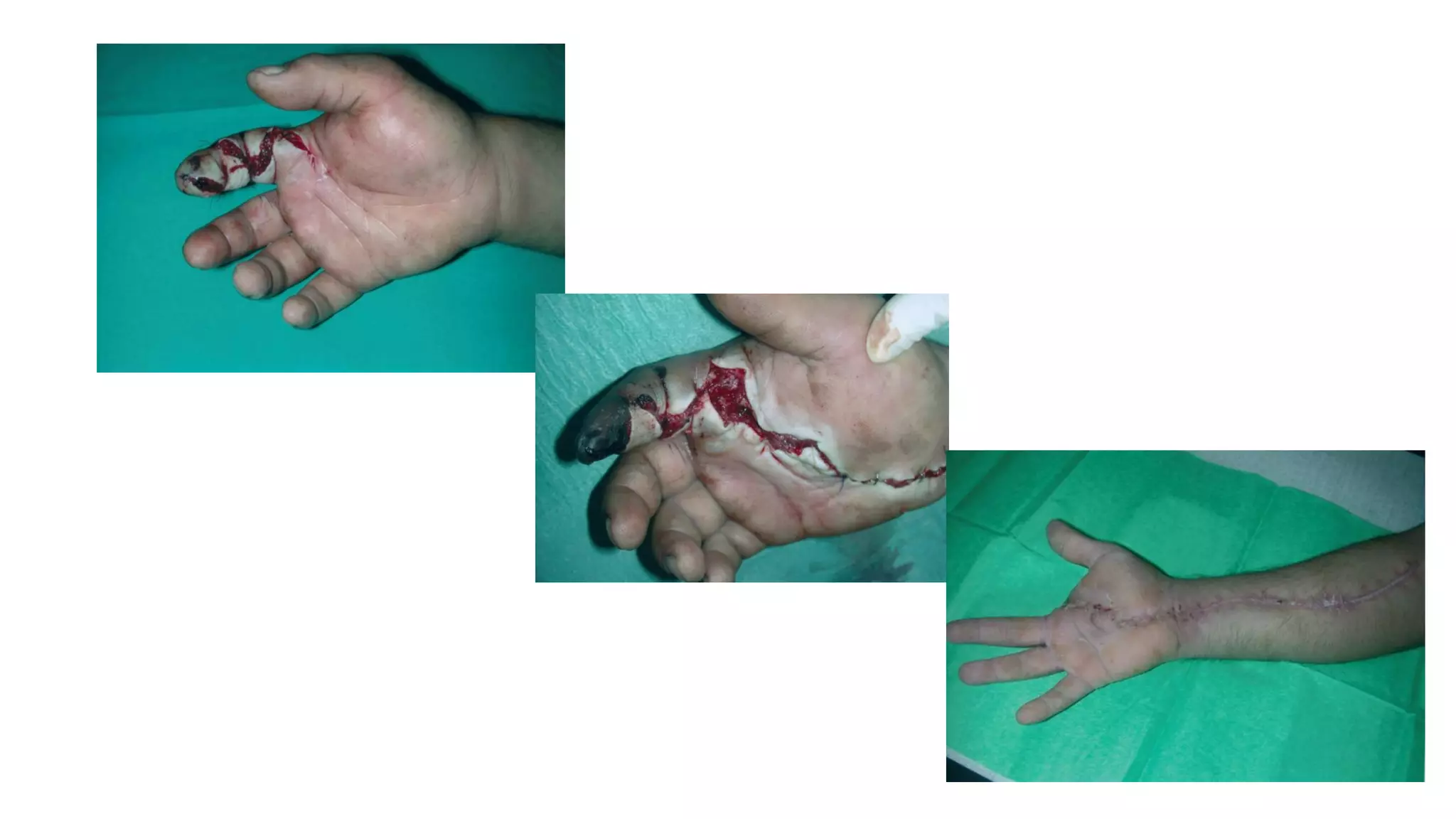
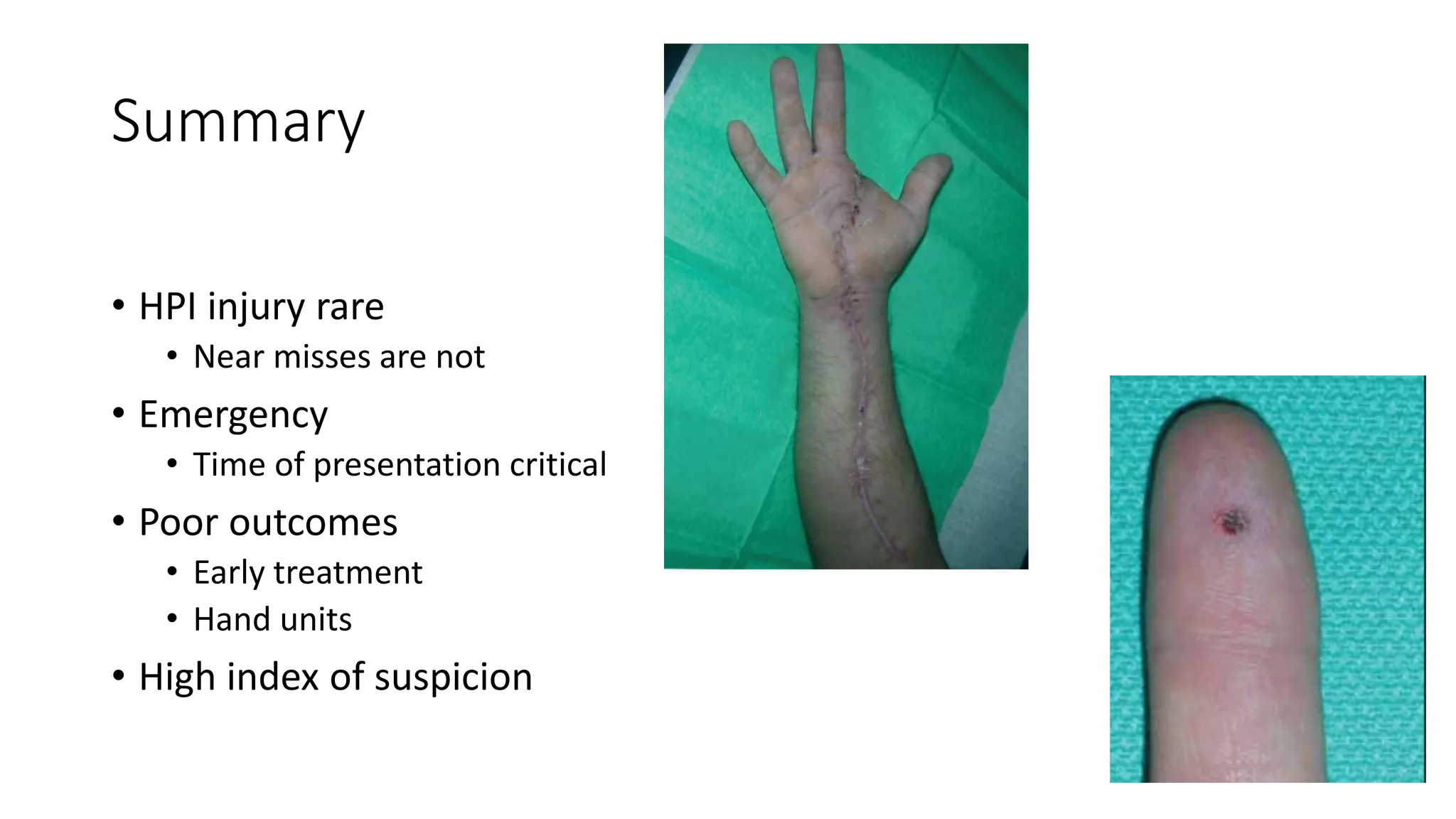
• Small punctate lesion over grasping surface
• Injectate expressed
• Innocuous appearance
• Late
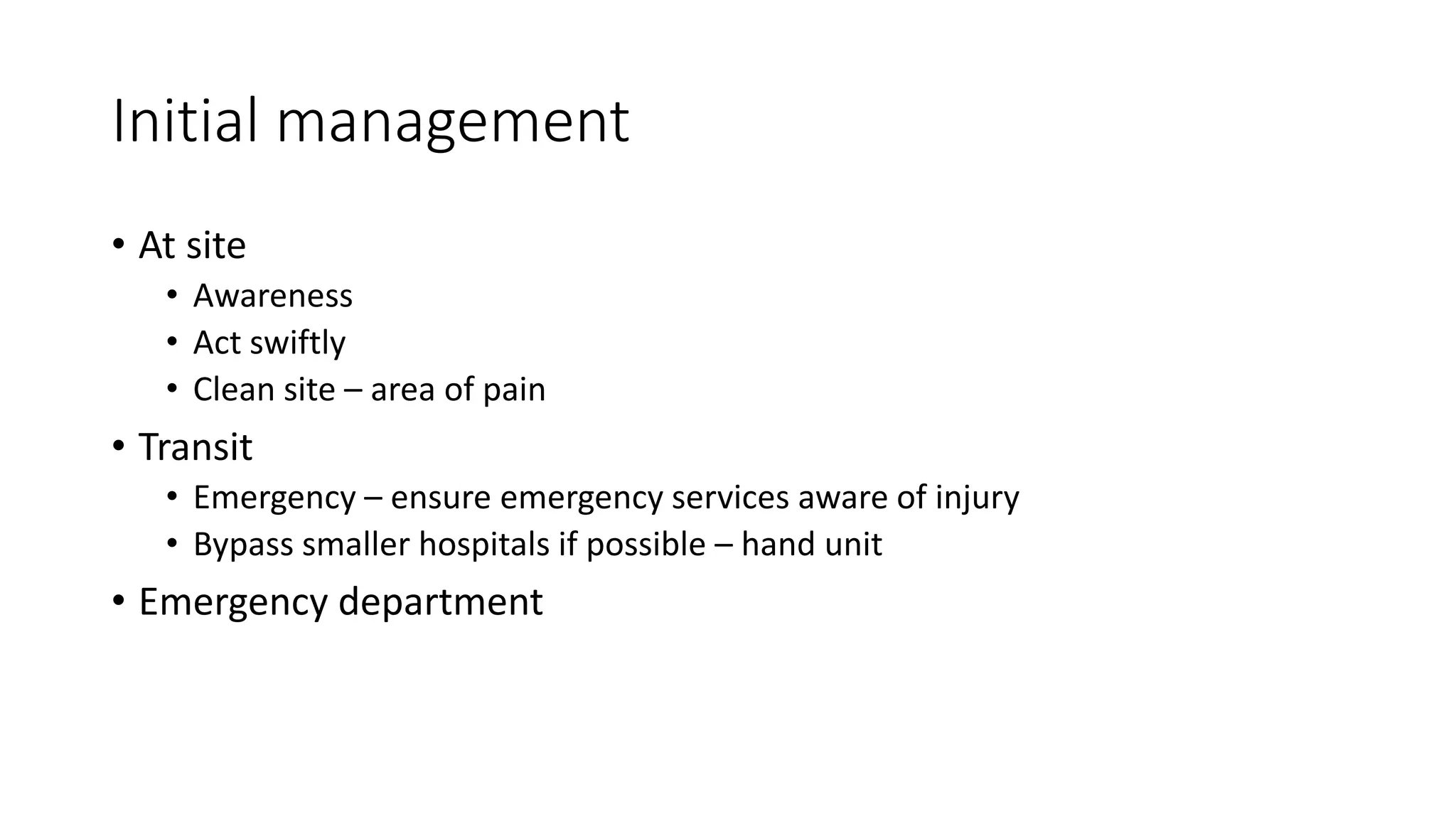
• Swelling
• Neurovascular compromise
• Flexor tenosynovitis
• Necrotising fasciitis
• Acute carpal tunnel syndrome
Initial management
• At site
• Awareness
• Act swiftly
• Clean site – area of pain
• Transit
• Emergency – ensure emergency services aware of injury
• Bypass smaller hospitals if possible – hand unit
• Emergency department
Initial management
• Investigations
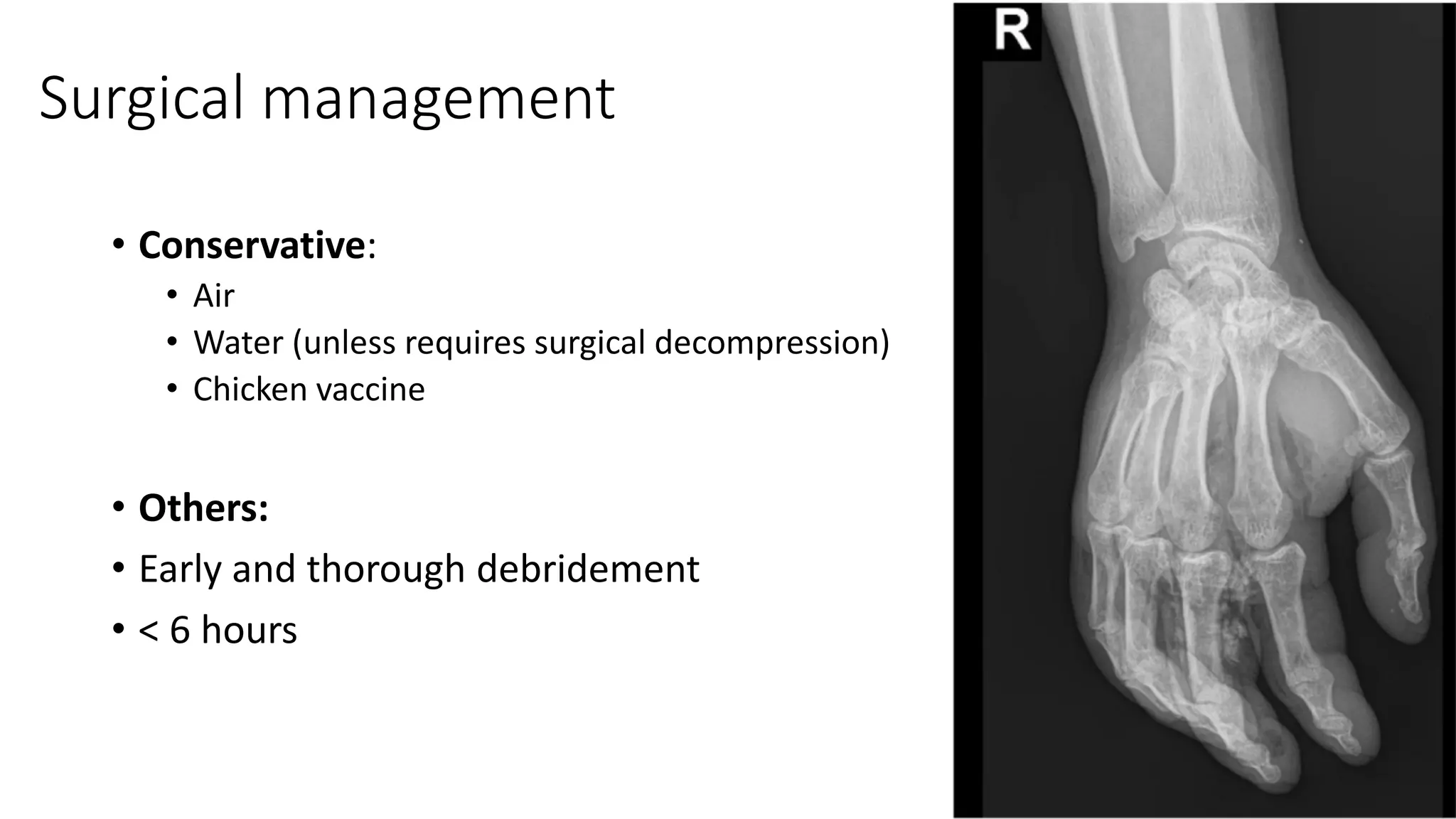
• XR
• FB
• Radio-opaque chemical
• Underlying bone injury
• Bloods
• Elevate limb
• Tetanus prophylaxis
• IV antibiotics
• Analgesia
• Resting splint
• Monitor for compartment syndrome
Surgical management
• Conservative:
• Air
• Water (unless requires surgical decompression)
• Chicken vaccine
• Others:
• Early and thorough debridement
• < 6 hours
Surgical management
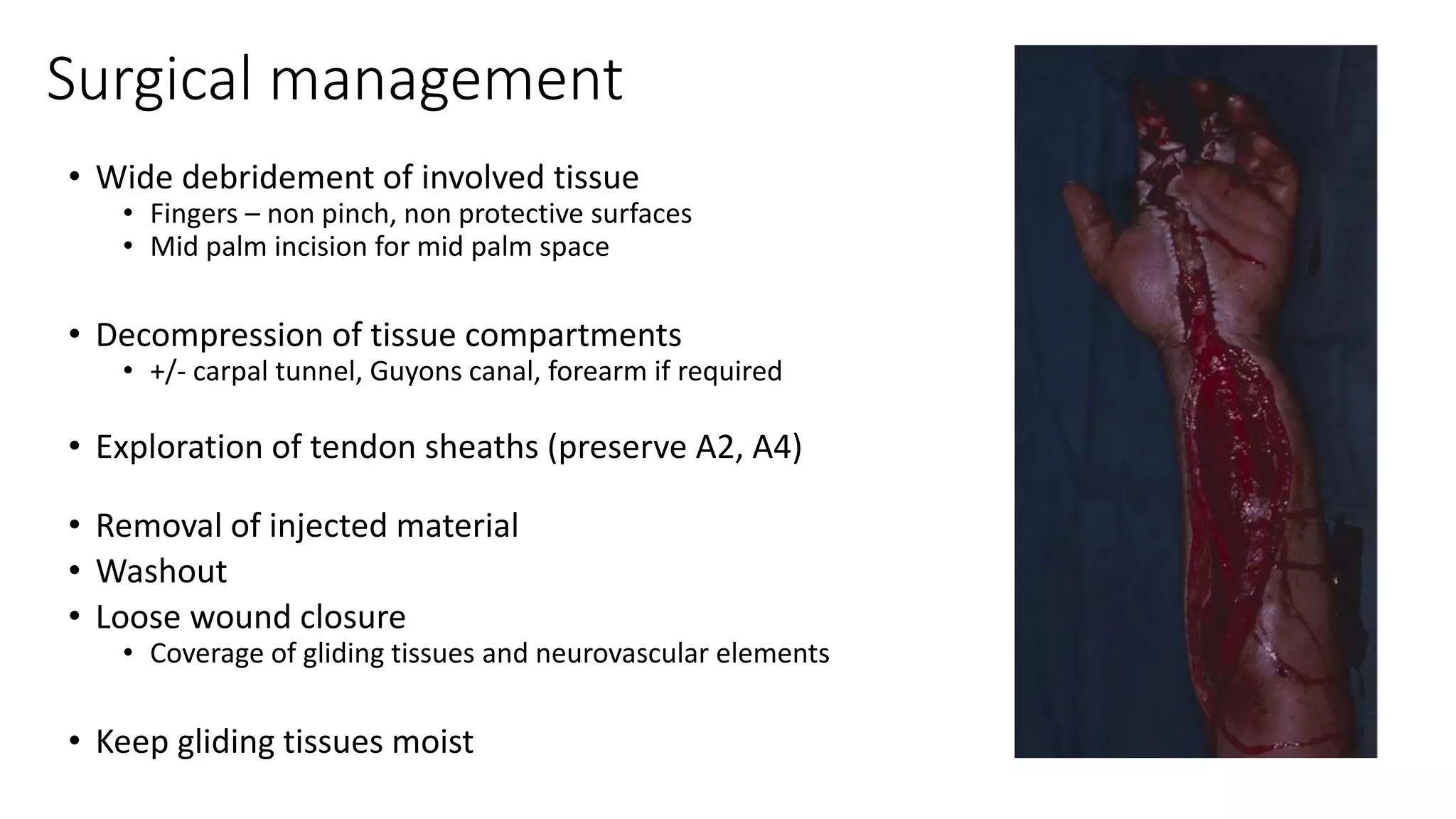
• Wide debridement of involved tissue
• Fingers – non pinch, non protective surfaces
• Mid palm incision for mid palm space
• Decompression of tissue compartments
• +/- carpal tunnel, Guyons canal, forearm if required
• Exploration of tendon sheaths (preserve A2, A4)
• Removal of injected material
• Washout
• Loose wound closure
• Coverage of gliding tissues and neurovascular elements
• Keep gliding tissues moist
Surgical management
• Repeat debridement at 24-72 hours may be required
• Multiple debridement's may be required
• Once adequate wound bed established, soft tissue coverage with skin
graft / flap may be necessary
• Early active, active assisted and pROM stressing tendon gliding and
digital oedema control
Steroids and antibiotics
• Steroids
• Controversial
• Minimise swelling / inflammatory response
• ?impact on superimposed infection
• Antibiotics
• Cover both gram positive and gram negative
Rehabilitiation
• Hand therapist
• Not always readily available – worth effort
• Tissue injured
• Tendons, joints, skin, nerves
• Site of injury
• Volar v dorsal
• Time to healing
• Prolonged open wounds or skin grafts
• Improvement over one year
• Significant change over 3 months
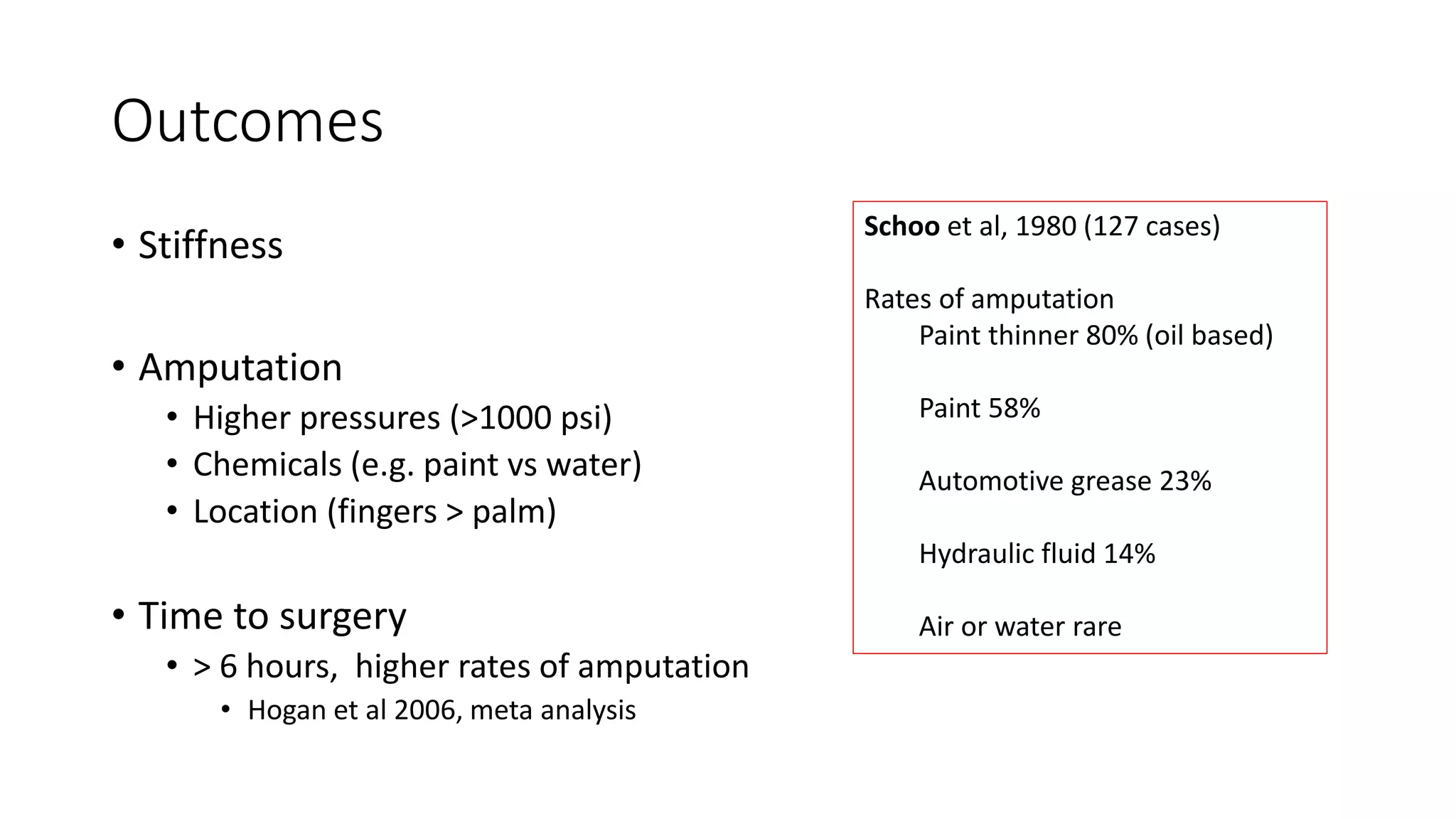
Outcomes
• Stiffness
• Amputation
• Higher pressures (>1000 psi)
• Chemicals (e.g. paint vs water)
• Location (fingers > palm)
• Time to surgery
• > 6 hours, higher rates of amputation
• Hogan et al 2006, meta analysis
Schoo et al, 1980 (127 cases)
Rates of amputation
Paint thinner 80% (oil based)
Paint 58%
Automotive grease 23%
Hydraulic fluid 14%
Air or water rare
Summary
• HPI injury rare
• Near misses are not
• Emergency
• Time of presentation critical
• Poor outcomes
• Early treatment
• Hand units
• High index of suspicion
References
• 1. Rosenwasser M, Wei D. High-pressure Injection Injuries to the Hand. Journal of the
American Academy of Orthopaedic Surgeons. 2014;22(1):38-45. doi:10.5435/jaaos-
22-01-38
• 2. Luber K, Rehm J, Freekand A. High-Pressure Injection Injuries of the Hand.
Orthopedics. 2005;28(2):129-132.
• 3. Hogan C, Ruland R. High-pressure Injection Injuries to the Upper Extremity: A
Review of the Literature. J Orthop Trauma. 2006;20(7):503-511.
doi:10.1097/00005131-200608000-00010
• 4. Schoo M, Scott F, Boswick J. High-pressure injection injuries of the hand. Journal of
Trauma. 1980;20(3).

High pressure injection injuries Dr Sean Nicklin

  • 1.
    High pressure injection injuries SeanNicklin Hand Surgeon Sydney Hospital, Prince of Wales & Sydney Children's Hospitals
  • 2.
    High pressure injectioninjuries • High pressure injection into hand • Paint, paint stripper, grease, oil, water, air • First cases described by Hesse in 1925 (German) • Rees 1937 • Jet fuel R MF 4000psi • Infection and necrosis • Surgical emergency • Timely I&D, debridement and washout • Severity of injury often underestimated
  • 3.
    Epidemiology • 1 in600 hand traumas • 1-4 / year large centres • Patient: • Male • 35 yo • Labourer • Industrial cleaning, fueling, painting • Site: • Non dominant hand • Index finger (>50%) > palm > rest of hand • Mechanism: • Cleaning nozzle with hand or cloth • Grasping pressurised tubing with leak
  • 4.
    Pathophysiology •Important factors • Initialinjury • Local chemical irritation • Superimposed infection
  • 5.
    Initial Injury • Pressures:3000 to 10,000 psi • 100 psi sufficient to penetrate skin - only with direct contact • Grease gun injury • Equivalent to 1000 kg from 25 cm • Dissection along planes of least resistance • Commonly neurovascular bundles • Ischaemia • Vascular injury • Oedema • Volume
  • 6.
    Factors – rareoccurrence • High pressure fluids common in industry, but HPI relatively rare • 3 factors • Dimensions of jet • Pressure of jet • Proximity to skin • All need to be right (wrong) • HPI rare, but high pressure fluids common in industry • Near misses – thousands for every actual HPI injury • Decreasing
  • 7.
    Initial Injury • Siteimportant in deep injury • High pressure = less predictable • Fingers • Deflect from robust tissues e.g. Annular pulleys • Penetrate soft tissues e.g. flexor sheath at cruciate pulleys • Up to 750 psi in anatomical studies • LF  ulnar bursa • Thumb  radial bursa • Communicate in 80% patients • Higher pressures • Thumb and IF  thenar space • MF to LF  mid-palmer space
  • 8.
    Initial Injury • Midpalm • Deposition of material deep to palmar aponeurosis • Occasional through and through injuries
  • 9.
    Local chemical irritation •Common: • Paint, grease, hydraulic fluid, diesel, paint thinner • Features: • Intrinsically cytotoxic • Induce large inflammatory response • Dissolve fats/nerve sheaths e.g. turpentine • Viscosity can determine extent of injury • Prognosis: • Oil based paints - 58% amputation • Grease – 6% amputation • Air or water – rare amputation Poorer prognosis Better prognosis Paint (oil based) Grease Water Air Water based paint
  • 10.
    Secondary infection • Superimposedinfection • Necrotic material • Polymicrobial • Can propagate proximally along dissected tissue planes • Sepsis
  • 11.
    Natural history • Clinicalstages (Mason and Queen, 1941) • Acute • Immediate • Spasm, compression, damage to neurovascular bundles • Ischaemia • Intermediate • Foreign body reaction • Severe fibrosis • Formation of granulomas • Stiffness and loss of function • Late • Remodeling phase • Breakdown of granulomas • Widespread cutaneous lesions and sinuses • Malignancies reported
  • 12.
    Clinical presentation • Symptoms •Early • Initially pain-free • Delay presentation • Late • Progressive pain and parasthaesia • Signs • Early • Small punctate lesion over grasping surface • Injectate expressed • Innocuous appearance • Late • Swelling • Neurovascular compromise • Flexor tenosynovitis • Necrotising fasciitis • Acute carpal tunnel syndrome
  • 13.
    Initial management • Atsite • Awareness • Act swiftly • Clean site – area of pain • Transit • Emergency – ensure emergency services aware of injury • Bypass smaller hospitals if possible – hand unit • Emergency department
  • 14.
    Initial management • Investigations •XR • FB • Radio-opaque chemical • Underlying bone injury • Bloods • Elevate limb • Tetanus prophylaxis • IV antibiotics • Analgesia • Resting splint • Monitor for compartment syndrome
  • 15.
    Surgical management • Conservative: •Air • Water (unless requires surgical decompression) • Chicken vaccine • Others: • Early and thorough debridement • < 6 hours
  • 16.
    Surgical management • Widedebridement of involved tissue • Fingers – non pinch, non protective surfaces • Mid palm incision for mid palm space • Decompression of tissue compartments • +/- carpal tunnel, Guyons canal, forearm if required • Exploration of tendon sheaths (preserve A2, A4) • Removal of injected material • Washout • Loose wound closure • Coverage of gliding tissues and neurovascular elements • Keep gliding tissues moist
  • 17.
    Surgical management • Repeatdebridement at 24-72 hours may be required • Multiple debridement's may be required • Once adequate wound bed established, soft tissue coverage with skin graft / flap may be necessary • Early active, active assisted and pROM stressing tendon gliding and digital oedema control
  • 18.
    Steroids and antibiotics •Steroids • Controversial • Minimise swelling / inflammatory response • ?impact on superimposed infection • Antibiotics • Cover both gram positive and gram negative
  • 19.
    Rehabilitiation • Hand therapist •Not always readily available – worth effort • Tissue injured • Tendons, joints, skin, nerves • Site of injury • Volar v dorsal • Time to healing • Prolonged open wounds or skin grafts • Improvement over one year • Significant change over 3 months
  • 20.
    Outcomes • Stiffness • Amputation •Higher pressures (>1000 psi) • Chemicals (e.g. paint vs water) • Location (fingers > palm) • Time to surgery • > 6 hours, higher rates of amputation • Hogan et al 2006, meta analysis Schoo et al, 1980 (127 cases) Rates of amputation Paint thinner 80% (oil based) Paint 58% Automotive grease 23% Hydraulic fluid 14% Air or water rare
  • 25.
    Summary • HPI injuryrare • Near misses are not • Emergency • Time of presentation critical • Poor outcomes • Early treatment • Hand units • High index of suspicion
  • 26.
    References • 1. RosenwasserM, Wei D. High-pressure Injection Injuries to the Hand. Journal of the American Academy of Orthopaedic Surgeons. 2014;22(1):38-45. doi:10.5435/jaaos- 22-01-38 • 2. Luber K, Rehm J, Freekand A. High-Pressure Injection Injuries of the Hand. Orthopedics. 2005;28(2):129-132. • 3. Hogan C, Ruland R. High-pressure Injection Injuries to the Upper Extremity: A Review of the Literature. J Orthop Trauma. 2006;20(7):503-511. doi:10.1097/00005131-200608000-00010 • 4. Schoo M, Scott F, Boswick J. High-pressure injection injuries of the hand. Journal of Trauma. 1980;20(3).