Wound Management Emerg Med Clin N Am, 25 (August 2007) 873–899
Goal of Wound Management Providing painless, quick wound closure Excellent cosmetic result Avoiding infection
History  Contaminated wounds mammalian bites, human bites,  wounds incurred in submerged bodies of water (eg, streams, lakes, ponds).  “ old” wounds, high level of bacteria 6 to 8 hours after wounding.
Golden Period for Wounds Repair The accepted interval from injury to wound closure is up to  6 hours for wounds to the extremities  and up to  24 hours for face and scalp  wounds.
Tetanus-Prone Wounds Age of wound greater than 6 hours Stellate wound or avulsion Depth of wound greater than 1 cm, mechanism of injury is a missile, crush, burn, or frostbite Signs of infection are present Devitalized tissue is present Presence of contaminants (dirt, feces, soil, or saliva) Presence of denervated or ischemic tissue
Physical Examination  Location Length in centimeters Neurovascular examination Motor examination Exploration for tendon or joint involvement Presence of foreign body
Wound Preparation  High-pressure irrigation Recommended irrigation pressure is 5 to 8 psi which can be achieved by using a 30 to 60 ml syringe and a 19 gauge needle or splash shield Use  50 to 100 ml of irrigant per cm  of laceration  If  saline  is not available for irrigation,  tap water  may be a good alternative Detergents, hydrogen peroxide, and concentrated povidone-iodine should be  avoided in wound irrigation
Types of Wound Closure Primary closure  is closure of the wound before formation of granulation tissue.  All “clean” wounds can be closed primarily except puncture wounds that cannot be irrigated adequately.
Contaminated wounds, noncosmetic animal bites, abscess cavities, and wounds presenting after a delay should be irrigated, hemorrhage controlled, and debrided.  Delayed primary closure  can be performed after 3 to 5 days to allow the patient's defense system to decrease the bacterial load.
 
Secondary closure   is healing by granulation tissue. This type of closure is suited for partial-thickness avulsions (ie, fingertip injuries), contaminated small wounds (ie, puncture wounds, stab wounds), and infected wounds.
Techniques of Wound Closure When the goal is to obtain the best function, the laceration should be closed in a single layer with the least amount of sutures.  When cosmesis is most important, a multiple-layer closure should be used.
Stellate wounds are best closed with simple interrupted sutures.
For a wound under increased tension, such as over joints, horizontal mattress sutures can be used in a single-layer closure because they are naturally everting, hemostatic, and do not cut through skin edges if tension increases from movement or swelling.
Materials  Sutures Staples Tissue adhesives Adhesive tapes
 
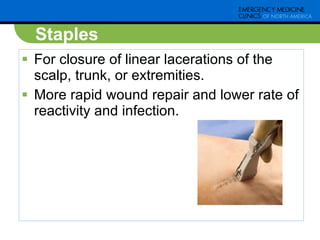
Staples For closure of linear lacerations of the scalp, trunk, or extremities. More rapid wound repair and lower rate of reactivity and infection.
Tissue Adhesives Less painful and faster than closure with sutures.  Limited to linear lacerations less than 4 cm in length in wounds devoid of significant tension or repetitive movement.
Adhesive Tapes  Less risk of infection than either staples or sutures.
Scalp A scalp wound requires palpation and exploration for the evaluation of a possible skull fracture.  Scalp lacerations 3 to 10 cm in length also can be closed using the patient's own hair.
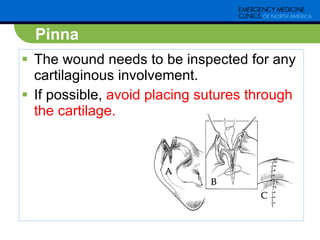
Pinna  The wound needs to be inspected for any cartilaginous involvement. If possible,  avoid placing sutures through the cartilage.
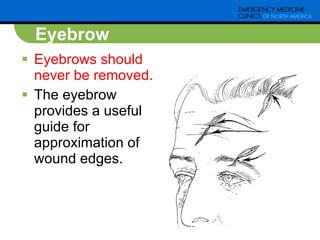
Eyebrow Eyebrows should never be removed.  The eyebrow provides a useful guide for approximation of wound edges.
Lip  Through-and-through lip lacerations require  layered closure from the inside out .  Suturing the oral mucosa first  minimizes contamination of the wound from saliva.  Subsequently the muscle layer is closed with 4.0 or 5.0 absorbable suture. In closing the outer aspect of the lip, priority is given to approximating the vermilion border with the first stitch or “stay” suture placed at this site.
 
Oral Cavity and Mucous Membranes Lacerations of the buccal mucosa and gingiva generally heal without repair. Wounds that are longer than 2 cm, gaping, or continuing to bleed should be closed tightly with absorbable 4.0 or 5.0 suture.
Face With cheek lacerations, there is potential for injury to the parotid gland and to the seventh cranial nerve.  Discharge of clear fluid from the wound indicates parotid gland or Stensen's duct involvement.
Bites
Gunshot Wounds  Wounds caused by bullets should be debrided, irrigated, and left open to be repaired with delayed primary closure or by secondary closure.
Antibiotics in Wound Care  In general, antibiotics are recommended for contaminated wounds or wounds that cannot be adequately debrided or irrigated.  Also antibiotics need to be considered in patients who are more prone to infection including DM, bacterial endocarditis, orthopedic prosthesis and lymphedema.
 

Wound Management

  • 1.
    Wound Management EmergMed Clin N Am, 25 (August 2007) 873–899
  • 2.
    Goal of WoundManagement Providing painless, quick wound closure Excellent cosmetic result Avoiding infection
  • 3.
    History Contaminatedwounds mammalian bites, human bites, wounds incurred in submerged bodies of water (eg, streams, lakes, ponds). “ old” wounds, high level of bacteria 6 to 8 hours after wounding.
  • 4.
    Golden Period forWounds Repair The accepted interval from injury to wound closure is up to 6 hours for wounds to the extremities and up to 24 hours for face and scalp wounds.
  • 5.
    Tetanus-Prone Wounds Ageof wound greater than 6 hours Stellate wound or avulsion Depth of wound greater than 1 cm, mechanism of injury is a missile, crush, burn, or frostbite Signs of infection are present Devitalized tissue is present Presence of contaminants (dirt, feces, soil, or saliva) Presence of denervated or ischemic tissue
  • 6.
    Physical Examination Location Length in centimeters Neurovascular examination Motor examination Exploration for tendon or joint involvement Presence of foreign body
  • 7.
    Wound Preparation High-pressure irrigation Recommended irrigation pressure is 5 to 8 psi which can be achieved by using a 30 to 60 ml syringe and a 19 gauge needle or splash shield Use 50 to 100 ml of irrigant per cm of laceration If saline is not available for irrigation, tap water may be a good alternative Detergents, hydrogen peroxide, and concentrated povidone-iodine should be avoided in wound irrigation
  • 8.
    Types of WoundClosure Primary closure is closure of the wound before formation of granulation tissue. All “clean” wounds can be closed primarily except puncture wounds that cannot be irrigated adequately.
  • 9.
    Contaminated wounds, noncosmeticanimal bites, abscess cavities, and wounds presenting after a delay should be irrigated, hemorrhage controlled, and debrided. Delayed primary closure can be performed after 3 to 5 days to allow the patient's defense system to decrease the bacterial load.
  • 10.
  • 11.
    Secondary closure is healing by granulation tissue. This type of closure is suited for partial-thickness avulsions (ie, fingertip injuries), contaminated small wounds (ie, puncture wounds, stab wounds), and infected wounds.
  • 12.
    Techniques of WoundClosure When the goal is to obtain the best function, the laceration should be closed in a single layer with the least amount of sutures. When cosmesis is most important, a multiple-layer closure should be used.
  • 13.
    Stellate wounds arebest closed with simple interrupted sutures.
  • 14.
    For a woundunder increased tension, such as over joints, horizontal mattress sutures can be used in a single-layer closure because they are naturally everting, hemostatic, and do not cut through skin edges if tension increases from movement or swelling.
  • 15.
    Materials SuturesStaples Tissue adhesives Adhesive tapes
  • 16.
  • 17.
    Staples For closureof linear lacerations of the scalp, trunk, or extremities. More rapid wound repair and lower rate of reactivity and infection.
  • 18.
    Tissue Adhesives Lesspainful and faster than closure with sutures. Limited to linear lacerations less than 4 cm in length in wounds devoid of significant tension or repetitive movement.
  • 19.
    Adhesive Tapes Less risk of infection than either staples or sutures.
  • 20.
    Scalp A scalpwound requires palpation and exploration for the evaluation of a possible skull fracture. Scalp lacerations 3 to 10 cm in length also can be closed using the patient's own hair.
  • 21.
    Pinna Thewound needs to be inspected for any cartilaginous involvement. If possible, avoid placing sutures through the cartilage.
  • 22.
    Eyebrow Eyebrows shouldnever be removed. The eyebrow provides a useful guide for approximation of wound edges.
  • 23.
    Lip Through-and-throughlip lacerations require layered closure from the inside out . Suturing the oral mucosa first minimizes contamination of the wound from saliva. Subsequently the muscle layer is closed with 4.0 or 5.0 absorbable suture. In closing the outer aspect of the lip, priority is given to approximating the vermilion border with the first stitch or “stay” suture placed at this site.
  • 24.
  • 25.
    Oral Cavity andMucous Membranes Lacerations of the buccal mucosa and gingiva generally heal without repair. Wounds that are longer than 2 cm, gaping, or continuing to bleed should be closed tightly with absorbable 4.0 or 5.0 suture.
  • 26.
    Face With cheeklacerations, there is potential for injury to the parotid gland and to the seventh cranial nerve. Discharge of clear fluid from the wound indicates parotid gland or Stensen's duct involvement.
  • 27.
  • 28.
    Gunshot Wounds Wounds caused by bullets should be debrided, irrigated, and left open to be repaired with delayed primary closure or by secondary closure.
  • 29.
    Antibiotics in WoundCare In general, antibiotics are recommended for contaminated wounds or wounds that cannot be adequately debrided or irrigated. Also antibiotics need to be considered in patients who are more prone to infection including DM, bacterial endocarditis, orthopedic prosthesis and lymphedema.
  • 30.