Classification and management of
wound, principle of wound healing,
haemorrhage and bleeding control
1
WOUND
2
What is a wound?
⚫ It is a circumscribed injury which is caused by an external
force and it can involve any tissue or organ.
surgical, traumatic
It can be mild, severe, or even lethal.
Simple wound
Compound wound
Acute
Chronic
3
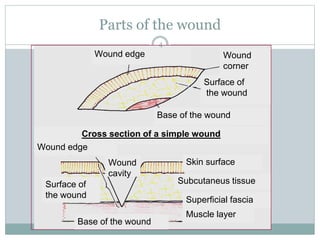
Parts of the wound
Wound edge Wound
corner
Surface of
the wound
Base of the wound
Cross section of a simple wound
Skin surface
Subcutaneus tissue
Superficial fascia
Muscle layer
Base of the wound
Wound edge
Surface of
the wound
Wound
cavity
4
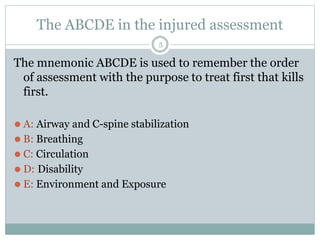
The ABCDE in the injured assessment
The mnemonic ABCDE is used to remember the order
of assessment with the purpose to treat first that kills
first.
⚫ A: Airway and C-spine stabilization
⚫ B: Breathing
⚫ C: Circulation
⚫ D: Disability
⚫ E: Environment and Exposure
5
Wound management
⚫When and where was the wound occured?
⚫Alcohol and drug consumption
⚫What did caused the wound?
⚫The circumstances of the injury
⚫Other diseases eg. diabetes mellitus, tumour,
atherosclesosis, allergy
⚫The state of patient’s vaccination against Tetanus
⚫Prevention of rabies
⚫The applied first-aid
6
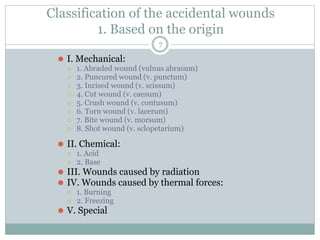
Classification of the accidental wounds
1. Based on the origin
⚫ I. Mechanical:
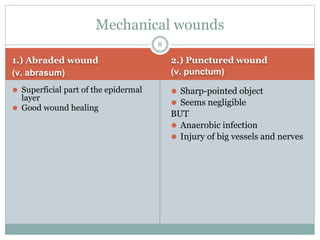
⚪ 1. Abraded wound (vulnus abrasum)
⚪ 2. Puncured wound (v. punctum)
⚪ 3. Incised wound (v. scissum)
⚪ 4. Cut wound (v. caesum)
⚪ 5. Crush wound (v. contusum)
⚪ 6. Torn wound (v. lacerum)
⚪ 7. Bite wound (v. morsum)
⚪ 8. Shot wound (v. sclopetarium)
⚫ II. Chemical:
⚪ 1. Acid
⚪ 2. Base
⚫ III. Wounds caused by radiation
⚫ IV. Wounds caused by thermal forces:
⚪ 1. Burning
⚪ 2. Freezing
⚫ V. Special
7
1.) Abraded wound
(v. abrasum)
2.) Punctured wound
(v. punctum)
⚫ Superficial part of the epidermal
layer
⚫ Good wound healing
⚫ Sharp-pointed object
⚫ Seems negligible
BUT
⚫ Anaerobic infection
⚫ Injury of big vessels and nerves
Mechanical wounds
8
3.) Incised wound
(v. scissum)
4.) Cut wound (v. caesum)
⚫ Sharp object
⚫ Best healing
⚫ Sharp object + blunt additional
force
⚫ Edges - uneven
Mechanical wounds
9
5.) Crush wound
(v. contusum)
6.) Torn wound
(v. lacerum)
⚫ Blunt force
⚫ Pressure injury
⚫ Edges – uneven and torn
⚫ Bleeding
⚫ Great tearing or pulling
⚫ Incomplete amputation
Mechanical wounds
10
(v. lacerocontusum)
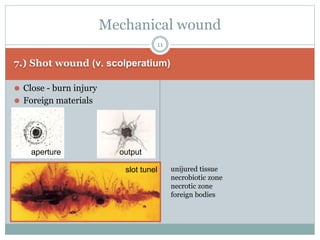
7.) Shot wound (v. scolperatium)
⚫ Close - burn injury
⚫ Foreign materials
Mechanical wound
11
unijured tissue
necrobiotic zone
necrotic zone
foreign bodies
aperture
slot tunel
output
8.) Bite wound (v. morsum)
⚫ Ragged wound
⚫ Crushed tissue
⚫ Torn
⚫ Infection
⚫ Bone fracture
⚫ Prevention of rabies
⚫ Tetanus profilaxis
Mechanical wounds
12
Distal Proximal
The wound healing is good
The direction of the flap
13
1.) Acid 2.) Base
⚫ in small concentration – irritate
⚫ in large concentration –
coagulation necrosis
⚫ colliquative necrosis
Chemical wounds
14
Symptoms and severity
depend on:
⚫ Amount of radiation
⚫ Length of exposure
⚫ Body part that was exposed
Symptoms may occur immediately,
after a few days, or even as long
as months.
What part of the body is
most sensitive during
radiation sickness?
bone marrow
gastrointestinal tract
Wounds caused by radiation
15
1.) Burning 2.) Freezing
⚫ a – normal skin
⚫ 1 - 1st degree – superficial injury
(epidermis)
⚫ 2 – 2nd degree –partial or deep partial
thickness (epidermis+superficial or deep
dermis)
⚫ 3 – 3rd degree – full thickness (epidermis
+ entire dermis)
⚫ 4 – 4th degree – (skin + subcutaneous
tissue + muscle and bone)
⚫ Treatment:
⚫ Cooling – cold water and clean covering
Wounds caused by thermal forces
16
Metabolic change! - toxemia ⚫ mild, moderate, severe (redness,
bullas, necrosis)
⚫ rewarm – not only the frozen area
but the whole body
Exotic, poisonous animals
⚫ Toxins, venom - toxicologist
⚫ Skin necrosis
Special wounds
17
Classification of the wounds
2. According to the bacterial contamination
⚫Clean wound
⚫Clean-contaminated wound
⚫Contaminated wound
⚫Heavily contaminated wound
18
⚫Superficial
⚫Partial thickness
⚫Full thickness
⚫Deep wound
Classification of the wounds
2. Depending on the depth of injury
+ bone, opened cavities, organs…etc.
19
source: http://www.funscrape.com/Search/1/skin+layers.html
Wound management - history
⚫ Ancient Egypt – lint (fibrous base-wound site closure), animal grease
(barrier) and honey (antibiotic)
„closing the wound preserved the soul”
⚫ Greeks – acute wound= „fresh” wound; chronic wound = „non-healing”
wound
maintaining wound-site moisture
⚫ Ambroise Paré – hot oil ↔ oil of roses and turpentine, ligature of
arteries instead of cauterization
⚫ Lister pretreated surgical gauze – Robert Wood Johnson →1870s;
gauze and wound dressings treated with iodide
20
Applied wound management -
colour continuum
black black-yellow yellow yellow-red red red-pink pink
21
source: Applied wound management supplement – www.wounds-uk.com
Applied wound management
infection continuum
contamination
colonisation infection
sterility
critical colonisation
22
the quantity and diversity of microbes
source: Applied wound management supplement – www.wounds-uk.com
Applied wound management
exudate continuum
volume high - 5 medium - 3 low - 1
high - 5
medium -3
low - 1
Viscosity
23
source: Applied wound management supplement – www.wounds-uk.com
The wound managemanet
⚫Temporary wound management (first aid)
⚪ clean, hemostasis, covering
⚫Final primary wound management
⚪ clean, anaesthesis, excision, sutures
⚪ ALWAYS: thoracic cavity, abdominal wall or dura mater injury
⚪ NEVER: war injury, inflammation, contamination, foreign
body, special jobs,
bite, shot, deep punctured wound
⚫Primary delayed suture (3-8 days)
⚪ clean, wash – saline, cover
⚪ excision of wound edges, sutures
24
The wound managemanet
25
⚫Early secondary wound closure (2 weeks)
⚪ after inflammation, necrosis – proliferation
⚪ anesthesia, refresh wound edges, suturing and draining
⚫Late secondary wound closure (4-6 weeks)
⚪ anesthesis, scar excision, suturing, draining
⚪ greater defect – plastic surgery
The surgical wound
⚫ Surgical incision
⚫ Stretch and fix
⚫ Handling the scalpel
⚫ Langer lines
⚫ Skin edges
⚫ Vessels and nerves
⚫ Hemostasis
Langer lines
The wound edges
Handling the scalpel
26
source: http://www.med-
ars.it/galleries/langer.htm
Tissue unifying and dressing the wound
Skin:
⚫ Stiches
⚫ Clips
⚫ Steri-Strips
⚫ Tissue glues
Fascia and subcutaneous layers:
⚫ Interrupted stiches
Fat – fat necrosis!
Dressing: sterile, moist, antibiotic-containing, non-allergic,
non-adhesive
27
The wound healing
⚫Hemostasis-inflammation
⚫Granulation-proliferation
⚫Remodelling
capillaries
fibroblasts
lymphocytes
macrophages
neutrophyl gr.
thrombocytes
0 1 2 3 4 5 6 7 8 9 10 11 10 13 14 15
28
http://www.worldwidewounds.com/2004/august/Enoch/images/enochfig1.jpg
The main steps of the wound healing
1. Hemostasis-inflammation
vasoconstriction
fibrin clot formation
proinflammatory citokines and
growth factors releasing
vasodilatation
infiltration PMNs, macrophages
cytokines releasing
→ angiogensis
→ fibroblast activation
→ B- and T-cells activation
→ keratinocytes activation
→ wound contraction
29
2. Granulation-proliferation
fibroblast migration
collagen deposition
angiogensis
granulation tissue formation
epithelisation
contraction
3. Remodelling
regression of many capillaries
physical contraction – myofibroblasts
collagen degeneration and synthetisation
new epithelium
tensile strength – max. 80%
Types of wound healing
⚫ Healing by primary
intention
⚫ Healing by secondary
intention
⚫ Healing by tertiary
intention
30
source: http://quizlet.com/13665246/chapter-3-tissue-renewal-regeneration-
and-repair-flash-cards/
Factors affecting wound healing
⚫ Local
⚪ Ischemia
⚪ Infection
⚪ Foreign body
⚪ Edema, elevated
tissue pressure
⚫ Systemic
⚪ Age and gender
⚪ Sex hormones
⚪ Stress
⚪ Ischemia
⚪ Diseases
⚪ Obesity
⚪ Medication
⚪ Alcoholism and smoking
⚪ Immunocompromised
conditions
⚪ Nutrition
Hyperbaric oxygen
treatment
31
infection
ischemia
foreign
bodies
edema/
elevated
tissue
pressure
IMPAIRED
HEALING
Complications of wound healing
I. Early complications
⚫Seroma
⚫Hematoma
⚫Wound disruptin
⚫Superficial wound infection
⚫Deep wound infection
⚫Mixed wound infection
32
1.) Seroma 2.) Hematoma
⚫ Filled with serous fluid, lymph
or blood
⚫ Fluctuation, swelling, redness,
tenderness, subfebrility
TREATMENT:
⚫ Sterile punture and
compression
⚫ Suction drain
Early complications of wound healing
33
⚫ Bleeding, short drainage time,
anticoagulant
⚫ Risk of infection
⚫ Swelling, fluctuation, pain,
redness
TREATMENT
⚫ Sterile puncture
⚫ Surgical exploration
3.) Wound disruption
A. partial – dehiscenece
B. complete - disruption
⚫ Surgical error
⚫ Increased intraabdominal
pressure
⚫ Wound infection
⚫ Hypoproteinaemia
TREATMENT:
⚫ U-shaped sutures
Early complications of wound healing
34
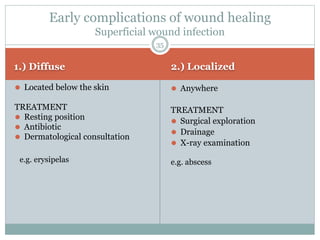
1.) Diffuse 2.) Localized
⚫ Located below the skin
TREATMENT
⚫ Resting position
⚫ Antibiotic
⚫ Dermatological consultation
⚫ Anywhere
TREATMENT
⚫ Surgical exploration
⚫ Drainage
⚫ X-ray examination
Early complications of wound healing
Superficial wound infection
35
e.g. erysipelas e.g. abscess
1.) Diffuse 2.) Localized
TREATMENT
⚫Surgical exploration
⚫Open therapy
⚫H2O2 and antibiotics
e.g. anaerobic necrosis
⚫ Inside the tissues or body cavities
TREATMENT
⚫ surgical exploration
⚫ drainage
Early complications of wound healing
Deep wound infection
36
Mixed wound infection
e.g. gangrene
⚫ necrotic tissues
⚫ putrid and anaerobic
infection
⚫ a severe clinical picture
TREATMENT
⚫ aggresive surgical
debridement
⚫ effective and specified
(antibiotic) therapy
37
Complications of wound healing
I. Early complications
Complications of wound healing
II. Late complications
⚫Hyperthrophic scar
⚫Keloid formation
⚫Necrosis
⚫Inflammatory infiltration
⚫Abscesses
⚫Foreign body containing abscesses
38
Hypertrophic scar Keloid
⚫ Develop in areas of thick
chorium
⚫ Non-hyalinic collagen
fibres and fibroblasts
⚫ Confine to the incision
line
TREATMENT
⚫ Regress spontaneously
(1-2 yrs)
Late complications
39
⚫ Mostly African and Asian
population
⚫ Well-defined edge
⚫ Emerging, tough structure
⚫ Overproliferation of collagen
fibers in the subcutaneous tissue
⚫ Subjective complains
TREATMENT
⚫ Postoperative radiation
⚫ Corticosteroid + local anaesthetic
injection
BLEEDING AND HEMOSTASIS
40
Anatomical Diffuse
⚪ Arterial – bright red,
pulsate
⚪ Venous – dark red,
continuous
⚪ Capillary – can become
serious
⚪ Parenchymal
Bleeding
41
Bleeding
Severity of bleeding – the volume of the lost blood and
time
42
source: http://lifeinthefastlane.com/2012/03/trauma-tribulation-025/
The direction of hemorrage
⚫External
⚫Internal
⚪ In a luminar organ (hematuria, hemoptoe, melena)
⚪ In body cavities (intracranial, hemothorax, hemascos,
hemopericardium, hemarthros)
⚪ Among the tissues (hematoma, suffusion)
43
Bleeding
⚫ Preoperative hemorrhage
Prehospital care! – maintenance of the airways, ventillation and circulation
bandages, direct pressure, turniquets
⚫ Intraoperative hemorrhage
anatomical and/or diffuse
depending on the surgeon, the surgery, position,
the size of the vessel, pressure in the vessel
ANESTHESIA!
⚫ Postoperative bleeding
ineffective local hemostasis, undetected hemostatic defect, consumptive
coagulopathy or fibrinolysis
44
Local General
⚫ Hematoma, suffusion,
ecchymosis
⚫ Compression in the pleural
cavity, in pericardium, in the
skull
⚫ Functional disturbancies – e.g.
hyperperistalsis
⚫ Pale skin, cyanosis, decreased
BP. and tachycardia, difficulty
in breeding, sweeting,
decreased body temperature,
unconsciousness, cardiac and
laboratory standstill, laboratory
disorders, signs of shock
Signs of the bleeding
45
Surgical hemostasis
Aim – to prevent the flow of blood from the incised or
transected vessels
⚫Mechanical methods
⚫Thermal methods
⚫Chemical and biological methods
46
Surgical hemostasis
Mechanical methods
⚫Digital pressure – direct pressure,
e.g. Pringle maneuver
⚫Tourniquet
⚫Ligation
⚫Suturing
⚫Preventive hemostasis
⚫Clips
⚫Bone wax
⚫other
47
Thermal methods
⚫Low temperature
⚪ Hypothermia – eg. stomach bleeding
⚪ Cryosurgery
⯍ dehidratation and denaturation of fatty tissue
⯍ decreases the cell metabolism
⯍ vasoconstriction
48
Thermal methods
⚫High temperature
⚪ Electrosurgery – electrocauterization
⚪ Monopolar diathermy
⚪ Bipolar diathermy
⚪ Laser surgery
coagulation and vaporization
for fine tissues
49
Thermal methods
⚫High temperature
⚪ Electrocoagulation
⚪ Electrofulguration (A)
⚪ Electrodessication
⚪ Electrosection
50
Hemostasis with chemical and biological
methods
vasoconstriction coagulation hygroscopic effect
Absorbable collagen
Absorbable gelatin
Microfibrillar collagen
Oxidized celluloze
Oxytocin
Epinephrine
Thrombin
Hemcon
QuikClot
51
Hemostasis with chemical and biological
methods
HemCon
52

Wound 1.pptx

  • 1.
    Classification and managementof wound, principle of wound healing, haemorrhage and bleeding control 1
  • 2.
  • 3.
    What is awound? ⚫ It is a circumscribed injury which is caused by an external force and it can involve any tissue or organ. surgical, traumatic It can be mild, severe, or even lethal. Simple wound Compound wound Acute Chronic 3
  • 4.
    Parts of thewound Wound edge Wound corner Surface of the wound Base of the wound Cross section of a simple wound Skin surface Subcutaneus tissue Superficial fascia Muscle layer Base of the wound Wound edge Surface of the wound Wound cavity 4
  • 5.
    The ABCDE inthe injured assessment The mnemonic ABCDE is used to remember the order of assessment with the purpose to treat first that kills first. ⚫ A: Airway and C-spine stabilization ⚫ B: Breathing ⚫ C: Circulation ⚫ D: Disability ⚫ E: Environment and Exposure 5
  • 6.
    Wound management ⚫When andwhere was the wound occured? ⚫Alcohol and drug consumption ⚫What did caused the wound? ⚫The circumstances of the injury ⚫Other diseases eg. diabetes mellitus, tumour, atherosclesosis, allergy ⚫The state of patient’s vaccination against Tetanus ⚫Prevention of rabies ⚫The applied first-aid 6
  • 7.
    Classification of theaccidental wounds 1. Based on the origin ⚫ I. Mechanical: ⚪ 1. Abraded wound (vulnus abrasum) ⚪ 2. Puncured wound (v. punctum) ⚪ 3. Incised wound (v. scissum) ⚪ 4. Cut wound (v. caesum) ⚪ 5. Crush wound (v. contusum) ⚪ 6. Torn wound (v. lacerum) ⚪ 7. Bite wound (v. morsum) ⚪ 8. Shot wound (v. sclopetarium) ⚫ II. Chemical: ⚪ 1. Acid ⚪ 2. Base ⚫ III. Wounds caused by radiation ⚫ IV. Wounds caused by thermal forces: ⚪ 1. Burning ⚪ 2. Freezing ⚫ V. Special 7
  • 8.
    1.) Abraded wound (v.abrasum) 2.) Punctured wound (v. punctum) ⚫ Superficial part of the epidermal layer ⚫ Good wound healing ⚫ Sharp-pointed object ⚫ Seems negligible BUT ⚫ Anaerobic infection ⚫ Injury of big vessels and nerves Mechanical wounds 8
  • 9.
    3.) Incised wound (v.scissum) 4.) Cut wound (v. caesum) ⚫ Sharp object ⚫ Best healing ⚫ Sharp object + blunt additional force ⚫ Edges - uneven Mechanical wounds 9
  • 10.
    5.) Crush wound (v.contusum) 6.) Torn wound (v. lacerum) ⚫ Blunt force ⚫ Pressure injury ⚫ Edges – uneven and torn ⚫ Bleeding ⚫ Great tearing or pulling ⚫ Incomplete amputation Mechanical wounds 10 (v. lacerocontusum)
  • 11.
    7.) Shot wound(v. scolperatium) ⚫ Close - burn injury ⚫ Foreign materials Mechanical wound 11 unijured tissue necrobiotic zone necrotic zone foreign bodies aperture slot tunel output
  • 12.
    8.) Bite wound(v. morsum) ⚫ Ragged wound ⚫ Crushed tissue ⚫ Torn ⚫ Infection ⚫ Bone fracture ⚫ Prevention of rabies ⚫ Tetanus profilaxis Mechanical wounds 12
  • 13.
    Distal Proximal The woundhealing is good The direction of the flap 13
  • 14.
    1.) Acid 2.)Base ⚫ in small concentration – irritate ⚫ in large concentration – coagulation necrosis ⚫ colliquative necrosis Chemical wounds 14
  • 15.
    Symptoms and severity dependon: ⚫ Amount of radiation ⚫ Length of exposure ⚫ Body part that was exposed Symptoms may occur immediately, after a few days, or even as long as months. What part of the body is most sensitive during radiation sickness? bone marrow gastrointestinal tract Wounds caused by radiation 15
  • 16.
    1.) Burning 2.)Freezing ⚫ a – normal skin ⚫ 1 - 1st degree – superficial injury (epidermis) ⚫ 2 – 2nd degree –partial or deep partial thickness (epidermis+superficial or deep dermis) ⚫ 3 – 3rd degree – full thickness (epidermis + entire dermis) ⚫ 4 – 4th degree – (skin + subcutaneous tissue + muscle and bone) ⚫ Treatment: ⚫ Cooling – cold water and clean covering Wounds caused by thermal forces 16 Metabolic change! - toxemia ⚫ mild, moderate, severe (redness, bullas, necrosis) ⚫ rewarm – not only the frozen area but the whole body
  • 17.
    Exotic, poisonous animals ⚫Toxins, venom - toxicologist ⚫ Skin necrosis Special wounds 17
  • 18.
    Classification of thewounds 2. According to the bacterial contamination ⚫Clean wound ⚫Clean-contaminated wound ⚫Contaminated wound ⚫Heavily contaminated wound 18
  • 19.
    ⚫Superficial ⚫Partial thickness ⚫Full thickness ⚫Deepwound Classification of the wounds 2. Depending on the depth of injury + bone, opened cavities, organs…etc. 19 source: http://www.funscrape.com/Search/1/skin+layers.html
  • 20.
    Wound management -history ⚫ Ancient Egypt – lint (fibrous base-wound site closure), animal grease (barrier) and honey (antibiotic) „closing the wound preserved the soul” ⚫ Greeks – acute wound= „fresh” wound; chronic wound = „non-healing” wound maintaining wound-site moisture ⚫ Ambroise Paré – hot oil ↔ oil of roses and turpentine, ligature of arteries instead of cauterization ⚫ Lister pretreated surgical gauze – Robert Wood Johnson →1870s; gauze and wound dressings treated with iodide 20
  • 21.
    Applied wound management- colour continuum black black-yellow yellow yellow-red red red-pink pink 21 source: Applied wound management supplement – www.wounds-uk.com
  • 22.
    Applied wound management infectioncontinuum contamination colonisation infection sterility critical colonisation 22 the quantity and diversity of microbes source: Applied wound management supplement – www.wounds-uk.com
  • 23.
    Applied wound management exudatecontinuum volume high - 5 medium - 3 low - 1 high - 5 medium -3 low - 1 Viscosity 23 source: Applied wound management supplement – www.wounds-uk.com
  • 24.
    The wound managemanet ⚫Temporarywound management (first aid) ⚪ clean, hemostasis, covering ⚫Final primary wound management ⚪ clean, anaesthesis, excision, sutures ⚪ ALWAYS: thoracic cavity, abdominal wall or dura mater injury ⚪ NEVER: war injury, inflammation, contamination, foreign body, special jobs, bite, shot, deep punctured wound ⚫Primary delayed suture (3-8 days) ⚪ clean, wash – saline, cover ⚪ excision of wound edges, sutures 24
  • 25.
    The wound managemanet 25 ⚫Earlysecondary wound closure (2 weeks) ⚪ after inflammation, necrosis – proliferation ⚪ anesthesia, refresh wound edges, suturing and draining ⚫Late secondary wound closure (4-6 weeks) ⚪ anesthesis, scar excision, suturing, draining ⚪ greater defect – plastic surgery
  • 26.
    The surgical wound ⚫Surgical incision ⚫ Stretch and fix ⚫ Handling the scalpel ⚫ Langer lines ⚫ Skin edges ⚫ Vessels and nerves ⚫ Hemostasis Langer lines The wound edges Handling the scalpel 26 source: http://www.med- ars.it/galleries/langer.htm
  • 27.
    Tissue unifying anddressing the wound Skin: ⚫ Stiches ⚫ Clips ⚫ Steri-Strips ⚫ Tissue glues Fascia and subcutaneous layers: ⚫ Interrupted stiches Fat – fat necrosis! Dressing: sterile, moist, antibiotic-containing, non-allergic, non-adhesive 27
  • 28.
    The wound healing ⚫Hemostasis-inflammation ⚫Granulation-proliferation ⚫Remodelling capillaries fibroblasts lymphocytes macrophages neutrophylgr. thrombocytes 0 1 2 3 4 5 6 7 8 9 10 11 10 13 14 15 28 http://www.worldwidewounds.com/2004/august/Enoch/images/enochfig1.jpg
  • 29.
    The main stepsof the wound healing 1. Hemostasis-inflammation vasoconstriction fibrin clot formation proinflammatory citokines and growth factors releasing vasodilatation infiltration PMNs, macrophages cytokines releasing → angiogensis → fibroblast activation → B- and T-cells activation → keratinocytes activation → wound contraction 29 2. Granulation-proliferation fibroblast migration collagen deposition angiogensis granulation tissue formation epithelisation contraction 3. Remodelling regression of many capillaries physical contraction – myofibroblasts collagen degeneration and synthetisation new epithelium tensile strength – max. 80%
  • 30.
    Types of woundhealing ⚫ Healing by primary intention ⚫ Healing by secondary intention ⚫ Healing by tertiary intention 30 source: http://quizlet.com/13665246/chapter-3-tissue-renewal-regeneration- and-repair-flash-cards/
  • 31.
    Factors affecting woundhealing ⚫ Local ⚪ Ischemia ⚪ Infection ⚪ Foreign body ⚪ Edema, elevated tissue pressure ⚫ Systemic ⚪ Age and gender ⚪ Sex hormones ⚪ Stress ⚪ Ischemia ⚪ Diseases ⚪ Obesity ⚪ Medication ⚪ Alcoholism and smoking ⚪ Immunocompromised conditions ⚪ Nutrition Hyperbaric oxygen treatment 31 infection ischemia foreign bodies edema/ elevated tissue pressure IMPAIRED HEALING
  • 32.
    Complications of woundhealing I. Early complications ⚫Seroma ⚫Hematoma ⚫Wound disruptin ⚫Superficial wound infection ⚫Deep wound infection ⚫Mixed wound infection 32
  • 33.
    1.) Seroma 2.)Hematoma ⚫ Filled with serous fluid, lymph or blood ⚫ Fluctuation, swelling, redness, tenderness, subfebrility TREATMENT: ⚫ Sterile punture and compression ⚫ Suction drain Early complications of wound healing 33 ⚫ Bleeding, short drainage time, anticoagulant ⚫ Risk of infection ⚫ Swelling, fluctuation, pain, redness TREATMENT ⚫ Sterile puncture ⚫ Surgical exploration
  • 34.
    3.) Wound disruption A.partial – dehiscenece B. complete - disruption ⚫ Surgical error ⚫ Increased intraabdominal pressure ⚫ Wound infection ⚫ Hypoproteinaemia TREATMENT: ⚫ U-shaped sutures Early complications of wound healing 34
  • 35.
    1.) Diffuse 2.)Localized ⚫ Located below the skin TREATMENT ⚫ Resting position ⚫ Antibiotic ⚫ Dermatological consultation ⚫ Anywhere TREATMENT ⚫ Surgical exploration ⚫ Drainage ⚫ X-ray examination Early complications of wound healing Superficial wound infection 35 e.g. erysipelas e.g. abscess
  • 36.
    1.) Diffuse 2.)Localized TREATMENT ⚫Surgical exploration ⚫Open therapy ⚫H2O2 and antibiotics e.g. anaerobic necrosis ⚫ Inside the tissues or body cavities TREATMENT ⚫ surgical exploration ⚫ drainage Early complications of wound healing Deep wound infection 36
  • 37.
    Mixed wound infection e.g.gangrene ⚫ necrotic tissues ⚫ putrid and anaerobic infection ⚫ a severe clinical picture TREATMENT ⚫ aggresive surgical debridement ⚫ effective and specified (antibiotic) therapy 37 Complications of wound healing I. Early complications
  • 38.
    Complications of woundhealing II. Late complications ⚫Hyperthrophic scar ⚫Keloid formation ⚫Necrosis ⚫Inflammatory infiltration ⚫Abscesses ⚫Foreign body containing abscesses 38
  • 39.
    Hypertrophic scar Keloid ⚫Develop in areas of thick chorium ⚫ Non-hyalinic collagen fibres and fibroblasts ⚫ Confine to the incision line TREATMENT ⚫ Regress spontaneously (1-2 yrs) Late complications 39 ⚫ Mostly African and Asian population ⚫ Well-defined edge ⚫ Emerging, tough structure ⚫ Overproliferation of collagen fibers in the subcutaneous tissue ⚫ Subjective complains TREATMENT ⚫ Postoperative radiation ⚫ Corticosteroid + local anaesthetic injection
  • 40.
  • 41.
    Anatomical Diffuse ⚪ Arterial– bright red, pulsate ⚪ Venous – dark red, continuous ⚪ Capillary – can become serious ⚪ Parenchymal Bleeding 41
  • 42.
    Bleeding Severity of bleeding– the volume of the lost blood and time 42 source: http://lifeinthefastlane.com/2012/03/trauma-tribulation-025/
  • 43.
    The direction ofhemorrage ⚫External ⚫Internal ⚪ In a luminar organ (hematuria, hemoptoe, melena) ⚪ In body cavities (intracranial, hemothorax, hemascos, hemopericardium, hemarthros) ⚪ Among the tissues (hematoma, suffusion) 43
  • 44.
    Bleeding ⚫ Preoperative hemorrhage Prehospitalcare! – maintenance of the airways, ventillation and circulation bandages, direct pressure, turniquets ⚫ Intraoperative hemorrhage anatomical and/or diffuse depending on the surgeon, the surgery, position, the size of the vessel, pressure in the vessel ANESTHESIA! ⚫ Postoperative bleeding ineffective local hemostasis, undetected hemostatic defect, consumptive coagulopathy or fibrinolysis 44
  • 45.
    Local General ⚫ Hematoma,suffusion, ecchymosis ⚫ Compression in the pleural cavity, in pericardium, in the skull ⚫ Functional disturbancies – e.g. hyperperistalsis ⚫ Pale skin, cyanosis, decreased BP. and tachycardia, difficulty in breeding, sweeting, decreased body temperature, unconsciousness, cardiac and laboratory standstill, laboratory disorders, signs of shock Signs of the bleeding 45
  • 46.
    Surgical hemostasis Aim –to prevent the flow of blood from the incised or transected vessels ⚫Mechanical methods ⚫Thermal methods ⚫Chemical and biological methods 46
  • 47.
    Surgical hemostasis Mechanical methods ⚫Digitalpressure – direct pressure, e.g. Pringle maneuver ⚫Tourniquet ⚫Ligation ⚫Suturing ⚫Preventive hemostasis ⚫Clips ⚫Bone wax ⚫other 47
  • 48.
    Thermal methods ⚫Low temperature ⚪Hypothermia – eg. stomach bleeding ⚪ Cryosurgery ⯍ dehidratation and denaturation of fatty tissue ⯍ decreases the cell metabolism ⯍ vasoconstriction 48
  • 49.
    Thermal methods ⚫High temperature ⚪Electrosurgery – electrocauterization ⚪ Monopolar diathermy ⚪ Bipolar diathermy ⚪ Laser surgery coagulation and vaporization for fine tissues 49
  • 50.
    Thermal methods ⚫High temperature ⚪Electrocoagulation ⚪ Electrofulguration (A) ⚪ Electrodessication ⚪ Electrosection 50
  • 51.
    Hemostasis with chemicaland biological methods vasoconstriction coagulation hygroscopic effect Absorbable collagen Absorbable gelatin Microfibrillar collagen Oxidized celluloze Oxytocin Epinephrine Thrombin Hemcon QuikClot 51
  • 52.
    Hemostasis with chemicaland biological methods HemCon 52