

RECENT ADVANCES IN MANAGEMENT OF HIE
BY
DR. TAUHID IQBALI
MBBS (JIPMER)
MD PED. (PMCH)
DEFNITION OF HIE
NEONATAL ENCEPHALOPATHY FOLLOWING SEVERE
BIRTH ASPHYXIA OR PERINATAL HYPOXIA IS REFERED
TO AS HIE
PATHOPHYSIOLOGY OF HIE
• Pathogenesis of HIE involves cascades of events.
And it consist of:
1. Primary energy failure
2. Latent phase
3. Reperfusion injury
4 .Secondary phase
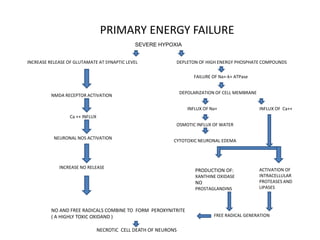
PRIMARY ENERGY FAILURE
SEVERE HYPOXIA
DEPLETON OF HIGH ENERGY PHOSPHATE COMPOUNDSINCREASE RELEASE OF GLUTAMATE AT SYNAPTIC LEVEL
FAILURE OF Na+-k+ ATPase
DEPOLARIZATION OF CELL MEMBRANE
INFLUX OF Na+ INFLUX OF Ca++
OSMOTIC INFLUX OF WATER
CYTOTOXIC NEURONAL EDEMA
ACTIVATION OF
INTRACELLULAR
PROTEASES AND
LIPASES
PRODUCTION OF:
XANTHINE OXIDASE
NO
PROSTAGLANDINS
FREE RADICAL GENERATION
NMDA RECEPTOR ACTIVATION
Ca ++ INFLUX
NEURONAL NOS ACTIVATION
INCREASE NO RELEASE
NO AND FREE RADICALS COMBINE TO FORM PEROXYNITRITE
( A HIGHLY TOXIC OXIDAND )
NECROTIC CELL DEATH OF NEURONS
LATENT PHASE
PHASE WHERE CEREBRAL METABOLISM
TRANSIANTLY RECOVERS
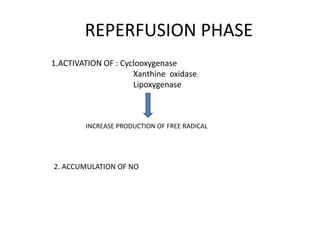
REPERFUSION PHASE
1.ACTIVATION OF : Cyclooxygenase
Xanthine oxidase
Lipoxygenase
INCREASE PRODUCTION OF FREE RADICAL
2. ACCUMULATION OF NO
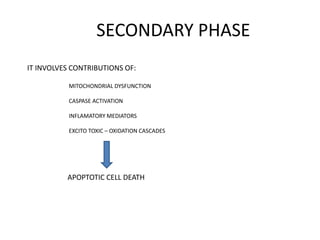
SECONDARY PHASE
IT INVOLVES CONTRIBUTIONS OF:
MITOCHONDRIAL DYSFUNCTION
CASPASE ACTIVATION
INFLAMATORY MEDIATORS
EXCITO TOXIC – OXIDATION CASCADES
APOPTOTIC CELL DEATH
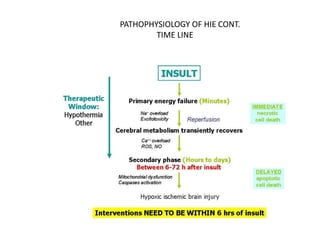
PATHOPHYSIOLOGY OF HIE CONT.
TIME LINE
SO NOW AS WE UNDERSTOOD THE CURRENT
MECHANISM OF HIE !!
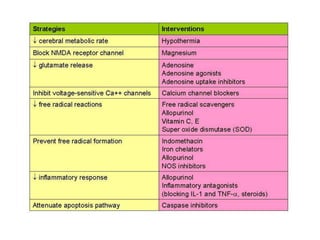
OUR STRATEGIES WOULD BE TO:
• DECREASE CEREBRAL METABOLIC RATE
• BLOCK NMDA RECEPTOR CHANNEL
• DECREASE GLUTAMATE RELEASE
• INHIBIT VOLTAGE GATED Ca++ CHANNELS
• DECREASE FREE RADICAL REACTIONS
• PREVENT FREE RADICAL FORMATIONS
• DECREASE INFLAMATORY RESPONSE
• ATTENUATE APOPTOSIS CASCADES
THIS IS WHAT GIVES US HUNTING GROUND
FOR ADVANCED THERAPUTIC MODALITIES IN
HIE
HYPOTHERMIA THERAPY
MILD HYPOTHERMIA (3-4 degree below baseline temperature) IS NEUROPROTECTIVE
MECHANISM OF ACTION:
1.DECREASE CEREBRAL METABOLICRATE AND ENERGY DEPLETION
2.DECREASE EXCITATORY NEUROTRANSMITTER RELEASE
3.DECREASE APOPTOSIS
4.DECREASE VASCULAR PERMEABILITY AND EDEMA
What is the optimal timing of initiation of
hypothermia therapy?
Cooling must begin early, within 6 hours of
injury. However, experimental evidence
strongly suggest that the earlier the better.
What is the optimal duration of
hypothermia therapy?
The greater the severity of the initial injury,
the longer the duration of hypothermia
needed.
But it should be at least used for 72 hours
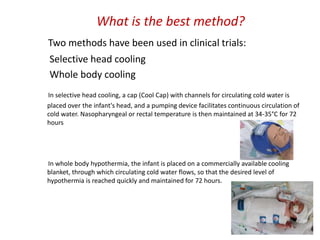
What is the best method?
Two methods have been used in clinical trials:
Selective head cooling
Whole body cooling
In selective head cooling, a cap (Cool Cap) with channels for circulating cold water is
placed over the infant's head, and a pumping device facilitates continuous circulation of
cold water. Nasopharyngeal or rectal temperature is then maintained at 34-35°C for 72
hours
In whole body hypothermia, the infant is placed on a commercially available cooling
blanket, through which circulating cold water flows, so that the desired level of
hypothermia is reached quickly and maintained for 72 hours.
What is the optimal rewarming method?
Rewarming is a critical period. In clinical
trials, rewarming was carried out gradually,
over 6-8 hours.
ADVERSE EFFECTS:
THOUGH THEORETITAL IT INCLUDES
COAGULATION DEFECT
LEUKOCYTES MALFUNCTION
PULMONARY HYPERTENSION
WORSENING OF METABOLIC ACIDOSIS
ABNORMALITIES OF CARDIAC RHYTHM
2013 Cochrane review says
Significant adverse effect is limited to only SINUS BRADYCARDIA and
THROMBOCYTOPENIA
LONG TERM OUTCOME:
2012 NICHD trial
Combined outcome of death and IQ score
below 70 occurred in
62% of patient in control group
47% of patient in hypothermia therapy group
Death
Control group 48%
Hypothermia therapy group 28%
Severe disability
Control group 60%
Hypothermia therapy group 41%
STUDIES ON THERAPUTIC HYPOTHERMIA IN HIE
A decrease in the combined outcomes of mortality/major
neurodevelopmental disability at 18 months (8 studies)
A reduction in mortality (11 studies)
A reduction in neurodevelopmental disability in survivors (8 studies)
9 independent meta-analyses have confirmed a consistent and robust
beneficial effect of therapeutic hypothermia for moderate-to-severe
encephalopathy
OTHER NEW THERAPUTIC MODALITIES
OXYGEN FREE RADICAL INHIBITOR AND SCAVENGERS
DIRECT INHIBITORS:
SUPEROXIDE DISMUTASE
ENDOPEROXIDASE
CATALASE
SCAVENGERS:
VITAMIN E
VITAMIN C
MANNITOL
INDIRECT INHIBITORS:
INDOMETHACIN
ALLOPURINOL
CYCLOOXYGENASE
N-ACETYL CYSTEINE
MELATONIN
Study have shown promising results but
their use will depend on the ability to
develop appropriate delivery system that
will allow action at the cellular and
specific tissue site
CALCIUM CHANNEL BLOCKERS
FLUNARIZINE
NIMODIPINE
These two drugs appears mot efficacious on animal study
Results of clinical trial is awaited
ERYTHROPOIETIN
Its neuroprotective mechanism is mediated through:
1.Direct neurotropic effect
2.Decrease susceptibility to glutamate toxicity
3. Release of antiapoptotic factors
4.Reduce inflamation
5. Decrease nitric oxide mediated injury
6.Direct antioxidant effect
Epo 5000 u/kg have shown to provide significant neuroprotection
and improved outcome
EXCITATORY AMINO ACID ANTAGONIST
INHIBITOR OF GLUTAMATE RELEASE:
BACLOFEN
ADENOSINE
ADENOSINE AGONIST
NMDA RECEPTOR BLOCKER:
MAGNESIUM
PHENCYCLIDINE
DEXTROMETHORPHAN
KETAMINE
MK- 801
EAA antagonist MK-801 , has shown promising results in experimental animals and in a limited
number of adult trials. However, this drug has serious cardiovascular adverse effects
HOWEVER
MAGNESIUM SULFATE IS A NATURAL ANTAGONIST OF NMDA WITH LESS SIDE EFFECTS SO ROLE OF MS AS A
NEUROPROTECTIVE AGENT IN PREVENTION OF BRAIN DAMAGE IN HIE DESERVE ACTIVE CONSIDERATION AND
EVALUATION IN FUTURE
PREVENTION OF EXCESS NITRIC OXIDE FORMATION
NOS INHIBITOR:
NITROARGININE
Administration of nitroarginine in immature rats caused prolonged inhibition
of NOS and thus reduction in the extent of brain injury
Agents decreasing inflamatory response:
Allopurinol
Inflamatory antagonist
IL1 blocker
TNF alfa blocker
ATTENUATE APOPTOSIS PATHWAY
CASPASE INHIBITORS
STEM CELL TRANSPLANTATION
• THERE IS EVIDENCE THAT SUGGEST NEONATE BRAIN IS ENDOWED WITH THE
CAPABILITY FOR ENDOGENOUS NEUROGENESIS FLOWING HIE
• INFACT MANY EXPERIMENTAL EVIDENCES SUGGEST SCT MAY REPAIR THE
DAMAGED NEURONSIN BRAIN
• SEVERAL TYPES OF STEM CELLS HAVE BEEN USED IN RODENTS INCLUDING
NEURONAL STEM CELLS MESNCHYMAL STEM CELLS AND HEMATOPOIETIC
STEM CELLS
• THERE IS EVIDENCE THAT SUGGEST THAT GENETICALLY MODIFIED STEM CELLS
MAY BE MORE EFFECTIVE THAN UNMODIFIED STEM CELLS
THUS SCT HAS POTENTIAL TO BECOME A FUTURE NEUROPROTECTIVE AND
REGENERATIVE THERAPY FOR HIE
THANK YOU

HIE

  • 1.
    RECENT ADVANCES INMANAGEMENT OF HIE BY DR. TAUHID IQBALI MBBS (JIPMER) MD PED. (PMCH)
  • 2.
    DEFNITION OF HIE NEONATALENCEPHALOPATHY FOLLOWING SEVERE BIRTH ASPHYXIA OR PERINATAL HYPOXIA IS REFERED TO AS HIE
  • 3.
    PATHOPHYSIOLOGY OF HIE •Pathogenesis of HIE involves cascades of events. And it consist of: 1. Primary energy failure 2. Latent phase 3. Reperfusion injury 4 .Secondary phase
  • 4.
    PRIMARY ENERGY FAILURE SEVEREHYPOXIA DEPLETON OF HIGH ENERGY PHOSPHATE COMPOUNDSINCREASE RELEASE OF GLUTAMATE AT SYNAPTIC LEVEL FAILURE OF Na+-k+ ATPase DEPOLARIZATION OF CELL MEMBRANE INFLUX OF Na+ INFLUX OF Ca++ OSMOTIC INFLUX OF WATER CYTOTOXIC NEURONAL EDEMA ACTIVATION OF INTRACELLULAR PROTEASES AND LIPASES PRODUCTION OF: XANTHINE OXIDASE NO PROSTAGLANDINS FREE RADICAL GENERATION NMDA RECEPTOR ACTIVATION Ca ++ INFLUX NEURONAL NOS ACTIVATION INCREASE NO RELEASE NO AND FREE RADICALS COMBINE TO FORM PEROXYNITRITE ( A HIGHLY TOXIC OXIDAND ) NECROTIC CELL DEATH OF NEURONS
  • 5.
    LATENT PHASE PHASE WHERECEREBRAL METABOLISM TRANSIANTLY RECOVERS
  • 6.
    REPERFUSION PHASE 1.ACTIVATION OF: Cyclooxygenase Xanthine oxidase Lipoxygenase INCREASE PRODUCTION OF FREE RADICAL 2. ACCUMULATION OF NO
  • 7.
    SECONDARY PHASE IT INVOLVESCONTRIBUTIONS OF: MITOCHONDRIAL DYSFUNCTION CASPASE ACTIVATION INFLAMATORY MEDIATORS EXCITO TOXIC – OXIDATION CASCADES APOPTOTIC CELL DEATH
  • 8.
    PATHOPHYSIOLOGY OF HIECONT. TIME LINE
  • 9.
    SO NOW ASWE UNDERSTOOD THE CURRENT MECHANISM OF HIE !!
  • 10.
    OUR STRATEGIES WOULDBE TO: • DECREASE CEREBRAL METABOLIC RATE • BLOCK NMDA RECEPTOR CHANNEL • DECREASE GLUTAMATE RELEASE • INHIBIT VOLTAGE GATED Ca++ CHANNELS • DECREASE FREE RADICAL REACTIONS • PREVENT FREE RADICAL FORMATIONS • DECREASE INFLAMATORY RESPONSE • ATTENUATE APOPTOSIS CASCADES
  • 11.
    THIS IS WHATGIVES US HUNTING GROUND FOR ADVANCED THERAPUTIC MODALITIES IN HIE
  • 13.
    HYPOTHERMIA THERAPY MILD HYPOTHERMIA(3-4 degree below baseline temperature) IS NEUROPROTECTIVE MECHANISM OF ACTION: 1.DECREASE CEREBRAL METABOLICRATE AND ENERGY DEPLETION 2.DECREASE EXCITATORY NEUROTRANSMITTER RELEASE 3.DECREASE APOPTOSIS 4.DECREASE VASCULAR PERMEABILITY AND EDEMA
  • 14.
    What is theoptimal timing of initiation of hypothermia therapy? Cooling must begin early, within 6 hours of injury. However, experimental evidence strongly suggest that the earlier the better.
  • 15.
    What is theoptimal duration of hypothermia therapy? The greater the severity of the initial injury, the longer the duration of hypothermia needed. But it should be at least used for 72 hours
  • 16.
    What is thebest method? Two methods have been used in clinical trials: Selective head cooling Whole body cooling In selective head cooling, a cap (Cool Cap) with channels for circulating cold water is placed over the infant's head, and a pumping device facilitates continuous circulation of cold water. Nasopharyngeal or rectal temperature is then maintained at 34-35°C for 72 hours In whole body hypothermia, the infant is placed on a commercially available cooling blanket, through which circulating cold water flows, so that the desired level of hypothermia is reached quickly and maintained for 72 hours.
  • 17.
    What is theoptimal rewarming method? Rewarming is a critical period. In clinical trials, rewarming was carried out gradually, over 6-8 hours.
  • 18.
    ADVERSE EFFECTS: THOUGH THEORETITALIT INCLUDES COAGULATION DEFECT LEUKOCYTES MALFUNCTION PULMONARY HYPERTENSION WORSENING OF METABOLIC ACIDOSIS ABNORMALITIES OF CARDIAC RHYTHM 2013 Cochrane review says Significant adverse effect is limited to only SINUS BRADYCARDIA and THROMBOCYTOPENIA
  • 19.
    LONG TERM OUTCOME: 2012NICHD trial Combined outcome of death and IQ score below 70 occurred in 62% of patient in control group 47% of patient in hypothermia therapy group Death Control group 48% Hypothermia therapy group 28% Severe disability Control group 60% Hypothermia therapy group 41%
  • 20.
    STUDIES ON THERAPUTICHYPOTHERMIA IN HIE A decrease in the combined outcomes of mortality/major neurodevelopmental disability at 18 months (8 studies) A reduction in mortality (11 studies) A reduction in neurodevelopmental disability in survivors (8 studies) 9 independent meta-analyses have confirmed a consistent and robust beneficial effect of therapeutic hypothermia for moderate-to-severe encephalopathy
  • 21.
    OTHER NEW THERAPUTICMODALITIES OXYGEN FREE RADICAL INHIBITOR AND SCAVENGERS DIRECT INHIBITORS: SUPEROXIDE DISMUTASE ENDOPEROXIDASE CATALASE SCAVENGERS: VITAMIN E VITAMIN C MANNITOL INDIRECT INHIBITORS: INDOMETHACIN ALLOPURINOL CYCLOOXYGENASE N-ACETYL CYSTEINE MELATONIN Study have shown promising results but their use will depend on the ability to develop appropriate delivery system that will allow action at the cellular and specific tissue site
  • 22.
    CALCIUM CHANNEL BLOCKERS FLUNARIZINE NIMODIPINE Thesetwo drugs appears mot efficacious on animal study Results of clinical trial is awaited ERYTHROPOIETIN Its neuroprotective mechanism is mediated through: 1.Direct neurotropic effect 2.Decrease susceptibility to glutamate toxicity 3. Release of antiapoptotic factors 4.Reduce inflamation 5. Decrease nitric oxide mediated injury 6.Direct antioxidant effect Epo 5000 u/kg have shown to provide significant neuroprotection and improved outcome
  • 23.
    EXCITATORY AMINO ACIDANTAGONIST INHIBITOR OF GLUTAMATE RELEASE: BACLOFEN ADENOSINE ADENOSINE AGONIST NMDA RECEPTOR BLOCKER: MAGNESIUM PHENCYCLIDINE DEXTROMETHORPHAN KETAMINE MK- 801 EAA antagonist MK-801 , has shown promising results in experimental animals and in a limited number of adult trials. However, this drug has serious cardiovascular adverse effects HOWEVER MAGNESIUM SULFATE IS A NATURAL ANTAGONIST OF NMDA WITH LESS SIDE EFFECTS SO ROLE OF MS AS A NEUROPROTECTIVE AGENT IN PREVENTION OF BRAIN DAMAGE IN HIE DESERVE ACTIVE CONSIDERATION AND EVALUATION IN FUTURE
  • 24.
    PREVENTION OF EXCESSNITRIC OXIDE FORMATION NOS INHIBITOR: NITROARGININE Administration of nitroarginine in immature rats caused prolonged inhibition of NOS and thus reduction in the extent of brain injury Agents decreasing inflamatory response: Allopurinol Inflamatory antagonist IL1 blocker TNF alfa blocker
  • 25.
    ATTENUATE APOPTOSIS PATHWAY CASPASEINHIBITORS STEM CELL TRANSPLANTATION • THERE IS EVIDENCE THAT SUGGEST NEONATE BRAIN IS ENDOWED WITH THE CAPABILITY FOR ENDOGENOUS NEUROGENESIS FLOWING HIE • INFACT MANY EXPERIMENTAL EVIDENCES SUGGEST SCT MAY REPAIR THE DAMAGED NEURONSIN BRAIN • SEVERAL TYPES OF STEM CELLS HAVE BEEN USED IN RODENTS INCLUDING NEURONAL STEM CELLS MESNCHYMAL STEM CELLS AND HEMATOPOIETIC STEM CELLS • THERE IS EVIDENCE THAT SUGGEST THAT GENETICALLY MODIFIED STEM CELLS MAY BE MORE EFFECTIVE THAN UNMODIFIED STEM CELLS THUS SCT HAS POTENTIAL TO BECOME A FUTURE NEUROPROTECTIVE AND REGENERATIVE THERAPY FOR HIE
  • 26.

Editor's Notes